



Abstract
Although domestic violence has long been identified as a serious social problem in China, little is known about police officers’ attitudinal and behavioral tendencies toward such incidents. Drawing upon survey data collected from police officers in two Chinese provinces, this study assesses whether officer and organizational factors are correlated to police inaction and intervention in resolving family violence. More than a quarter of Chinese police officers often and sometime did not take any action when responding to domestic violence. Chinese officers favored most the least punitive approaches of mediation and separation, with the most punitive actions, written warning and criminal sanction as the least preferred interventions. We found that Chinese officers with low levels of knowledge about the domestic violence law, higher degrees of tolerance of violence and less supportive attitudes toward an active police role in handling domestic violence are less willing to take any action against the offenders. Chinese police officers who perceived stronger supervisory support and expressed better knowledge about China’s new domestic violence law are more likely to intervene in domestic violence, whereas police officers who expressed greater degrees of tolerance of violence and believed in gender equality in society are less inclined to intervene. Policy makers and police administrators ought to pay greater attention to frontline supervisors’ attitudes and behavior toward proper responses to family violence. If active intervention is preferred, then measures and programs should be put into place to improve police officers’ legal knowledge and communication and problem-solving skills pertaining to conflict resolution.
Keywords
Introduction
Violence against women has been widely identified as a serious social problem in China (Qin & Yang, 2018; Yang et al., 2019). Women’s rights organizations and All China Women’s Federation have repeatedly called for better legal protection of and services for domestic violence victims, finally spurring the passage of the People’s Republic of China Anti-Domestic Violence Law (hereafter the DV Law or the Law) in 2016. Although the government views the DV Law as a breakthrough in regulating and advancing official responses to violence against women, scholars and feminist activists were highly doubtful about the effectiveness of the Law in improving victims’ rights and safety (Jiang, 2019; Wang, 2017). Researchers found that in seeking ways to address their mishaps, domestic violence victims’ plight continues as police officers seldom impose meaningful sanctions against perpetrators, the court system is reluctant to grant divorces, and traditional patriarchy values male dominance and blames women for domestic conflicts (Jiang, 2019; Lin et al., 2018; Michelson, 2019).
Since the enactment of the DV Law, a large number of studies have investigated the prevalence, typology, risk factors, characteristics, attitudes, and behaviors of victims and offenders associated with violence against women in China (e.g., Breckenridge et al., 2019; Lin et al., 2018; Qin & Yang, 2018; Xue et al., 2018; Yang et al., 2019). Studies have also reported various interventions and activities initiated by social service agencies and nongovernment organizations (NGOs) in fighting domestic violence (Brauer, 2016; Leggett, 2017). Despite a burgeoning body of research on violence against women in China, police officers’ attitudinal and behavioral tendencies toward domestic violence have received relatively little scholarly attention, partially due to the strenuousness of collecting data from the Chinese police.
This study assesses the connections between organizational and officer factors, and Chinese police’s willingness to intervene in domestic violence incidents. Past studies have identified organizational and individual explanations as plausible framework to account for police discretionary decision-making (e.g., Worden, 1995). Organizational explanations contend that variations in departmental characteristics, such as rules and regulations, training and supervision, standard operating procedures, and incentives and disincentives, tend to influence officers’ behavior toward the public (Novak et al., 2016). Individual explanations of police behavior posit that officers’ personal outlooks and backgrounds, such as their attitudes, perceptions, personality, race, gender, education, experience, and assignment, affect their actions during encounters with citizens (Sun et al., 2008). This study focuses on officers’ supervisory support and in-service training, and their attitudes and knowledge directly related to domestic violence.
This article represents several conceptual and methodological improvements over previous studies on police actions toward domestic violence in China. Starting with the dependent variables, we distinguished five types of police interventions, including inaction, mediation, separation, written warning, and criminal sanction. Among them, mediation and separation have been conventionally utilized by the Chinese police, whereas written warning is newly prescribed in the DV Law and criminal sanction is rarely adopted by the police. We illustrated officers’ preferences for each of these options, which, albeit quite fundamental information, were seldom reported in previous research. We delineated a graded range of intervening behaviors based on the degree of punitiveness involved in police actions. Studies with a sole emphasis on arrest have grossly missed other, much more frequently utilized, approaches embedded in Chinese police responses to domestic conflict.
On the independent variables side, we incorporated measures capturing the possible effects of one of the most recent and milestone developments in official reactions to domestic violence in China, the promulgation of the DV Law in 2016. Specifically, we tested whether officer training and knowledge on the Law can be linked to their willingness to act (or not to act) when handling domestic violence incidents. To the best of our knowledge, our study constitutes the first attempt to analyze these plausible linkages among Chinese police officers.
Additionally, we analyzed data garnered from Chinese police officers who have actual experience responding to domestic violence incidents in recent years. Previous studies have employed information obtained from Chinese college students (Sun et al., 2011) and police cadets (Hayes et al., 2022; Qu et al., 2018) to gauge preferred police interventions in domestic violence or police attitudes toward domestic conflict. Given that these groups had no or very limited experience of handling violent incidents, findings from prior studies arguably cannot adequately reflect officers’ occupational outlooks and operational styles in responding to domestic violence.
Relying on survey data gathered from 898 police officers in two Chinese provinces, Jiangsu and Hunan, this study is designed to fill the knowledge void in the literature of policing domestic violence by addressing two questions: (a) What are the general patterns of officers’ preferences for inaction and using mediation, separation, written warning, and criminal sanction to settle domestic conflict and (b) Are officers’ supervisory support and in-service training and their knowledge about and attitudes toward domestic violence predictive of officers’ interventions in domestic violence?
Policing Domestic Violence in China
China’s DV Law defines domestic violence as “physical, psychological or other infractions between family members effected through the use of methods such as beatings, restraints, maiming, restrictions on physical liberty as well as recurrent verbal berating or intimidation” (China Law Translate, 2015). Several of its articles are directly related to the focus of this study—different forms of police interventions in domestic violence. For instance, article 15 of China’s DV Law stipulates that “After public security organs receive a report of domestic violence, they shall promptly dispatch police, stop the domestic violence, and follow the relevant provisions in investigating and gathering evidence, assisting victims in receiving medical care, and evaluating injuries” (China Law Translate, 2015). The Law broadly requires Chinese officers to take actions, but it does not specifically mandate the police, for example, to make arrest. Chinese officers normally do not take domestic violence seriously unless the victim is severely harmed (Breckenridge et al., 2019) and they rarely make arrests when handling domestic violence principally due to complex approval processes, lack of legal mandate and supervisory encouragement, and patriarchal values (Jiang, 2019).
Instead of arresting the offenders, mediating the conflicts and separating both parties through verbal exchanges are more commonly adopted by the Chinese police (Wang et al., 2019). Mediation in particular has a long tradition in Chinese culture and plays an important role in criminal justice practices in settling various types of disputes (Peerenboom & He, 2008). In addition to mediation and separation, article 16 of China’s DV Law specifies that “Where the circumstances of domestic violence are lighter and public security administrative sanctions are not given in accordance with law, the public security organs should criticize or educate the perpetrator or issue a written warning” (China Law Translate, 2015). China’s new DV law thus allows police officers to formalize their interventions by issuing a written warning to the offender and informing the neighborhood resident committee about the incident. These warnings nonetheless are neither criminal nor civil sanctions as the offenders do not face any penalties. Such warnings may be considered as having a “labelling” function and punitive in nature as police agencies and neighborhood resident committees can conduct follow-up inspection visits to the perpetrator and the victim. More importantly, having warnings on record can serve as evidence considered by the judge in subsequent court proceedings on divorce.
The Chinese police are empowered with the authority to administratively sanction minor or public disorder violations, including minor domestic violence cases, normally through short-term detention (up to 15 days) or fines or both without any judicial approval. Article 16 of the DV Law states clearly that written warnings should be issued for minor domestic violence incidents that have not reached the level of administrative sanction, suggesting that a huge number of perpetrators and victims should have been handled with written warnings. In practice, however, the Chinese police gives out paper warnings infrequently1, usually only when the incidents could amount to administrative and criminal offenses and upon victims’ requests (Jiang, 2019).
Although not clearly stipulated in the DV Law, Women’s Federation is a de facto agency organizing and coordinating a formal support system for the prevention of and intervention in violence against women. The Federation nonetheless has very limited administrative power to implement protective and deterrent measures for domestic violence victims, resulting in a greater and innovative participation in counter-violence efforts by NGOs (Brauer, 2016). Despite loosely coupled and underfunded, China’s nonpolice organizations, rather than the police, have taken the lead role in assisting victims, preventing further violence, and educating the public.
Nearly a decade ago, scholars characterized policing domestic violence in China as “…rudimentary, low in priority, and largely non-punitive” (Sun et al., 2011, p. 3293). There is little evidence to indicate that such observations have changed, even after the passage of the DV Law. The progress of enhancing official response is sluggish due partially to obvious contradictions embedded in China’s counter-domestic violence efforts (Jiang, 2019). While the DV law aims at improving the protection of victims’ rights and safety, it also stresses the importance of maintaining family harmony (and ultimately social stability) through less formal and more flexible dispute resolution mechanisms, such as mediation by the courts or neighborhood mediation committees. Mediators normally focus more on restoring the broken family relationship rather than protecting the best interests of the victim (Xie et al., 2018). Complicating matters further, protective orders are underused2 and divorce petitions are difficult to obtain from judges, generating tremendous levels of stress, frustration, and hopelessness among domestic violence victims (Michelson, 2019; Wang, 2017). To be fair, policing domestic violence is filled with challenges to Chinese police officers, particularly when they choose to impose criminal sanctions. The victims frequently change their mind by modifying their statements and claiming that the police have broken their families, subjecting officers to possible disciplinary actions (Jiang, 2019).
Acknowledging that multiple options are available to Chinese police officers to resolve family disturbance and that these actions can be delineated along a continuum based on the level of punitiveness involved, this study assesses Chinese police officers’ degrees of preferences for five different types of interventions, ranging from the less punitive ones of inaction, mediation, and separation to more punitive options of written warning and criminal sanction. Warning and criminal sanctions represent greater levels of punitiveness than mediation and separation as they normally involve applying greater legal authority, such as issuing warning letters, conducting household visits, detaining or arresting the offenders, imposing fines, and filing formal criminal charges. Among possible police interventions, “inaction” should be a rare event as the new DV Law specifically requires officers to take actions. Besides inaction, which serves as the baseline for comparison, we speculate that the level of preference for a certain intervention is inversely related to the level of punitiveness involved in Chinses police actions. That is, in addressing domestic violence, officers are more likely to engage in mediation, followed by separation, written warning, and criminal sanction.
Predicting Officer Interventions in Domestic Violence
Previous research has identified a wide array of predictors of officers’ behavior toward citizens in resolving domestic violence. This study attends to two lines of explanatory variables, with one signaling organizational support for handling domestic violence and the other reflecting officers’ knowledge, and social and occupational attitudes related to domestic violence. Both groups of predictors have been underinvestigated in the existing literature and are particularly relevant to the Chinese context.
Organizational Support
Organizational support signals the extent to which an organization recognizes its employees’ contributions and cares about their well-being (Eisenberger et al., 1986). Higher levels of perceived organizational support tend to generate positive psychological and behavioral outcomes, such as stronger felt obligation to reach organizational objectives, greater affective commitment to the organization, improved job performance, and decreased occupational stress and burnout (e.g., see Zagenczyk et al., 2020). Given that Chinese police officers are encouraged or required to take certain actions when facing domestic violence incidents, supervisors’ caring and supportive attitudes geared toward how to properly deal with such conflicts and in-service training on domestic violence offered by their agencies are proper forms of organizational support.
One of the most important reference groups for rank and file officers are their immediate supervisors, whose occupational outlooks and operational styles may exert certain influence on the attitudes and behavior of subordinates (Engel & Worden, 2003). A critical aspect of organizational support thus involves supervisors’ favorable attitudes toward intervention in domestic violence, which is underanalyzed in terms of their linkages to officers’ actions in resolving family violence. Two studies conducted in the United States, however, found that supervisors’ attitudes about domestic violence enforcement as a priority was not predictive of officers’ arrests in family disturbance incidents (Johnson, 2010; Johnson & Dai, 2016), suggesting the need to further test the association between supervisory endorsement and officers’ response to domestic violence.
A second form of organizational support is in-service training, which was found to enhance officers’ awareness, knowledge, and skills of handling domestic violence (Belknap, 1990). Indeed, training aimed at equipping officers with a better understanding of relevant laws represents one of the plausible ways of improving officers’ knowledge about legal mandates and subsequently promoting responses to domestic violence in line with the law. In the United States, more domestic violence training is correlated with higher proportions of domestic violence calls, resulting in arrests among study municipal police agencies (Johnson, 2010; Johnson & Dai, 2016). Using police cadets in a Chinese police college as a sample, a recent study showed that cadets’ attitudes toward domestic violence changed after receiving a 30-minute lecture on domestic violence, but neither their previous training on domestic violence nor their feeling about needing training on domestic violence was linked to their attitude modifications (Hayes et al., 2022). To date, no known studies have empirically analyzed the relationships between supervisory endorsement for actively handling domestic violence and training on China’s DV Law and officers’ response to domestic violence. This study attempts to fill this knowledge gap.
In brief, organizational support is expected to be predictive of officers’ engagement in settling domestic violence. We hypothesize that officers who express higher supervisory support toward handling domestic violence and receive more training in the DV Law are more likely to engage in interventions in domestic violence.
Domestic Violence Knowledge and Attitudes
Besides organizational support, police officers’ knowledge about domestic violence law and policies could be connected to their behavioral orientations toward how to dispose of such incidents. Officers’ familiarity with legal requirements of various interventions is likely to facilitate their proper response to domestic violence. The potential connection between knowledge about the DV law and officers’ preferred interventions have yet to be adequately assessed. Similarly, another understudied area is the relationships between officers’ attitudes toward violence and gender equality and preferences for police intervention.
A broader vein of research found that the endorsement of violence and gender inequality tends to increase men’s willingness to accept rape myths and probabilities of engaging in violence against women (e.g., Eckhardt et al., 2012; Forbes & Adams-Curtis, 2001; Lee et al., 2010). Studies also showed substantial variations in public views on gender equality, crime, and violence, and definitions of domestic violence (see Robinson, 1999 for a review), suggesting that police officers likewise would view such issues differently. An earlier study reported that police officers were more likely than victims to hold traditional views of women’s roles in society (Saunders & Size, 1986). Similarly, a study conducted in Hong Kong found that police officers were more inclined than social workers and nurses to define abusive behaviors (e.g., female child sexual abuse and controlling and managing prostitutes) as violence against women (Tang et al., 2002). One may extend the available evidence to speculate that police officers who have higher degrees of acceptance of violence and gender inequality are less likely to endorse any kinds of interventions in domestic violence.
Based on the same vignette data collected from police officers in a Chinese city, two recent studies tested the relationship between officers’ attitudes and their preferred interventions in handling domestic violence. Zhao et al. (2018) found that officers who endorsed feminism and nontraditional response to domestic violence are more likely to favor arresting the male suspect. Wang et al. (2019) further indicated that officers who supported a traditional gender role for women are less likely to mediate family conflicts and more likely to arrest the female suspect. Their analysis also showed that officers who favored a reactive and passive police role of handling domestic violence are more inclined to engage in mediation and less inclined to arrest the male suspect.
This study assesses four dimensions of officer knowledge and attitudes related to domestic violence, including knowledge about the DV Law, understanding of police role in handing domestic violence, tolerance of violence, and perception of gender equality. Although past studies have yet to produce consistent evidence pertaining to these attitudes, we hypothesize that officers who express a degree of knowledge about the DV Law and favor a more active police role in resolving conflicts are more likely to engage in interventions in domestic violence, whereas officers who display a higher level of tolerance of violence and believe that gender equality has been achieved in society are less likely to initiate interventions in domestic violence.
Methods
Data Collection and Sample
Data used in this study were obtained from two Chinese provinces, Jiangsu and Hunan, between June and October of 2019 for a research project titled Policing Domestic Violence in China (PDVC). Jiangsu, a coastal province in east China, is one of the most economically and culturally developed areas with the second-highest gross domestic product (GDP) among Chinese provinces. Hunan is a landlocked province located in central China. The province is also economically well developed, ranking seventh in the provincial level GDP. The two provinces were chosen as research sites mainly because they are located at different regions in the country and considered as relatively more progressive areas in police responding to domestic violence3. Even more importantly, the research team has prolonged engagement with local officials who were willing to help with data collection and served as our onsite coordinators.
PDVC was initiated by researchers with a Chinese university. The primary purpose of the project is to assess Chinese police officers’ attitudes and behaviors toward domestic violence in the era of the new DV Law. The project team developed a survey instrument with an information sheet explaining the purpose and the anonymous and voluntary nature of participation. The survey included 65 items and was pre-tested on a small sample of Chinese police officers. Revisions were made based on feedback from the pre-test. The team decided to adopt the traditional paper-and-pencil approach for data collection as police officers are highly suspicious of, and reluctant to participate in, online surveys requested by people they do not directly know.
In Jiangsu, data collection was conducted by local officials and police administrators who are acquaintances of the researchers. After being debriefed about the project purpose and procedures, they agreed to distribute paper surveys to police officers in two cities in the province. In one of the two cities, a total of 500 officers in 15 field stations (paichusuo) were given the survey by the project coordinator, who was a local official, and 423 officers returned the survey. In the second city a total of 300 surveys were distributed to officers in 4 police stations (fengju), which is the organizational units above the field stations. All 300 surveys were returned to project coordinators, who were police administrators, resulting in a response rate of 90% from the two cities in Jiangsu. In Hunan, data collection efforts were carried out by a faculty member within a local police college, who also served as an instructor of in-service training classes for police officers on the college campus. Surveys were administered to a total of 500 officers, most of whom were commanding officers of police field stations (e.g., paichusuo) throughout the province, who attended training classes at the police college during the months of data collection. Among them, 402 officers returned the survey, representing a roughly 80% response rate. The high response rate is in line with the percentage reported in recent studies on Chinese police officers (see Sun et al., 2019; Wang et al., 2019).
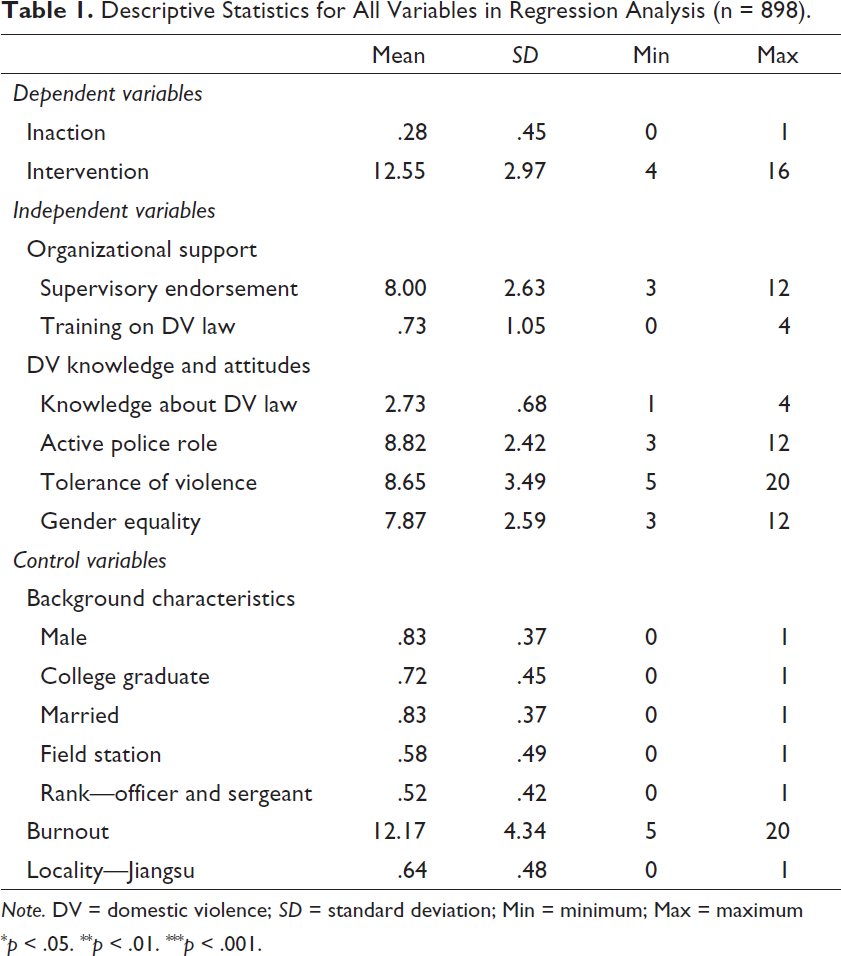
Descriptive Statistics for All Variables in Regression Analysis (n = 898).
Note. DV = domestic violence; SD = standard deviation; Min = minimum; Max = maximum
*p < .05. **p < .01. ***p < .001.
Measures
Recall that our sample included only police officers who had handled domestic violence cases over the past three years. Officers who answered “yes” to the screening question about previous experience of dealing with domestic violence were then asked about the frequency of them applying a list of interventions when dealing with domestic violence. These police interventions include: “inaction” (I do nothing, acting as a bystander and leaving the scene after the situation quiets down), “mediation” (I attempt to mediate the dispute between two parties), “separation” (I separate both parties, e.g., making one party leave the scene), “written warning” (If the situation is minor, I issue a written warning to the perpetrator), and “criminal sanction” (If the victim is apparently injured, based on the seriousness of injury, I file public disorder or criminal charges against the offender). It should be noted that the items used to represent written warning and criminal sanction are consistent with the statements prescribed in the new DV Law, which clearly specify the situational circumstances (e.g., the seriousness of the incident) to be considered in police response. Response categories for these items included: never ( = 1), rarely ( = 2), sometime ( = 3), and very often ( = 4). The original responses to these five ordinal variables were used to answer the first research question about the general patterns of officer preferences for each intervention.
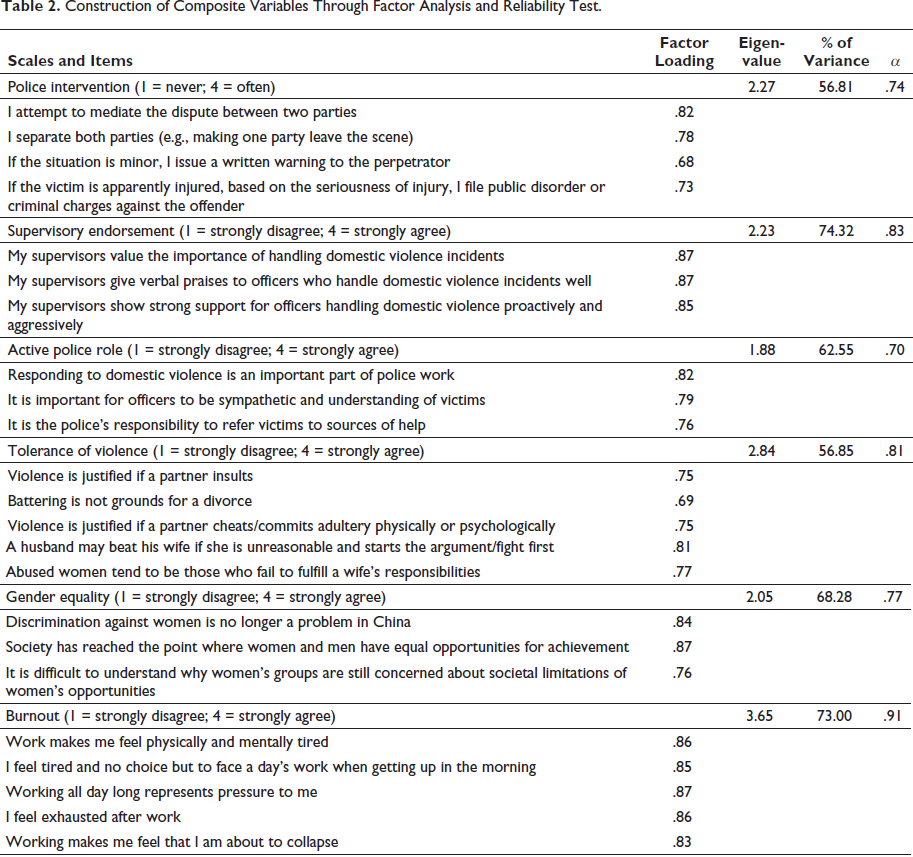
Construction of Composite Variables Through Factor Analysis and Reliability Test.
A second dependent variable was constructed based on the single item indicating police “inaction” (I do nothing, acting as a bystander, and leaving the scene after the situation quiets down). As it was an ordinal measure, ordered logistic regression was the foremost considered analytical procedure. We found that, however, the assumption of the parallel lines for ordered logistic regression was violated. Binary logistic regression was thus employed in multivariate analysis. The dependent variable was recoded into a dummy variable with value 0 representing those who answered “never” and “rarely”, and value 1 representing those who reported “sometime” and “very often” to the question about the frequency of taking no action in handling domestic violence.
Independent variables are classified into two groups: organizational support and domestic violence related knowledge and attitudes. Organizational support is comprised of two variables. First, an additive scale of three items reflecting the degree of supervisory endorsement for actively handling domestic violence was constructed. As shown in Table 2, factor analysis and reliability test showed that the three items loaded onto a common factor with good internal consistency (Cronbach’s alpha = .83). A higher value of the scale indicates a great level of supervisory support for actively responding to domestic violence. Second, a five-category item signals the length of training on China’s DV Law that the respondents have received from their agencies over the past three years. Response categories included: none ( = 0), 1–4 hours ( = 1), 5–8 hours ( = 2), 2–3 days ( = 3), and more than 3 days ( = 4).
The second group of independent variables contains four measures reflecting officer knowledge and attitudes related to domestic violence. A first measure represents the respondents’ degree of familiarity with China’s DV Law (1 = never heard about it; 2 = heard about it, but know little; 3 = have some but not comprehensive knowledge about it; and 4 = know it very well). A second scale consists of three items reflecting whether the respondents believe that the police should play an active role in disposing of domestic violence incidents. A third one is a five-item scale demonstrating officers’ levels of tolerance of violence. The final variable represents the degree of agreement that the respondents had regarding whether gender equality exists in China. A higher level of agreement suggests lower sensitivity to issues of gender inequality. As displayed in Table 2, factor analysis confirmed the appropriateness of combining these items into scales and the Cronbach’s alpha associated with each scale ranging from .70 to .81 suggests at least acceptable internal reliability. A higher score of these scales indicates favoring an active police role in dealing with domestic violence, displaying a greater level of tolerance of violence, and believing in gender equality in society.
Seven measures were constructed as control variables. Officer demographic characteristics were operationalized through five dichotomous variables: gender, educational attainment, marital status, work unit, and rank, with 1 representing respectively male, college graduate, married, field station (unit), and officers and sergeants (rank). Given that burnout is a common occupational hazard in policing that tends to influence officer mental health and behaviors (see Kohan & Mazmanian, 2003), we assembled a five-item scale reflecting officers’ degrees of burnout (see Table 2; Cronbach’s alpha = .91). Finally, a dummy variable locality was created with 1 representing the province of Jiangsu. Table 1 reports the descriptive statistics for all variables used in regression analysis.
Results
Percentage Distributions of Officer Interventions
Figure 1 numerically and graphically displays percentage distributions of police interventions across four levels of occurrence (i.e., never, rarely, sometime, and very often). Looking at the “inaction” category, while the majority of the respondents (72%) stated that they “never” or “rarely” responded to domestic violence without do anything, still more than a quarter (28%) of respondents expressed that they “often” and “sometime” took no action in resolving conflicts, revealing that the traditional responding style of inaction remains a viable option among Chinese police officers.
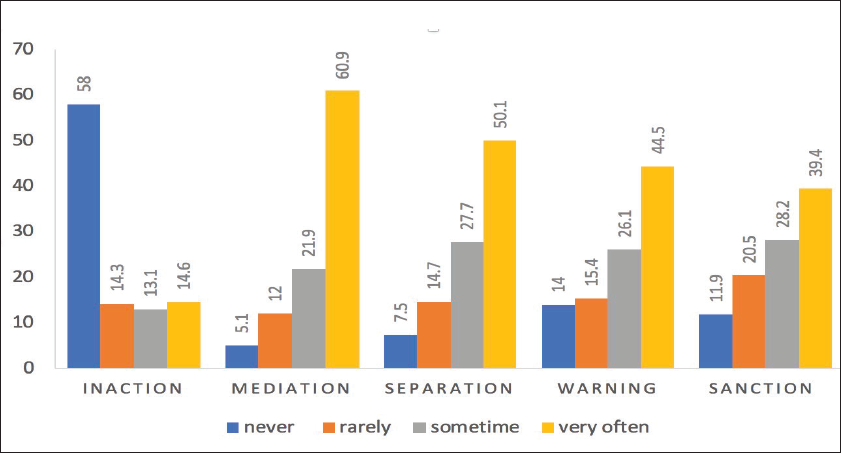
Percentage distributions of officers preferred actions in handling domestic violence.
Beyond the treatment of inaction, a general pattern of police response emerges. Consistent with our expectation, the level of preference for a certain type of action increases when the degree of punitiveness involved decreases. Moving to the “never” category (blue bars in Figure 1), the relatively new approach of written warning, rather than criminal sanction, is the least utilized approach of resolving conflicts, with 14% of the respondents saying that they never used it, followed by criminal sanction (11.9%), separation (7.5%), and mediation (5.1%). Slightly over 20% of the officers stated that they rarely adopted criminal sanction to handle domestic violence (orange bars in Figure 1), followed by 15.4% adopting written warning, 14.7% adopting separation, and 12% adopting mediating. Switching to the “very often” category (yellow bars in Figure 1), nearly 61% of the respondents frequently engaged in mediation and the percentage decreases to 50% for separation, to 44.5% for warning and to below 40% for criminal sanction.
Multivariate Regression Results of Police Interventions
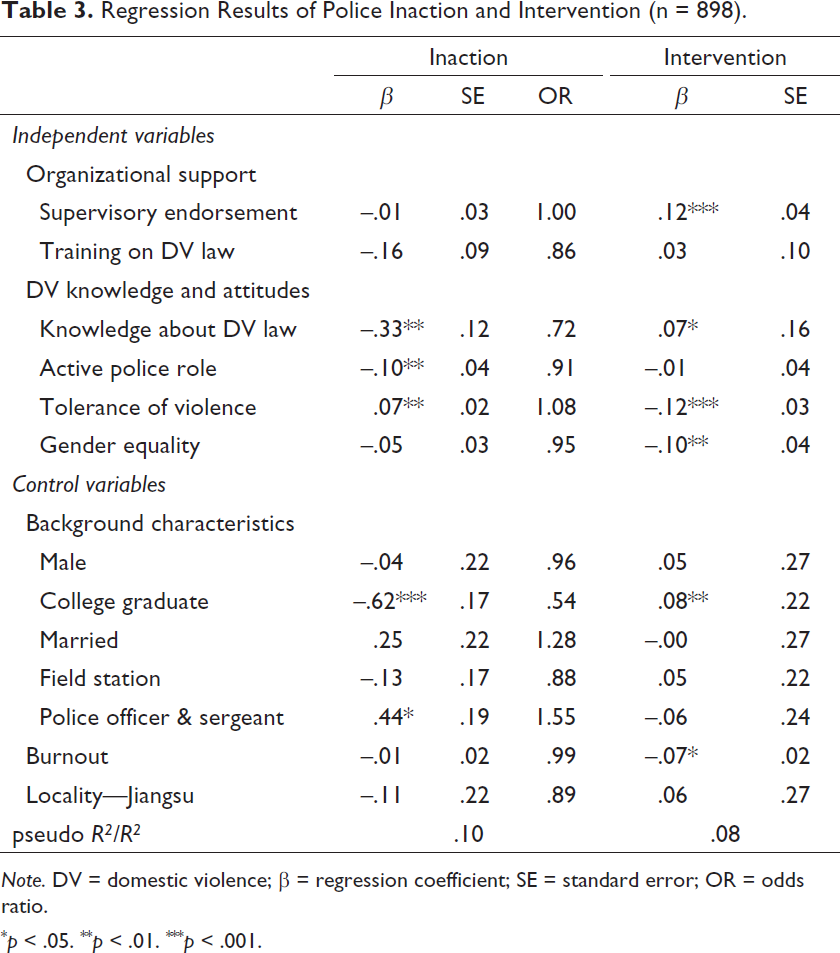
Regression Results of Police Inaction and Intervention (n = 898).
Note. DV = domestic violence; β = regression coefficient; SE = standard error; OR = odds ratio.
*p < .05. **p < .01. ***p < .001.
In the intervention model, officers who expressed greater supervisory support and knowledge on the DV Law are more likely to initiate actions against the offenders, which is consistent with our hypothesis. As expected, officers who displayed a lower degree of tolerance of violence and greater sensitivity to gender inequality in China are more inclined to intervene in domestic violence. Two control variables were predictive of officer intervention. College-educated officers are more likely to exercise intervention, whereas officers suffered greater levels of burnout were less inclined to intervene in domestic violence.
Discussion
China has faced tough challenges and difficulties in tackling the pervasive problem of domestic violence in recent decades. Under China’s new DV Law enacted in March 2016, the police are required to take actions aimed at quelling family violence and protecting victims’ rights and safety. This study generates evidence on the general patterns of actions preferred by police officers and correlates of police interventions in domestic conflict. Despite the promulgation of the DV Law, we found that more than one-fourth of Chinese officers stated that they often and sometime acted as bystanders of domestic violence incidents, doing nothing and leaving the scene when the disputants calm down. Past studies revealed that the Chinese police attributed their handoff and unresponsiveness policing approach primarily to heavy workload and uncooperative victims (Jiang, 2019). Others view passive police response as a reflection of patriarchy deeply embedded in society and exemplified in police practice (Sun et al., 2011). Theoretically speaking, Bourdieu’s (1990) relational concepts of “field” and “habitus” might be used to explain Chinese police action (or inaction) in responding to domestic violence as a relationship between structural conditions of policing and the cultural dispositions of societal and police cultures (Narayanan, 2005). Our findings signal the overall orientation of policing domestic violence in China that is predominately reactive and heavily influenced by officers’ tendency to place the maintenance of harmonious relationships over the protection of victims’ rights. Such a style of policing domestic violence aligns squarely with the ultimate goal of public security in China, maintaining social stability and ensuring regime dominance. Future research should continue to investigate the interplay between societal and police cultures in shaping police response to domestic violence.
Looking beyond inaction, Chinese police officers in the study exhibit an attitudinal ladder in their preferences for intervention, favoring most the least punitive approach of mediation, followed by separation, written warning and criminal sanction. As anticipated, mediation, a mainstream dispute resolution mechanism that has been widely utilized by the entire criminal justice system in China (Peerenboom & He, 2008), represents the most popular action among Chinese police officers. The utilization of mediation is deeply rooted in the Chinese culture of conflict resolution that emphasizes repairing the relationship over justice seeking and the tradition of patriarchy that dismisses domestic violence as a serious social problem. Mediation is also clearly prescribed and emphasized in the new DV Law. Perhaps even more influential, the objective of mediation meshes well with the government’s intention of maintaining family harmony and broadly regime stability (Jiang, 2019). As long as such a political consideration persists, it is reasonable to expect the Chinese police to continue exercising mediation as their primary tool of settling family violence.
It is not surprising to find that criminal sanction, either administrative or criminal punishment, is the least desirable option for Chinese officers. First, criminal sanction entails greater efforts and time for the responding officers. Second, such an option is not always appreciated by supervisors who tend to view domestic violence as equivalent to a family dispute and thus peripheral police work (Jiang, 2019). Indeed, without a legal mandate of arrest in the new DV Law and supportive supervisors, rank and file are unlikely to impose formal criminal sanction against the offenders.
Several findings can be summarized from our regression results. First, we found that supervisory endorsement is instrumental in stimulating officers’ interventions in domestic violence. When supervisors regularly stress the importance of responding to domestic violence aggressively and praise subordinates for doing so, rank and file are more likely to intervene in domestic violence. Contrary to our expectation, however, training is ineffective in predicting officers’ willingness to intervene in domestic violence. One possible explanation of this finding is that little training has been provided to Chinese officers. Our data indicate that more than 80% of respondents received no (56.7%) or merely 1 to 4 hours (26.3%) training on the DV Law over the last three years. This finding suggests that familiarizing officers with the legislation remains a low priority in Chinese police training. Furthermore, our data show that the variables of training and knowledge on the DV Law are only modestly related (r = .37), implying that receiving training does not automatically translate to higher perceived knowledge on the DV Law. Nonetheless, the potential of training to modify officers’ responses to domestic violence stays a possible approach for the Chines police that deserves more research attention in future studies.
Second, officers’ decisions to take action or no action during the process of disposing domestic violence incidents are closely connected to their knowledge and attitudes toward such violence. For instance, officers’ greater familiarity with the new DV Law is accompanied by lower probabilities of inaction and higher likelihoods of adopting intervention. Similarly, officers are less likely to act as bystanders of domestic violence without intervening if they support an active police role in dealing with domestic violence.
Not surprisingly, we also found that higher levels of tolerance of violence increase officers’ tendencies toward inaction and hinder officers’ probabilities of intervening in family violence. Also, officers who buy into the notion of gender equality are less willing to intervene in domestic violence. Considering these findings together, it appears that officers’ intention to act or not is highly intertwined with their professional and social views about domestic violence.
Finally, among our control variables, one is particularly worthy of mentioning. Our study confirms that burnout, as a common occupational hazard among police officers (McCarty & Skogan, 2012), is also an inhibitor of Chinese officers’ engagement in intervention in domestic violence. While Chinese officers often complain about their demanding and unfriendly working environment (Scoggins & O’Brien, 2016), research on the sources and consequences of officer burnout is scarce. More research efforts are required to further analyze the detrimental effects of burnout on officers’ psychological and behavioral tendencies and how the influence may vary across officers and jurisdictions.
While our study makes contributions to the existing literature, several limitations should be acknowledged. First, one of our key predictors, officer training on the DV Law, was measured as a five-category variable, which reflects only the amount of training time that officers have received without tapping into the training content and methods. Future studies should take into consideration a broad range of training-related information to adequately test the relationship between training and officer preferred actions in tackling conflicts. Second, organizational support is a broad concept that encompasses a wide variety of factors not included in the study. For instance, department policy, leadership style, and civilianization and formalization (Eitle, 2006) should be considered in future research. In addition, future research should incorporate other relevant variables, such as legal (e.g., evidence strength and citizen preference) and extra-legal (e.g., citizen demeanor and citizen and officer background characteristics) factors, in analyzing officers’ decisions to engage in mediation, separation, warning and criminal sanction. Finally, though officer survey served the purpose of this study well, we encourage researchers, if possible, to diversify study sample and data collection methods, which enable scholars to juxtapose survey data, for example, with information gathered from in-depth interviews and nonparticipant observations of the police. As another example, our findings could be different in underdeveloped rural areas in China where domestic violence was found to be pervasive and underreported due principally to male dominance in family finances and beliefs in harmonious relationship (Song et al., 2021). Rural police may develop a certain way of dealing with domestic violence than their urban counterparts, warranting further examination in future research.
Our findings yield some implications for policy. We found that supervisory support can be linked to officers’ willingness to intervene to stop violence. Chinese policy makers and police administrators need to pay greater attention to frontline supervisors’ attitudes and behavior toward proper responses to family violence. For example, if department leaders prefer officers to deal with domestic violence following the DV Law, then they ought to advertently communicate with their supervisors about their intentions and show managerial support for appropriate interventions in conflicts. Likewise, if active intervention is preferred, then measures and programs should be put into place to improve officers’ legal knowledge and communication and problem-solving skills pertaining to conflict resolution. Perhaps fundamentally important, if police administrators wish to promote approaches of resolving conflicts in officers’ behaviors and minds, they ought to seek ways to efficaciously reduce work-related stress and burnout among frontline officers, who commonly feel frustrated about their work environments resulting mainly from heavy workloads, low salary, and administrative drudgery (Scoggins & O’Brien, 2016). Undoubtedly, a mentally and physically healthy group of police officers is more likely to actively respond to family violence, truly improving the protection of victims’ rights and safety as prescribed in the DV Law.
Regardless of cultural and social context of China, our findings echo the results from a line of recent studies showing that organizational justice tends to generate such positive outcomes as compliance with rules and policies, fair treatment of and trust in the public, and better officer well-being (Carr & Maxwell, 2018; Haas et al., 2015; Nix & Wolfe, 2016; Trinkner et al., 2016; Wu et al., 2017). Thus, the implication for policing domestic violence is clear—effective law enforcement against violence starts within the police organization by treating frontline officers with dignity and respect and such organizational justice can go a long way by cultivating fair and respect treatment of citizens involving in domestic violence. Although the police alone cannot completely eliminate the problem of domestic violence, supervisory endorsement of actively handling such incidents is likely to generate greater public satisfaction with the police.
Footnotes
Acknowledgments
This article was based on data collected by the project “Policing Domestic Violence in China”. The project was directed by Xiying Wang of Beijing Normal University. The authors would like to thank Ruth Triplett for her thoughtful comments on an earlier draft of this study.
Declaration of Conflicting Interests
The author(s) declared no potential conflicts of interest with respect to the research, authorship and/or publication of this article.
Funding
The author(s) disclosed receipt of the following financial support for the research, authorship, and/or publication of this article: The project was supported by the International Joint Research Project of Faculty of Education, Beijing Normal University.
