




Abstract
Gottfredson and Hirschi’s theory of low self-control has generated a considerable amount of research and the results of these studies have shown that low levels of self-control are consistently associated with involvement in antisocial outcomes. Despite the empirical support for this theory, there still remain areas of it that need to be more fully evaluated. Once such area is whether self-control is associated with antisocial outcomes in samples of immigrants. The current study sought to address this gap in the literature. To do so, data drawn from the National Longitudinal Study of Adolescent to Adult Health (Add Health) were analyzed. The results of the statistical models revealed that low levels of self-control were associated with increases in self-reported delinquency, being arrested, being convicted of a crime, being sentenced to probation, being incarcerated, and being victimized. Taken together, the results of this study show that self-control is a robust predictor of antisocial outcomes among immigrants. We conclude by identifying limitations of the current study and directions for future research.
Introduction
Gottfredson and Hirschi’s (1990) theory of low self-control has been studied extensively during the past 30 years. These studies have tested the various propositions delineated in the theory, but most of the research has focused on the main hypothesis—that is, that there is a significant association between low levels of self-control and involvement in crime, delinquency, and aberrant behaviors. The results of these studies have been quite unequivocal in showing that persons with relatively lower levels of self-control are more involved in all different types of antisocial behaviors, ranging from nonviolent offenses through some of the most serious and violent criminal behaviors, indicating that self-control is involved—at least in some capacity—in the etiology of crime and delinquency (Pratt & Cullen, 2000; Vazsonyi et al., 2017). Despite the accrual of such empirical support for the theory, there remain some areas that have not been fully evaluated and there remain some key gaps in the literature where the theory has not been fully applied. One area of Gottfredson and Hirschi’s theory that could be more fully developed is whether low levels of self-control might differentially explain antisocial outcomes in different groups of people, especially among immigrants.
There has been a tremendous amount of interest in understanding the connection between immigrants and their involvement in criminal and delinquent involvement (Miller & Peguero, 2018; Ousey & Kubrin, 2018; Zatz & Smith, 2012). And while the results have been somewhat mixed, most research has shown that immigrants are less involved in crime and delinquency than are nonimmigrants (Ousey & Kubrin, 2018). Against this backdrop, a line of research has explored various explanations and theories that might be able to explain the differential rates of criminal involvement for immigrants and nonimmigrants (Adler, 2006; Lane, 1986; Mears, 2001; Miller & Peguero, 2018; Shaw & McKay, 1942). To date, however, there has been a paucity of research examining whether certain theories are able to explain crime, delinquency, and other antisocial outcomes within samples of immigrants. This is a particularly important oversight for at least two reasons. First, immigrants might differ in ways that are fundamental to the explanatory power and generalizability of criminological theories. Simply assuming that what is found with nonimmigrants would also be found with immigrants could lead to erroneous conclusions and, as a result, could also lead to policy implications that are helpful to nonimmigrants and harmful to immigrants. Second, given issues with replication in the social sciences (Freese & Peterson, 2017), it is essential to systematically and methodologically examine whether certain results are reproducible across many different contingencies. Doing so will help to show the limitations or the robustness of theories and, at the same time, will help lead to a more scientific approach to evaluating theoretical perspectives. It is in this spirit, that the current study sought to examine whether Gottfredson and Hirschi’s theory was able to explain self-reported delinquency, involvement with the criminal justice system, and adolescent victimization among immigrants residing in the USA. To do so, data were analyzed from a longitudinal sample of Americans who were adolescents in the 1990s.
The Nature of Self-control
In 1990, Gottfredson and Hirschi published their theory on the causes of crime, delinquency, and other forms of maladaptive behaviors. In this theory, they argued that low levels of self-control, in combination with a criminal opportunity, were the cause of crime and other forms if disrepute. Low self-control, according to these theorists, was comprised of a constellation of factors, such as having a here-and-now orientation, the preference for easy and simple tasks, and engaging in risky and exciting behaviors. These elements of low self-control coalesce to form a unidimensional construct. Persons who score relatively lower on self-control, according to the logic of the theory, are significantly more likely to engage in crime and other forms of antisocial behavior when compared to persons who score comparatively higher on self-control. The cause of crime, as outlined by Gottfredson and Hirschi, is therefore relatively straightforward and simple.
Gottfredson and Hirschi also provided an explanation as to how and why there is variation in levels of low self-control. According to them, self-control is inculcated in children by their parents. Specifically, they argued that in order to promote high levels of self-control in their offspring, parents must monitor their children, recognize when their children are engaging in misbehavior, and then consistently and effectively correct their wayward behavior. Parents who consistently engage in these parental management techniques will raise children with relatively high levels of self-control; parents who do not engage in these techniques will raise children with relatively low levels of self-control. Of particular interest is that this theory posits that levels of self-control are determined by around the age of 10 years and then will remain relatively fixed throughout the remainder of life. Consequently, the development of self-control, and resulting levels of self-control in adolescence and adulthood, is determined by how successful parents are at engaging in effective parental management techniques.
Gottfredson and Hirschi’s theory has been evaluated and analyzed extensively. The vast majority of this research has been focused on the main proposition that variation in levels of self-control is associated with criminal and delinquent involvement. The results generated from this line of studies have been quite consistent and shown that persons with relatively lower levels of self-control are significantly more likely to engage in crime and delinquency when compared with persons who have relatively higher levels of self-control. This association between low self-control and crime and delinquency is quite robust and has been detected in college students and the general population (Beaver et al., 2009a; Gibbs et al., 1998; Higgins, 2002), in adults and adolescents (Beaver et al., 2009a; Grasmick et al., 1993), across racial categories (Beaver et al., 2009a; Vazsonyi & Crosswhite, 2004), and for males and females (Burton et al., 1998). To synthesize the results across studies, Pratt and Cullen (2000) conducted a meta-analysis of 21 studies examining the criminogenic effects of self-control and found a statistically significant association between self-control and crime, with the effect size exceeding .20. In a more recent meta-analysis, Vazsonyi and colleagues (2017) examined the association between low self-control and deviance across 99 studies. Their results also revealed a robust association between low self-control and deviance, and these results were detected in both cross-sectional (Mr = .415, p < .05) and longitudinal (Mr = .345, p < .05) studies. As a result, the link between self-control has been well established and is considered one of the most robust correlates to crime.
Research has also revealed that the deleterious effects of low levels of self-control extend beyond behavioral measures of crime and delinquency (Evans et al., 1997). For example, low levels of self-control have been found to be associated with school failure, affiliating with antisocial friends, and stressed family relationships (Gibson et al., 2000). More recently, a body of research has examined whether self-control might be associated with the propensity to be victimized (Schreck, 1999). The results of a broad range of studies have examined this possibility, with a meta-analysis revealing a significant association between low self-control and victimization across 66 studies (Pratt et al., 2014). Although considerable variation existed across studies, across types of victimization, and whether the estimated effect sizes were from bivariate or multivariate models, the meta-analyses revealed an overall mean effect of Mz = .154 (p < .05) which the authors interpreted as “modest” (p. 99). Taken together, the available literature clearly shows that low levels of self-control are tied not only to criminal behaviors, but also to maladaptive life outcomes and to the odds of being victimized.
Self-control Theory and Immigrants
Despite the large amount of research devoted to testing self-control theory, one area that has not been fully evaluated is whether this theory would apply equally to immigrants. To date, most of the research has ignored immigrants or simply pooled immigrants and nonimmigrants together without examining whether the predictive ability varies across the groups. This is a particularly vexing issue for two reasons. First, there is evidence that the causal mechanisms that produce crime and delinquency among immigrants are not entirely the same as the causal mechanisms that produce crime and delinquency among nonimmigrants (Miller & Peguero, 2018). Second, and relatedly, social and cultural processes of immigrants have been shown to mitigate against crime and violence (Bersani et al., 2014; Bui & Thongniramol, 2005; Curry et al., 2018). As a result, some crime-producing factors for nonimmigrants may not necessarily have the same criminogenic effects in samples of immigrants. Against this backdrop, it is imperative to examine in greater detail whether low self-control is a risk factor for crime, delinquency, and other antisocial outcomes in samples that consistent entirely of immigrants. There are two lines of research bearing on the issue of whether low self-control is a criminogenic risk factor for immigrants. First, there is an emerging line of literature examining the self-control-crime connection in international samples. Studies, for instance, have been conducted on samples gathered from Belgium (Svensson et al., 2010), Saudi Arabia (Beaver et al., 2016), Hungary (Vazsonyi & Belliston, 2007; Vazsonyi et al., 2001), Sweden (Svensson et al., 2010), the Netherlands (Svensson et al., 2010; Vazsonyi & Belliston, 2007; Vazsonyi et al., 2001), Switzerland (Vazsonyi & Belliston, 2007; Vazsonyi et al., 2001), and Japan (Vazsonyi & Belliston, 2007; Vazsonyi et al., 2004). Overall, the results from these studies have confirmed what has been found previously, in that low self-control is a consistent predictor of criminal outcomes. What these findings suggest is that since low self-control is associated with antisocial behaviors in nations from which persons might emigrate from, then it stands to reason that self-control should also be related to crime for immigrants from these nations. Of course, there is a range of factors that might make such a generalization inaccurate, such as selection effects (i.e., differences between people who choose to immigrate and those who do not) along with unique social and cultural influences that might differentially impact immigrants versus those who remain in their native countries. Despite these concerns, the available literature suggests that low self-control and crime are associated across a range of international samples (Vazsonyi & Belliston, 2007).
Second, there are a limited number of studies that have directly examined the connection between low self-control and antisocial behaviors among immigrants, including immigrants to nations other than the USA. Consistent with prior research (Pratt & Cullen, 2000; Vazsonyi et al., 2017), the results have once again revealed a significant association between self-control and crime. To illustrate, one study reported that variation in low levels of self-control was associated with antisocial behavior in immigrants in Switzerland (Vazsonyi & Killias, 2001). In another study, Pauwels (2012) analyzed whether low self-control and morality interacted to predict offending in a sample of adolescents from Belgium. The results of the analyses revealed a significant interactive effect between low self-control and morality and, most noteworthy for the current study, that this interaction was significant for nonimmigrants as well as immigrants. Perhaps the most germane results come from certain studies indicating that low self-control is associated with antisocial behaviors in ethnic groups that have recently immigrated to the USA. For instance, one study examined whether low self-control was related to criminal involvement among Latinos (Shekarkhar & Gibson, 2011). The results of this study revealed a statistically significant connection between low self-control and self-reported violent and property offending. Studies have revealed similar findings when analyzing other racial/ethnic groups in the USA (Flexon et al., 2012; Pokhrel et al., 2013; Vazsonyi & Crosswhite, 2004), pointing to the robustness of self-control theory and its ability to explain crime across diverse samples.
Current Study
Hundreds of studies have tested various aspects of Gottfredson and Hirschi’s (1990) theory tying variation in self-control to differential involvement in crime. Overall, there has been a great deal of support for the main propositions of this theory (see Pratt & Cullen, 2000; Vazsonyi et al., 2017), leading it to be considered one of the most accurate and important explanations of crime. Even so, there are some areas of the theory that need to be more examined in greater detail in order to understand more fully the full merits of the theory and recent extensions of it. The current study seeks to add to the self-control literature by examining whether there is an association between low self-control and measures of crime and contact with the criminal justice system in a sample of immigrants drawn from a nationally representative sample of Americans. Additionally, we also examine whether low self-control is associated with victimization among immigrants, a topic that, to date, has not been examined systematically. Collectively, the empirical examination of these issues will provide information on the extent to which self-control theory is applicable to samples of immigrants.
Methods
Data
Data for this study were drawn from the National Longitudinal Study of Adolescent to Adult Health (Add Health). The Add Health is a longitudinal sample consisting of four waves of data (with a fifth wave not yet released) and is designed to be a nationally representative sample of American youth who were enrolled in middle or high school during the 1994–1995 school year (Udry, 2003). The first wave of data collection—known as the Wave 1 in-school component of the study—consisted of self-report surveys being administered on a specified school day to all students who were in attendance that day. Participants were asked questions that covered a wide array of topics, including questions about their social life, their experiences at school, and their behaviors. Overall, about 90,000 youth participated in this component of the study. A subsample of these participants was then selected to be reinterviewed in their homes along with their primary caregiver. This component of the study which is known as the Wave 1 in-home component of the study asked more detailed questions and questions about sensitive topics, such as their sexual experiences, their involvement in delinquency, and their peer relationships. In total, 20,745 youth and more than 17,000 of their primary caregivers participated in the Wave 1 in-home component of the study (Harris et al., 2003).
The second wave of data collection began about 1–2 years after data collection commenced (Harris et al., 2003). Since relatively little time had passed since Wave 1, most of the respondents were still adolescents. Consequently, the topics and questions asked at Wave 1 were still appropriate and applicable at Wave 2 and, as a result, the survey instruments were largely similar between the two waves. For example, youth were asked questions about their alcohol and drug use, their involvement in illegal activities, and their social relationships. In total, 14,738 adolescents participated in the Wave 2 component of the study. Then, in 2001–2002, the third wave of data was collected. Most of the respondents were now young adults and so the questionnaires were redesigned to include topics and questions that were more applicable to this age group. To illustrate, participants were asked about their educational achievement, their marital history, and their employment experiences. A total of 15,197 respondents were included in the study at Wave 3. Last, in 2007–2008 the fourth wave of data was collected when most of the respondents were in their 20s or 30s. During this wave of data collection, participants were asked questions about most aspects of their lives, including those related to their engagement in criminal behaviors, their child-rearing techniques, and their romantic relationships. In total, 15,701 participants were included in the fourth wave of the study.
Measures
Antisocial Outcomes
Descriptive Statistics for Delinquency, Criminal Justice Processing, and Victimization Variables and Scales Used in the Analyses.
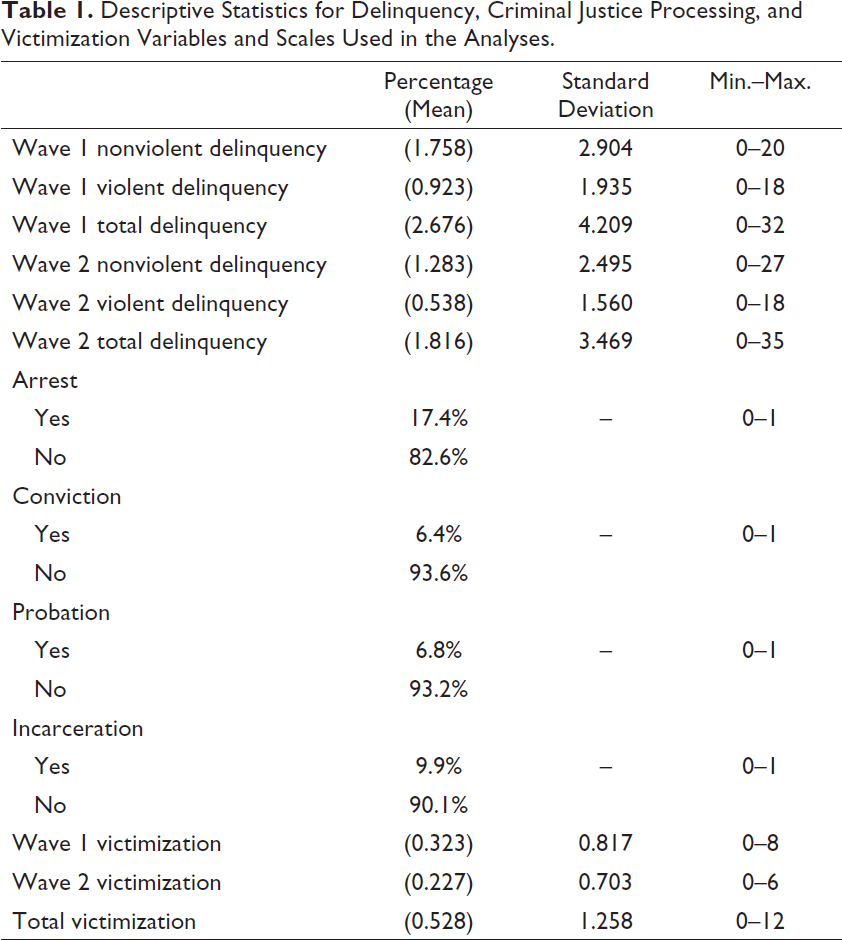
Second, four measures of being processed through the criminal justice system were included in this study. Specifically, during Wave 4 interviews, respondents were asked whether they had ever been arrested, convicted of a crime, sentenced to probation, and incarcerated. Responses to each of these items was coded dichotomously in the analyses, wherein 0 = never occurred and 1 = occurred at least one time. These measures have been used in previous research (Boccio et al., 2018; Boutwell & Connolly, 2017).
Third, three victimization measures were included in the analyses. First, during Wave 1 interviews, respondents were asked four questions that measured their experiences with personal victimization. For instance, they were asked to indicate how often in the previous 12 months they had been stabbed, jumped, shot, and had a knife/gun pulled on them. Reponses to these items were as follows: 0 = never, 1 = once, and 2 = more than once. The responses for all four of the questions were summed to create the Wave 1 victimization scale (alpha = .59). Second, a victimization scale using the same items from Wave 1 was constructed using data drawn from Wave 2 interviews (alpha = .58). Third, a total victimization scale was developed by combining scores on the Wave 1 and Wave 2 victimization scales (alpha = .70). Importantly, these victimization scales are similar to ones used in previous Add Health research (Beaver et al., 2007, 2009a; Haynie & Piquero, 2006).
Low Self-control
During Wave 1 interviews, respondents were asked a wide array of questions that tapped various aspects of their personality, attitudes, and behavioral patterns. Previous research subjected these items to analyses and identified 23 of them that coalesced to measure variation in levels of self-control (Beaver et al., 2009b, 2009c). For instance, adolescents were asked whether they have trouble paying attention at school, whether they have trouble keeping their mind focused, and whether they go with their “gut feelings” without reflecting too much on the consequences. Responses to these items were then summed to create the low self-control scale (alpha = .73), where higher values indicate lower levels of self-control.
Socialization Measures
Five socialization measures were included in the study. First, research has consistently demonstrated that exposure to delinquent peers is one of the strongest predictors of delinquent involvement (Warr, 2002). Consequently, we included a peer substance use measure in the analyses that was created from three items collected at Wave 1. Specifically, respondents were asked how many of their three closest friends consume alcohol at least once a month, smoke marijuana more than once a month, and smoke at least one cigarette a day. Responses to these items were coded as follows: 0 = zero friends, 1 = one friend, 2 = two friends, and 3 = three friends. The responses to each of these three items were then summed to create the peer substance use scale (alpha = .76). This scale is identical to the one that has been used previously with the Add Health data (Bellair et al., 2003).
Second, a maternal disengagement scale was created by extracting five items from the Wave 1 data. Specifically, youth were asked questions that tapped the overall quality of their relationship with their mother and how much warmth their mother provides them. Responses to the items were summed to create the maternal disengagement scale (alpha = .82), where higher values indicate greater levels of maternal disengagement. This scale has been used previously in Add Health research (Beaver, 2008).
Third, a maternal attachment measure that has been used previously was included in the analyses (Schreck et al., 2004). During Wave 1 interviews, respondents were asked two questions that measured the degree of maternal attachment. Specifically, they were asked how close they feel to their mother and their perception of how much their mother cares about them. Responses to these two items were combined to create the maternal attachment scale, with higher values indicating greater levels of maternal attachment (alpha = .68).
Fourth, a maternal involvement index was included in the analysis that is similar to the same index used in previous research (Crosnoe & Elder, 2004). This index was developed by using questions asked to the respondent during Wave 1 interviews. Specifically, at Wave 1 respondents were asked to report how frequently in the past four weeks they engaged with ten different activities with their mother, including going shopping, playing a sport, and attending a museum. These items were coded dichotomously (0 = no, 1 = yes) and they were summed to create the maternal involvement index (alpha = .57).
Fifth, a parental permissiveness scale was included in the analyses to measure individual variation in the autonomy afforded to them by their parents. Specifically, at Wave 1, youth were asked seven questions that measured parental permissiveness, including whether they had any input on issues related to their choice of friends and their bedtimes. These items were coded dichotomously (0 = no, 1 = yes) and the responses were summed to create the parental permissiveness scale (alpha = .65), with higher values reflecting more parental permissiveness. Importantly, this scale has been used previously (Barnes & Morris, 2012).1
Control Variables
Five control variables were included in the analyses to help prevent model misspecification. First, a public assistance variable was developed to capture variation in the financial well-being of the respondent. Specifically, during Wave 1 interviews the primary caregiver was asked whether they received financial assistance due to financial difficulties (0 = no, 1 = yes). Second, since some research indicates that intelligence might be a risk factor for antisocial behaviors (Beaver et al., 2013; Herrnstein & Murray, 1994), a measure of intelligence was included in the models. During Wave 1 interviews, respondents completed the Add Health Peabody Vocabulary Test (AHPVT), a test designed to measure variation in verbal abilities and receptive vocabulary and that has been used in previous research (Rowe et al., 1999). Third, gender was included as a dichotomous variable, where 0 = female and 1 = male. Fourth, age was included as a continuous variable that was measured at Wave 1. Last, race was measured with three categories: Caucasian, African American, and Other Race. This measure was converted into a series of three dummy variables and in the analyses, Caucasian was the omitted reference category.
Plan of Analysis
The analysis for this study proceeded in a number of sequential steps. First, since the focus of this study is on immigrants, all US-born citizens were excluded from the analyses. This was accomplished by employing an immigration variable that has been used in previous research (Rima et al., 2020). Specifically, during Wave 1 interviews, respondents were asked whether they were born in the United States. Responses to this question were coded dichotomously (0 = no and 1 = yes). Only respondents who indicated that they were not born in the United States were retained for the analyses. Second, the association between levels of self-control and nonviolent delinquency, violent delinquency, and total delinquency was explored. To do so, separate ordinary least squares (OLS) regression equations were estimated for each of these delinquency measures at Wave 1 and again at Wave 2. All of these equations included the socialization measures and the control variables. Third, the potential connection between levels of self-control and the four criminal justice processing variables (i.e., arrest, conviction, probation, and incarceration) was examined. Since all of the criminal justice processing variables were dichotomously coded, binary logistic regression analyses were estimated. These logistic regression models included the socialization measures and the control variables. Last, OLS regression models were estimated to examine whether levels of self-control were related to the Wave 1 victimization scale, the Wave 2 victimization scale, and the total victimization scale. Once again, these models included the socialization measures and the control variables. After excluding missing data using listwise deletion, and after restricting the data only to immigrants, the analytic sample sizes ranged between N = 684 and N = 1040.
Results
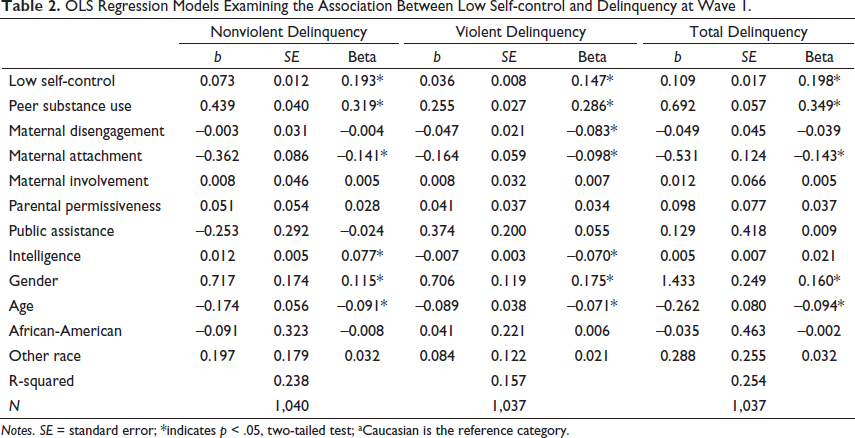
The analysis for this study began by examining the association between scores on the low self-control scale and the three Wave 1 delinquency scales. The results of these models are presented in Table 2. As can be seen, low self-control is positively associated with scores on the nonviolent delinquency scale (Beta = .193, p < .05), the violent delinquency scale (Beta = .147, p < .05), and the total delinquency scale (Beta = .198, p < .05). What these results indicate is that immigrants who have relatively lower levels of self-control are also at-risk for self-reporting comparatively higher involvement in all forms of delinquency. Also of interest in these models are the results for the peer substance use scale and the maternal attachment scale, wherein the former maintained a positive association with all three delinquency scales (Betas ranging between .286 and .349, ps < .05) and the latter maintained a negative association with the three delinquency scales (Betas ranging between –.098 and –.143, ps < .05).
OLS Regression Models Examining the Association Between Low Self-control and Delinquency at Wave 1.
Notes. SE = standard error; *indicates p < .05, two-tailed test; aCaucasian is the reference category.
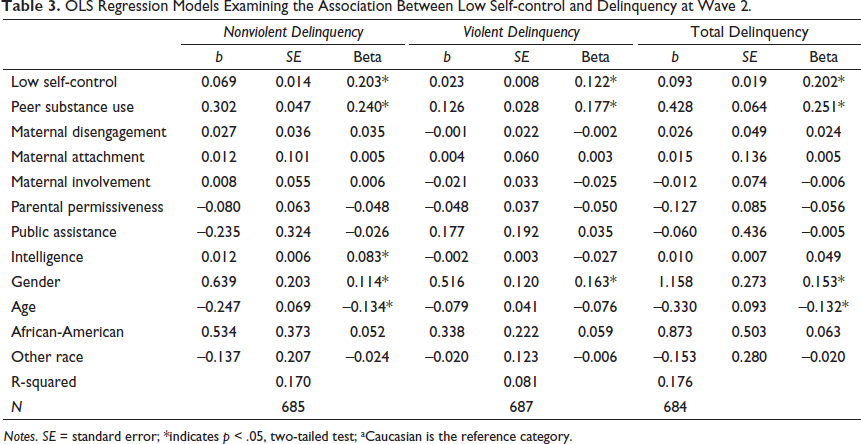
OLS Regression Models Examining the Association Between Low Self-control and Delinquency at Wave 2.
Notes. SE = standard error; *indicates p < .05, two-tailed test; aCaucasian is the reference category.
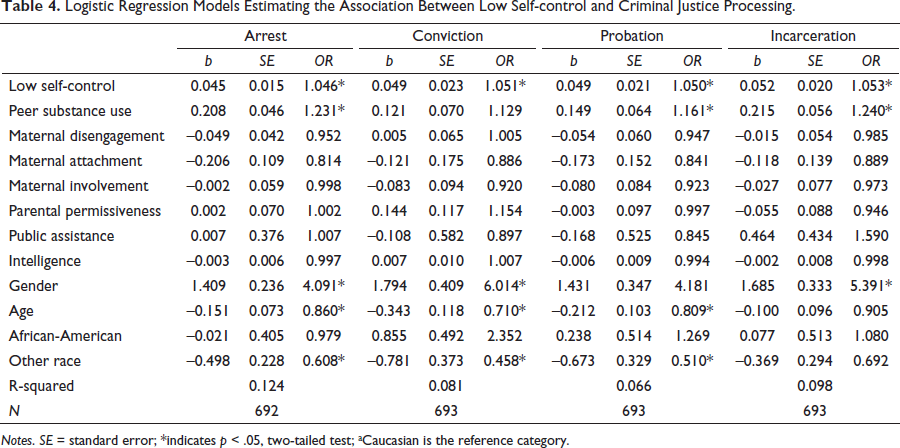
Logistic Regression Models Estimating the Association Between Low Self-control and Criminal Justice Processing.
Notes. SE = standard error; *indicates p < .05, two-tailed test; aCaucasian is the reference category.
OLS Regression Models Examining the Association Between Low Self-control and Adolescent Victimization.
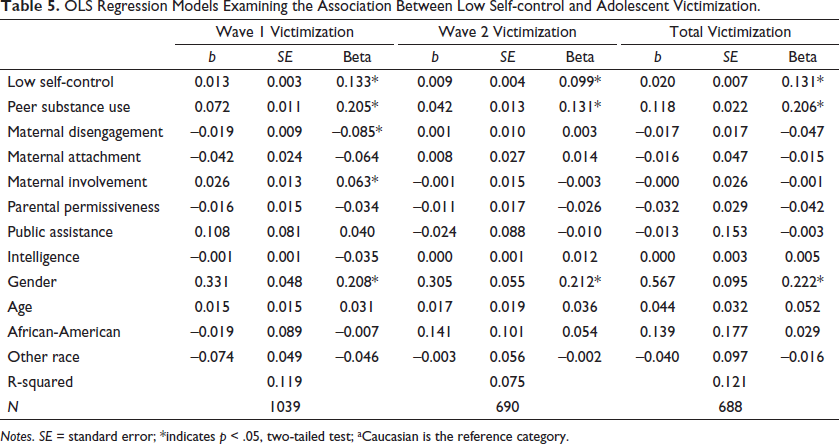
Notes. SE = standard error; *indicates p < .05, two-tailed test; aCaucasian is the reference category.
Discussion
While Gottfredson and Hirschi’s (1990) theory was not necessarily popular when first published (e.g., Geis, 2000), the theory has accrued so much support that it has become of the most influential criminological theories. Results from virtually every study testing for an association between levels of self-control and involvement in criminal and delinquent behaviors has reported a statistically significant association (Pratt & Cullen, 2000; Vazsonyi et al., 2017). As a result, more recent studies have begun to examine other propositions of the theory and have begun to examine some of the ways in which the theory might be limited (Wright & Beaver, 2005). One area that has not been fully developed and that requires additional testing is whether the association between self-control and antisocial outcomes is observable for immigrants. The current study examined this possibility by using a sample of immigrants in the USA. The results of the analyses revealed four key findings.
First, and most noteworthy, self-control was found to be associated with crime and delinquency. Indeed, the results revealed that self-control measured in adolescence was predictive of self-reported nonviolent, violent, and total delinquency both cross-sectionally and longitudinally. Self-control was also found to be a significant predictor of the probability of being arrested, convicted of a crime, sentenced to probation, and incarceration. Taken together, these results add to the voluminous literature tying variation in levels of self-control with involvement in crime and delinquency (Pratt & Cullen, 2000) and highlight the very real possibility that self-control theory is applicable to immigrants in the USA.
Second, and relatedly, the results of this study revealed that self-control was positively associated with adolescent victimization. Specifically, the measure of self-control was associated with a cross-sectional measure of adolescent victimization and it was also associated with a measure of victimization that was drawn from data collected about 1.5 years later. The results of this study, coupled to those garnered from other studies (Pratt et al., 2014), highlight that self-control is involved, in some capacity, in the etiology of victimization. The current study also expands on previous research by indicating that the self-control-victimization nexus is generalizable to immigrants in the USA.
Third, the findings also provided additional evidence of the criminogenic effects of peer substance use. Across all of the models (except for the equation predicting conviction), associating with substance-using peers was related an increase in crime and delinquency as well as the odds of being victimized. These results should not be too surprising given that the available evidence shows that measures of delinquent peer exposure tend to be among the most consistent and strongest predictors of antisocial behavior (Pratt & Cullen, 2000; Warr, 2002). Nonetheless, these findings once again show the predictive utility of peers and that the effect of such measures is not conditioned by immigrant status.
The fourth key finding to emerge from the analyses centered on the parental socialization measures. Unlike the low self-control and delinquent peers’ measures, these parenting measures maintained inconsistent and mostly nonsignificant associations with all of the outcome measures. To illustrate, in the models predicting Wave 2 delinquency, none of the four parenting measures was significantly associated with the three delinquency measures. Similar results were generated in the other equations, too. Although criminology has a long history of linking parenting techniques to delinquency (Wright & Beaver, 2005), the largely null results reported in this study fall in line with more recent critiques of the parenting literature and point to the limits of family influence in the etiology of antisocial behaviors (Harris, 1998; Rowe, 1994), including among immigrants.
The results of this study add to the large literature testing Gottfredson and Hirschi’s theory, but the results should be viewed with caution because of a number of limitations. First, all of the measures used in the analyses were based on self-reports. As a result, there is a possibility that any of the significant associations detected could be due to shared methods variance, not to a “true” significant association. Unfortunately, the Add Health data did not include any observational measures of self-control reported on by trained raters or any official measures of crime, thereby forcing us to use self-reported measures. Whether these results would be detected and triangulated using other measures of the key constructs needs to be addressed in future studies. Second, our analyses were restricted to non-US born adolescents living in the USA in the 1990s. Since that time, there has been considerable changes in the sociopolitical climate of the USA, which could mean that the results reported in this study would not necessarily be applicable to more recent time periods. Third, the peer substance use scale was based on three indirect measures wherein youth were asked to indicate the substance use of their friends. Perceptual measures of peer delinquency can be problematic and not necessarily accurate reflections of actual peer delinquency (Weerman & Smeenk, 2005; Young et al., 2011). As a consequence, the use of indirect/perceptual measures of peer delinquency has been shown to produce effects that can be overestimated and, at the same time, that can decrease the effects of other measures (Meldrum et al., 2009). Additionally, the behaviors included in the peer substance use scale do not necessarily match with the outcome measures employed in the analyses. For example, it would have been ideal if measures included in the victimization scales had also been available to create a perceptual peer victimization scale. Taken together, the use of an indirect measure of peer substance use might have produced a pattern of results that would have differed from a direct measure of peer delinquency and victimization. Last, our analyses were restricted only to behavioral measures of crime, delinquency, and victimization. Future research would benefit greatly by examining whether measures of self-control might be related to other outcomes that have been studied by criminologists, such as health and social well-being, in samples of immigrants. Such studies would be able to provide a more complete and accurate picture of the entirety of the consequences associated with low levels of self-control among immigrants.
Footnotes
Acknowledgments
This research uses data from Add Health, a program project directed by Kathleen Mullan Harris and designed by J. Richard Udry, Peter S. Bearman, and Kathleen Mullan Harris at the University of North Carolina at Chapel Hill. Special acknowledgment is due Ronald R. Rindfuss and Barbara Entwisle for assistance in the original design. Information on how to obtain the Add Health data files is available on the Add Health website (http://www.cpc.unc.edu/addhealth). No direct support was received from Grant P01-HD31921 for this analysis.
Declaration of Conflicting Interests
The author(s) declared no potential conflicts of interest with respect to the research, authorship, and/or publication of this article.
Funding
The author(s) disclosed receipt of the following financial support for the research, authorship, and/or publication of this article: This work is funded by Grant P01-HD31921 from the Eunice Kennedy Shriver National Institute of Child Health and Human Development, with cooperative funding from 23 other federal agencies and foundations.
