



Abstract
Intimate partner sexual violence (IPSV) is common, yet in many jurisdictions the law still does not adequately recognize it. In those jurisdictions that have formally criminalized IPSV, little is known about the extent to which IPSV-related law on the books is implemented in practice. Especially scarce is systematic quantitative evidence on the processing of IPSV cases by the justice system. We investigate unique case-level court data on the processing and sanctioning of violent sex crime cases in Belgium, a jurisdiction where the law adequately criminalizes IPSV, but where criminal judges are afforded broad sentencing discretion. Our data allow us to observe both the conviction and the sentencing decision. Consequently, we are able to address the endogenous sample selection concerns that arise in the assessment of IPSV-related sentencing disparities by estimating a full-fledged sample selection model. Upon inclusion of a broad range of defendant, victim, and other case controls, we show that defendants who are the victims’ spouses or partners receive statistically significantly shorter prison sentences than defendants who are unrelated to the victims, in the sense that they are neither the victims’ current or former spouses nor family. The documented extralegal disparity is quantitatively noteworthy and survives a series of robustness checks as well as alternative model specifications. Our analysis thus lends empirical credibility to the perspective that while national legislatures have often been slow to address IPSV, the justice systems may be even slower at internalizing the corresponding law. Our evidence-based insight into de facto legal responses to IPSV is of direct relevance to many jurisdictions globally.
Keywords
Through the dispositions they make and the sentences they impose … judges can send a message to victims, offenders, and the community that they understand the immense harm of IPSV, that it is a crime, and that it will be treated with the utmost severity.
—(Hecht Schafran, 2014, pp. 229–230)
Introduction
Violent sex crimes constitute some of the most disturbing forms of interpersonal violence. In many instances, the perpetrators of such violent acts are intimate partners of the victims. Yet intimate partner sexual violence (IPSV) has been criminalized only relatively recently. In the U.S., for example, states finally abolished the absolute marital rape exceptions in 1993, but with several states continuing to retain special exemption clauses to this day (see, e.g., Hecht Schafran, 2014; Seo, 2010). In many jurisdictions worldwide, marital rape is legally still not considered a crime. National laws of many countries continue to include explicit statutory provisions that may be interpreted as effective “licenses for rape” in a marital setting. 1
For an overview, see the Equality Now report entitled The World’s Shame: The Global Rape Epidemic: How Laws Around the World are Failing to Protect Women and Girls from Sexual Violence, available at https://www.equalitynow.org/.
In those jurisdictions that have formally criminalized IPSV, relatively little is known about the extent to which the law on the books about IPSV constitutes the law in action. Beyond a handful of qualitative studies and doctrinal analyses (e.g., Carline & Easteal, 2016; Easteal & Gani, 2005; Eskow, 1996; Rumney, 1999), there is great scarcity of systematic quantitative evidence on how the justice systems process instances of IPSV and especially on whether convicted IPSV perpetrators are truly sentenced commensurately with their crimes, as warranted by the letter of the law. 2
Accordingly, in a recent survey focused on the USA and juries, Rerick et al. (2019) emphasize that the vast majority of research in this domain has utilized data obtained on the basis of experiments or surveys involving undergraduate students. See, for example, McCormick et al. (1998), Kirkwood and Cecil (2001), and Frese et al. (2004). The relative absence of quantitative empirical studies utilizing original court data also applies to resolution of interpersonal violence more generally. For rare exceptions, see Fitzgerald et al. (2019) and Wasileski and Poteyeva (2019).
The paucity of quantitative research on the sanctioning of IPSV perpetrators in courts, as well as the adjudication of violent sex crimes more generally, is, at least in part, due to the overall dearth of applicable data. For reasons of privacy protection and the extraordinarily sensitive nature of the underlying legal cases, detailed court data on adjudication of IPSV cases and related violent sex crimes are not public and hence not readily available to researchers.
Especially scant are data that cast light on the pre-sentencing (conviction) stage of the court adjudication process for violent sex crimes, even though knowledge about the conviction stage of adjudication is invaluable from a methodological standpoint. The subset of court cases that result in conviction is not a random sample of all court cases; rather, unobserved factors that shape the severity of the pronounced sentence tend to be correlated with unobserved determinants of whether the defendant was convicted in the first place. Thus, any examination of the disparities in sentencing that utilizes only cases ending in conviction, but disregards the cases ending in acquittal (see, e.g., McCormick et al., 1998; Rumney, 1999), is subject to the classic endogenous sample selection concerns. Consequently, conventional statistical analyses that utilize only the sample of convicted defendants are inherently biased and may lead to erroneous conclusions about how the courts process instances of IPSV.
In this article, we take a step toward filling the substantive and methodological gaps in the literature on IPSV and the legal system’s response to IPSV (e.g., Carline & Easteal, 2016; Hecht Schafran, 2014; Rerick et al., 2019). To this end, we investigate a confidential micro-level dataset on court processing of violent sex crime cases in Belgium, an especially interesting jurisdiction for the purpose at hand. As one of the founding members of the EU, Belgium legally equated marital rape as a particularly blatant manifestation of IPSV with other forms of rape in 1989. At the same time, Belgian judges have traditionally enjoyed a very wide scope of discretion in sentencing. In particular, Belgian judicial sentencing guidelines do not explicitly stress the legal equality between IPSV and non-IPSV cases, a frequent policy recommendation aimed at mitigating potential court bias (Carline & Easteal, 2016). Accordingly, the Belgian justice system offers a fertile ground for the empirical study of whether, and if so to what extent, the IPSV laws on the books are in fact implemented in action.
Our micro-level data on court adjudication of violent sex crimes have several attractive features. First and foremost, we are able to distinguish between cases of IPSV and other instances of violent sex crimes. Our data therefore facilitate a unique insight into the role of the intimate nature of victim-defendant relation for sentencing outcomes. Second, we observe a wide set of victim, defendant, and other case characteristics. The inclusion of the corresponding controls allows us to minimize the impact of any confounding factors in an attempt to isolate any sentencing disparities with respect to instances of IPSV versus non-IPSV. Last but not least, the data enable us to observe both the sentencing and the preceding conviction versus acquittal decision. This rare feature of the data allows us to directly tackle the aforementioned sample selection concerns by estimating a full-fledged sample selection model. We therefore not only provide a rare quantitative glimpse into the sanctioning of IPSV by the justice system; we offer a methodological application that has clear advantages over the approaches utilized in the scant existing literature.
The rest of the article is organized as follows. In the next section we provide the key institutional background on the law on, and adjudication of, violent sex crimes in Belgian courts. The subsequent sections introduce our data, provide a conceptual framework guiding our empirical reasoning, develop our empirical approach, and present the results. In the final section we conclude with a broader discussion of our findings.
Institutional Background
Given our interest in investigating extralegal disparities in sentencing of IPSV versus non-IPSV, this section offers core background information about the Belgian law on violent sex crimes and the legal process for their adjudication. For readers who wish to skim through this section, we stress two crucial insights. First, while present-day Belgian penal law-on-the-books places IPSV and non-IPSV on an equal footing, this has not always been the case. Second, Belgian judges enjoy broad discretionary powers in sentencing.
Rape, Indecent Assault, and IPSV in Belgian Law
Belgian law has distinguished between rape and indecent assault since 1867, the passage of the nation’s first penal code. We first discuss the legal aspects of rape and then turn to indecent assault. Throughout, we focus especially on whether, and if so how, the pertinent law has addressed instances of IPSV.
Although rape has been criminalized since 1867, Belgian legislators did not formally define rape until 1989. In particular, prior to 1989, the courts’ working definition of rape excluded the possibility that a man could be a victim of rape and, notably, did not at all foresee the possibility that there could be rape in the context of marriage. A wife’s consent to marriage was interpreted as consent to (any kind of) sexual intercourse with her husband (De Nauw, 2005; Hutsebaut, 1990)
A 1979 court verdict foreshadowed, and contributed to, legal change. Following adjudication of a contentious instance of IPSV, the Brussels appellate court ruled that the husband in the case was guilty of raping his wife. The court’s justification was based on the argument that while marriage gives the husband the right to normal sexual relations with his wife, it does not imply that the husband can enforce his right using physical force and brutality. The appellate court’s reasoning was subsequently followed by several other courts in related cases (Van Kerckvoorde, 1992).
In 1982, a parliamentary bill sought to expand the definition of rape to, among others, render marital rape prosecutable and punishable. The bill was debated for seven years. With regard to the notion of marital rape, opponents of the bill rested their case on the argument about the universal nature of marital consent. Proponents argued that modern-day criminal law should be independent of the law of civil (i.e., marital) obligations. In 1989, the bill was finally adopted, thereby expanding the notion of rape and (at least formally) legally equating spousal rape, and more generally intimate partner-inflicted rape, with any other form of rape. Article 375 of the Belgian penal code thus defines rape as “any act of sexual penetration, of whatever sort and by whatever means, committed upon a non-consenting person”.
Unlike in the case of rape, the legislature never attempted to fully clarify the notion of indecent assault. The 1867 penal code distinguished indecent assault from rape based on the assumption about the perpetrator’s motive: indecent assault was viewed as driven by the intention to inflict harm and rape by sexual desire (Bulthé & Remouchamps, 1979). Later legislation did not provide a more concrete definition of indecent assault. Thus, the delineation of what exactly constitutes indecent assault had been left to the courts and jurisprudence (Delbrouck, 1997).
To fill the legal vacuum, in 2011 the Court of Cassation defined indecent assault as “any act against the morality, committed upon or with the assistance of a person, without the consent of the victim”. To count as indecent assault, the act or behavior must hold a certain degree of seriousness and must compromise the sexual integrity of the victim. Notably, the Court also explicitly stated that it is up to the judges presiding over a specific case to decide whether or not a particular act pertinent to the case in fact constituted indecent assault (Hof van Cassatie, 2011).
In contrast to rape, the prosecution of perpetrators of indecent assault depends on the victim’s age. If the victim has reached the legal age of sexual consent (currently sixteen), prosecution for indecent assault is possible only if the committed act entailed the use of violence or a threat. Importantly, as in the case of rape, present-day Belgian law views indecent assault committed upon a spouse or an intimate partner punishable as any other form of indecent assault.
Adjudication of Violent Sex Crimes in Belgian Courts
The legal process commences with the prosecutor’s decision to press charges, after which the court receives the prosecutor’s dossier on the case. In Belgium, sex crimes such as rape and indecent assault are considered severe criminal offenses. Court adjudication of sex crimes thus takes place in three-judge panels headed by a presiding judge. To ensure impartiality in judicial decision-making, panel composition is selected on a de facto random basis (Bielen & Grajzl, 2020).
Conviction and sentencing take place within the same criminal trial hearing. The judges first decide whether to convict or acquit the defendant based on available evidence (see, e.g., Rozie, 2008; Smetryns, 2005; Van den Wyngaert et al., 2017). If the defendant is convicted, the judges subsequently choose a sentence. Belgian law gives judges considerable discretion in sentencing. Sentencing standards for sex crimes are defined in the section Crimes and Offenses Against the Order of the Family and Against Public Morality of the Belgian Penal Code (Van den Wyngaert et al., 2017). For each crime type, the law specifies the lower and the upper sentencing bound. Because individualization of judicial decisions is valued highly in Belgian legal culture (Beyens, 2000, p. 313; Monsieurs et al., 2011), the implied sentencing ranges are wide. For example, for both indecent assault and rape without further aggravating circumstances, judges in practice have discretion to assign a prison sentence of between one month and five years. Crime-specific aggravating circumstances (e.g., victim was tortured or held in captivity) increase the minimum and the maximum bounds, but leave scope for judicial discretion (Van den Wyngaert et al., 2017).
Judges have the authority to suspend any portion of the prison sentence, thereby reducing the effective prison sentence below the assigned prison sentence. A judge may even altogether suspend the conviction (opschorting), an outcome that implies guilt but carries no punishment and is not entered on the defendant’s criminal record. In principle, the judges may also levy a monetary fine as a secondary sentence. In indecent assault and rape cases, however, prison sentence is the rule and secondary fines are rare.
In contrast to many other countries, Belgian judges operate under no additional sentencing guidelines beyond those articulated in the applicable penal law itself (Monsieurs et al., 2011; Van den Wyngaert et al., 2017). Indeed, judges are formally bound only by Articles 6 and 14 of the European Convention on Human Rights (ECHR), which prohibits them from basing conviction and sentencing decisions on factors such as gender, race, ethnicity, language, religion, and political views. The law does require that the judges justify their sentencing decision (Rozie & Van Deuren, 2012). However, in practice, acceptable justifications are normally very brief and vague (e.g., “the gravity of the committed crime warrants a harsh application of the law”).
Conceptual Background, Hypotheses, and Interpretative Considerations
The substantial discretion enjoyed by Belgian criminal judges at sentencing raises the question whether court adjudication of violent sex crimes leads to any systematic disparities with respect to features of cases that, based on the letter of the law, should not influence judicial decisions. Our focus is on sexual violence inflicted by an intimate partner, as captured by whether the victim of a violent sex crime is defendant’s spouse or partner. Congruent with the paradigm of broad discretion in sentencing, the judges are, strictly speaking, not explicitly forbidden to consider the general nature of victim-defendant relation in their sentencing decision. Indeed, an ascendant or blood relation between the defendant and victim is an aggravating circumstance that the judges are legally expected to take into account in sentencing. The intimate character of victim-defendant relation, however, constitutes an extralegal factor and, as such, should not affect sentencing outcomes, all else equal.
Yet extralegal factors may play a potentially potent role, as has been well-acknowledged in the literature on judicial behavior. Modern theories of judicial decision-making emphasize that, in adjudicating criminal cases, judges face information and time constraints (see, e.g., Albonetti, 1991; Hawkins, 1981; Johnson et al., 2010, pp. 988–989; Steffensmeier et al., 1998; Stephenson, 2009, p. 200). To address their focal concerns and form attributions of defendant’s criminal risk, judges therefore rely on decision-making schema that incorporate social stereotypes, personal experiences, and courtroom mores. In the absence of comprehensive information, sentencing judges may come to (consciously or unconsciously) systematically associate the level of defendant’s expected future criminality with observable extralegal case characteristics, including whether the victim and the defendant are involved in an intimate relationship (see, e.g., Dawson, 2006; McQuade, 2014). In particular given that in the not-so-distant past IPSV was not even legally recognized as a crime, adjudicators, who are themselves embedded in the broader social context, may come to perceive defendants who are victim’s intimate partners as somehow less socially harmful and injurious than defendants who are not intimate partners of victims (see, e.g., Carline & Easteal, 2016; Harless, 2003; Klarfeld, 2011; Rerick et al., 2019; Rumney, 1999). The corresponding erroneous, yet commonly invoked, cultural scripts can clearly serve as an impediment to a just processing of instances of IPSV by the legal system.
Thus, whether the intimate nature of victim–defendant relation affects defendant sentencing, and if so in what way, is an empirical question. A failure to uncover sentencing disparities with respect to the intimate character of victim-defendant relation would be consistent with the hypothesis that, at least in the examined set of cases, the courts treat intimate partner crimes as intended by law. On the other hand, uncovering of sentencing disparities per se would not be prima facie evidence of judicial bias. The reason is that in the absence of experimental data, it is inherently difficult to entirely rule out the possibility of confounding effects due to unobservable features of the case that may be correlated with the observable nature of the defendant-victim relation and, at the same time, exert an independent effect of adjudicatory outcomes. Of course, the prospects for the omitted variable bias will be reduced when the set of available controls is rich, as is the case in our empirical exploration. However, even in the presence of a wide set of controls, estimates should be interpreted with caution.
The above caveats notwithstanding, the presence or absence of sentencing disparities reveals important information about the functioning of the justice system and, as such, has merit on its own. Accordingly, a voluminous empirical literature in social sciences and criminology has investigated sentencing disparities with respect to a wide range of factors and in a variety of adjudicatory contexts (e.g., Johnson & Betsinger, 2009; Starr, 2015; Starr & Rehavi, 2013; Steffensmeier et al., 1995; Volkov, 2016). Within this literature, hardly any attention has been devoted to the study of sentencing disparities in adjudication of violent sex crimes, a setting where extraneous factors may play an especially salient role due to the deviant nature of the underlying offenses. In particular, we are aware of no micro-level empirical study investigating the role of victim-defendant intimate partner relation on sentencing outcomes in violent sex crimes.
Data
To examine the role of victim-defendant intimate partner relation in the sentencing of defendants in violent sex crimes, we collected data on rape and indecent assault cases adjudicated at the largest court of general jurisdiction in the Flanders region of Belgium. The pool of cases from which we drew our sample was the complete set of a multiplicity of sex offenses that were resolved at the criminal bench of the court between January 1, 2006 and December 31, 2014. The focus on the resulting, somewhat distant, time window ensures that any subsequent higher court appeals to the court’s decision have already been resolved and hence all case dossiers have been returned to the court under consideration. This approach minimizes any sample selection issues that could arise if cases based on temporarily unavailable dossiers were fundamentally different from cases based on available dossiers.
From this initial set of offenses, we identified a random sample of 1,000 one-defendant, one-victim sex crime cases. To maintain focus on alleged crimes involving interpersonal violence, we excluded all cases not involving charges of rape or indecent assault (i.e., cases involving obnoxious images, prostitution, public indecency, and human trafficking). Given our interest in the justice system’s treatment of IPSV cases, we also excluded the cases in which the victim is less than fourteen years old, the legal age of sexual consent based on the original Belgian penal code. We were granted confidential access to the archived dossiers containing information about the underlying offenses, victims, and defendants. All names of defendants and victims were removed to preserve full victim and defendant anonymity. Upon dropping a handful of cases with substantially incomplete records, we arrived at a final sample of 364 single-defendant rape or indecent assault cases. Importantly, for each case, we observe the conviction versus acquittal decision and, for each instance of conviction, the assigned prison sentence. None of the cases in our sample feature a secondary monetary fine.
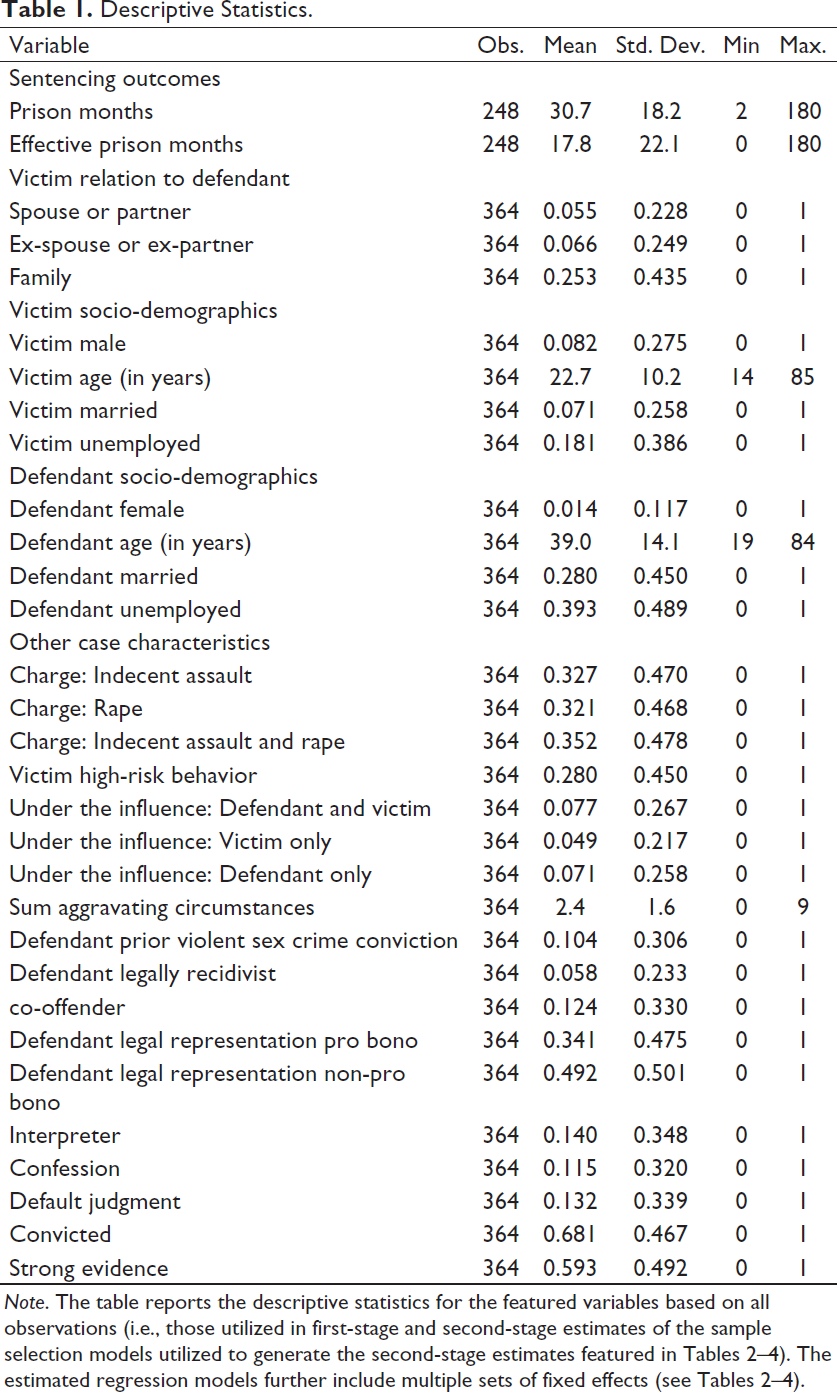
Table 1 provides detailed descriptive statistics for the key variables. (Table A1 in the Appendix offers variable definitions.) With regard to the nature of the victim–defendant relation, the victim is the defendant’s current spouse or partner in 5.5% of the cases. The victim is the defendant’s ex-spouse or ex-partner in 6.6% of the cases. The victim is the defendant’s (nuclear or extended) family (excluding current or previous spouse or partner), in about a quarter of the cases.
Descriptive Statistics.
Note. The table reports the descriptive statistics for the featured variables based on all observations (i.e., those utilized in first-stage and second-stage estimates of the sample selection models utilized to generate the second-stage estimates featured in Tables 2–4). The estimated regression models further include multiple sets of fixed effects (see Tables 2–4).
The composition of our sample is diverse with regard to many observable victim and defendant attributes, including gender, age, and socioeconomic status. The majority of victims are females and the overwhelming majority of defendants are males. However, male victims constitute more than 8% of the sample and, while rare, female defendants are featured in our data. Only 1% of cases in our data entail a male victim and a female defendant. The victim and the defendant are of the same gender in as many as 7.5% of the cases. Average victim age is less than 23 years, but the oldest victim is 85 years old. Average defendant age is 39 years while the oldest defendant is 84 years old. The cases in our sample therefore encompass victims and defendants from a broad range of age groups. About 18% of victims and 39% of defendants are unemployed. Defendants are legally represented by a pro-bono lawyer in 34% of the cases and by a non-pro bono attorney in 49% of the cases. This is a clear indication that the victims and defendants featured in our sample come from diverse socioeconomic strata.
With regard to the remaining features of our sample, more than 10% of defendants have previously been charged with a violent sex crime. Only 6% of defendants are being charged within five years from the end of last punishment involving at least a year of imprisonment. About 28% of victims engaged in behavior deemed high-risk from the standpoint of incidence of violent sex crime (e.g., prostitution). In about a fifth of the cases, either the victim or the defendant, or both, were under the influence of alcohol or drugs at the time of the alleged crime.
The most common charge, featured in 35% of the cases, entails a joint charge of both rape and indecent assault. The average number of aggravating circumstances (such as abuse of authority, use of pronounced violence or weapon, torture, and young age of the victim) in a case is 2.4. A co-offender was involved in 12% of the cases. A default judgment was issued in 13% of the cases. The defendant confessed the crime in close to 12% of the cases. Strong evidence, in the form of DNA, an eyewitness account, or a surveillance tape, exists in 59% of the cases.
About 68% of defendants are convicted. For those convicted, the mean length of total prison sentence, irrespective of any suspension, is 30.7 months. Once taking into account any suspensions, the mean length of effective prison sentence in our sample is 17.8 months.
Table A2 in the Appendix displays the full set of Pearson correlations for the variables featured in Table 1. Pearson correlations, however, do not adequately capture the ceteris-paribus relationship between sentence severity and the nature of victim-defendant relation, the key relationship of our interest. In particular, Pearson correlations do not control for confounding variables and, notably, do not address concerns about endogenous sample selection. We thus proceed with utilizing more powerful methods.
Methods
Empirical Approach
The central empirical conundrum when estimating the determinants of sentence severity stems from the fact that the sample of convicted defendants is a non-random sample of all defendants. If there exist unobservable case characteristics that affect both the prospects that the defendant is convicted and sentence severity, then estimating an OLS regression on the sample of convicted defendants only, without incorporating information from the conviction decision, would lead to biased estimates. For example, if judges rely on the nature of the victim-defendant relation to form attributions of the defendant’s guilt, then any disparities in sentence severity observed in the sample of convicted defendants with respect to those case characteristics would merely reflect the types of defendants selected into the convicted subsample and not court behavior at the sentencing stage per se.
To address the resulting empirical concern, we leverage the fact that our data allow us to observe the outcome of both the conviction and the sentencing decision. This important feature of our data facilitates the estimation of a full-fledged sample selection model. We use the Heckman (1979) two-step (Heckit) procedure, the workhorse method for addressing sample selection concerns in the social sciences. In the first (for us ancillary) stage, we run a probit, estimated on the sample of all 346 (convicted and acquitted) defendants. The outcome variable, Convicted, is an indicator equal to one if the defendant was convicted and zero otherwise. In our primary approach, we treat instances of fully suspended conviction (opschorting) as acquittal. 3
There are 41 instances of opschorting in our sample. 22 among those cases involved the charge of indecent assault only; 15 the charge of both indecent assault and rape; and four the charge of rape only.
In the second stage, we then estimate the determinants of sentence severity, with the outcome variable defined as the log of Prison Months. (In an alternative specification, we also utilize the outcome Effective Prison Months.) Logging the outcome variable smooths out the effect of outliers, reduces the extent of skewness of the distribution, and facilitates the interpretation of estimates as semi-elasticities. We run an OLS regression on the sample of 248 convicted defendants only, but with the estimated inverse Mills ratio as an additional included variable to correct for the underlying endogenous sample selection bias. We base statistical inference on the correspondingly corrected robust standard errors (see Heckman, 1979).
To facilitate the identification of the parameters, we rely on an exclusion restriction. As the variable that enters the first stage (probit regression on all defendants) but not the second stage (OLS regression on convicted defendants) of the estimation, we use the binary indicator Strong Evidence that equals one if the case against the defendant features especially clear evidence (in the form of DNA, an eyewitness account, or a surveillance tape) and zero otherwise. The resulting variable should be a compelling predictor of the conviction versus acquittal decision, but it should not impact the severity of the sentence given to convicted defendants. Conditional on conviction, the strength of evidence namely plays no role in the court’s determination of sentence severity.
Focal Explanatory Variables and Controls
Our focal explanatory variables are indicators for the nature of victim-defendant relation. We are especially interested in discerning the effect of a scenario where the victim is the defendant’s current spouse or partner (Spouse or Partner), a binary indicator capturing intimate partner relation between the victim and the defendant. In addition, we explore the effect of scenarios where the victim is defendant’s former spouse or former partner (Ex-Spouse or Ex-Partner), or family (Family). The omitted (baseline) category is therefore the scenario where the victim and the defendant are neither current or prior spouses or partners, nor family, and are, in this sense, unrelated. Clearly, the defendant and the victim in our omitted category scenario need not necessarily be strangers in the strict sense of the word; they could be, for example, casual acquaintances or co-workers, but our data do not reveal such nuanced information. Our use of “unrelated” should be understood correspondingly.
To minimize omitted variable bias, we employ a wide range of controls. We control for sociodemographic characteristics of the victim and the defendant. For both victim and defendant, we include indicators for their gender (male for victims; female for defendants), marital status, (un)employment standing, and age. To allow for non-linear effects of age, we control for victim and defendant age with a series of age-cohort indicators.
We further employ detailed data on other characteristics of the case. We include controls for charge type (rape, indecent assault, or both). We include indicators for whether the defendant or the victim, or both, were under the influence at the time of the alleged crime and if victim engaged in high-risk behavior (e.g., prostitution). We control for the number of aggravating circumstances; whether the defendant has previously been convicted of a sex crime; if the defendant is being charged within five years from the end of last punishment involving at least a year of imprisonment (legal definition of recidivism); and whether the case featured a co-offender. We use controls for whether the defendant confessed the crime, and if the decision was rendered as a default judgment (i.e., the defendant or their legal representative did not appear in court). We further include indicators for the nature of defendant’s legal representation (pro bono, or non-pro bono), if any. Following our empirical approach, we add an indicator for strong evidence only in the conviction part of the estimated model.
Finally, we control for three sets of fixed effects. The first are prosecutor fixed effects. Individual prosecutors can exert considerable influence on criminal justice outcomes even beyond the decision to press charges, including in IPSV cases (see, e.g., Eskow, 1996). Because the assignment of cases to prosecutors is normally not random, failure to control for prosecutor fixed effects may bias the results. Yet due to data limitations, few empirical analyses of adjudicatory outcomes have been able to control for prosecutor-specific effects. The second set, presiding judge fixed effects, absorb the average effects of specific presiding judges on case outcomes. Controlling for presiding judge fixed effects therefore holds constant any presiding judge-specific idiosyncrasies in adjudication and allows us to focus on any patterns in sentencing outcomes net of presiding judge-specific effects. Finally, we add fixed effects for the year of verdict to address any potential seasonality effects in court decision-making.
Results
Main Results
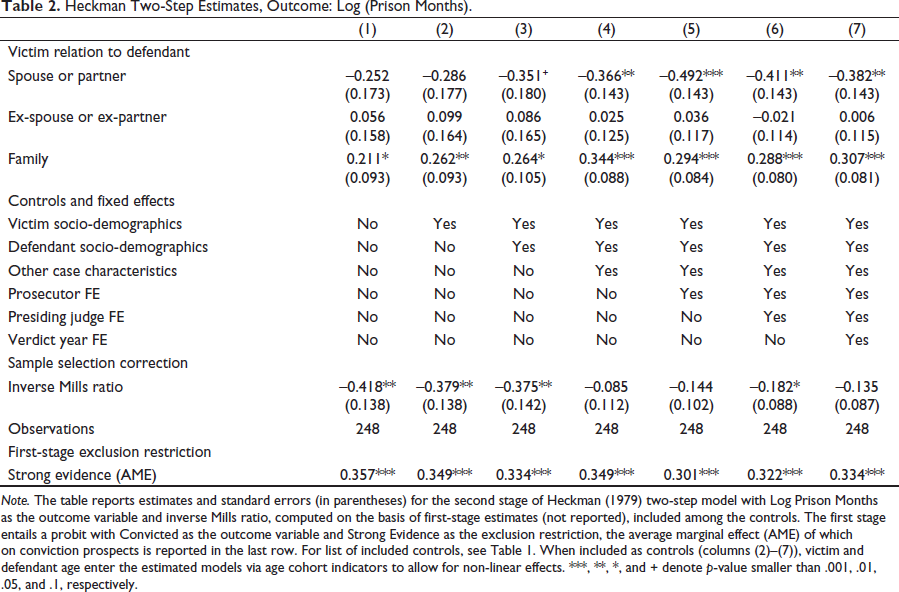
Table 2 summarizes our main results for a series of specifications, with each reported specification constituting the second stage of the Heckit approach with the outcome variable logged Prison Months. Column (1) shows the results based on a specification in which the only included variables are the indicators for the nature of victim-defendant relation. The focal estimated coefficient on the indicator Spouse or Partner is negative, but not (yet) statistically significant.
Heckman Two-Step Estimates, Outcome: Log (Prison Months).
Note. The table reports estimates and standard errors (in parentheses) for the second stage of Heckman (1979) two-step model with Log Prison Months as the outcome variable and inverse Mills ratio, computed on the basis of first-stage estimates (not reported), included among the controls. The first stage entails a probit with Convicted as the outcome variable and Strong Evidence as the exclusion restriction, the average marginal effect (AME) of which on conviction prospects is reported in the last row. For list of included controls, see Table 1. When included as controls (columns (2)–(7)), victim and defendant age enter the estimated models via age cohort indicators to allow for non-linear effects. ***, **, *, and + denote p-value smaller than .001, .01, .05, and .1, respectively.
Columns (2) through (8) show results for specifications where we gradually add sets of controls and fixed effects. Throughout this process, the coefficient on the Spouse or Partner indicator remains negative, even if it fluctuates somewhat in terms of magnitude. The inclusion of controls, on the one hand, reduces the prospects for omitted variable bias and, at the same time, decreases the variance of the error term, which in turn improves the precision of our estimates. The coefficient on the indicator Spouse or Partner becomes marginally statistically significant (at 10% level of significance) once we add both victim and defendant sociodemographic controls (column (3)). The effect becomes fully statistically significant (at 1% level of significance) upon inclusion of other case level controls (column (4)) and remains strongly significant after further inclusion of prosecutor, presiding judge, and year of verdict fixed effects (columns (5) through (7)). Based on our preferred specification featuring the full set of controls and fixed effects (column (7)), the magnitude of the corresponding disparity is sizeable. All else equal, in instances where the victim is the defendant’s spouse or partner rather than unrelated to the victim, the defendant is on average given a 31.8% (≈(e–0.382 − 1) × 100) shorter prison sentence (approximately 9.7 months based on the mean sentence length).
In contrast, we find no evidence of an effect of the victim and the defendant being ex-spouses or ex-partners as opposed to unrelated. The coefficient on the Ex-Spouse or Ex-Partner indicator is statistically insignificant across all of the featured specifications, with point estimates themselves very close to zero. We do, however, find a robust and statistically significant positive effect of victim and defendant sharing a familial relation (e.g., parent). Based on the estimates in column (7), in instances where the victim is the defendant’s family as opposed to unrelated to the defendant, the defendant is on average given a 35.9% (≈(e0.307 − 1) × 100) longer prison sentence (approximately 11 months based on the mean sentence length). Notably, in the specification in column (7) we control for the sum of aggravating circumstances, which can include the defendant being the victim’s ascendant or adoptive parent. Thus, the discovered effect is unlikely explained solely by judges diligently imposing harsher sentences in light of available aggravating circumstances. Instead, it is quite possible that, all else equal, a familial relationship between the defendant and the victim serves as a further extraneous factor that influences sentencing outcomes.
The coefficient on the inverse Mills ratio is statistically significant in four out of seven specifications in Table 2, an indication that sample selection correction is indeed warranted. The negative sign of the estimated coefficient is suggestive of the presence of negative selection; unobservables that affect conviction prospects are negatively correlated with those that influence sentence severity. The coefficient on the inverse Mills ratio does become statistically insignificant upon the inclusion of the full set of case controls and fixed effects (column (7)), our preferred specification. Because our exclusion restriction, Strong Evidence, exhibits a robustly statistically significant positive effect on the prospects of conviction (see the last row of Table 2), the lack of statistical significance of the inverse Mills ratio in column (7) should not be a consequence of collinearity between the inverse Mills ratio and other covariates (see, e.g., Bushway et al., 2007, p. 164). Rather, it must be that the inclusion of a broad range of controls and fixed effects in our estimated model mitigates well the omitted-variable bias arising from the non-random selection of the sample of convicted defendants (see, e.g., Achen, 1986; Heckman, 1979, pp. 22–23).
Alternative Specifications and Robustness Checks
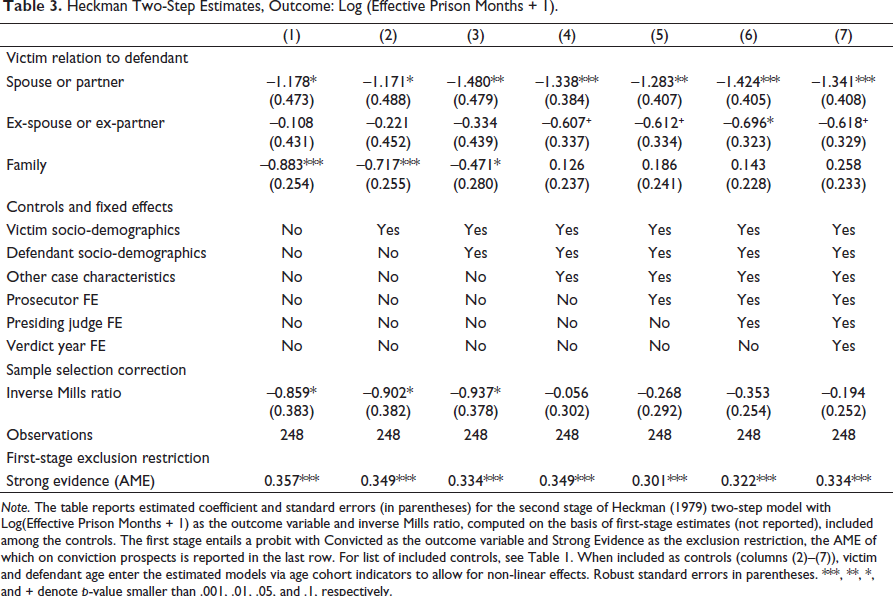
We examine alternative model specifications and perform a series of robustness checks. First, rather than using logged Prison Months as the outcome variable, we use logged Effective Prison Months. 4
Prior to applying the log transform, we add the value one to this variable to avoid dropping the cases in which the judges chose to suspend the entirety of the assigned prison sentence.
Heckman Two-Step Estimates, Outcome: Log (Effective Prison Months + 1).
Note. The table reports estimated coefficient and standard errors (in parentheses) for the second stage of Heckman (1979) two-step model with Log(Effective Prison Months + 1) as the outcome variable and inverse Mills ratio, computed on the basis of first-stage estimates (not reported), included among the controls. The first stage entails a probit with Convicted as the outcome variable and Strong Evidence as the exclusion restriction, the AME of which on conviction prospects is reported in the last row. For list of included controls, see Table 1. When included as controls (columns (2)–(7)), victim and defendant age enter the estimated models via age cohort indicators to allow for non-linear effects. Robust standard errors in parentheses. ***, **, *, and + denote p-value smaller than .001, .01, .05, and .1, respectively.
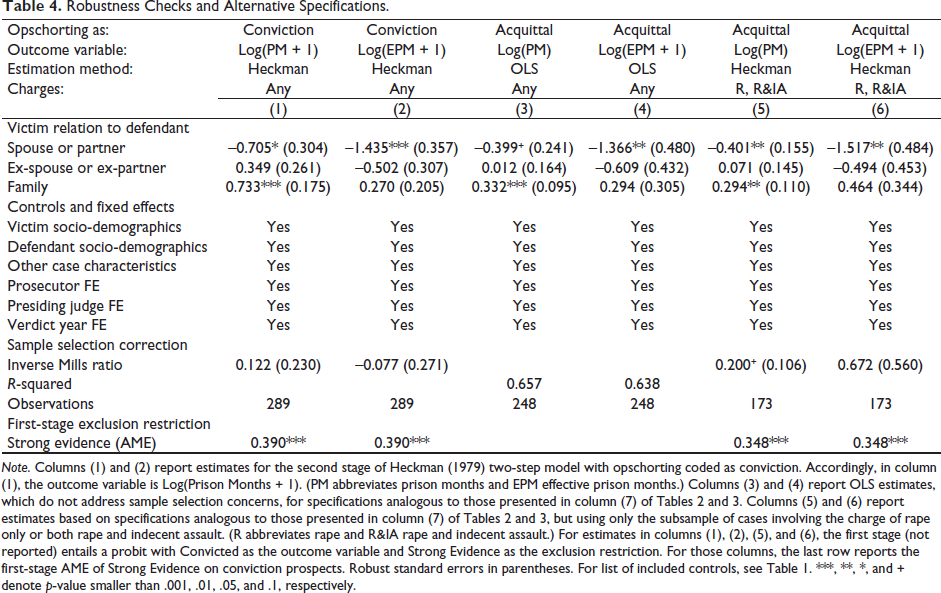
Second, rather than viewing fully suspended sentence (opschorting) as acquittal, as we have thus far, we regard it as conviction. The values of variables Prison Months and Effective Prison Months for the corresponding cases are re-coded to equal zero. We then re-estimate the specifications with full set of controls and fixed effects as featured in column (7) of Tables 2 and 3. The results are reported in columns (1) and (2) of Table 4. The coefficient on the focal indicator Spouse or Partner is still negative and statistically significant.
Robustness Checks and Alternative Specifications.
Note. Columns (1) and (2) report estimates for the second stage of Heckman (1979) two-step model with opschorting coded as conviction. Accordingly, in column (1), the outcome variable is Log(Prison Months + 1). (PM abbreviates prison months and EPM effective prison months.) Columns (3) and (4) report OLS estimates, which do not address sample selection concerns, for specifications analogous to those presented in column (7) of Tables 2 and 3. Columns (5) and (6) report estimates based on specifications analogous to those presented in column (7) of Tables 2 and 3, but using only the subsample of cases involving the charge of rape only or both rape and indecent assault. (R abbreviates rape and R&IA rape and indecent assault.) For estimates in columns (1), (2), (5), and (6), the first stage (not reported) entails a probit with Convicted as the outcome variable and Strong Evidence as the exclusion restriction. For those columns, the last row reports the first-stage AME of Strong Evidence on conviction prospects. Robust standard errors in parentheses. For list of included controls, see Table 1. ***, **, *, and + denote p-value smaller than .001, .01, .05, and .1, respectively.
The coefficient on the inverse Mills ratio in our preferred specification in column (7) of Tables 2 and 3 is statistically insignificantly different from zero. As a third set of robustness checks, we therefore also estimate our preferred empirical specifications without the sample-selection correction, thereby running an OLS regression on the subsample of convicted defendants only. The resulting specification is not our preferred, as this approach altogether ignores endogenous sample selection concerns; we explore it for sake of completeness only. The results are reported in columns (3) and (4) of Table 4. The coefficient on the focal indicator Spouse or Partner remains negative and statistically significant (for specification in column (3) at the 10% level).
Finally, the legal debate concerning IPSV often revolves specifically around rape. To examine the empirical relevance of the intimate nature of victim–defendant relation in that specific context only, we estimate our preferred specifications, featured in column (7) of Tables 2 and 3, on the subsample of cases that all involve the charge of rape, either as the sole charge or in conjunction with indecent assault. The corresponding estimates, produced on the basis of a correspondingly smaller sample, are reported in columns (5) and (6) of Table 4. Yet again, the estimated coefficient on the indicator Spouse or Partner remains negative and statistically significant.
Discussion and Conclusion
Our analysis provides one of the first empirical examinations of the sanctioning of IPSV by the justice system using case-level court data. According to the letter of the law, in Belgium, the intimate partner relation between the victim and the defendant should not result in lesser punishment of the perpetrators of violent sex crimes. Yet our estimates reveal that, at a major Belgian court, violent sex crime defendants who are the victims’ current spouses or partners are sentenced considerably less harshly than defendants in comparable sex crimes who are unrelated to the victim, in the sense that they are neither the victim’s current or former spouses or partners, nor family. This extralegal disparity is quantitatively noteworthy; persists upon inclusion of a wide set of victim, defendant, and other case level controls and fixed effects; and survives a series of robustness checks and alternative model specifications. At the very least, our analysis lends empirical credibility to the oft-emphasized perspective that, while national legislatures have typically been slow to address IPSV, the justice systems may be even slower at internalizing the corresponding law and implementing it in action (see, e.g., Carline & Easteal, 2016; Fus, 2006; Harless, 2003).
Given the non-experimental nature of our data, it would be too early to interpret our estimates as providing decisive evidence of the judicial system’s partiality to defendants who are intimate partners of victims of violent sex crimes. Our results merely suggest that such a bias is indeed a possibility. To cast further light on the documented disparity, follow-up research should investigate the mechanism, or mechanisms, underlying the documented effect.
In particular, while our empirical approach has focused on identifying and adequately estimating the IPSV disparity in court data, our analysis does not address how and why exactly judges and prosecutors might settle on shorter prison sentences for defendants who are victims’ intimate partners. An improved understanding of the precise reasons for the empirical finding documented in the present article would be important from the policy perspective. To the extent that the disparity truly is an outcome of conscious or unconscious biases ingrained in the justice system, different mechanisms underpinning the disparity would likely warrant different policy responses (see, e.g., Carline & Easteal, 2016). Thus, to ascertain to what degree the documented disparity is a consequence of the perpetuation of the erroneous belief that IPSV is not quite “the same” as non-IPSV (see, e.g., Carline & Easteal, 2016; Rerick et al., 2019), further qualitative research is needed. Such research—perhaps in the form of structured interviews of the judges and courtroom participants—should highlight the legal reasoning, as well as any cultural attitudes, that underpin the sentencing of defendants in violent sex crimes at the court in question.
The Belgian judiciary operates under a common set of national rules and the court from which we draw our data is one of the key courts in the country. We would therefore expect the gist of our findings to generalize to other Belgian courts that adjudicate IPSV cases. External validity of our findings, however, should nevertheless not be taken for granted.
In particular, if the documented extralegal disparity with respect to the sanctioning of IPSV versus non-IPSV cases is indeed driven by a culturally-conditioned (mis)perception that the two forms of sexual violence are somehow distinct with regard to harm and malice, then the broader societal culture surely serves as one salient contextual factor affecting how instances of IPSV are processed by the justice system (see, e.g., National Institute of Justice, 2016, p. 7, 15, 26). Accordingly, there may exist differences in how the courts process instances of IPSV versus non-IPSV even within Belgium. For example, the (Dutch-speaking) Flanders region and the (French-speaking) Walloon region have been shown to exhibit systematic differences with respect to societal beliefs and attitudes (e.g., Cohen et al., 2012; Meeusen et al., 2017).
It would therefore be pertinent to examine whether and if so to what extent the magnitude of the disparity—and hence the seriousness of the underlying problem if caused by a systematic bias—varies across the culturally distinct regions of Belgium itself. For the same reason, it would be important to investigate to what extent our findings extend to other jurisdictions where the law (at least nominally) places IPSV and non-IPSV on an equal footing with regard to anticipated punishment of the perpetrators, but where the prevailing cultural attitudes toward IPSV may differ from those in Belgium.
Cross-jurisdictional cultural diversity notwithstanding, we would expect the essence of our findings to apply to many other countries. After all, the criminalization of IPSV is a recent phenomenon. Thus, the discord between the law on the books and the law in action with regard to IPSV that we have documented is likely a frequent, if not ubiquitous, occurrence. Existing anecdotal and suggestive quantitative evidence from a multiplicity of diverse jurisdictions corroborates this conjecture (see, e.g., Carline & Easteal, 2016; Eskow, 1996; Jordan, 2004, p. 11; Rumney, 1999; United Nations, 2019, p. 122).
Comparative analysis of the functioning of IPSV-related laws-on-the-books versus laws-in-actions, however, can also be challenging due to significant heterogeneity across legal systems with regard to the interpretation of IPSV. In many countries, the criminal justice system “interprets intimate partner violence in terms of actions, emphasizing the physical”, while other sub-systems, such as those focused on the family and child protection, tend to “consider patterns of behaviors and the implication of those patterns” (United Nations, 2019, p. 126). This renders “the consistent interpretation of [IPSV] across legal systems a challenge” (United Nations, 2019), a fact that underscores the necessity for a careful consideration of diverse formal institutional arrangements relevant to IPSV-related sanctioning as an additional salient contextual factor.
Irrespective of the above considerations, our work has direct and immediate relevance beyond Belgian borders. IPSV is a global crime and, due to its immensely detrimental consequences for the victims, a global health problem (World Health Organization, 2013). Empirical insights about IPSV from one country can serve as a valuable source of knowledge about the issues at stake for another country. In this regard, our analysis offers a methodological framework for ascertaining extralegal disparities with regard to IPSV, an approach that could be productively employed to foster evidence-based understanding of the problem in other, hitherto unexplored countries. The accumulation of quantitative evidence across jurisdictions would stimulate a transnational public discourse on how the justice systems process IPSV, as well as form a basis for welfare-improving policy change both locally and globally.
In addition to exploring the presence of extralegal sentencing disparities in IPSV versus non-IPSV cases in different jurisdictions, it would be interesting to examine whether the extent of the discovered extralegal disparity is contingent on victim, defendant, and judge characteristics. For instance, are sentencing disparities regarding IPSV versus non-IPSV uniform across different victim-defendant gender pairs or are they perhaps dependent on the victim’s and defendant’s gender, as would be the case if the sanctioning of IPSV is also influenced by prevailing gender norms? Do the characteristics of adjudicating judges, such as their age and gender, influence the magnitude of extralegal disparities in IPSV versus non-IPSV cases? The answers to these questions would offer further valuable insight into the legal system’s treatment of IPSV versus non-IPSV and, notably, elucidate the importance of additional contextual factors that might exert an effect on the legal system’s de facto response to IPSV. We hope to begin addressing these issues in future work.
Finally, subsequent quantitative research would benefit from incorporating information about the victims’ and prosecutors’ decision to prosecute versus abandon alleged instances of violent sex crimes. Our analysis has taken an important step toward addressing sample selection concerns in assessing the IPSV effect in sentencing. However, IPSV-based considerations may be important also at the earliest stages of the criminal justice process (see, e.g., Spohn & Holleran, 2001). An enhanced quantitative insight into the resulting selection effects would be valuable both on its own and to aid an even better understanding of IPSV-related effects in sentencing. In sum, especially in light of the growing awareness of IPSV and the emerging social consensus about the need to mitigate its harmful impact, the question of how justice systems address and process instances of IPSV is certainly worthy of additional investigation.
Footnotes
Appendix
(Part 2): Pearson Correlations.
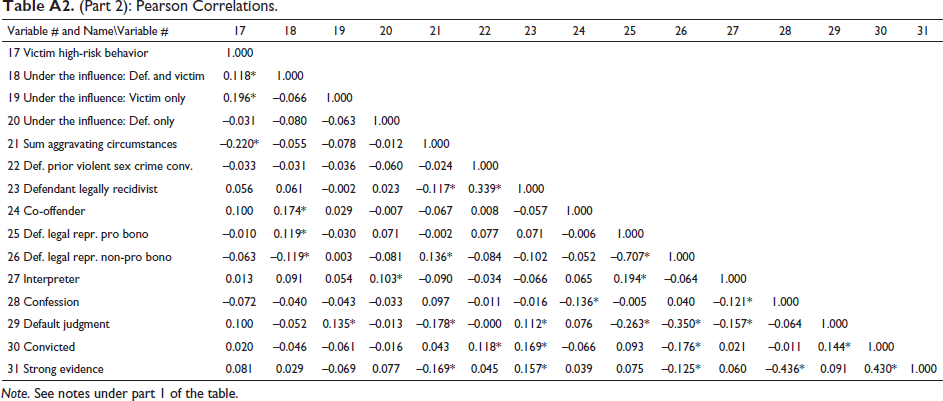
| Variable # and Name\Variable # | 17 | 18 | 19 | 20 | 21 | 22 | 23 | 24 | 25 | 26 | 27 | 28 | 29 | 30 | 31 |
| 17 Victim high-risk behavior | 1.000 | ||||||||||||||
| 18 Under the influence: Def. and victim | 0.118* | 1.000 | |||||||||||||
| 19 Under the influence: Victim only | 0.196* | –0.066 | 1.000 | ||||||||||||
| 20 Under the influence: Def. only | –0.031 | –0.080 | –0.063 | 1.000 | |||||||||||
| 21 Sum aggravating circumstances | –0.220* | –0.055 | –0.078 | –0.012 | 1.000 | ||||||||||
| 22 Def. prior violent sex crime conv. | –0.033 | –0.031 | –0.036 | –0.060 | –0.024 | 1.000 | |||||||||
| 23 Defendant legally recidivist | 0.056 | 0.061 | –0.002 | 0.023 | –0.117* | 0.339* | 1.000 | ||||||||
| 24 Co-offender | 0.100 | 0.174* | 0.029 | –0.007 | –0.067 | 0.008 | –0.057 | 1.000 | |||||||
| 25 Def. legal repr. pro bono | –0.010 | 0.119* | –0.030 | 0.071 | –0.002 | 0.077 | 0.071 | –0.006 | 1.000 | ||||||
| 26 Def. legal repr. non-pro bono | –0.063 | –0.119* | 0.003 | –0.081 | 0.136* | –0.084 | –0.102 | –0.052 | –0.707* | 1.000 | |||||
| 27 Interpreter | 0.013 | 0.091 | 0.054 | 0.103* | –0.090 | –0.034 | –0.066 | 0.065 | 0.194* | –0.064 | 1.000 | ||||
| 28 Confession | –0.072 | –0.040 | –0.043 | –0.033 | 0.097 | –0.011 | –0.016 | –0.136* | –0.005 | 0.040 | –0.121* | 1.000 | |||
| 29 Default judgment | 0.100 | –0.052 | 0.135* | –0.013 | –0.178* | –0.000 | 0.112* | 0.076 | –0.263* | –0.350* | –0.157* | –0.064 | 1.000 | ||
| 30 Convicted | 0.020 | –0.046 | –0.061 | –0.016 | 0.043 | 0.118* | 0.169* | –0.066 | 0.093 | –0.176* | 0.021 | –0.011 | 0.144* | 1.000 | |
| 31 Strong evidence | 0.081 | 0.029 | –0.069 | 0.077 | –0.169* | 0.045 | 0.157* | 0.039 | 0.075 | –0.125* | 0.060 | –0.436* | 0.091 | 0.430* | 1.000 |
Note. See notes under part 1 of the table.
Acknowledgments
The authors are grateful to the staff of the applicable court of general jurisdiction for having facilitated this research project. Two anonymous reviewers and the editor Jon Conte provided helpful comments and suggestions on an earlier version of this article.
Author’s Note
Availability of data and code: The court data used to generate the findings in this study are confidential and are not publicly available. The custom code produced to generate the findings of this study is available on reasonable request from the corresponding author.
Declaration of Conflicting Interests
The author(s) declared no potential conflicts of interest with respect to the research, authorship, and/or publication of this article.
Funding
The author(s) received no financial support for the research, authorship, and/or publication of this article.
