



Abstract
Violence against women is a form of gender violence, and the lethal aspect of it, defined as femicide, is a global health and human rights problem.
This study looked at 330 cases of femicide that occurred in North West Italy, between 1970 and 2020, committed by 303 male perpetrators. The victims included women who were prostitutes and those who were not.
Findings show that only a small proportion of femicide occurs within an anonymous setting: Victims were mostly killed by a man they knew. The type and intensity of the relationship was likely to affect how the violence occurred. In those cases in which victims and perpetrators had an intimate relationship, the risk of overkill, that is, an excessive use of violence that goes further than what is necessary to cause death, was four times higher in comparison with the murder of unknown victims. As with non-prostitutes, the risk of overkill was almost fourfold for those prostitutes who knew their perpetrators. Furthermore, when comparing prostitutes with any unknown victims, the risk of being overkilled was almost five times higher for the former, suggesting that prostitutes are more at risk of being murdered with excessive violence. In addition, prostitutes were more likely to be victims of sexual murder, postmortem mutilation, and being killed by men who had previous criminal records.
Women who are victims of violence are not a homogeneous group, although some of the psychosocial correlates are the same and relevance should be given to the features behind the type, intensity, and nature of the relationship between prostitutes and non-prostitutes and their perpetrators. These variables are what make violence against women a preventable problem.
According to the World Health Organization (WHO, 2017), violence against women is a form of gender violence, and a major public health problem affecting 15–71% of reproductive-aged women worldwide over their lifetime (Garcia-Moreno et al., 2006).
Violence against women is a stable and systematic pattern of emotionally, psychologically, and physically charged events that can escalate in frequency, variety, and severity of violence (Garcia-Moreno et al., 2013; Jung & Stewart, 2019; Marks et al., 2020). At times, the victims are at serious risk for their lives (Gino et al., 2019; Matias et al., 2020). Research suggests that femicide (Russell & Harmes, 2001) takes different forms depending on whether victims and perpetrators know each other, or not. According to some scholars (Dawson & Gartner, 1998; Zara et al., 2019) only a small proportion of femicide occurs within an anonymous setting, and women are often abused and killed by a man they know (Zara & Gino, 2018).
Stöckl and colleagues (2013) carried out a global prevalence study using data obtained for 66 countries. Their systematic review shows that overall 13.5% of homicides were committed by an intimate partner. It is interesting to see that this proportion was six times higher for female homicides than for male homicides. Specifically, median percentages for female intimate partner homicide were highest in high-income countries (41.2%) and in Southeast Asia (58.8%). Interpretations of their data suggest that at least one in seven homicides globally, and more than a third of female homicides, are perpetrated by an intimate partner. Such violence commonly represents the culmination of a long history of abuse.
A global study on gender-related killing of women and girls carried out by the United Nations Office on Drugs and Crime (2018) has indicated that the global rate of female total homicide in 2017 was estimated to be 2.3 per 100,000 female population. Looking at types of relationships, findings show that the global female femicide rate of a known perpetrator (intimate partner and family-related member) was 1.3, while the femicide rate of an intimate partner was estimated at 0.8 per 100,000 female population. Exploring the differences in the proportion of women versus men killed by an intimate partner, the report indicated, that approximately 82% of women versus 18% of male victims were killed by an intimate partner.
Researchers have made some attempts at exploring who these intimate violence perpetrators are, and how they differ depending on their relationships with their victims. Holtzworth-Munroe and Stuart (1994) presented a typology of intimate violence perpetrators: The family-only perpetrators who were violent only against family members; the generally violent and antisocial perpetrators, who exhibited severe physical, sexual, and other forms of violence both within the family context and also outside towards friends, acquaintances, strangers, and prostitutes. Dobash and Dobash (2015) explored the profile of intimate partner homicide offenders and concluded that men who killed their intimate partners were less likely to be antisocial and less likely to be involved in a criminal career in comparison with those who killed strangers and prostitutes.
Despite the growing scientific interest in specifically studying violence against prostitutes (e.g., Canter et al., 2016; Farley, 2004a, 2004b; Lowman, 2000; Quinet, 2011; Sorochinski & Salfati, 2019), it still remains an under-explored topic and is often disregarded in national and global agendas for preventing violence (Deering et al., 2014). Violence against prostitutes offers an opportunity to explore violence against women by comparing different types of violence and the dynamics of killing, and different risk settings where violence can lead to murder. This includes the consideration of contextual factors such as (a) whether the man and the woman did not have any previous link apart from the one-time professional sex exchange for money (e.g., first time client), (b) did have a professional long-lasting connection (e.g., he was the protector or a habitual client), and (c) did have an intimate or an affective relationship (e.g., he was a partner).
In Northwest Italy, few studies have considered these contextual factors with regard to violence perpetrated against prostitutes compared with that perpetrated against non-prostitutes. Such a specific focus will permit comparisons to be made with findings from a study carried out in the UK (e.g., Salfati et al., 2008). Our approach will allow for a more comprehensive analysis and will investigate the differences between prostitutes and non-prostitutes based on whether there was an intimate relationship between the victim and perpetrator compared with those cases in which the victim was not familiar or was unknown.
Violence Against Prostitutes and Non-Prostitutes
A vast array of studies provide evidence on those significant conditions in which violence against women occurs. Among them, traumatic bonding and emotional dependency (Dutton & Painter, 1981), pathological relationships (Zara et al., 2019), attachment pathology (Meloy, 1992), and a context of pervasive domination and control (Farley, 2004b; Malik & Lindhal, 2006) are the most recurrent and those requiring specialized scientific attention. These conditions are, in fact, especially relevant for disentangling the criminogenic factors behind violence against prostitutes and non-prostitutes that reify a justification for violence against women and sustain the idea that prostitutes are at their client’s disposal (Salfati et al., 2008). This is part of the so-called “prostitute imaginary”.1
The term ‘prostitute’ still conveys a dirty meaning (Addley, 2006), and it is not unusual for women, who do not sell sex, to be called prostitutes as a means to degrade their womanhood and their humanness, and taint their freedom and independence.
According to this view, violence against prostitutes becomes the best setting to explore directly gender disparity (Jovanovski & Tyler, 2018) and objectification (Coy, 2008). Like any other type of violence, violence against prostitutes takes different forms (Carvalho Moreira & de Souza Monteiro, 2012): slavery and exploitation, physical injuries, forced pregnancy (Deisher et al., 1989), along with the risk of sexually transmitted diseases (Ulibarri et al., 2010), and the risk of severe violence and sexual homicide (Horan & Beauregard, 2018). It has been estimated that three-quarters of prostitutes experience human rights violations at least once in their life (Evens et al., 2019). Besides the high levels of victimization, prostitutes are also exposed to institutional neglect and disinterest (Evens et al., 2019). Their disappearance is less likely to be reported (Horan & Beauregard, 2018) and witnesses are less willing to share information with the police (Levi-Minzi & Shields, 2007).
Previous Research
Scientific evidence about the differential levels of risk is concordant: Violence is considered such a frequent occurrence among street prostitutes (Amogne et al., 2019) that they report expecting it to happen at some point in time (Bisschop et al., 2017; Dalla et al., 2003).
In several countries, prostitutes who meet clients outdoors are 6 times more at risk of violence than those who work indoors (Deering et al., 2014). Additionally, those who solicit on the street are at higher risk of being victims of violence than those who work indoors (Raphael & Shapiro, 2004), and more at risk of being murdered (Lowman & Fraser, 1995). This risk seems to be higher also for these victims in those countries where there is intense campaigning to raise awareness of the safety of sex work (Kinnell, 2008).
Campbell and colleagues (2019) argued that the increased risk of violence against prostitutes is influenced by the illegality of sex work and its unsafe conditions, while other studies counter-argued that it is the condition of prostitution per se that is detrimental for the safety of women (Potterat et al., 2004) and their mental health (Brody et al., 2005), regardless of its status (legal, illegal or decriminalized) or its physical location (escort/home, street, etc.; Farley, 2004b).
Farley and colleagues (1998) interviewed 475 sex workers from different countries (South Africa, Thailand, Turkey, USA, and Zambia) and investigated effects of race, and whether the person was prostituted on the street or in a brothel. They found significantly more physical violence in street, as opposed to brothel prostitution. However, there was no difference in the incidence of post-traumatic stress disorder (PTSD) in these two types of prostitution: 67% of them met the criteria for a PTSD diagnosis according to the DSM-IV (1994). There was no distinction between those from different cultures or countries in the level of psychological distress experienced.
Rössler and colleagues (2010) showed that prostitutes in their study displayed high rates of mental disorders that were primarily related to the different forms of violence these women endured. A study conducted with 96 female indoor prostitutes in the Netherlands (Vanwesenbeeck, 2005) explored the three-dimensional level of burnout (emotional exhaustion, depersonalization, and personal competence) among this population. Depersonalization, that is, a cold, indifferent, and cynical attitude, was significantly higher among indoor prostitutes in comparison with that of female nurses and with a comparable group of work-related psychological problems’ patients. Some of the variance in depersonalization (42%) was explained by experiences of violence, lack of control in interacting with clients, not working by choice, and negative social reactions.
International literature suggests that some forms of dissociative mechanisms, described by Vanwesenbeeck (2005) as dissociative proficiency, are compensative responses that make it possible for many women to work as prostitutes, and endure the offensive and violent attitudes and behavior of their clients. Precipitating factors such as arguments over the payment or service (e.g., the sex act finishing before the man had reached orgasm), defensive reactions of the victims against an attempted robbery by their clients, a real or perceived humiliation or mockery from the prostitute (e.g., for a failure to get an erection) or the client’s misogyny, or sadism, may count for some of the triggers behind the motive for killing (Chan & Beauregard, 2019).
Salfati and colleagues (2008) carried out a study on prostitute femicides that occurred in the UK, and used data from three homicide datasets (Home Office, Hillary Kinnel Press Reports, and Police Forces). Demographic characteristics of perpetrators, crime scenes and types of violent dynamics were analyzed and differentiated by victims (e.g., prostitutes and non-prostitutes) and compared with femicide offenders in general. Prostitutes who had higher incidences of risk factors (e.g., drug or substance abuse, being homeless, living rough, and working for a pimp or for her partner) were more vulnerable to attacks in comparison with the general prostitute population (Salfati et al., 2008). Moreover, prostitute femicide offenders were more aggressive than other femicide offenders. Perpetrators of prostitute femicides had previous convictions especially for violent offenses. Prostitutes often became the primary target of serial homicides (Lee & Reid, 2018; Quinet, 2011; Salfati et al., 2008), which were mostly characterized by extreme forms of violence (e.g., foreign object penetration, post-mortem mutilation, and other fetish practices) (Morton et al., 2014).
These findings indicate that notwithstanding that the vast majority of femicides against prostitutes are occupation-related (Cunningham et al., 2018), other aspects need to be taken into account when studying violence against them. Some prostitutes are killed by friends, partners, or family members (Cunningham & Sanders, 2017) or by men with whom they had an intimate relationship (Ulibarri et al., 2018), suggesting that the dysfunctional or pathological aspects of the relationship played a significant role in the violence.
More research and structural interventions are necessary to shed light on the criminogenic factors behind the reality of violence against women, in general, and against prostitutes in particular (Loinaz et al., 2018). In fact, the demonstrated heterogeneity of perpetrators (Cavanaugh & Gelles, 2005; Marcus & Swett, 2002) suggests that there may be differences in types of perpetrators and, consequently, in the frequency, variety, and severity of the violence.
This Study
This study examines cases of femicide, which occurred in Northwest Italy, specifically in Turin and the metropolitan area of about 1,000,000 inhabitants, between 1970 and the first three months of 2020. The aim of this study is twofold: First, to analyze femicides that involve prostitutes and non-prostitutes. Second, to explore differences between violence perpetrated against those prostitutes in an intimate relationship with their killer and those who were not involved in any relationship with their killer.
Specifically, we asked the following questions:
Does the intensity of violence differ when the perpetrator is an unknown or acquaintance or intimate person? Does the type of relationship between the victims and perpetrator contribute to excessive violence such as overkill? Does violence against prostitutes and non-prostitutes differ in kind or in intensity?
Method
Data Collection and Information for the Study
The data were collected at both the Institute of Legal Medicine and the Archive of the Morgue of Turin. All data were anonymized and made unidentifiable; data were also numerically coded for statistical purposes. The research was approved by the Bioethics Committee of the University of Turin (protocol nr. 191414/2018).2
Cases of natural death or suicide were excluded. The first phase of the study consisted in identifying the victims of femicide, while in a second phase information about age, profession, previous involvements in violence or criminality, dynamics of the aggression, and types of relationships between perpetrators and victims were gathered. Information on injuries and causes of death, included in the written reports of coroners, was collected. Forensic files from the Criminal Court were also examined, along with files from the archive of the medical experts who assessed the cases.
Variables
All information collected was classified according to the following dimensions: temporal trends and locations of the femicide, age, nationality and occupation of victims and perpetrators, medico-legal aspects of the murder (e.g., weapons used, location of deadly injuries on the body, defense wounds, evidence of sexual behavior, post-mortem mutilation/dismemberment), motives for killing. Types, intensity, and duration of the relationship between the victim and perpetrator provided researchers with information to differentiate between intimate partner femicide and non-intimate partner femicide.
Dimensions relevant in the assessment of violence against women were as follows:
Contentiousness: The presence of frequent rows, emotional tension or conflicts, frequent experiences of break ups, and any violent incidents that occurred previously as recorded in the forensic files examined. Overkill3: The dynamics of femicide by examining the extent of force or action used to cause death. The presence of post-mortem mutilation or dismembering.
Contentiousness can be assessed only when the victim and perpetrator know each other. It implies the presence of psychological erosive, negative, intense, and enduring emotional strain between people in a relationship (Birkley & Eckhardt, 2015).
The definition of overkill employed in this study was bound to the excessiveness of violence, of amount or severity of wounds, and of trauma beyond that necessary to cause death.
According to Zerbo and colleagues (2018), post-mortem mutilation/dismemberment is defined as fragmenting the corpse, severing the limbs, mutilating a part of the body and/or cutting the body into small pieces after killing the victim. Regarding motives for killing, two macro-categories were developed according to the typologies available in literature that distinguish multi-problematic relationships (Johnson, 2008), and predatory motives and antisociality (Petersson et al., 2019).
Two independent raters carried out the categorization of data into the assessment of contentiousness, overkill, post-mortem mutilation/dismembering, and motives of crime. Separate variables were created to indicate the presence (coded as 1) or absence (coded as 0) of assessed dimensions in each case. When a discrepancy emerged, the two independent raters discussed the case with the research group, and re-assessed it, until a better level of agreement was reached. The Cohen’s Kappa statistic (Cohen, 1960) provides a measure of agreement between raters that takes into account chance levels of agreement, and it is appropriate for this type of data. The levels of agreement for the category of ‘contentiousness’ (Cohen’s K was 0.97, p < .0001), for the category ‘overkill’ (Cohen’s K was 0.93, p < .0001), for the category of ‘post-mortem mutilation/dismembering’ (Cohen’s K was 0.94, p < .0001), for the category ‘motives of crime’ (Cohen’s K was 0.94, p = .0001), suggest a substantial inter-rater agreement coefficient for all of these variables (McHugh, 2012; Viera & Garrett, 2005).
Sample
The whole sample consisted of 330 victims of femicide; their average age was 44.31 years (SD = 20.67). 83.0% (n = 274) of the victims were Italians, while 17% (n = 56) were foreigners. Perpetrators were 303: 288 of them (95%) had only killed one victim, while 15 perpetrators (5%) killed at least two victims in distinct episodes; there were five cases of serial murders each with at least three victims. The average age of the perpetrators was 42.88 (SD = 16.97). Overall, 26.4% (n = 84) of the perpetrators had previous official criminal records. Table 1 synthesizes the characteristics of the sample.
Sample Description
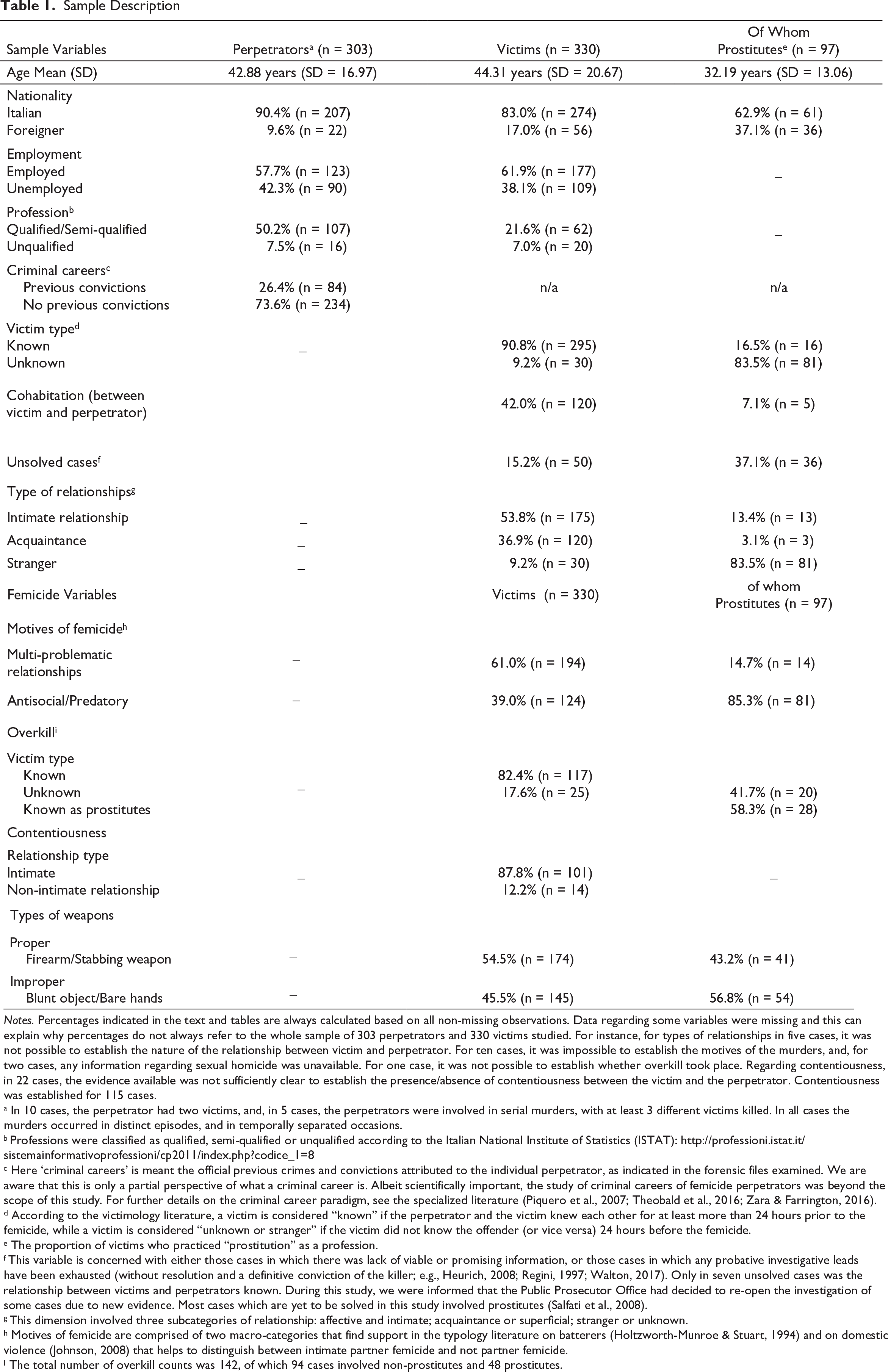
Notes. Percentages indicated in the text and tables are always calculated based on all non-missing observations. Data regarding some variables were missing and this can explain why percentages do not always refer to the whole sample of 303 perpetrators and 330 victims studied. For instance, for types of relationships in five cases, it was not possible to establish the nature of the relationship between victim and perpetrator. For ten cases, it was impossible to establish the motives of the murders, and, for two cases, any information regarding sexual homicide was unavailable. For one case, it was not possible to establish whether overkill took place. Regarding contentiousness, in 22 cases, the evidence available was not sufficiently clear to establish the presence/absence of contentiousness between the victim and the perpetrator. Contentiousness was established for 115 cases.
a In 10 cases, the perpetrator had two victims, and, in 5 cases, the perpetrators were involved in serial murders, with at least 3 different victims killed. In all cases the murders occurred in distinct episodes, and in temporally separated occasions.
b Professions were classified as qualified, semi-qualified or unqualified according to the Italian National Institute of Statistics (ISTAT):
c Here ‘criminal careers’ is meant the official previous crimes and convictions attributed to the individual perpetrator, as indicated in the forensic files examined. We are aware that this is only a partial perspective of what a criminal career is. Albeit scientifically important, the study of criminal careers of femicide perpetrators was beyond the scope of this study. For further details on the criminal career paradigm, see the specialized literature (Piquero et al., 2007; Theobald et al., 2016; Zara & Farrington, 2016).
d According to the victimology literature, a victim is considered “known” if the perpetrator and the victim knew each other for at least more than 24 hours prior to the femicide, while a victim is considered “unknown or stranger” if the victim did not know the offender (or vice versa) 24 hours before the femicide.
e The proportion of victims who practiced “prostitution” as a profession.
f This variable is concerned with either those cases in which there was lack of viable or promising information, or those cases in which any probative investigative leads have been exhausted (without resolution and a definitive conviction of the killer; e.g., Heurich, 2008; Regini, 1997; Walton, 2017). Only in seven unsolved cases was the relationship between victims and perpetrators known. During this study, we were informed that the Public Prosecutor Office had decided to re-open the investigation of some cases due to new evidence. Most cases which are yet to be solved in this study involved prostitutes (Salfati et al., 2008).
g This dimension involved three subcategories of relationship: affective and intimate; acquaintance or superficial; stranger or unknown.
h Motives of femicide are comprised of two macro-categories that find support in the typology literature on batterers (Holtzworth-Munroe & Stuart, 1994) and on domestic violence (Johnson, 2008) that helps to distinguish between intimate partner femicide and not partner femicide.
I The total number of overkill counts was 142, of which 94 cases involved non-prostitutes and 48 prostitutes.
Analytical Strategy
Descriptive analyses with Odds Ratio (OR) were carried out to explore characteristics of the sample involved. The OR was calculated to identify which factors significantly and independently explained motives for killing, and which other factors predicted the dynamic for overkill. Also explored was whether contentiousness, among known victims, was a significant variable affecting the likelihood of intimate partner femicide. The OR provides information about the existence, direction, and strength of an association between target and comparison groups regarding the likelihood of an event occurring (Farrington & Loeber, 2000). When ORs are higher than 1, situations characterized by that particular attribute have relatively higher odds of occurring than those that do not have that attribute (Zara & Farrington, 2020).
Logistic regression analyses were conducted to investigate overkill.
Results
Violence Against Women in Northwest Italy
This study explored violence against women (prostitutes and non-prostitutes) in Northwest Italy, and its escalation into femicide, depending on the types of relationships involved between the victim and the perpetrator (unknown versus known; acquaintance versus intimate).
These findings show that most of the victims were killed by a man they knew (90.8%; n = 295) compared with those killed by a complete stranger (9.2%; n = 30). In those cases in which there was either an intimate (53.8%; n = 175) or an acquaintance (36.9%; n = 120) relationship, the relationship lasted on average 13.71 years (SD = 13.77).
Does the intensity of violence differ when the perpetrator is an unknown, or acquaintance or intimate person?
Contentiousness between known victims and perpetrators was present in 40.4% of the cases (n = 115) in which there was a form of relationship. When exploring the intensity of violence, it was found that when the relationship was intimate, contentiousness was present in 87.8% (n = 101) of the cases versus 12.2% (n = 14) of the cases in which the relationship was between acquaintances (OR = 8.66; 95% CI = 4.53–16.56).
Does the type of relationship between the victims and perpetrator contribute to excessive violence such as overkill?
Findings suggest that, considering the whole sample, overkill occurred in 43.2% of cases (n = 142). As expected, when the victims knew their perpetrators (46.1%; n = 136) the risk of overkill was nearly four times higher in comparison with the risk posed by unknown perpetrators (16.7%; n = 5) (OR = 4.28; 95% CI = 1.59–11.48). Specifically, overkill seemed to occur more frequently when the relationship between victim and perpetrator was contentious and emotionally tense (53.9%; n = 62) compared with non-contentious relationships (35.3%; n = 60) (OR = 2.15; 95% CI = 1.32–3.48).
Motives that triggered intimate partner femicide and overkill.
Depending on whether the victims knew their perpetrators, and on the types of relationships, the motives behind the killings were multi-problematic relationships (61.0%; n = 194), and antisocial or predatory (39.0%; n = 124) (see Table 1 for details).
Victims were killed mostly by being struck on the head (55.0%; n = 171), on the trunk (20.9%; n = 25) or both (24.1%; n = 75), with a proper weapon (e.g., firearms or stabbing weapons) (54.5%; n = 174), in their own home or in the perpetrator’s home (65.7%; n = 213). The majority of the victims did not make any defense attempts (55.3%; n = 119) in order to save their lives, suggesting perhaps that the perpetrator acted unexpectedly. In 5.5% (n = 18) of the cases some forms of post-mortem mutilation took place.
Predicting overkill.
The above analyses indicate that femicide seems more likely to occur when the victim knew her perpetrator, and that the types of relationship may have served as potential predictors of how the victims were killed. A series of logistic regression analyses was conducted to test these variables in predicting who was more likely to be overkilled. The model included types of relationships between victims and perpetrators (known and unknown victims), intensity of the relationship (intimate versus familiar), contentiousness in the relationship, and motives of killing (multi-problematic relationships and predatory and antisocial motives). The results showed (see Table 2) that the intensity of the relationship and contentiousness were significant predictors, while motives were not. Overall being in an intimate relationship with the perpetrator (β = –.800, p = .009), and contentiousness and emotional tension in the relationship (β = .960, p = .001) played a significant role in the excess of violence acted out to overkill. The overall model was significant, χ (df = 2) = 12.624, p = .002.
Logistic Regressions Predicting Overkill in Intimate Partner Femicide.
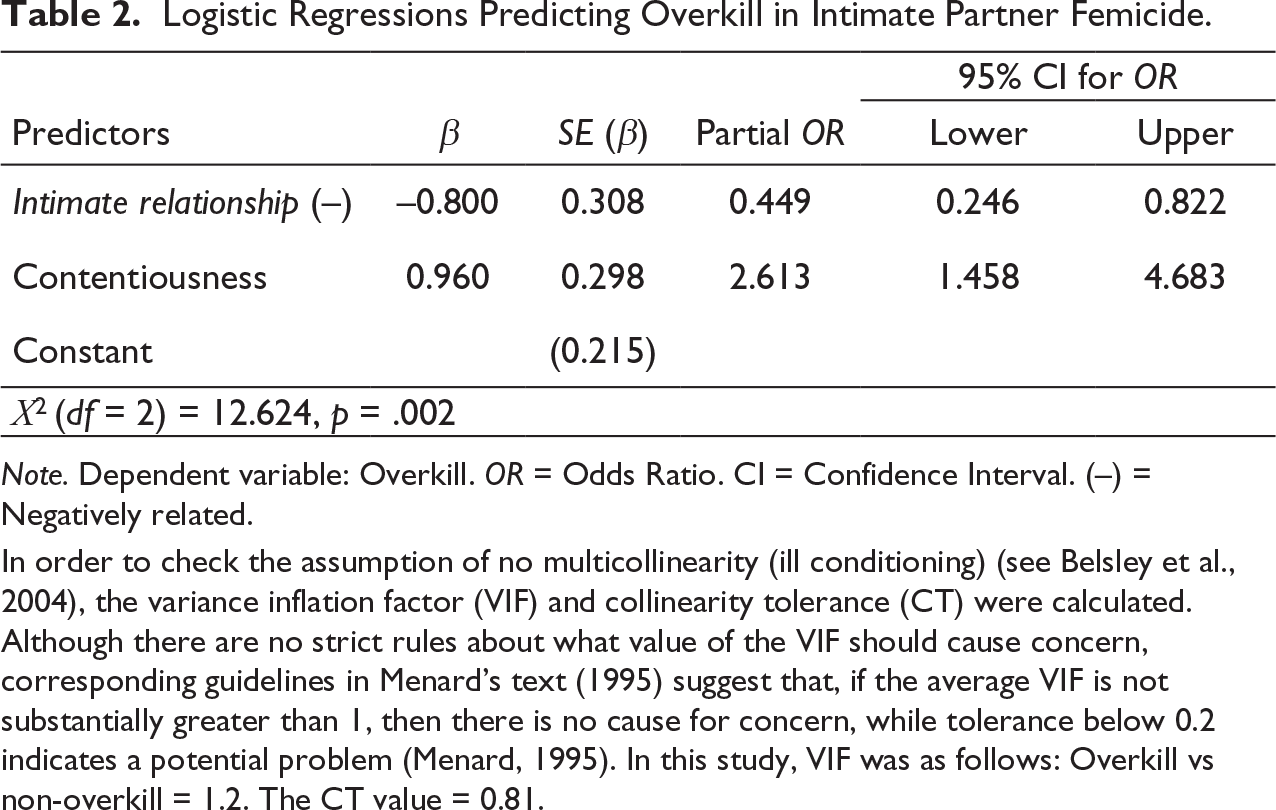
Note. Dependent variable: Overkill. OR = Odds Ratio. CI = Confidence Interval. (–) = Negatively related.
In order to check the assumption of no multicollinearity (ill conditioning) (see Belsley et al., 2004), the variance inflation factor (VIF) and collinearity tolerance (CT) were calculated. Although there are no strict rules about what value of the VIF should cause concern, corresponding guidelines in Menard’s text (1995) suggest that, if the average VIF is not substantially greater than 1, then there is no cause for concern, while tolerance below 0.2 indicates a potential problem (Menard, 1995). In this study, VIF was as follows: Overkill vs non-overkill = 1.2. The CT value = 0.81.
Violence against prostitutes.
Ninety-seven prostitutes were a subgroup of the whole sample. Prostitutes were more likely to be killed (75.3%; n = 61) at night in comparison with non-prostitutes (48.1%; n = 102) (OR = 0.304; 95% CI = 0.172–0.539). In 49.5% (n = 48) of cases overkill occurred.
In 83.5% (n = 81) of the cases, prostitutes and perpetrators did not know each other. In 16.5% of the cases (n = 16), they knew each other beyond the professional service, and, in 13 cases (13.4%), there was an intimate and affective relationship between them. Prostitutes (34%; n = 33) were more likely to be killed by a man who had previous criminal records in comparison with non-prostitutes victims (23.4%; n = 51) (OR = 1.69; 95% CI = 1.00–2.85).
Does violence against prostitutes and non-prostitutes differ in kind or in intensity?
The risk of being overkilled was almost fourfold for those prostitutes who knew their perpetrators (58.3%; n = 28), in comparison with those who did not know (41.7%; n = 20) (OR = 3.50; 95% CI = 1.50–8.15). When comparing prostitutes (49.5%; n = 48) with non-prostitutes (40.9%; n = 94) the risk of overkill was higher for the former, though it was only near to significance (OR = 1.42; 95% CI = 0.880–2.28). However, when comparing prostitutes (48.9%; n = 45) with any unknown victims (16.7%; n = 5) the risk of overkill was almost five times higher for those victims known as prostitutes (OR = 4.79; 95% CI = 1.69–13.59).
According to the forensic pathology examination, sexual femicides were more frequent in the case of prostitutes (70.1%; n = 68) rather than non-prostitutes (6.5%; n = 15) (OR = 33.61; 95% CI = 17.02–66.37). Furthermore, it was found that a sexual femicide occurred more often when the prostitute (81.8%; n = 45) did not know her perpetrator rather than when she knew him (54.8%; n = 23) (OR = 0.27; 95% CI = 0.11–0.67).
Motives behind violence against prostitutes.
The likelihood for prostitutes being killed for predatory or antisocial motives (65.3%; n = 81) was 24 times higher than for non-prostitutes (34.7%; n = 43) (OR = 24.22; 95% CI = 12.55–46.75).
Prostitutes were more likely to be killed with an improper weapon (e.g., blunt objects or bare hands; 56.8%; n = 54), with the perpetrator injuring multiple parts of the victim’s body (55.7%; n = 44). In 64.8% of the cases (n = 57), the head was the part mostly injured, followed by the trunk (11.4%; n = 10); in 23.9% of the cases (n = 21), both areas were injured. The coronary reports indicated that during the attack prostitutes had strenuously fought to save their lives (61.2%; n = 30). Furthermore, 73.7% (n = 70) of prostitutes were killed in a car or a secluded public space. The risk of post-mortem mutilation was almost seven times higher for prostitutes (72.2%; n = 13) in comparison with non-prostitutes (27.8%; n = 5; OR = 6.97; 95% CI = 2.41–20.13).
Predicting the killing of prostitutes.
Prostitutes were more likely to be killed for predatory or antisocial motives, and by perpetrators who had previous criminal records. A series of logistic regression analyses was carried out to test these predictors. The model tested included criminal career of the perpetrators, type of relationship (known and unknown victims), nature of the relationship (affective/intimate or professional), sexual evidence of the femicide, and motives of killing (multi-problematic relationships and predatory and antisocial motives). The results showed (see Table 3) that only the type of relationship (affective/intimate versus unknown) was a significant predictor of enduring overkill, while the others were not. Overall, the condition of being a prostitute and knowing the perpetrator played a significant role in the escalation of violence into overkill (β = 1.3958, p = .044). The overall model was significant, χ (df = 1) = 4.729, p = .030.
Logistic Regressions Predicting Overkill in Prostitute Femicide.

Note. Dependent variable: Overkill. OR = Odds Ratio. CI = Confidence Interval.
In order to check the assumption of no multicollinearity (ill conditioning) (see Belsley et al., 2004), VIF and CT were calculated. Although there are no strict rules about what value of the VIF should cause concern, corresponding guidelines in Menard’s text (1995) suggest that, if the average VIF is not substantially greater than 1, then there is no cause for concern, while tolerance below 0.2 indicates a potential problem (Menard, 1995). In this study, VIF was as follows: Overkill vs non-overkill = 1.00. The CT value = 1.00.
Discussion
This study investigated the extent to which violence occurred against women in Northwest Italy, between 1970 and 2020. The focus was to explore to what extent the types of relationships between the victim and perpetrator made a difference in how women were killed.
Studying prostitutes allowed for an investigation of psychosocial variables that seemed to be related to how women are perceived, and how they become the target of violence. Although further studies are needed to support these results, the initial findings allow us to make some tentative suggestions regarding factors that play a significant role in killing prostitutes and non-prostitutes.
Do our results allow some preliminary considerations for violence against prostitutes and violence against non-prostitutes?
Violence against women did not occur in an anonymous setting. Consistent with other studies (Proulx et al., 2018), most prostitutes were killed by a man they did not know or by a client, and the motives for the killing were likely to be antisocial ones.
Most of the women knew their perpetrators and had a relationship with them, albeit of a different nature. Intimate partner violence was triggered by a dysfunctional relationship, in which the intensity (e.g., contentiousness between partners) and the type of the relationship (e.g., acquaintance versus intimate) contributed to the escalation of pervasive violence into femicide (see Table 1 for details).
Sexual homicide is the intentional killing of a person during which there is sexual behavior by the perpetrator (Meloy, 2000, p. 2). In line with previous studies (Salfati et al., 2008), sexual femicide occurred more against prostitutes than non-prostitutes, and when victims and perpetrators did not know each other. These findings are, however, preliminary and based only on information available in the forensic pathology reports. A more complete understanding of the sexual and non-sexual nature of violence against prostitutes could be achieved by getting direct access to surviving victims, and being allowed to interview them.
Most non-prostitutes were killed because of multi-problematic relationships; a result that is supported by research (see Meloy, 1997) that look at the relational pathology between partners as a crucial factor in intimate violence. Relational pathology is likely to be influenced by the level of emotions and affection involved, and proportional to the length of the dysfunctional duration of the relationship (see Table 2).
Was overkill more likely to occur depending on whether the victim and the perpetrator knew each other?
As expected, and in line with previous studies (Zara et al., 2019), overkill was significantly higher among known victims. Precisely, overkill was positively and strongly related to the types of relationship between victims and perpetrators: Intimate victims were more likely to experience overkill. Such violence seems to represent the culmination of a long history of abuse (Dobash & Dobash, 2015). Strategies to reduce femicide risk should include investment in intimate partner violence prevention, risk assessments, and mostly in informative campaigns that aim at supporting women who are most often exposed to violence, institutional neglect, and social disregard.
Our results show that there might be more of a difference in intensity rather than in kind. First, we looked at those cases in which the prostitute knew her killer. Many psychosocial variables involved in the violent dynamic against prostitutes were the same as identified in violence against women. Some interesting results emerged when the perpetrator knew the prostitute and had a relationship with her. Also for prostitutes, overkill was the prevalent form of receiving violence, especially when they knew their killer (see Table 3).
Second, we looked at those cases in which prostitutes were compared with any unknown victims. If on the one hand prostitutes are more at risk for being the target of violence because they belong to a marginalized group and are over-exposed to criminal and illegal contacts, the impact of prostitution imaginary upon the likelihood of violence cannot be discounted when trying to understand violence against women in a broader sense. Prostitution imaginary elicits biased and distorted beliefs (e.g., a woman as a commodity; Coy, 2008), which often worsens the violence: A combination of externalized anger and targeted destructiveness (Slezak, 2017).
Violence against prostitutes seems to be fueled by high emotionality, angry rumination, vindictive rage, and schema, and an excessively aggressive response style (Meloy, 1997). Five perpetrators involved in the study were serial killers (3–9 victims), and some of them verbalized offensive and misogynist comments against their victims when asked to give their versions of their killings. One of the perpetrators confessed that he preferably looked for ugly, fat, old, and southern prostitutes who resembled his stepmother, who he deeply hated. In his own words, he defined prostitutes as “[…] animals; they are only women, and I wanted to do some sort of clearance […].”
While there is no doubt that identifying the type of offenders with the type of victims is crucial, still more studies are necessary to look at the differences between the violence perpetrated by strangers and the violence perpetrated by known men.
These findings are in line with other studies which show that violence against prostitutes is rooted in the general misconception (Armstrong, 2019) that prostitutes are second-class citizens (Salfati et al., 2008) and that women should act within the social and sexual sphere consented by cultural (Stefanile et al., 2021) and moral expectations (Farley, 2004a).
The struggle against social stigma of prostitutes and the reduction or prevention of negative social reactions toward them should be an additional aim of any policy working to provide prostitutes with structural and legal changes to ensure secure work environments, gender and economic equity (Acquadro Maran, 2020), and especially an easy access to mental and physical health facilities (Goodyear & Cusick, 2007).
By addressing these social and political determinants, it would be possible to provide better-targeted prevention initiatives that are specifically tailored to respond to the differential risks posed by the various forms violence against women takes. These variables are encouraging in so far as they identify what makes violence against women a preventable problem.
Limitations of the Study
These findings should be interpreted in light of the limitations of the study.
All data were retrospective, and it was not possible to gather first-hand information from family members about the quality of the relationship between victim and perpetrator and from perpetrators about the motives behind the killing. The evidence gathered explains only part of the dynamics of the intimate partner violence that fostered the femicide. Furthermore, it was impossible, with these data, to reconstruct exactly whether the violence was mostly unilateral (from man toward woman), and to identify the victimogenic factors that interacted with other factors to escalate into femicide.
It would have been challenging to explore further the dynamics of killing and to look at the differential sexual component of the killing in prostitutes and non-prostitutes. We were unable to explore this aspect further because the information gathered on the sexual nature of femicide were exclusively based on the forensic pathology reports, while access to the family members of the victims or to the offenders was not possible. However, it is unlikely that we would have been able to acquire more specific information about the sexual nature of the relationship between victims and perpetrators, nor of the sexual nature of the femicide. Needless to say that getting in contact with the family members of the victims or perpetrators was beyond the scope of this study. Research findings (Beech et al., 2005; Stefańska et al., 2015) show that deviant sexual and sadistic fantasies are an important factor in the characterization of this subtype of sexual femicide. However, because analyses were based on the information in the files available, it was not possible to assess this aspect in this study. It would have been interesting to explore whether personality and psychopathological factors might have increased the risk of intimate partner violence and the violence against prostitutes, but this analysis could not be carried out because the forensic files did not report any specific information of this kind.
Despite these limitations, this study contributes to understanding the psychosocial factors behind violence against prostitutes in comparison with the violence against non-prostitutes. Whatever the preventive approach, relevance should be given to the features behind the type, intensity, and nature of the relationships between prostitute and non-prostitute victims and their perpetrators. It is by looking not only at the type (known versus unknown) of the relationship but also at the intensity (intimate versus professional versus acquaintance) and quality of it (contentious or pathological) that differential risk assessment can be planned, and differential measures of intervention can be applied (Zara, 2013).
Footnotes
Declaration of Conflicting Interests
Funding
The authors received no financial support for the research, authorship, and/or publication of this article.
