



Abstract
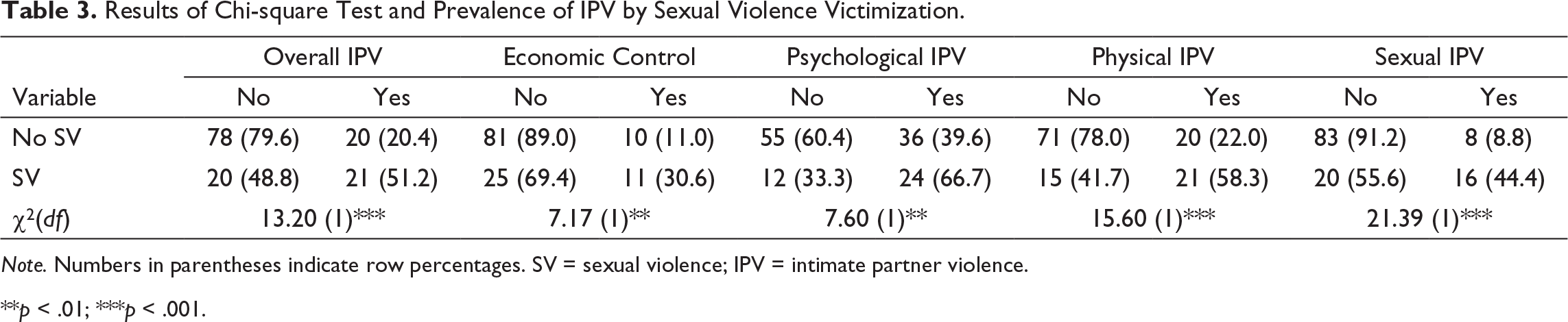
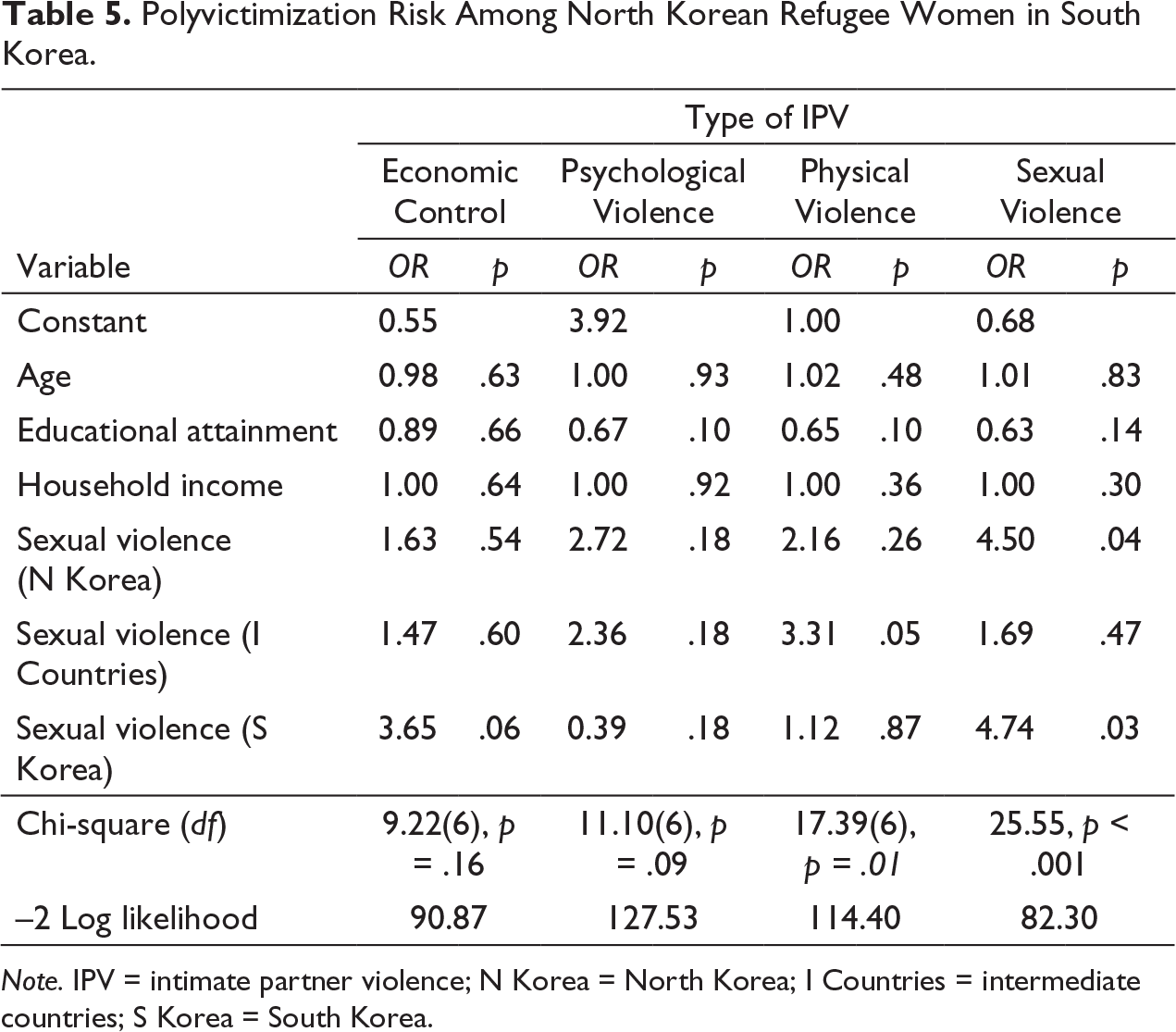
North Korean (NK) refugee women living in South Korea are known to be vulnerable to interpersonal violence, but little is known about the possible link between or co-occurrence of acts of sexual violence (SV) and intimate partner violence (IPV) perpetrated against NK refugee women. This study examined the prevalence of polyvictimization and explored the association between SV in different settings (i.e., North Korea, intermediate countries, and South Korea) and various types of IPV. A convenience sample of 140 adult NK refugee women was analyzed, and logistic regression analyses were conducted to examine the link between SV and polyvictimization in IPV. NK refugee women with a history of SV reported a significantly higher rate of IPV over the previous 12 months (51.2%) compared to those without a history of SV (20.4%). NK refugee women with a history of SV are significantly more likely to become victims of most forms of IPV. SV victimization in intermediate countries significantly increased the odds of being physically victimized by their male partners in South Korea (OR = 3.31, p =.05). An SV victimization history in North Korea (OR = 4.50, p =.04) and SV victimization experienced outside their intimate relationship in South Korea significantly increased the odds of sexual IPV from their current intimate partner (OR = 4.74, p =.03). This study showed that victims of human trafficking and sexual assault during their journey to South Korea were at a greater risk of IPV in South Korea. Male partners of NK refugee women with a history of SV may shame and physically sanction NK refugee women for “breaching honor.” Therefore, screening for potential risk of physical and sexual IPV among NK refugee women with a prior exposure to SV is needed to develop programs in safety planning for NK refugee women experiencing SV and IPV.
Keywords
Introduction
Violence has always been a central component of the flight and resettlement experience for North Korean (NK) refugee women, who represent approximately 75.4% of the NK refugee population in South Korea (Korea Hana Foundation, 2019). In general, NK women have greater mobility than men and are often deceived by traffickers of a better chance at marriage and employment in intermediary countries or South Korea (Kim et al., 2009). Consequently, NK refugee women are at a disproportionally higher risk of gender-based victimization (e.g., sexual violence [SV] and human trafficking) during the defection process, as evidenced in many empirical studies (Kim et al., 2009; Lee, 2011; Yeon, 2018). Most NK refugee women experience some form of victimization or trauma while in North Korea and defecting—the process of illegitimately leaving one’s country to enter another—and, as a result, are likely to suffer severe and persistent physical and psychiatric consequences (Chang et al., 2008; Choi et al., 2017; Lee et al., 2001).
NK women, in particular, are financially and socially more vulnerable than NK men, given the specific circumstances surrounding North Korea, an economically fragile country with a patriarchal society that has strongly embedded gender roles (Chang et al., 2008). In North Korea, women are often victims of both structural (Park, 2012; United Nations Human Rights Council, 2014) and domestic violence (Choo, 2006). Government officials perpetrate SV and enforce their exploitation (Park, 2012) and use physical violence directed against NK women to maintain the country’s regime when needed (Jung & Dalton, 2006). In a NK household, women are seen as subordinate to their husbands; they are expected to fulfill their traditional gender roles and have no legal recourse to address domestic violence (Jung & Dalton, 2006). As a result, approximately 70% of NK women are victims of violence perpetrated by their husbands (Kim, 2011). Even after fleeing from North Korea, NK refugee women remain vulnerable to gender-based victimization. NK women, who are caught while fleeing, are forcibly repatriated and subjected to violence, rape, torture, and detention in concentration camps (Davis, 2006; Ko et al., 2004). Moreover, recent studies have found that many NK refugee women are victims of violence, including intimate partner violence (IPV), even after their resettlement in South Korea. Researchers are increasingly concerned with the increased risk of polyvictimization—exposure to multiple types of victimization—in the form of SV and IPV among NK refugee women. However, previous research on NK refugee women has focused on identifying risk factors of specific kinds of victimization. Little attention has been paid to the possibility of polyvictimization and past victimization elevating the risk of subsequent victimization in different settings.
Most NK refugees travel through intermediary countries (e.g., China, Cambodia, and Vietnam) before entering South Korea (Korea Hana Foundation, 2019). Many NK refugees are likely to reside in intermediary countries as illegal immigrants for at least three years (Chang et al., 2008) before they get an opportunity to move on to South Korea. Although the experience of violence and trauma of refugees while fleeing is universal to some extent (Freedman, 2016; Ward & Vann, 2002), many studies on NK refugees have highlighted the traumatic experiences and the alarmingly high rate of SV during their stay in intermediary countries (Jeon et al., 2008; Lee et al., 2001). In particular, these studies extensively discuss SV and the exploitation of NK refugee women and suggest that a significant proportion of NK refugee women are sexually victimized (Kim et al., 2009; Lee, 2011; Muico, 2005; Yeon, 2018). In China, approximately 80%–90% of NK refugee women are allegedly victims of SV and human trafficking (Human Rights Watch, 2005).
Despite overcoming victimization in intermediary countries, NK refugee women are at risk of other forms of victimization following their arrival in South Korea. A few qualitative studies that have documented the lives of NK refugees after their resettlement suggest that NK refugee women are often the victims of IPV (Cho & Jeon, 2005; Jin & Lee, 2007; Lee, 1999; Lee & Sung, 2001). Additionally, the prevalence of IPV among NK refugee women is significantly higher than its prevalence among South Korean women. According to a nationwide survey on IPV, more than 41% of NK refugee women reported physical IPV victimization, which is 2.5 times higher than its prevalence among South Korean women. To summarize, the high prevalence of IPV among NK refugee women—likely related to their past SV victimization in intermediary countries—suggests that there is a possible link between the two types of violence.
Literature on polyvictimization suggests that multiple victimization is common and victimization risks are intercorrelated (Finkelhor et al., 2007). In other words, being a victim of SV can be a risk factor for subsequent victimization in South Korea (Campbell et al., 2008; Capaldi et al., 2012). One explanation for this association is a patriarchal and Confucius belief system that is strongly embedded in East Asian cultures. NK refugee women who are victims of SV may be stigmatized and shamed by their male partners and thus physically punished for “breaching honor.” However, there has been limited research on the risk of polyvictimization among NK refugee women in South Korea and this requires hypothesis testing.
Current Study
The present study extends the literature on victimization among NK refugee women by examining (a) the prevalence and sociodemographic characteristics of SV and IPV, and (b) the association between exposure to SV in different settings (i.e., North Korea, intermediary countries, and South Korea) and IPV perpetrated by their current intimate partners. We hypothesized that the history of SV is associated with past-year IPV experience.
Method
Sample
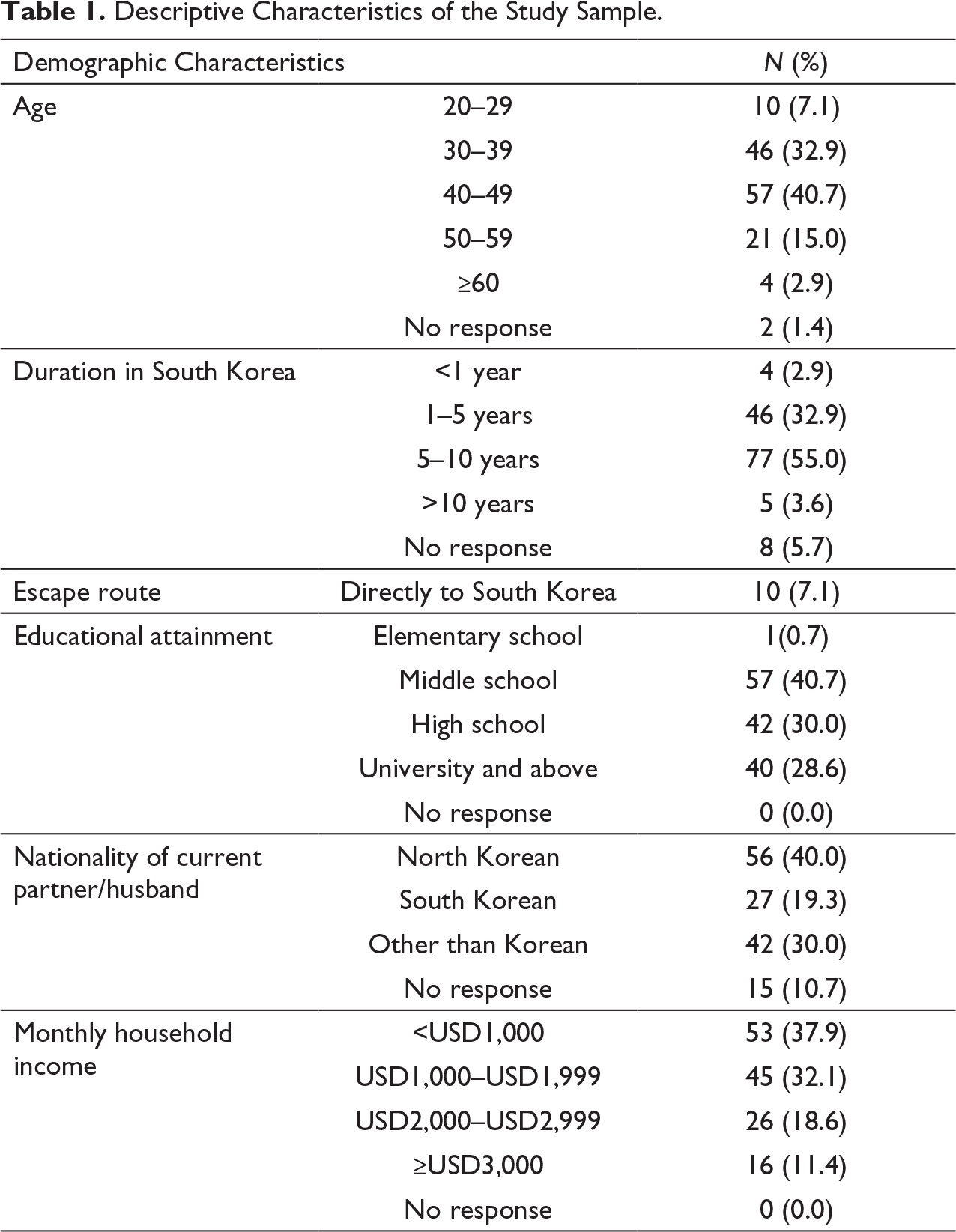
This study used data from the Customized Support Plan for Victimized NK Female Refugees, which is supported by the Korean Ministry of Gender Equality and Family (2012). Snowball sampling was used to recruit participants; it was the best available method to recruit adult NK refugee women (aged 19 or older) due to limited access to the sampling frame of this population. Of the 142 NR refugee women who participated in the survey, 140 were included in the analysis after excluding two cases with incomplete data. Participation in this study was voluntary and informed consent was obtained from all the participants. A gift card valued at approximately 10 USD was provided to the participants at the end of the survey as compensation for their participation.
Descriptive Characteristics of the Study Sample.
Measures
IPV victimization. The past-year IPV was assessed using 15 items of the revised conflict tactics scale (CTS2, Straus et al., 1996). The CTS2 generated four subdimensions of IPV: economic control (e.g., restriction of financial resources), psychological violence (e.g., insulting and threatening to hit), physical violence (e.g., slapping, choking, and beating up), and SV (e.g., forcing to have sex). Four binary variables were generated from the scale indicating the presence of each type of IPV in the past year.
SV victimization. Measures of SV included sexual harassment, sexual assault (e.g., unwanted touching or kissing and groping), attempted rape, and rape. Respondents reported whether they had ever been exposed to any of the five items of SV in three different settings—North Korea, intermediate countries, and South Korea. As for SV in South Korea, victimization was assessed separately from the CTS2, so it measured SV victimization perpetrated outside their intimate relationship. Three binary variables indicating the existence of SV at three different phases of migration were generated from these 15 items.
Covariates. Age, educational attainment, and household income were included as continuous covariates.
Analysis
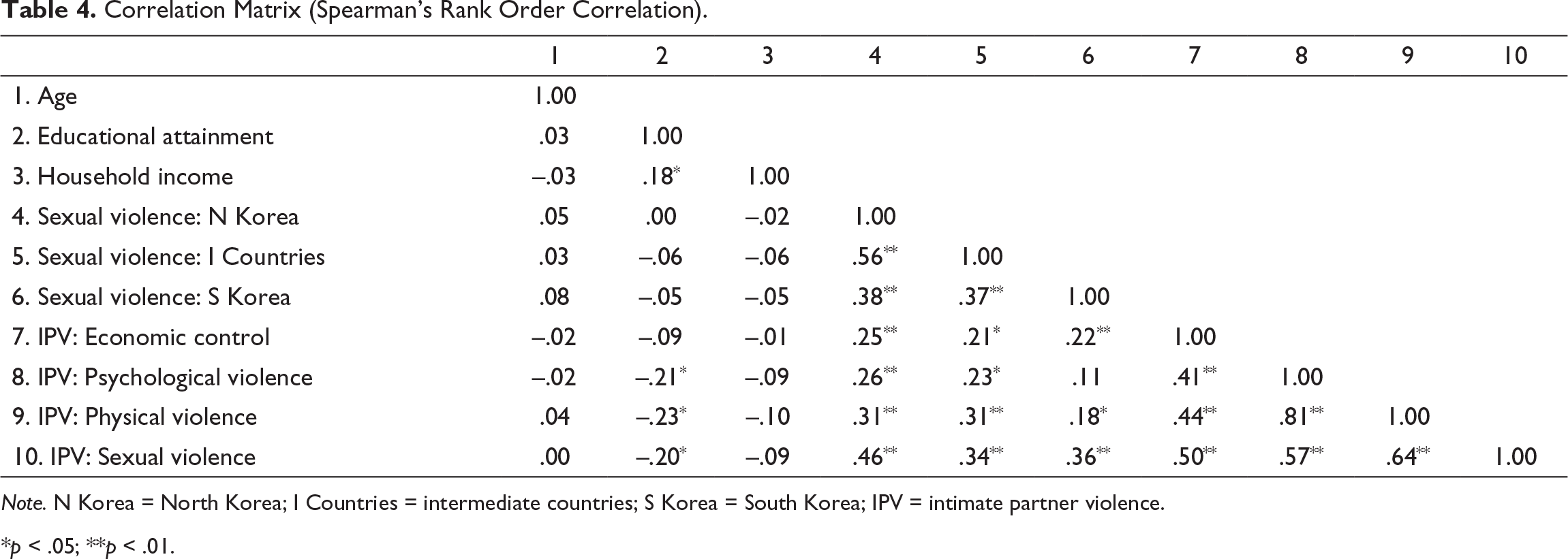
The characteristics of the study sample and major variables were analyzed using descriptive analyses. Bivariate analyses were conducted to explore associations between SV and IPV; the prevalence of IPV by SV and their associations were examined with chi-square tests, and the strength of the associations between major variables of this study were explored using Spearman’s rank order correlation, the nonparametric version of the Pearson product–moment correlation. A set of logistic regression analyses was used to examine the relationship between SV and various types of IPV, which was conceptualized as polyvictimization. Age, educational attainment, and household income were adjusted in each logistic regression analysis predicting various types of IPV victimization from SV in three different migration phases (i.e., North Korea, intermediate countries, and South Korea).
Results
Prevalence and Bivariate Associations Between SV and IPV
Prevalence of Sexual Violence and Intimate Partner Violence Victimization.

Results of Chi-square Test and Prevalence of IPV by Sexual Violence Victimization.
Note. Numbers in parentheses indicate row percentages. SV = sexual violence; IPV = intimate partner violence.
**p < .01; ***p < .001.
Correlation Matrix (Spearman’s Rank Order Correlation).
Note. N Korea = North Korea; I Countries = intermediate countries; S Korea = South Korea; IPV = intimate partner violence.
*p < .05; **p < .01.
Polyvictimization Risk
Polyvictimization Risk Among North Korean Refugee Women in South Korea.
Note. IPV = intimate partner violence; N Korea = North Korea; I Countries = intermediate countries; S Korea = South Korea.
Discussion
NK refugee women are often exposed to traumatic events, and a small but significant number of NK refugee women experience sexual assaults en route to South Korea (Lee & Lee, 2020; Korean Ministry of Gender Equality and Family, 2012). NK refugee women are vulnerable to different types of victimization, and this state continues even after they settle in South Korea. One previous study found that, about 51% NK refugee women experienced physical IPV and about 76% experienced psychological IPV in South Korea (Korean Ministry of Gender Equality and Family, 2010). Previous studies suggest that IPV and SV often co-occur and could take place multiple times throughout a victim’s lifetime (Black et al., 2011; Campbell et al., 2008; Classen et al., 2005). Despite this, little research has been conducted to examine the potential intersection between sexual assault and IPV victimization. Besides, most studies examined refugee women’s exposure to violence without differentiating their victimization based on migration phases and setting. This study examined the prevalence of polyvictimization and explored a potential intersection between SV and IPV, with a focus on understanding SV victimization during three different phases of migration. The prevalence of SV, particularly in intermediate countries (23.0%), is alarming, and the prevalence of physical violence (32.3%) and psychological violence (47.2%) is also higher than experienced by ordinary South Korean women (15.3% physical violence and 33.6% psychological violence; Korean Ministry of Gender Equality and Family, 2010). Many NK refugee women experience SV or IPV, and about 21.3% of NK refugee women are exposed to both SV and IPV. NK refugee women with a history of SV in intermediate countries are more likely to become victims of physical violence from their intimate partner in South Korea. The findings also indicate that SV experienced NK refugee women in North Korea and outside their intimate relationship in South Korea is significantly associated with sexual IPV within their current intimate relationship.
Data suggest that various forms of IPV co-occur in any population (Garcia-Moreno et al., 2006); however, the risk of polyvictimization can be higher in certain groups of women or women under certain circumstances. For example, the risk of sexual revictimization is greater among African American women (Miner et al., 2006), and female veterans show higher rates of both SV and IPV than the general population (Campbell et al., 2008). Risk of victimization increases for refugee women (Hynes & Cardozo, 2000). In prevailing conditions of insecurity and vulnerability during ongoing wars, in refugee camps, and journeys to destination countries, women are subject to various types of violence (Ferris, 2007; Freedman, 2016). Insecurities during armed conflicts and displacement impose an increased risk of physical and SV against women (Hynes & Cardozo, 2000). Besides, refugee women are further exposed to the risk of sexual abuse from smugglers or traffickers during their journey to host countries (Korean Ministry of Gender Equality and Family, 2012). The traffickers force sexual relations in return for assisting women in escaping to their final destinations (Freedman, 2016). Polyvictimization across migration phases has been less studied, but this study showed that refugee women’s trials do not end when they enter the host country. Almost one in three NK refugee women in this study experienced SV during their escape period. The victims of human trafficking and sexual assault during their journey to South Korea are at a greater risk of physical and sexual IPV from their male partners in South Korea. It is conceivable that NK refugee women’s male partners with a history of SV may shame and physically sanction NK refugee women for “breaching honor” or may easily employ physical violence in the face of conflicts and arguments. Revictimization can lead to difficulties in building interpersonal relationships, controlling emotions, and/or developing a positive self-image (Classen et al., 2005). Therefore, for NK refugee women with prior exposure to SV and IPV, we need to screen for the potential risk of physical and sexual assaults and develop programs on safety planning.
Limitations
This study has several limitations that need to be considered. The cross-sectional nature of the data prevents an understanding of temporal and causal relationships between the variables included in this study. The significant association between SV outside their intimate relationship in South Korea and economic control at a marginal level can be attributed to the small sample size. Additionally, the use of a small, nonprobability sample of NK refugee women might mitigate the generalizability of the study’s findings to the population, but the findings may still be applicable to other NK refugee women, as the demographic characteristics of this sample resembles its population. Further, the association between SV and IPV found in this study may be more generalizable to refugee women who are exposed to SV during the migration phases, especially refugee women and their partners with an Asian cultural background or Confucianism. Future studies using a larger sample with participants from more diverse racial/ethnic backgrounds could help us with a more precise testing of this relationship.
Conclusion
Refugee women are exposed to violence in every phase of their journey to their destination country. NK refugee women experience various types of violence, especially SV in intermediate countries, and this victimization is also evident in IPV in South Korea. Victimization generally leaves victims with feelings associated with psychological and physical; however, its impact can be graver in refugee women due to circumstances specific to them (e.g., lack of social support, volatile social and legal status, social exclusion, and economic hardship). The professionals working in the areas of physical, psychological, and social well-being of refugee women need to consider the risk of IPV in conjunction with a history of SV.
Footnotes
Declaration of Conflicting Interests
Funding
The author(s) received no financial support for the research, authorship, and/or publication of this article.
