



Abstract
Relationships among African American (AA) parents living apart can be contentious. A common assumption is that men are the perpetrators and women are the victims of violence. Research examining the symmetry of intimate partner violence (IPV) has not focused enough on AA parents who are co-parenting their young children while living apart. The purpose of this study is to explore reports of IPV among non-cohabiting AA co-parents of 2-6-year-old children enrolled in the Dedicated African American Dad Study (DAADS). Our objectives for this study are to characterize the nature of intimate partner relationships among non-co-residing co-parents by exploring the association between the quality of relationship and co-parenting fathers’ and mothers’ Hurt, Insult, Threaten, and Scream (HITS) scores. The HITS is a domestic violence screening tool for use in the community. As part of the screening protocol for study inclusion, we administered the HITS to father-mother dyads. Fathers were ineligible for participation if either parent reported HITS cut-off scores >10 and identified safety concerns for themselves when interacting with their co-parent. Among DAAD study parenting dyads, we noted symmetry in reports of IPV (i.e., both parents reported elevated HITS scores). The most frequently elevated HITS items were “insult or talk down to” and “scream or curse” indicating the preponderance of verbal conflict among parents in the study. The nature of IPV among co-parents in this study is predominantly verbal. In light of the potential for reciprocity in IPV, interventions for families in this context should focus on communication and problem solving to support fathers and mothers and minimize child harm.
Keywords
Intimate partner violence (IPV), one of the most frequently encountered forms of violence, is a public health concern that is heavily influenced by social, structural, and systemic factors (Basile, 2003; Garcia-Moreno et al., 2006). Despite controversy over whether men and women are equally likely to be perpetrators of IPV, one in three women and one in four men have experienced IPV (Black et al., 2011; Hines & Douglas, 2016). There are two predominant schools of thought regarding gender in the perpetration and victimization of IPV; the feminist and family violence perspective. The feminist perspective challenges the notion of gender symmetry, that women and men are similarly aggressive in their intimate relationships (Johnson, 2006; Melton & Belknap, 2003; Straus, 2006; White, 2009). On the other hand, the family violence perspective argues that IPV should be reconceptualized from one of women being battered to one of family violence (Morse, 1995). In this paper, we explore gender symmetry in reports of IPV by non-co-residing African American (AA) parents. More specifically, the purpose of this study is to explore reports of IPV among non-co-residing AA parents of 2-6-year-old children enrolled in a randomized trial of a fatherhood intervention called Building Bridges to Fatherhood (BBTF). BBTF was tested against a Financial Literacy comparison condition (Money Smart) in a sample of 183 fathers who were recruited from the west and south side communities in Chicago. As part of the inclusion criteria for the study, the Hurt, Insult, Threaten, and Scream (HITS; Sherin et al., 1998) domestic violence screening tool was administered to the father-mother dyads. Our objective for this study is to characterize the nature of intimate partner relationships among non-co-residing parents by exploring the association between the quality of relationship and co-parenting fathers’ and mothers’ HITS scores. We expect gender symmetry amongst reports of IPV in line with the family violence perspective and that reports of the quality of the relationship will be associated with reports of IPV as measured by the HITS screening tool.
Review of the Literature
Every year approximately 16% of heterosexual co-residing or married couples, experience at least one occurrence of IPV (Breiding, Chen, & Black, 2014). Violence within the context of a romantic relationship has generated a lot of public interest and research (Capaldi, Knoble, Shortt, & Kim, 2012). Even so, there has been considerably less research focused on IPV in fragile families, which tend to be families with tenuous romantic relationships (McHale, Waller, & Pearson, 2012). Families are considered fragile and more vulnerable when impacted by structural risks such as high rates of poverty and neighborhood disadvantage. Neighborhood disadvantage stemming from structural racism and disparities in economic opportunities contribute to the overrepresentation of AAs in the perpetration of IPV (Sutton, et al., 2020). Families living in rental property in urban areas, with young single mothers are also considered to be more fragile and vulnerable to IPV (West, 2016).
The quality of relationships in fragile families, be they romantic or casual, is likely to be a key factor in understanding the pervasiveness of IPV. For example, the quality of the relationship among dating couples is one of the most influential risk factors for dating violence (Viejo, Monks, Sánchez, & Ortega-Ruiz, 2016). Typically, as IPV increases, the quality of the relationship decreases; yet, multiple factors can influence the quality of relationships. These factors include violence severity, substance abuse, life stressors, negative communication, and attachment styles (Bonache, Gonzalez-Mendez, & Krahé, 2019). For example, anxious and avoidant attachment styles are related to sexual coercion and psychological abuse (Bonache et al., 2019). IPV can be heavily influenced by situational violence (Cleary Bradley & Gottman, 2012), which typically stems from an argument getting out of control. This significant contributor to IPV reflects deficits in communication rather than a mental or behavioral disorder (Cleary Bradley & Gottman, 2012).
Overall, there is a greater paucity of knowledge regarding gender symmetry in IPV among the AA population. This is true despite higher rates of IPV among AA women compared to White women (40.9% vs. 31.7%) and AA men compared to White men (32.8% versus 28.1%) (Black et al., 2011). Bidirectional IPV in AA relationships has been reported in 61% of couples and demonstrated through mutual aggression. Among AA women who reported IPV in their relationships, they were more likely to identify themselves as perpetrators than AA men who saw themselves as both victims and perpetrators (Caetano, Field, Ramisetty-Mikler, Lipsky, 2009; West, 2016). Even so, there is evidence that race-comparative research on female perpetrated violence reveals differences. For example, in a study by Washington, Cannon, and Buttell (2018), AA women who self-identified as perpetrators attributed their violence to efforts to ward-off violence from their partners, retaliation, or self-defense. Other research with a predominantly White sample revealed reasons for perpetration were related to mutual violence or the woman serving as the primary perpetrator (Stewart, Gabora, Allegri, & Slavin-Stewart, 2014). The proclivity of both races to violence is similar based upon levels of exposure to trauma (Washington et al., 2018).
Among AAs, historically families were intentionally torn apart and the bonds of matrimony were illegitimatized by the prevailing White culture (Washington et al., 2018). This history has perpetuated family structures that are more prone to single-mother headed households. In addition, the ongoing mass incarceration of AA men, which decreases the sheer numbers of available AA marriage candidates, can contribute to the large number of single-parent households. Nevertheless, over time, AA families have developed and refined structures to support their overall health and wellbeing. These resilient and flexible structures often include extended family and fictive kin that contribute to the long-term positive outcomes of their children (Clinkscales, 2019). Thus, AAs live in a society that is often not only disapproving of AA family structures, but intentionally disruptive in some circumstances (Washington et al., 2018).
Structural racism is defined as “the cumulative and compounding effects of an array of societal factors including the history, culture, ideology, and interactions of institutions and policies that systematically privilege White people and disadvantage people of color” (Apollon et al., 2014, p. 3). For AA couples embroiled in IPV, these factors tend to land more heavily on women victims. Educational disadvantage can hamper efforts to escape abusive relationships. In a study of college students, educational advancement was undermined by school staff who were emotionally abusive and limited access to campus resources for victims of IPV (Voth Schrag, Edmond, & Nordberg, 2020). Similarly circumstances that depict Black women as “aggressive, domineering and violent,” can inform attitudes and behaviors of service providers leading to psychological aggression against AA battered women when they reach out for help (Nnawulezi & Sullivan, 2014). Thus, racism and stereotypes may undermine the capacity of the social service sector to provide resources and support to AA survivors of IPV. Additionally, individuals who work in domestic violence shelters may also engage in microaggressions and insults that steer AA survivors of IPV toward low-paying service jobs, rather than to job training and educational opportunities (Nnawulezi & Sullivan, 2014). Without appropriate economic resources, it becomes increasingly more difficult for survivors to escape abusive relationships. AA men experience structural racism in the form of overrepresentation in the criminal justice system and increased likelihood of being victims of police and other forms of violence. These experiences undermine educational and employment opportunities and contribute to disenfranchisement and marginalization (Burrell et al., 2020). Furthermore, racial discrimination can lead to psychological harm that contributes to higher rates of IPV (Al’Uqdah et al., 2016). Without question, these structural and social forces exert an impact on AA couples’ relationships.
Finally, despite the fact that 65% of AA children are raised in single or blended family homes, a significant disparity in IPV research exists within the context of AA co-parenting relationships (McHale et al., 2012). Researchers have rarely explored the nature of interpersonal relationships and IPV among AA non-co-residing parents. Co-parenting relationships among individuals whose romantic relationship has ended, whether married or not, are riddled with challenges associated with parents navigating roles, re-negotiating boundaries, and implementing structural changes to the family (Hardesty et al., 2012). Although disparities exist in what is known about co-parenting relationships between AA unmarried parents (Hardesty et al., 2012), what is known is that relationships between unmarried co-parents tend to be strained (Kamp, Dush Kotila, & Schoppe-Sullivan, 2011). Parental conflict is known to exert a negative impact on a child’s growth and development (Adhia & Jeong, 2019). However, the ability to maintain a supportive co-parenting relationship after separating is challenging. Even so, in order for parents to establish an effective co-parenting relationship, they must move past their previous romantic relationship and set aside their differences for the sake of the child. Thus, both conflict and supportiveness can exert an influence on the co-parenting relationship.
The IPV and co-parenting after separation model.
Hardesty et al. (2012) propose a model that examines the interplay between IPV and co-parenting after separation. In this model, conflict is likely to ensue when post-separation disagreements occur while negotiating family structural changes. In turn, support refers to each co-parent’s capacity to favorably regard and consider the other as a co-parent. Research on co-parenting relationships with high conflict and low support tend to be more common when: families are larger with younger children (Maccoby, 1990), the separation is more recent (Adamsons & Pasley, 2006), there is a hostile separation (Maccoby, 1990; Madden-Derdich & Arditti, 1999), there are custody or support disagreements (Maccoby, 1990), mothers are dissatisfied with custody or support agreements (Madden-Derdich & Arditti, 1999), and there are difficulties establishing new parenting boundaries (Madden-Derdich, Leonard, & Christopher, 1999). The IPV and Co-Parenting after Separation Model provide a framework for our study which explores co-parenting relationship outcomes post-separation through the use of father and mother reports of post-separation violence and the quality of the relationship.
In a study by Hardesty et al. (2017), researchers evaluated how marital IPV affects common dimensions of efficient co-parenting after separation (co-parental conflict, support and communication, and harassment), as well as the variability in the relationship. Using the Dominance Isolation Subscale of the Psychological Maltreatment of Women Inventory (PMWI) (Tolman, 1992), researchers examined and characterized two types of IPV (Johnson, 2008a, 2008b). Coercive control violence (CCV) was characterized as reports of at least one act of violence and a PMWI score of 19 or higher while situational coercive violence (SCV) was characterized as at least one act of violence and a PMWI score of 18 or less. CCV included schemes to monitor, isolate, or incite fear in partners whereas, SCV referred to violence that is dependent on specific situations without an overarching motive to coercively control the partner (Johnson, 2008a, 2008b). Hardesty et al. (2017) found that over time co-parental conflict decreased considerably regardless of the type of IPV. Mothers in all three groups (CCV, SCV, or no violence) reported decreases in support, communication about childrearing, and harassment. In addition, there was significantly more variability in co-parental conflict and harassment in mothers with CCV compared to those who reported no violence or SCV. The quality and effectiveness of co-parenting relationships after separation may rely on the type of IPV present during the relationship and how patterns of control manifest.
Methods
Design
This study is part of a randomized controlled trial (RCT) of two fatherhood interventions conducted with AA non-resident fathers of children aged 2-6 years enrolled over a 4-year period from 2014 to 2018 (refer to Julion et al., 2016, for further details). The study was known to the community as the Dedicated African American Dad (DAAD) Study. Data were collected from fathers and the mothers of their children at three timepoints (baseline, post intervention, and 6 months post baseline). The study was approved by the University Institutional Review Board. In order to determine eligibility for enrollment in the DAAD Study, fathers and mothers were screened for IPV using the HITS. Of particular interest in this study were the results of the HITS and the quality of the relationship as measured by the Quality of Relationship Inventory (QRI; Pierce et al., 1997) for both fathers and mothers at baseline.
Participants/Setting
AA research assistants recruited non-resident fathers of children ages 2-6 in community settings frequented by AA men such as barber shops, gyms, and churches (Julion, Sumo, & Bounds, 2018). The HITS was incorporated into data collection at all three timepoints to monitor for the risk of IPV. All participants were interviewed by recruiters either in person or via phone. Data were collected and entered into Research Electronic Data Capture (REDCap) (Harris et al., 2009, 2019). A total of 493 fathers expressed interest in participating in the study. Of these, 76 (15%) never completed the screening process and 180 (43%) were determined to be ineligible. Of the 237 (57%) eligible fathers, 178 (75%) fathers were enrolled in the study, completed baseline data, and were randomized to either BBTF or Money Smart. Mothers were recruited into the study as data informants only. Of the 178 fathers who were enrolled, a total of 130 (73%) mothers participated in data collection. Only cases with valid father and mother data were included in the present analyses.
Measures
Participant demographics.
The investigator developed Demographic Data Form (DDF) was used to obtain father’s age, educational level, income, employment status, child gender and age, socio economic status, history of involvement with the criminal justice system, and whether fathers’ lived with their own fathers while growing up (Julion et al., 2016).
HITS.
The HITS, a domestic violence-screening tool for use in the community, was administered as part of the screening protocol for study inclusion for the DAAD study (Julion et al., 2016). HITS is a mnemonic that stands for “Hurt,” “Insult,” “Threaten,” “Scream,” and is scored using a 0-4 point scale. Fathers were ineligible for participation if either parent reported a HITS cut-off score >10 (range 0-16) and identified safety concerns for themselves or their child when interacting with the father. The HITS was initially developed for use with women in family practice settings. According to Sherin et al. (1998), Cronbach’s alpha was .80 for the HITS scale and demonstrated concurrent validity with the Conflicts Tactic scale, a highly recognized measure of IPV. The correlation of HITS and Conflict Tactics Scale scores was .85 (Sherin et al., 1998). The HITS was later validated for use with men (Shakil, Donald, Sinacore, & Krepcho, 2005). For the present sample, Cronbach’s alpha was .78 for fathers and .74 for mothers.
Quality of relationship.
The QRI was also collected in the same manner as the HITS at all three timepoints from both fathers and mothers. The 25-item inventory was used to explore conflict between co-parents (12 items), supportiveness (7 items), and depth of the relationship (6 items) (Pierce et al., 1997). The QRI has good internal consistency reliability with Cronbach’s alphas ranging from .84 to .87 for fathers and .86 to .88 for mothers in the current sample.
Data Analysis
Demographic information was collected and reported descriptively as means and percentages. Spearman correlations were used to test the association between father and mother baseline reports of HITS scores and to test the associations between HITS scores and quality of relationship scores at baseline. Differences in father/mother scores on the HITS and the individual items comprising the HITS were tested using Wilcoxon Signed-ranks tests.
Results
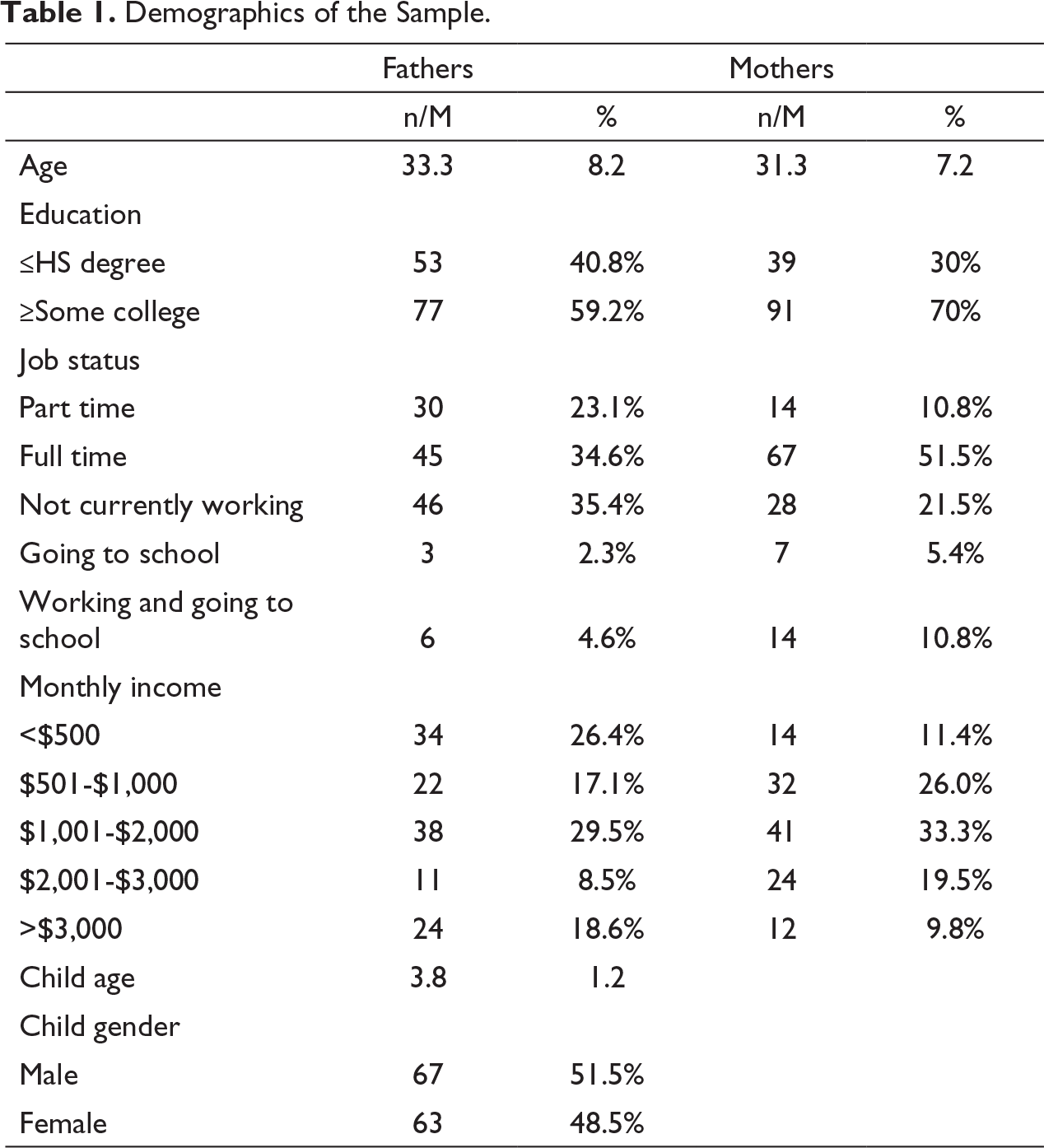
Demographics of the sample.
Demographics of the Sample.
Reports of IPV.
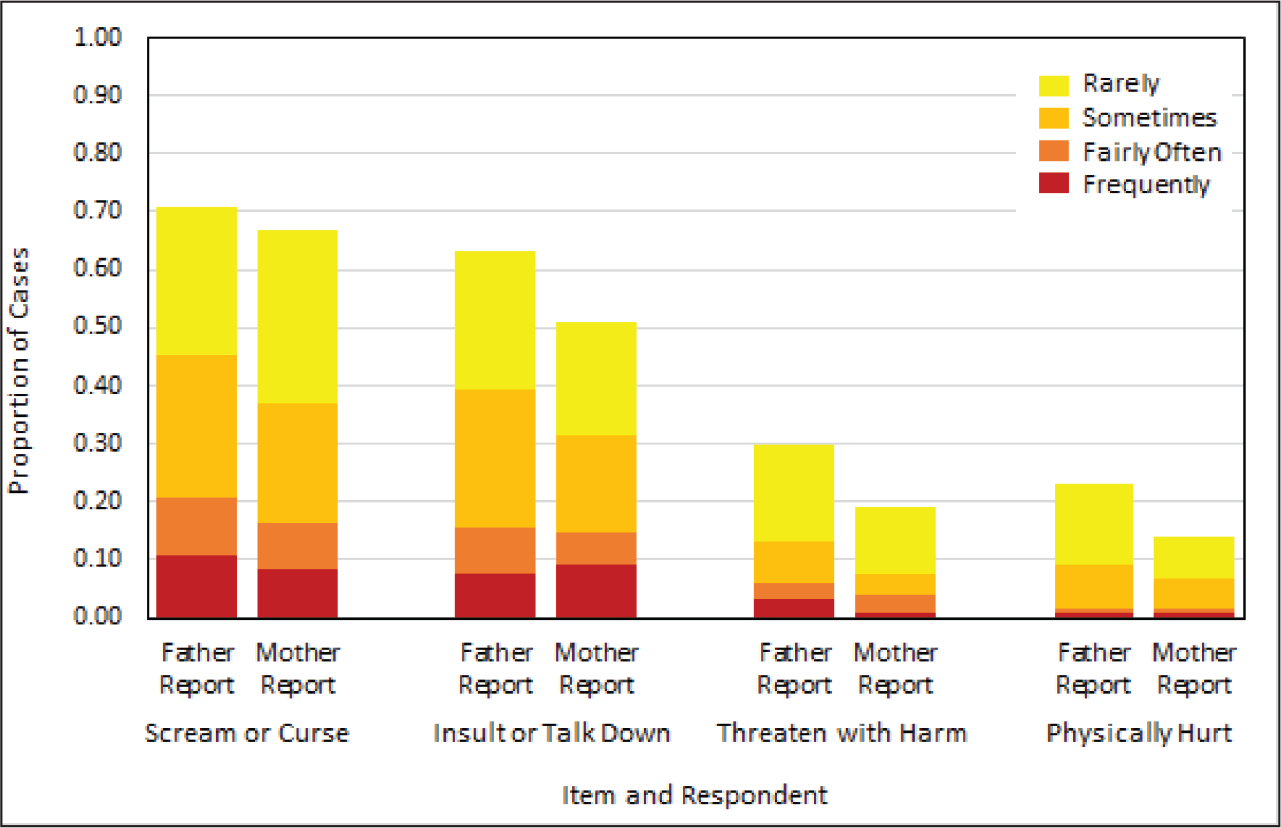
DAAD study parenting dyads reports of IPV between fathers and mothers were modestly correlated (r = .23, p = .008). The most frequently elevated HITS items were “insult or talk down to,” and “scream or curse,” indicating the preponderance of verbal conflict (psychological abuse) among parents in the study (Figure 1). Although fathers’ reports of mothers’ behavior tended to be slightly higher than mothers’ reports of fathers’ behavior, Wilcoxon Signed-ranks tests showed that this difference was only significant for the item “threatening with harm” Z = 2.01, p = .04.
Reports of IPV.
When comparing HITS scores of father reports of mothers’ IPV to mother reports of fathers’ IPV (Figure 2), most (73.1%) reports fell into low levels of IPV perpetrated by both fathers and mothers (Quadrant 3). There were, however, equal numbers of cases in which (a) father reported low IPV perpetrated by the mother and the mother reported high IPV perpetrated by the father (Quadrant 1) and (b) mother reported low IPV perpetrated by the father and the father reported high IPV perpetrated by the mother (Quadrant 4). There were a small number of instances (n = 5) where both the father and mother reported high IPV (Quadrant 2).
Comparing father and mother reports.

Associations between reports of IPV and relationship quality.
The perceived relationship quality (QRI) was associated with reports of IPV as measured by the HITS. Increased relationship support was negatively associated with reports of IPV on the HITS for both father (r = −.38, p < .001) and mother (r = −.43, p < .001) reports. Likewise, increased relationship conflict was positively associated with reports of IPV on the HITS for both father (r = .57, p < .001) and mother (r = .61, p < .001) reports.
Discussion
In this study, we explored the relationship between paternal and maternal reports on an IPV screening tool (HITS). We found that victimization in this study was predominantly verbal, a type of psychological abuse commonly seen in situational couple violence. Johnson (2008a, 2008b) postulates that situational couple violence occurs due to a specific situation and is not focused on one partner trying to coercively control another partner. Situational violence typically stems from an argument and reflects deficits in communication (Cleary Bradley & Gottman, 2012). This study expounds upon Hardesty & Ogolsky’s (2020) recent review which supports the belief that men are not the only aggressors/perpetrators in verbal aggression and situational IPV. Similar to other studies, we found that both men and women report experiencing IPV (Eckhardt, Murphy, & Sprunger, 2014). As expected, the findings of our study more closely align with the family violence perspective where IPV is focused on the family’s experience with violence and not merely one in which women are victims of intimate partner violence (Morse, 1995). When addressing IPV as seen through the family violence lens, community responses must attempt to respond to family violence through the integration of social services and criminal justice. Thus, community responses should be grounded in an assessment of risks and strengths, rather than focusing exclusively on violence between the victim and the perpetrator (Rakovec-Felser, 2014).
It is evident that situational couple violence may be perpetuated by men or women, and this type of violence may be mild and limited to an isolated incident or may be severe and/or chronic (Hardesty et al., 2012; Johnson, 2008a, 2008b). Psychological abuse may impart consequences as severe as physical aggression and, therefore, should not be underestimated (Karakurt & Silver, 2013). This study adds to the knowledge related to fragile families and supports the premise that bidirectional family violence occurs within fragile families. Further investigation that includes reports of both victimization and perpetration from both fathers and mothers is needed, particularly to explore interventions that facilitate support and decrease conflict. Interventions designed to bolster healthy relationship skills and communication are likely to contribute to reductions in IPV in situationally violent couples. Also, attention should be paid to structural barriers (e.g., racism and stereotypes) that may impact intervening with men and women who experience situational violence; aforementioned barriers influence available resources and support for AA survivors and perpetrators of IPV (Sutton, et al., 2020). Furthermore, structural barriers such as high rates of poverty and residing in disadvantaged neighborhoods may be particularly detrimental to relationship quality in fragile families (Sutton, et al., 2020).
Our findings suggest that both father and mother reports of the quality of their relationship with their co-parent are associated with their reports of victimization. When the quality of the relationship was deemed supportive, there were fewer reports of IPV, and when there was the perception of greater conflict, there were increased reports of IPV. The perceived quality of the co-parent relationship is, therefore, an important factor for co-parents. What is not entirely understood is whether conflict and support are antecedents to or consequences of IPV. What we do know is that when parents separate, it is difficult to configure and maintain supportive co-parenting relationships (Kamp Dush et al., 2011).
The factors associated with IPV among unmarried, non-resident fathers and the mothers of young children are not well understood (Bronte-Tinkew & Horowitz, 2010). Our study makes a unique contribution to the literature because few studies examining IPV include both men and women data informants who are non-co-residing co-parents (Capaldi et al., 2012). However, what is observed in the literature is that mothers experience psychological violence more commonly than physical violence (McLanahan et al., 2014) and experience long-term effects of IPV on mood (i.e., depression) and parenting (Postmus, Huang, & Mathisen-Stylianou, 2012). Researchers have identified unemployment as a factor that diminishes supportive co-parenting for families with unmarried, nonresident fathers of preschool children (Bronte-Tinkew & Horowitz, 2010).
Parental conflict is known to exert a negative impact on a child’s growth and development (Adhia & Jeong, 2019). Additionally, in the presence of IPV in unmarried couples, children are more likely to be impacted by lower father involvement, harsh parenting, and child neglect (McLanahan et al., 2014). An important implication of this study is that, in light of the potential for vicarious victimization of children exposed to IPV, child screening for exposure should be considered when children are being raised by co-parents living in separate households.
This study adds to the body of knowledge focused on IPV and the Co-Parenting After Separation Model among AA non-residential fathers and their co-parents. Findings within this study reveal that, since both mothers and fathers report being victims of IPV, there is gender symmetry in IPV among this group of co-parents. While mothers are more likely to be identified as victims of IPV than fathers, understanding gender symmetry requires more research and development of measures that can accurately reflect the experiences of fathers (Hardesty & Ogolsky, 2020).
Since there is an inverse relationship between IPV and relationship quality, additional research is needed focused on interventions designed to foster improved relationship quality among AA co-parents living in separate households (McHale et al., 2012). The most effective intervention model for supporting non-co-residing co-parents is currently unclear. Even so, since unmarried childbearing is a growing phenomenon, more knowledge is needed about the intersection between IPV and non-co-residing co-parenting within fragile families. The strategies used to address co-parenting in two-parent nuclear families and divorced families are likely to warrant significant modifications.
Limitations
There were a few limitations that should be noted when interpreting the results of this study. First, we relied on self-report measures that only asked about victimization, not perpetration. Thus, we do not know the accuracy of these self-reports of victimization or participants’ perpetration history in the relationship. Second, despite the stem of the question asking about the past 30 days we noted that, upon follow-up, some co-parents responded to the HITS according to the entirety of their past co-parenting relationship. Therefore, there is some uncertainty surrounding the timing and context of the co-parents’ reports (past vs. present; couple versus co-parenting) on the HITS. Third, this study reports on HITS and QRI scores of AA co-parents who do not live with each other. Therefore, generalizability beyond this specific group of AA co-parents is limited. Fourth, our results are correlational. We, therefore, know there is an association between reports of victimization and the quality of the relationship but we do not know which came first or caused the other. Finally, in this study, IPV was measured via the HITS screening tool, rather than through a standardized IPV tool such as the widely used Conflicts Tactics Scale (CTS; Allen, 2011). Despite criticisms that the CTS does not consider the contexts of violent encounters, motives for IPV, culture, or ethnicity, the use of the CTS in this study may not have elicited a more comprehensive view of IPV. Nevertheless, a potential limitation of this study is that the results may not be replicable because of the use of the HITS, rather than the CTS.
Conclusion
This study supports the occurrence of bi-directional IPV among non-resident fragile families which was primarily psychological/verbal in nature. Additionally, the results of this study demonstrate that co-parents’ perceptions of their relationship quality are related to their report of IPV. Situational violence is a significant contributor to IPV among couples and may be particularly relevant for individuals who are navigating co-parenting outside of the boundaries of a romantic relationship. Interventions to address situationally violent, psychological forms of IPV in non-resident co-parents should be focused on honing interpersonal communication skills, fostering problem-solving abilities, and bolstering the ability to exercise self-control. These interventions are important for co-parents, but also for children as parental conflict exerts a negative impact on children. In light of the potentially negative impact of parental conflict on children exposed to situational violence, this study supports centering family violence as the context for intervening as a prudent approach. Current rates of non-marital childbearing are unlikely to abate in the near future. Therefore, more research is needed to address IPV in parents raising children in the context of non-residential fragile families.
Footnotes
Declaration of Conflicting Interests
Funding
The author(s) declared the following financial support for the research, authorship, and/or publication of this article: This research was funded by the National Institutes of Health/National Institute of Nursing Research Grant #2R01NR011182. At the time of the study, Dawn Bounds was employed by Rush University Medical Center and a Scholar with the HIV/AIDS, Substance Abuse, and Trauma Training Program (HA-STTP), at the University of California, Los Angeles; supported through an award from the National Institute on Drug Abuse (R25DA035692) and National Center for Advancing Translational Sciences (NCATS) of the National Institutes of Health (NIH) through Grant Number 5KL2TR002387-02 that funds the Institute for Translational Medicine (ITM). The content is solely the responsibility of the authors and does not necessarily represent the official views of the NIH. The authors report no actual or potential conflicts of interest.
