



Abstract
Despite Hong Kong’s ranking as having one of the lowest homicide rates worldwide, it has one of the highest female homicide rates globally. This research catered to the need for a systematic empirical analysis of the femicide phenomenon in Hong Kong by examining census data of femicide cases that occurred in Hong Kong in 5 years: from January 2015 to December 2019. Thirty-eight cases were examined and coded, covering 17 variables relating to victims, perpetrators, and modus operandi. Despite the small number of cases, this article highlights femicide’s sociocultural diversity by discussing its unique patterns in Hong Kong, with a high share of femicide-suicide cases and overrepresentation of foreigners and women older than 60. The article concludes with recommended policy strategy reformulations needed to better combat femicide in Hong Kong.
Introduction
Femicide is the major cause of the unnatural death of women and the seventh leading cause of the premature death of women worldwide (Campbell et al., 2003). Femicide intersects with gender-based domestic violence (UNODC, 2019, Vol. 1, p. 1, 9, 14) and displays empirical proximity to the family arena. Thus, the women are primarily murdered within the framework of “their family”, that is, by their partners, and in many cases femicide also involves the murder of family members or bystanders such as relatives, the couple’s children, or the victim’s new partner (Dobash & Dobash, 2012; UNODC, 2019, Vol. 5, p. 18).
Scholars agree that the sociocriminological features of femicide are distinct from other forms of homicide and deserve a gender-specific framework of analysis (Landau & Hattis Rolef, 1998; Taylor & Jasinski, 2011). Feminist scholars’ exploration of the femicide phenomenon amid a patriarchal social structure and oppression (e.g., Hunnicutt, 2009; Russell & Radford, 1992; Taylor & Jasinski, 2011) requires contextual fine tuning, because although it transcends geographic locations, cultures, and groups of women (Alvazzi del Frate & Nowak, 2013), femicide’s manifestations—just as any other criminal phenomenon (Landau, 1984; Landau & Hattis Rolef, 1998, p. 82)—diversify based on the particular sociocultural context in which it operates. Indeed, research findings on crime highlighting geographical, community, and crime control differences across place (Gallup-Black, 2005) and femicide rates varying across regions (Corradi & Stöckl, 2014) suggest the plausibility of the femicide phenomenon diversifying based on the contextual sociocultural aspects in which it operates.
For example, contextualized research on femicide in Arab cultures has noted its indigenous characteristics, resulting in femicide victims being much younger than their Western counterparts and perpetrators coming from the victims’ extended family, rather than their intimate partner (Chesler, 2010). Similarly, research on femicide in India has highlighted its indigenous form related to sociocultural customs of dowry and its correlated aspects targeting relatively newly wedded wives and killing them by burning through a staged kitchen accident (Mohanty et al., 2004). Equally so, a unique femicide form was noted in Ghana, with killings linked to beliefs and accusations of witchcraft resulting in the killing of older women, supposedly witches, who were lynched, stoned, and bludgeoned by an irate mob (Adinkrah, 2004). These criminal manifestations differ from reported findings on femicide in Western societies (which account for the vast majority of femicide research), which have reported such killings as usually perpetrated by the women’s current or former intimate partner, predominantly linked to the end of their intimate relationship and often featuring a firearm (Campbell et al., 2003, 2007). This suggests that femicide’s heterogenic and complex nature is demonstrated through its wide array of various forms.
This research is thus situated in the quest to delve into femicide’s heterogenic manifestations, by contextualizing femicide focusing on the Hong Kong Special Administrative Region (SAR) of the People’s Republic of China. Furthermore, the choice to focus this research on a world region in which there has been very little published about femicide or female homicide is itself worthy of research. The special focus on Hong Kong is all the more important because this world region features a unique, endemic anomalous homicide trend, with one of the lowest homicide rates in the world but one of the highest global femicide rates.
Despite Hong Kong’s ranking as having one of the lowest homicide rates worldwide (UNODC, 2019, Vol. 2, p. 16), it has one of the highest female homicide rates globally (UNODC, 2014, p. 54−55; UNODC, 2019, Vol. 2, p. 12, 60). In other words, if a killing is perpetrated in Hong Kong, the victim will most likely be a woman. This gendered criminological homicide characteristic in Hong Kong is in stark contrast to the worldwide homicide pattern in which male homicide victims outnumber female victims, who comprise no more than 10% of global homicide victims [UNODC, 2019, Vol. 1, p. 18, 23; UNODC, 2019, Vol. 5, 21; UNODC, 2019, Vol. 2, p. 69]. Gender discrepancies in the demographics of homicide are mostly due to the fact that homicide is dominated by male-to-male lethal violence, often between gang members.
This intriguing characteristic of femicide in Hong Kong in and of itself calls for in-depth criminological study about the nature of this phenomenon in the Hong Kong SAR. The need to conduct systematic research on femicide in Hong Kong is exacerbated by scant research on femicide in non-Western regions in general (Dayan, 2018, 2019), and in Hong Kong in particular. This article presents findings on sociodemographic and criminological characteristics of femicide in Hong Kong and discusses the research findings in light of its sociocultural aspects. Despite the small number of cases, this article highlights femicide’s sociocultural diversity by discussing its unique patterns in Hong Kong, with a high share of femicide-suicide cases and overrepresentation of foreigners and women older than 60. Following the discussion, the article outlines the implications of this research and the correlative adjustments to policies needed to eradicate femicide in Hong Kong.
Research Population
Hong Kong was one of the safest cities in the world up until recently, with low property and violent crime rates (Bouhours & Broadhurst, 2015; Broadhurst et al., 2010) despite characteristically higher homicide rates in urban compared to rural areas (UNODC, 2014, p. 27). As a financial hub in the Asian continent and a former British colony, Hong Kong is an economically developed Asian city (Chan et al., 2003), with a population of 7.5 million (Census and Statistic Departments, the Government of Hong Kong SAR, 2019. Hereinafter: CDS SAR), low mortality rates and high life expectancy (Zhao et al., 2017). Modernization and economic growth have influenced the expression of Chinese culture in Hong Kong. Thus, with the advent of modernity and Western influences, patriarchal authority arguably declined and traditional extended kinship households gave way to nuclear families as the basic social unit (Pearson & Leung, 1995). Amidst modernization, women entered the workforce as fully productive contributors, although, on aggregate, their wages remain lower than those of male workers (Broadhurst et al., 2012).
The cultural foundations of Honk Kong have often provided possible explanations for the fact that, despite its low homicide rates, gender-based violence rates are high. Thus, variables such as traditional cultural values, including gender values which still prevail in all aspects of Chinese life in Hong Kong regardless of its westernization and rapid social changes (Goodwin & Tang, 1996; Tang & Cheung, 1997), have been seen as the cause of the high rates of gender-based violence. In fact, although the role of women has changed in the modern period, Hong Kong is often described as having retained many of the traditional patriarchal values of China in the familial domain, including the institutionalized subordination of women and a degree of tolerance for domestic violence (Bouhours & Broadhurst, 2015). This means that, in spite of social adaptation to economic development and modernization, family expectations still uphold the male’s position as the principal breadwinner, designate women as the primary caretakers or supervisors of housework and children even if they have full-time careers. Moreover, family expectations discourage women from disrupting honor, solidarity, and harmony in their family, thus relegating women’s individual rights to second place (Bouhours & Broadhurst, 2015; Lee, 2002).
Research suggests that Hong Kong’s traditional patriarchal, patrilineal, and patri-local Chinese cultural views, which consign women to submissive positions in society and to the family context, seem to counter and weaken its cultural notions that emphasize harmony, self-restraint and discipline—culminating in the social legitimization of gender-based violence and aggression (Tang & Cheung, 1997). Indeed, prior studies about domestic violence, homicide, and homicide-suicide in Hong Kong reflect women’s vulnerability to domestic violence, including statistics of increased gender-based violence (Bouhours & Broadhurst, 2015; Leung, 2019; Tsun & Lui-Tsang, 2005). For example, reports about spousal abuse and cohabitant battering cases indicate that there are many more female victims than male victims (CSD SAR, 2019, p. 33), and reports of fatal violence show that females comprise the majority of victims in family-related homicides and homicide-suicides (Chan et al., 2003; Chan et al., 2010; Lau et al., 2012). Nonetheless, cultural factors are often only one, and certainly not the sole defining factors of such patterns. The interplay of social and cultural factors may be just as important.
In light of the need for a systematic empirical analysis of the femicide phenomenon in Hong Kong, this study is of an exploratory nature, aiming to map the phenomenon’s main sociocultural and criminological characteristics (incident characteristics such as killing weapon, killing motive, killing scene, and overkilling the victim). Accordingly, the two main questions of the study are:
What are the sociodemographic characteristics of femicide in Hong Kong? What are criminological characteristics of femicide in Hong Kong?
These questions are posed in order to understand the possible role that sociocultural factors may play in femicide (Dayan, 2018, 2019). The findings may also have implications for suitable policy strategies for its prevention.
Method
Because scholars have emphasized that only adult women fall into the femicide category, the study population was composed of women aged 15 years or older (Corradi et al., 2016, p. 981). The study defined femicide as homicide involving any intentional killing of a female victim. The definition of intentional killing for the purpose of this research differs from the legal definition of “intent” required for a murder conviction, because it caters to all “active” killings, rather than passive killings, and would also include cases of repeated domestic violence that have caused death despite the absence of the legal killing intent definition required to secure legal conviction (Dawson & Carrigan, 2020). All cases of femicide were included in the research, irrespective of the perpetrator’s identity (family member/intimate partner/other). Femicide cases that occurred in Hong Kong between January 2015 to December 2019 were included if the killing was confirmed either by the police or by criminal procedures as a homicide offense and was not related to a terror attack, medical negligence, gross negligence, vehicular accident, political protests, or unrelated criminal activity.
Data on femicide remains difficult to access and collect because existing data, often collected by official agencies, are ill-suited for research (Dawson & Carrigan, 2020; Walby et al., 2017). To begin with, such data are not easily accessible by researchers. Second, crucial information deemed irrelevant for legal procedures is often lacking, culminating in an abundance of relevant missing data. Third, such data archives are not systematized organized for research purposes. The nature of such data forces researchers into a lengthy and labor-intensive process of reading all available data, case by case, file by file, to build a research sample.
Due to unavailability of official data on femicide in Hong Kong, cases and their various relevant factors were collected using an electronic legal database (HKLII Database) and Media Surveillance Methodology (MSM). Femicide cases in the years 2015-2019 were extracted from legal databases and the media, and then reviewed and coded. In cases of missing data in the available legal databases, particularly regarding femicide-suicide cases where criminal procedures were not conducted due to the perpetrator’s death, the researcher corroborated the data with media reports on femicide cases, where obtainable, from the following English media published in Hong Kong: South China Morning Post, China Daily Hong Kong Edition, FactWire, Hong Kong Free Press, Coconuts Online Media Hong Kong, and Asia Times Online. In victimology research the study of femicide using MSM has been accepted as a valid methodology due to scarcity or unavailability of official data sets about the phenomenon (Adinkrah, 2014, p. 372; Warren-Gordon et al., 2010, p. 1594). Overall, the data collected constitute a census of all known cases of femicide cases in Hong Kong for the years 2015-2019.
A total of 38 eligible cases of intentional killing of a female victim were found and comprised the research sample 1 . Every case file, which was the unit of analysis, was reviewed and coded by the researcher, who has considerable experience in femicide data coding from legal and media archives. Each case was coded for 17 variables. Categorical variables included: (a) demographic variables (gender, origin, victim-perpetrator relation) of killer and victim; (b) socio-economic variables (substance abuse, chronic illness, killers’ financial or economic problem); and (c) killing variables (killing scene, weapon used, motive for killing, overkilling [more than 4 fatal wounds], whether the killer committed suicide). Numerical variables included date of killing, killer, and victim age. In this study, missing values were notable regarding the killing motive (47%, n = 18 missing values) and the killer’s financial or economic problems (39%, n = 15 missing values). Although bias is likely in analyses with more than 10% missing data, variables with high missing values may be kept for statistical analysis if considered important to the research (Dong & Peng, 2013; Jakobsen et al., 2017). Due to the relevance of the killing motive and the perpetrator’s financial problem to the understanding of femicide in Hong Kong, these two variables were kept in statistical analysis despite their high share of missing values.
Femicide events, victims, and perpetrators were compared by calculating frequency distributions, and chi-square tests were used to compare incidence and find significant statistical differences. Binomial proportion and one sample t-tests were used to compare observed ratios with population-based rates by using official reports of the Census and Statistics Department (CSD), Hong Kong Special Administrative Region (SAR) (2017 and 2019).
Results
Sociodemographic Characteristics of Femicide in Hong Kong
Gender and Age.
As can be seen in Table 1, most perpetrators who committed femicide were male (84%, n = 32). Victim’s mean age was 48.83 (SD = 20.76), slightly higher than the mean female age in the general population (44.1) (CSD SAR, 2019) (t(35) = 1.37, p > .05). As can be seen in Table 2, elderly women age 60 and above were over-represented in femicide cases. While their share in femicide cases was 32% (n = 12), their share in the general population is 25% (CSD SAR, 2019) (Z = 1.15, p > .05). As can be seen in Table 1, perpetrators were slightly younger than the victims [48.83 (SD = 20.76), 48.41 (SD = 16.81) respectively]. Drug or alcohol usage at the time of the killing was low and noted only in 8% (n = 3) of perpetrators, with such substance abuse entirely absent among killers and victims aged 60 and above.
Social Wellbeing.
In 34% (n = 13) of the cases, the killer’s financial or economic problems were noted. The killer or victim’s chronic medical or mental illness (as reported in media coverage by family and friends or by medicolegal diagnoses presented in legal documents) was noted in about 20% of the cases (21%, n = 8 victims; 18%, n = 7 perpetrators).
Origin.
As can be seen in Table 2, when analyzing killer and victim origin (Hong Kong born versus non-Hong Kong born: mainland China, Asia or Western countries), empirical data show that the share of non-Hong Kong born killers and victims is higher than their share in the general population. This overrepresentation of immigrants and foreign workers is more salient among killers than among victims. While the share of non-Hong Kong born men in the general population is only 5% (CSD SAR, 2017), their share among femicide killers is significantly higher (21%, n = 8) (Z =
Sociodemographic Characteristics.
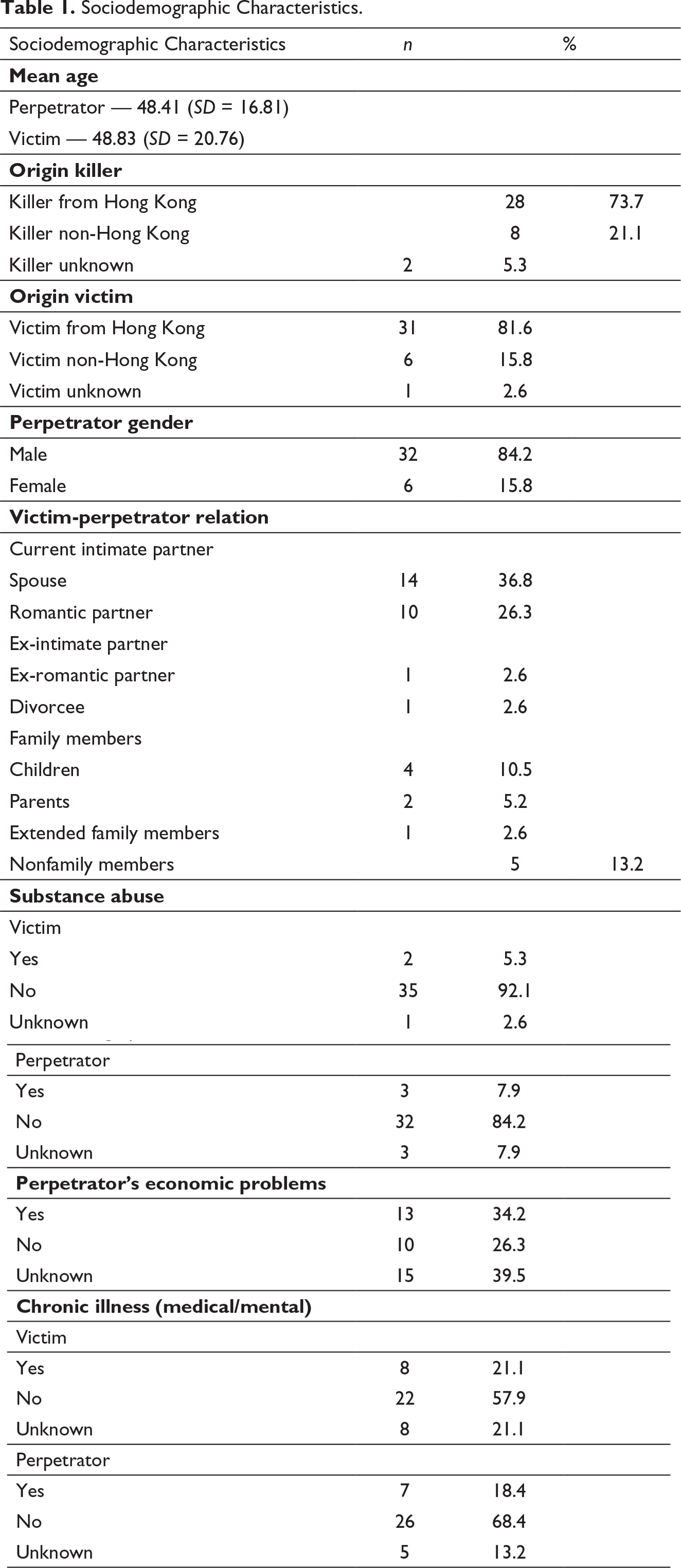
Sociodemographic Characteristics by Age and Origin.

Criminological Characteristics of Femicide in Hong Kong
Domestic Context.
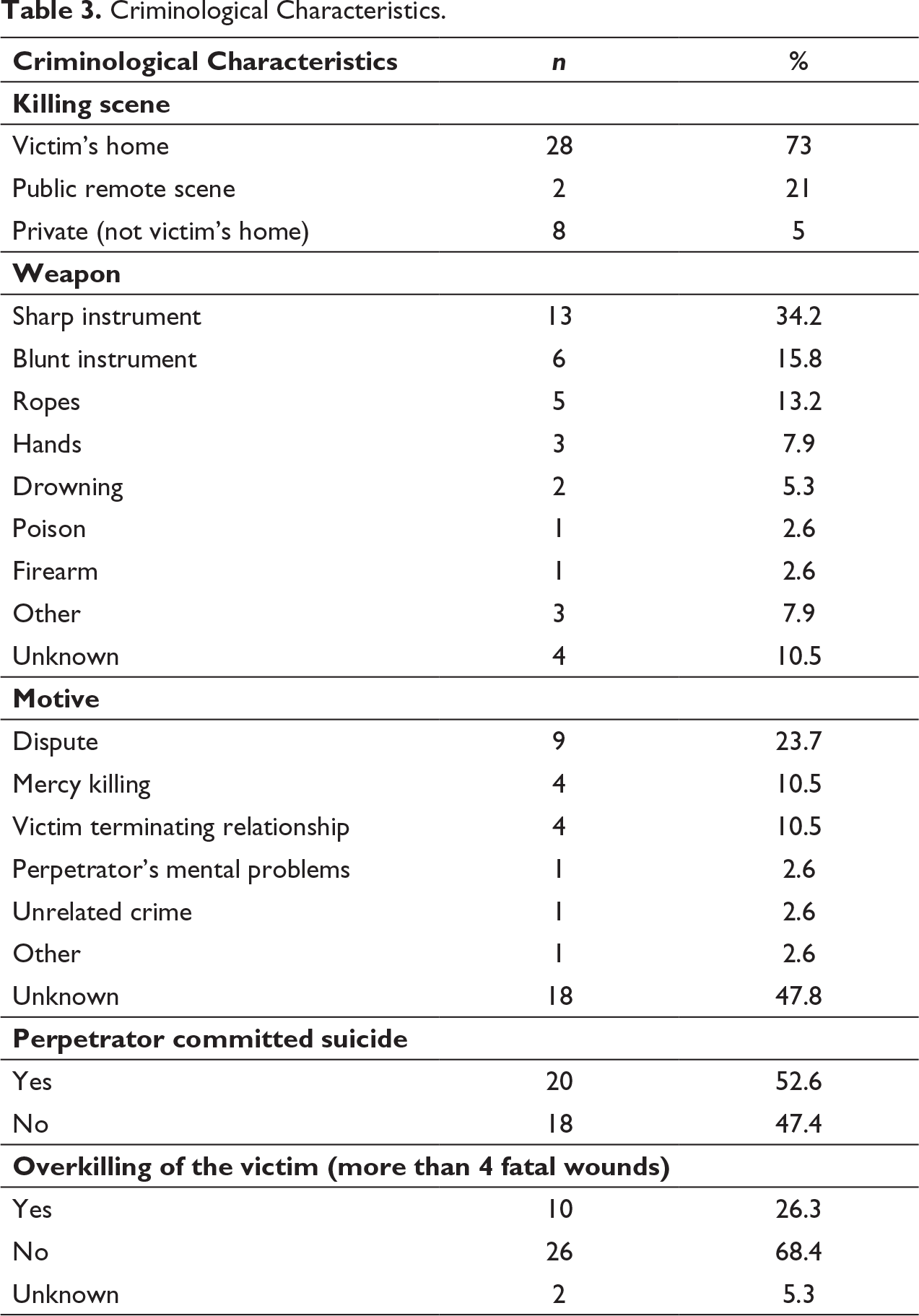
As can be seen in Tables 2 and 3, the cases display empirical proximity to the family arena: as can be seen in Table 2, most femicide cases were perpetrated by family members (87%, n = 33), and as can be seen in Table 3, most killings (73%, n = 28) were perpetrated at the location where both the victim and the killer resided. The vast majority of femicide cases were perpetrated by the victim’s intimate partner (current or ex-intimate partner/divorcee/spouse) (68%, n = 26), with the most common killer being the victim’s current or ex-spouse (39%, n = 15), followed by the victim’s nonmarried current or ex-intimate partner (29%, n = 11). When calculated based on victim age, younger women less than 60 years of age were more likely to be killed by their intimate partner compared to women aged 60 and above (79%, n = 19/24 and 50%, n = 6/12, respectively), although these results are statistically insignificant (Fisher’s exact test p > .05). Family member killers (parents/children/uncles) comprised 18% (n = 7) of all killers, with the victim’s children comprising most femicide killers in this group (57%, n = 4, composed of two sons and two daughters).
Motives.
As can be seen in Table 3, the most common motive related to the killing was dispute (personal, financial or familial) which comprised 24% (n = 9) of all femicide cases, followed by intimate partnership dissolution on the part of the victim and mercy killing (as described by media coverage and ruling statements stressing the victim’s chronic and fatal illness along the extended caregiving they received from the would-be killers) of the victim (11%, n = 4 each). The least common motive for killing was the killer’s mental problems (3%, n = 1). When compared by victim’s age, younger women under the age of 60 were more likely to be killed on the backdrop of a dispute and their wish to terminate the intimate relationship with the would-be killer (50%, n = 5/10 and 30%, n = 3/10, respectively), compared to older women aged 60 and above (33%, n = 3/9 and 11%, n = 1/9, respectively). Older women aged 60 and above were more likely to be killed for reasons of mercy killing compared to younger women less than 60 years old (33%, n = 3/9 and 10%, n = 1/10, respectively), and were more likely to be killed as part of the killer’s engagement in unrelated criminal activity such as robbery (11%, n = 1 and 0%, respectively).
Modus Operandi—Weapons.
The most common weapon used in the femicide cases was a sharp instrument (34%, n = 13), followed by a blunt instrument (16%, n = 6), rope (13%, n = 5) and hands (8%, n = 3). The least common weapons used in femicide cases were drowning (5%, n = 2), firearm, and poison (3%, n = 1 each). Overkilling (more than 4 fatal wounds) was evident in 26%, n = 10 of all femicide cases. When compared by victim’s age, overkilling was more prevalent among younger women less than 60 years of age than among older women aged 60 and above (33%, n = 8/24 and 18%, n = 2/11, respectively). In other words, the killing of elder women was “less brutal.”
Criminological Characteristics.
Modus Operandi—Femicide-Suicide.
As can be seen in Table 3, a notable empirical observation relates to the relatively high frequency of a femicide phenomenon subtype: femicide-suicide (killing of the woman followed by the killer committing suicide). More than half of the killers committed suicide after killing the woman (53%, n = 20). Statistically significant sociodemographic differences were found between the two types of killers regarding their substance abuse, prior criminal record, and origin.
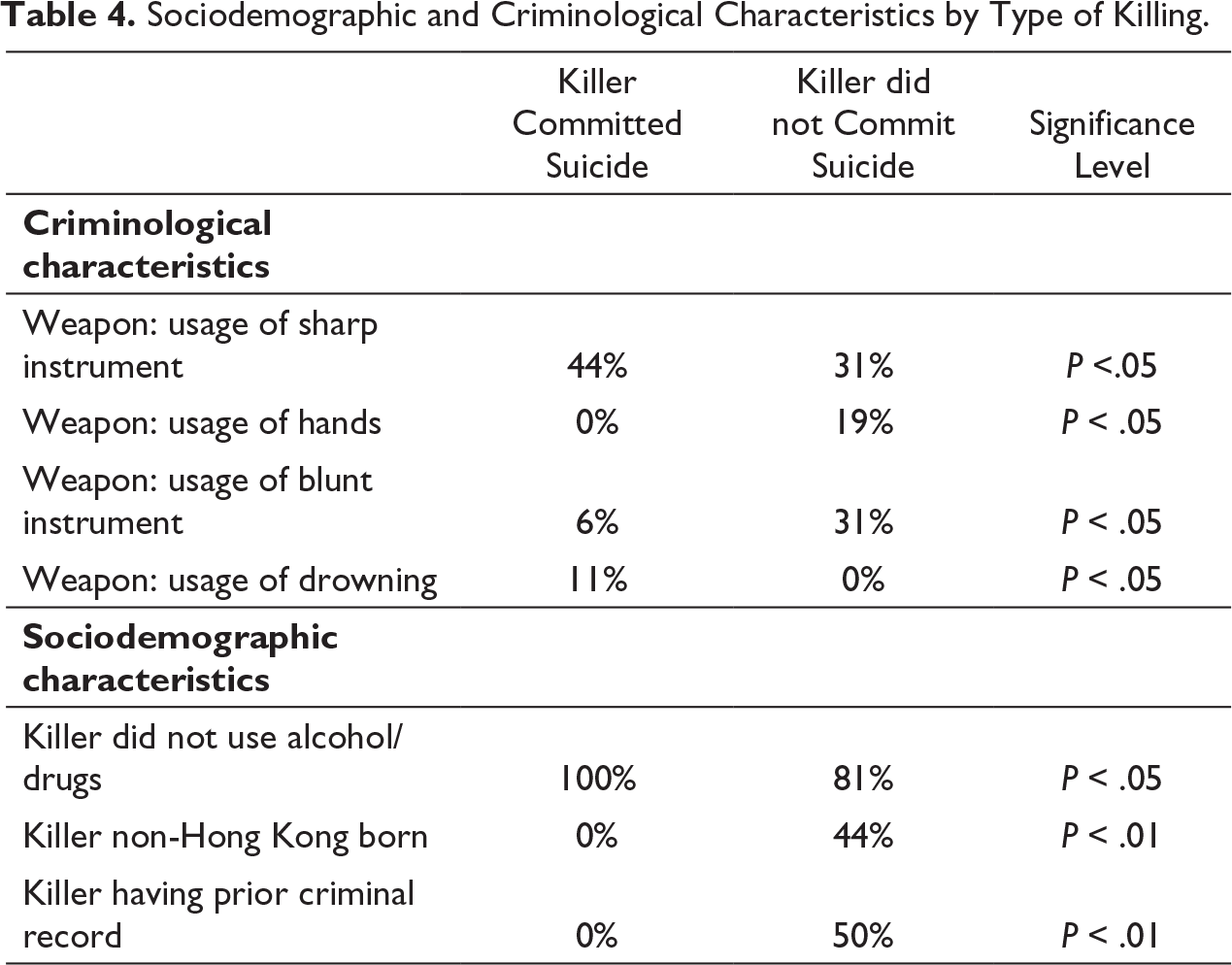
As can be seen in Table 4, the low drug or alcohol usage rates previously noted with regard to all killers (8%, n = 3) were all the more prominent when comparing killers who committed suicide with those who did not: only killers who did not commit suicide after the killing used drugs or alcohol, while none of the femicide-suicide killers used drugs or alcohol at the time of the killing and when committing suicide (χ2(1) = 3.896, p < .05). Similarly, no prior criminal records were found among femicide-suicide killers, while 50% (n = 9) of the killers who did not commit suicide had prior criminal records (Fisher’s exact test, p < .01). Additionally, while none of the non-Hong Kong born killers committed suicide, killers who committed suicide after committing femicide were exclusively Hong Kong born (Fisher’s exact test, p > .01).
Sociodemographic and Criminological Characteristics by Type of Killing.
Discussion
Three sociodemographic characteristics of femicide in Hong Kong echo prior global findings, particularly the gender aspect of the phenomenon, with women killed mainly by men and proximity to the familial arena in that most women are killed by their intimate partners (Bitton & Dayan, 2019; Campbell et al., 2007). These aspects speak to both the universality of the phenomenon across societies and cultures, as well as to its crucial intersection with gender-based violence in general and domestic violence in particular (Campbell et al., 2003, 2007).
The overrepresentation of minorities and immigrants among femicide victims and killers was also previously noted in global studies, usually linked to theories of social strain to explain the difficulties facing immigrants and minorities (Campbell et al., 2003; Dayan, 2018; Geiger, 2013; Wallace, 1986). The overrepresentation of non-Hong Kong victims among those suffering from domestic injuries in Hong Kong was previously noted by Choi et al. (2015), who reported that about 20% of females admitted to hospitals due to domestic violence injuries were non-Chinese women (mainly from South East Asia). The empirical findings of the study corroborate victimology theories, noting that the vulnerability of women in general, and of immigrant and minority women in particular (Adinkrah, 2003; Mathews et al., 2008; Roberts et al., 2010), points to the possible identification of this sociodemographic status as a femicide social risk factor.
Aside from the above sociodemographic universal characteristics, a unique pattern of femicide is empirically evident in Hong Kong: the overrepresentation of elderly female victims. The alarming number of elderly women who were killed is in stark contrast to sociodemographic global patterns of homicide in general and femicide in particular (Koheler et al., 2006). Thus, while relative age-specific homicide risks faced by women differ across the various continents, all continents share the decline of homicide risks faced by women aged 60 and above (Brennan, 2018; UNODC, 2019, Vol. 2, p. 16). The share of elderly femicide victims in Hong Kong is all the more at odds when compared to the fact that age-specific homicide risks faced by women across Asia are for women 30-44 years of age (UNODC, 2019, Vol. 2, p. 16). In fact, there is a decreasing global pattern of homicide of female victims aged 60 and above (UNDOC, 2019, Vol. 2, p. 62). If anything, the high proportion of the elderly in the aging population in Hong Kong should have resulted in a smaller number of femicides, as an aged population has been linked to lower homicidal rates, to the point of arguing that an aging population may in and of itself function as a protective factor against homicide (Santos & Testa, 2018). On the other hand, this finding might be related to patterns concerning elder homicide in general, because several studies noted that women are overrepresented among older homicide victims (Abrams et al., 2007; Jordan et al., 2010; Shields et al., 2004).
The high proportion of elderly women in femicide cases perpetrated in Hong Kong seems to run counter to Chinese Confucian cultural norms which uphold respect to social hierarchy in terms of age and generation (Chung, 2001; Hernandez, 2017; Tang, 1999). This high proportion has never been reported as such in prior studies about homicide and homicide-suicide in Hong Kong, and indicates a change of pattern, a new social risk factor for femicide that should be addressed. This is particularly significant in light of the high life expectancy in Hong Kong in general (Wong & Yeung, 2019) and among Hong Kong women in particular (CSD SAR, 2019), along with future expected demographic trends indicating the continuous growth of the elderly population in Hong Kong (CSD SAR, 2019).
Criminological characteristics of femicide in Hong Kong are similar to global findings in terms of the victim’s home as the most common killing location. In this respect, “the home remains the most dangerous place for women, who continue to bear the heaviest burden of lethal victimization as a result of inequality and gender stereotypes” (Campbell et al., 2003; Chan et al., 2010; UNODC, 2019, Vol. 1, p. 14). Similarities have also been noted with regard to multiple additional victims such as the victim’s children (Flynn et al., 2009; Liem et al., 2011; Lund & Smorodinky, 2001; Marzuk et al., 1992; Panczak et al., 2013), particularly in femicide-suicide cases. Indeed, as observed in this and previous studies, femicide-suicide displays empirical proximity to the family arena/sphere and to femicide (Banks et al., 2008; Flynn et al., 2009; Liem et al., 2011).
Still, while Western studies note that in most femicide cases the killing was perpetrated on the backdrop of the woman’s decision to dissolve the intimate partnership (Campbell et al., 2003), the most salient motive for femicide in Hong Kong is related to a dispute of some kind, financial or familial. This finding regarding disputes as the salient motive for femicide may be related to financial or economical problems in Hong Kong, as financial disputes seem to be a recurrent theme in this study. Financial domestic disputes may be linked to Hong Kong’s financial crises felt throughout the years the research was conducted. Being an international financial hub, Hong Kong was greatly affected by the global financial crisis of 2008, which continued affecting its financial situation during 2010-2016, with poverty rates increasing from 14.7% in 2016 to 20.1% in 2017. 2 This lingering financial crisis was further exacerbated by a notable economy recession rooted in Hong Kong citizens’ protesting of China’s involvement in Hong Kong (2014-2019), which coincided with the U.S.-China trade war. 3 This financial context resonates with research findings on femicide and femicide-suicide, linking the two by financial hardships faced and strain theories (Dayan, 2019; Geiger, 2013).
Take for example a 77-year-old husband who killed his 76-year-old wife on the backdrop of a dispute over social welfare department money. According to the court, the jury’s verdict “accepted that something the killer’s wife had said and done that night caused him to snap and assault her violently and kill her in the course of that assault.” In sentencing the killer, the court stated that indeed there was no evidence that the killer was a violent man by nature, and added, very much to the killer’s credit, that he and his wife had brought up three children, all of whom the court had “no reason to believe are anything other than hardworking and decent citizens” HCCC 48/2015, HKSAR vs. Woo Kam-cheung).
The current empirical analysis of femicide in Hong Kong demonstrates a point of departure from previous sociocultural homicidal patterns reported with regard to homicide-suicide in this city. This is the first time mercy killings of elderly women by their spouses, and of elderly mothers by their children (matricide)—have ever been reported in Hong Kong. Thus, the study findings are unprecedented, as in prior studies on homicide-suicide mercy killing was virtually absent. In fact, prior studies reported that homicide-suicide in Hong Kong differs from cases reported in Western literature with respect to the absence of mercy killing between elderly couples (Chan, 2007; Chan et al., 2003; Yip et al., 2008). This absence among the elderly in Hong Kong was highlighted as a unique feature of homicide-suicide in Hong Kong that linked to traditional Chinese values that emphasize parental dignity and encourage cohabitation with elderly parents, in compliance with the expectation of filial piety as a Confucian value. This also serves to explain the similar absence of mercy killing perpetrated by a spouse of a couple that has children, since the caregiving obligations of Chinese grown-up children living in Hong Kong towards their frail elderly parents results in many elderly people living with their adult children (Yip et al., 2008).
This new phenomenon of mercy killing in Hong Kong might pertain to the myriad concerns of the main caretaker (either spouse or child) over the future ability to provide and attend to the medical needs of their elderly and chronically ill spouse/parent. The killing method used in such killings also tends to take on a “merciful” quality: with a higher likelihood of choosing a “nonbloody” weapon such as asphyxiation. One such typical example refers to a defendant who was 80 years old in 2017 when he killed his 76-year-old wife. According to the court’s ruling, the couple had a son who suffered from Crohn’s disease and tragically killed himself in 2007 when he was 23 or 24 years old. At that time the defendant was already a 70-year-old man. His wife suffered a stroke in 2015, in addition to her other illnesses that included hypertension, rheumatoid arthritis, and hypothyroidism. At first, she was admitted to a home for the elderly, but later moved back home to live with the defendant, who was her primary caregiver until her death. She suffered from another stroke and was paralyzed on her right side, and went on to lose her mobility and sense of taste and to suffer from falls and chronic pain. She also lost her eyesight so she could no longer watch television with the defendant.
The defendant in this case, grew increasingly concerned when his own health began to deteriorate, and began to worry that he would die before his wife and she would then starve to death. He thought of ending his wife’s life many times but did not have the courage to do so. While the deceased never told the defendant that she wanted to die, she repeatedly mentioned her pain and immobility, saying that she was sick and tired of her life. On the night prior to the killing the deceased again told the defendant how dissatisfied she was with her life. After the defendant cooked for her, she asked him why she had to eat when she could not taste anything. At around 5 am on 6 June 2017, when the defendant woke up, he saw his wife lying face up, exposing her neck. He took a bamboo stick which he used to scratch his back and pressed it against his wife’s neck for about 30 minutes. His wife did not struggle. He stopped when he felt tired and could not feel his wife’s pulse. Initially he had planned to kill himself after killing his wife, hence the three notes he wrote regarding disposal of the belongings and his body. He then changed his mind, as he wanted to shoulder the responsibility. The court noted that both the defendant and his siblings had written asking for leniency and stating that he had killed his wife as an act of mercy to end her suffering. The defendant’s siblings even offered their apologies for having failed to take care of the defendant and promised the court that they would look after the defendant from now on. Explaining the defendant’s lenient sentence for manslaughter the court stated:
This is indeed a tragic case. The defendant and his wife lost their only son when their son was only in his early twenties and the defendant was already 70 years of age. The defendant did not have anyone to share the responsibility of taking care of his wife. This was the case of one aged person taking care of another aged person. One can imagine the hardship faced by both: for the wife, the pain and suffering and the indignity of having to rely on her husband to help her in almost all aspects of daily life; for the husband, the physical difficulty of taking care of the wife and the mental anguish in watching her suffer. As the defendant was suffering from Major Depressive Disorder which substantially impaired his judgment and his ability to control his actions, he felt that killing his wife was an act of mercy, the only way available to help her and her suffering.” (HCCC 94/2018 [2019] HKCFI 223, HKSAR v Wong Kok-man).
Unique criminological characteristics were noted regarding the killing weapon. Whereas most studies conducted on femicide point to firearms as the most common weapon of choice, sharp instruments are the weapon of choice in Hong Kong. The tendency to use sharp instruments was reported in prior research on homicide in Hong Kong (Au & Beh, 2011; Chan, 2007; Lau et al., 2012; Yip et al., 2008) and may be related to extensive restrictions on firearms under Hong Kong law (Chan et al., 2003). At the same time, the weapon of choice may indicate cultural preferences, as studies on femicide in non-Western societies have noted the tendency to use sharp instruments over firearms (Dayan, 2018). An additional weapon that seems to be culturally endemic to Hong Kong relates to charcoal burning. This entails smoldering barbecue coal in a small and sealed space in the aim of producing carbon monoxide, believed to be a nonviolent, nondisfiguring, and painless way to end one’s life (Chen et al., 2015; Liu et al., 2007).
As noted, a relatively high rate of femicide cases in Hong Kong take on the particular modus operandi of femicide-suicide. In these cases, most empirical observations are similar to patterns seen globally in terms of the killer’s gender: male (Stack, 1997, p. 442, 445; Wallace, 1986, p. 191), the relationship to the victim: predominantly the victim’s intimate partner (e.g., Banks et al., 2008; Berman, 1996; Flynn et al., 2009; Harper & Voigt, 2007; Liem et al., 2011; Milroy, 1995; Saleva et al., 2007; Scott, 2009; Wallace, 1986; Warren-Gordon et al., 2010), the killer’s low usage of drugs and alcohol at the time of the killing (Cooper & Eaves, 1996; Harper & Voigt, 2007; Morton et al., 1998; Panczak et al., 2013; Starzomski & Nussbaum, 2000) and the low incidence of prior criminal behavior among the killers (Cooper & Eaves, 1996; Flynn et al., 2009; Morton et al., 1998; Scott, 2009).
Nonetheless, a unique criminological characteristic was found regarding the femicide-suicide modus operandi in Hong Kong. Studies of femicide-suicide conducted in Western countries pointed to high levels of brutality, as demonstrated by lethal intimate or domestic femicide-suicide cases with multiple face and head wounds. Thus, it was reported that in more than two-thirds of the sample of intimate or domestic cases in Harper and Voigt’s study (2007), perpetrators seemed bent not only on taking a life but also on obliterating the victim by destroying her face or defacing her with multiple facial gunshot wounds. This pattern was not salient in femicide-suicide cases in Hong Kong, with statistically significant differences found when compared to killers who did not commit suicide. Specifically, femicide-suicide killers in Hong Kong significantly refrained from using “bloody/brutal” weapons such as blunt instruments and hands when killing women and tended to use “nonbloody” weapons such as poison and drowning. This finding echoes Chan’s (2007) reports that Hong Kong homicide-suicide offenders who lacked obvious hostility against their victims experienced frustration from health or financial problems. Moreover, they were more likely to kill their victims with minimum force and less likely to use hands-on methods to kill, thus using for example poisoning by coal gas, by carbon monoxide from charcoal burning, or by pushing the victim from a height.
Conclusion
This research demonstrates the heterogeneity, complexity, and diversity of the femicide phenomenon in different places of the world. In terms of high-risk groups, the findings imply that women may be a high-risk group even in places with a low homicide rate and that older women and foreign women, together with populations struggling with economic hardships, are more vulnerable to femicide.
The empirical findings of this research point to women as a high-risk group in general, and in the familial context in particular. Echoing Verkko’s “static law” (1951), the UN report states that countries with a low homicide rate will have a relatively higher rate of female victims, because intimate partner/family related homicide, which is predominantly male-to-female violence, is relatively stable across countries and regions (UNDOC, 2019, Vol. 2, p. 61). This observation, however accurate statistically, does not offer an explanation as to why female homicide victim rates remain stable and do not decrease even in places like Hong Kong, where homicide crime rates have fallen substantially.
UN’s observations about Hong Kong’s reversed patterns of gender in homicidal crime (where women are at least half if not more of the total homicide victims), as a manifestation of Verkko’s “static law” (1951) which predicts that when the homicide rate is low the proportion of female offenders and victims is higher, deserves a second consideration, in light of the criminological characteristics of femicide. The larger proportion of female victims in places with a low homicide rate may in fact indicate that policies which were effective in decreasing the homicide rate in general, in other words for mitigating male-to-male homicide—are entirely inconsequential and ill-suited for reducing male-to-female homicide. Thus, policies catering to reducing homicide rates in general, that mainly call for the enforcement of regulations in public spaces (such as increasing street lighting and patrolling and restricting gun ownership and bar opening hours), in fact do nothing to eradicate lethal gender-based violence towards women. This is the case because most such lethal violence has empirical proximity to the domestic sphere, not to streets and gangs. Women are mainly being killed in the private, secluded, unpatrolled sphere: at home. Furthermore, they are not killed by gang members and criminals, but rather by so to speak “normative” men (Dobash et al., 2004), and more specifically, by their male family members. This means that unless policies sensitive to gendered forms of homicide are formulated and enforced, the rate of female homicide victims will remain as high, even in places with low homicidal rates.
In addition, the study’s empirical findings suggest that the overrepresentation of elderly women killed by either their spouse or their children point to a possible change of the unique cultural pattern observed in homicide-suicide in Hong Kong up until now. Besides showing gender and aging as alarming femicide social risk factors, the findings may indicate a possible clash between Chinese cultural filial piety values and the social strains faced by people residing in Hong Kong. This alarming pattern should be further studied, particularly in light of Hong Kong’s demographic trend—the growth of its aging population. It may also reflect the possible lack of adequate social welfare services for the elderly population. The latter may be the result if, as argued, the Confucian welfare model is in fact accepted in Hong Kong and translated into government policy. In other word, the family is considered the first line of support for its members, while the government’s services considered a last resort (Bhourhous & Broadhurt, 2015; Lee, 2002; Leung, 2019).
Furthermore, research findings highlight that social factors such as economic hardship may outweigh cultural risk factors in the phenomenon of femicide. This observation is manifested both by the significant overrepresentation of poorer populations among femicide perpetrators: non-Hong Kong-born killers, that is, immigrant and foreign workers, and femicide-suicide perpetrators whose femicide is rooted in financial and welfare hardships. Overrepresented populations facing economic struggles may be linked to Santos et al.’s (2018) findings regarding poverty as a social factor that increases homicide rates in countries with lower homicide rates. Seen as such, the overrepresentation of immigrants, foreign workers, and people facing economic hardships, may be better understood on the backdrop of social strain theories, rather than notions about cultural diversity. In other words, given that immigrants, foreign workers and people amidst financial crisis tend to have higher rates of poverty (Gu & Yeung, 2020)—the abovementioned policy implications regarding the aging population also hold true regarding the need for the social welfare system to be more pro-active in reaching out to this social group. Indeed, the changing nature of the family, particularly the growing aging population, requires state responses instead of dependence on the family. Redesigning social service systems to address the growing elderly population and people facing poverty is urgent, because failing to do so may have very high costs, among them, as this study shows—femicide.
This study has limitations, among them a small number of cases, scarcity of national data sets, lack of relevant information in legal databases (for example, because of the demise of both perpetrator and victim), possibly biased data (media coverage) and missing data in cases without witnesses. Shortcomings relating to data collection have to do with the fact that legal and media databases are not compiled for the purpose of academic research (Chan et al., 2010, p. 404), and therefore information considered peripheral for media coverage or the legal criminal procedure of the case is not necessarily included. In addition, methodological reliance on the secondary sources used in this study (electronic legal databases and media coverage) is, by nature, inherently biased and lacking in detail. The nature of the data collected therefore impedes the reliability and validity of the study findings, and extrapolated observations should therefore be treated with caution.
Future research is needed to validate this research’s empirical observations in a place characterized by low homicide rates. The larger proportion of female victims found in this research may indicate that policies mitigating male-to-male homicide are entirely inconsequential and ill-suited for reducing male-to-female homicide, and in fact do nothing to eradicate lethal gender-based violence towards women. In addition, future research would benefit from analyzing diverse sociocultural manifestations of femicide by contextualizing sociocultural aspects in various parts of the world. Such contextual research will contribute to the understanding of potential risk factors of femicide and the ability to formulate evidence-based and suitable policies. As this research implies, the study of femicide awaits further understanding of minority groups (older women and foreign women), and groups struggling with facing financial and economic hardships, who seem to face higher femicidal risk.
Footnotes
Author’s Note
The author was a senior research visiting fellow in Asia Research Institute, National University of Singapore, at the time the paper was written.
Declaration of Conflicting Interests
Funding
The author(s) received no financial support for the research, authorship, and/or publication of this article.
