



Abstract
Children and adolescents with maltreatment experiences show worse representations of themselves, as compared to their nonmaltreated counterparts. According to the looking-glass self hypothesis (LGSH), individuals’ self-representations (SR) stem from interactions with significant others, reflecting associations between what significant others think of them (i.e., actual appraisals), individuals’ perceptions of significant others’ appraisals of them (i.e., reflected appraisals), and SR. However, little is known about the looking-glass self process in maltreated children and adolescents. This multi-informant study aimed to test the LGSH within the mother–child relationship with children and adolescents with maltreatment experiences. Specifically, including maltreatment experiences as co-predictors, this study analyzed the mediating role of mothers’ reflected appraisals (MRA) in associations between mothers’ actual appraisals (MAA) and children/adolescents’ SR. Participants were 203 children/adolescents (52.5% boys), 8–16 years old (M = 12.6; SD = 2.49), assisted by children and youth protection committees (CYPC), their mother, and their CYPC case workers. Case workers reported on child/adolescent maltreatment, children/adolescents reported on SR and MRA, and mothers reported on MAA. A multiple mediation path analysis revealed significant mediation effects of MRA between MAA and child/adolescent SR in instrumental, social, emotional, intelligence, and opposition SR, thus supporting the LGSH in the context of child/adolescent maltreatment. Also, psychological neglect was associated to worse intelligence SR, mediated by intelligence reflected appraisals. Findings emphasize the importance of the role of MRA on maltreated children and adolescents’ SR construction process, and provide useful clues to incorporate in prevention and intervention strategies targeting maltreated children and adolescents.
Maltreatment experiences are generally associated with disturbances in the self-system in children and adolescents (Berzenski et al., 2019; Cicchetti, 2016; Shonkoff et al., 2012; Thibodeau et al., 2019). Specifically, neglectful and/or abusive caregivers are likely to cause their children to develop negative representations of themselves (Harter, 1998, 2015). Self-representations (SR; or self-schemas) are conceptualized as “cognitive generalizations about the self, derived from past experience, that organize and guide the processing of the self-related information contained in an individual’s social experience” (Markus, 1977, p.1). These SR huddle into different specific domains, corresponding to different categories of self-knowledge, such as instrumental/competence, social, emotional, intelligence, physical appearance, and behavioral conduct, which in turn make up a person’s self-concept (Harter, 2015; McConnel, 2011; Oosterwegel & Oppenheimer, 2002).
SR are constructed through social interactions, especially with significant others (Cooley, 1902/1964; Silva, Calheiros, et al., 2016; Silva & Calheiros, 2018), involving self-relevant feedback of other people (e.g., Oyserman et al., 2012). In the earlier phases of abstract thinking development (i.e., 8–10 years old), maltreatment experiences can shape the cognitive construction of children’s SR toward a greater predisposition to view themselves in a mostly negative way (Harter, 2015). Specifically, neglected children and adolescents, experiencing lack of responsiveness, nurturance, encouragement, and approval, are less likely to be supported in developing SR (Harter, 2015). Abuse experiences, in turn, are likely to set harsh and unrealistic behavior expectations that, being unattainable, might cause feelings of personal failure in children and adolescents (Harter, 1998). In the extreme, children subjected to severe and chronic maltreatment can come to view themselves as fundamentally flawed (Turner et al., 2017). Such negative SR, inculcated in hostile family environments, can become automatized and increasingly resistant to change (Siegler & Alibali, 2005). In the process of incorporating the opinions of significant others in their SR, maltreated children and adolescents ultimately internalize the contempt that maltreating parents communicate in their interactions with them (Harter, 1998, 2015).
The Looking-glass Self Hypothesis
Theories and research in the field of self and identity converge in asserting that social interactions and individuals’ perceptions of how they are perceived by others are main sources of self-knowledge (e.g., Nurra & Pansu, 2009; Oyserman et al., 2012). This process has been the focus of the symbolic interactionism theory (Cooley, 1902/1964; Mead, 1934), according to which, throughout development, people gradually accumulate a stock of self-schemas, which are built as significant others, as well as others in general and the broader cultural context, inform them about themselves. The incorporation of significant others’ appraisals in one’s SR has been enunciated by Cooley’s looking-glass self hypothesis (LGSH; Cooley, 1902/1964; Wallace & Tice, 2012), which proposes that individuals’ SR reflect how they perceive to be perceived by significant others (i.e., reflected appraisals). Specifically, according to the LGSH, SR are indirectly influenced by others actual appraisals, through others’ reflected appraisals (Kinch, 1963; Shrauger & Schoeneman, 1979; Stets et al., 2020).
Although the symbolic interactionists recognize that social relationships in general and the broader cultural context have an important role in the construction of individuals’ SR (Cooley, 1902/1946; Mead, 1934), the LGSH proposed that close and significant social relationships are especially relevant in this process. According to Cooley (1902/1964), SR develop through interaction and communication with specific and significant others and reflect individuals’ perceptions of how they are perceived by others. In close relationships, there are typically opportunities for individuals to observe, in a more regular basis, the cues about others’ actual appraisals, which may therefore be more salient (Cook & Douglas, 1998). In addition, research has indicated that close others are more likely to have more information and to make accurate appraisals about one’s personal attributes than others in general (Bollich et al., 2011; Vazire, 2010; Vazire & Carlson, 2010, 2011). In line with this, more recent evidence has showed that individuals are more confident about their reflected appraisals regarding informants they are closer to or who they have known longer (Carlson & Furr, 2013).
Since SR are more malleable in early life, significant others (e.g., parents, teachers, friends), especially parents, are particularly influential in shaping the construction of individuals’ SR across childhood and adolescence in almost every domain of activity (Carmichael et al., 2007; Paulus et al., 2018). Regarding the potential contributions of different significant others to the construction of SR in adolescence, although peers become increasingly prominent in adolescents’ significant relationships network (e.g., Harter, 2015; Jankowski et al., 2014; Pfeifer & Peake, 2012), relationships with parents continue, nonetheless, to have a pivotal role as building blocks for self-construction (Gniewosz et al., 2012; McLean, 2016; Nurra & Pansu, 2009).
In view of this body of research, parent–child relationships, being at the center of children and adolescents’ social network, provide the most valuable context for studying the LGSH in children and adolescents (Nurra & Pansu, 2009). In addition to the strong emotional connection, the closeness of parent–child relationships allows children to have a better awareness of how their parents perceive them (Cook & Douglas, 1998). Indeed, the unique, pervasive, and potentially continuous and stable influence of parent–child relationships has been soundly supported in research (e.g., Collins & Laursen, 2004). In line with these arguments, studies analyzing the LGSH with children and adolescents in the context of parent–child relationships, have indeed found support for the mediating role of parents’ reflected appraisals in associations between parents’ actual appraisals and children/adolescents’ SR (Bellmore & Cillessen, 2006; Bois et al., 2005; Nurra & Pansu, 2009; Silva et al., 2020).
However, these studies were all developed in community samples, so the processes proposed by the LGSH remain unexplored in the context of child maltreatment. Since maltreated children and adolescents are particularly vulnerable to construct negative SR, as a result of traumatic social experiences and their parents’ negative perceptions of them (Van der Kolk et al., 2005), analyzing these processes in the context of child/adolescent maltreatment may provide important clues for the development of interventions aimed at protecting these children and adolescents from those negative consequences. The LGSH emerges then as a promising framework to analyze how maltreating caregivers’ appraisals of their children are associated with children and adolescents’ SR.
Moreover, although previous studies have considered the multidimensional nature of SR, by analyzing the LGSH in several domains of child and adolescent SR, these studies have considered each domain under analysis in isolation, not considering potential cross-domain associations (e.g., Nurra & Pansu, 2009; Silva et al., 2020). Given that the contemporary perspectives on the self conceptualize SR domains as being interrelated (Harter, 2015; McConnel, 2011), considering potential cross-domain effects in the LGSH could further contribute to increase our understanding of how significant others’ appraisals may influence children and adolescents’ SR. In addition, most previous studies have focused on more concrete representations of the self, namely self-perceptions of competence. However, research indicated that, with development, as children accumulate more information about the self, concrete SR become increasingly abstracted into trait summaries (McConnel, 2011). With the emergence of concrete operations in middle childhood, there is a transition from the more concrete SR (i.e., attributes that are observable) to more conceptual or trait-like self-attributes, which represent the newfound ability to classify specific attributes into categories and to form higher-order generalizations about the self (Ray et al., 2009). Thus, research on the LGSH with children and adolescents should be supplemented by analyzing SR operationalized as self-schemas, focusing on their specific cognitive content (e.g., Markus, 1977).
The Present Study
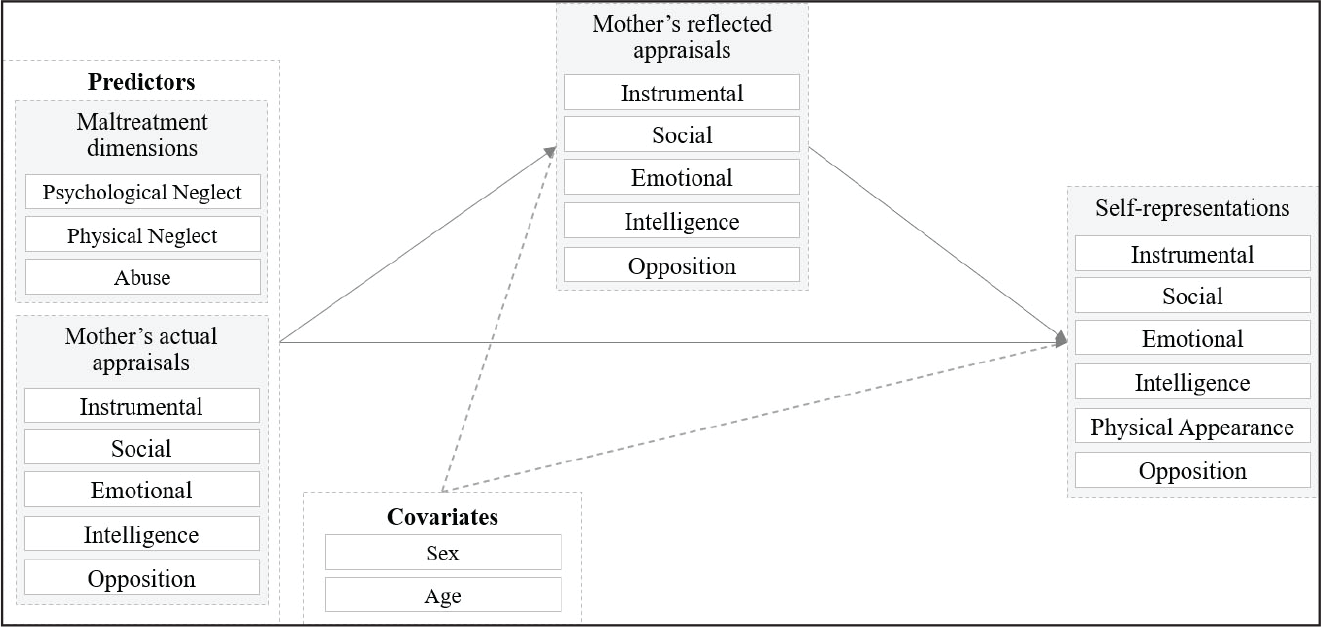
This study aimed to test the LGSH as a model accounting for the social construction of children and adolescents’ SR in the context of child/adolescent maltreatment. Specifically, we intended to test the mediating role of mothers’ reflected appraisals (MRA; i.e., children and adolescents’ appraisals of their mothers’ appraisals of them) in the effects of maltreatment experiences and mothers’ actual appraisals of their children (MAA; i.e., what parents actually think of their child) on children and adolescents’ self-representations. In doing so, we intended to go beyond previous studies testing the LGSH by considering not only within-domain effects (i.e., pathways between the different perspectives of the same representation domain) but also cross-domain effects (i.e., concurrent pathways including the different domains of MAA, MRA, and SR). Based on the theoretical background presented above, it was expected that MRA would mediate associations between MAA content and children and adolescents’ SR. In addition, it was expected that the associations between and among the LGSH elements would be stronger for the SR domains including more observable characteristics, for which feedback is more likely to be clearly communicated through parent–child communication. Also, considering that self-concept is conceptualized as a multidimensional system, in which the information about the self is organized in a set of multiple domain-specific, conceptually, and statistically independent but interrelated SR (Harter, 2015; McConnel, 2011), it was also expected to find some cross-domain mediational pathways, especially between and among representation domains comprised by more observable characteristics. The hypothesized model is depicted in Figure 1.
Visual representation of the hypothesized model.
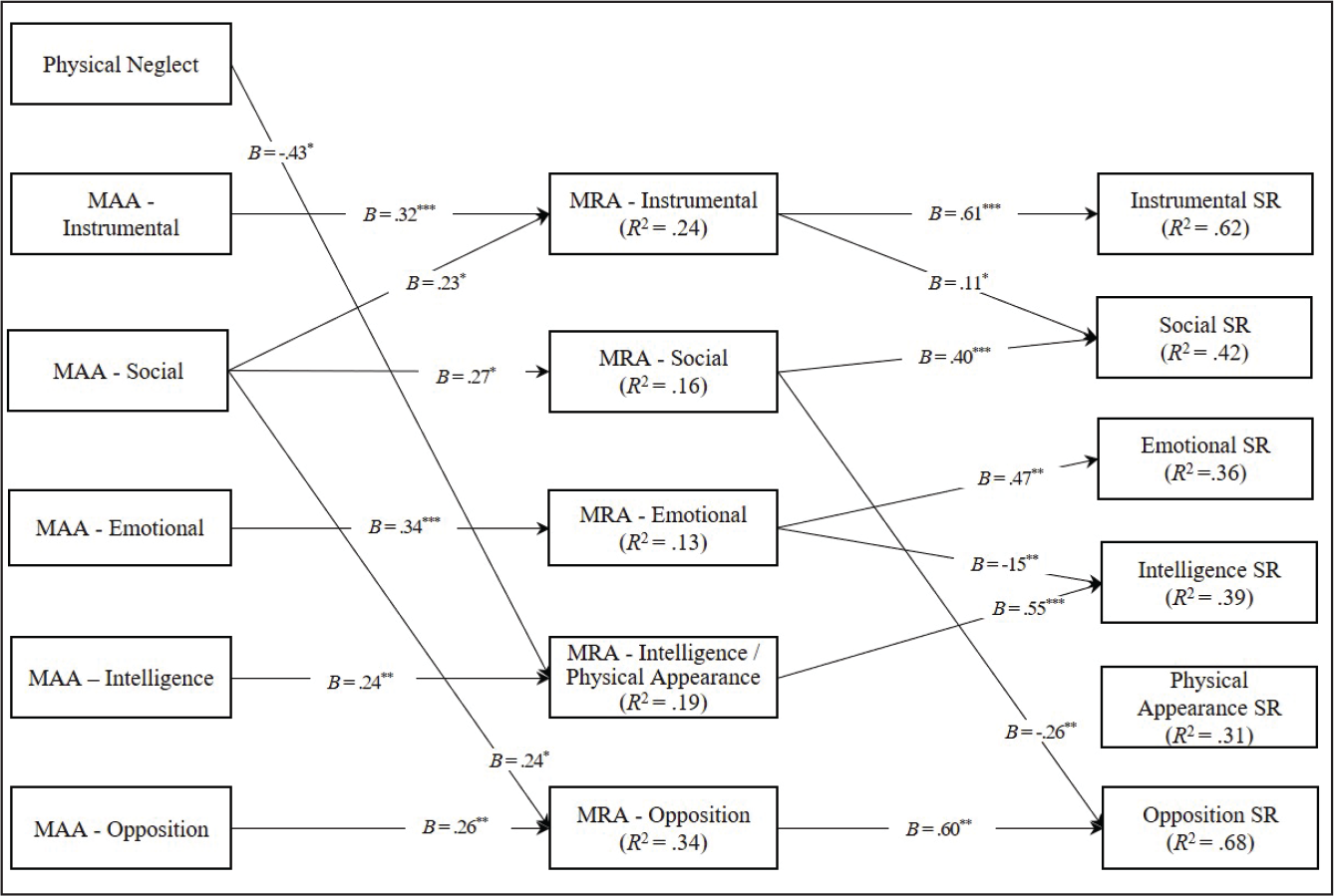
Note. Arrows in solid refer to significant indirect effects. For ease of interpretation, only significant effects and covariances are represented. MAA = Mothers’ actual appraisals; MRA = Mothers’ reflected appraisals; SR = Self-representations.
Method
Participants
Sociodemographic Characteristics of the Study Sample.
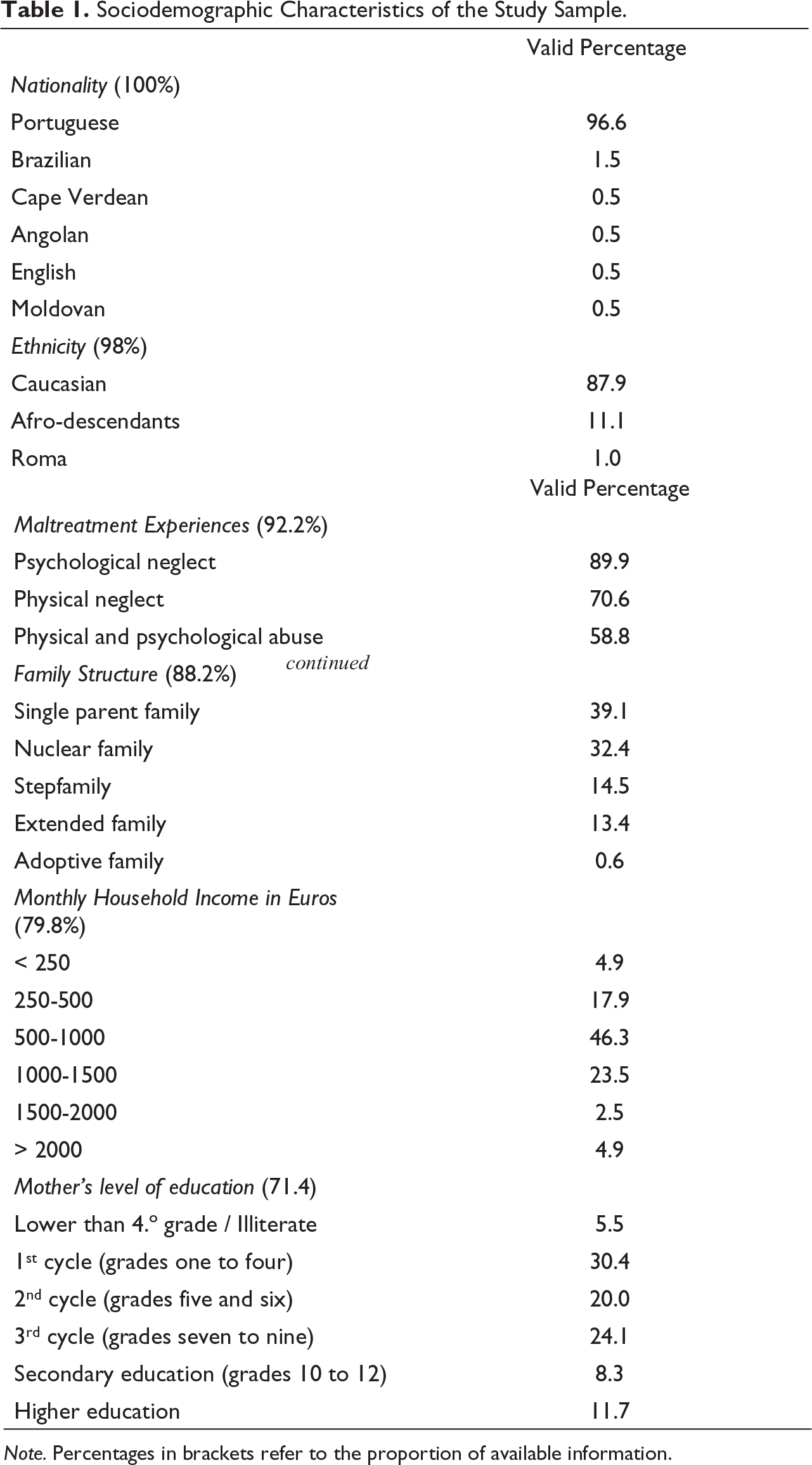
Note. Percentages in brackets refer to the proportion of available information.
Measures
Child and adolescent maltreatment. Children and adolescents’ maltreatment experiences were measured through the Child Maltreatment Severity Questionnaire (MSQ; Calheiros et al., 2019), filled out by the CYPC case workers based on the information they had gathered regarding each participating child/adolescent. The MSQ consists of 18 items, each with 4 descriptors, which were rated by the case workers using a 5-point scale (1 = unknown/never occurred; 2 = a little severe; 3 = moderately severe; 4 = highly severe; 5 = extremely severe). The eighteen items are organized in a three-factor structure, comprising the dimensions: (a) Physical Neglect, composed of eight items describing parental omissions regarding the assurance and monitoring of the child’s physical well-being and health, namely clothing, hygiene, housing conditions and contextual environmental security; (b) Physical and Psychological Abuse, consisting of four items describing abusive physical and psychological actions, namely coercive/punitive disciplinary methods, physically violent methods or verbal interactions that offend and denigrate the child, with the potential to disrupt psychological attributes, such as self-esteem; and (c) Psychological Neglect, which comprises six items describing omissions related to children’s emotional development (e.g., failure to respond to children’s need for affection and attention), mental health monitoring, school attendance, development needs. Higher values in each maltreatment dimension indicate more severe maltreatment. A confirmatory factor analysis of the MSQ with the present sample revealed an acceptable model fit (χ² (115) = 271.57; χ²/df = 2.36; CFI = .91; RSMEA = .08, CI90% [.07, .09]; SRMR = .08) and good internal consistency (Cronbach’s alpha) values for all three factors: Physical Neglect (α = .80), Physical and Psychological Abuse (α = .79), and Psychological Neglect (α = .81).
Self-representations. SR were measured with the Self-representation Questionnaire (SRQ; Martins, 2013; Silva, Martins, et al. 2016]), consisting of 18 attributes—10 positive (e.g., happy, intelligent) and 8 negative (e.g., sad, lazy)—in which children and adolescents rated themselves on a 5-point scale, from 1 = not at all like this to 5 = I am exactly like this. This measure comprises six factors: instrumental (five items; e.g., responsible); social (four items; e.g., nice); emotional (three items; e.g., angry); physical appearance (two items; e.g., pretty); intelligence (two items; e.g., intelligent); and opposition (two items; e.g., stubborn). The negative attributes are reverse scored. Thus, higher values in each domain represent more favorable SR. In the present sample, the attribute “friendly” was excluded from the subsequent analyses due to a highly skewed distribution (i.e., sk = −3.75; sk/SE = 21.49). A confirmatory factor analysis of this factor structure with the present sample with the remaining 17 attributes revealed a good model fit: χ2 (116) = 209.45, p < .001; χ2/df = 1.81; CFI = .92; RMSEA = .08, 90% CI [.05, .07]; SRMR =.06. Internal consistency of the SR domains in the present sample, assessed through Cronbach’s alpha, was acceptable to good: instrumental (α = .73), social (α = .68), emotional (α = .63), physical appearance (α = .84); intelligence (α = .84); and opposition (α = .70). For the social and emotional SR domains, the alpha coefficients fell below the .70 benchmark, usually considered to establish acceptable reliability. Given that a small number of items per factor can lead to lower alpha coefficients, particularly when items are less than seven (Swailes & McIntyre-Bhatty, 2002), we followed the recommendation of Clark and Watson (1995) and for these domains we additionally calculated the mean inter-item correlation—a correction factor provided by Cronbach (1951) which is independent of the number of factor items. The mean inter-item correlation for both the social and emotional domains (i.e., respectively .41 and .36) was within the .15–.50 recommended range, suggesting that the reported alpha coefficients can be considered adequate (Clark & Watson, 1995).
Mothers’ reflected appraisals. Following the standard paradigm used to measure the LGSH components (e.g., Nurra & Pansu, 2009), the instrument used to measure MRA was adapted from the SRQ, consisting of the same 18 attributes, in which children and adolescents were asked to rate what their mothers thought they were in a 5-point scale, from 1 = not at all like this to 5 = exactly like this. Thus, the initial phrase “I am…” was reworded into “My mother thinks I am…”. Negative attributes are reverse scored. Previous exploratory factor analyses on the MRA measure (Silva et al., 2020) resulted in a solution of 16 attributes organized in five dimensions: instrumental (responsible, organized, untidy, and hardworking), social (helpful, caring, nice, and friendly), emotional (sad, lonely), opposition (grouchy, stubborn), and one dimension combining the intelligence and physical appearance attributes (intelligent, smart, pretty, ugly). In the present work, the attributes “ugly” and “friendly” presented a highly skewed distribution (ugly: sk = 2.34, sk/SE = 13.30; friendly = −2.13; sk/SE = 12.12) and were thus removed from the subsequent analyses. A confirmatory factor analysis of this structure with the present sample revealed a good model fit: χ2(66) = 116.48, p < .001; χ2/df = 1.81; CFI = .92; RMSEA = .06, 90% CI [.04, .08]; SRMR =.06. Cronbach’s alpha values ranged from .72 to .84.
Mothers’ actual appraisals. Mothers’ actual appraisals were also measured with an adaptation of the 18 attributes of the SRQ, following the standard paradigm used to measure the LGSH components (e.g., Nurra & Pansu, 2009). Mothers were asked to rate to what extent those attributes described their child, on a 5-point scale, from 1 = not at all like this to 5 = exactly like this. Hence, the initial phrase “I am…” was reworded into “My son/daughter is…”. Negative attributes are reverse scored. Previous exploratory factor analyses (Silva et al., 2020) on the MAA measure resulted in a solution of 14 attributes organized in 5 dimensions: instrumental (responsible, organized, untidy, and hardworking), social (helpful, caring, nice, and friendly), emotional (sad, lonely), intelligence (intelligent, smart), and opposition (grouchy, stubborn). In the present work, the attribute “friendly” presented a highly skewed distribution (i.e., sk = −2.99; sk/SE = 16.68) and thus was removed from the subsequent analyses. A confirmatory factor analysis of this structure with the present sample revealed a good model fit: χ2(51) = 88.60, p < .05; χ2/df = 1.74; CFI = .94; RMSEA = .06, 90% CI [.04, .09]; SRMR =.07. Cronbach’s alpha values ranged from .65 to .75.
Procedure
This study was approved by the Iscte - University Institute of Lisbon ethics commission. A request for permission to conduct the study, with a detailed explanation of its goals and data collection procedure, was made to all the children and youth protection committees (CYPC) of three Portuguese districts—two from the mainland (Lisbon and Setúbal) and one from one Portuguese archipelago (Madeira), via email. In addition, permission was also requested to the Madeira Domestic Violence Victims Support Team (MDVVST). Eighteen CYPC—seven from Lisbon district, four from Setúbal district, and seven from Madeira district—and the MDVVST agreed to collaborate in the study. In each of these services (CYPC and MDVVST), the case workers were asked to select, among the cases they were assisting, the ones regarding children and/or adolescents aged between 8 and 16 years old, in which the evaluation carried out allowed the identification of at least one maltreatment action or omission listed in the MSQ. Then, at the end of a case work meeting, the case workers informed the families that their service was collaborating in a research study and asked the families if they would accept to be provided with more detailed information by the researcher regarding the aims and procedure of the study. For those who accepted, detailed information regarding the goals, procedure, and ethical considerations of the study was provided, followed by an invitation to participate in the study. After declaring to accept, parents signed the information and consent form, declaring to accept to participate in the study and providing permission for their child’s participation. Then, adolescents aged more than 12 years old also signed an information and consent form, and children under 12 years old provided informed assent to participate in the study. All participants were told that their participation was voluntary and that they could choose not to participate or to quit participating at any time, if they desired. Participant anonymity was guaranteed, and they were assured that information would be used only for research purposes. The questionnaires were individually administered to each participant (parents and children/adolescents). Case workers filled out the SMQ for each child/adolescent whose participation was authorized by the parent(s)/parenting figure(s).
Data Analyses
Initial analyses included missing value analysis, descriptive statistics, and bivariate correlations among the model variables (i.e., predictors, criterions, mediators, moderators, and covariates). All variables included in the model were composites computed by averaging their respective items (except for children and adolescents’ age and sex). Preceding the test of the LGSH mediation model, a missing value analysis conducted with all model variables revealed that missing data were mostly at random (MCAR; Little’s MCAR test chi-square = 117.692, DF = 72, p < .05; normed chi-square = 1.63 (so < 2.0). Therefore, missing data were handled with the full information maximum likelihood method, using MPlus 7.1. (Muthén & Muthén, 1998–2012).
Subsequently, the proposed mediation model was tested using path analysis, performed with MPlus 7.1. (Muthén & Muthén, 1998–2012), with bootstrap estimation. Since we intended to test the LGSH in the context of child/adolescent maltreatment, and considering the research literature documenting significant negative relations between child/adolescent abuse and neglect and children and adolescents’ SR (e.g., Shonkoff et al., 2012; Thibodeau et al., 2019), maltreatment dimensions (i.e., physical neglect, psychological neglect, and abuse) were included in the model as co-predictors. Thus, a multi-mediator path analysis was conducted to test indirect effects of maltreatment experiences and MAA (instrumental, social, emotional, intelligence, and opposition) on children and adolescents’ SR, through MRA (instrumental, social, emotional, intelligence/physical appearance, and opposition; i.e., children and adolescents’ appraisals of their mother’s appraisals of them). Given that previous studies have shown significant age and sex differences in adolescents’ SR (see Harter, 2015), participants’ age and sex were included in the model as covariates. Based on theoretical assumptions and on the results of the correlation analysis, correlations between the maltreatment dimensions and between the MAA domains were estimated in the model. For the same reasons, the disturbance terms of MRA domains shown to be significantly correlated, as well as those of SR domains, were allowed to covary in the model. To test the mediation hypothesis, we used bootstrap 95% confidence intervals based on 10,000 bootstrap resamples (Hayes, 2017). To evaluate model fit, the following indexes and criteria were used: the relative χ2 index (χ2/df) values ≤ 2.0 (Arbuckle, 2017), the comparative fit index (CFI) > .95, the root mean square error of approximation (RMSEA) < .05 and the standardized root mean residual (SRMR) < .08 (Hu & Bentler, 1999; Kline, 2011).
A post hoc power analysis using G * Power 3.1 (Faul et al., 2009) indicated that our sample size is sufficient to detect medium and large effect sizes in any of the endogenous constructs (i.e., mediator and criterion variables) of the proposed multi-mediator model. For each mediating variable, with 10 predictors (i.e., covariates, maltreatment dimensions, and MAA domains), with α = .05, and a sample size of 203, power exceeded .95 to detect a medium effect (f2 = .15) and .99 to detect a large effect (f2 = .35). For each criterion variable, with 15 predictors (i.e., covariates, maltreatment dimensions, MAA domains, and MRA domains), with α = .05, and a sample size of 203, power also exceeded .95 and .99 to detect a medium and a large effect, respectively.
Results
Descriptive Statistics and Correlations
Table 2 presents the means, standard deviations, and correlations among all the variables included in the model. Correlations are generally in line with the theoretically expected pattern of relationships. Significant positive correlations were observed among most self-representation domains, as was also the case for the MAA and MRA domains. In addition, significant positive correlations were found between the SR and reflected appraisals domains; these correlations were stronger between the two perspectives of the same domain. All domains of MAA were significantly and positively correlated with reflected appraisals and SR in the same domain, and some significant cross-domain correlations were also found. The correlations between actual appraisals and reflected appraisals in the same domain were stronger than between actual appraisals and SR. In addition, these correlations were weaker than between reflected appraisals and SR. As also expected, child and adolescent age was significantly and negatively correlated with all SR domains and reflected appraisals except for the emotional domain. These correlations were stronger for the opposition domain. A significant negative correlation between age and MAA was found only for the social domain.
Mediation Model
Descriptive Statistics and Correlations Among the Study Variables.

Note. Inst. = Instrumental; Soc. = Social; Emo. = Emotional; Int. = Intelligence; Ph. Ap. = Physical Appearance; Opp. = Opposition; SR = Self-representations; MRA = Mother’s reflected appraisals; MAA = Mother’s actual appraisals. *p < .05. ** p < .01. *** p < .001.
Sex: 1 – Male and 0 – Female and the proportion of males is reported.
Total and Direct Effects of the Predictors, Covariates, and Mediator Variables on Self-representations.

Note. B = Unstandardized estimate; SE = Standard error; CI = Confidence interval; MAA = Mother’s actual appraisals; MRA = Mother’s reflected appraisals.
SR = Self-representations. *p < .05. ** p < .01. *** p < .001.
Effects of the Predictor Variables and Covariates on the Mediator Variables.

Note. B = Unstandardized estimate; SE = Standard error; CI = Confidence interval; MAA = Mother’s actual appraisals; MRA = Mother’s reflected appraisals.
*p < .05 ** p < .01 *** p < .001
In addition to these significant within-domain indirect effects, results also revealed the following cross-domain indirect effects, that is, pathways from MAA to MRA to SR including different representation domains (Figure 1 & 2): (a) Instrumental MAA on social SR through instrumental MRA (B = .04, p = .046, 95% CI [.006, .075])—higher instrumental MAA were associated with higher instrumental MRA, which, in turn, were associated with higher social SR. In other words, children and adolescents appraised by their mother as, for example, more responsible, organized and hardworking, are more likely to think that their mothers perceive them that way, and subsequently tend to think of themselves as nicer, friendlier and more helpful; (b) Social MAA on instrumental SR through instrumental MRA (B = .14, p = .052, 95% CI [.009, .295])—higher social MAA were associated with higher instrumental MRA, which, subsequently, were associated with higher instrumental SR. That is, children and adolescents appraised by their mother as nicer, friendlier and more helpful, are more likely to think that their mothers perceive them as responsible, organized and hardworking, and subsequently are also more likely to perceive themselves that way; and (c) Emotional MAA on intelligence SR through emotional MRA (B = –.05, p = .035, 95% CI [–.108, –.013])—higher emotional MAA were associated with higher emotional MRA, which, subsequently, were associated with lower intelligence SR. That is, children and adolescents appraised by their mother as sadder, angrier, and lonelier, are more likely to think that their mothers perceive them that way, and subsequently tend to perceive themselves as less intelligent and smart. Results also revealed a significant total indirect effect of Social MAA on physical appearance SR (B = .11, p = .042, 95% CI [.021, .248]). Children and adolescents appraised by their mother as nicer, friendlier, and more helpful are more likely to report more positive physical appearance SR. This significant global indirect effect, in the absence of any significant specific indirect effect, indicates that all MRA domains taken together accounted for this relation (i.e., the sum of all specific indirect effects).
In addition to the effects described above, results revealed a significant indirect effect of physical neglect on intelligence SR, via reflected appraisals in the intelligence and physical appearance domain (B = –.24, p = .047, 95% CI [–.476, –.011]). That is, children and adolescents with higher levels of physical neglect experiences thought their mother thought of them more negatively in terms of intelligence and physical appearance, and, in turn, perceived themselves as less intelligent and smart.
Discussion
This study aimed to test the looking-glass self hypothesis (LGSH) in the context of child and adolescent maltreatment, considering the relationship between children and adolescents and their mother. Research and theories on the self converge in asserting that the relational context is paramount for individuals’ development, functioning as the primordial soup for the construction of SR (e.g., Bollich et al., 2011; Carmichael et al., 2007; Cooley, 1902/1964; Stets et al., 2020). Specifically, the LGSH, integrated in the symbolic interactionism theory, highlights the pivotal role of interactions with significant others in the self-representation construction process, positing that SR stem from significant others’ actual appraisals, through significant others’ reflected appraisals (Cooley, 1902/1964; Kinch, 1963; Nurra & Pansu, 2009). Results of this study revealed that the LGSH was supported for each self-representation domain common to the three perspectives analyzed (i.e., instrumental, social, emotional, intelligence, and opposition domains). In addition, findings showed total mediation for the instrumental, social and intelligence domains, and partial mediation for the emotional, physical appearance and opposition domains. These findings thus support the assumption that what mothers think of their children (i.e., MAA) influences what children and adolescents think of themselves (i.e., SR), and that this influence is mediated by what children/adolescents think their mothers think of them (i.e., MRA).
These results provide further support to the findings of a recent study, conducted with adolescents from a community sample (Silva et al., 2020), in which the LGSH, tested in the context of parent–child relationships, was supported for the instrumental, social, emotional, and opposition self-representation domains. Another similarity between that study and the present one regards the total and partial mediation effects: (Silva et al., 2020) also found that, in the mother–adolescent model, mediation was total for the instrumental and social domains, and partial for the emotional and opposition domains. These findings are also in line with previous studies testing the LGSH with children, considering the role of specific significant others, and focusing on the analysis of their skills perception (Bois et al., 2005; Nurra & Pansu, 2009), in which the LGHS was supported regarding perceived social acceptance, academic, physical, and behavioral skills (Nurra & Pansu, 2009), and athletic skills (Bois et al., 2005). Moreover, findings of this study expand this previous body of research, by testing the LGSH in the context of child/adolescent maltreatment, with a sample from an understudied vulnerable population—children and adolescents reported to the child protection system. In addition, this study also adds to previous tests of the LGSH by considering cross-domain effects. Indeed, testing the LGSH for all self-representation domains together in one model allows for the consideration of cross-domain relationships, which can provide additional insight about the associations among the several self-representation domains, considering the three perspectives of the LGSH.
Results of this study also support the premise that in the context of closer relationships, namely with significant others—characterized by more frequent interactions between the appraiser and the target, more opportunities for communication of one’s appraisals, and a higher motivation to pay attention to the cues and feedback provided by the other—sufficient accuracy in individuals’ reflected appraisals (i.e., a significant association between others’ actual appraisals and reflected appraisals) is more likely, thus allowing the LGSH process (Cook & Douglas, 1998). Notwithstanding, in line with previous research (Silva et al., 2020), even though significant associations were found between MAA and MRA in all domains assessed (i.e., instrumental, social, emotional, intelligence, and opposition), these associations were not as strong as the ones observed between MRA, and children and adolescents’ SR.
However, an interesting difference between that study and the present one concerns the amount of variance explained in the several self-representation domains: in Silva et al.’s (2020) study, in the LGSH model within the mother–child relationship with the mother, the percentage of variance explained in the instrumental, social, emotional and opposition domains was higher than in our study. This might be explained by the weaker associations between MAA and both reflected appraisals and SR, as compared to those found in Silva et al.’s (2020) study. Considering that the quality of the interactions between children/adolescents and their mothers may be significantly better in normative than in maltreating family environments (Beeghly & Cicchetti, 1994), this difference between these study’s findings is not surprising. On the one hand, it is likely that the information about the relevant attributes may be less clearly communicated within mother–child interactions in the context of child/adolescent maltreatment than in a normative relationship context, thus yielding a lower accuracy of children and adolescents’ MRA (Beeghly & Cicchetti, 1994). Alternatively, it might also be that in maltreating family environments children and adolescents give less weight to their mothers’ appraisals about themselves and search elsewhere, in more healthy relationships, for a reflection of their attributes. Thus, the lower explained variance observed in this study might reflect an adaptive way for them to deal with negative reflections projected by their mother and protect their self-views. Therefore, though strongly supporting the LGSH, this study’s findings suggest that, in a maltreating family environment, a lower accuracy of children and adolescents’ reflected appraisals and/or a higher dismissal of MAA might weaken the strength of the mediation pathways between MAA to children and adolescents’ SR through MRA.
In addition, although all SR domains evaluated were significantly predicted by the corresponding MAA and MRA, the stronger effects of actual appraisals on reflected appraisals and on self-representation were observed in the instrumental and opposition domains. This finding is in line with the literature emphasizing that significant others’ influence on individuals’ self-representation may be stronger in some domains than others (Branje et al., 2003; Nurra & Pansu, 2009; Van der Cruijen et al., 2018), especially those comprising more observable characteristics, whose behavioral cues are more easily perceived (Cook & Douglas, 1998), such as the attributes composing the instrumental (i.e., organized, messy, hardworking, and responsible) and opposition (i.e., stubborn and grouchy) domains. This tendency might be even more pronounced within mother–child relationships in maltreating family environments, where mothers are typically less sensitive to their children’s subjective cues or signals (Camilo et al., 2020; Wagner et al., 2015) and, thus, less able to accurately perceive attributes that are less observable, such as in the emotional domain (which presented one of the lowest effect sizes). Also, the fact that the opposition SR domain showed the stronger effect size is consistent with prior evidence that maltreating parents are more likely to pay attention to noncompliant child behavior (Milner, 2003), due to inaccurate cognitive schemas about child development and education that biases parent’s processing of information regarding their children, by filtering relevant environmental information about their behavior (Azar et al., 2017).
Finally, accounting for the concurrent effects of all dimensions of maltreatment and MAA, experiences of physical neglect stood out as a significant predictor of more negative children and adolescents’ SR in the intelligence domain, via their reflected appraisals of intelligence and physical appearance. In other words, children and adolescents with higher levels of physical neglect experiences were more likely to think that their mother perceived them as, for example, less intelligent and pretty, and to perceive themselves as less intelligent. This finding is consistent with research literature indicating that the chronic lack of attention in neglecting homes hinders the construction of positive SR in children and adolescents’ and that maltreated children tend to underestimate their competence (Cicchetti, 2016). Specifically, these children and adolescents’ may have internalized the messages conveyed by the unrealistic expectations (Azar et al., 2017) and lower empathic concerns (Rodrigo et al., 2011), typically demonstrated by more neglectful parents, in the form of more negative intelligence SR, via their corresponding MRA.
Despite the contributions of this study, some limitations of should be noted. First, although the hypothesized direction of effects is based on a solid theoretical and empirical background, future studies testing the LGHS should include longitudinal design to empirically reinforce the theoretical assumption of significant others’ influence. Also, to further shed light on the lower variance explained in this study, as compared to Silva et al.’s (2020), future studies should include both maltreated and nonmaltreated children, and adolescents, and compare the hypothesized process between the two groups.
In addition, Silva et al.’s (2020) findings highlighted the importance of including both mothers and fathers in understanding the process of adolescents’ self-representation construction since the LGSH was supported considering both parents’ specific role on adolescents’ SR. Indeed, while mothers’ role has been usually emphasized in the analysis of parents’ impact on individuals’ development, fathers’ role, though also recognized as important by both researchers and laypeople, has been notoriously less explored in this research field (e.g., Phares et al., 2005). In the present study, despite our effort to include fathers, the low number of participating fathers was not enough to perform the intended analysis, which led to the decision to test the LGSH only in the mother–child relationship. Indeed, the difficulty of recruiting fathers to participate in research focused on identifying risk and protective factors in child/adolescent developmental outcomes, especially in the context of child maltreatment, has been highlighted by several authors (e.g., Cassano et al., 2006). Although Silva et al. (2020) did not find significant differences between the influence of mothers and of fathers’ actual appraisals and their children’s SR, we consider that the present study would be much enriched if the fathers’ specific role could have been analyzed. This would not only contribute to address the underrepresentation of fathers in the research literature, but also potentially add to the existing evidence by demonstrating fathers’ relevance for children and adolescents’ self-representation construction process. Therefore, it would be interesting to replicate this study including both parents.
Moreover, despite the pivotal role of parent–child relationships on children and adolescents’ SR construction (e.g., Gniewosz et al., 2012; McLean, 2016; Nurra & Pansu, 2009), the inclusion of other significant others from adolescents’ broader social network in the test of the LGSH could emphasize other SR domains as more susceptible to their influence (Nurra & Pansu, 2009). For example, a previous study with adolescents has indicated that they privilege the perspective of friends regarding appraisals of their social attributes (Pfeifer’s et al., 2009). Peers’ influence could also be stronger for physical appearance SR, given the normative age-related scrutiny and critical evaluation by peers (e.g., regarding clothes, hair styles, activities, and interests) that typically lead to the feeling that they are as preoccupied with one’s appearance as the child/adolescent is him or herself (Vartanian, 2000).
Another limitation worth mentioning is that this study relied on rating scales only. A multi-method design would allow a more robust assessment of the constructs under analysis, especially children and adolescents’ maltreatment experiences. For example, future studies could combine both self- and hetero report measures to evaluate child/adolescent maltreatment and/or combine both quantitative and qualitative (e.g., interviews) data.
Notwithstanding these considerations, the reliance on multi-informants (i.e., mother, child/adolescent, and case manager) is a methodological strength of this study, which reduces the proportion of shared informant variance, thus preventing inflated relationships between the model variables. Furthermore, since significant others’ influence might vary depending on the representation contents under analysis, research on the LGSH has emphasized the importance of considering the domains under analysis, which need to be relevant to the target (Nurra & Pansu, 2009), the specific others under consideration, and the relationship between both. Consistent with these claims, by using a self-representation measure developed and validated in the Portuguese context (Silva, Martins, et al., 2016), and identifying the most salient attributes in MAA and MRA, the measures used to assess the LGSH components allowed the test of this hypothesis with domains that were relevant for both the target (i.e., children and adolescents) and the observer (i.e., mothers). Also, the fact that we also tested for cross-domain pathways between MAA, MRA and children and adolescents’ SR provides is a new approach to the test of the LGSH, which has been usually tested considering only within domain effects, mostly in separate models.
With respect to diversity, findings of this study add to the literature in this field, by increasing our understanding of the LGSH in the context of relationships with significant others in a sample from an under-investigated population in this line of research: children/adolescents with maltreatment experiences and their mothers. Compared to previous studies with community samples (e.g., Silva et al., 2020; Nurra & Pansu, 2009), results of this study, although also supporting the LGSH, indicate that there are specificities to this process in maltreated children and adolescents (as discussed above), which should be considered by practitioners working with this population. In addition, considering the scarcity of research on the LGSH in Portugal, this study also adds a cross-cultural perspective to the existing literature in this field, by testing this model in a Portuguese sample.
Findings of the present study bear important practical implications. Specifically, interventions aimed at enhancing children and adolescents’ SR should include mothers and other significant others as pivotal agents in interventions directed toward improving children and adolescents’ domain-specific SR. This study’s results highlight the relevance of increasing caregivers’ awareness that their children can read their appraisals of them and act accordingly. By revealing a significant role of MAA on the way their children perceive those appraisals and themselves, these findings suggest that psychological intervention strategies focused on cognitive restructuring and reattribution training (e.g., Azar et al., 2008) could be useful in helping caregivers develop more objective and beneficial appraisals of their children. This would be especially relevant in the context of child maltreatment, where caregivers are typically more susceptible to errors and biases in processing information related to their children (Azar et al., 2017), and thus to construct negatively biased perceptions of their children.
Parents should be aware not only of the potential effects of what they do and say to their children but also of the way children understand, perceive, and interpret their behaviors and what they communicate. Interventions aimed at helping parents stimulate positive reflected appraisals and self-appraisals, positive expectancies, and reassurance should encourage parent figures to communicate approval based on their children’s adequate behavior so that children and adolescents are able to actively own the positive attributes instead of being too dependent on external feedback. Parents should also be encouraged to listen to their children, as a powerful validation strategy, thereby communicating that their thoughts, opinions, and feelings are respected. This way, children and adolescents will be more likely to construct more accurate SR and express themselves in a more authentic way (Harter, 2015).
The significant associations between MAA and their children’s reflected appraisals and SR suggest that, particularly in maltreating families, it may be especially critical to deliver these interventions before the consolidation of negative working models of the self and others. This is likely to be more effective as a preventive strategy than as therapy beginning when potential negative representation models are already crystalized. Specifically, interventions aimed at preventing the crystallization of negative SR should target families with pre-school children, whose representational models may be more open to being modified by better experiences with caregivers as well as with other significant others who challenge their prior negative experiences with caregivers (Carmichael et al., 2007).
Taken together, this study’s findings support the theoretical assumption that children and adolescents’ self-representation construction process is shaped by significant others’ actual appraisals, through significant others’ reflected appraisals (Cooley, 1902/1964). These findings also support the notion that LGSH illustrates a complex and contextualized process of significant others’ influence on children and adolescents’ SR. Given that prior research on the LGSH has been marked by inconsistencies regarding the role of others in the construction of the self, findings of this study make an important contribution to that debate. Specifically, our results add to a growing body of research that suggests that the mediational pathways proposed by the LGSH are stronger and clearer in the context of close relationships with significant others. Considering the mother as the significant other, the results suggest that this is so even in relational contexts where the mother–child relationship may be more hampered, such as in the context of child maltreatment.
Footnotes
Acknowledgments
We thank the Children and Youth Protection Committees for accepted to collaborate in this study and especially all children and adolescents, mothers and case workers who took part in this work.
Declaration of Conflicting Interests
Funding
The author(s) declared the following financial support for the research, authorship, and/or publication of this article: This research was funded by Portuguese National Funds, via FCT – Fundação para a Ciência e Tecnologia, through a research grant awarded to the fist author [SFRH/BD/90354/2012].
