




Abstract
The current study explores if and how dual-process thinking styles (System I/experiential and System II/rational processing) predict and explain the degree to which members of the public express moral panic toward and support for existing sex offender management policies (registration, notification, residence restrictions), regardless of their efficacy or effects on recidivism rates, for different types of individuals who commit sex offenses (sex offender, juvenile sex offender, cybersex offender, female sex offender, rapist, child molester). Online experimental methods were used with a lay sample (N = 324). Results show that the extent to which participants exhibited a reliance on System I processing significantly predicted their feelings of moral panic (concern, hostility, and volatility) toward individuals classified as child molesters. Further, feelings of concern, hostility, and volatility, as significant predictors of support for existing sex offender management policies for individuals classified as child molesters, were found to increase as a function of participants’ reliance on the System I, experiential thinking style. Implications of this work, specifically related to addressing public support for existing sex offender management policies for individuals classified as child molesters, are discussed.
Keywords
Introduction
The American response to sex offenses has been considered a modern-day “moral panic” (Critcher, 2009; Jenkins, 2004; Wright, 2015). Moral panic is a societal reaction that arises when a group or person threatens social values, identified as the “folk devil”, and media and popular culture begin to present the “folk devil” in stylized, stereotypical ways (Cohen, 2002). Frequent media reporting on the “folk devil” influences public fervor, fear, and opposition (Goode & Ben-Yehuda, 1994). Then, “moral barricades” are erected and maintained by the public, journalists, and governments; in response, governmental modes of addressing the “folk devil’s” behavior are pronounced, often leading to haphazard legislative solutions to diagnose and solve the issue and appease public outcry (Cohen, 2002).
Moral panic encapsulates five elements that intensify anxiety and uproar of the public toward the targeted “folk devil:” concern, hostility, consensus, disproportionality, and volatility (Goode & Ben-Yehuda, 1994). Heightened concern during a moral panic indicates that community members are aware of and fear the “folk devil,” and that efforts should be taken to curtail its perceived threat. Hostility, specifically high levels of anger and disgust, is directed toward the “folk devil.” For moral panic to occur, there must be a consensus, or agreement, within a large portion of society or a community about the “folk devil’s” threat. Moral panics also involve volatility, meaning panic erupts rapidly and passionately in temporal bursts of great attention, and disproportionality, in which panic toward the “folk devil” is significantly exaggerated compared to its real threat.
Individuals who commit sex offenses (“ICSO”) have often been considered a prime example of the modern-day “folk devil” in American culture, and law, politics, and popular culture have continually “manned the moral barricades” against them as a group (Cohen, 2002; Jenkins, 2004). In the last 40 years, moral panic in American society toward ICSO has remained a stable construct that has continued to intensify, largely due to media and legislative forces (Burchfield & Mingus, 2014; Fox, 2013; Lytle, 2019; Pickett et al., 2013; Quinn et al., 2004).
Yet instead of nuanced debate, discourse on ICSO is most often condensed to one “simplified, totalizing narrative” in both the media and amongst the public (Leon, 2011; Wright, 2015). In fact, feelings of moral panic toward ICSO are often rooted in false perceptions that all ICSO are a homogenous group with similar behaviors, levels of threat, and recidivism rates (Harris & Socia, 2016; Lynch, 2002; Willis et al., 2010). In reality, however, ICSO have unique personal and criminal histories, victimology, and attitudes that support sex offending (Beech et al., 2003). Utilizing offender characteristics and victim-choice, Robertiello and Terry (2007) devised a typology that consists of five classes of ICSO, including juvenile sex offenders, rapists, child molesters, cybersex offenders, and female sex offenders. Although moral panic most often understands and responds to ICSO as an “one-size fits all” group, reducing recidivism is best accomplished by recognizing distinctions between types of sex offending (Worthen, 2016).
Unsurprisingly, moral panic surrounding ICSO has been considered an underlying reason for why many members of the public support and demand policies that curtail the potential threat of sex offending (Ewing, 2011). Since the 1990s, in response to public outcries, state and federal legislators have established and expanded what are known as “sex offender management policies” (Call & Gordon, 2016), such as registration, notification, and residence restrictions, that have been marketed as ways to improve public safety by monitoring ICSO post-conviction (Levenson, 2008). However, numerous studies indicate that these sex offender management policies have had little to no effect on recidivism rates (Meloy et al., 2007).
Yet, even though such laws have done little to influence recidivism, studies show that public support for existing sex offender management policies persists even when it is known that such policies do little for public safety (Levenson et al., 2007; Maguire & Singer, 2011). This may indicate that many individuals support such laws out of fear and emotion, and potentially moral panic, rather than evaluations in terms of efficacy (Maguire & Singer, 2011). Indeed, studies have shown that moral panic (and specifically feelings of hostility) significantly predicts public support for policies that seek to regulate the “folk devil” believed to threaten our nation’s moral fabric, even if they know such policies may only have minimal effects on reducing offending by said “folk devil” (Burchfield et al., 2014; Klein & Cooper, 2019). Unsurprisingly, sex offender management policies are often described as inefficient, and instead, primarily serve “symbolic” purposes for the outraged public (Wright, 2015).
There is little known on which specific psychological processes may help to explain why some members of the public express moral panic toward ICSO and how this panic may lead to support for inefficacious sex offender management policies (Critcher, 2008). What is known, however, is that the public’s emotional reactions to and perceptions of ICSO, which perpetuate moral panic, have been thought to be a type of moral judgment (Berryessa & Lively, 2019; Critcher, 2009; Levenson et al., 2007). Moral judgments were long assumed to be deliberate, with individuals cautiously weighing relative values of fairness, justice, rights, and harm (Haidt, 2001). Yet this view has been challenged by more contemporary evidence suggesting moral judgments are not necessarily based on, nor require, conscious reasoning, and are often quick and emotion-based (Greene et al., 2001, 2004; Haidt, 2001).
Dual-process models have recently been supported as modes of psychological processing that combine elements of both rational and emotional thinking in moral judgments. These models propose that different kinds of moral thinking use two largely independent cognitive “systems” (Evans, 2008). In the most widely cited dual-process model, humans process information via a fast, automatic, and intuitive experiential path (System I), which can in turn be moderated by a relatively slow, deliberate, and rational path (System II) (Kahneman, 2011). In relation to moral judgments, Greene and colleagues have tested a dual-process model in which moral judgments that are characteristically considered deontological (i.e. judgments made on whether something itself is right or wrong) are driven by emotionally-based, System I cognitive processes, while judgments that are more utilitarian (e.g., maximizing positive consequences for the most people) are driven by more conscious, rational System II cognitive processes (e.g., Greene et al., 2001; Greene & Haidt, 2002; Greene et al., 2004).
As dual-process models show that humans use multiple cognitive systems in moral processing, Harper (2018) suggests such models may help to explain how people think about and react to ICSO. Indeed, more rational thinking, related to System II processing, may explain some areas of moral disapprobation toward sex offenses. For example, harms caused by sex offenses have the power to incur great physical and psychological distress on victims and their families (Shapland & Hall, 2007). As such, there are rational reasons for supporting policies that regulate ICSO behavior, as finding effective methods to protect community safety from such harms is a logical extension of public concerns (Corrigan, 2006).
Yet, System II processing does not appear to explain moral panic toward ICSO and what might be considered “irrational” support for sex offender management policies known to have little empirical support for protecting the public. Instead, experiential cognitive pathways, related to System I processing, are more likely to envisage the degree to which ICSO evoke emotions and moral panic in certain members of the public and facilitate their policy support (Sunstein, 2008). For example, hostility, which encompasses the emotions of anger and disgust, is often expressed toward ICSO and is a key dimension of moral panic (Goode & Ben-Yehuda, 1994). Scholars have increasingly recognized disgust’s influence on moral judgments, especially in predicting feelings toward “outgroups perceived as dangerous” (Schnall et al., 2008). Such evidence suggests that System I thinking may also predict feelings of moral panic toward ICSO.
Further, System II processing often resolves feelings of anger or disgust involved in moral decision-making; however, depending on the gravity of those emotions, System II thinking may fail to provide an override to lessen the severity of hostility-driven, moral judgments (Sunstein, 2008). Sunstein (2008) argues that “System I [processing] can make some compelling demands” (p. 433) on the thinking of members of the public as they weigh their support for certain policies, which may lead them to back policies that are contrary to empirical evidence or counter to proven evidence-based practices. Indeed, when people are not sure what strategies to back, they often consult their levels of anger or disgust in order to scale policy support to their “internal feelings” (Nelissen & Zeelenberg, 2009). Thus, when members of the public express moral panic in relation to their support for sex offender management policies, this support may be primarily driven by the “compelling demands” of System I processing (Meloy et al., 2013; Sunstein, 2008). This suggests that the degree to which some members of the public exhibit moral panic-based support for sex offender management policies may be at least partially explained as a function of their reliance on System I, thinking styles.
Current Study
The current study uses experimental methods to examine if and how dual-process thinking styles may predict or explain the degree to which certain members of the public express moral panic toward ICSO and support sex offender management policies regardless of their scientific backing or known efficacy. As both public and political moral panic, and the sex offender management policies shaped by it, often understands and responds to ICSO as a “one-size fits all” group of offenders (Lynch, 2002; Worthen, 2016), it is unclear how dual-process thinking may influence feelings of moral panic if the specific type of ICSO is considered. Thus, this study also seeks to examine how relationships between moral panic, as well as policy support, and dual-process thinking may differ depending on the type of ICSO.
For reasons outlined above, this study hypothesized that participants’ reliance on System I, experiential thinking would positively predict their feelings of moral panic toward ICSO, particularly related to hostility, regardless of the type of ICSO. Further, moral panic-based support for sex offender management policies, regardless of type of ICSO, was also hypothesized to increase as a function of participants’ System I thinking. Thus, dual-process thinking was tested as a moderator to the relationship between moral panic and support for sex offender management policies. Finally, as support for sex offender management policies is often symbolic and not based on efficacy or empirical evidence showing reductions in recidivism (Maguire & Singer, 2011; Meloy et al., 2013), this study hypothesized that participants’ reliance on System II, rational thinking would not predict moral panic toward, nor moderate support for, sex offender management policies for any type of ICSO.
Ultimately, examining psychological roots of moral panic and subsequent policy support of the public may help to contextualize how and why certain members of the public support inefficacious strategies, as well as how to shift their policy support toward more effective sex offender management policies (Call & Gordon, 2016; Young, 2009). In fact, the public is the most important actor in the formation of moral panic (Garland, 2008). Moral panic only exists to the extent that there is an outcry from the public over the alleged threat posed by the targeted person or group (Morton & Aroney, 2016). Moreover, the success of politicians, the media, and criminal justice in precipitating moral panic is dependent upon how successfully they fuel public outrage toward the “folk devil” (Garland, 2000). Thus, this paper will conclude by discussing implications of this work for understanding public outrage toward ICSO and educating the public on existing and potentially more effective sex offender management policies.
Method
Participants
The target population was US adults. The sample for this study was drawn from Amazon’s Mechanical Turk (MTurk), and respondents were each randomly administered different versions of the study (paid $1.00 each). Honesty and attention questions were asked to ensure the quality of the data. Three participant who did not correctly answer those questions were automatically excluded from participation in the middle of the study.
Study Design and Procedure
This study is a between-subjects, randomized online experiment. Participants were randomly assigned one of six types of ICSO (“sex offender,” “cybersex offender,” “female sex offender,” “juvenile sex offender,” “rapist,” “child molester”), and all were asked the same series of response and demographic variables. Stimuli were pretested before data were collected with members of the public to check for intelligibility; those who took part in pretesting were debriefed and asked to describe the meaning of the content in their stimuli, line-by-line, to ensure that the design and variables were clear and understood in the way intended by the researcher (Martin, 2004). All participants provided informed consent. The study lasted about 10 minutes and was administered on Qualtrics in April 2020. This study received approval from the author’s Institutional Review Board. All study materials are in Supplementary Material (available online).
Independent Variables
The independent variables in this study were the type of ICSO assigned to participants at the beginning of the study. All participants randomly received one of six types of ICSO. Five of these types of ICSO were drawn from Robertiello and Terry (2007)’s five sex offender typologies: cybersex offender, female sex offender, juvenile sex offender, rapist, and child molester. In addition to the five sex offender typologies, the general class of “sex offender,” which is not one of the five typologies defined by Robertiello and Terry (2007), was also examined. This methodological choice was made because ICSO are often conceptualized as a homogenous group (Willis et al., 2010; Harris & Socia, 2016). Thus, the use of the “sex offender” class, as a reference group, helps to compare how moral panic may differ for specific types of ICSO relative to this “catch-all” “sex offender” class. Participants were told that questions were about their views on the type of ICSO provided to them, and they were given definitions based on Robertiello and Terry (2007)’s descriptions.
Response Variables
In addition to basic demographics, all participants were asked the same series of questions measuring their (a) feelings of moral panic, across five dimensions, toward the type of ICSO provided to them; (b) support for existing sex offender management policies, regardless of efficacy, for the type of ICSO provided to them; (c) a series of control variables, used previously in Call and Gordon (2016); and (d) questions to measure their dual-process thinking styles.
Concern (α = 0.85): Five items measured participants’ concern toward the type of ICSO provided to them. Hostility (α = 0.87): Five items measured participants’ hostility toward the type of ICSO provided to them. Consensus (α = 0.75): Five items measured participants’ consensus toward the type of ICSO provided to them. Volatility (α = 0.78): Five items measured participants’ volatility toward the type of ICSO provided to them. Disproportionality (α = 0.78): Four items measured participants’ disproportionality toward the type of ICSO provided to them.
Second, two further scales, both used in their entirety from Call and Gordon (2016), that measured general punishment philosophy were also administered. All questions used a 1 (definitely not) to 100 (definitely yes) scale in response to the query of whether each item was the best way to reduce crime. Traditional Punishment Philosophy Scale resulted in an averaged composite score of seven items (α = 0.75) indicating agreement with traditional punishment philosophies (deterrence, retribution, incapacitation). Rehabilitative Punishment Philosophy Scale resulted in an averaged composite score of seven items (α = 0.73) indicating agreement with rehabilitative punishment philosophies (restoration, rehabilitation).
Analysis Plan
The analysis plan followed in several steps. Cronbach’s alpha (α) was calculated to estimate the internal consistency for each of the multi-item, composite scores resulting from the scales described above; each Cronbach’s Alpha was found to be of an acceptable level (α > 0.70) to reflect internal consistency of the composite measure. Next, as data met the assumptions of ordinary least squares (OLS), a series of OLS regression models were calculated (using p < .05 as the significance level in order to reject null hypotheses).
OLS regression analysis followed in three parts. First, in order to examine how participants’ ratings on moral panic and policy support may have differed due to the type of ICSO, OLS was used to identify the main effects of the type of ICSO (independent variable) on participants’ composite scores for each of the five dimensions of moral panic and their support for sex offender management policies. As the general “sex offender” class was included in this study in order to compare how feelings of moral panic may differ for different types of ICSO relative to this “catch-all” group, the “sex offender” class was used as a reference group for each model. Models included control variables—composite scores from the Rehabilitative Punishment Philosophy Scale, Traditional Punishment Philosophy Scale, Predisposition Scale, and Lack of Virtue Scale.
Second, in order to examine how participants’ dual process thinking styles predicted their feelings of moral panic toward the type of ICSO, a second set of OLS regression models were used to examine if and how participants’ rationality and experientiality composite scores predicted their ratings for each of the five dimensions of moral panic as outcome variables. These models included variables for both experiential and rational thinking, allowing them to compete for explained variance as potential predictors, and control variables noted above.
Third, in order to examine if and how support for sex offender management policies may be a function of participants’ dual-process thinking styles, a third set of OLS regression models were used to examine how participants’ composite scores for the five dimensions of moral panic predicted their support for sex offender management policies. One model was run for each type of ICSO, which included five variables measuring the dimensions of moral panic (allowing them to compete for explained variance as potential predictors) and the control variables noted above. This third set of OLS models was followed by moderation analyses (per Aiken et al. [1991] method) for each model, in order to measure if and how participants’ rationality and experientiality composite scores moderated these results.
Finally, Cohen’s effect sizes (d) (Sullivan & Feinn, 2012) were calculated for significant results to illustrate the strength of the results (small: d = ±0.20 to d = ±0.50; medium: d = ±0.50 to d = ±0.80; large: above d = ±0.80), and they are included in the narrative below.
Results
Demographics
A sample of 324 respondents completed the study which attained sufficient statistical power (f = 0.25, power = 0.95, for 6 different groups, 54 respondents per group). The sample was 57.01% male and Mage= 39.32 years (SD = 11.64). The racial breakdown of the sample was that 73.83% identified as White, 7.17% as Black, 9.66% as Hispanic, 5.30% as Asian, and 4.05% as Other. The education breakdown was that 10.28% of the sample had a high school education, 23.99% had some college, 50.16% had a college degree, 2.80% had some post-graduate study, and 12.77% had a post-graduate degree. Geography included 18.99% of the sample from the West, 23.21% from the Midwest, 35.19% from the South, and 22.61% from the Northeast. Demographics, including income, political leaning, and religion are available upon request. Analyses revealed no significant demographic differences across conditions.
Main Results 1
Descriptive Statistics (Mean, Standard Deviation) for Participants’ Composite Rankings of the Five Moral Panic Dimensions and Support for Sex Offender Management Policies for Each Type of ISCO.
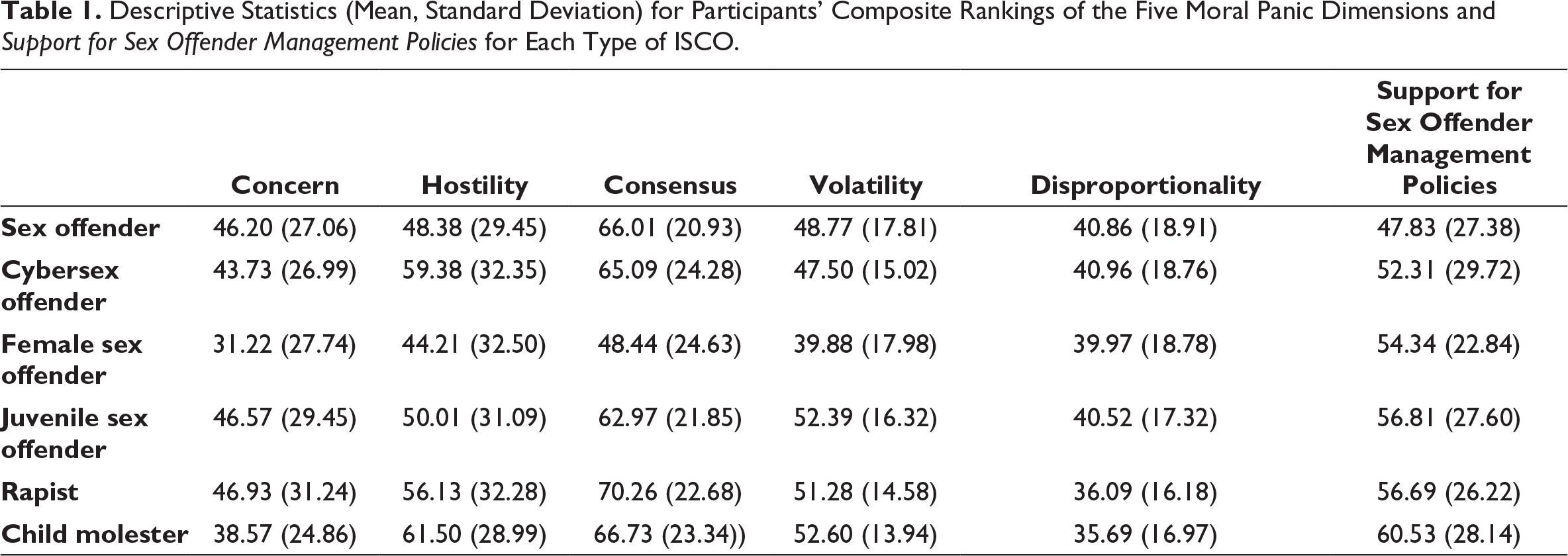
Six OLS regression models identified the main effects of the type of ICSO (independent variable) on participants’ ratings on each of the five dimensions of moral panic and their support for sex offender management policies. The results of these models are found in Table 2. Participants who provided ratings on female sex offenders indicated significantly less concern (b = –14.98, SE = 5.51, t = –2.72, p = .007, d = –0.53), volatility (b = –8.90, SE = 3.15, t = –2.82, p = .005, d = –0.55), and consensus (b = –17.57, SE = 4.53, t = –3.88, p < .0001, d = –0.75), as compared to ratings for the general “sex offender” class. Participants who provided ratings on child molesters, however, indicated significantly more hostility (b = 13.12, SE = 6.03, t = 2.18, p = .030, d = 0.42), as compared to compared to the general “sex offender” class. Finally, participants’ support for sex offender management policies was significantly greater when receiving a stimulus involving child molesters (b = 12.71, SE = 5.27, t = 2.41, p = .016, d = 0.47), as compared to support for such policies for the general “sex offender” class.
OLS Main Effects of Type of ISCO on Participants’ Composite Ratings of the Five Dimensions of Moral Panic and Support for Sex Offender Management Policies.

Note. p < .05 are in boldface.
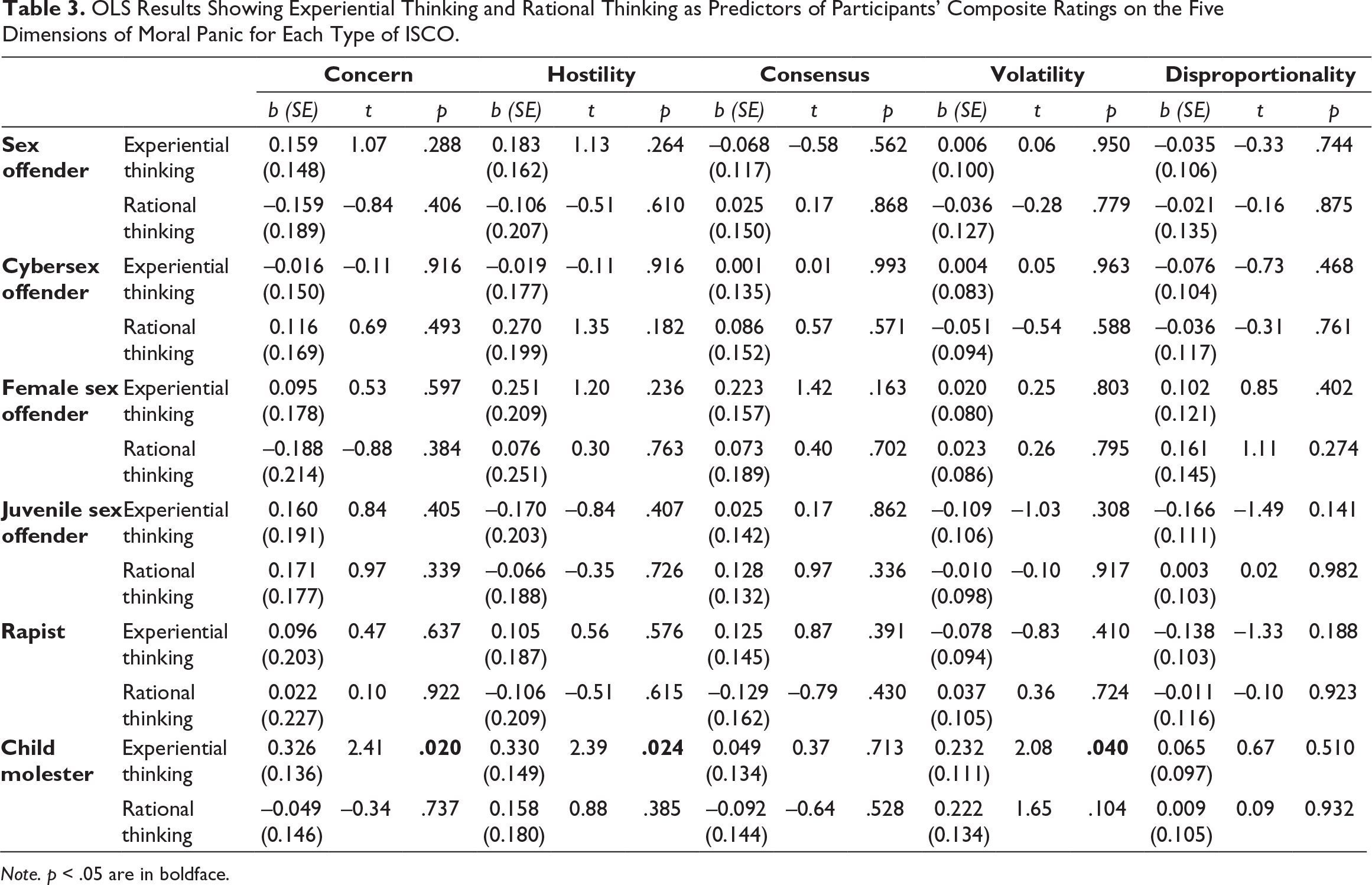
OLS Results Showing Experiential Thinking and Rational Thinking as Predictors of Participants’ Composite Ratings on the Five Dimensions of Moral Panic for Each Type of ISCO.
Note. p < .05 are in boldface.
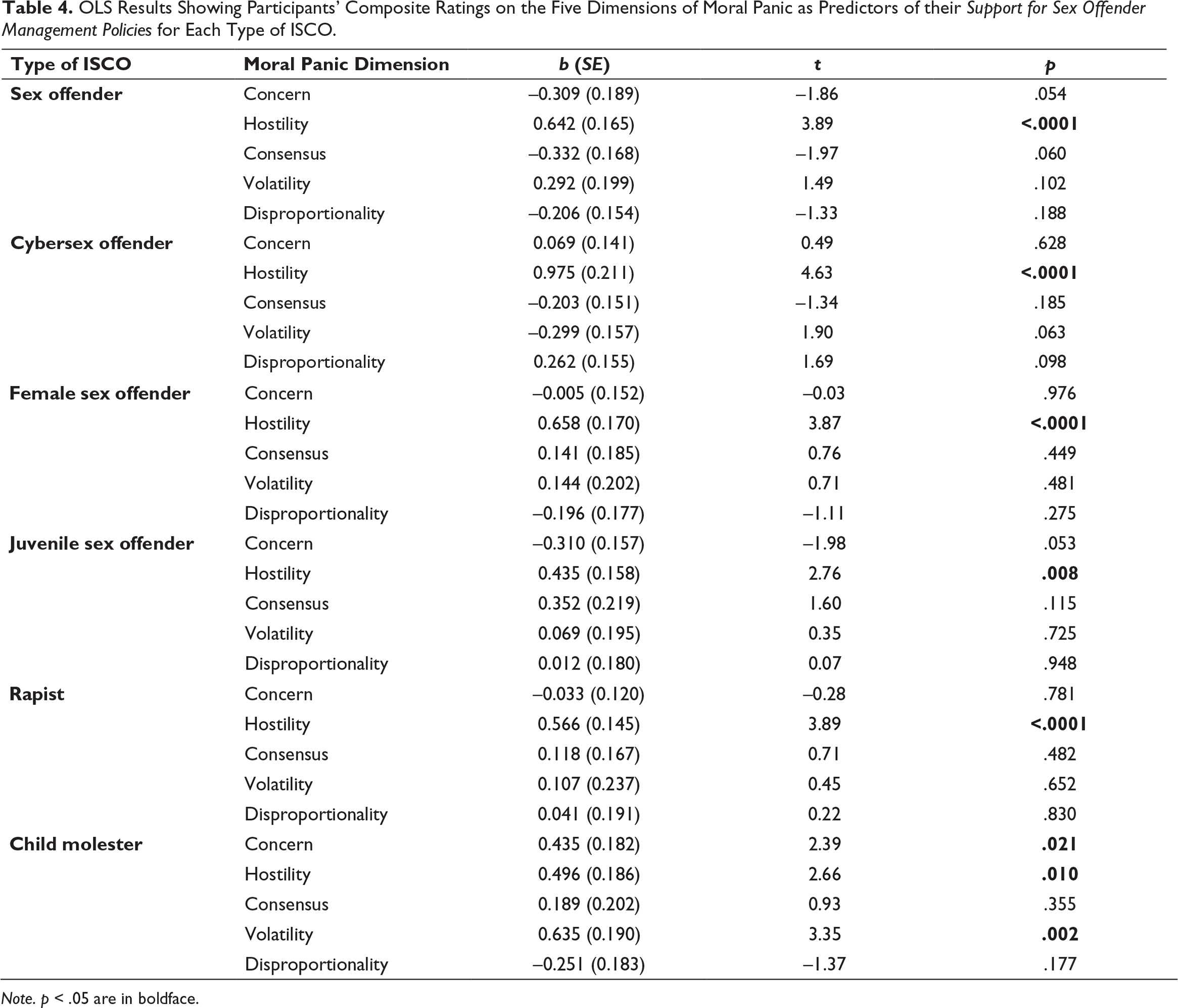
OLS Results Showing Participants’ Composite Ratings on the Five Dimensions of Moral Panic as Predictors of their Support for Sex Offender Management Policies for Each Type of ISCO.
Note. p < .05 are in boldface.
Moderation analyses of the models in Table 4 showed that participants’ experientiality scores moderated results only in relation to child molesters. For those individuals who provided ratings on child molesters, the predictive relationship between participants’ ratings on their concern (b = 2.02, SE = 0.966, t = 2.09, p = .042, d = 0.57), hostility (b = 0.998, SE = 0.412, t = 2.42, p = .020, d = 0.67), and volatility (b = 1.22, SE = 0.516, t = 2.36, p = .023, d = 0.65) and their support for sex offender management policies significantly increased as a function of participants’ experientiality scores. Participants’ rationality and experientiality scores were not found to moderate any other results in Table 4, regardless of the type of ICSO. Non-significant moderation analyses are available upon request.
Discussion
Overall, the current study found that System I, experiential thinking significantly predicted increased feelings of concern, hostility, and volatility toward individuals classified as child molesters, and that these same feelings toward child molesters significantly predicted support for sex offender management policies. This relationship was found to increase as a function of participants’ reliance on System I thinking. Contrary to this study’s hypothesis, System I thinking did not significantly predict expressions of moral panic toward, nor moderate support for existing sex offender management policies for, any other type of ICSO. This was surprising, given that people are known to exhibit emotional and highly passionate reactions to different types of ICSO (Berryessa & Lively, 2019; Levenson et al., 2007).
Yet the fact that System I thinking significantly predicted increased feelings of concern, hostility, and volatility toward individuals classified as child molesters specifically, but was not significant for the other types of ICSO, does compliment previous literature. Evidence suggests that ICSO labelled as child molesters, and often as “modern day monsters” (Simon, 1998), may elicit potentially more negative, emotion-based reactions as compared to other types of ICSO (Berryessa & Lively, 2019; Jenkins, 2004; Levenson et al., 2017). Many people believe these individuals are “better off dead” and express fear, anger, hostility, and violence toward those labelled as child molesters, and branded as “pedophiles,” relative to other ICSO (Jahnke et al., 2015). Cases involving child sex abuse, which can cause volatility via pervasive media attention, often receive more exposure, and incite disgust and sadness on behalf of victims (Fox, 2013).
Additionally, the higher participants self-reported themselves to rely on the System I, thinking style, the stronger the predictive relationship between these same feelings of moral panic (concern, hostility, and volatility) and support for sex offender management policies for individuals classified as child molesters. It has been long thought that some members of the public support sex offender management policies as emotionally fueled and symbolic strategies to attack the targeted “folk devil,” but are largely unconcerned with their realistic effectiveness in reducing offending (Maguire & Singer, 2011; Wright, 2015). As individuals classified as child molesters are often viewed by society as potentially the most abhorrent type of offender, it is arguably considered one of, if not the, worst type of “folk devil” (Jenkins, 2004; Simon, 1998). Unsurprisingly, this fear for our society’s most innocent members, and a desire to protect them, is known to result in support for management policies specifically targeted at those labelled as child molesters (Jahnke et al., 2015). As such, moral panic-based support for sex offender management policies for this group, as a function of emotionally driven thinking, also aligns with this existing work.
As hypothesized, System II, rational processing does not appear to explain moral panic toward ICSO and support for existing, inefficacious sex offender management policies. System II processing often resolves anger, disgust, or fear toward a person or situation during moral judgments; yet in this study, a reliance on System II processing appeared to be unable to resolve feelings of hostility, concern, or volatility toward individuals classified as child molesters. Often it is the strength of emotions that leads to the override of System II processing, which may lead to support for policies that have no proven effectiveness related to their objectives (Sunstein, 2008). Indeed, when people are not sure what strategies to back, people may consult their emotions to scale policy choices to their “internal feelings” (Nelissen & Zeelenberg, 2009). As moral panic-based support for management strategies was found to be a function of System I processing when thinking about individuals classified as child molesters, even when participants were asked to consider that there may be no scientific evidence to their use in ratings of support, results suggest that the “compelling demands” of System I processing may not be mitigated by System II processing when considering policies targeting this group (Maguire & Singer, 2011).
It is also important to note how the overall results of this research compliment previous work on moral panic and its influence on community backing for sex offender management policies. Current findings show that feelings of hostility, as a dimension of moral panic, predict support for sex offender management policies across all types of ICSO. Previous work has also shown that feelings of hostility significantly predict support for registration, notification, and residence restrictions for ICSO (Burchfield et al., 2014; Ewing, 2011; Klein & Cooper, 2019). In addition to hostility, concern and volatility also predicted policy support for individuals classified as child molesters. As mentioned above, such public sentiments and their relationship to policy support may be unsurprising for those labelled as child molesters relative to other types of ICSO (Jahnke et al., 2015; Jenkins, 2004; Pickett et al., 2013). Yet this study suggests that the degree to which members of the public express feelings of concern, volatility, and hostility toward such offenders is at least partially explained by a person’s reliance on System I thinking.
Additionally, results indicated that different types of ICSO, including cybersex offenders, juvenile sex offenders, and rapists, elicit similar levels of moral panic as compared to the general, “catch-all” “sex offender” class perpetuated by the media and public (Leon, 2011; Wright, 2015). These results support previous research advising that moral panic may lead the public to consider and conceptualize different types of ICSO as a homogenous group of offenders (Harris & Socia, 2016; Lynch, 2002). However, female sex offenders elicited significantly less concern, consensus, and volatility, which aligns with existing work that suggests that the public may show less negative feelings toward female ICSO, as compared to male ICSO, because they are less fearful of being victimized by them (Cain & Anderson, 2016). Indeed, some estimates suggest that females commit sex offenses at a rate that is 20-fold less than males (Bunting, 2005).
Finally, although this discussion has been particularly focused on how feelings of moral panic toward individuals classified as child molesters may influence support for sex offender management policies, it should not suggest that dimensions of moral panic toward other types of ICSO do not have any influence on public support for sex offender management policies. Indeed, although many dimensions of moral panic toward other types of ICSO were not significant predictors for public support of these policies, this should not suggest that the public’s feelings of moral panic have no practical significance in terms of understanding support for or opinions about sex offender management practices for other types of ICSO. Rather, although the degree of moral panic may be less and not statistically significant, it likely still practically influences individuals’ support of such policies on some level.
This research is not without its limitations. Online experiments, although helpful in discerning effects and reducing social desirability bias, are not necessarily ecologically valid, and it is unknown how these results may extend to real-world expressions of moral panic (Hughes & Huby, 2002). Future work should examine the roles of dual-process thinking, as well as other known psychological processes, in support for sex offender management policies with more ecologically valid, qualitative, and other research designs, stimuli, and instruments. For example, the reference group used in this research (the general “sex offender” class) actually contains child molesters, as well as other types of ICSO, since it represents the “catch-all” group of sex offenders portrayed by the media and public; therefore, it is possible that the strong reactions toward child molesters seen in this research may be related to the specific terminology used, rather than the specific type of ICSO, and that reactions to different types of ICSO may be tempered when referring to them in more neutral or general ways. Future work should examine the current issues with other reference groups and ways of describing ICSO.
Further, the use of the service Amazon’s MTurk, which is limited in its sample frame to those that participate in that service, suggests that the views of this study’s sample may not be demonstrative of the general public at large. MTurk is known to lack demographic diversity in its samples, which limits its representativeness (Levay et al., 2016). However, the use of MTurk has been known to collect reliable data that most often does not significantly differ from many other conventional survey samples (Bartneck et al., 2015; Rouse, 2015). Further, experimental methods help to assuage issues of representativeness (Keppel & Wickens, 2004). However, this research should be replicated with more representative samples that account for the United States’ demographic diversity.
Regardless of its limitations, the current results have implications with regards to addressing public support for existing sex offender management policies, and specifically those targeted toward individuals classified as child molesters. Call and Gordon (2016) argue that due to their lack of efficacy, the usefulness of current sex offender management policies for all types of ICSO must be called into question and possible alternatives should be explored to better manage sex offending. Yet, due to public outrage, the government’s ability to change such policies, especially those targeted toward individuals classified as child molesters, appears to be exceedingly difficult. Garland (2000) conceptualizes public outrage as a response to a collective feeling that the public has better ideas of how to punish threats or protect society than social scientists or government officials. Public outrage, in turn, leads to support for symbolic policies that align with the public’s “internal feelings” but may not be evidence-based (Garland, 2000). Existing sex offender management policies are a perfect example of such strategies: they indicate the public’s desire for quarantining ICSO, as threatening “folk devils,” rather than the desire to actually increase public safety and reduce offending (Jenkins, 2004; Wright, 2015).
Power to govern stems from the legislature and courts, but also the mass media (Garland, 2000). The media has been a primary source for inciting public support for sex offender management policies, and both the volume and rhetoric of coverage has shown ICSO, and particularly those labelled as child molesters, as the dangerous, immoral “enemy” (Brown et al., 2008). Particularly, the media often focuses heavily on child sexual abuse cases, relative to many other types of sex offenses and crimes generally, and this may perpetuate consensus in the public’s moral panic-based beliefs that individuals classified as child molesters can only be addressed via existing punitive strategies (Fox, 2013; Weatherred, 2015). Thus, if governments do not account for this type of popular sentiment in approaches to sex offender management policies targeted at this group, even if they are not evidence-based, many members of the public will assume that they are incompetent or negligent in tackling the societal risk, although amplified by the media, that individuals classified as child molesters are thought to represent to society (Brown et al., 2008).
This quandary is called “governing through crime,” in which notoriety of certain offenses in the public imagination leads to “new opportunities for governance” (Simon, 2007, p. 5). The media encourages the public to situate themselves, loved ones, and children as potential future victims of certain types of offenders; this “feared future,” enabling moral panic, “produces [individuals] who are likely to place large demands on governance at all institutional levels” to fight the “folk devil” (Simon, 2007, p. 279). Irrespective of efficacy, demands on governance are deemed appropriate by members of society incited by their “feared future” (Young, 2009).
As this study indicates, the degree to which individuals rely on emotionally driven, System I thinking not only predicts support for sex offender management policies for individuals classified as child molesters, but also the strength of support. This suggests that individuals who are more reliant on System I thinking when processing information or making judgments may be those most prone to having their feelings towards those labelled as child molesters affected by the media, demonstrate moral panic toward this “folk devil,” and support the use of symbolic sex offender management policies for them, regardless of efficacy (Weatherred, 2015). Thus, members of the public who rely more on System I thinking may be more likely to be incited by “feared futures” and demand such policies from their governments (Young, 2009).
Ultimately, if the goal is to modify the use of existing strategies and explore better ways to manage offending by individuals classified as child molesters, it may be best to start with influencing the beliefs of those who rely more on System I thinking by better engaging their System II thinking-styles when considering sex offender management policies. Particularly, Call and Gordon (2016) argue that the key to moving away from existing sex offender management policies is to educate their most fervent supporters on the realities and limitations of current policies, the benefits of more effectual management policies, and what existing empirical evidence tells us about how to best combat offending.
Education efforts likely could include focusing on materials and workshops for those in victim organizations and other advocacy groups but also might begin with enlisting the media as “a partner in educating the public about sexual abuse through the dissemination of accurate and research based information about sexual violence, sexual perpetrators, and victimization” (Levenson et al., 2007, p. 156). As moral panic has been historically perpetuated by the media, accurate, factual information and education about ICSO and related management policies via the same avenues that have played a role in misinforming members of the public on these issues should help to facilitate attitudinal changes toward existing sex offender management policies in order to begin focusing on “what works” (Cochran & Chamlin, 2005). For example, existing sex offender management policies, and particularly registration and notification, are thought to have potential criminogenic effects on ICSO because the collateral consequences of these laws ultimately interfere with ICSO reentry and reintegration (Meloy et al., 2007). Indeed, it is important for members of the public to know that by supporting existing sex offender management policies, they may in fact be actually furthering strategies that are counter to their own interests and community safety (Levenson et al., 2007).
Although efforts via the media may help educate all members of the public on these issues, those who rely more on System I thinking may be more likely to take notice of information on “what works” as it relates to sex offender management policies, via education efforts, and begin to advocate for policy changes. Indeed, Call and Gordon (2016) argue that public urgency for better policies to manage ICSO, and particularly urgency from those who are most emotional and passionate about particular causes and active in advocacy, will be absolutely necessary in order to formulate and enact new ones. Ultimately, if they are equipped with accurate information on sex offender management policies, these are the individuals most likely to demand new, more effective, potentially evidence-based strategies (Young, 2009).
Footnotes
Declaration of Conflicting Interests
Funding
The author(s) received no financial support for the research, authorship, and/or publication of this article.
