




Abstract
There are two distinct combinations of psychopathic traits (primary and secondary) that have been proposed to be a function of unique cognitive-affective deficits. This study sought to use theories of psychopathy to understand the factors that exacerbate (i.e., provocation) and attenuate (i.e., distraction) aggression in individuals high in psychopathic traits in a controlled laboratory task. Male undergraduates, who scored across the range of primary and secondary psychopathic traits, completed the Taylor Aggression Paradigm (TAP; Taylor, 1967) under conditions of low and high provocation. Participants were also randomly assigned to either a distraction condition, in which they completed a distracting concurrent task, or a control condition, in which no such task was completed. Inconsistent with our prediction, results showed that regardless of condition, primary psychopathic traits were positively related to laboratory aggression. Consistent with our hypothesis, a positive association between secondary psychopathic traits and laboratory physical aggression was observed following high provocation among nondistracted participants; this association was significantly reduced among distracted participants. These results clarify the factors that contribute to aggression for individuals high in psychopathic traits and may provide directions for future intervention development.
Introduction
Psychopathic traits are a constellation of individual differences that are related to several high impact negative outcomes (e.g., aggression, criminality; Hare, 2003; Patrick et al., 2009). Although psychopathic traits have a strong positive correlation with aggression (Hyatt et al., 2019), there is a paucity of experimental research that seeks to understand the factors that exacerbate or attenuate this relation. In particular, identifying factors that may disrupt this link may help in the development of interventions to reduce the negative consequences of psychopathic traits. Moreover, building on research and theory, which suggests unique combinations of psychopathic with distinct core deficits (Baskin-Sommers et al., 2015b; Hicks et al., 2004; Karpman, 1941; Patrick et al., 2009), it might be possible to develop interventions tailored to different combinations of psychopathic traits (Baskin-Sommers et al., 2015b). Provocation is a critical antecedent to aggression (Bettencourt et al., 2006) and may activate some combinations of psychopathic traits and not others (Baskin-Sommers et al., 2015b). Other research suggests that attention is key a mechanism in aggression and psychopathy (Hamilton & Newman, 2018), and that manipulations which distract attention away from provocative cues cause reductions in aggression (Giancola & Corman, 2007; Subramani et al., 2019). Hence, the goal of this study was to examine the effect of provocation and distraction on aggression in undergraduate men with varying levels of psychopathic traits.
Key Components of Psychopathy and Their Distinct Combinations
Although there is debate in the literature as to the exact combination of traits that make up psychopathy, there is general agreement that meanness (e.g., callousness, antagonism) and disinhibition (e.g., impulsivity, boredom proneness) are core components (Hare, 2003; Patrick, et al., 2009; Sleep et al., 2019). Some theorists further posit that boldness (e.g., low anxiety, social efficacy) is either an additional core aspect of psychopathic traits (Lilienfeld et al., 2016; Patrick, et al., 2009) or a diagnostic specifier (Sleep et al., 2019). Thus, there are two well-established combinations of psychopathic traits: those with disinhibition, meanness, and boldness and those with disinhibition and meanness. Consistent with this view, there is a body of theory and research showing two groups of individuals who are high on overall psychopathic traits but show unique combinations of core psychopathic traits (Hicks et al., 2004; Olver et al., 2015). One group, often termed as being high in primary psychopathy, displays elevated levels of meanness (e.g., callousness) and boldness (e.g., low stress reactivity); the other group, often termed as being high in secondary psychopathy, displays affective instability and meanness. Both groups tend to evidence similar levels of disinhibition (Olver et al., 2015). Although not completely synonymous, a similar distinction has been made between psychopathy (here defined as a combination of boldness, disinhibition, and meanness) and externalizing disorders, which are characterized by disinhibition and meanness (Baskin-Sommers et al., 2015b; Patrick et al., 2009, 2005). Thus, in this literature, psychopathy is akin to primary psychopathic traits and externalizing disorders are akin to secondary psychopathic traits.
In addition to using classification techniques to identify subgroups, it is possible to assess combinations of psychopathic traits dimensionally. For example, the Levenson Self-report Psychopathy Scale (LSRPS; Levenson et al., 1995) has two scales, primary psychopathic traits and secondary psychopathic traits, which tap into unique combinations of psychopathic traits. Drislane and Patrick (2017) examined the correlations between primary psychopathic traits and secondary psychopathic traits, as assessed by the LSRPS, and boldness, meanness, and disinhibition in a large sample of undergraduates. They found a large positive correlation between primary psychopathic traits and meanness and small-to-medium positive correlations between primary psychopathic traits and both boldness and disinhibition; conversely, they found a large positive correlation was between secondary psychopathic traits and disinhibition, a medium positive correlation between secondary psychopathic traits and meanness, and a small negative correlation between secondary psychopathic traits and boldness (for similar results see Drislane et al., 2014).
Etiological Pathways to Psychopathic Traits
Consistent with research showing two different combinations of psychopathic traits, theories have proposed different etiological pathways that lead to a similar phenotype (Baskin-Sommers et al., 2015b; Karpman, 1941; Patrick et al 2009). Specifically, different core deficits in cognition have been proposed for primary and secondary psychopathic traits. Understanding the different deficits that contribute to psychopathic traits may help identify interventions tailored to the unique etiological factors at play for combinations of psychopathic traits, which may have the downstream effect of reducing the negative outcomes associated with psychopathic traits. In particular, very little research has applied differential etiological theories of psychopathy to understand how psychopathic traits are related to aggression.
Core deficit: Primary psychopathic traits. One prominent theory to explain psychopathic behavior is the response modulation hypothesis proposed by Newman and colleagues (Hamilton & Newman, 2018; Patterson & Newman, 1993). This theory proposes that the core deficits in psychopathy are cognitive, not affective. Specifically, this theory proposes that individuals high in psychopathic traits have an attentional bottleneck such that they process information serially rather than in parallel. Because of limited cognitive resources, this leads individuals high in psychopathic traits to prioritize stimuli relevant to their current goals. This leads to an advantage in tasks where individuals high in psychopathic traits need to ignore irrelevant stimuli (Hiatt et al., 2004); however, it also leads to a disadvantage in tasks where individuals high in psychopathic traits need to adjust their behavior in response to stimuli not immediately in line with their goal (e.g., cues to inhibit responding; Kosson & Newman, 1986; Newman & Lorenz, 2003). Applying this theory to aggression, individuals high in psychopathic traits are posited to prioritize processing stimuli relevant to aggression in many situations because it is more in line with general psychopathic goals of advancing self-serving interests. As a result, they are more likely to engage in aggression. If an alternative goal was more salient than their default goal (e.g., financial reward for performance), however, individuals high in psychopathic traits may be less aggressive.
Previous research has found that two manipulations can improve the ability of individuals high in psychopathy traits to attend to peripheral stimuli. Early studies showed that individuals high in psychopathy took less time to look at error feedback on a passive avoidance task and that time looking at error feedback was negatively associated with failures to inhibit responding (Newman & Schmitt, 1998). Later research found that when individuals high in psychopathy were given additional time to view error feedback, their task performance improved (Arnett et al., 1997). Research has also found that when the goals of the task require focus on peripheral stimuli, individuals high in psychopathy do not show differences in performance. For example, individuals high (vs. low) in psychopathy show enhanced performance on a lexical decision task with emotional words when the emotionality of the words is irrelevant to the task; however, psychopathy was not related to task performance with different task instructions (Glass & Newman, 2009). These studies show that individuals high in psychopathic traits have highly malleable attention depending on what cues are made task relevant. Thus, in the case of aggression, providing individuals high in psychopathic traits with a salient nonaggressive goal should result in them allocating more attention to nonaggressive, relative to aggressive, stimuli and, in turn, reduce their likelihood for aggressive behavior.
Core deficit: Secondary psychopathic traits. Research and theory posit a distinct cognitive-affective deficit for individuals high in secondary psychopathic traits. Specifically, these individuals purportedly over allocate attention to emotionally and motivationally salient cues (Baskin-Sommers et al., 2015a). Focusing on emotional cues leads to increased reactivity to emotions (Baskin-Sommers, et al., 2012) and difficulty engaging executive functions (Endres et al., 2011). Thus, individuals high in secondary psychopathic traits have difficulty regulating behavior (e.g., inhibiting responding) when emotional cues are present. This suggests that the association between secondary psychopathic traits and aggression may be explained by attention and reaction to aggressive cues (e.g., provocation), which is in line with general aggression theories (Anderson & Bushman, 2002; Berkowitz, 1990).
Given this mechanism, it follows that methods which redirect attention from provoking, emotional cues toward neutral, nonemotional cues will reduce aggression in individuals who are high in secondary psychopathic traits. Several pieces of indirect evidence support this prediction. In one study, participants who focused their attention on neutral topics after provocation displayed less displaced aggression toward a confederate than participants who ruminated after provocation (Bushman et al., 2005). In another study, intoxicated, provoked participants who were distracted were less physically aggressive on a laboratory task than their counterparts who were not distracted (Gallagher & Parrott, 2011). Prior theory suggests that, similar to individuals high in secondary psychopathic traits, intoxicated individuals are more likely to focus their attention on emotional cues (e.g., provocation; Giancola & Corman, 2007; Giancola et al., 2011). Thus, these findings offer a conceptually similar test of how distraction can reduce aggression in individuals high in secondary psychopathic traits. Finally, a recent study found a positive association between trait disinhibition and laboratory-based physical aggression among highly provoked, nondistracted participants (Subramani et al., 2019). Importantly, this association was significantly reduced when participants were distracted. Because disinhibition is one aspect of secondary psychopathic traits, these results support the prediction that distraction will decrease aggression among provoked individuals high in secondary psychopathic traits.
In summary, there are two distinct combinations of psychopathic traits that have been proposed to be a function of unique deficits. primary psychopathic traits are proposed to be a function of a cognitive deficit where attention is focused on the most salient goal, whereas secondary psychopathic traits are proposed to be a function of a cognitive-affective deficit where attention is focused on emotional cues. Both deficits can lead to the same result (i.e., increased aggression) but through different mechanisms (i.e., primary psychopathy: ignoring nonaggressive peripheral goals; secondary psychopathy: attending to emotional stimuli). Moreover, there are situations where dissociations could occur. For instance, for primary psychopathic traits, only salient goal-directed distraction should influence aggression. In contrast, for secondary psychopathic traits, any distraction may be sufficient to reduce aggression.
Current Study
Building on these theories, this study sought to address two limitations of the current psychopathy literature. First, theories of psychopathy have not been applied to understand the factors that exacerbate or attenuate aggression in individuals high in psychopathic traits. Second, there are few studies that have examined psychopathic aggression under controlled laboratory conditions, and extant studies have not examined the distinct combinations of psychopathic traits (Denson et al., 2009; Veit et al., 2010) or their unique deficits (Fanning et al., 2014; Parrott & Zeichner, 2006; Reidy et al., 2007). Thus, the purpose of the current study was to (a) examine the association between primary and secondary psychopathic traits and physical aggression as measured in a laboratory setting by the Taylor Aggression Paradigm (TAP), and (b) identify moderators of this relation. Specifically, we examined the effects of provocation and distraction. Based on prior research and theory (Baskin-Sommers et al., 2012; Gallagher & Parrott, 2011), we had two predictions. First, we predicted that regardless of provocation, there would be a positive association between primary psychopathic traits and aggression among nondistracted participants and that this association would be significantly reduced among distracted participants (Hypothesis 1). Second, we predicted that under conditions of high provocation, there would be a positive association between secondary psychopathic traits and aggression among nondistracted participants and that this association would be significantly reduced among distracted participants. No such effect was expected under conditions of low provocation (Hypothesis 2).
Method
The present study used data collected for a larger investigation (Subramani et al., 2019) focused on disinhibition and laboratory-based aggression. In contrast to the parent project, distinct hypotheses regarding psychopathy and laboratory-based aggression were advanced. All results reported herein are unique to the present investigation.
Participants
Participants were undergraduate men in introductory psychology courses who enrolled in the study via an online advertisement. The protocol involved participants coming to the lab on two separate days to complete self-report questionnaires (Session 1) and an experimental session (Session 2). One hundred fifty-one participants completed the first session and 133 completed both sessions. Participants provided informed consent at the outset of each session and received course credit for their time. Seventeen participants were excluded from the final analyses (six were not deceived, four for equipment malfunction, two withdrew after consent, two did not follow task instructions, three were missing self-report psychopathy data). This left 116 participants with a mean age of 20.27 (SD = 3.45). The majority of the participants identified as Non-Hispanic/Non-Latino (87.16%). The racial composition of the sample was 38% Black/African American, 31% White, 22% Asian, and 9% who identified with more than one race. This study was approved by the university’s Institutional Review Board.
Measures
Demographic form. To measure demographics, we asked a series of demographic questions within the questionnaire battery (age, sex, etc.)
Psychopathy. To measure primary and secondary psychopathic traits, we used the LSRPS (Levenson et al., 1995). Participants responded to 26 items on a Likert scale from one (disagree) to four (agree), with higher scores reflecting higher levels of psychopathy. The LSRPS has two subscales. 1 The primary scale assesses primary psychopathic traits (16 items; sample item: “For me, what’s right is what I can get away with”). The secondary scale assesses secondary psychopathic traits (10 items; sample item: “I have been in a lot of shouting matches with other people”). In the present sample, alpha reliabilities for primary (α = .83) and secondary (α = .73) psychopathy were consistent with the standardization sample (Levenson et al., 1995).
Aggression. Aggression was measured with a modified version of the TAP (Giancola & Zeichner, 1995; Taylor, 1967). In the TAP, participants are told that they will engage in a reaction time competition in which they can administer shocks to, and receive shocks from, an ostensible male participant who is “seated in an adjacent room.” In reality, participants do not compete against another person; rather, they experience a preselected pattern of trials and shocks controlled by the experimenter’s computer. Participants are seated at a table with a computer screen and keyboard. The numbers “1” through “10” on the computer keyboard are labeled from “low” to “high” to allow participants to determine varying levels of shock to administer. Participants receive visual feedback on the computer monitor indicating whether they “won” or “lost” a trial as well as the shock level selected and received. The software for the task was developed by Vibranz Creative Group (Lexington, KY) and the hardware was developed by Coulbourn Instruments (Allentown, PA). The TAP and other similar shock-based laboratory paradigms have been repeatedly shown to be safe and valid measures of aggressive behavior (Anderson & Bushman, 1997; Parrott et al., 2015).
To manipulate the level of provocation, participants completed two blocks of trials. In the first block (16 trials), all participants received shocks that were one second in duration and ranged from 55% (a “1”) to 60% (a “2”) of the highest tolerated shock intensity. In the second block (16 trials), participants received shocks that were one second in duration and ranged from 95% (a “9”) to 100% (a “10”) of the highest tolerated shock intensity. There are two “transition trials” between blocks in which participants lost and received shocks of “5” and “6,” respectively. The sequence of trials is intended to give the appearance of an increasingly provoking aggressive interaction. Thus, there were a total of 34 trials (16 trials per block with two transition trials). Each block consisted of 8 wins and 8 losses. Previous research indicates that the potential risk of these procedures to participants mental and physical health is very low (Parrott et al., 2015).
Physical aggression was derived from a summation of standardized scores for the average intensity and duration of shocks selected during the task. These scores were averaged within the first block (low provocation) and the second block (high provocation). This was done because previous research has demonstrated that shock intensity and shock duration are highly correlated and part of a more general construct of direct, physical aggression (Carlson et al., 1989). Additional analyses in the Supplemental Material show similar results for intensity and duration when considered separately.
Distraction Manipulation
Participants were randomly assigned to either a control condition (no distraction) or a distraction condition. Participants in the control condition completed the TAP without interruption. In the distraction condition, during the administration of the TAP, participants were asked to follow a computerized memory-sequencing task. In this task, participants were presented with a 3 × 3 matrix of 2-cm light gray squares on a white computer screen. On each trial, participants were asked to attend to and memorize a sequence of four squares illuminated in black in a random order. After each trial, participants were asked to click on the squares in the order in which they illuminated. In order to prevent confounding emotional responses, performance feedback was not provided. To ensure participants actively engaged in the task, distraction condition participants were told they would receive a bonus of $10 or 1.0 extra credits if they performed better than 80% of subjects who had already been tested. Regardless of performance, all participants received the preferred form of compensation. Previous laboratory aggression research has used this distractor task successfully (Gallagher & Parrott, 2011; Giancola & Corman, 2007).
Procedure
Participants presented to the laboratory on two separate days. During Session 1, informed consent was provided, and participants were informed they could discontinue participation at any time and still receive compensation. All participants completed a battery of questionnaires in an individual testing room. Upon arrival to the lab for Session 2, participants provided informed consent and were told that the purpose of the study was to examine the relation between personality and reaction time. Participants were then escorted to the testing room and given instructions for the reaction time task. Although there was no other participant, participants were told they were competing against a male opponent named Elliot. They were told that winning a trial allowed them to deliver a shock to their opponent and a losing trial resulted in receiving a shock from their opponent. For each trial, participants were informed that shortly after the words “Get Ready” appeared on the computer screen, the words “Press the Spacebar” would appear. They would then press and hold down the spacebar until the words “Release the Spacebar” appeared. At this time, they were told to release the spacebar as quickly as possible. A “win” was signaled by the words “You Won. You Get to Give a Shock” and a “loss” was signaled by the words “You Lost. You Get a Shock.” A winning trial allowed participants to deliver a shock to their opponent and a losing trial resulted in receiving a shock from their opponent. Participants were told that they had a choice of 10 different shock intensities to administer at the end of each winning trial for a duration of their choosing. Although participants could not elect to not shock their opponent, they were told that shock button “#1” would deliver a low intensity shock that was “very mild” and “definitely not painful.” No participants chose to opt out of selecting shocks. Following the instructions for the TAP, participants in the distraction condition partook in “practice” trials of the distraction task until they demonstrated an understanding of the task.
Next, participant subjective pain ratings were measured to account for individual differences in sensitivity to electric shock. During this procedure, participants were seated in the testing room while the experimenter was in an adjacent control room. They communicated via an intercom. Pain thresholds were assessed via administration of one second electric shocks. All shocks were administered through two electrodes attached to the index and middle fingers of the nondominant hand using Velcro straps. Participants were instructed to inform the experimenter when the shocks were “first detectable” and then when they reached a “painful” level. These values were used as the minimum and maximum of the shocks that participant could receive during task. Immediately before assessing participants pain thresholds, they were informed that their male opponent would undergo the threshold assessment first. They were able to hear his response to the procedure over an intercom. In actuality, a male confederate answered the experimenter's questions regarding the testing of his pain thresholds in accordance with a list of predetermined responses. This was done to aid in the deception of competing against a real opponent. The overall pain threshold procedure lasted approximately 2-3 minutes.
Following the pain threshold assessment, the TAP commenced. The distraction group was reminded to concurrently play the “Tile Game” (the distraction task) on an adjacent computer. The sequence of the TAP trials was the same for both the distraction and no-distraction control conditions. A “volt meter” and the illumination of 1 of the 10 “shock lights” on the computer screen signaled to the participant the shock that he or the opponent selected. From a separate room, the experimenter monitored the computer that controlled the initiation of trials, administration of shocks to participants, and recording of their responses. Upon completion of the aggression task, participants were asked a variety of questions to assess the credibility of the opponent deception (see below). Participants were then fully debriefed, provided verbal and written descriptions of the study’s aims, and compensated.
Results
Data Analytic Plan
Data were analyzed using multilevel modeling to account for the nesting of provocation within-subjects (Singer & Willett, 2003). The Level 1, within-subjects model contained provocation (effect-coded). The Level 2, between-subjects model contained distraction conditions (effect-coded) and psychopathic traits (primary or secondary, mean-centered). The intercept was treated as a random effect. Of particular interest were the cross-level psychopathic traits by condition interactions. Significant interactions were followed up with simple slopes analyses as outlined by Preacher et al. (2006). The supplementary materials have additional analyses examining the correlations among the study measures, TAP intensity and duration as separate dependent variables, and the three-factor structure of the LSRPS.
Manipulation Checks
Deception. Prior to debriefing, participants were asked to describe their impression of their opponent and whether or not the task was a good measure of “reaction time.” The main criteria for exclusion included participants beliefs that they were not actually competing against another person or that this task was a measure of aggression. Of the 133 participants who presented to the laboratory session, 6 (5%) indicated they were not deceived based on the above criteria.
Distraction. Participants in the distraction condition (M = 334.10, SD = 28.16) were slower to respond on TAP trials than participants in the control condition (M = 290.00, SD = 28.33), t(108) = 8.18, p < .001, d = 1.56. This suggests that the distraction condition was successful at increasing cognitive load (cf. Giancola & Corman, 2007).
Main Analyses
Primary psychopathic traits. Contrary to Hypothesis 1, the primary psychopathic traits by distraction interaction was not significant, F(1, 109) = .42, p = .518, nor was the primary psychopathic traits by distraction by provocation, F(1, 109) = .80, p = .372. A significant main effect of primary psychopathic traits was detected, which indicated a significant positive relation between primary psychopathic traits and aggression, b = .05, t(109) = 3.17, p = .002. Thus, regardless of the level of provocation or distraction, higher levels of primary psychopathic traits were related to higher levels of TAP aggression. Averaged across trials, the correlation between primary psychopathic traits and aggression was medium in size (r = .29, p = .002). No other effects were below the significance threshold (ps > .116; see Table 1 for parameter estimates).
Multilevel Model Parameter Estimates.

Note. Distraction: control condition = –1; distraction condition = 1; provocation: low provocation = –1, high provocation = 1
Secondary psychopathic traits. Consistent with Hypothesis 2, there was a significant three-way secondary psychopathic trait by distraction by provocation interaction, F(1, 109) = 4.57, p = .032. There were no other significant effects involving secondary psychopathic traits (ps > .200; see Table 1 for parameter estimates). To further understand this three-way interaction, we first examined the four simple slopes of secondary psychopathic traits at low and high provocation in the control and distraction condition. As depicted in Figure 1 (top), analyses indicated that for low provocation trials, secondary psychopathic traits were not significantly related to TAP aggression, with an effect size near zero, for both the control condition, b = –.01, t(138) = –.11, p = .911, and the distraction condition, b = .03, t(138) = .59, p = .554. As depicted in Figure 1 (bottom), somewhat consistent with our prediction, for high provocation trials, there was a positive, but nonsignificant, association between secondary psychopathic traits and TAP aggression in the control condition, b = .07, t(138) = 1.55, p = .123, that was reduced in the distraction condition, b = .01, t(138) = .16, p = .875.
Aggression on that Taylor Aggression Paradigm (TAP) as a function of secondary psychopathic traits, distraction condition (control and distraction), and provocation (low, high).
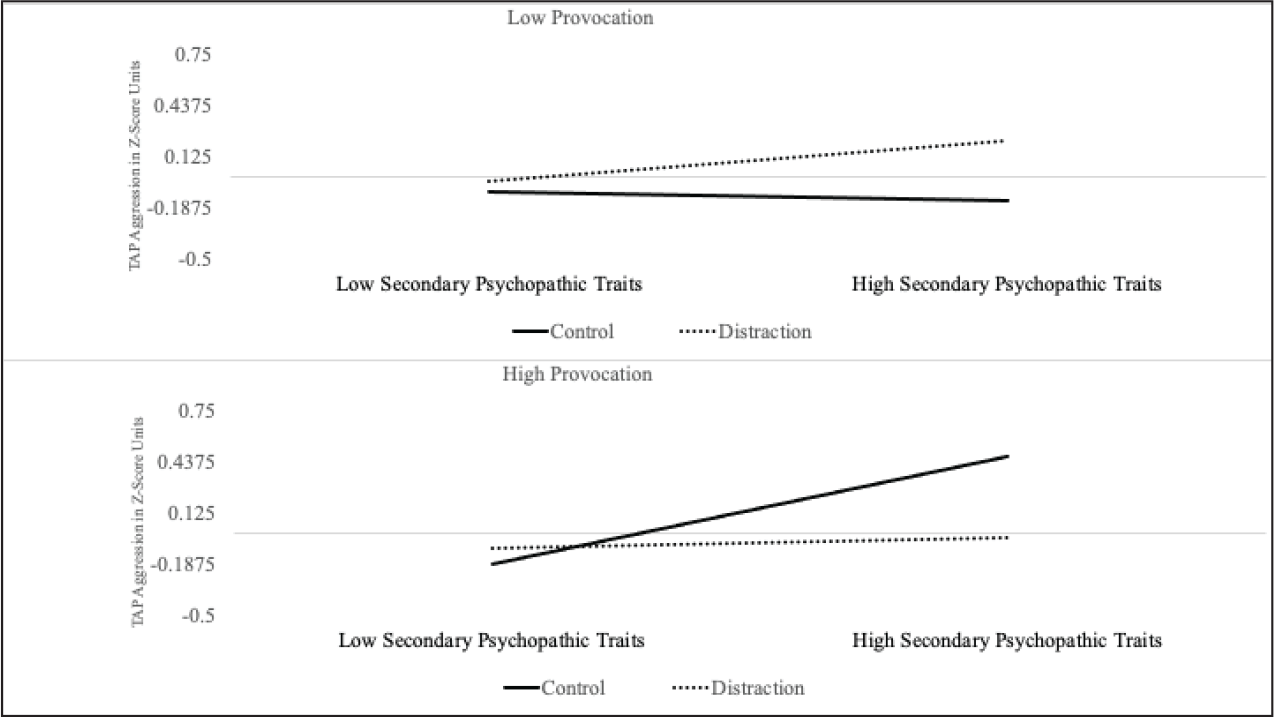
Given that none of our simple slopes were significantly different from zero despite a significant three-way interaction, we tested the two-way distraction by secondary psychopathic traits interactions at low and high provocation to better understand our results. These analyses showed that the distraction by secondary psychopathic traits interaction was not significant for low provocation trials, F(1, 138) = .24, p = .622, or high provocation trails, F(1, 138) = 1.00, p = .318. These results indicate that at both low and high provocation the slopes for secondary psychopathic traits do not differ for the control and distraction conditions.
To further explore, our results we also tested the two-way provocation by secondary psychopathic traits for the control and distraction conditions. Here we found that there was a significant two-way interaction between provocation by secondary psychopathic traits in the control condition, F(1, 109) = 5.85, p = .004, but not the distraction condition, F(1, 109) = .40, p = .527. These results suggest that, as predicted, within the control condition the slope for secondary psychopathic traits at high provocation is significantly different from the slope at low provocation. The lack of significant interaction in the distraction condition further supports our prediction that the distraction reduced the effect of provocation. Thus, these results indicate that in the control condition secondary psychopathic traits (a) were positively related to aggression under high, but not low, provocation, and (b) distraction significantly attenuated this association.
Discussion
The primary aim of the current study was to examine the effect of distraction on the association between primary and secondary psychopathic traits and laboratory-based physical aggression among men who received varying levels of provocation. Hypotheses were partially supported. Consistent with extant literature, primary psychopathy was positively associated with physical aggression. However, contrary to Hypothesis 1, results did not detect a significant Primary Psychopathy × Distraction interaction. Thus, distraction did not reduce the magnitude of the association between primary psychopathic traits and aggressive responding. Consistent with Hypothesis 2, results indicated that the association between secondary psychopathic traits and laboratory-based physical aggression following high provocation was significantly reduced among men who were distracted compared to men who were not distracted. No such effects were observed following low provocation. Collectively, these results contribute to our understanding of how provocation and distraction influence the associations between primary and secondary psychopathic traits and physical aggression.
Although Hypothesis 1 was not supported, primary psychopathic traits were positively correlated with laboratory-based physical aggression across provocation levels. Prior research has shown that provocation is one of the key factors in influencing aggressive behavior (Bettencourt & Miller, 1996). Therefore, it is somewhat surprising that provocation did not significantly increase aggression among individuals high in primary psychopathy traits. Meta-analytic work, however, shows that individual personality variables may influence the amount of aggressive responding in response to provocation. Specifically, individuals who are high in trait aggressiveness respond more aggressively than those with low trait aggressiveness in both neutral and provoking conditions (Bettencourt et al., 2006). Previous research has found that the primary psychopathic trait scale of the LSRPS is more strongly positively related to disagreeableness (closely related to trait aggressiveness; Suls et al., 1998) than the secondary psychopathic trait scale (Miller et al., 2008). Given this literature, it is possible that the disagreeable/meanness traits explain why individuals high in primary psychopathic traits are aggressive regardless of the level of provocation.
Consistent with Hypothesis 2, the positive association between secondary psychopathic traits and laboratory-based physical aggression following high provocation among nondistracted participants was significantly reduced among distracted participants. This finding supports the view that (a) individuals with high levels of secondary psychopathic traits responded more aggressively when provoked because they focused on the emotional cues elicited by provocation (Baskin-Sommers, et al., 2012) and experienced concomitant difficulty engaging executive functions (Endres et al., 2011), and (b) the distraction task facilitated a shift in attention away from these emotional cues, thereby reducing the level of physical aggression. We believe that this focus on neutral stimuli decreased participants’ reactivity to emotions and allowed then to display less aggression toward their “opponent” (Bushman et al., 2005). Future research could seek to identify the mechanisms that allow distraction to reduce aggression (e.g., attention to aggressive cues, emotional arousal).
Regarding the lack of support for Hypothesis 1, two methodological issues merit consideration. First, participants were told they would receive a bonus of $10 or 1.0 extra credits if they performed better than 80% of subjects who had already been tested on the distraction task. It is possible that this incentive was not strong enough to incentivize a shift of attention away from the provoking nature of the TAP and toward the distraction task. If true, then participants who endorsed high levels of primary psychopathic traits may have not been sufficiently distracted from the provoking nature of the TAP for the hypothesized intended effect to occur. To address this potential issue, future research could provide participants varying rewards for the successful completion of the distraction task to determine the strength of reward necessary to produce the predicted effect.
Second, it is possible that our assessment of primary psychopathic traits did not accurately capture the key aspects of primary psychopathic traits. As discussed above, individuals high in primary psychopathic traits display elevated levels of meanness, disinhibition, and boldness. Research on the LSRPS shows that it is more strongly related to meanness and disinhibition than boldness (Drislane et al., 2014). In line with this, some of the research on the attentional bottleneck theory has only found effects for individuals high in psychopathy and low in anxiety (Newman & Brinkley, 1997; Zeier & Newman, 2013), which is akin to high boldness. Future research should seek to replicate our findings with other measures of psychopathy.
These results have potential implications for the development of just-in-time interventions focused on redirecting attention away from emotionally laden cues during provocation. For example, a mobile health intervention could utilize the ability to monitor an individual’s arousal (e.g., heartrate, skin response) as an index of a potential aggression-provoking situation and provide the individual with a variety of distracting games or activities when the risk of aggression is high. In the same vein, distraction may be used to reduce aggression in traditional therapies (e.g., Dialectical Behavior Therapy; Frazier & Vela, 2014). In both of these potential applications, an individual’s emotional reactivity would be reduced which, in turn, should decrease their propensity to respond to those emotional cues with aggression.
There are some limitations of our experiment that should be discussed. The use of college students as participants provided us with a limited range of psychopathic traits. Future research should replicate our results in community, clinical, and/or forensic samples that exhibit a greater range of psychopathic traits. Our sample also only included men; therefore, it is unclear whether these results extend to women and other gender identities. Psychopathy research in general has focused on men and understanding commonalities and differences between men and women can improve etiological theories of psychopathic traits (cf. Verona, & Vitale, 2006). The present study was limited in its examination of laboratory-based physical aggression. Although there is ample support for the construct validity of the TAP (Chester & Lasko, 2019), participants may express aggression differently within a controlled laboratory setting than in real-life situations. Additionally, there are several validated measures of psychopathic traits (Drislane et al., 2014; Lilienfeld & Widows, 2005). By only using the LSRPS (Levenson et al., 1995), we were limited to a singular measure of psychopathic traits. To increase the generalizability of our results, this experiment could be replicated with a different measure of psychopathic traits.
Despite these limitations, the present study used a well-validated and controlled experimental design and a behavioral measure of aggression. Behavioral tasks can help mitigate positive impression management, which is common among individuals high in psychopathy (Kelsey et al., 2015). Few studies on psychopathic traits have utilized experimental designs and much of the research in this area utilizes self-report measures of aggression (Drislane et al., 2014). Thus, the present study provides cross-method support. In addition, the present study examined two factors of psychopathy, whereas extant laboratory-based aggression studies used a total psychopathy score (Parrott & Zeichner, 2006; Reidy et al., 2007). Together, results from this study identify that distraction may be an effective way to reduce aggressive behavior among individuals high in secondary psychopathic traits under conditions of provocation.
Footnotes
Declaration of Conflicting Interests
Funding
The author(s) received no financial support for the research, authorship, and/or publication of this article.
Note

Supplemental material
Author Biographies
References
Supplementary Material
Please find the following supplemental material available below.
For Open Access articles published under a Creative Commons License, all supplemental material carries the same license as the article it is associated with.
For non-Open Access articles published, all supplemental material carries a non-exclusive license, and permission requests for re-use of supplemental material or any part of supplemental material shall be sent directly to the copyright owner as specified in the copyright notice associated with the article.
