



Abstract
The present study assesses differences between acknowledged and unacknowledged victims in post-victimization psychopathology, abuse disability and coping. Few studies have examined abuse acknowledgment among intimate partner violence (IPV) victims. To our knowledge, this study is the first to use an experimental manipulation to assess changes in acknowledgment among IPV victims. Female undergraduate students currently in dating relationships completed demographic, coping and psychopathology questionnaires, and the Conflict Tactics Scale (CTS). They then watched a video of an IPV perpetrator who either acknowledged abuse or did not acknowledge abuse. Following the video, participants completed a psychopathology questionnaire and a post-video acknowledgment assessment. Approximately 38% of the sample reported IPV victimization. Only 7.89% acknowledged victimization. Acknowledged IPV victims had the highest mean victimization score but reported psychopathology similar to nonvictims on all subscales except phobic anxiety. Unacknowledged victims reported greater psychopathology, depression, anxiety, and hostility than nonvictims and were more symptomatic overall. Unacknowledged victims reported more frequent use of avoidant coping strategies than nonvictims. These strategies included substance use, self-blame, and behavioral disengagement. Acknowledged and unacknowledged victims reported greater abuse disability than nonvictims, and acknowledged victims reported greater life restriction than unacknowledged victims. Following the video, the number of acknowledged victims nearly doubled, and acknowledged victims reported increased depression. On the basis of these findings, clinicians and researchers should carefully consider acknowledgment as a potential factor in post-victimization mental health and explore ways to increases victim acknowledgment.
Keywords
Introduction
Intimate partner violence (IPV) is a widespread social problem. IPV is defined as physical, sexual, psychological violence, or stalking committed by an intimate partner (Breiding et al., 2015). IPV accounted for 13% of all violent crimes in 2018 (Morgan & Oudekerk, 2019). US lifetime prevalence rates for IPV are approximately 30% for physical violence and 18% for sexual violence. Seventy-one percent of women experience an IPV incident before the age of twenty-five (Smith et al., 2018).
Much of the IPV literature focuses on the relationship between victimization, mental health, and coping. IPV victims report a wide range of psychological disorders. Depression, PTSD, and substance use disorders are the most common (Spencer et al., 2019). Studies show that IPV victims are far less likely than nonvictims to use adaptive coping strategies such as problem solving and far more likely than nonvictims to use avoidant coping strategies such as substance use and denial (Craparo et al., 2014; Devries et al., 2014). Avoidant coping strategies are associated with high levels of depression and anxiety (Clements, et al., 2018).
Victim Acknowledgement
One understudied variable affecting IPV victims’ mental health and coping is acknowledgment of victimization (Clements & Ogle, 2009). Acknowledged victims self-identify as having experienced abuse and report victimization on objective measures. Unacknowledged victims do not self-identify as having experienced abuse but report victimization on objective measures (Littleton et al., 2006). The fact that few studies address acknowledgement is problematic, as some research indicates that IPV acknowledgement rates are low and that non-acknowledgment negatively affects victim physical and psychological wellbeing (Anderson & Pezzarossi, 2012; Peterson & Muehlenhard, 2011). There is a much wider literature assessing rape victim acknowledgment and its’ effects (Hammond & Calhoun, 2007; Wilson et al., 2017). Because of this, we draw on the rape acknowledgment literature to support the importance of IPV research in this area. Furthermore, these crimes often overlap. Twenty-five percent of IPV victims report sexual victimization, and 51% of all female rape victims report that the perpetrator was an intimate partner (Black et al., 2011).
Studies of IPV acknowledgment show that 38–54% of female IPV victims are unacknowledged (Anderson & Pezzarossi, 2012; Hamby & Gray-Little, 2000; Hammond & Calhoun, 2007). Clements and Ogle (2009) found that only 19% of participants classified on the Revised Conflict Tactics Scale (CTS-2) as victims of physical abuse acknowledged their victim status. Like IPV victims, the minority of rape victims acknowledge. A recent meta-analysis showed that up to 61% of rape victims do not label forced sexual intercourse as rape (Wilson & Miller, 2016). Acknowledged rape victims typically report better mental health than unacknowledged victims (Wilson et al., 2017). Given that rape and IPV heavily intersect, it is possible that acknowledged IPV victims will also report better mental health than unacknowledged victims (Jaffe et al., 2021).
Understanding acknowledgment through the transtheoretical model.
The Transtheoretical Model may be a useful way to understand IPV victim acknowledgement. In this model individuals move from precontemplation (denial that anything is wrong) to contemplation (admitting there is a problem but not taking action), to action and, finally, to maintenance of gains. This progression is not necessarily linear; individuals may move back and forth between stages (Prochaska et al., 2015). In one longitudinal study, IPV victims were more likely to move forward than backward through the stages of change and they typically moved one stage at a time (Burkitt & Larkin, 2009).
When IPV victims self-identify (acknowledge) as abuse victims they move from precontemplation to contemplation. In addition, acknowledgment plays a critical role in victims maintaining forward movement through the later stages of change (Burke et al., 2004). This continued progression is important as victims in the action and maintenance of gains phases report less psychopathology and greater use of community resources than victims in early stages (Burkitt & Larkin, 2009). Thus, using the logic of the Transtheoretical Model, acknowledgment should represent a key component in IPV victim recovery from abuse.
Factors predicting victim acknowledgment.
The rape literature shows a variety of factors associated with victim acknowledgment. Rape victims are less likely to acknowledge victimization when they blame themselves, know their perpetrator, use substances prior to victimization, deny serious injury, or normalize sexual abuse (Orchowski et al., 2013; Suzuki & Bonner, 2017). The few IPV acknowledgment studies suggest that IPV victims are less likely to acknowledge when they blame themselves or remain in the relationship (Hamby & Gray-Little, 2000). More frequent and severe victimization is associated with greater likelihood of rape acknowledgment (Cleere & Lynn, 2013; Wilson et al., 2017). IPV victims are more likely to acknowledge when they experience severe or frequent physical abuse (Rodríguez-Franco et al., 2012). Thus, similar variables appear to affect acknowledgment in both victim groups, though rape victim acknowledgment is far more studied.
Another factor that may influence IPV victim acknowledgment is perpetrator acknowledgement. Research on restorative justice programs and victim impact statements suggests that perpetrator acknowledgement plays an important role in IPV victim recovery (Hopkins, 2012; Laxminarayan, 2013). Most restorative justice programs focus on perpetrator apologies rather than acknowledgement of perpetration. Indeed, some research shows that receiving an apology is associated with positive victim outcomes even when the perpetrator does not acknowledge that the behavior was abusive (Dhami, 2012). Thus, the importance of perpetrator acknowledgment in victim mental health is unclear, although perpetrator apologies seem to be beneficial.
Victim acknowledgment and mental health outcomes.
The literature on rape suggests that acknowledging victimization improves psychological functioning. Unacknowledged rape victims report more depression, anxiety, and substance use compared to acknowledged victims (Wilson et al., 2017). Similarly, acknowledged IPV victims report better mental health and more adaptive coping than unacknowledged victims (Peterson & Muehlenhard, 2011). In one direct comparison of rape victims to IPV victims, IPV victims reported high levels of depression and anxiety regardless of acknowledgment status, whereas acknowledged rape victims reported fewer psychological symptoms than unacknowledged rape victims (Clements & Ogle, 2009). This study suggests that the effects of acknowledgment on psychological symptoms may differ as a function of victim status.
Rationale
The initial purpose of this study was to add to the literature on IPV victim acknowledgment and address inconsistent findings about the effect of victim and perpetrator acknowledgment on post-victimization mental health. Identifying variables associated with victim acknowledgment may help clarify the role that they play in psychological functioning, allowing for better prevention and intervention efforts. The second goal was to extend Clements and Ogle’s (2009) study of the impact of IPV acknowledgment on psychopathology and coping. They found that the effect of IPV victim acknowledgement on psychopathology and coping was unclear. Therefore, we sought to further clarify the association between IPV acknowledgment, psychological symptoms, and coping by specifically focusing on IPV victims rather than comparing them to rape victims. The third goal of this study was to add to the IPV acknowledgement literature by experimentally assessing the effects of perpetrator acknowledgement on IPV victims. To our knowledge, no studies experimentally assess the impact perpetrator acknowledgment on victim acknowledgement and victim mental health. This lack of experimental methodology severely constrains the IPV victim acknowledgment and mental health literature.
Hypotheses
Unacknowledged victims will report greater psychopathology than acknowledged victims, who, in turn, will report greater psychopathology than nonvictims.
Unacknowledged victims will report greater maladaptive coping than acknowledged victims, who, in turn, will report greater maladaptive coping than nonvictims.
Unacknowledged victims will report greater abuse disability than acknowledged victims, who, in turn, will report greater abuse disability than nonvictims.
The number of acknowledged victims will increase following exposure to an acknowledged perpetrator.
Unacknowledged victims will report greater hostility, depression, anxiety, and dysphoria when exposed to an acknowledged perpetrator than acknowledged victims.
Method
Participants
Participants were 633 undergraduate female students recruited from a southeastern university who were currently in a romantic relationship. The average relationship length was 18.61 months (SD = 28.16). The average age of participants was 19.03 years (SD = 2.86). Ethnicity was unequally represented, with 84.4% of the sample identifying as Caucasian, 4.1% as African American, 3.3% as Hispanic, and 8.5% as other/mixed race.
Materials
It is important to note that no questions on the ADQ referred directly to IPV. Rather, ADQ questions ask participants to rate feelings on the same intimate relationship referenced in the CTS. In addition, the survey was labeled “ADQ” and not “abuse disability.” Thus, we used the ADQ to assess domains of disability in acknowledged and unacknowledged IPV victims as and nonvictims.
Procedure
Participants entered the lab one at a time and completed informed consent. Participants then filled out the CTS-2, SCL-90-R, COPE-B, and ADQ. Participants filled out the first MAACL (MAACLa) immediately prior to viewing the perpetrator acknowledgement video. Before watching the video, experimenters informed participants that they would be watching a student discussing a physically violent relationship conflict and to imagine that the man in the video was their romantic partner. Participants completed a second MAACL (MAACLb) immediately after viewing the perpetrator acknowledgment video. Participants then completed the post-video assessment and were debriefed.
Results
A Bonferroni correction established a p-value of .01 for all multivariate and univariate levels of analyses. Post-hoc analyses were not corrected as they explored differences subject to the correction. All post-hoc comparisons discussed are significant at the p < .05 level.
Preliminary Analyses
Preliminary analyses of variance (ANOVAs) assessed differences in continuous demographic variables. Chi-square analyses were used to assess categorical variables. No significant differences were found.
Descriptive Statistics
An acknowledgement variable was created to classify the sample (N = 633) into three groups: nonvictims (n = 395), unacknowledged victims (n = 219), and acknowledged victims (n = 19). Acknowledgment status was constructed by comparing the CTS-2 victimization score to the self-reported acknowledgment question included on the demographic questionnaire. Seven percent of participants meeting the CTS-2 criteria for physical abuse self-labeled as an IPV victim on the acknowledgement question. Eighteen percent of acknowledged victims reported currently being in counseling while only 8% of unacknowledged victims were currently attending counseling.
An ANOVA was used to examine differences in CTS-2 physical abuse scores among pre-video manipulation acknowledgment groups. There were significant differences between the groups, F (2,630) = 207.30, p < .001. Acknowledged victims reported a higher CTS-2 mean score (M = 22.58, SD = 19.04) than unacknowledged victims (M = 6.88, SD = 8.15). CTS-2 scores were used as a covariate in subsequent analyses. An ANOVA was used to examine potential between-condition differences in CTS-2 scores. There were no significant differences, F (1, 631) = 0.86, p = 0.35.
Analyses
Descriptive Statistics for the SCL-90-R-R by Acknowledgment Status.
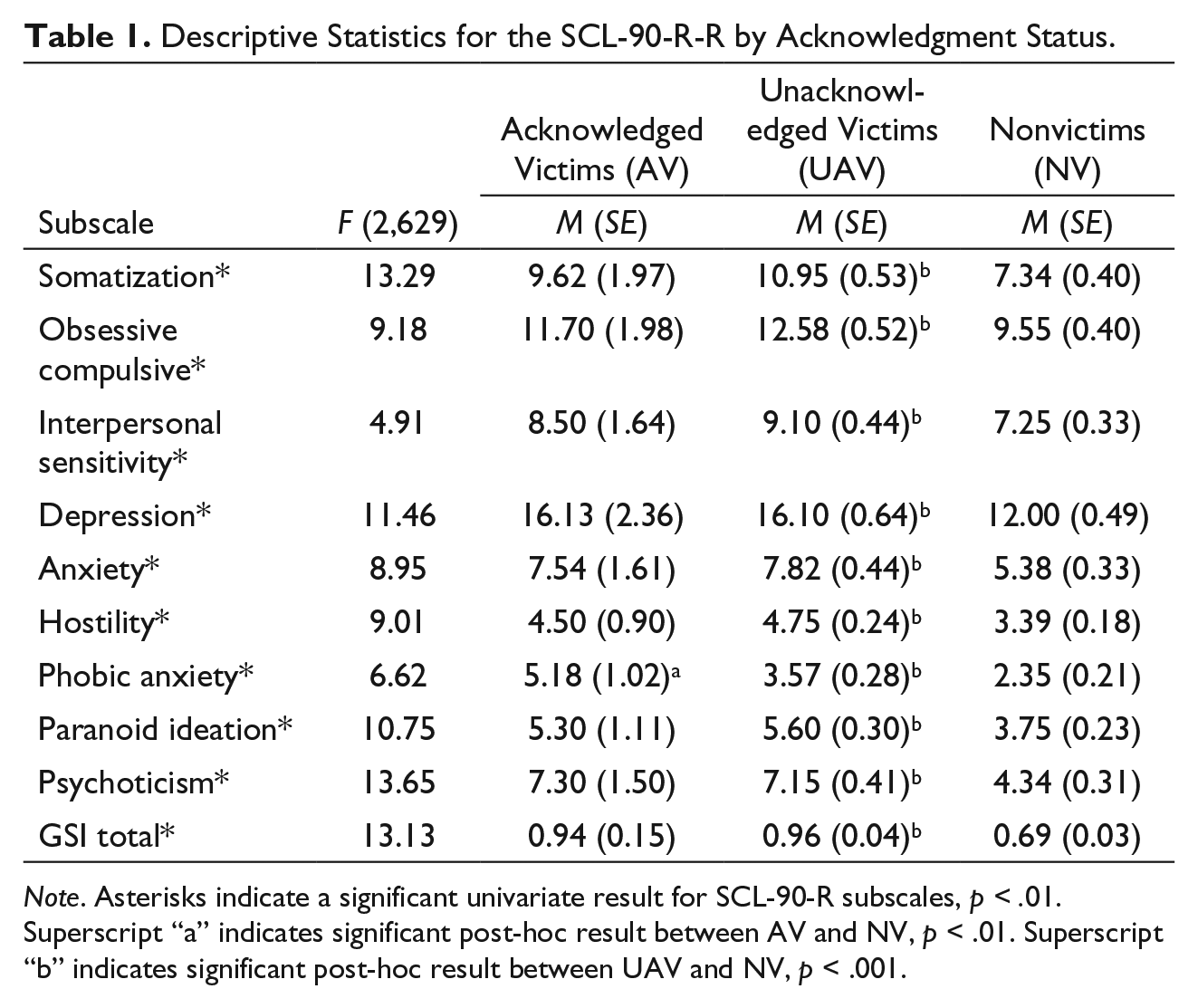
Note. Asterisks indicate a significant univariate result for SCL-90-R subscales, p < .01. Superscript “a” indicates significant post-hoc result between AV and NV, p < .01. Superscript “b” indicates significant post-hoc result between UAV and NV, p < .001.
Descriptive Statistics for the Cope-B Subscales by Acknowledgment Status.

Note. Asterisks indicate a significant univariate result for the Cope-B subscales, p < .01. Superscript “a” indicates significant post-hoc result between AV and NV, p < .01. Superscript “b” indicates significant post-hoc result between UAV and NV, p < .01.
Descriptive Statistics for the ADQ Subscales by Acknowledgment Status.

Note. Asterisks indicate a significant univariate result for the ADQ subscales, p < .01. Superscript “a” indicates significant post-hoc result between AV and NV, p < .01. Superscript “b” indicates significant post-hoc result between UAV and NV, p < .01. Superscript “c” indicates significant post-hoc result between AV and UAV, p < .01.
Manipulation Analyses
Seven of the newly acknowledged victims viewed the acknowledged perpetrator and seven viewed the unacknowledged perpetrator. There was no difference in the number of victims who changed acknowledgment status as a function of perpetrator acknowledgment, X2(1, N = 219) = 0.31, p = .58. Exposure to a perpetrator discussing physical abuse increased victim acknowledgment, regardless of perpetrator acknowledgment. Because there was no effect of video type on changes in acknowledgment status, it was not included in subsequent analyses. Newly acknowledged victims had a mean relationship length higher than the overall sample (M = 34.41, SE = 12.33) and they all acknowledged abuse occurring in the past two months.
Discussion
Consistent with other studies of college students, 38% of participants reported physical IPV victimization within the last two months (Banyard et al., 2020). These findings confirm the results of many studies showing high rates of IPV victimization in college samples and suggests the need for targeted IPV intervention, in addition to prevention, programs (Dardis et al., 2017). The vast majority of victims did not acknowledge experiencing IPV even though they reported moderate to severe physical abuse. This clearly underscores the need for more research in the process of victim acknowledgement (DeGue et al., 2014; Ellsberg et al., 2015). Finally, this study suggests that exposure to IPV perpetrators increases IPV acknowledgment among college undergraduates.
Acknowledgement rates in this sample were lower than those previously reported by Clements and Ogle (2009) but consistent with more recent studies (Rodríguez-Franco et al., 2012). This was unexpected given that this study occurred after the “#MeToo” movement began, when public acknowledgment of victimization increased in public consciousness (Gibson et al., 2019). The “#MeToo” movement largely focused on sexual victimization and not IPV. It may be important to assess whether the current focus on sexual victimization negatively impacts IPV acknowledgment. It is possible that public acknowledgement of assault and harassment can lead to concurrent increases in victim self-blame and victim-blaming rhetoric. For example, victim-blaming in social media increases after well-publicized acknowledged sexual assaults (Stubbs-Richardson et al., 2018). Longitudinal studies are needed to assess the impact movements like “#MeToo” on acknowledgement IPV victimization.
The limited research on IPV acknowledgement suggests that greater acknowledgment is associated with higher abuse severity, as was the case in this study (Sylaska & Edwards, 2014). Numerous studies show that people view lower severity IPV as more acceptable (Martín-Fernández et al., 2018). In addition, greater IPV severity is related to higher victim disclosure (Sabina & Ho, 2014). Thus, victims of severe IPV may be more likely to disclose and social networks more likely to validate their experience as abuse. This may be the mechanism by which abuse severity is related to higher rates of acknowledgment and, in turn, explain why acknowledged victims report better mental health despite higher abuse severity (Jaffe et al., 2021).
Psychopathology and Coping
The current literature assessing the relationship between acknowledgment and psychopathology is inconsistent. Some studies show that acknowledgement is associated with less psychopathology while other studies find no association between acknowledgement and psychopathology (McMullin & White, 2006; Peterson & Muehlenhard, 2011). In this study, unacknowledged victims consistently reported higher rates of psychopathology than nonvictims.
Acknowledged victims’ reported psychopathology was closer to nonvictims even though they reported higher physical abuse severity. One possible reason for this difference is that more than twice as many acknowledged victims reported receiving counseling services. This finding is consistent with literature which suggests that IPV severity is associated with increased help seeking behavior (Ansara & Hindin, 2010). It is important to assess the extent to which acknowledgement mediates the relationship between IPV severity and help-seeking. Moreover, it underscores the need for targeted evidence based mental health interventions for unacknowledged victims.
Consistent with past research, unacknowledged victims reported using more maladaptive coping strategies with greater frequency than nonvictims (Clements & Ogle, 2009; Orchowski et al., 2013). The maladaptive strategies unacknowledged victims reported were forms of avoidant coping. Avoidant coping strategies reduce distress by reducing stress-related thoughts or behaviors (Aldao et al., 2010). College students who use more avoidant strategies, including behavioral disengagement and substance use, report higher stress, and depression (Chao, 2011). More specifically, IPV victims using avoidant strategies report much higher psychopathology (Rizo et al., 2017). This study suggests that acknowledgment may have a salutary effect, decreasing avoidant coping efforts and, in turn, psychopathology. Future studies should assess whether intervention strategies designed to reduce the use of avoidant coping are associated with decreased psychopathology.
Although the strategies endorsed by unacknowledged victims appear to be detrimental in the long-term, these strategies may serve to alleviate immediate psychological distress. It is important to determine whether unacknowledged victims’ short-term distress management strategies (e.g., denial) displace longer term solution-oriented strategies (i.e., planning). It may be important to study victim/nonvictim differences in distress tolerance and emotional regulation as meta-analyses associate deficits in these areas with avoidant coping (Leyro et al., 2010; Naragon-Gainey et al., 2017).
These data suggest that clinical intervention with unacknowledged IPV victims should focus on coping rather than acknowledgment. Lack of acknowledgement may be viewed as another manifestation of avoidant coping, providing short-term relief from anxiety and depression to the detriment of long-term mental health. If victims are given the coping strategies, they need to address short-term increases in psychological symptoms they may be better able to acknowledge and move into the “action” work of addressing abuse.
Abuse Disability
We hypothesized that unacknowledged victims would report higher abuse disability than acknowledged victims who, in turn, would report higher abuse disability than nonvictims. Although both victim groups reported relatively high abuse disability, unacknowledged victims reported abuse disability manifesting in more ways than acknowledged victims. However, acknowledged victims reported greater life restriction than unacknowledged victims.
Victims of other crimes also restrict to decrease perceived vulnerability to revictimization (Lasky et al., 2018; Wollinger, 2017). Thus, acknowledged victims may be restricting as a long-term problem-solving strategy to prevent revictimization. Unacknowledged victims reported abuse disability behaviors that provide short-term relief, such as substance use and denial. One study found that acknowledged IPV victims make more behavioral changes to avoid revictimization than unacknowledged victims (Hammond & Calhoun, 2007). Future research should assess whether acknowledgement increases victims’ use of precautionary behaviors to avoid future IPV. Moreover, clinicians should be aware of the association between acknowledgement and precautionary behaviors and assess the extent to which these behaviors are driving long term mental health symptoms such as anxiety.
Perpetrator Acknowledgment
We hypothesized that more victims would acknowledge when exposed to an acknowledged perpetrator and that unacknowledged victims would report more depression, hostility, and anger in response to the perpetrator than acknowledged victims. The number of acknowledged victims nearly doubled in response to the video manipulation. It did not matter whether the perpetrator in the video acknowledged their behavior as abusive or not. It is possible that perpetrator acknowledgement did not matter because participants identified with the female partner the perpetrator described. The defensive attribution principle suggests that people assign less blame to those who are more like them (Grubb & Harrower, 2008). Because the participants in this study were all female, they may have assigned more blame to the male perpetrator than the female victim, regardless of the perpetrators’ acknowledgement.
Alternatively, victim acknowledgment videos may be more salient to victims than perpetrator videos (Powers et al., 2020). Social learning theory explains how behaviors are learned through the imitation and observation of others and suggest that this effect is strengthened as similarity between people increases (Wareham et al., 2009). Supporting this finding, there is some evidence that victim disclosure may lead to disclosure in other victims (Edwards & Dardis, 2020). Further research is needed to assess the relative efficacy of victim versus perpetrator acknowledgment videos on increasing victim acknowledgment (Powers et al., 2020).
Acknowledged victims reported increases in depression after viewing the perpetrator video. This finding is consistent with past research suggesting that initial reports of acknowledgement are associated with temporary negative mental health consequences, or the experience of “revictimization” (Mummert et al., 2014). Longitudinal research indicates that acknowledgment is associated with long-term positive outcomes, such as leaving the perpetrator and seeking help, which outweigh initial psychological distress (Murray et al., 2015; Zink et al., 2004). In the current study acknowledged victims were more likely to be in counseling and reported fewer avoidant coping strategies and better mental health. These results suggest that interventions designed to increase victim acknowledgement are beneficial to victims’ long-term well-being even if they are associated with short term increases in dysphoria. Supporting these findings, one study found that educating victims about the constituents of abuse resulted in increased victim acknowledgment, decisions to leave the abuser and improved reported quality of life over a year (Valpied et al., 2014).
Limitations and Future Directions
This study assessed college student female IPV victims. Thus, these results may not generalize to non-college samples. Further, lack of racial diversity in this study may reduce the generalizability of these findings. This may be especially important given that there are cultural differences in IPV victims’ disclosure, stigma, and self-blame (Kennedy & Prock, 2018). Future research should assess more diverse samples. For example, IPV victims in same-sex relationships report experiencing more stigma and shame than victims in heterosexual relationships. In addition, perceptions of what constitutes physical abuse differ in homosexual and heterosexual relationships (Sylaska & Edwards, 2014).
Future studies should assess potential differences in acknowledgment between bidirectionally vs unidirectionally violent relationships and extend our findings to include psychological and sexual IPV. Assessing bidirectionally violent relationships would allow us to assess the impact of acknowledgment in perpetrators as well as victims. This is especially important because the majority of IPV is bidirectional. Further, women in bidirectionally violent relationships report more psychological distress and more severe violence than victims of unidirectional violence (Pu et al., 2022). Extending these finding to would allow for intervention targeted to specific types of victimization. Thus, the extant literature suggests that evidenced based clinical intervention needs to be targeted to victimization type.
This study was cross-sectional in design and therefore cannot support causal conclusions about the effects of acknowledgement. It is possible that victims with pre-existing greater psychopathology and avoidant coping may be less likely to acknowledge their abuse. Future studies should employ prospective designs to assess whether acknowledgment plays a causal role in mental health symptoms or coping strategies establish the casual order of events, perhaps utilizing interventions like psychoeducational programs which increase victim acknowledgement (Valpied et al., 2014).
Conclusion
This research confirms the results of many studies showing high rates of IPV victimization and low rates of victim acknowledgment in college samples (Rodríguez-Franco et al., 2012). Further, exposure to an IPV perpetrator increased victim acknowledgment and reported depressive symptoms in the short term, even though acknowledgement is associated with better long-term mental health (Murray et al., 2015; Zink et al., 2004).
These findings underscore the need for targeted evidence-based mental health interventions for unacknowledged victims. Unacknowledged victims consistently reported higher rates of psychopathology, more maladaptive coping, and a wider range of abuse disability than nonvictims. Thus, clinicians should assess for IPV more widely and recognize that short-term increases in psychological symptoms may follow victim acknowledgment of abuse. These findings further point to the need for more research in the process of victim acknowledgement. It would be important to assess lack acknowledgement as a form of avoidant coping, perhaps used to reduce negative affect (DeDue et al., 2014; Ellsberg et al., 2015).
Footnotes
Declaration of Conflicting Interests
Funding
The author(s) received no financial support for the research, authorship and/or publication of this article.
