




Abstract
Interracial violence is a high-profile issue in the United States; however, there is little empirical research on interracial intimate partner violence (IPV). Interracial relationships are becoming more common. However, interracial couples continue to face stressors (e.g., discrimination) that likely impact the relationship (e.g., IPV) than their monoracial counterparts. Research indicates that military populations more likely oppose interracial marriages than nonmilitary counterparts. Yet, no study to date has investigated IPV within military monoracial and interracial couples. To understand the intersecting effects of race/ethnicity among military couples, this study investigates male perpetrated IPV in interracial and monoracial relationships. Using structural equation modeling, this study sample contains information about 449 male veterans from the National Longitudinal Study of Adolescent to Adult Health (1994-2008): Waves I and IV. Findings indicate that (a) White and Black veterans are more violent in monoracial relationships, meanwhile, Latino veterans have a higher IPV prevalence in interracial relationships; (b) Black and White veterans were more likely to use alcohol and other drugs (AOD) after IPV perpetration in interracial relationships, in contrast to Latino veterans’ post IPV perpetrations AOD use in monoracial relationships; (c) veteran mental health status was affected after perpetration of IPV, similar to the effects experienced after combat. In an attempt to address the lack of research on the characteristics associated with interracial violence this study addresses the following questions: (a) Are veterans in interracial families more likely to commit IPV and use of alcohol and other drugs (AOD) than in monoracial families? (b) Among the military samples, is AOD a facilitator for IPV? (c) How does mental health status affect IPV perpetration?
Introduction
Greater rates of intimate partner violence (IPV) perpetration are reported among military families than the nonmilitary populations when controlling for age and race/ethnicity (Cancio, 2018; Cancio & Altal, 2019). The increase of military-related calls into the National Violence Hotline (457 in 2006 to over 1,100 in 2010), indicates that IPV is getting worse among military families (Women’s Justice Project, 2011). From a military perspective, conflict among service members and their families is closely related to higher levels of health care service use, lower military morale, poorer job performance across actors (i.e., both the perpetrator/s and victim/s), and inflated mission safety risk for service members (Fontana & Rosenheck, 2010). In addition, studies have concluded that beyond injury and death, victims of IPV are more likely to report a variety of acute and chronic health conditions resulting in hospitalization, disability, and/or death (Black, 2011; Cancio, 2020b; Coker et al., 2002). However, among U.S. military IPV perpetrators, empirical research has yet to flesh out the various prevalent forms of violence that manifest distinctively among mixed race military families. To date, there is a limited body of research that has examined interracial relationships and IPV in the United States (Karlsson et al., 2018).
Interracial relationships are becoming more common (Buggs, 2019; Robinson, 2019). It’s been half a century since the U.S. Supreme Court decriminalized interracial marriage (Robinson, 2017). Since then, the share of interracial and interethnic marriages in the United States has increased fivefold, from 3% of all weddings in 1967 to 17% in 2015 (Pew Research Center, 2017). According to the Pew Research Center (2017) a growing share of adults say interracial marriage is generally a good thing for American society. Although ramifications of engaging in an interracial relationship have decreased over time, couples continue to face stressors (e.g., discrimination, prejudice) that are likely to impact the couple’s relationship and may leave interracial couples at greater risk for IPV than their monoracial counterparts (Cancio & Altal, 2019; Fusco, 2010; Martin et al., 2013). A body of research demonstrates that low social support, or the perception of low social support, is a significant risk factor for IPV (Coker et al., 2002; Jewkes, 2002; Thompson et al., 2004). In addition, Cancio (2017) highlights how substance use acts as a facilitator for IPV perpetration. Research also shows that interracial couples are frequently ostracized from their families of origin (Gaines, 2001) and are more likely to hide their relationship from family and friends for fear of rejection (Wang et al., 2006). Research has indicated that military populations are more likely to oppose interracial marriages than nonmilitary counterparts. These contextual explanations are not meant to excuse the violence but to highlight some of the unique challenges often experienced in this community (Fusco, 2010). To date, there are no interracial IPV studies on military families in the United States.
Literature Review
Understanding the complex connections between substance use and violence involves a review into the social contexts in which the two activities intersect. Thus, allowing for understanding the assortment of modes in which social contexts potentially create conditions where violent behaviors can manifest. While there is no shortage of theoretical models of IPV, this study focuses on the theoretical backdrop that premises contextual conditions in which substance use may influence IPV. Studies focused on IPV have investigated the social and psychological effects of alcohol on behavior (Caetano et al., 2004), substance use and racialized behaviors (Ballard et al., 2015; Cancio, 2017, 2018), and initial exposures to substance use and violence (Mandavia et al., 2016; Monahan et al., 2015; Peinado et al., 2014). Although there are other risk factors associated with IPV, this literature review will only focus on factors most prevalent among military families (e.g., alcohol and substance use).
Demographic Factors: Age, Ethnicity, Education, and Income
In a study of veterans, Johnson et al. (2015) found that younger age was associated with higher IPV perpetration among substance abuse inpatients. Focusing on race and age differentials, studies using representative samples of veterans suggest that the execution of IPV perpetration is more frequent among non-Whites than Whites and is negatively associated with the age of the perpetrators (McCarroll et al., 2003; Rosen et al., 2002). Breiding et al., (2014), expands on ethnicity by considering other forms of violence both in and outside the family unit. Studies focused on IPV and military veterans have found that IPV does not manifest uniformly across groups of men of similar racial/ethnic groups (Cancio, 2017).
Using a sample of pre-9/11 veteran perpetrators, Cancio (2017) found that White veterans were more disposed to perpetuate sexual violence against their partners; meanwhile, Black veterans were more likely to carry out physical IPV. The study also posited that a number of social determinants of mental and physical health, such as limited access to education, economic resources, and social services, likely play important roles in IPV types and perpetration rates (Cancio, 2017). The stress associated with the financial situation of the family unit may also be related to the perpetration of IPV because higher IPV prevalence has been found among families with combined household income less than $50,000 than for families with a combined income over $75,000 (Breiding et al., 2014). Consistent with some studies, there exists an inverse relationship between IPV and income (Cunradi et al., 2002), and between IPV and education (Ackerson et al., 2008), and a direct relationship between education and income (Erten & Keskin, 2018). Considering variations based on demographic constructs offers a particular context from which substance use and IPV perpetrators manifest. These demographics also affect the availability and acceptability of substance types and rates of use.
Interracial/Monoracial IPV
The development and patterns of cross-group relationships remains an element of active research, and studies indicate that cross-race or cross-ethnicity friendships or relationships tend to develop in situations where peer norms are supportive (Plummer et al., 2016; Titzmann et al., 2015; Tropp et al., 2014). Given potential disapproval from their community, it is possible that people in interracial relationships feel less welcome within their milieu. The resulting stress on the couple from a relative lack of social integration could increase conflict and IPV within their relationship (Brownridge et al., 2018).
Interracial relationships are vulnerable to experiencing cultural contrasts due to the different cultural background of each partner. These contrasts translate to the couples’ manners of communication. These cultural contrasts are facilitators for miscommunication and frustration. For example, interracial couples may experience more communication differences which could potentially lead to higher levels of violence than monoracial relationships (Kochman, 2013). Taking into consideration that every culture acquires unique perspectives and alternate meanings to words, miscommunication due to differences in race or ethnicity can lead to arguments oftentimes manifesting into different forms of violence whether it be verbal, sexual, or physical.
Carbone-Lopez (2013) examined differences in IPV based on the race/ethnicity of couples and found that partner education, childhood victimization, and being in a non-White monoracial relationship were associated with higher likelihood of physical violence, verbal aggression, and coercive control than with a White monoracial relationship. Being in an interracial relationship was associated with higher likelihood of verbal aggression and coercive control than physical violence. Studies suggest that there may be differences based on the specific nature of the racial or ethnic composition of the pair in which violence occurs. There is no theory specifically designed to explain why interracial relationships face an elevated risk of violence (Brownridge, 2016). Validated measures of relevant concepts and constructs, such as stress, couple communication, differences in expectations, and racism and discrimination, need to be examined (Brownridge, 2016).
Drugs/Alcohol and IPV
Substance use is only one of several important factors that influence the risk for IPV, and vice versa (De Bruijn & De Graaf, 2016). Regardless of the direction of the relationship between substance use and IPV, the co-occurrence of IPV and substance use is substantial across a series of studies (Ahmadabadi et al., 2019; Cancio, 2017; De Bruijn & De Graaf, 2016; Shorey et al., 2014). Substance use may also be influenced by other risk factors (e.g., violence in the family) and substance use may also influence other risk factors (e.g., belief that violence is appropriate). Illicit drug use is more correlated to IPV than alcohol (Choenni et al., 2017). The higher the frequency of inebriation also increases IPV perpetration among men (Shorey et al., 2014). Regardless of what substance is consumed, higher levels of substance use are related to higher IPV perpetration.
Military Service: Stress, Mental Health, and IPV
Occupational-related stress manifests differently between civilian and military occupations. This difference is increased by military stressors (e.g., military deployments, the ambiguity of family relations, combat, etc.) (Campbell & Nobel, 2009). From indoctrination, military recruits are socialized to new social norms (i.e., values and norms of masculinity, military vocabulary, a new set of values, etc.) (Cancio, 2015). Intense physical and psychological stressors stimulate military recruits to operate under new sets of norms, emotional and physical. This social and psychological conditioning into military life includes hyperactive vigilance to perceived threats and emotional distancing from others (Grossman, 1995). Other military-related factors (e.g., exposure to combat, the number of deployments, and posttraumatic stress disorder [PTSD]) may also influence the use of various substances (Gewirtz et al., 2010) and IPV connections (Taft et al., 2011). Under these conditions, service members and veterans respond to perceived threats of hostility by using military-related reactions (i.e., violence) (Gonzalez et al., 2016).
Novaco and Chemtob (2015) concluded that veterans are more likely to employ an overly hostile interpretation of events and will override their ability to engage in self-monitoring to lower the risk for aggressive reactions. The presence of combat-related PTSD places a service member at a substantially higher risk for experiencing IPV (Taft et al., 2011). PTSD symptoms and impulsivity, as seen among combat veterans, can help account for aggressive behavior in the absence of active substance use (Heinz et al., 2015).
Higher IPV perpetration has also been linked to depression among perpetrators (Taft et al., 2011). This suggests an added risk connected with these comorbid diagnoses. This is because depression has been found to co-occur with PTSD (Seal et al., 2009). Post-9/11 veterans have reported rates of depression around 20% with symptom rates even higher when both PTSD and depression are co-occurring, and over half had severe impairment in close relationships with others (RAND Center for Military Health Policy Research, 2008). Consequently, a person suffering from depression may have agitated behavior, this exacerbated by the presence of PTSD. Excessive episodes of agitated behavior have been linked to risk of IPV perpetration (Gerlock, 1999).
Existing research suggests that stress and depression among active-duty personnel are associated with an increased risk of IPV perpetration. Marshall et al. (2005) found higher rates of depressive symptoms among Army IPV perpetrators, compared with those who were nonviolent. Personality traits (e.g., attitudes toward women) did not distinguish IPV perpetrators from nonaggressive controls in a sample of active-duty service members (Marshall et al., 2005).
When an IPV perpetrator expresses the belief that there is nothing to lose, and feels jealousy, there is a potential increased risk for an IPV-related homicide (Campbell, 1992). Service members and veterans experience changes in the ways in which they view the world after being exposed to extreme stress, combat, and possible war-related atrocities, including difficulties with respect to trusting others, developing closeness, and struggles with power and control (Taft et al., 2011). There is also some empirical evidence suggesting that IPV perpetration is more common among low-ranking military personnel than higher-ranked personnel (Rosen et al., 2003).
In an attempt to move toward a theoretical framework that allows for the framing and exploring of variables relevant to understanding the causes of IPV, unbound by the usual theoretical limitations and that may provide a clearer understanding of the association between substance use and IPV in cross-racial relationships. It is important to understand the dynamic ways in which behavior and substance uses interact. In an attempt to address the lack of research on the characteristics associated with cross-racial violence this study addresses the following questions: (a) Are veterans in interracial families more likely to commit IPV and use of alcohol and other drugs (AOD) than in monoracial families? (b) Among the military samples, is AOD a facilitator for IPV? (c) How does mental health status affect IPV perpetration?
Methods
The study sample contains information about 449 active duty and veteran male 1 participants from the National Longitudinal Study of Adolescent to Adult Health (1994-2008): Wave I and IV In-Home Interview in 2008 (Harris et al., 2009). Add Health is a longitudinal study of a nationally representative sample following initial adolescents, between grades 7 and 12 in the United States during the 1994-95 school years. Participants have been followed through four in-home interviews, the most recent in 2008 when the sample was aged 24-32. This study used Wave I and IV, conducted in 2008, includes in-home interviews with original respondents, now young adults. Inclusion criteria for military sample included responding if the participant has ever been in the military and/or is currently serving in the military (N = 449). Accounting for the relative sample size, 2 the analytic strategy took two approaches in order to address potential issues with the subsample (Wolf et al., 2013). First, as recommended by Muthén & Muthén (2002), we tested the stability of the results by running the analyses multiple times with a new, randomly selected seed number 3 (i.e., so that data generation began at a different point). Second, we designed models in which the number of indicators per factor was greater than the minimum number of indicators required for model identification (Marsh et al., 1998).
Measures
The following variables were used as exogenous indicators. Frequency of physical IPV, from the perpetrator (Physical abuse toward partner) and physical IPV from victim (IPV physical from partner) were constructed by aggregating IPV in the past 12 months (i.e., violent toward partner, slap/hit/kick partner, and injured partner) making the mean is zero and the standard deviation is one. This allowed for a standardized composite score for physical IPV. Sexual IPV (sexual abuse toward partner) and sexual IPV from victim (sexual IPV from partner) were measured as a dichotomous variable, where respondents answered questions about forced sex on partners. Perpetrator and partner demographic factors as reported by the perpetrator include military service (yes/no), race/ethnicity (White, Black, and Latino).
A measurement model was used to create an endogenous latent construct SES. SES created using income and education. Income designates annual income of the perpetrator; this variable was constructed as a categorical ordinal variable using 12 categories with increments of $10,000 each, beginning with $5,000 or less to $150,000 and more. Education was created using a single item intake question, education designates the highest grade completed at the time of the survey; this variable was constructed as a categorical ordinal variable using six categories beginning with less than a high school diploma and ending at postgraduate school. A measurement model was also used to create an endogenous latent construct mental health history. Mental health history is manifested by three observed variables: being diagnosed with depression, diagnosed with post-traumatic stress disorder, and diagnosed with panic or anxiety.
The observed substance use variables 4 (i.e., drug use of a prescription drug without prescription) were all dichotomized where zero indicated that the individual did not use the specific substance within the last 30 days, and one has used the substance (≥1 times) within the last 30 days. Marijuana and alcohol use were examined as single-item indicators, zero indicated that the individual did not use the specific substance within the last 30 days, and one has used the substance (≥1 times) within the last 30 days. Alcohol use and marijuana use were operationalized so that one indicated that the substance was used more than 12 days per month, and zero indicated that the substance was used less than 8 days per month. A measurement model was also used to create an endogenous latent construct, mental health history. Mental health history is manifested by three observed variables: ever being diagnosed with depression, diagnosed with PTSD, and diagnosed with panic or anxiety.
Analysis
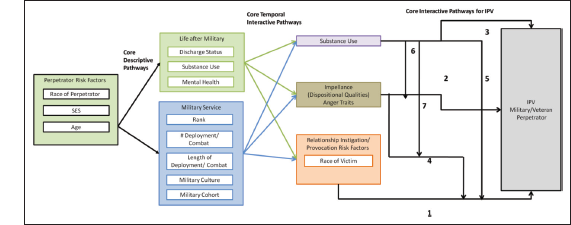
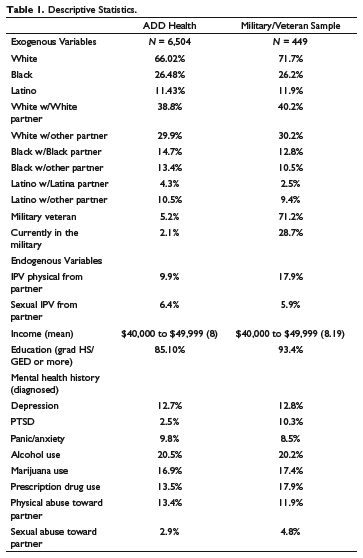
The analytic strategies first employed descriptive statistics (means, standard deviations, and category percentages) using STATA 15 (Table 1). Second, confirmatory factor analysis and SEM were utilized to examine the total effects of the simultaneous equation path model of veterans by race/ethnicity, followed by an examination of the similarity among military and nonmilitary perpetrators (Table 2). All estimated parameters were hypothesized a priori, intending to estimate a parsimonious and theoretically based model testing line three of the model, focused on the relationship between substance use and IPV (Espinoza & Cancio, 2020) (Figure 1). To compare the general population to veterans and service members, this study tested the factor structures between military and nonmilitary by race/ethnicity and cohort (Table 3). In Table 3, a group comparison procedure was conducted for the different racial/ethnic groups examining veteran and nonveteran models together and then again grouping all veterans with nonveteran perpetrators. Results from STATA regression analysis of the selected variables indicated that multicollinearity did not need to be a concern in this model. Absolute values of correlations among the independent variables are less than 0.3; estimated regression coefficients are positive as expected. All standardized coefficients are relatively small, and the significance of the regression coefficients is consistent with the significant R2.
Theoretical Simultaneous Path Model of the Correlates of IPV.
Descriptive Statistics.
Theoretical Simultaneous Path Model.
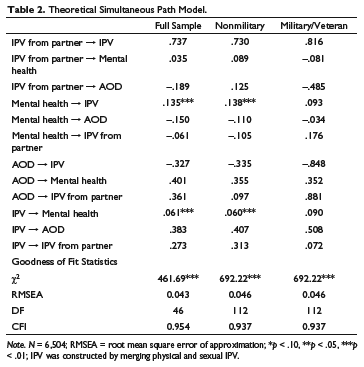
Note. N = 6,504; RMSEA = root mean square error of approximation; *p < .10, **p < .05, ***p < .01; IPV was constructed by merging physical and sexual IPV.
Theoretical Simultaneous Path Model for White Perpetrators.
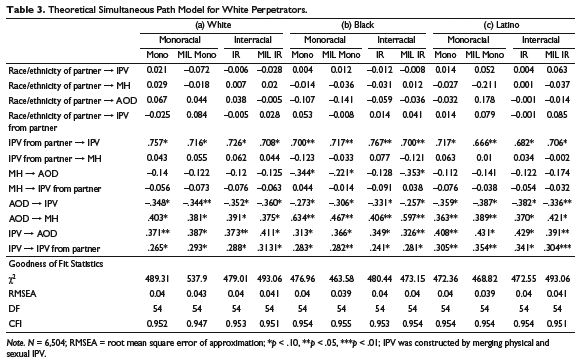
Note. N = 6,504; RMSEA = root mean square error of approximation; *p < .10, **p < .05, ***p < .01; IPV was constructed by merging physical and sexual IPV.
The goodness-of-fit was used to specify a baseline model that fits the data’s veteran perpetrators of IPV and substance use. 4 The baseline model specification process took two sequential stages by the status of military service. Starting with the “propositional” model shown in Figure 1, the researchers first observed indications of model misspecification. To this end, modification indices were employed. 5 The second stage involved systematically trimming out of nonsignificant paths (i.e., coefficient estimates with p values >.05). 6 At each step, interim evaluations were carried out in search of any relevant path once the model had been simplified. The process of finding the best-fitting model stopped when no additional paths were suggested by the modification indices, as all-remaining paths retained statistically significant given acceptable levels of model fit.
Findings
The theoretical simultaneous path models illustrated in Table 2, indicate that there are significant differences between military and nonmilitary IPV perpetrators and the context of their relationships (e.g., having partners who reciprocate IPV-type behaviors). When looking at the IPV reciprocated from the partner to the IPV perpetrator, military veterans are more likely to reciprocate violence when provoked than the general population. In addition, military veterans’ mental health is less affected when receiving IPV from their partners than their civilian counterparts. IPV from the partner is most likely to affect the use of AOD in nonmilitary populations than among veterans. The impact mental health has on the perpetrators of IPV is 1.4 times less significant for veterans than among their civilian counterparts. veterans who use AOD are nine times more likely to experience IPV from their partner, than their civilian counterparts. IPV is 1.5 times more likely to affect veteran perpetrators’ mental health than that of nonmilitary perpetrators. Military perpetrators are 1.3 times more likely to indulge in AOD after an incident of IPV perpetration than the general IPV perpetrator population. Veterans are four times less likely to receive reciprocation of IPV from their partner after they have committed IPV than their civilian counterparts.
For Whites, being in the military is a protective factor for IPV. This is more prevalent in monoracial than interracial military families where the perpetrator is White. Findings from Table 3a, or the theoretical simultaneous path model for White perpetrators indicate that although White military perpetrators are more violent in interracial relationships, they are less violent than White veterans in monoracial relationships. White veterans in monoracial relationships have higher rates of AOD and are more likely to reciprocate IPV than White veterans in interracial relationships. The reciprocation for IPV is more likely to affect the mental health of White veterans in monoracial relationships than White veterans in interracial counterparts. AOD use is more likely to occur after IPV incidents than AOD use to influence IPV outcomes, this is most significant among White veterans in interracial relationships than monoracial.
Black veteran perpetrators are more violent in monoracial relationships than in interracial relationships (Table 3b). Black veterans in interracial relationships are 3.9 times most likely to use AOD than their monoracial counterparts. In addition, Blacks veterans in monoracial relationships are more likely to reciprocate IPV than in interracial relationships. The reciprocation of IPV is more likely to affect the mental health of Black veterans in monoracial relationships as opposed to their interracial counterparts. Among Black veterans, AOD use is more likely to occur after IPV incidents than AOD use to influence IPV outcomes, this is most significant among interracial relationships than monoracial.
For Latinos, military status is not a protective factor against IPV perpetration (Table 3c). Latino veteran population is more violent in interracial relationships than their monoracial counterparts. Latino veteran monoracial relationships overwhelmingly use 13.7 times more AOD than their interracial counterparts. Latino veterans in interracial relationships show significantly higher prevalence in IPV reciprocation, as a reaction to IPV from their partner, than in monoracial relationships. Military IPV perpetrators, in monoracial relationships, who are also victims of IPV, suffer higher effects on their mental health status than those in interracial relationships. In contrast to other groups, AOD use is more likely to occur after IPV incidents than used to influence IPV outcomes in monoracial relationships than interracial relationships. Reciprocation, initial IPV from perpetrator manifesting into IPV from victim to military perpetrator, is more likely to occur in monoracial relationships than interracial relationships.
Discussion
In an attempt to address the lack of research on the characteristics associated with interracial violence this study addressed the following questions: (a) Are veterans in interracial families more likely to commit IPV and use of alcohol and other drugs (AOD) than in monoracial families? (b) Among the military samples, is AOD a facilitator for IPV? (c) How does mental health status affect IPV perpetration? This study was able to conclude that military IPV was most prevalent in White and Black monoracial relationships. Although White veterans have higher IPV in interracial relationships, they are less violent than White veterans in monoracial relationships. Similar to White veterans, Black veteran IPV perpetrators are more likely to engage in AOD after IPV incidents in interracial relationships than monoracial. Latino veterans demonstrated higher prevalence of IPV in interracial relationships.
Argued by Kochman (2013), interracial couples may experience more cultural differences and couple conflict, which could potentially lead to higher levels of violence, we found this not to be statistically significant, in military families where male perpetrators were White and/or Black. Latino perpetrators in interracial relationships did show significant increases in IPV in interracial relationships. Similarly, many scholars argue that interracial couples may experience more communication differences (Kochman, 2013). Taking into consideration that every culture acquires unique perspectives and alternate meanings to words, miscommunication due to differences in race or ethnicity can lead to arguments oftentimes manifesting into different forms of violence whether it be verbal, sexual, or physical. As such in interracial Latino families where cultural (e.g., language usage, machismo, gendered customs, etc.) and contextual (e.g., mixed status families, community composition, varying degrees of social support) factors greatly differ than among other types of families (Cancio, 2018). Given potential disapproval from their community, it is possible that people in interracial relationships feel less welcome within their milieu. The resulting stress on the couple from a relative lack of social integration could increase conflict and IPV within their relationship (Brownridge et al., 2018).
Although several lines of evidence suggest that AOD use plays a facilitative role in IPV by precipitating of exacerbating violence, this study found that Black and White veterans were more likely to use AOD after perpetrating IPV in interracial relationships (Table 3a and c). Meanwhile, Latinos were more susceptible to AOD use after an IPV incident in monoracial relationships. Altogether, Latino and Black veterans were more likely to use AOD in interracial relationships than their respective counterparts (Table 3b and c). Some studies suggest the benefit of interventions that focus on AOD use/addiction in men who have histories of IPV (Cancio, 2017, 2020a; Cancio & Altal, 2019); in this study we suggest considering interventions that do not fixate on AOD use as facilitator of IPV but possibly as an outcome for military populations. The strong relationship between AOD use and perpetration of IPV has been found in primary health care settings, family practice clinics, prenatal clinics, and rural clinics.
Findings show a significant impact of mental health status on IPV prevalence, and vice versa. Specifically, mental health status on IPV prevalence is 1.4 times less significant for veterans than among their civilian counterparts. IPV perpetration is 1.5 times more likely to affect veteran perpetrators’ mental health status than that of nonmilitary perpetrators. This finding might be related to military socialization processes. Military personnel are socialized and conditioned to respond in violent ways to threats. Under these conditions, service members and veterans respond to perceived threats of hostility by using military-related reactions (i.e., violence) (Gonzalez et al., 2016). For service members, postcombat may manifest feelings of guilt from trauma; as such, contributing to potential combat/trauma-related PTSD. This sense of post guilt may manifest similarly within their relationships (i.e., post-IPV perpetration). Novaco and Chemtob (2015) have concluded that veterans are more likely to employ an overly hostile interpretation of events and will override their ability to engage in self-monitoring to lower the risk for aggressive reactions. When conflict arises within their relationships, veterans or service members may respond violently, reflecting military conditioning. In the end, IPV perpetrators may have feelings of guilt or disconnection that potentially contribute to poorer mental health status, and subsequently higher AOD use/misuse (Cancio, 2021).
Although this study provides significant contributions to the literature on family violence in military families, it is not without limitations. First, qualitative data should be collected in order to fully depict the interactive effects of the various risk and protective factors in military families suffering from IPV. Such data can be useful in creating grounded theoretical models that can be tested using larger samples. Second, the sample size in this study was small, yet significant. Finally, the data employed was limited to specific military measures (e.g., era of service, rank, and military occupation) of an individual service member and/or veteran might allow for a closer examination of the lasting effects of exposure to the military lifestyle in the form of a military career. Finally, the data did not include violence occurring between partners of the same gender or where female perpetrators were violent toward men.
Conclusion
There is no overarching theory that explains why interracial relationships face an elevated risk of violence (Cancio, 2021); in this study, we have created validated a priori measures of relevant concepts and constructs. We found that (a) White and Black veterans are more violent in monoracial relationships, meanwhile, Latino veterans have a higher IPV prevalence in interracial relationships; (b) Black and White veterans were more likely to use AOD after IPV perpetration in interracial relationships, in contrast, Latino veterans use AOD in monoracial relationships; (c) veteran mental health status was affected after perpetration of IPV, similar to the effects experienced after combat.
This study is an important step in understanding the nature of military service and its impact on IPV perpetration in interracial and monoracial relationships. The theoretical findings in this study suggest that there is uniqueness about the military context in which the lives of those who are directly (e.g., service members and veterans) and indirectly (e.g., spouses, partners, and/or other dependents) associated with military life are exposed to a unique context. It is within that military-specific context that IPV perpetration manifests uniquely. Future research should consider expanding on this study by including instigation and provocation risk factors (e.g., communication, differences in expectations) and racism and discrimination, need to be examined (Figure 1). Future studies should consider other possible correlates of IPV and military factors. The effect of military service IPV perpetration suggests an expansion in the understanding of violence in the context beyond theories of substance use and race/ethnicity of partners. Findings warrant further investigation to understand the differences in patterns and dynamics of IPV associated with military service and nonmilitary service–related IPV in interracial and monoracial families. The differences may highlight opportunities for potential interventions and have implications for the design of perpetrator programs.
Footnotes
Declaration of Conflicting Interests
Funding
The author(s) received no financial support for the research, authorship, and/or publication of this article.
