




Abstract
Sexual violence continues to plague college campuses even with the implementation of bystander intervention programs. Previous research has demonstrated that diminished situational risk recognition increases the risk for sexual assault victimization. However, there is a paucity of research comparing men’s and women’s risk perception in sexual assault scenarios, risk perception from a victim or perpetrator perspective, or the role of previous sexual violence history, rape myth acceptance, and world assumptions on sexual risk perception. The current study examined male and female college students’ risk perception while reading a sexual assault scenario. Participants also completed measures of victim and perpetrator blame, rape myth acceptance, and beliefs in a just world. The results suggested that men’s and women’s risk perception is influenced by different rape myths and world assumptions. Specifically, women’s risk perception and victim blame are associated with sexual communication myths and beliefs in the randomness of the world, while men’s risk perception and victim blame are related to the acceptance of myths that women ask for sexual assault and that the world is a just, cruel place. The results call for the incorporation of additional training on how rape myths and world assumptions may impact risk recognition and intervention in sexual assault education. It will also be important to target different barriers to intervention for men and women.
College campuses have a long history of being plagued with sexual assault (Fedina et al., 2016; Franklin et al., 2020). Several research studies have found that one in five women and one in ten men experience sexual assault before graduating (Carey et al., 2018; RAINN, n.d.). Governmental initiatives (Campus SaVE Act, Title IX, and The Clery Act), have mandated that bystander intervention be at the forefront of efforts to combat sexual violence (Campus SaVE Act, 2013; Fenton & Mott, 2018). Campus initiatives quietly demand that men must be allies to reduce the prevalence of sexual violence. Clearly defining, isolating, and recognizing pertinent risk factors associated with sexual assault would generate an opportunity that may enhance the impact of bystander intervention programs to reduce dangers for potential victims or bystanders that may have the opportunity to intervene (Melkonian et al., 2017).
Koelsch et al. (2012) noted that college students may be more open-minded to the notion of monitoring their cohort’s behavior. Given the many barriers inhibiting bystander behavior (Burn, 2009), accurate and effective bystander intervention is difficult. Attitudes of the potential bystander about sexual assault, the potential victims, and their self-efficacy—or ability to intervene successfully—impact the likelihood of intervention (Banyard, 2011). Much of the research on bystander intervention for sexual assault has focused on increasing awareness and improving attitudes (Lonsway, 1996). However, another barrier in need of further study is risk perception.
Most sexual assault incidents may seem ambiguous, creating a scenario in which the victim or bystanders may not be able to recognize possible risk factors and choose the appropriate behavior to retreat from or intervene during the eminent danger. Brown et al. (2005) questioned whether previous sexual victimization risk perception. They found in an all-female college population that sexual assault experience increased improved sexual assault risk perception. Messman-Moore and Brown (2006) explored the connection between past sexual victimization and increased likelihood of adult victimization of college women. Decreased risk perception was one factor that increased the likelihood revictimization (Messman-Moore & Brown, 2006). Poor risk perception on the part of victims has been shown to be related to increased risk of sexual assault victimization (Gidycz et al., 2006). Faulty risk perception has also been linked to failure to recognize a threat and intervene for bystanders (Bennett et al., 2014).
Yet little is known about what factors influence risk perception beyond previous sexual assault experience. A likely culprit is rape myths. Lonsway and Fitzgerald (1994, p. 134) defined rape myths as “attitudes and beliefs that are generally false, but are widely and persistently held, and that serve to deny and justify male sexual aggression against women.” Research has demonstrated that rape myths sprout from our culture norms that directly or indirectly support sexism and violence toward women (McMahon et al., 2020). Rape myths place women in a marginalized status and at a detriment to their male counterparts by blaming the victim and absolving the offender by minimization or justification of responsibility of inappropriate behavior (Vandiver & Duplap, 2012). Discussions surrounding rape myths have focused on blaming the victim or victim behaviors, which should have occurred by the victims to prevent the sexual assault (Bevens et al., 2018; Grubb & Turner, 2012; Suarez & Gadalla, 2010). Previous research (Reitz-Krueger et al., 2017; Ryan, 2011) has upheld the strong link between beliefs in rape myths and the risk for both sexual victimization and sexual perpetration. Acceptance of rape myths embedded within the culture may affect sexual assault risk perception because of the social constructed reality.
The analysis would be remiss without the inclusion of the world assumption framework proposed by Janoff-Bulman (1989). Janoff-Bulman (1989) described how our understanding of sexual violence is in part impacted by basic assumptions we make of the world. Assumptions we have about the world may lead to sexual assault scripts that require high levels of force and stranger assailants (Littleton & Axsom, 2003). World assumption theory has been found to impact outcomes after sexual violence, including increased depression and fear of intimacy (Harris & Valentiner, 2002). The negative outcomes associated with just world assumption may be caused by the significant schema shift that happens when the victim is betrayed by someone they trusted (Freyd, 1997) or when they are hurt in a situation that they initially believed to be safe (Littleton et al., 2006). The sexual assault trauma will not match the schema or “real rape” that dictates an increased awareness of threat and cautious interpretation of the situation (Janoff-Bulman, 1989), which would translate into this situation as a lack of risk perception.
Embedded within this dialogue is that men and women may use different mechanisms to recognize and act upon risks related to sexual assault at specific points (Diamond-Welch et al., 2016). It is possible that perception of risk in a situation may differ for men and women due to social conditioning or previous experiences. Burn (2009) studied male and female undergraduates’ assessment of five scenarios based on the situational model of bystander intervention outlined by Latane and Darley (1969) to determine whether some barriers were more prevalent, and the impact of gender on these barriers. He found that men reported more barriers than women and that these barriers affected intention to intervene and victim blame. Burn (2009) suggested that participants were unable to recognize high risk situations. This lack of recognition signals a need to look further for a nuance of gender within the narrative concerning risk perception (McMahon & Dick, 2011; Piccigallo et al., 2012).
The purpose of this study is to examine when male and female college students would recognize risk in a sexual assault scenario and how a history of sexual violence, perception of the scenario from the lens of a perpetrator or victim, rape myth acceptance, and world assumptions impact risk perception in men and women. We hypothesized that female students would perceive risk and seek to leave the scenario earlier than their male counterparts. We also hypothesized that for both men and women, previous sexual victimization or perpetration, acceptance of rape myths, and higher just world assumptions would be associated with poorer risk perception in both men and women.
Methods
Participants
A total of 139 participants (51.1% male) were recruited from a Midwestern university. The sample was predominantly Caucasian (67.6%), 23.7% were African American, 5.0% were Latino, 2.2% were Asian American, and 1.4% reported their race as “other.” The average age for the participants was 19.9 (SD = 1.6). Freshmen made up 33.1% of the sample, while 32.4% were 11 sophomores, 21.6% were juniors, and 12.9% were seniors. Participants were stratified accordingly: 92.8% reported that they were heterosexual, 3.6% reported they were bisexual, 1.4% reported they were gay or lesbian, and 2.2% stated that they preferred not to answer. In total, 72% of the participants lived in campus housing. Almost half of the participants (48.9%) came from suburban areas, while 20.9% were from urban areas and 30.2% were from rural areas. In total, 5% of the participants were current or former military.
Measures
Demographic questionnaire. Each participant completed a demographics questionnaire designed to obtain information about the participant’s age, year in school, ethnicity, sexual orientation, housing information, and military background.
Modified sexual experiences survey (SES; Koss & Gidycz, 1985). The SES is a 12-item questionnaire, which asks participants about their history of sexual abuse and assault history. Items ask about increasingly more severe sexual abuse situations, from misinterpreting sexual intent to completed rape. Participants respond to the questions with either a “yes” or “no.” For the female participants, they responded about their sexual assault victimization history; men responded based on their sexual assault perpetration history. Just over 60% (60.3%) of women reported experiencing some form of sexual assault. Of these women, 5.9% reported a misinterpretation of the level of intimacy, 29.4% reported verbal coercion, 3% reported threats of physical force, and 22.1% reported physical force was used for sexual intimacy. Just over 60% (60.4%) of the men in the study reported engaging in some type of sexual assault perpetration history: 31.0% reported misinterpreting the level of intimacy, 26.8% reported using verbal coercion, and 2.8% reported using physical force for sexual intimacy. We used the original SES because it was shorter than the revised version.
Illinois Rape Myth Acceptance Scale (IRMA, Payne et al., 1999). This 45-item self-report measure assessed the degree to which men and women adhere to rape myths. Participants indicate their agreement with statements on a 7-point Likert scale (ranging from 1 = “not at all agree” to 7 = “very much agree”), with higher scores representing stronger beliefs in rape myths. The IRMA has seven subscales: It’s Not Really Rape, She Lied, She Asked for It, He Didn’t Mean To, She Wanted It, Rape is a Trivial Event, and Rape is a Deviant Event. The IRMA has demonstrated good reliability (i.e., α > .75) with an alpha of .93 (Payne et al., 1999).
World Assumptions Scale (WAS, Janoff-Bulman, 1989). The WAS is a 32-item measure that assesses a person’s beliefs about the world and how it operates. Participants answer the questions using a 6-point scale from 1 (disagree completely) to 6 (agree completely). The WAS has five subscales: Justice, Benevolence of People, Benevolence of the World, Randomness, and Controllability. The subscales of the WAS have demonstrated adequate reliability (.68-.86) and have demonstrated concurrent validity with trauma exposure and response variables (Elklit et al., 2007).
Risk Perception Survey (RPS; Messman-Moore & Brown, 2006). The RPS was used to assess risk perception and behavior using two PowerPoint vignettes modeled after those created by Messman-Moore and Brown (2006). However, a male “perpetrator” version was added as a second vignette, describing the social experience from the perspective of the male, yet corresponding to the female vignette slide by slide. The two vignettes were designed to exhibit clear and ambiguous risk factors in a hierarchical structure, with the clear risk factors becoming gradually more prominent. Clear and ambiguous risk factors for sexual assault were modeled based off those identified by the literature (Messman-Moore & Brown, 2006; Muehlenhard & Linton, 1987). Clear risk factors have been identified as: verbal sexual comments, physical pressure while fondling, and persistence despite a clear unwillingness by the other party. Ambiguous risk factors include consumption of alcohol or other drugs by men and women, comments containing sexual undertones, and social isolation.
Both vignettes comprised of 25 PowerPoint slides, depicting a series of chronological events based on a hypothetical social encounter. Each slide was administered on a timed, 15-second delay. Participants were asked to imagine themselves in the social scenario and respond as they would if the event were happening to them. Female participants viewed the PowerPoint vignette written from the perspective of the “victim,” while male participants viewed that of the “perpetrator.” Threat appraisal and risk response were examined as the slides progressed; men and women rated whether they would feel: (a) uncomfortable, (b) would leave the situation, or (c) would do or respond in a different way. Responses to each slide were recorded based on categorical “yes” or “no” checkboxes and qualitative, handwritten descriptions of behavior. Higher slides numbers for the first “yes” responses indicated an increased risk for potential sexual victimization. Responses were scored by identifying the number of the slide when the participant (a) felt uncomfortable and (b) when they would leave. Scores that were higher indicated that the participant felt uncomfortable or would leave later in the vignette, suggesting greater risk for assault. The RPS has demonstrated good reliability and convergent validity (Messman-Moore & Brown, 2006).
After completing the vignette, the participants were asked to respond to the yes/no question, “Was this sexual assault?” They were also asked to rate to what degree they blamed the man, the woman, and the situation using a 5-point scale from 1 (not at all) to 5 (very much).
Procedure
Participants were recruited from an undergraduate psychology research pool and were compensated with class credit. A same-sex research assistant ran participants in same-sex groups. Participants were tested in groups of no more than 10 people at a time in large classrooms. The researcher read the informed consent aloud to the participants, after which all participants were asked to sign the informed consent.
Participants viewed a 25-slide PowerPoint presentation of a hypothetical and ambiguous heterosexual sexual assault situation written in second person perspective. They were then asked to respond as if the sexual assault scenario were happening to them. Participants viewed a gradually ascending hierarchy of sexual events, beginning with attending a party and eventually culminating in a rape scene. Participants marked at which point during the vignette they would feel uncomfortable and when they would leave the situation, as well as if they would feel or do anything else. After the vignette, participants answered four questions about how much they blamed the woman, the man, and the situation. Participants then completed the remaining measures. Researchers provided debriefing information about the purpose of the study as well as local resources for sexual assault prevention and counseling at the end of the study. The study received institutional review board approval from the university at which it was conducted.
Data Analysis Plan
The research was examined for missing data and total scores were calculated for the WAS subscales and IRMA subscales. Sexual assault victimization was calculated in a categorical manner. The responses for feeling uncomfortable for the 25 slides were also recoded into a single variable, with endorsement of feeling uncomfortable later in the scenario would result in a higher score than feeling uncomfortable earlier in the vignette. The responses for leaving the situation were recorded in a similar manner. We also calculated a difference score between when participants would feel uncomfortable and when they would leave. We ran a series of t tests to examine the differences within and between women and men on when they would feel uncomfortable and when they would leave the scenario. We also ran a series of t tests to examine differences between women and men on the degree to which they blamed the woman, the man, and the situation; a chi-square was used to examine differences between men and women on if they considered the event a sexual assault. A series of stepwise hierarchical regression equations were run separately for men and women. The outcome variables were when participants would feel uncomfortable, when they would leave and the difference value between these two scales, as well as the degree to which the participants blamed the woman, the man, and the situation. In the first step, previous sexual assault experience was entered into the equation. In the second step, the IRMA and WAS subscales were entered into the equation.
Results
Missing data was minimal (<1%) and was replaced with the series mean. A review of the correlation matrix and the pairwise plots showed no evidence of heteroscedasticity or multicollinearity. There were also no univariate and multivariate outliers. Four of the subscales of the IRMA (She Lied, Not Really Rape, Rape is a deviant event, and Rape is a trivial event) were moderately positively skewed. They were transformed using a square root transformation.
There was a significant difference between when participants felt uncomfortable and left the situation for both men, t(70) = –4.21, p < .001, and women, t(67) = –6.01, p < .001. Women felt uncomfortable earlier in the scenario than did men, t(137) = 4.15, p < .001. Women also reported that they would leave the situation earlier than the men reported they would leave, t(137) = 4.04, p < .001. The chi-square demonstrated no difference between men and women on whether they considered the scenario a sexual assault, and there was no difference between men and women on how much they blamed the man or the situation (ps > .20); however, the women were more likely to blame the women as compared to the men, t(137) = –3.21, p = .002.
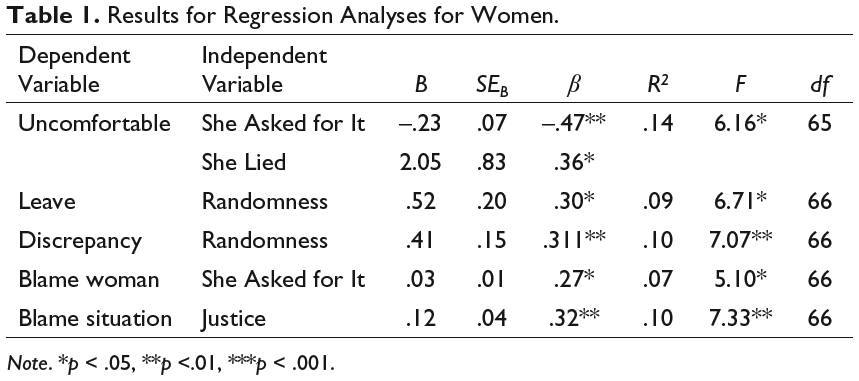
Results for Regression Analyses for Women.
Note. *p < .05, **p <.01, ***p < .001.
The level of blame for the assault placed on the women in the scenario by female participants was significantly predicted by the IRMA subscale of She Asked for It (Table 1). The results show that female participants were more likely to blame the woman in the scenario if they believe that victims become victims because they ask for sex. None of the variables were significantly predictive of the level of blame placed on the man in the scenario by the female participants. The degree to which the female participants blamed the situation was predicted by the IRMA subscale of Justice. Therefore, beliefs that the world is a fair place were associated with the belief that the situation was at fault—or that the way the world works is responsible for what happened in the scenario.
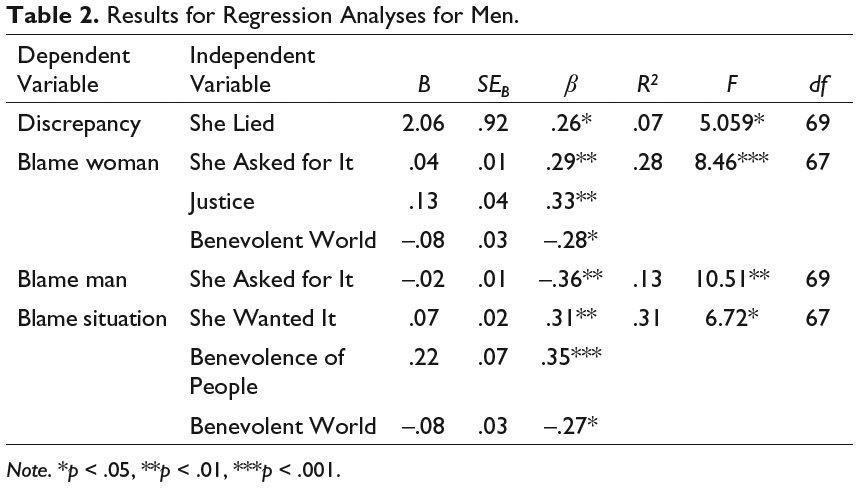
Results for Regression Analyses for Men.
Note. *p < .05, **p < .01, ***p < .001.
Discussion
The results of the sexual experiences survey were somewhat surprising, as over half of the women reported some form of sexual violence victimization and over half of the men reported some form of sexual perpetration history. These levels are much higher than has been reported in previous studies of college student sexual victimization (Banyard et al., 2007; Carey et al., 2018; Sutherland et al., 2014). It may be that previous studies underestimated the true level of sexual perpetration and victimization (Forsman, 2017). The sample also had a higher inclusion of people of color than previous studies; research has demonstrated that women of color are at more risk for sexual victimization than white women and it is possible similar discrepancies exist for sexual assault perpetration (Voth Schrag, 2017). It is possible that the heightened levels of previous sexual victimization history influenced the results. Women with previous victimization histories are at a higher risk of future victimization, often because of increased substance use, risky sexual behavior, and the negative impact of mental health issues and posttraumatic stress (Risser et al., 2006; Walsh et al., 2020). Maladaptive cognitive processes and physiological reactivity may also impact risk perception in survivors of sexual violence (Jaffe et al., 2019; Waldron et al., 2015). Men with a history of successful sexual violence perpetration are likely to have faulty sexual initiation scripts in which sexual violence is considered a normal part of a sexual relationship. They may have also learned that low levels of sexual perpetration are acceptable and hold the mistaken belief that these behaviors are not sexual assault (Abbey et al., 1998; Wegner et al., 2015).
Women perceived risk and stated they would leave the situation earlier than men, which is consistent with previous research (May et al., 2010). However, both men and women had a delay between when they felt uncomfortable and when they would leave the situation, suggesting that there is a time for all participants when they notice that something is not entirely right and when they would remove themselves from the situation. This period included some of the ambiguous risk components such as social isolation of the victim, increased alcohol consumption by the victim, and comments made by the perpetrator with sexual overtones. It is possible that this delay time is the ideal moment to target when teaching bystanders to intervene, especially by including additional training in distracting behaviors, distancing the victim from the situation, or delegating the responsibility to those with more authority (Moschella & Banyard, 2020).
Female participants’ risk perception was related to rape myths associated with unclear and ambiguous communication strategies on the part of the victim, as well as beliefs that the world is random and that we have little control over what happens. Social norms for sexual communication, especially for youth and emerging adults, include high rates of indirect and ambiguous communication tendencies that often rely on nonverbal communication and implicit consent tendencies (Villalobos et al., 2014). When paired with an external locus of control, ambiguous sexual communication seems to greatly impair risk perception and prediction in women. The results also demonstrate that women were more victim blaming than the men, and this victim blaming was related in part by faulty beliefs that the victim asked for or wanted sexual intercourse. These results are consistent with previous research supporting the role of defensive attribution of victim blame (Pinciotti & Orcutt, 2020).
Male participants’ risk perception was not related to rape myths or world assumptions in this study. However, the length of time men stated they would stay in an uncomfortable situation was predicted by an increased belief that victims lie about their experiences, a common rape myth (Lonsway & Fitzgerald, 1994). It may be that men’s beliefs that women falsely report sexual assault more often than they do led the men in this study to stay in a situation longer because they did not believe it would lead to a sexual assault. Similarly, endorsement of rape myths about victims asking for and wanting unwanted sexual intercourse were associated with increased victim blame and decreased perpetrator and situation blame for male participants. Consistent with research by Macrae and Shepherd (1989), men in the sample may blame the victim more because they perceived the women in the scenario failing to conform to the traditional gender stereotype of the chaste, good girl who abstains from sex.
Men who endorsed world assumptions that the world is a cruel place and that people get what is coming to them also were more likely to blame the victim in the scenario, suggesting that just world beliefs may play a strong role in how men perceive responsibility in sexual assault scenes. These results are consistent with previous research demonstrating the strong impact of world assumptions on perceptions of sexual assault (Harris & Valentiner, 2002; Littleton & Axsom, 2003).
The results suggest that rape myths, especially those related to victim communication strategies and victim desire for sexual intercourse, are associated with a delay of participants leaving the situation but also increased victim blame. There were differences between men and women on which world assumptions influenced risk perception and victim blame. For women, randomness and uncontrollability of the world were stronger predictors of our outcomes; for men, it was a belief in a just, cruel world. These results have implications for bystander intervention programming. First, bystander intervention programming should specifically address rape myths surrounding sexual communication and gendered expectations of sexual behavior. Specifically, they should provide opportunities for participants to recognize their own endorsement of rape myths and how they might influence their own tendencies to victim blame. Second, bystander intervention programming should include information on world assumptions and demonstrate how participant world assumptions may influence their ability to recognize sexual violence and feel motivated to intervene. Consistent with Burn’s (2009) model, a more in-depth discussion of rape myths and world assumptions may improve participants likelihood to identify a scenario as intervention appropriate and take responsibility to act. Third, including opportunities to practice with feedback about impact of the intervention would also be helpful to not only increase future likelihood to intervene but also combat inherent rape myths and world assumptions.
The findings should be viewed considering the study limitations. The data collected was cross-sectional, which prevents us from drawing any causal relationships among the variables. The procedures also presupposed that all participants were cisgender and heterosexual; it is likely that transgender or nonbinary participants were forced to choose whether to identify as a male or female while nonheterosexual participants could have had difficulty placing themselves in the scenario—that could have skewed the results. While the sample size was large enough to detect an effect, future research should replicate the results in a larger, more diverse sample to further elucidate the nuanced impact of race, ethnicity, geographical region, and urbanicity on risk perception.
Additionally, data was collection procedures differed for men and women—men were asked about sexual perpetration history and read the scenario as a potential perpetrator, while women were asked about their sexual victimization history and read the scenario as a potential victim. Knowing both the victimization and perpetration history of both men and women may be an important information to predict decisions more accurately about risk and blame (Arnocky & Vaillancourt, 2014; Macchietto, 1992). While sexual victimization and perpetration histories were not related to any outcomes in the present study, future research should more thoroughly examine sexual victimization and perpetration of all participants.
In the study, male participants were asked to place themselves in the shoes of the male perpetrator and female participants were asked to place themselves in the shoes of the female victim. This decision was made in part to validate a companion narrative to the victim narrative developed by Messman-Moore and Brown (2006). It was also made because previous research has demonstrated elevated rates of sexual perpetration by college men (Anderson et al., 2021) and perpetrator risk perception had not been assessed using this methodological paradigm to the authors’ knowledge. However, these decisions can be perceived as problematic. These gendered stereotypes are simplistic and may perpetuate the myth that only men perpetrated and only women can be victims. It is also possible that error was introduced in the results because of these disparate data collection procedures or if participants were primed due to the scenario they were asked to put themselves in. National data has demonstrated that female perpetration and male victimization rates are prevalent (Stemple et al., 2017), and future work should assess men and women as potential victims, perpetrators, and bystanders.
Limitations notwithstanding, the results indicate that acceptance of rape myths and endorsement of world assumptions can impact risk perception and victim blame in both men and women in sexual assault situations. It will be essential for sexual assault education to address these constructs in the curriculum and training implementation if we are to see continued impact on reducing sexual assault in college communities.
Footnotes
Declaration of Conflicting Interests
Funding
The author(s) received no financial support for the research, authorship, and/or publication of this article.
