




Abstract
Criminal protection orders (POs), with varying degrees of restrictions on offenders’ behavior, are issued by the criminal justice (CJ) system to enhance the safety and well-being of victims of domestic violence (DV). Yet, little research exists to elucidate outcomes associated with their issuance, and no research has examined outcomes of POs that are issued with greater restrictions than what victims requested. Among 187 women who were victims in a criminal DV case with a male intimate partner and who voiced their preference about a PO in the court system, this study examined if women’s DV revictimization by their partner and mental health (i.e., posttraumatic stress disorder and depression symptom severity, perceived stress, and fear) are differentially impacted by whether criminal POs issued by the court were more restrictive than what was requested by victims. Results showed that regardless of whether the level of criminal PO issued was more restrictive or not, victims reported significant decreases in victimization and improvement in mental health over time. However, there was greater benefit regarding victimization and mental health outcomes in the degree of change over time for victims with POs that were not more restrictive than those whose POs were more restrictive. Findings are discussed in the context of Therapeutic Jurisprudence and survivor-defined practice, which underscore the importance of victims’ input and requests in criminal PO proceedings.
Keywords
Criminal protection orders (POs), with varying degrees of restrictions on offenders’ behavior, are issued by the criminal justice (CJ) system to enhance the safety and well-being of victims of domestic violence (DV). They are different from civil POs in that criminal POs are initiated by actors of the court subsequent to an arrest of the offender, whereas civil POs are initiated by the victim regardless of police involvement (Long et al., 2010). The assumption is that criminal POs are generally helpful to victims. Yet, little research exists to elucidate specific outcomes associated with their issuance (Brame et al., 2015; McFarlane et al., 2015; Sullivan et al., 2019), and no research has examined outcomes of orders that are issued at levels more restrictive than what victims requested. This study is conceptualized within the frameworks of (a) Therapeutic Jurisprudence, which posits that laws and CJ system actors can have therapeutic effects on victims (i.e., those that promote healing and recovery) or antitherapeutic ones (Wexler, 2000), and (b) survivor-defined practice, which suggests that the role that victims/survivors play in the types of services they receive is critical to achieving positive outcomes (Goodman et al., 2016b; Nichols, 2013). Therefore, the purpose of this study is to determine if victims’ well-being, namely DV revictimization by their partner and mental health, is differentially impacted by whether the level of criminal PO that was issued by the court was more restrictive (vs. not more restrictive) than what was requested by victims.
Both Therapeutic Jurisprudence and survivor-defined practice acknowledge that court actions, regardless of their intentions, can affect victims positively or negatively (Anderson, 2015; Cattaneo & Goodman, 2010; Costello & Durfee, 2020; Nichols, 2013; Wexler, 2000). Therapeutic Jurisprudence values and speaks to “psychologically healthy outcomes in legal disputes and transactions” (Yamada, 2017, p. 1). Survivor-defined practice and its closely associated concept, victim-centered services, value the role of victims’ “voices” and “choices” in determining what services are provided or received, and in those services being designed and/or provided in a way that meet victims’ unique needs—these are conceptualized as key to achieving positive outcomes (Anderson, 2015; Cattaneo et al., 2009; Costello & Durfee, 2020; Goodman et al., 2016b). Such practices, as defined by court-based victim advocates, include accompanying victims to court, working with victims to identify the benefits and challenges of POs, explaining the law/available options to help inform victims’ decisions (and support victims’ autonomy), and addressing court-imposed POs to facilitate victim safety during the PO process (Costello & Durfee, 2020; Nichols, 2013).
Use of survivor-defined practices in the court system can positively impact the likelihood of DV revictimization and victims’ well-being (Anderson, 2015; Belknap & Sullivan, 2002; Cattaneo & Goodman, 2010) by validating their experiences and respecting their voice and choice—two distinct aspects of empowerment (Anderson, 2015). In turn, empowerment has demonstrated its role in promoting recovery among victims, including in relation to decreased posttraumatic stress disorder (PTSD) and depression symptoms (Goodman et al., 2016a). Prosecutors and judges’ consideration of victims’ input and requests is associated with lower rates of physical and psychological DV over time and with improvements in depression and overall quality of life (Anderson, 2015; Belknap & Sullivan, 2002; Cattaneo & Goodman, 2010).
A model policy regarding the issuance of full no-contact criminal POs has existed for nearly a decade (Long et al., 2010). However, in many states, the decision to issue a criminal PO and with what restrictions is up to the discretion of prosecutors and judges, with no internal policies or models existing to guide their issuance. POs are issued with the aim of protecting both the victim and community (Long et al., 2010). Although their issuance may be well intentioned, the actions of the court in the PO process may be perceived as paralleling the process of abuse; the victim experiences restricted autonomy and disempowerment by the court, which “presume[es] to know better than [the] victim what is in her own best interests” (McDermott & Garofalo, 2004, p. 1,251). We believe that this is especially relevant to the issuance of court-imposed full no-contact criminal POs, which may not serve to empower victims, especially those who only want the violence to stop, not the relationship to end. Instead, the issuance of these more restrictive POs can result in negative outcomes, which include the victim being less likely to use the system again in the future to disclose abuse to police or to file for a civil PO (McDermott & Garofalo, 2004).
To some extent, research on civil POs can inform understanding regarding the outcomes of criminal POs; however, the differences between them make drawing parallel conclusions about criminal POs impossible. As previously mentioned, the process for obtaining civil versus criminal POs is unique wherein the former is initiated at the will of the victim, whereas the latter is not (Long et al., 2010). However, one relevant parallel between the two is that victims’ voices may not be heard; with civil POs, this has been reflected in victims being denied the PO they request (Gist et al., 2001). The little empirical research that exists on the impact of criminal POs shows that the level of restriction of orders matters; the issuance of POs with the greatest restrictions was associated with the greatest reported decreases in physical, sexual, and psychological victimization, and mental health problems such as PTSD symptoms, depression symptoms, and perceived stress (redacted for blind review). However, no attention has been paid to outcomes when they are examined considering victims’ requests.
Largely on the basis of survivor-defined practice and victim-centered services scholarship, as well as the emerging research on criminal POs, we hypothesized that victims who were issued more restrictive criminal POs than they requested would experience poorer outcomes, whereas victims who were issued POs that were not more restrictive would fare better. Specifically, we predicted that victims who were issued more restrictive POs would not have lower scores at Time 2 than Time 1 on physical, sexual, and psychological DV; unwanted pursuit behaviors; fear of revictimization; posttraumatic stress symptom severity; depression symptom severity; and perceived stress over time, and further, the degree of change that did occur would be less among victims whose POs were more restrictive.
Method
Participants and Procedures
All procedures were reviewed and approved by the first authors’ Institutional Review Board. Women were eligible to participate if they were an English- or Spanish-speaking victim in a criminal DV case with a male intimate partner and if their offender was arraigned for that case approximately 12-15 months prior to study entry. The 12- to 15-month period was chosen because the passage of time since the PO was issued needed to be sufficient to allow for the impact of the PO on women’s daily functioning to occur, while at the same time, recent enough so that recall bias was minimized. Eligibility criteria were determined via records from the Family Violence Victim Advocates Office or the State of Connecticut Judicial Branch.
Potential participants were sent a letter by our study team inviting them to participate in a confidential two-hour study about “women’s experiences with court.” Interested participants were asked to call the study phone in response to the mailed letter. Research assistants followed up on the recruitment letter with a phone call to those who did not respond because either the letter was returned or a call back was not received. If interested, eligible participants were scheduled to participate in an in-person, face-to-face interview.
After providing written informed consent, individual interviews were administered by trained masters- or doctoral-level female research associates or postdoctoral fellows in private offices to protect participants’ confidentiality. During this semistructured interview, participants reported their experiences about two time periods (a) 30 days before the arraignment (approximately 12-15 months before the study interview; hereafter, Time 1 or T1) and (b) 30 days before the study interview (presently; hereafter, Time 2 or T2). Participants were remunerated $50 for their participation and provided with a list of community resources relevant to DV, mental health and substance use, social services, employment, and economic stability. Additionally, victims were offered the opportunity to develop a detailed, individualized safety plan at the conclusion of the interview.
The final sample included 298 women. A subsample of women who talked with a victim advocate prior to their partners’ arraignments-and, thus, had the opportunity to request a PO with a specific level of restriction-was used in the current study (n = 187). Participants ranged in age from 18 to 75 years (M = 36.27, SD = 11.51). In terms of racial/ethnic background, 47.6% of participants (n = 89) self-identified as Black/African American, 29.9% (n = 56) as White, 17.6% (n = 33) as Latina, and 4.7% (n = 9) as another or multiple racial/ethnic backgrounds. Many women were unemployed prior to the interview (n = 90; 48.1%); 30.5% (n = 57) were employed full time and 21.4% (n = 40) were employed part time. Women’s monthly household income ranged from $0 to $5,660 (M = $1,577.84; SD = $1,176.08), and their mean level of education was 12.80 years (SD = 2.10). The mean years in the relationship with the offending partner was 6.39 (ranging from less than 1 month to 55 years; SD = 6.62). At the time of the study interview (i.e., 12-15 months after the arraignment), most women were not dating the offending partner (n = 137; 73.3%).
Context
Given the variability in CJ system responses to arrest of DV offenders across the United States, we next present information on the processing of offenders postarrest in the state where this study was conducted (Connecticut Statistical Analysis Center, June 2007). An arrested offender is arraigned the next business day (i.e., they first appear in the court for the DV crime for which they were arrested; they are advised of their rights by a judge and may respond to the criminal charges by entering a plea). Family relation counselors, who are state judicial branch employees, assess the offender and victim to decide whether to accept the case for referral, which is done when the counselor believes the offender can benefit from mental health, substance use, anger management, or family violence services. If the counselor does not accept the case, they refer the case for prosecution. Regardless of offender track, the victim is provided with the same level of service and support from the family violence victim advocates, employees of the local DV service provider who are located in the courthouse. Advocates reach out to all victims to provide information about the court process. Victims can provide input about the case and express their wishes to the advocate-information the advocate can share with the prosecutor/judge with the victim’s permission-however, the judge ultimately decides whether to issue a criminal PO and with what level of restriction. If a criminal PO is issued (no state statute exists that says one must be issued or that guides decisions to inform their issuance), it typically is classified as one of three types: limited, residential stay way, or full no-contact, described below.
Measures
PO Type Requested by Victims Versus Issued by the Court
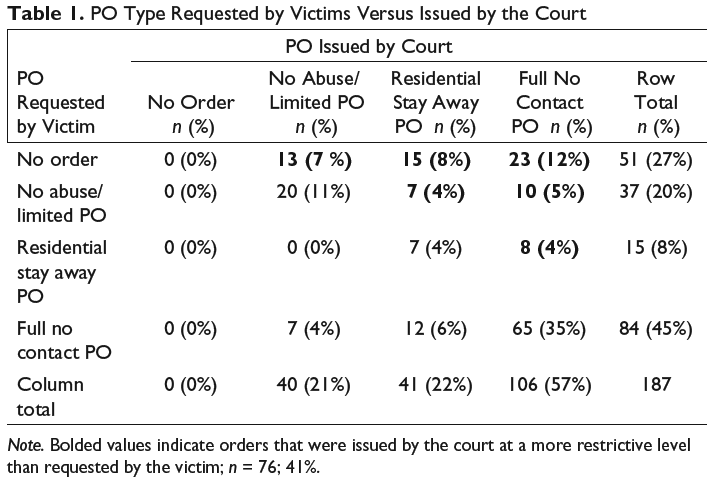
Note. Bolded values indicate orders that were issued by the court at a more restrictive level than requested by the victim; n = 76; 41%.
Fear. Fear was assessed with the Intimate Partner Violence Fear-11 Scale (Sullivan et al., 2020). Specifically, participants were asked the extent to which they feared that the offending partner would harm them and specific behaviors they used to avoid upsetting their partner. Participants rated their experience on a 4-point Likert scale, with higher scores representing greater fear (1 = strongly disagree, 4 = strongly agree). Cronbach’s αs = .89 and .96 for the 11-item scale at T1 and T2, respectively.
Women reported their age, race/ethnicity, income, level of education, and employment, as well as Time 2 relationship status with the offending partner (i.e., still together vs. broken up).
Data Analysis
Descriptive statistics were used to characterize PO level of restriction regarding requested and issued POs, and separately, whether the PO issued was more restrictive than what was requested. We conducted paired samples’ t-tests to determine if there were reported decreases between T1 and T2 in victimization (physical, sexual, and psychological DV; unwanted pursuit behavior; fear of victimization) and mental health (PTSD and depression symptom severity; perceived stress). Next, a residual change score for each outcome (([value of the indicator at T1 + 1] – [value of the indicator at T2 + 1])/(value of the indicator at T1 + 1) was calculated to assess the amount of reported change between T1 and T2, and analysis of variances (ANOVAs) examined whether this amount varied as a function of being issued a more restrictive order than what was requested. A higher positive residual change score indicates greater decreases in a score from T1 to T2. Of note, because the fear of victimization variable does not have a true zero, a residual change score could not be calculated, and an ANOVA for this outcome was not conducted.
Results
Preliminary Analyses
All women were issued POs. Seventy-six (40.6%) women were issued a PO that was more restrictive than what they requested.
In order to identify covariates for subsequent analyses, Pearson product-moment correlations, chi-square tests, t-tests, and ANOVAs were conducted to examine the associations between relationship factors (i.e., the length of relationship with the offending partner, cohabitation status with the offending partner, and the number of children shared with the offending partner), both the independent variable (i.e., PO level issued more/not more restrictive than PO level requested), and the dependent variables (i.e., T2 and residual change score values for physical, sexual, and psychological DV; fear of revictimization [only T2 score]; unwanted pursuit behavior; PTSD symptom severity; depression symptom severity; perceived stress). Because the inclusion of covariates significantly associated with the independent variable in nonrandomized designs may remove a portion of the variance attributed to the independent variable and thus negatively affect its construct validity (Miller & Chapman, 2001), variables that were significantly related to the dependent variables were only included as covariates if they were not significantly related to the independent variables.
PO level issued was more likely to be more restrictive than PO level requested for Black/African American participants (more restrictive: n = 46 [51.69%]; not more restrictive: n = 43 [48.31%]); and less likely to be more restrictive than PO level requested for Latina (more restrictive: n = 14 [42.42%]; not more restrictive: n = 19 [57.58%]), White (more restrictive: n = 13 [23.21%]; not more restrictive: n = 43 [76.79%]), and another or multiple racial/ethnic groups (more restrictive: n = 3 [33.33%]; not more restrictive: n = 6 [66.67%]) participants (χ2 [3] = 11.79, P = .01). PO level issued was also more likely to be more restrictive than PO level requested for participants that lived with their offending partner (more restrictive: n = 18 [58.06%]; not more restrictive: n = 13 [41.94%]) vs. did not live with their offending partner (more restrictive: n = 58 [37.18%]; not more restrictive: n = 98 [62.82%]; χ2 [1] = 4.68, P = .03). Regarding T2 outcomes, age was positively associated with T2 PTSD symptom severity (r = .17, P = .02), depression symptom severity (r = .18, P = .01), and fear of revictimization (r = .17, P = .02); participants who lived with the offending partners were more likely to report fear of revictimization (F [1, 185] = 13.20, P < .001) and psychological DV (F [1, 186] = 7.34, P = .01); and the length of relationship with the offending partner was positively related to fear of revictimization (r = .21, P = .004). Regarding residual change score outcomes, age was negatively associated with changes in PTSD symptom severity (r = −.21, P = .004) and perceived stress (r = −.18, P = .02) and positively associated with changes in depression symptom severity (r = .20, P = .01); participants who lived with their offending partners were less likely to report changes in psychological DV (F [1, 186] = 20.41, P = .01), and the length of relationship with the offending partner was negatively related to changes in sexual DV (r = −.17, P = .02). Thus, consistent with recommendations set forth by Miller and Chapman (2001), age was included as a covariate in analyses for the T2 outcomes of PTSD symptom severity and depression symptom severity, and the residual change score outcome of depression symptom severity; and length of relationship with the offending partner was included as a covariate for the residual change score outcome of sexual DV.
Being Issued a More Restrictive PO Than What Was Requested as a Predictor of Revictimization
Victimization outcomes (physical, sexual, and psychological DV; unwanted pursuit behavior; fear of victimization) significantly decreased from T1 to T2 for both those women issued a PO that was more restrictive than requested and those whose PO was not more restrictive (see Table 2). Analyses examining the amount of change over time accounting for victims’ T1 scores indicated that physical and sexual victimization significantly differed, such that women with POs that were not more restrictive reported greater reductions in physical and sexual victimization (see Table 3).
Being Issued a More Restrictive PO Than What Was Requested as a Predictor of Mental Health Outcomes
Descriptive Statistics and Within-group (More Restrictive vs. Not More Restrictive PO) Differences in Domestic Violence and Mental Health Outcomes From Time 1 and Time 2.
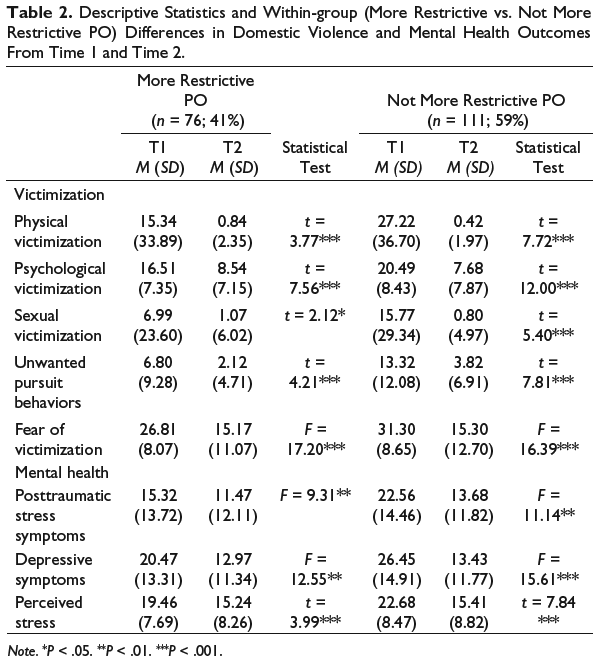
Note. *P < .05. **P < .01. ***P < .001.
Analyses of Variance Examining Between-Group Differences in Residual Change Scores for Victimization and Mental Health Outcomes as a Function of Being Issued a PO That Was More Restrictive Than What Was Requested
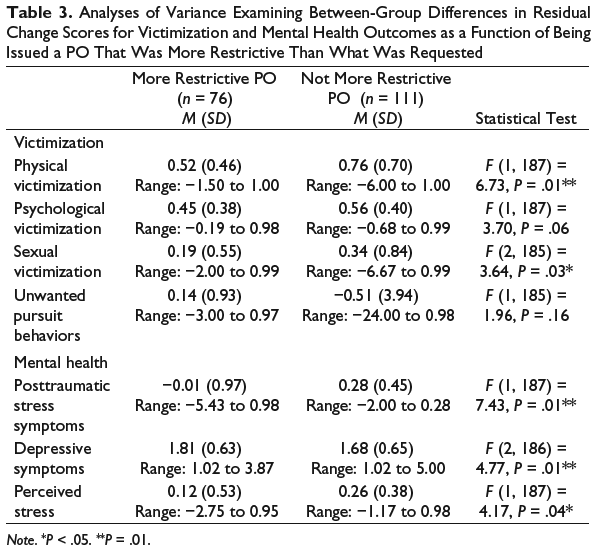
Note. *P < .05. **P = .01.
Discussion
To our knowledge, this is the first study to examine the impact of courts issuing criminal POs at more restrictive levels than requested by victims on their DV revictimization and mental health. Forty-one percent of the sample was issued POs that were more restrictive. Further, Black/African American women were more likely to be issued more restrictive POs than women from other racial/ethnic groups. Women who were (vs. who were not) cohabitating with their partners also were more likely to be issued more restrictive POs. Given evidence of racial disparities in the CJ system (Kamalu et al., 2010; Lytle, 2014; Wu, 2016), findings regarding racial/ethnic differences are not unexpected. These findings could be interpreted as Black/African American women’s voices being heard less often than other racial/ethnic groups and/or Black/African American men being given harsher consequences (as the large majority of Black/African American women’s partners were also Black/African American). However, in light of extant research that shows no racial/ethnic differences in overall levels of restrictions of POs issued (redacted for blind review), this finding is difficult to interpret, and speculation is beyond the scope of our data and this article. Additional research is needed to understand this disparity. Regarding differences in POs by cohabitation status, one possibility for this difference is that women living with their partners may be requesting less restrictive POs because more restrictive orders (e.g., residential stay away POs) would be more disruptive to their lives. Alternatively, the courts might perceive the frequent close contact of cohabitation as riskier and, therefore, issue more restrictive POs.
Both who were issued more restrictive POs and who were issued POs that were not more restrictive experienced decreases in scores over time, reflecting decreases in victimization and improvement in well-being. Though these findings are positive, they are not entirely consistent with our first hypothesis. This may raise questions for some about the value of survivor-defined practices and victim-centered services; however, we do not believe that it should. Whether or not the PO was issued as requested by the victim is only one aspect or factor to consider within these frameworks. It is quite possible that, despite not being issued the level of PO requested, victims still had positive experiences in court and felt validated and supported in other ways, which contributed to positive outcomes. As noted previously, this could include accompanying victims to court, working with victims to identify the benefits and challenges of POs, explaining the law/available options, and addressing court-imposed POs to facilitate victim safety during the PO process (Costello & Durfee, 2020; Nichols, 2013). Future research should explore these and other possibilities which could fall under the umbrella of Procedural Justice (Tomkins & Applequist, 2008), which is related to Therapeutic Jurisprudence. Though there were improvements over time for both groups, the range of scores included in Table 3 for victimization and mental health outcomes includes negative numbers, which means that some women fared worse in terms of victimization and mental health over time. This is a case where aggregated data, necessary for certain analyses, can obscure important information. Future research with larger samples is needed to elucidate the experiences of these victims.
Consistent with Therapeutic Jurisprudence and survivor-defined practice, our second hypothesis was supported for many but not all outcomes. The degree of change over time for physical and sexual victimization, and posttraumatic stress symptoms, and perceived stress is greater for victims with POs that were not more restrictive, meaning that there was greater benefit to them than those whose POs were more restrictive. Findings suggest that listening to victims-giving them voice and choice-impacts them in meaningful ways (Anderson, 2015; Belknap & Sullivan, 2002; Cattaneo & Goodman, 2010). Relatedly, recent research reveals that the (mis)match of a criminal PO between what a victim requested versus what was issued can differentially affect her future willingness to engage with the CJ system based on whether she experienced the court process as positive versus negative (Holmes 2021.). This focus on understanding the impact of the system on victims’ well-being, both in the present and for the future, informs the Therapeutic Jurisprudence framework. Further, it is aligned with the related framework of procedural justice, which is focused relatively more on the perceived fairness of the processes even if the outcome is not what was desired (Lind & Tyler, 1988). Relatedly, the mechanism of action for the positive outcomes among victims whose POs were not more restrictive, suggested in previous work, is empowerment, particularly regarding mental health outcomes, (Goodman et al., 2016a), which should be examined in future research.
To state our findings regarding degree of change in other words, women with more restrictive POs reported fewer reductions in physical and sexual victimization and fear of revictimization-they fare worse (than women without more restrictive POs). One possible explanation is that women who had greater contract restrictions than they requested may have disregarded the PO because they wanted or needed contact with their partners for various reasons, and this contact in turn is associated with victimization. Alternatively, it could be that those with greater restrictions had partners who were more likely to violate the conditions of the PO. Separately, these findings could reflect that women who are issued more restrictive POs than requested do not trust the CJ system because it does not take into account their requests, with some describing the process as being “revictimized” by the court (Hannah & Goldstein, 2010). Therefore, women may feel disempowered by the CJ system and may not perceive an alliance with system actors, so that they do not call the police at future events of harm (Goodman et al., 2016a).
Improvements were noted in some areas when POs were issued with greater restrictions than requested. The finding regarding change in depression symptom severity is noteworthy as it is in the direction opposite of what was hypothesized and other findings regarding mental health. Women issued more restrictive POs than they requested had greater improvements in depression symptom severity over time. Coupled with the findings that both groups experienced decreases in victimization and improvement in well-being over time, findings suggest that issuing POs with greater restrictions than victims request is a nuanced issue with much gray area. One contributing factor as to why courts issue more restrictive POs could be related to findings revealed almost two decades ago that victims do not always accurately assess their level of danger (Campbell, 2004). In Campbell’s study of 456 women who experienced homicide or near homicide by an intimate partner, only about half accurately perceived their risk. To say that DV and court processing of charges and sanctions is a complicated issue is gross understatement.
Clearly, there are benefits to safety and well-being of listening to victims, described in both the DV scholarship reviewed here and our empirical findings. However, we do not mean to mislead readers. We aimed to discuss findings in a balanced way, including the ways in which court actors can affect, and have affected, the lives of victims consistent with the Therapeutic Jurisprudence framework. Our goal is not to criticize court actors, many of whom are judges and prosecutors invested in doing what is in the best interest of victims and the public. Processing DV charges is a complex process, especially in light of the research that women often underestimate the potential for danger in their relationship, which though rarely made explicit, may be a driving factor for the court issuing POs at a level more restrictive than victims request. Additional research is needed to inform evidence-based policies and practices in the court that will improve the lives of victims.
A few additional points are worthy of discussion. That findings regarding degree of change were not significant for psychological DV and unwanted pursuit is not entirely unexpected as these forms of abuse are addressed less directly by certain POs. That the mean number of years in a relationship at the time of the interview is 6 supports a statement frequently heard in the DV field, “She doesn’t necessarily want the relationship to end, she just wants the violence to stop.” The goal of continuing the relationship but ending the violence seems to be at odds with certain types of POs, including the residential stay away and full no contact POs, which almost effectively dissolve the relationship. This mismatch between the goals of the victim and the system/PO is understudied, but research in this area has strong potential to inform practice and policy.
Limitations of the current study warrant consideration when interpreting findings. Self-selection bias may have influenced which victims decided to participate or to speak to a victim advocate, which may have decreased the variability in experiences reported. Also, data are not available to know if participants are representative of those served by the court. Regarding diversity, the sample is racially/ethnically diverse; however, it is homogeneous in that all participants identified as women and all partners were men. Whether these results extend to individuals of other genders and those in same-sex relationships requires study. Further, although no state statute exists that mandates that a criminal PO be issued, POs were issued in all cases and thus, there were no participants without a criminal PO. Relatedly, the sample size was not large enough to examine the outcomes of POs issued at a less restrictive level separate from as requested; this would be an important avenue for future research. In addition, this study was not longitudinal; data collection about the two time points occurred during one interview. All offenders experienced arrest, which could be a driving factor for the decrease in DV across the board. Alternatively, having any type of PO could improve DV and mental health over time. Ideally, resources would support a prospective design in future research. Such research would also speak to the extent to which victims’ experiences extend beyond this timeframe including after the PO is no longer in effect. Finally, variability in practices among states and courts limits generalizability only to those courts that have parallel processes and structures.
Conclusion
The extant research on criminal POs underscores the significance of level of restriction: POs with the greater restrictions are related to decreases in physical, sexual, and psychological victimization, and mental health problems such as posttraumatic stress symptoms, depression symptoms, and perceived stress (redacted for blind review). However, investigations have yet to consider the role of victims’ requests in the outcomes of criminal POs. Regardless of whether the level of criminal POs issued was more restrictive or not, victims reported significant decreases in victimization and improvement in well-being over time. However, consistent with Therapeutic Jurisprudence and survivor-defined practice, there was greater benefit to victims with POs that were not more restrictive (vs. were more restrictive) in the degree of change over time for physical and sexual victimization and the mental health outcomes of PTSD symptom severity as well as perceived stress. Our findings underscore the importance of considering women victims’ input and requests in criminal PO proceedings.
Footnotes
Declaration of Conflicting Interests
Funding
The author(s) disclosed receipt of the following financial support for the research, authorship, and/or publication of this article: This project was supported by Award No. 2012-IJ-CX-0045, awarded by the National Institute of Justice, Office of Justice Programs, U.S. Department of Justice. Support also was provided by NIH grants T32 DA019426, K23 DA039327, L30 DA038349, and P20 GM125507.
