



Abstract
It is now widely recognized that victims of crime in general, and victims of sexual offences in particular, commonly experience secondary victimization resulting from dismissive, poor, and sometimes retraumatizing treatment when they encounter the formal criminal justice system. However, little is known about victims’ experiences when initially reporting crime outside of the formal justice system, for example crime that occurs during cruise ship holidays. The cruise industry is the fastest growing tourism sector. The total number of passengers onboard cruise ships internationally was expected to reach 30 million in 2019. There is limited reliable data about how many people experience crime onboard cruise ships, though crime victimization does occur. While victimization onboard cruise ships has received some attention, there is a dearth of evidence about when and how victims report crime, how victims are treated when they report their experience of crime to cruise ship companies, or the justice outcomes. Nor does the available data address whether victims of crime from diverse social groups are treated differently by cruise companies. Drawing on qualitative accounts produced by primary and secondary victims of crime onboard cruise ships, it is argued that as well as the known challenges that victims face, the addition of brand protection can compound cruise ship victims’ experiences of secondary victimization. Secondary victimization refers to additional, or compounded harms experienced because of social or systemic responses to their experience of crime. There are three key implications of these findings: greater understanding of crime victims’ experiences should be developed via refined, mandatory reporting of crime onboard cruise ships, and robust qualitative research; cruise ship staff need improved specialized training in responding to victims of crime, and legislation should be considered mandating an independent authority onboard cruise ships to receive, investigate and monitor victimization reports and responses.
Introduction
The cruise ship industry is the fastest growing tourism sector, increasing at almost twice the rate of land-based tourism (Brida & Zapata, 2016), though the impact of COVID-19 on cruise tourism into the future remains unknown. Worldwide, in 1970 approximately 500,000 passengers travelled onboard a cruise ship. By the new millennium this number stood at around 10 million (Weaver, 2005). More recently, in the five-year period between 2011 and 2016, a 20.5% increase in passengers was recorded by the Cruise Lines International Association (CLIA) (2017). In 2018 the total number of passengers was more than 28 million, an increase of approximately 600,000 passengers from 2017 (CLIA, 2017, 2018). A further 6% increase was predicted in 2019 with the total number of passengers anticipated to reach 30 million. This trend was predicted to continue in 2020 with a projection of 32 million passengers worldwide, however the recent impact of COVID-19 on the industry, and therefore these projections, remains unknown (CLIA, 2019). In addition to the passenger load, there is also approximately 250,000 staff 1 who work onboard cruise ships (Crew Centre, 2017). However, this is an estimate as the industry has highly variable regulation and amounts of staff transparency around the world, staff are often employed on a casual, fixed term basis, from a large variety of countries, and there is high staff turnover (Bolt & Lashley, 2015).
Most of the literature on the cruise ship industry has focused on passengers’ motivations to choose a cruise holiday as opposed to an alternative holiday option (Hung & Petrick, 2011; Jones, 2011). Little literature explores the extent and nature of crime onboard cruise ships despite the large number of people choosing a cruise holiday or working onboard cruise ships each year. There are at least three interrelated rationales for the high likelihood of crime occurring onboard cruise ships. First, spatial analyses of crime patterns argue that the type and use of space relates to the probability of a crime occurring. Areas in which large numbers of tourists congregate or that are entertainment-oriented in nature typically present an increased likelihood of victimization (Boakye, 2010). Second, the performative nature of being a tourist commonly includes relaxation and recreation and this can result in lowered vigilance over personal items, leaving items unattended in spaces that others access (such as berths, pools, and onboard facilities including restaurants), and the high consumption of alcohol. Indeed, greater alcohol consumption by people on holiday has been associated with tourists “let[ting] their guard down,” which in turn may increase the likelihood of some crime types such as theft, sexual offences, and alcohol-related assaults (SPLA, 2013a, p. 15). Third, in general, locations associated with high levels of alcohol consumption (such as licensed venues) are linked to higher rates of crimes including assault and sexual assault (Roncek & Maier cited in Boakye, 2010; Brunt et al., 2000).
Despite these theoretical rationales for significant rates of crime onboard cruise ships there remains limited reliable evidence about the amount of crime that occurs. All the well-rehearsed criticisms of crime rate data apply to crime that occurs onboard cruise ships including the likely underreporting of sexual victimization and intimate partner violence, and attrition resulting from crime reporting and recording processes (Anderson et al., 2013; Hester, 2006; Tilley & Burrows, 2005). There are also potentially new, or different barriers to obtaining an accurate picture of the extent and nature of crime onboard. For people who experience crime onboard a cruise ship there may be a reluctance to interrupt a holiday with reporting processes, uncertainty about who to report to onboard, jurisdiction for policing authorities on land, docked and at sea, and how to make, or follow-up, a report after time has lapsed. Drawing on publicly available victims’ accounts from two sources, this article explores the evidence about victims’ experiences of reporting crime to cruise ship staff or companies.
Literature Review
Crime does occur onboard cruise ships, though the evidence is equivocal about whether there is a greater or reduced likelihood of experiencing crime onboard cruise ships compared to everyday activities or during other types of recreational holidays. Self-regulation remains common in many aspects of the cruise ship industry (Diaz et al., 2014). Few jurisdictions require cruise companies to publicly report incidents of crime and whether crimes are internally labelled as crimes, or something else, is likely to direct responses, or lack thereof. Where public reporting is mandated, such as in the United States (U.S.), it is limited to some offence categories, reporting thresholds, and by the location of the ship at the time of the crime (Panko and Henthorne, 2019).
In the United States, the Cruise Vessel Security and Safety Act (CVSSA) amended in 2014 requires all vessels embarking and disembarking from any U.S. territorial port to report criminal activity to the FBI. Alleged crimes committed onboard cruise ships are recorded and investigated by the FBI, and data are collated and published as a quarterly report by the United States Department of Transportation (USDOT). 2 The crimes captured in these data are limited to theft (>US$10,000), homicide, death (suspicious), assault with serious bodily injury, sexual assault, kidnapping, missing persons (U.S. national), and firing or tampering with a vessel. Other offences, such as drug-related crimes and petty theft are not captured, limiting the extent to which the true “reality” of crime onboard cruise ships may be ascertained, and skewing the picture toward more serious crimes.
A review of these U.S. data shows that between 2017 and 2019 the most reported offence that occurred onboard cruise ships was sexual assault, with 259 reports making up 72.8% of all reported crime in these data. The next most common offence category was theft at 45 incidents making up 12.6% of all reported crime (USDOT, 2020). However, we note that reportable thefts in these data only included theft of goods or money totaling more than US$10,000. This threshold is likely to result in an underestimate of theft onboard. Moreover, critics have argued that there are significant problems with cruise crime data arising from cruise company staff control over reporting, including what incidents are reported, and what labels are attached to incidents (Klein, 2020). Control over the crime reporting process enables cruise companies to define-down offences and avoid formal reporting, or obscure the true nature of the incident.
Alternative literature sources have attempted to compare data from cruise ships to land-based crime reports. Referring specifically to assault in the United States, Myers (2007 cited in Panko et al., 2009, p. 33) argued that the risk of assault is at least 50% greater onboard a cruise ship, compared to the risk on land. Conversely, the Australian House of Representatives Standing Committee on Social Policy and Legal Affairs (SPLA, 2013a) reported lower crime rates onboard compared to crime rates in U.S cities. In Australia, there is no reliable, publicly accessible national statistics documenting crimes committed against Australians at sea, including onboard cruise ships (SPLA, 2013a). The lack of comprehensive, international, and independent data about the prevalence of crime onboard cruise ships remains a significant challenge to the quality of knowledge about crime (SPLA, 2013a). Moreover, there is a very small body of work about victims’ experiences of cruise ship crime. What does exist has focused on sexual violence, is mostly American, and with some exceptions is journalistic rather than empirical.
There has been some research attention given to potential/actual passenger risk perceptions about cruise ship holidays. However, this body of research work has primarily focused not on risk of crime but rather risk of illness, except for some work on terrorism (Le & Arcadias, 2018). Given the contemporary experience of COVID-19 transmission onboard several cruise ships it is likely that the health-risk focus will continue in the immediate future. Taken together, this body of work underestimates or masks incidents of crime, is equivocal about crime risk compared to daily life or other forms of recreational holiday, is narrowly geographically focused, and does not indicate if or how cruise passengers think about crime risk.
Reporting Victimization
Irrespective of the rates and perceptions of victimization resulting from crime onboard cruise ships, and their comparison against land-based experiences of crime, victimization is commonly associated with a range of negative well-being consequences from serious psychological effects such as trauma and depression to comparatively short-term negative emotional responses such as frustration and anger (Elliot et al., 2014). Victimology, a subfield of criminology, has been concerned with documenting the nature, effects, and responses to victimization since the middle of the 20th century (Ferguson & Turvey, 2009). Concerning responses to victimization, recent work has foregrounded the utility of procedural justice for victims. Procedural justice was developed in the 1970s by Thibaut and Walker (1975). It posits that justice is perceived by victims to have occurred when the process followed is considered fair, even if the outcome is not preferred. Wemmers, drawing on Folger (1977 in Wemmers, 2010, p. 31) explains further using the concept of “process control” as follows; “Process control refers to whether and to what extent parties are able to present information throughout the decision-making procedure. Later this was referred to as voice….” More recently, Tyler’s work (2000 in Wemmers, 2010) added the notions of respect and dignity to process control, or voice. When victims feel that they have been treated with respect by authorities they are more likely to view their experience as fair.
It is not only a matter of justice. Applying procedural justice theory to practice, Elliot et al. (2014) explored the mechanisms by which police adherence to procedural justice principles could reduce trauma and other negative impacts associated with victimization. Organized into three processual themes; precontact with police, contact with the police, and postcontact with police they argued that, conceptually, procedural justice can respond to victims’ feelings of violation, helplessness, and lost safety. Interactions with authorities, in this case police, that are therapeutic offer victims’ validation by acknowledging and denouncing the wrong, listening and acting with empathy and without judgment, and closure, which is in turn empowering.
Secondary Victimization
Despite the significant body of work on the opportunity afforded by procedural justice to enhance victims’ experiences of the justice process there remains very well documented concerns about how victims are treated by reporting and responding authorities. Much of this work has drawn on the concept of secondary victimization, which has been defined as the “…negative social or societal reaction in consequence of the primary victimization and is experienced as further violation of legitimate rights or entitlements by the victim” (Orth, 2002, p. 314). Secondary victimization can occur as a result of negative attitudes directed by authorities toward victims of crime, for example by displaying judgmental attitudes or blaming the victim for their victimization (Wemmers, 2013). Though there are many versions of secondary victimization definitions, for Wemmers (2013, p. 222). “What these definitions all have in common is the idea that victims are injured once by the crime and then a second time by criminal justice authorities.”
The literature on secondary victimization is expansive and a comprehensive review is beyond the scope of this article. However, much of the extant work has focused on the secondary victimization experiences of victims of sexual assault. For example, Campbell and Raja’s work (2005) with female veterans who had experienced sexual assault found that both legal and medical systems within and outside of the military compounded women’s trauma. Secondary victimization behaviors included discouraging women from reporting the assault, refusing to record the report of an assault, and minimizing the seriousness of the assault, or denying that it occurred. As a result, the large majority of women in Campbell and Raja’s (2005) study (83%) were discouraged from further help-seeking. This work is important for the present research for several reasons. It documents the breadth and depth of secondary victimization experiences; it considers reporting and secondary victimization experiences beyond the formal criminal justice system, and it highlights that the consequences of secondary victimization are immediate and long-term as further help-seeking is less likely to occur in the future.
Passenger Rights and Responses to Victimization on Cruise Ships
The context in which crime occurs and is responded to onboard ships sailing in international waters is complex, resulting in limited enforcement capabilities (Knapp & Franses, 2009). For example, the leading regulator of the shipping industry, the International Maritime Organization (IMO), does not directly monitor the compliance of member states’ safety, pollution, and search and research standards. While assigned to multiple agencies and bodies, the responsibility for the safety of a vessel and its staff is held by the owner and Master (Bell, 1993). Similarly, jurisdictional powers in a criminal context are complex and consequently a criminal act committed onboard a cruise ship will often result in competing jurisdictional claims (SPLA, 2013a). Under the United Nations’ Convention of Law on the Seas (UNCLOS) (1982), the nation in which a vessel is registered has primary responsibility for reporting, investigating, and prosecuting crime committed onboard. However, a State may invoke jurisdiction when the crime is committed in territorial waters, has a detrimental impact on national security, one of their citizens is involved or when the conduct is so widely condemned (e.g., genocide or hostage-taking) that all nations proclaim punitive action (SPLA, 2013a). Australia, like all other nations, may also exercise jurisdictional rights over crime committed on a vessel that will be docking in a territorial port where the Master will report the conduct to local authorities in the next port-of-call (SPLA, 2013a). Minor matters, such as petty theft, are often left to the Master to determine the best course of action (SPLA, 2013a).
Publicly available examples of official documentation used by cruise companies does little to shed light on the duty of care owed to crime victims. The Royal Caribbean International Cruise Ticket Contract side-steps company responsibility, stating that the “Passenger understands and agrees that Carrier has a zero tolerance policy for illegal activity and shall report such activity to the appropriate authorities” (Royal Caribbean International, n.d.). Similarly, the “liability” clauses in the Royal Caribbean Terms and Conditions do not mention crime, illegal activities, victim, or justice. The closest acknowledgment of care refers to “loss” but the examples given are loss of enjoyment or luggage (Royal Caribbean International, 2018). While there is variation in the content of passenger contracts across different cruise companies (Gibson, 2018) the contracts are littered with legal jargon and written in a manner that may be confusing to the lay person. The situation is so complex that Gibson (2018, p. 17) summarizes thus “a passenger who books a cruise may understandably have little or no idea as to what the terms of the cruise actually are, or even with whom contract is made.” However, by purchasing tickets and boarding a cruise ship, passengers are accepting the terms, conditions, and liabilities (or lack thereof) set out in these documents (Gibson, 2018).
Cruise ships can be understood as environments in which passengers have few rights. In Europe, the Athens Convention provides some rights for cruise ship passengers but there are limits to its reach including, for example, that “the ship is flying the flag of, or is registered in a Member State” (Lamont-Black, 2018, p. 40). In addition, there are limits to the breadth of rights, with little liability for passengers’ experiences of crime. Writing in the Australian context, Lewins (2018, p. 1) argues “The Australian law applicable to passengers carried by sea is labyrinthine and complex. Recent cases provide some welcome clarity on a few points, but there is still uncertainty.” Yet, the high number of passengers on cruise ships compared to other modes of carriage presents the potential for increased adverse incidents (Lamont-Black, 2018). It is not only a matter of passenger rights. The industry is “young” with rapid and recent growth in cruise tourism since the mid-20th century. There has also been significant change in the way in which the industry responds to crime in that time period. A small number of cruise companies hold the large majority of the market share in the industry and it is largely deregulated (Clancy, 2017). These features contributed to the distinctiveness of the cruise ship environment compared to land-based tourism operations with implications for the protections passengers can expect and their recourse if those protections are not realized.
Commonly, passengers have to demonstrate that a cruise company breached its duty of care to have recourse. This means that passengers not only have to demonstrate their victimization experience but also that it amounts to a breach of duty of care. This is clearly a high threshold. However, there may be changes favorable to passengers in some jurisdictions arising from an Appellate decision in the Southern District of Florida in 2019 (K. T. vs. Royal Caribbean Cruises, Ltd., 2019). The plaintiff, who had experienced serious sexual violence, successfully demonstrated that Royal Caribbean were negligent in failing to protect her because, among other things, the danger was foreseeable and preventable.
There does not appear to be any academic literature that focuses specifically and centrally on victims’ experiences of crime onboard cruise ships and cruise ship responses. However, it has been noted that many cruise ships do not have adequately trained staff or facilities to provide high quality responses to victimization including medical assistance, evidence collection, and counselling (U.S. Senate Committee on Commerce, Science and Transportation, 2013). Consequently, layers of discretion and the absence of data and research attention remain a significant barrier to understanding responses to crime onboard cruise ships. Overall, the cruise ship environment is unique. There is a combination of self-regulation, selected legislative requirements for reporting crime, limited passenger rights pertaining to victimization, and likely reduced understanding of how to report crime and the intersection with land-based authorities. It is within this complex and distinct environment that experiences of victimization and secondary victimization must be understood.
Crime and Public Image
While concerns about protecting “the brand” will exist in very many industries, some authors have argued that the way in which brands are communicated and protected in the marketing process is unique in different industries, and for different commodities (Zinn & Johnson, 1990). In an historical review of cruise industry marketing practices Branchik argues an evolution in the purpose of cruises from an immigration and luxury focus from the mid-19th century to 1914 to a “cruising for all” approach since 1970 (Branchik, 2014, p. 250). Contemporary branding coemphasizes affordability and luxury:
[c]ruise lines today universally stress a combination of luxury and value as key components of their marketing mix. Introductory videos for Carnival, Costa, Cunard, Holland America, Princess and P&O (all brands owned by the largest cruise operator, Carnival Corporation and PLC), and Royal Caribbean International display language such as “luxury,” “style,” and “pampering,” as well as “value,” “affordable,” and “all-inclusive. (Branchik, 2014, p. 252)
This shift also signals a diversification in the target market and therefore a democratization of brand appeal. In trying to achieve universal commodity and brand appeal in a rapidly growing industry, it may be even more important to “protect the brand.” The dual impact of a largely self-regulated industry and a focus on image and brand is significant, as Panko et al. (2009) note:
Cruise lines have a long history of failing to properly disclose incidence of sexual assaults, sexual batteries, thefts and other crimes (Dickerson, 2007). This is because the incentives to underreport the crimes are very high: publicized crimes aboard will substantially reduce sales volume. Marketing messages by cruise liners, in their attempts to lure tourists, project cruise ships as an exotic adventure. (Panko et al., 2009, pp. 33-34)
The literature canvassed above demonstrates that while crime does occur onboard cruise ships there are significant barriers to its visibility. Barriers include; the threshold, requirement and responsibility for reporting crime, discretion arising from alternative lines of responsibility and complex state and international legislation, the profit-driven self-regulation in the cruise industry, and the relative lack of research attention. We aim to shed some light on victims’ experiences of crime by analyzing their stories.
Methodology
Accounts of victimization publicly available from two sources were collated for analysis. The first, and main source was the International Cruise Victims Association (ICVA) website. The second source was victims’ submissions made to the Australian House of Representatives Standing Committee on SPLA inquiry into crimes at sea which reported findings in 2013 (SPLA, 2013b, 2013c). The two sources were then reviewed against inclusion and exclusion criteria; must be an account of criminal victimization, crime must have occurred while onboard a cruise ship, account must include data about cruise ship responses, extraordinary events (i.e., Costa Concordia incident) unlikely to recur were excluded. A further detailed list of accounts that were excluded are detailed below. Once collated, duplicate victims’ narratives were removed as in some cases victims had told their stories in more than one place. In addition to these two sources we reviewed submissions made to the Troubled Waters: Consideration of the Government response to the 2012 inquiry into arrangements surrounding crimes at sea and the U.S. House of Representatives Subcommittee on Coast Guard and Maritime Transportation of the Committee on Transportation and Infrastructure, which reported in 2007. However, neither of these additional two sources contained additional victims’ accounts which met the inclusion criteria.
The limitations of these data sources were related to the context in which the accounts were made and published. For instance, poor experiences with how cruise ship companies and local law enforcement dealt with incidents of victimization would be a significant motivator to submit such accounts to an association that advocates for passenger protection and greater transparency about crime in the cruise ship industry, or to inquiries into crime onboard cruise ships. Positive experiences would hold little benefit to the association’s work, or would not be relevant to an inquiry because its focus is on reform. The sample is not representative of the broad range of victims’ experiences. Both positive experiences and experiences of less serious crimes are highly likely to be underrepresented in the sample, though these may be more prevalent. Furthermore, we acknowledge that the cruise industry has changed significantly over the period of time reflected by the data, including in its response to crime. However, this research is concerned with exploring what victims’ may experience when reporting crime onboard cruise ships. There is no threshold that has to be reached about the proportion of victims who have a particular experience for that enquiry to be important and relevant as a starting point for further research, particularly given that there is no singular experience of victimization or reporting and justice processes.
A further limitation of these data relates to the small sample size. The total number of analyzed accounts was 27, and accounts were made by citizens from a limited number of similar countries. This clearly does not reflect the volume of crime victimization experienced onboard cruise ships, and findings do not represent all, or diverse, victims’ experiences of reporting crime onboard cruise ships. As noted above, the primary purpose of this research is to explore what we do know about what victims have experienced, and to highlight the many and significant gaps in knowledge to stimulate further research in this area.
In total, 32 unique
3
accounts were initially collated. Inclusion criteria was then applied to ensure relevance to the study, resulting in the exclusion of 6 accounts based on the following:
The account detailed the Costa Concordia incident, excluded on the basis that the crimes committed by the Master, and the subsequent experience of victimization detailed as a result, is comparatively unique and unlikely to reflect victimization otherwise commonly experienced onboard cruise ships. The crime occurred off the ship, not meeting the qualification of crime committed onboard a cruise ship. The incident did not constitute criminal victimization. For instance, one account detailed a wedding that was planned onboard a cruise ship, but due to issues with ship ports being missed, guests could not board. The company refused to compensate the passengers. Similarly, another detailed a poor rescue attempt following a man overboard incident, resulting in the death of the person, but as a crime did not occur, this was also excluded. The account had already been included from the ICVA data and the second, duplicate account did not contain additional information relevant to understanding victims’ experiences of reporting crime onboard cruise ships, or the treatment they received in relation to the crime by cruise staff or the company. Two accounts from the Australian House of Representatives Standing Committee on Social Policy and Legal Affairs inquiry were removed as they duplicated ICVA data.
As a result, 26 accounts, detailing the victimization of 27 individuals, were analyzed. One account did not detail any specific experience of victimization, rather, it detailed the criminal activity of the author’s fellow staff members and industry attitudes toward crime.
Demographic Features of the International Cruise Victims Association (ICVA) Accounts.1
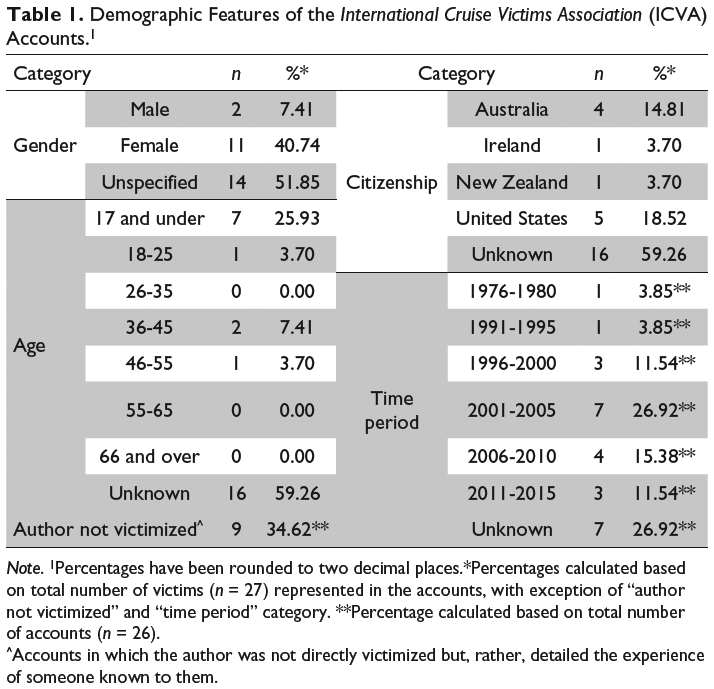
Note. 1Percentages have been rounded to two decimal places.
*Percentages calculated based on total number of victims (n = 27) represented in the accounts, with exception of “author not victimized” and “time period” category. **Percentage calculated based on total number of accounts (n = 26).
^Accounts in which the author was not directly victimized but, rather, detailed the experience of someone known to them.
The accounts were analyzed both descriptively, to gather quantitative data about crime and offender types and frequency, and thematically, to better understand experiences of victimization. To maintain meaningful yet useful and reliable findings, qualitative data must be analyzed methodically. This includes the systematic recording and disclosure of the methods used to gather and interpret the data (Attride-Stirling, 2001). Accordingly, in the case of this research project, all qualitative data was analyzed thematically, guided by the “analytic steps” outlined by Attride-Stirling (2001): coding of material, identification of themes, construction, description and exploration of a thematic network, summary and, finally, the interpretation of patterns. Qualitative data is documented descriptively and supported, where appropriate, by quantitative data represented as percentages due to a number of denominators being present (e.g., the number of victims that experienced victim-blaming vs. the number of identified offenders that were passengers).
Based on these steps, a coding framework was developed drawing on deductive and inductive categories. For example, following the aim of the research and guiding research questions, at a high-level data were deductively coded according to experiential or perceptive accounts of victimization, and responses to victimization. These broad categories were further broken down according to recurring subthemes. For example, the global theme of “response to crime” was broken down into organizing themes of “lack of empathy” and “lack of action.” Specific examples were then grouped together by generalized attitudes and/or behaviors (i.e., victim-blaming) under these themes, creating a network in which the themes and ideas could be linked and analyzed in context.
Themes also emerged inductively. This approach was taken to ensure that the absence of literature on the topic did not limit the analytical process and identification of findings. Inductive themes were identified using the analytical steps documented above. Here, data relevant to understanding the nature of victimization, the victim’s experience, and the subsequent response that was not captured by the deductive process were noted. An example of an inductively derived theme that emerged from the data was victim-blaming. All the themes were reviewed, discussed, and agreed by the authors.
Findings and Discussion
While the analyzed accounts are not representative of all victimization experiences onboard cruise ships, they do provide insight into the treatment of victims of crime and demonstrate the need for robust data which enables crime victims’ experiences to be comprehensively understood. During analysis, two high level themes summarized how victimization is experienced onboard cruise ships: a lack of empathy and a lack of action. As documented in the literature review, secondary victimization arises from the inappropriate actions and attitudes of service providers (e.g., victim blaming) that furthers the trauma experienced by victims of crime (Campbell & Raja, 1999). In this case, the service providers are initially cruise ship staff. It is through service providers not believing victims or not stating that a victim’s case is credible, and failing to consider and respond to victims’ needs, that victims are subjected to further trauma (Campbell & Raja, 1999; Campbell et al., 2001). All these experiences were evident to varying degrees within the accounts, demonstrating that secondary victimization is experienced following victimization onboard cruise ships. Moreover, the victims’ accounts showed that secondary victimization has been experienced by victims of crime onboard cruise ships for many decades, suggesting that the industry has made little progress in the manner in which they respond to crime, especially in the case of sexual assault. For example, the earliest account of sexual assault in the sample occurred in 1978:
They [the staff] seemed frustrated, but, I was the victim and this whole process was extremely humiliating, not to mention the assault itself! My parents tell me now that the ship staff were not very cooperative or sympathetic. I know one thing, I felt the lack of sympathy then. I remember being made to feel as if I were a pain in the you-know-what. Account 5 (female passenger)
These feelings of humiliation due to the inappropriate attitudes and behaviors of staff were duplicated decades later. For instance, in 2006, a victim was similarly humiliated by the process as detailed below:
[Two officers] sat on the bed, where the rape occurred. Eventually, I was permitted to go to the ship’s doctor, but he told M and I to go back to our cabin and collect the sheets & clothing from the incident and to place then in plastic bags, which they had provided. I also wrote a demanded [sic] statement and gave it to the officers on the ship. The entire process was so humiliating! Account 11 (female passenger)
While the behaviors of staff in these two accounts differ, both victims document a disregard for the sensitivity of the situation and their needs. Furthermore, the lack of empathy was displayed through victim-blaming. Victim blaming extended to staff-victims as well as passenger-victims:
…she [the victim] was called into the Security Office, where her supervisor was also present at which time, they terminated her for “being drunk while on duty,” giving her 15 minutes to gather her belongings and get off the ship. She was in shock! Account 13 (female staff member, account provided by victim’s family)
Like victim-blaming, the minimization or disbelief of the victim’s case was a common experience (23%), especially in disputes over consent. The failure of staff to conduct an adequate investigation in such cases indicates that victims of sexual assault were not believed. Victim’s cases were also, at times, discredited:
At first, the security personnel made it painfully clear that they did not believe what I had told them, so I believed that if they doubted me, why in the hell would they [author’s parents] ever believe I had just been raped?...Before my parents arrived, the security personnel told me that they did not believe me, and claimed that I had a “wild” imagination. I was so angry! Account 7 (female passenger) The doctor phoned me in my stateroom later that afternoon and said that the head of security had told him that I was out for money. Security and shipboard officers tried to discredit my story and were aggressively hostile during the next 24 hours. Account 24 (female passenger)
It is apparent through the victims’ accounts that as a result of lack of action and empathy by cruise ship staff secondary victimization is likely to be a common experience. However, it should be noted that the extent to which this reflects workplace culture versus individual staff member’s poor behavior remains unclear. There were some instances (3%) throughout the accounts where individual staff members showed a level of empathy and understanding of the victim’s needs in the face of the poor attitudes and actions of their colleagues:
There was the nurse and a female security officer present in the bathroom with me. They were very good about just idly chit-chatting to make it seem not so uncomfortable for me. Account 20 (female passenger)
Evidence of additional positive experiences is also found in the report detailing the hearing before the U.S. House of Representatives Subcommittee on Coast Guard and Maritime Transportation of the Committee on Transportation and Infrastructure (2007, p. 94). Submitted by a witness are copies of an email (1), handwritten letters (3), and a news article (1) that detail “helpful and courteous” interactions with staff, indicating that the actions and attitudes of cruise ship staff and crew cannot be understood as only negative and/or positive. It should be noted that a bias exists due to the witness holding a senior position within a cruise ship company and thus a conflict of interest will exist. Furthermore, these accounts detail experiences regarding the deaths of family members from natural causes, not as a result of a crime. Thus, while it is evident that cruise ship staff and crew can provide empathy and support and that not all interactions following a traumatic event are negative, it remains apparent that secondary victimization must be addressed by the cruise industry.
Protecting the “Brand”
The lack of empathy and action documented in the victims’ accounts may be partially explained by prioritization of the “brand” over that of victims and their needs. These findings are not unique to the cruise ship industry, rather they support the wider body of literature that has studied secondary victimization of sexual assault victims in a land-based context. Adopting the differentiated categorization of sexual assault processing by Martin and Powell (1994), the processing of crime as a whole by the cruise ship industry can be considered “unresponsive.” Unresponsive processing refers to the emphasis of the needs of the organization (i.e., police, hospitals, and rape crisis centers) over that of the victim, resulting in further trauma (Campbell & Raja, 1999; Martin & Powell, 1994). In the case of this research project, the organization represents the “brand,” being both the “brand” of the specific cruise company and the “brand” of the cruise industry as a whole. Therefore, unlike in Martin and Powell’s (1994) work, the prioritization of the organization and its needs included significant economic influence as was evident throughout the accounts:
There were a good number of security personnel around (the staff member at the teen center with whom I talked had made some calls), but they seemed more concerned about publicity than about my daughter. Account 14 (female passenger, account provided by victim’s family) The hotel director then said that the chief of security was there to protect [the cruise ship company]! The company, not the passengers! Account 24 (female passenger) I said, “Captain, do you even know what happened?” The Captain replied, “What happened is not relevant. What IS relevant is that there be no repeat of it, and to ensure that, I have directed that you be removed from the ship. There will be no further discussion. Goodbye.” Account 23 (male passenger and son) [The room attendant] had reported her [the victim] missing from her cabin for five days during the cruise and was told by his supervisor to “forget it and just do your job.” Account 27 (female passenger, account provided by victim’s family)
It was common for victims to be offered coupons for future cruises. In one case, the victim was subjected to a marketing pitch by security staff while they were taking statements about the victimization:
The security crew members left the cabin, but not before pitching a marketing statement for us to consider booking our next cruise with [the cruise ship company]. How insensitive and inappropriate was that? We were so stunned with their response. Account 10 (female passenger, author’s children) Days and weeks went by before I received an email or a phone call from [the cruise ship company]. The email included a $150 voucher as their apology to use on a future cruise. Account 17 (female passenger) When we arrived back home, we contacted the head U.K. office of [the cruise ship company] in London and told them of our experience. Their response, as a “gesture of good will,” was to offer 250 pounds sterling in tokens toward the cost of a future cruise. Account 24 (female passenger) The only thing I received from the cruise line, following this incident, was a promotional letter from the President of [the cruise ship company], which stated, “Thank you for sailing with us and giving us the opportunity to send you home with an experience to remember.” He even included a discount coupon! Once again, I felt humiliated and could not stop crying. Account 11 (female passenger)
Organizational practices within the cruise ship industry privilege the interests of the “brand” over victims, which filters down to victims via insensitive attitudes and actions by first-responders and staff who make subsequent contact with victims and their families. Contemporary cruise branding draws on tropes such as escapism and luxury and presents cruise ships as an opportunity for increased social recognition and status, bonding, learning, and discovery (Hung & Petrick, 2011). The association with crime would counter these tropes impacting on marketability and risking sales volume (Panko et al., 2009). This is not limited to the cruise ship industry but can be more broadly applied to the tourism industry in general (Boakye, 2010). Marketing strategies employed by the cruise industry are perceived as extremely effective at countering or reframing negative stories that pose a threat to the industry’s image (Klein, 2008). Regarding crime, the effect is profound. As Klein (2002, p. 61) argues, most passengers are unaware that crime does occur onboard cruise ships and “naïvely believe there is nothing to fear.” This is an issue that may change following the appellate decision earlier described. In addition to protecting sales, cruise companies concern about potential legal liability may also reduce the likelihood that staff, and companies more broadly, recognize that a crime has taken place (Malkin, 2019).
Conflict of Interest
As staff onboard cruise ships respond to and investigate crimes where their colleagues and employers are implicated either in the commission of the crime, or through a duty of care to passengers, a conflict of interest exists (Klein, 2012). For example, in the ICVA accounts analyzed, staff made up over half (58%) of alleged perpetrators compared to only 23% of accounts where the alleged perpetrator was another passenger.
5
The existing data on passenger versus staff offending is equivocal. A study conducted by Klein and Poulston (2011) found that perpetrators of sexual offences that occurred between 1998 and 2005 onboard cruise ships were primarily male staff-members. Meanwhile, the USDOT (2020) data reports that the number of sexual assaults that featured passengers as alleged perpetrators more than doubled between 2005 and 2008 (Klein & Poulston, 2011). The more up-to-date data from the USDOT (2020) show that this shift has been maintained. Passengers were identified perpetrators in the large majority of cases (68.8% of all offences), and were allegedly responsible for 193 sexual assaults (74.5% of this offence category) in the three-year period from 2017 to 2019. However, as Klein (2008) speculates, assaults between staff may be underreported
6
for a variety of reasons. Reporting barriers are exacerbated by the precarious nature of much cruise industry work. Barriers may arise from real or perceived contractual issues associated with terms of employment, fear of reprisal or impacts on ongoing or future employment opportunities, or as a result of the practice of classifying incidents between staff as personal issues and disputes rather than crime. The following quote demonstrates how staff victimization can be reframed:
The purser decided he was right and that police need not come on board; after all, I was drinking and the crew didn’t like me. Account 18 (female staff member)
The result of an investigation into crime victimization poses a threat to the brand’s public perception and, thus, marketability and profit. This reflects crime data literature on policing practices that proposes external factors, such as pressures from superiors, may ultimately influence the decision to formally record a crime (Eterno et al., 2014; Victorian Auditor-General’s Office, 2018). In the case of the cruise ship industry superiors represent officers of higher ranks and the cruise companies. It is in the best interest of staff, the companies and industry to obscure victimization in order to protect the “brand.” This occurs whether the victim is a passenger or staff member:
The statement I wrote was ripped up in front of me…. The captain never saw me and never said anything to me about this. Account 18 (female staff member)
While this is a uniquely extreme example in the ICVA sample where the victim’s statement was physically destroyed, it does reflect the literature about the limitations of self-regulation. For example, Landau’s (1996) Canadian research on complaints against police that were investigated by the police first before an external investigation highlighted practices such as discouragement of complaints, discrediting of witnesses, and the encouragement and coercion of withdrawals. This was evident in two accounts where access to evidence was hindered or completely withheld:
We asked to take custody of the blood sample so that we could have it checked by people who were independent of the cruise line. But this was refused; one security guard said “When there’s a crime on board, the evidence is ours, not yours.” Account 14 (female passenger, account provided by victim’s family) They [the cruise ship company] disposed of her property by giving most of it away to charity despite their protocol, which calls for property left on a ship to be held for 90 days … they told us they had no records and there had been no review concerning [the victim, a missing person]. However, in January, 2008 … one of their senior personnel admitted in writing that we had been lied to concerning the surveillance tapes regarding their retention and review by ship’s personnel. Account 27 (female passenger, account provided by victim’s family)
Consequently, in addition to the previous examples of the discrediting and minimization of victim’s experiences, it is apparent that practices onboard cruise ships can deny or limit internal investigations and influence external criminal investigations. The clear conflict of interest that exists means that the cruise ship industry cannot police itself adequately.
Conclusion
Crime occurs onboard cruise ships. However, the general absence of formal requirements to collate, report, and make public all data about crime and victimization obscures its nature and prevalence. This is likely compounded by the way in which crimes are labeled as such, or not, when they are reported. The extant literature is equivocal about the types of crime that most commonly occur, and by whom it is committed. Notwithstanding the limitations of using victims’ accounts of crime the data presented here indicate that women were most likely to be victimized and that the crime was most often committed by a staff member.
Documented experiences of victimization onboard cruises ships are significantly characterized by secondary victimization. The attitudes and behaviors of those tasked with responding to a crime committed onboard can be summarized by a lack of action and a lack of empathy. Mirroring secondary victimization literature (Campbell & Raja, 1999; Campbell et al., 2001), inappropriate and insensitive attitudes and behaviors, including victim blaming and disbelief by staff, has resulted in humiliation and further trauma. Based on this, the response to crimes committed onboard cruise ships within the industry are “unresponsive.” We argue that the economically and legally motivated prioritization of the “brand,” and consequent inherent conflict of interest influencing the response to, and initial investigation of, crimes committed onboard helps explain the lack of action and empathy toward victims of crime. However, further empirical research is needed to understand the true prevalence of these experiences, particularly for people from diverse groups, for different offence types, and onboard cruise ships operated by different companies. Such research should take into account reporting and recording practices to understand the extent to which crimes may be defined-down and reporting obligations obfuscated or avoided.
Based on the findings of this research, three leading suggestions are made. First, staff tasked with responding to a crime and interacting with victims need to receive further specialized training in order to understand victims’ experiences and needs, and to minimize victims’ subsequent experiences of secondary victimization. Additionally, all staff should receive some training because they may receive a disclosure or need to render assistance to a victim of crime. 7 Second, in agreement with both Klein (2002) and the ICVA, the inclusion of independent staff onboard cruise ships to act as an ombudsman outside of the hierarchical structure of the cruise industry would be beneficial in improving the initial response to crime. As a result of an “outsider” being present throughout the process, the ability to distort the true nature and occurrence of crime will be reduced (Klein, 2002). This does create the possibility for pressure from cruise ship companies to be applied to an independent person, however the inclusion of an independent authority will minimize self-regulation in the industry. Moreover, this approach will reduce the impact that the prioritization of the “brand” has on crime committed onboard and how staff respond to it. Finally, systematically collected, reliable information about the extent and nature of crime, and the treatment of victims of crime onboard cruise ships is needed. Specifically, revised reporting requirements should be implemented, which include reporting all crimes (not only crimes that meet arbitrary thresholds), data being made publicly available, and clarity about reporting and recording responsibilities. This would enable comprehensive quantitative research that should be complemented by qualitative research about crime and victimization experiences, which can be monitored over time to promote prevention and crime reduction interventions.
There are a range of additional possibilities that may result in enhanced prevention and detection of crime onboard cruise ships, however these possibilities are not yet sufficiently supported by empirical research. For instance, the extent to which passengers and staff are aware of crime reporting and recording processes and requirements is unknown. Therefore, the success of messaging about crime via passenger charters, employment contracts, and primary prevention literature is not understood. Similarly, the positive effects of bystander intervention strategies in violence prevention may provide a fruitful prevention avenue but cruise-specific research is needed to establish this. While the cruise industry lags behind land-based responses to crime and victimization there is an opportunity to apply evidence from those relevant fields of knowledge to make a substantial positive impact on victims’ experiences.
As demonstrated through the collation and analysis of experiences of victimization onboard cruise ships, it is clear that these experiences are diverse yet remain largely underrepresented in empirical research. It has been documented that experiences of victimization are characterized by numerous factors (i.e., attitudes and behaviors), both positive and negative, and therefore further empirical research is required to understand and improve responses to victims.
Supplemental Material
Supplemental material for this article is available online.
Supplemental Material for Protecting Victims or Protecting the Brand? Secondary Victimization and Cruise Ship Crime by Morgan Wilson and Natalia Hanley, in Journal of Interpersonal Violence
Footnotes
Acknowledgments
The authors are grateful to the International Cruise Victims’ Association for providing permission to reproduce short excerpts from victim-survivors’ accounts of their experiences and to the anonymous reviewers for providing constructive feedback.
Declaration of Conflicting Interests
Funding
The author(s) received no financial support for the research, authorship, and/or publication of this article.
Notes

Author Biographies
References
Supplementary Material
Please find the following supplemental material available below.
For Open Access articles published under a Creative Commons License, all supplemental material carries the same license as the article it is associated with.
For non-Open Access articles published, all supplemental material carries a non-exclusive license, and permission requests for re-use of supplemental material or any part of supplemental material shall be sent directly to the copyright owner as specified in the copyright notice associated with the article.
