



Abstract
Despite being a human rights violation, child marriage still takes place across the globe. Prior scholarship has shown early marriage to be associated with an increased risk of intimate partner violence (IPV). Drawing on data from the nationally representative Demographic and Health Surveys—conducted in developing and transitional nations where rates of child marriage tend to be higher—the current study provides a cross-national examination of individual-, community-, and national-level predictors of child marriage and their association with physical and emotional IPV. The sample of ever married women includes 281,674 respondents across 46 developing and transitional nations. Findings reveal the prevalence of child marriage was largely consistent with worldwide estimates. Over half of the sample (59.97%) were over the age of 18 when they married and about 1 in 10 women were married at age 14 or younger. A later age at marriage, measured continuously, was associated with lower odds of physical and emotional IPV. When considering the 18 and over cutoff traditionally used to operationalize child marriage, the odds of physical and emotional IPV were lower for women who married over the age of 18 than women who were 14 and younger when they married. However, there was a confounding effect when considering age at marriage as 18 and over when community-level predictors were not included in the model estimating physical abuse. This underscores the need to consider the nested nature of respondents’ experiences. Further, national legislation that protects against child marriage was not associated with risk of physical or emotional IPV. However, population size increased the odds of physical IPV and lowered the odds of emotional IPV. Such findings can be interpreted in light of opportunity theory and provide direction for prevention and intervention programming.
Introduction
Child marriage, often defined as marriage before the age of 18, has been recognized as a human rights violation (UNICEF, 2020). Despite calls by the international community about the harmful practices of child marriage and the negative consequences associated with early marriage, including an increased risk of experiencing intimate partner violence (IPV), the practice remains widespread across the globe. Indeed, estimates suggest the global prevalence of child marriage ranges from 21% to as high as 40.3% (Nguyen & Wodon, 2015; UNICEF, 2018). Though there is also regional variation within nations. Relatedly, in a systematic review, Jennings et al. (2017) found that 9% of girls and 37.2% of young women have experienced IPV, further suggestive of an overlap between early marriage and IPV.
While prior research has demonstrated an association between early marriage and IPV, most of the analyses are country-specific (Kidman, 2017; Nasrullah et al., 2014; Qamar et al., 2022). Multilevel analyses on the association between early marriage and IPV have been limited in the number of nations included (Omidakhsh & Heymann, 2020). Analyses that do consider the role of contextual effects tend to emphasize either community factors (Yount et al., 2016) or consider national legislation but do not examine how these policies affect individual experiences of IPV (Arthur et al., 2018). Absent from this body of work is a study that examines the influence of individual-level factors, including if the respondent herself was a child bride, community-level factors, and national-level norms and policies, such as legislation banning child marriage or the prevalence of child marriage, on the experience of IPV. Understanding the micro-macro forces of child marriage and how they shape the experience of IPV can directly inform prevention and intervention efforts. This is particularly salient given policies are often implemented at the national level. Since community norms may shape behaviors and can depart from national norms, especially in rural areas, they are also considered.
The current study examines the influence of individual, community, and national correlates on the odds of experiencing physical or emotional IPV. Data are drawn from the Demographic and Health Surveys (DHS) and include a sample of ever married women from 46 developing nations. A particular focus on developing nations is warranted given the highest rates of child marriage have been reported in sub-Saharan Africa and Southeast Asia (UNICEF, 2014). In addition, we assess if there are differences in the association between a continuous predictor of age at marriage or a series of binary predictors related to UNICEF (2014) recommendations on the legal age of marriage (i.e., married at 18 years of age or older, married between 15 and 17 years of age, married at 14 years of age or younger). Understanding if there is a threshold effect for age at marriage on the likelihood of experiencing different types of IPV has important implications for the design of legislation and programming.
Child Marriage
The 1989 Convention on the Rights of the Child called for the abolishment of child marriage and other acts that do not take the “best interests of the child” into consideration (United Nations Treaty Collection, 1989). While both boys and girls can marry before the age of 18, the practice of child marriage is much more common for girls than it is for boys (Nour, 2006; UNICEF, 2001). In spite of these international recommendations against the practice of child marriage, boys and girls are still married before they turn 18. Kidman (2017) reported that about 1 in 10 women aged 20-24 from 34 developing nations were married before they turned 15. Another quarter of young women were married between 15 and 17 years of age. According to UNICEF (2020), 5% of young women between the ages of 20 and 24 worldwide were married at 14 years of age or younger and 20% of young women were married before the age of 18. While Yount et al. (2016) acknowledge there are important distinctions in those who marry before 14 or between 15 and 17—compared to those who were 18 or older when they married—because of physical and cognitive developmental milestones, the focus tends to be on child (younger than 18) versus adult (18+) age differences in marriage. Stated differently, most studies do not differentiate beyond the 18 or younger cutoff.
When examining country-specific analyses of child marriage, Qamar et al. (2022) found that roughly 15% of Afghani women were married before the age of 15, 35% were married between 15 and 17, and 50% were married after 18 years of age. Similarly, a study of child marriage in Ethiopia found that 17% of respondents were married before the age of 15, 30% married between 15 and 17, and 26% married at 18 or 19 (Erulkar, 2013). To be sure, developing nations are not the only countries that struggle with child marriage. A study of children in the United States between the ages of 15 and 17 reported that 6.2% of children were married between 2010 and 2014 (Koski & Heymann, 2018).
Child marriage can lead to a multitude of negative health outcomes, including increased risk for unwanted pregnancy, termination of pregnancy, unregistered childbirth, HIV and sexually transmitted diseases, cervical cancer, and offspring health issues (Mourtada et al., 2017; Nasrullah et al., 2014; Nour, 2006). According to Nasrullah et al. (2014), 21.3% of women married as children have experienced at least one unwanted pregnancy compared to 11.5% of women married as adults. Rapid repeat childbirth (42.9% of child brides vs. 14.2% of nonchild brides) and pregnancy termination (21.9% of child brides vs. 13.1% of nonchild brides) are more common among women who were married as children (Nasrullah et al., 2014). Additionally, Nour (2006) reported that child pregnancy suppresses the immune system to make girls more susceptible to malaria and related complications during their first pregnancy. Importantly, child marriage also increases the risk of IPV (Kidman, 2017; Nasrullah et al., 2014; Qamar et al., 2022; Yount et al., 2016).
Intimate Partner Violence
IPV is broadly defined as acts of physical, sexual, emotional, and economic abuse committed by a current or former intimate partner (WHO, 2012). IPV can also have serious physical and mental health consequences for victims. These issues, which comprise both direct and indirect effects, include physical injury, death, disability, pregnancy, sexually transmitted diseases, substance abuse, and overall poor physical and mental health (Plichta, 2004).
The DHS are widely used for country-specific analyses to better understand risk factors of IPV in developing nations (Bazargan-Hejazi et al., 2013; Tlapek, 2015). Others have merged the country-specific datasets to better understand cross-national correlates of IPV attitudes (Hayes & Boyd, 2016; Pierotti, 2013), risk of IPV (Kidman, 2017; Omidakhsh & Heymann, 2020) or help-seeking behaviors (Goodson & Hayes, 2018). What is unique about the DHS is that the data collection effort spans a diverse population across the developing and transitional world. Countries from Eastern Europe, North and sub-Saharan Africa, Southeast Asia, the Caribbean, Central America, and South America are surveyed. In many ways the DHS captures data on part of the global population that is often overlooked. This shifts analyses away from a western lens and allows researchers to assess how risk factors of IPV operate in the developing world, which have different norms and policies. The dataset presents an opportunity to examine how norms and experiences around child marriage, among nations with some of the highest rates, shape risk of IPV.
Link Between Child Marriage and Intimate Partner Violence
It is well documented that child marriage is a risk factor for IPV (Kidman, 2017; Qamar et al., 2022; Yount et al., 2016). In a study of Pakistani women aged 15-24, Nasrullah et al. (2014) found that those married as children (i.e., younger than 18 years of age) were more likely to experience controlling behaviors and were more likely to experience physical or emotional abuse by their partner than those who were married as adults. Country-specific analyses in Afghanistan, Bangladesh, India, and Ethiopia reached similar conclusions (Erulkar, 2013; Qamar et al., 2022; Santhya et al., 2010; Yount et al., 2016). More specifically, in Bangladeshi villages with over a 25% prevalence of early child marriage, there was a 51.8% incidence of IPV (Yount et al., 2016). Multicountry analyses, described in more detail below, also demonstrate a similar linkage between child marriage and IPV. Many of the gendered norms that increase the likelihood of early marriage for girls likely influence the experience of IPV.
Individual-level correlates of child marriage and IPV.
Individual-level factors that may be associated with child marriage and IPV are poverty and economic conditions. Poorer families may be attracted to the lower dowry and reduced costs in education associated with early marriage (Yount et al., 2016). Other studies confirm this finding that socioeconomic status is inversely associated with risk of IPV, controlling for age at marriage (Nasrullah et al., 2014; Qamar et al., 2022). Santhya et al. (2007) also note a woman’s risk of experiencing unwanted sex decreased by 11% for every year of school the woman had completed. Together, this body of work highlights the importance of controlling for individual-level correlates of poverty and empowerment.
Individual attitudes toward IPV can also affect the risk of IPV. In a study on IPV in
Pakistan, Ali and Tariq (2021) found that women who believed that wife beating was justified were more likely to experience IPV. Women’s individual attitudes that support IPV lead to an increased likelihood of experiencing IPV because of the acceptance of gender inequality and patriarchal values, reinforcing that men are in a position of power and dominance over women (Waltermaurer, 2012; Zark & Satyen, 2021). More prevalent outside of Western countries, the approval of IPV can occur at the societal and individual levels (Zark & Satyen, 2021).
Norms and Policies Toward Child Marriage
Despite the body of scholarship that has demonstrated the relationship between child marriage and risk of IPV, the multilevel influence of child marriage on the risk of IPV remains “undertheorized and understudied” (Yount et al., 2016, p. 1826). To date, scholarship that has assessed the multilevel influence has examined either the village-level (Yount et al., 2016) or the country-level among a limited number of nations (Omidakhsh & Heymann, 2020). For example, Yount et al. (2016) demonstrated that village norms of child marriage across 77 Bangladeshi villages interacts with the individual-level protective effects of delayed marriage. In other words, any protection of delayed marriage is negated when the respondent lives in a village with a younger age at marriage on average. This means it is necessary to control for characteristics of the respondent’s neighborhood, including the prevalence of early marriage, when examining the relationship between child marriage and IPV.
At the national level, among a sample of nine countries, national changes toward a more protective child marriage policy that increased the minimum age of marriage to 18 were associated with a reduced risk of physical or sexual abuse (Omidakhsh & Heymann, 2020). Similarly, Kidman (2017) conducted country-specific analyses of child marriage on the risk of IPV across 34 countries and reported that physical and sexual IPV were significantly higher for those who were married as children. Kidman’s (2017) scholarship determined there was considerable heterogeneity in the association between age at marriage and risk of physical and/or sexual IPV. What is absent from this body of work is an analysis that considers not only the respondent’s own experience with child marriage but also the broader sociopolitical forces. Mixed effects models can account for the clustering of respondents within nations and allows for an analysis of country-level effects concurrently with individual- and community-level effects.
Countries have norms and legislation that either support or discourage IPV (Freedman, 2002; Waltermaurer, 2012). One such law is the age in which citizens can be married without parental or judicial consent. While 158 countries have set the legal age of marriage to 18 years of age, this means 34 nations have not. Furthermore, even if a country has a law on the book, they are rarely enforced (United Nations Population Fund, 2012). This means that norms and traditions may continue to shape behaviors even when there is legislation that proscribes early marriage. It is therefore possible to examine variations in legislation designed to protect women and ensure greater gender equality on the experience of IPV while accounting for the respondent’s own lived experience and the norms in which the respondent is embedded.
It is also important to consider that public opinion influences the formation of many policies (Roberts, 2000). In other words, as cultural norms shift, policies may be passed in response to shifting norms. As an example, Roberts (2000) found that legal reform did not influence support for corporal punishment in Sweden and that waning support for the practice likely led to reform in the first place. Consistent with this, scholars have shown laws against IPV do not influence overall attitudes toward IPV (Hayes & Boyd, 2016) or if an IPV victim seeks help (Goodson & Hayes, 2018). Instead, aggregate support for IPV was associated with individual attitudes toward IPV (Hayes & Boyd, 2016). Therefore, it is necessary to also account for national norms and laws that might shape early marriage and the experience of IPV.
Current Study
The current study had three overarching goals. First, we examined if an older overall age at marriage was associated with a reduced likelihood of ever experiencing physical or emotional IPV. Second, we consider if those who were 18 years of age or older when they married, compared to women who married at 14 years of age or younger or women who married between the ages of 15 and 17, are less likely to experience physical or emotional IPV. This is based on international recommendations for legislation to set the minimum age of marriage to at least 18 years. Finally, we assess the influence of community norms and national policy and norms related to IPV and child marriage on the likelihood of experiencing physical or emotional IPV.
Data and Methods
The DHS are nationally representative household surveys conducted in over 90 developing and transitional countries. Roughly every 5 years, nations, over a period of 18-20 months, survey women of reproductive age (15-49 years) and men aged 15-59. Surveys include questions on fertility, mortality, family planning, nutrition, and HIV/AIDS. Sample sizes range from 5,000 to 30,000 households per country and are representative at the national-, residence-, and regional-levels. The primary sampling units (PSUs) used in the DHS are initially selected from enumeration areas drawn from census files. A sample of households are then selected within each enumeration area using equal probability systematic sampling. Since the implementation of the DHS, additional modules have been incorporated into the core questionnaire and included on a volunteer basis by country. One such module is on IPV.
Dependent Variables
Physical abuse. The respondent’s lifetime experience of physical abuse was included as a binary indicator. If the respondent’s partner ever (a) pushed, shook, or threw something at her; (b) slapped her; (c) punched with fist or hit her with something harmful; (d) kicked or dragged her; (e) strangled or burnt her; or (f) threatened her with a knife/gun or another weapon she was coded as “1.” Respondents who did not experience any of the behaviors were coded “0.”
Emotional abuse. The respondent’s lifetime experience of emotional abuse was also captured as binary indicator. If the respondent’s partner ever (a) humiliated her; (b) threatened harm; (c) became jealous when she talked with other men; (d) accused her of being unfaithful; (e) did not permit her to meet with female friends; (f) limited her contact with family; or (g) insisted on knowing where she was then the respondent was coded as “1.” Respondents who did not report any of the above experiences were coded as “0.”
Individual-Level Independent Variables
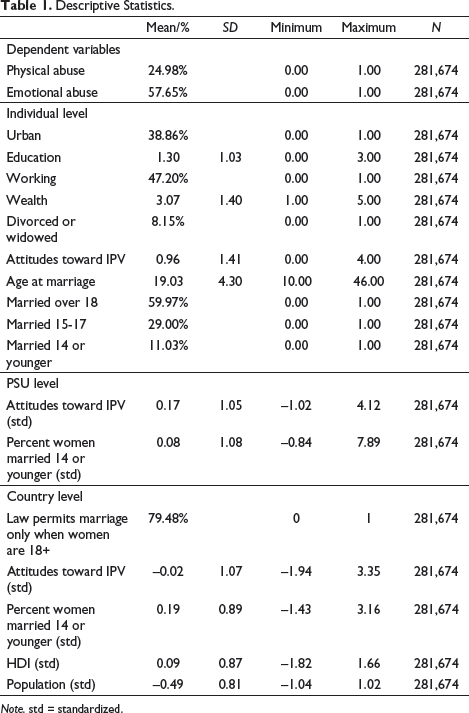
Two sets of items were created to capture early marriage. 1 First, a continuous measure was included that represented the respondent’s age at marriage (mean = 19.03, SD = 4.30, range = 10-46). Because of low cell sizes for some of the earliest and oldest ages at marriage (e.g., 19 respondents were married at 4 years old or 3 respondents were married at 49 years old) that would preclude bivariate and multivariate analyses, respondents who were married between the ages of 4-9 were recoded to 10. Respondents who were married between the ages of 47 and 49 were recoded to 46.
A series of dichotomous indicators were also created. Respondent’s age at marriage was recoded into if she was married at 14 years of age or younger (reference category), between the ages of 15 and 17, or if she was 18 or older when she married.
Individual-Level Control Variables
A series of indicators were included based on prior research on IPV with DHS data (Bazargan-Hejazi et al., 2013; Tlapek, 2015). If the respondent lived in an urban location was included as a binary predictor where “1” = urban and “0” = rural. The respondent’s level of education was included as a continuous item (mean = 1.30, SD = 1.03, range = 0.00-3.00). The respondent’s working status was included as a dichotomous predictor where “1” = respondent was currently working and “0” = respondent was not currently working. Because the nations were all at different stages of development, the respondent’s socioeconomic status was captured with the wealth index. The wealth index ranged from 1.00 (i.e., poorest) to 5.00 (i.e., the richest) and represents the respondent’s overall standard of living. The wealth index is based upon household ownership of selected assets, materials for housing construction, and water/sanitation access. Finally, the respondent’s attitudes toward IPV was a summative scale. Women were asked if wife beating was ever justified if (a) “the wife goes out without telling her husband,” (b) “if she neglects the children,” (c) “if she argues with her husband,” or (d) “if she burns the food.” The item ranged from 0.00 to 4.00 (mean = 0.96, SD = 1.41). 2
PSU-Level Independent Variables
Since the PSU is designated by the DHS, they do not have clear boundaries that would allow for the inclusion of validated predictors across the nations. Prior research has advocated aggregating individual-level correlates as a way to capture macro group features (Blakely & Woodward, 2000). These aggregated items are fundamentally distinct from the individual items used to create them (Pinchevsky & Wright, 2012). In many ways they represent a sui generis effect whereby the collective measure is no longer reducible to the individual level parts used to create it (Durkheim, 1951).
Two items were aggregated to the PSU-level. The first was the prevalence of women who were married under the age of 14. The second was the PSU’s overall attitudes toward IPV. These items were both standardized for ease of interpretation.
Country-Level Independent Variables
Two items were also aggregated to the country-level. Again, the prevalence of women who were married under the age of 14 was aggregated to the country-level. The second was women’s overall attitudes toward IPV within the nation. These items were both standardized.
The Human Development Index (HDI) for the corresponding year the survey was administered in the nation was included. The HDI represents a country’s progress in health, knowledge, and standard of living (United Nations Development Programme, 2010). The overall population in 2010 for the nation in millions was included (Harris et al., 2019). Both of these items were standardized for ease of interpretation. Finally, a country-level variable was created stating if each country bans marriage under the age of 18. This data was collected from individual country profiles within the Social Institutions and Gender Index (SIGI) database (OECD Development Centre, 2020) and was coded as “0” = legal age of marriage is less than 18 and “1” = legal age of marriage is 18+. 3
Analytic Plan
Because respondents are nested within nations and the focus of the current study was to examine the influence of individual-, community-, and national-level predictors on the likelihood of experiencing physical or emotional abuse, multilevel models were estimated. Given the binary nature of the dependent variables, data were analyzed with the mixed effects logistic regression technique. Before conducting analyses, we first examined variation at each level of analysis with the intraclass correlation coefficient (ICC). The PSU-level was included as a midrange level and the country was included as the highest level.
Assessment of missing data was dependent on a series of factors. The IPV module was only administered to about 50% of women in selected households. Among this subsample of women who had been selected for the IPV module (N = 436,179), 21.00% (N = 91,522) were single and therefore missing on key items. Among the married or divorced/widowed women selected for the IPV module (N = 344,657), percent of missing data ranged from 0.00% (i.e., marital status; wealth; urban/rural) to 8.50% (i.e., emotional abuse). As such, missing data was listwise deleted. The weighting variable for the IPV module was normalized, rescaled, and used. All continuous PSU-level and country-level items were grand mean centered.
Results
Descriptive Statistics.
Note. std = standardized.
Results of Logistic Regression Estimating the Influence of Individual-Level, PSU-Level, and Country-Level Predictors on the Odds of Ever Experiencing Physical Abuse.

Note. std = standardized; a = reference category is currently married; b = reference category is married younger than 14 years of age; *p ≤ .05; **p ≤ .01; ***p ≤ .001.
Table 2 presents the results for the models where physical abuse is the outcome. An unconditional model—without predictors (not presented here) was estimated as a baseline to calculate the ICC. The ICC indicated that 8.59% of the variance is at the country-level and 9.41% is at the PSU-level. Model 1 of Table 2 includes the control variables. Respondents who lived in urban areas and working respondents were more likely to experience physical abuse than respondents who lived in rural areas or respondents who were not working. Divorced or widowed respondents had higher odds of physical abuse than married respondents. Respondents with more supportive attitudes toward IPV had higher odds of ever experiencing physical abuse. As the respondent’s level of education or wealth increased, the odds she ever experienced physical abuse were lower. These items retained their significance in all remaining analyses.
Model 2 of Table 2 includes the continuous measure of age at marriage. For each year the respondent waits for marriage, there is a corresponding 3.00% (1 – 0.97) decrease in the odds of ever experiencing physical abuse. Model 3 of Table 2 includes the binary predictors of age at marriage, which were not significant. When PSU-level correlates are introduced in Model 4 though, women who married at 18 years of age or older had lower odds of ever experiencing physical abuse than women who married at 14 years of age or younger (Exp(B) = 0.84, p ≤ .001). Model 5 introduces the country-level predictors. Age of marriage is not significant again. Women who lived in more populous nations and women who lived in nations with more supportive attitudes toward IPV had higher odds of ever experiencing physical abuse. Model 6 of Table 2 includes all the individual-level, PSU-level, and country-level predictors. With the reintroduction of the PSU-level items, women who married at 18 years of age or older had lower odds of ever experiencing physical abuse than women who married at 14 years of age or younger (Exp(B) = 0.84, p ≤ .001). Country-level correlates of population size and women’s attitudes toward IPV remained significant. Lastly, the ICC was reestimated for Model 6 in Table 2. The country-level ICC improved to 5.89% and the PSU-level ICC improved to 6.87%. Items included in analyses at the individual-level, PSU-level, and country-level “explained” 2.70% of the variation at the country-level and 2.54% at the PSU-level.
Table 3 presents the results for models where emotional abuse is the outcome. Again, an unconditional model (not presented here) was estimated. The ICC indicated that 11.00% of the variance is at the country-level and 13.08% is at the PSU-level. Model 1 of Table 3 includes the control variables. Divorced or widowed respondents had higher odds of ever experiencing emotional abuse than married respondents. Respondents with more supportive attitudes toward IPV had higher odds of ever experiencing emotional abuse. These items retained their significance in all remaining analyses.
Results of Logistic Regression Estimating the Influence of Individual-Level, PSU-Level, and Country-Level Predictors on the Odds of Ever Experiencing Emotional Abuse.

Note. std = standardized; areference category is currently married; breference category is married younger than 14 years of age; + < 0.10; *p ≤ .05; **p ≤ .01; ***p ≤ .001.
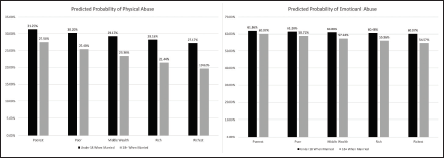
Finally, we considered an interaction between age at marriage (measured as 18+ or not) and wealth. As evidenced in Models 7 of Tables 2 and 3, this interaction was significantly associated with both physical and emotional abuse. To better interpret this finding, predicted probabilities were produced and are presented in Figure 1. There are minimal differences between the richest women who married under 18 (27.17%) and the poorest women who were at least 18 when they married (27.54%) and the predicted probability of physical abuse. It is evident a later age of marriage offers some protection against physical abuse across all levels of wealth. As evidenced in Figure 1, there were not many differences in the predicted probability of emotional abuse across wealth for women who married under 18. However, among women who were at least 18 when they were married, more wealth is associated with a slightly lower probability of experiencing emotional abuse.
Predicted probability of physical and emotional abuse by age at marriage (18+ or not) and wealth. All remaining variables were set the mean.
Discussion
The international community has largely relied on 18 years of age as the “cutoff” age for child marriage. Findings from the current study, which examined the association of early marriage and IPV—inclusive of physical and emotional abuse—across 46 developing nations, indicated that marriage at 18 or older offers some protection against IPV. What was particularly novel about the current study was that while national policies did not shape the relationship between early marriage and IPV, country-level factors did exert some influence on the overall odds of IPV. Such factors may be related to broader opportunity structures at the country-level.
To begin, our study revealed an average age at marriage of 19 years across the 46 nations. Consistent with UNICEF (2020), 11% of the sample married at 14 years or younger. While our findings are higher than the world average of 5% (UNICEF, 2020), our analysis did not include the most developed countries that have significantly lower rates of child marriage than developing nations. These conclusions emphasize the diversity of experiences between the developed and developing world.
Second, a later age at marriage (measured continuously) decreased risk of IPV—both physical and emotional abuse. This is consistent with prior country-specific analyses (Yount et al., 2016). However, this picture is incomplete and becomes more nuanced when considering international recommendations. Prior scholarship has limited analyses to women who were 24 years of age or younger (Kidman, 2017). The continuous age at marriage indicator ranged from 10 years of age to 46 years of age, suggesting 18 years of age is very early in the life course for some of the respondents. When examining the 18 or over cutoff, findings indicate that a later age of marriage offers some protection for emotional abuse but that the association with physical abuse is dependent on other factors.
Models that do not include PSU-level predictors did not find an association between marriage over the age of 18 and physical abuse. While this is consistent with research conducted in Afghanistan on child marriage and IPV (Qamar et al., 2020), there is likely a confounding effect. In other words, age at marriage—when included without the PSU-level items—was likely associated with the PSU-level items. The initial nonsignificant finding reflects the effect of the omitted PSU-level items. When the PSU-level items are added into the model, age at marriage no longer captures the PSU-level items and instead reflects the “true” effect, which in this case is significantly associated with physical abuse. Collectively, this highlights the need to account for and model the nested nature of respondents’ experiences.
Third, national legislation related to child marriage was not associated with the odds of ever experiencing IPV. This is inconsistent with prior research that found changes in national child marriage laws were associated with less supportive attitudes toward IPV and a lower risk of IPV (Omidakhsh & Heymann, 2020). Omidakhsh and Heymann (2020) only focused on nine nations, did not include additional country-level measures, and did not model the PSU-level. This latter point is particularly important given the PSU-level was confounded with if the respondent was 18 or older when she was married. Yet, findings from the current study are consistent with prior scholarship that has examined the influence of legislation and has not found a significant effect on attitudes toward corporal punishment (Roberts, 2000), homosexuality (Adamczyk & Pitt, 2009), and IPV (Hayes & Boyd, 2016). The legislation may be passed in response to waning support. In the case of physical IPV, the normative context—not formal policy—exerted a significant influence. Indeed, in countries where women had more supportive attitudes toward IPV, the odds a respondent ever experienced physical abuse were higher. Nevertheless, laws may also be passed in response to higher rates of child marriage or IPV. Trend analyses allow for the exploration of global cultural scripts around child marriage and IPV (Pierotti, 2013) to better determine why laws change and the intersection between norms, behaviors, and policy and are an avenue for future research. While laws are powerful, it is vital for policymakers and practitioners to remember that innovative and sustained community change around norms and practices is also necessary (Lundgren & Amin, 2015).
Fourth, women who lived in more populous nations were more likely to experience physical abuse and less likely to experience emotional abuse. The former finding is consistent with what multicontextual opportunity theory would propose—a larger population would increase exposure to motivated offenders (Wilcox et al., 2003). When considering emotional abuse, many of the behaviors involved other individuals, like limiting contact or becoming jealous when she spoke to other men. Such behaviors are dependent on others who may serve as guardians, who should reduce the likelihood of victimization (Cohen & Felson, 1979). A larger population may represent there are more capable guardians who can witness the emotional abuse and therefore reduces the risk. This complex association warrants further investigation.
Fifth, there was an interaction between wealth and age at marriage on the odds of experiencing physical or emotional abuse. The predicted probabilities of physical or emotional abuse, regardless of age at marriage, decreased as wealth increased. That is, women of lower socioeconomic status, regardless of age at marriage, were clearly at greater risk. Among richer respondents, a later age at marriage provided increased protection. This is consistent with Kovacs’ (2018) conclusion that wealthier women may have greater purchasing power for services that reduce risk of IPV. Together, these findings provide direction for the nuance needed in developing prevention programming (Heise & Kotsadam, 2015).
Additionally, divorced/widowed respondents and working respondents had higher odds of both physical and emotional abuse. Given the cross-sectional nature of the DHS data, it is impossible to determine if the abuse led to the divorce or if the woman sought a divorce because of the abuse. Separation is a dangerous time, an inherently complex process, and a challenge to an abuser’s power and control (DeKeseredy & Schwartz, 2009). Similarly, working respondents may experience a “backlash” where abuse is used to regain power and control (Whaley & Messner, 2002). Together, these two findings reinforce the broader sociostructural processes that influence risk of IPV (Heise & Kotsadam, 2015) and warrant further research.
Finally, analyses focused on women in the developing world. Some of the highest rates of child marriage are in the developing world (UNICEF, 2020). Because of this, international agreements—such as the Convention on Consent to Marriage and the Minimum Age for Marriage and Registration of Marriages—were created to protect children from early marriage. While the goal was to decrease the prevalence of child marriage globally, the total number of girls married in childhood is still 12 million per year (UNICEF, 2020). Future studies can be conducted to determine how to best implement child marriage prevention programs in developing nations to reduce rates of child marriage and associated IPV. Findings across both physical and emotional abuse indicate changing supportive attitudes toward IPV at both the individual- and national-level will be crucial. Both policymakers and practitioners need to consider how to challenge these norms among boys and girls before they marry. Such community-based interventions that reinforce gender equity have shown success (Lundgren & Amin, 2015) but will require full community (e.g., parents, teachers, religious leaders, community members) participation to really produce meaningful long-term change.
Nevertheless, there are several limitations that merit mention. First, very few respondents were married younger than the age of 10 or older than the age of 45. For analyses that included a continuous age of marriage, respondents who were married between the ages of 0 and 9 (n = 307) were collapsed into married at the age of 10 and younger and respondents who married between the ages of 46 and 49 (n = 37) were collapsed into married at the age 46 or older. Second, while we would have liked to included policies at the PSU-level that was not possible given the nature of the data. PSU-level measures were limited to those that could be aggregated from the data. Third, 51 nations had conducted the IPV module in recent waves of the DHS. Analyses were limited to nations that had all items used to create indicators as well as country-level measures. This limited analyses to 46 nations. Fourth, the items used to create a sexual abuse indicator are not consistent across nations. As such, analyses did not examine the association between early marriage and sexual violence. This is an important avenue for future research.
Conclusion
Overall, findings from the current study indicate child marriage is associated with an increased risk of both physical and emotional abuse across the developing world. Further, findings demonstrate legislation does not have the protective effect many anticipate. Therefore, IPV prevention and intervention programming needs to consider innovative ways that involve the community and that challenge supportive attitudes toward IPV. As suggested by the findings of population size, it is possible opportunity plays a role and should be included in program design. Together, these findings indicate that policy and practice need to target programming beyond victims to include the community.
Supplemental Material
Supplemental material for this article is available online.
Supplemental Material for Child Marriage and Intimate Partner Violence: An Examination of Individual, Community, and National Factors by Brittany E. Hayes and Michelle E. Protas, in Journal of Interpersonal Violence
Footnotes
Declaration of Conflicting Interests
Funding
The author(s) received no financial support for the research, authorship, and/or publication of this article.
Notes

Author Biographies
References
Supplementary Material
Please find the following supplemental material available below.
For Open Access articles published under a Creative Commons License, all supplemental material carries the same license as the article it is associated with.
For non-Open Access articles published, all supplemental material carries a non-exclusive license, and permission requests for re-use of supplemental material or any part of supplemental material shall be sent directly to the copyright owner as specified in the copyright notice associated with the article.
