



Abstract
The current study examines correlates of high school boys’ intentions to garner consent in a future sexual encounter (N = 816). Bivariate correlation analyses demonstrated that increased intention to garner sexual consent was negatively correlated with rape myth acceptance and perceived peer acceptance of violence, and positively correlated with gender equitable attitudes. In multivariate linear regression analyses, perceived peer acceptance of violence and gender equitable attitudes remained significant in relation to intentions to garner sexual consent. Specifically, boys who reported a greater likelihood of perceiving their peers as accepting of violence and a lower likelihood of holding gender equitable attitudes also reported a lower likelihood to garner sexual consent. These findings highlight the importance of developing sexual assault prevention programs for high school boys that address the complex relationships between perceived peer norms, harmful gender role expectancies, and risk for sexual aggression. Results from this study also add to the existing literature on sexual consent communication in adolescents.
Keywords
Introduction
Sexual violence—defined as any sexual act committed or attempted by an individual in the absence of another individual’s consent (Basile et al., 2014)—occurs throughout the lifespan. Early encounters of sexual violence victimization and perpetration often occur during adolescence (Espelage et al., 2012; Foshee et al., 2004). According to the 2019 Youth Risk Behavior Surveillance Survey (YRBS), approximately 1 in 10 high school students report being forced to do “sexual things” such as kissing, touching, or having sexual intercourse when they did not want to with victimization more than three times as prevalent in girls (16.6% vs. 5.2% in boys, respectively; Basile et al., 2020). Sexual violence perpetration, including forced sexual contact, coercive sex, and attempted or completed rape, is especially prevalent among adolescent boys (Taylor & Mumford, 2016; Ybarra & Mitchell, 2013). According to findings from the National Youth Survey Family Study, 70% of boys ever involved in sexual assault commit their first act by age 17 years (Grotpeter et al., 2008). Moreover, a longitudinal study of male undergraduates (Zinzow & Thompson, 2015) found that more than two-thirds of men who perpetrated sexual violence committed a repeat offense of similar or greater severity, 56% and 26% respectively, within a four-year timeframe. Recent findings from a 4-wave analysis of adolescents and young adults between the ages of 13 and 25 years also indicate that among youth who perpetrate multiple forms of sexual violence, three in five continued to do so over time (Ybarra & Petras, 2021). Taken together, these findings underscore the need for early prevention efforts that target adolescent boys.
Numerous studies document risk and protective factors associated with sexual violence perpetration among adolescent boys (Casey & Masters, 2017; Grotpeter et al., 2008; Tharp et al., 2012). As Jozkowski (2015) discusses, sexual consent is a critical component of understanding what constitutes sexual assault and rape. Sexual consent is also a core component of many prevention programs (Gidycz et al., 2011). Although several studies explore factors associated with sexual consent among college students (for a review see Muehlenhard et al., 2016), a smaller body of research focuses specifically on sexual consent among adolescents (Beres, 2007; Shafer et al., 2017).
Sexual consent is broadly defined as “some form of agreement to engage in sexual activity,” (Beres, 2007). However, what constitutes “agreement” between two individuals has been largely debated (Beres, 2007; Harris, 2018; Levand, 2020). The notion that “yes means yes, no means no” has become a well-known and widely adopted discourse used in education programs about consent and among many anti-rape activists, educators, and organizations (Harris, 2018; Levand, 2020). It has been asserted, however, that this type of discourse oversimplifies consent and ignores the cultural contexts that shape how individuals navigate sexual encounters (Harris, 2018; Levand, 2020). For example, some affirmative consent standards assume that initiators of sexual activity will stop their requests for sexual activity if an enthusiastic “yes” is not provided, and that individuals have the capacity to say “no” to unwanted sexual activity (Pugh & Becker, 2018). However, studies of adult female sexual assault survivors suggest that 37% to 42% experience significant to extreme forms of tonic immobility, which is the body’s innate tendency to become unresponsive when escaping or resisting the threat is not possible (Marx et al., 2008). In such cases, women reported losing their ability to verbally refuse an unwanted sexual advance, call out for help, move, or fight back (Marx et al., 2008).
Most sexual encounters involve the use of nonverbal behavioral cues, making it difficult to ascertain consent (Beres, 2007; Hall, 1998; Jozkowski et al., 2014; Levand, 2020; Muehlenhard et al., 2016; Righi et al., 2019). Overreliance on nonverbal behavioral cues and in turn, increased risk for sexual assault, may be especially relevant to high school students. In the context of male-female encounters, findings from a qualitative study conducted by Righi et al. (2019) indicate that high school students, namely girls, tend to convey consent through silence or the absence of saying “no” in response to boys’ sexual advances. Relatedly, most sexual violence incidents among teens (63%) are characterized by subtle coercive tactics, such as making the other person feel guilty for not complying, and occur in the context of drinking which can later be attributed to some “huge misunderstanding” (Grotpeter et al., 2008; Ybarra & Mitchell, 2013). Less than 10% of teen sexual violence involves nonsexual forms of physical aggression (e.g., hitting, slapping, etc.; Grotpeter et al., 2008; Walker, 1997; Ybarra & Mitchell, 2013) that may be more likely to prompt the use of explicit forms of nonconsenting behavior (e.g., “Stop! You’re hurting me!”) compared to less aggressive or more insidious acts of violence.
Findings from studies of sexual consent and sexual communication among college students (Johnson & Hoover, 2015; Shafer et al., 2017) reveal several important areas of inquiry to consider when examining factors associated with sexual consent among youth. For example, scholars contend that the different ways in which males and females convey and interpret sexual consent are largely influenced by sexual scripts or preconceived ideas about how sexual behavior ought to occur (Beres, 2007; Gagnon & Simon, 1973; Johnson & Hoover, 2015; Muehlenhard et al., 2016; Righi et al., 2019; Walker, 1997). In the context of traditional or heteronormative sexual scripts, males are supposed to initiate sex insofar as the female does not resist, whereas females are meant to serve as “gatekeepers” responsible for deciding whether sexual encounters will continue (Gagnon & Simon, 1973; Muehlenhard et al., 2016; Righi et al., 2019). Early adolescence is a time when youth start to develop a sense of their personal and sexual identity and engage in sexual situations for the first time (Miller, 2017; Van de Bongardt et al., 2015; Walker, 1997). Adolescence is also a period of development when gender socialization, or what it means to be considered masculine or feminine, is prominent (Amin et al., 2018). For these reasons, it is possible that adherence to traditional masculine norms may intersect with perceptions of what constitutes sexual consent among youth.
Further, many adolescents turn to their peers for guidance on what is considered acceptable sexual behavior, and in doing so, are especially susceptible to internalizing traditional sexual scripts (Amin et al., 2018). For example, boys who experience social pressure to adhere to traditional sexual scripts or widely held beliefs of masculinity emphasizing strength, aggression, and social rewards for sexual conquests (e.g., multiple sexual partners) may ignore sexual cues signaling refusal to enact power and garner peer acceptance (Santana et al., 2006). One study of adolescents found that boys, when compared to girls, were especially susceptible to peer influence surrounding their sexual behavior (Widman et al., 2016). There is some evidence to suggest that trying to prove one’s masculinity by adhering to traditional gender norms plays a role in sexual violence perpetration among adolescent boys (Reidy et al., 2015; Reyes et al., 2016). No studies to our knowledge, however, have quantitatively investigated the extent to which high school boys’ adherence to or beliefs about traditional gender roles influences their intention to obtain consent in a future sexual encounter. A recent study by Shafer et al. (2017) examined this relationship among male college students and interestingly, did not find a significant correlation between adherence to hypermasculine scripts and intentions to obtain consent. The authors posited that adherence to some dimensions of traditional sexual scripts may in fact be protective against sexual violence, such as honor or chivalry and protecting one’s partner from harm (Shafer et al., 2017). Research is needed to understand whether this finding also applies to adolescents.
In addition to beliefs about traditional gender roles, or masculinity being linked to sexual violence, theoretical models explaining sexual aggression among boys and men have emphasized the importance of considering not just one, but rather, multiple risk factors for sexual assault prevention. The Integrated Model of Sexual Assault and Acquaintance Rape (Berkowitz, 1992, 2003) offers one such framework and suggests that males’ beliefs (e.g., notions about what it means to be masculine) as well as attitudes (e.g., view toward gender equity, rape myth acceptance) and socialization experiences (e.g., perceived peer norms condoning sexual violence) increase their proclivity to perpetrate sexual violence. However, less is known about the extent to which this model applies to sexual consent specifically. Rape supportive attitudes can serve as heuristics for a perpetrator’s decision-making during sexual encounters resulting in rapid and potentially biased processing of sexual signals reflecting refusal of sexual advances (Farris et al., 2008). Thus, boys who develop rape myth attitudes may be more likely to ignore and less likely to attend to or seek out sexual cues communicating consent or lack thereof. Research shows that many men and boys also overestimate the extent to which their peers approve of sexual violence in turn increasing their likelihood of actual perpetration (Bohner et al., 2006; Dardis et al., 2016). Perceived peer approval for sexual violence as a risk factor for sexual violence is well-documented (for a review, see Casey & Masters, 2017); though gaps remain about the extent to which peer support for sexual violence more directly relates to consent communication. It is possible that when adolescent boys perceive their peers as condoning sexual violence, they may develop and internalize schema that excuse the need to obtain consent.
The Present Study
Given the propensity for sexual violence among adolescents, it is important to understand how gender and sexually based beliefs, attitudes, and internalized social norms, guide sexual consent communication. To our knowledge, no studies have investigated direct correlates of intentions to garner sexual consent in a sample of high school boys. The present study aims to fill this gap by examining the association between beliefs about masculinity and gender equity, rape myth acceptance, and perceived peer acceptance of violence in relation to boys’ intentions to garner sexual consent in the future (i.e., next sexual encounter). Specifically, we hypothesized that boys who possessed gender inequitable attitudes (i.e., more rigid attitudes about masculinity), rape myth acceptance, and perceived peer acceptance of violence would be less likely to report intentions to obtain consent in future sexual encounters compared to boys who were less likely to report these characteristics (Study Aim #1). Driven by the Integrated Model of Sexual Assault and Acquaintance Rape (Berkowitz, 1992, 2003), which recognizes the interplay of numerous drivers of sexual aggression, a secondary aim was to explore multivariate associations among the aforementioned constructs, accounting for sexual debut (Study Aim #2).
Method
Participants
Participants in the present research were gleaned from a larger study evaluating the effectiveness of a sexual assault prevention program among 10th grade high school youth (Orchowski et al., 2017). All participants were recruited from public, charter, and private high schools within the northeastern region of the United States. The analytic sample included 816 boys who provided complete information on all study variables, drawn from the larger sample of boys in the study who self-identified as heterosexual. Boys were predominantly 15 or 16 years of age (96%, N = 782). Assessment of race and ethnicity was not permitted by the Local Board of Education, as it was believed that this information would undermine participant anonymity. According to publicly available data from schools where participants enrolled in the study, approximately 31% of the sample would be expected to identify as a racial or ethnic minority. The study was limited to boys who identified as heterosexual.
Procedure
The study procedures were approved by the local Institutional Review Board, the state Department of Education, the study sponsor, and the Superintendent of Schools and School Board of schools where study participation was offered to students. All data were collected via paper and pencil surveys, or on online surveys administered via tablets in schools where the technology was available. The survey was completed in health classes, homerooms, and physical education classes, as directed by the school. Surveys were administered by trained members of the research team, and students were informed that their answers were anonymous. Steps were taken to protect student confidentiality when completing the survey. Students were given adequate space to complete the survey and returned all paper and pencil surveys directly to the research staff in a sealed manila envelope. All data were collected as a part of a baseline assessment, administered prior to the administration of a sexual assault prevention program.
Measures
Demographics characteristics and sexual history. At the end of the study assessment, participants completed a short questionnaire assessing gender, sexual orientation, and age. This survey also assessed age of sexual debut, with the following question: “How old were you when you willingly had sexual intercourse (vaginal or anal sex) for the first time?” This variable was utilized to identify whether the participant had engaged in sexual activity (no/yes).
Intent to garner sexual consent. Four items were used to measure students’ perceived likelihood to garner sexual consent in future sexual encounters. Items were gleaned from the Bystander Attitude Scale (BAS), which was originally created by Banyard et al. (2005), and revised by McMahon (2010). Participants were asked how likely they would be to behave in certain ways in a sexual situation in the future. For example, items included: “If you were in a sexual situation in the future, how likely would you be to ask for verbal consent when I am sexual with someone, even if we are in a long-term relationship?” and “If you were in a sexual situation in the future, how likely would you be to stop a sexual activity with someone if they say to stop, even if they were OK with it when it started?” These items were structured to address future sexual encounters, so that students could rate their perceived likelihood to garner sexual consent, even if they were not currently sexually active. Sexual activity was defined as “any kind of sexual behavior, such as kissing, touching or sexual intercourse.” Participants responded to each item along a 6-point scale with the following choice options: 0 = not likely, 1 = slightly likely, 2 = somewhat likely, 3 = likely, 4 = moderately likely, and 5 = very likely. Items were summed with lower scores indicating lower levels of perceived likelihood to garner sexual consent. Scores ranged from 0 to 20. Cronbach’s alpha was calculated at .89 in the analytic sample.
Gender equitable attitudes. Attitudes about masculine norms and gender equity were measured with 12 items modified from Barker’s Gender Equitable Norms Scale (Pulerwitz & Barker, 2007). Participants responded along a 4-point scale about how much they agreed with statements such as “In a good dating relationship, the guy gets his way most of the time” and “Guys should sleep with as many girls as possible.” Responses included 0 = strongly disagree, 1 = disagree, 2 = agree, and 3 = strongly agree. Items were summed, with lower scores indicating less gender equitable attitudes (i.e., more rigid attitudes about masculinity). For participants who completed >80% of items on the scale, a mean score for the scale was computed for each participant. Total scores ranged from 0 to 3. Internal reliability among boys was calculated at .65 for this sample.
Rape myth acceptance. Personal attitudes toward and acceptance of rape myths were assessed with 7 items gleaned from Cook-Craig et al.’s (2014) adaption of the Illinois Rape Myth Acceptance Scale (IRMAS). This scale was originally developed by Payne et al. (1999). Participants responded along a 7-point scale (0 = strongly disagree to 6 = strongly agree) to indicate their agreement with statements such as: “Sexual assault charges are often used as a way of getting back at guys.” Items were summed so that higher scores represented higher acceptance of rape myths. In order to include participants who completed with >80% of items within the scale, a mean score for the scale was computed for each participant. Total scores ranged from 0 to 6. The adapted IRMAS scale has demonstrated good reliability in previous research (Coker et al., 2011). The scale demonstrated good internal reliability among boys in this analytic sample, with a Cronbach’s alpha of .82.
Perceived peer acceptance of violence. A set of three items developed by Boeringer et al. (1991) assessed perceived peer approval for engaging in sexually aggressive behaviors. Participants indicated the extent to which they believed their peers would approve of several sexually aggressive behaviors along a 5-point scale, ranging from 0 = very disapproving to 4 = very approving. Responses were summed to create an overall score of perceived peer approval for engaging in violence. Scores ranged from 0 to 12. The Cronbach’s alpha was .79 in this analytic sample.
Analytic Plan
Study variables were examined for adherence to assumptions of normality. The statistics for asymmetry and kurtosis met acceptable standards for a normal univariate distribution (Bryne, 2010; George & Mallery, 2010). To identify correlates of high school boys’ perceived likelihood to garner sexual consent in future sexual encounters, a series of Pearson product-moment correlations were conducted that explored the bivariate associations between each of the study variables (e.g., gender equitable attitudes, rape myth acceptance, perceived peer acceptance of violence, likelihood to garner sexual consent in sexual encounters). Second, to assess multivariate predictors of boys’ perceived likelihood to garner sexual consent, a multiple regression was conducted. All independent variables of interest were entered in the model simultaneously, accounting for sexual debut as a covariate.
Results
Aim #1: Bivariate Correlations among Study Variables
Correlations Among Study Variables Among Heterosexual Adolescent Boys (N = 816).
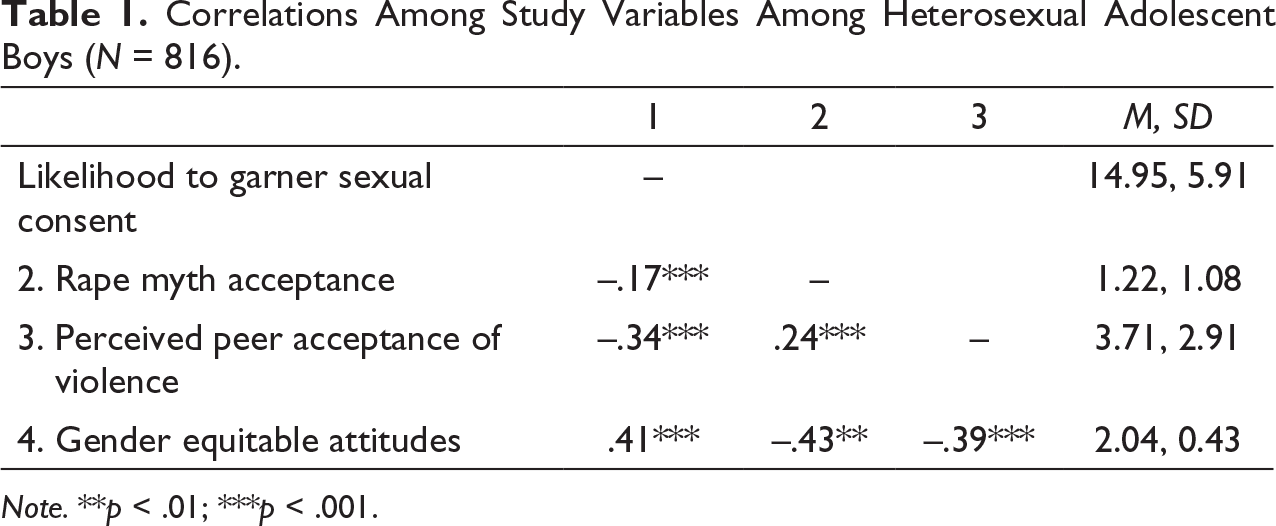
Note. **p < .01; ***p < .001.
Multiple Regression Predicting Perceived Likelihood to Garner Sexual Consent (N = 816).
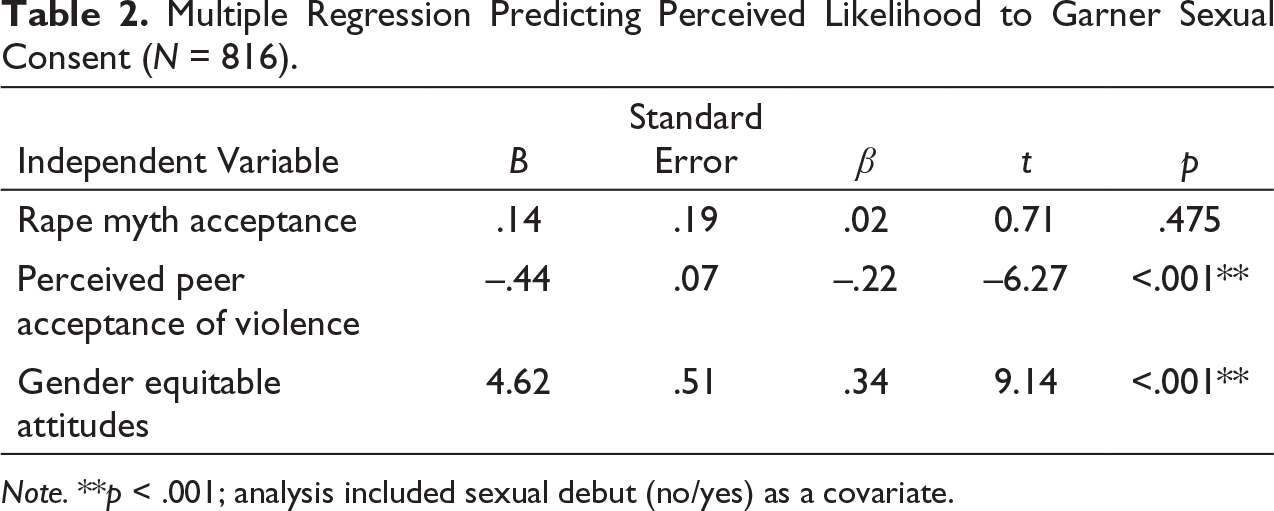
Note. **p < .001; analysis included sexual debut (no/yes) as a covariate.
Aim #2: Multivariate Associations Among Study Variables
Next, findings from the multiple regression analysis (Table 2) demonstrated that the model (which included sexual debut) accounted for a significant amount of variability in high school boys’ perceived intentions to garner sexual consent in a future sexual encounter, F(4, 811) = 52.17, p < .001, R2 = .21. When all predictors were considered together, only boys reporting a lower likelihood of holding gender equitable attitudes, t(1, 811) = 9.14, p <.001; and boys reporting a greater likelihood of perceived peer acceptance of violence, t(1, 811) = –6.27, p <.001; emerged as significant predictors of intentions to garner sexual consent. The strongest predictor of having lower intentions to garner sexual consent was holding gender inequitable attitudes, according to a standardized estimate of 0.34, which reflects a medium effect size.
A supplemental analysis was conducted to explore the possibility that perceived peer acceptance of violence might moderate the association between gender equitable attitudes and intention to garner sexual consent. The independent variables of gender equitable attitudes and perceived peer acceptance of violence were mean centered and entered in a linear regression equation predicting intentions to garner sexual consent, along with the interaction between gender equitable attitudes and perceived peer approval of violence. Although both independent variables demonstrated a significant association with intentions to garner sexual consent, the interaction term did not.
Discussion
To our knowledge, this study is the first to investigate beliefs, attitudes, and perceived peer norms regarding violence as correlates of intentions to garner sexual consent in a sample of high school boys. Results revealed two key findings. First, when analyzed independent of one another, all three indicators (e.g., gender inequitable attitudes, rape myth acceptance, and perceived peer approval of violence) demonstrated significant associations with boys’ decreased intentions to obtain consent in a future sexual encounter. This finding aligns with previous studies which examine sexual history, attitudes towards traditional gender roles, rape myth acceptance, and perceived peer approval of sexual violence as risk factors associated with boys’ propensity to perpetrate sexual violence (Abbey et al., 2011; Johnson & Hoover, 2015; Reyes et al., 2016; Tharp et al., 2012).
When boys’ attitudes toward gender equity, rape myth acceptance, and perceived peer approval of violence were examined as simultaneous predictors of decreased intention to garner sexual consent, after accounting for sexual debut, only gender inequitable attitudes and perceived peer approval of violence remained significant. These findings are not surprising, given that peers play an influential role in adolescent development and adoption of numerous attitudes and behaviors (Giletta et al., 2021). Reyes et al. (2016) also documented that the degree to which boys choose to act out hypermasculine (i.e., aggressive) scripts resulting in violent behavior is related to boys’ personal acceptance of violence. Although follow-up analysis did not support an interaction between attitudes towards traditional gender roles and perceived peer approval of violence as a predictor of intention to garner sexual consent, more research is needed to understand the role of peer influence and other risk factors, in shaping lower intentions to garner sexual consent among boys who adhere to more rigid attitudes toward masculinity.
Taken together, results from the present study underscore the complex associations between gendered and sexually based cognitions and intentions to garner sexual consent among boys. The current data also have important implications for school-based sexual violence prevention. Our finding that only gender inequitable attitudes and perceived peer approval of violence remained significant predictors of intentions to garner sexual consent after simultaneously considering other factors suggests that education regarding standards for consent must consider perceived peer norms condoning violence and encourage gender equitable attitudes and practices (Johnson & Hoover, 2015). In other words, prevention programs that address how boys negotiate sexual encounters must also address the broader contexts in which sexual encounters are embedded (Harris, 2018; Levand, 2020). Recognizing that sexual consent communication is bound to one’s cultural beliefs, values, and behaviors invites opportunities for conversations around why that is, including how one’s everyday experiences within various cultures or subcultures (e.g., western culture, high school culture, rape culture, patriarchal culture, heteronormative culture, binge drinking culture, etc.) influence how individuals negotiate sexual encounters (Beres, 2010; Harris, 2018; Levand, 2020). More broadly, it is important to recognize that programs must move beyond a verbal “enthusiastic yes” teaching model to include more culturally inclusive, relevant, and realistic discourses around sexual consent (Levand, 2020). Sexual assault prevention efforts must provide youth with the knowledge, awareness, and skills needed to navigate nuanced verbal and nonverbal cues signaling consent, and in turn, dismantle perpetrators’ tendency to attribute their actions to a “misunderstanding” (Harris, 2018; Levand, 2020).
To date, most sexual assault prevention programs in the peer-reviewed literature are geared toward mixed or female audiences, with few interventions targeting boys and men specifically (DeGue et al., 2014; Morrison et al., 2004). Of the prevention programs that do exist for male audiences, outcomes on attitudes tend to be short-term and there is little evidence that they have a significant and lasting effect on sexually aggressive behavior (Orchowski et al., 2020). A recent commentary by Orchowski et al. (2020) calls for an integrated, evidence-based, comprehensive framework for preventing sexual assault. Informed by a social ecological approach, the authors recommend programs tailored to men and women within an integrated, evidence-based, comprehensive framework that addresses both proximal and distal targets of change such as immediate risk factors for sexual violence, gender role expectations, and perceived social norms among peers. Given the significant increase in the incidence of sexual violence during adolescence, we propose that high school youth would also benefit from receiving developmentally appropriate and culturally informed interventions within this type of framework. While the present study was not able to capture the full breath of proximal and distal factors that may be associated with intentions to garner sexual consent among boys, it does offer insight into some of the factors that may be especially important to target in prevention interventions when developing a comprehensive framework for sexual violence prevention geared toward high school students.
Limitations
It is important to note that this study is not without several limitations. First, the cross-sectional design limits our ability to examine directionality of associations and mediational pathways between our indicators of interest and boys’ intentions to garner sexual consent. Longitudinal studies are needed to better understand causality and how relationships may evolve over time. Second, the present study did not collect data regarding participants’ race and ethnicity. As a result, analysis could not investigate potential differences across race or ethnicity. Moreover, the sample was primarily comprised of White, heterosexual youth, and specific to boys, limiting generalizability of our findings. Future studies should examine whether correlations shown to be significant in our study remain intact across diverse groups. Third, we were only able to assess participants’ intentions to garner sexual consent; not participants’ sexual consent behavior. Research suggests that intentions do not always predict behavior (Sheeran & Webb, 2016). It is possible that not all participants who reported an intention to garner consent, did so in a future sexual encounter. Lastly, social desirability bias may have influenced participants’ responses. To proactively mitigate the potential for social desirability, data were collected via self-report measures and efforts were made to ensure anonymity. Nevertheless, future studies would benefit from including an assessment of social desirability bias.
Conclusion
The present study addresses an important gap in the literature by investigating the role of sexual debut and gendered and sexually based beliefs, attitudes, and perceived peer norms in relation to intentions to garner consent among a sample of high school boys. Findings offer important considerations for researchers interested in exploring proximal and distal factors of sexual consent and how those factors may evolve over time as boys transition from adolescence into young adulthood. Results also contribute to the area of sexual violence prevention by identifying gender inequitable attitudes (i.e., more rigid attitudes about masculinity) and perceived peer acceptance of violence as more prominent correlates of lower intentions to garner sexual consent compared to boys’ sexual debut or individual beliefs regarding rape myth acceptance. Results underscore the importance of considering a multipronged approach for developing sexual violence prevention interventions by collectively addressing the influence of attitudes towards gender equity and perceived peer acceptance of violence on high boys’ decisions to garner sexual consent.
Footnotes
Declaration of Conflicting Interests
Funding
The author(s) disclosed receipt of the following financial support for the research, authorship, and/or publication of this article: This research is funded through a grant from the Centers for Disease Control and Prevention (U01CE002531) awarded to Lindsay Orchowski at Rhode Island Hospital.
