



Abstract
Intimate partner violence (IPV) has a high prevalence and serious consequences for the wellbeing of the victims. The impact of partner violence and the behavior of female victims continue to be poorly understood. Recently, a number of reviews have enhanced the understanding of the needs of female victims of IPV. These reviews improve the evidence base relating to IPV needs assessment and can enhance effectiveness of service provision. The aim of the current study is to review the currency of the knowledge used by social workers working with victims of IPV. We used a qualitative design in which 23 social workers from 10 IPV teams were asked to react to vignettes. Participants were asked what they perceived to be essential for understanding the women’s needs and determining an accurate treatment and guidance plan. Data were analyzed using open coding, followed by thematic analysis. Results indicate that in health services planning for battered women, service providers ask about the right domains, including: the characteristics of the relationship, social context, nature and pattern of abuse, characteristics of the female client, and—although to in a lesser degree—characteristics of the partner. Unfortunately, the sub themes within these domains are only partially considered, and sometimes superficially considered. Some topics that were not determined in the literature as relevant needs factors were seen as important by social workers, or assessed too soon, including the stay or leave question. These findings underline the realistic risk that staff members miss the actual reasons women stay with their partners or make certain choices in their help-seeking behavior. Incorrect needs assessments enhance the risk of female victims feeling unheard, and ineffective service provision, leading to care avoidance and low compliance with the services provided.
Keywords
Introduction
One in four women has experienced physical violence in an intimate relationship (Desmarais et al., 2012; WHO, 2013). In addition to its prevalence, partner violence is especially acute due to its repetitive character, invisibility, and the high risk of mental and physical injury and even death (Sullivan et al., 2012). Battered women suffer disproportionately from mental health problems including post-traumatic disorder, depression, anxiety, substance abuse, and suicide (Soleimani et al., 2017; Stockman et al., 2015). Most femicides are committed by an intimate partner (Central Bureau Statistics, 2019). Victims of intimate partner violence (IPV) are at high risk of re-victimization (Kuijpers et al., 2012). Repetition of partner violence is high, even after a victim has left their violent partner. Among female victims who leave their partners, 50–70% return and are revictimized (Fanslow & Robinson, 2010).
A battered woman is confronted with decisions about how to deal with the violence, and find support. Engaging with formal services can be supportive in buffering the violence and preventing future risks (Voth Schrag et al., 2021). Nevertheless, the impact of partner violence and the behavior of female victims continue to be poorly understood. Incorrect, stereotypical ideas, and misunderstandings persist around the issue (Overstreet & Quinn, 2013; Scarduzio et al., 2016). Stereotypical ideas on partner violence are prevalent among the general public, but also among professionals which result in barriers for victims seeking help and hampers effective service provision (Bates et al., 2019; Monterrosa, 2021). The processes of help-seeking of IPV victims are extremely complicated and multi-layered experiences (Liang et al., 2005). For formal support providers, it is therefore very complicated to understand the women’s decisions, obtain insight into the needs of the victims, and to come to a client-centered approach (Liang et al., 2005). This is especially difficult if the provider of formal support applies an unstructured approach for the assessment of the victim’s needs, that is the assessment without the use of a tool. The unstructured assessment is still the most widely used by practitioners in the IPV field (Cattaneo & Chapman, 2011; Svalin & Levander, 2020). This approach is known for the very limited accuracy and validity, vulnerability to bias and poor documentation of the final decision (Nicholls et al., 2013). Moreover, professionals can stigmatize or have prejudices regarding specific groups of victims (Hollenshead et al., 2006; Meyer, 2015), or insufficient knowledge of the individual or social-cultural influences that influence the decision-making process of IPV victims and place the burden on the victim to secure her own security (Gauwiler, 2008; Moe, 2007; Nicholls et al., 2017). To improve the evidence base relating to IPV needs assessment, a systematic review of the extant literature and interviews with professionals, experts, and clients were carried out by Nicholls et al. (2017). It resulted in the development of a needs framework and an accompanying assessment instrument: the Decision-Making In Abusive Relationships Interview (DIARI) (Nicholls et al., 2017). The DIARI was developed to provide a structured professional judgment measure to improve services for women with abusive (ex-)partners in order to increase their safety and wellbeing. A comprehensive assessment of relevant needs of the abused woman, factors that speak to the risk of future violence, and the woman’s will or capacity to seek help can contribute to the safety of the woman. The ultimate objectives of the assessment with the DIARI are to (a) reduce risk; (b) create a holistic safety-plan for the woman and any dependents; and (c) increase the likelihood that the woman will seek help and/or accept offered assistance or interventions (Nicholls et al., 2017). The DIARI consists of 25 items that are classified into five categories: (1) the Characteristics of the relationship (e.g., Attachment, Investment in the relationship); (2) the Social context (in which the abuse occurs) (e.g., Formal support, Informal support); (3) the Nature and pattern of the abuse (e.g., Fear of the abuser, Intermittent abuse); (4) Characteristics of the (female) client (e.g., Coping, Trauma history); and (5) Characteristics of the partner (e.g., Dependency [as perceived by the woman], Charming and manipulative). The items of the DIARI are likely associated with women’s decision-making in abusive relationships both directly and through their effect on women’s mental health status. The accuracy of this framework was confirmed by Dufort (2015) and Hilterman (2011) whose findings have indicated that the framework can predict strategizing and decision-making. They assessed the framework as having a sufficient interrater reliability. The aim of the current study is to review the currency of the knowledge used by social workers working with victims of IPV.
Methods
Methodological Approach
We used a qualitative design in which social workers were asked to react to vignettes. Vignettes can be used as proxies in situations where observations of real life situations are not possible or not desirable (Gould, 1996). We choose vignettes as they have been shown to be generalizable to real life behavior. Vignettes have also proven to be useful in examining judgments and decision-making processes, including clinical judgments made by health professionals (Evans et al., 2015). Further advantages of using vignettes were that we could ask all participants to react to the same situations, there was an absence of observer effect, and there was an avoidance of ethical dilemmas that occur in observation studies (Gould, 1996). Semi-structured interviews were used to enable respondents to openly share their experiences, perspectives, and thoughts on how they would determine the needs of the clients in the vignettes (Whitley & Crawford, 2005). The first author trained the interviewers with instructions, reading materials, and role-play. All participants received full information about the study and were asked for their approval for audiotaping their conversations. The Brabant Medical Ethical Commission approved the study protocol after ethical review (reference NL56259.028.16).
Participants and Setting
The participants worked in 10 teams of four different health care organizations that are specialized in the provision of direct services to victims of domestic violence. These included integrated services to address IPV, including basic health, legal, welfare and counseling services, and shelter facilities for women in acute danger. The teams also provided external referrals when required. The organizations were geographically spread across the Netherlands. A purposive sampling strategy was used, following a procedure of maximum variation to enhance saturation of the data and in this way the theoretical generalizability of the findings (Glaser & Strauss, 1967). Selection was made based on the domestic violence myth belief, and evidence-based practice acceptance for reasons explained in the introduction, and further extended by: years of professional experience in healthcare, and the partner violence setting, age, and gender as these characteristics are well known to be of influence on professionals’ myth belief, professional knowledge and (evidence based) acting (e.g., Lelaurain et al., 2018; Rollero & De Piccoli, 2020). Twenty-three social workers (35.4% of the total group) were recruited.
Domestic myth belief was determined in all team members using the Domestic Violence Myth Acceptance Scale (DVMAS; Peters, 2008), an 18-item scale. The DVMAS items are related to four factors for (1) victim blame; (2) character blame, (3) behavioral blame, (4) perpetrator exoneration and minimization of domestic violence with higher scores representing greater endorsement of myths surrounding IPV acceptance. The scale showed an internal consistency reliability (alpha) of 0.81 and good construct validity, as evidenced by confirmatory factor analysis in previous research. The scale showed a high correlation with similar constructs (Peters, 2008). The DVMAS was not available in Dutch and, with permission from the author, it was translated by three translators using the forwards backwards procedure.
Evidence-based practice acceptance was measured using the Evidence-Based Practice Attitude Scale (EBPAS; Aarons, 2004; van Sonsbeek et al., 2015), which measures the attitude of clinicians toward evidence-based interventions. The questionnaire comprises 15 items measured on a 5-point Likert scale ranging from 0 (Not at all) to 4 (To a very great extent). Confirmatory factor analysis supported a second-order factor model, and reliability coefficients for the subscales ranged from 0.91 to 0.67 (total scale = 0.74) (Aarons et al., 2010).
Procedure
In the interview, the participants were requested to react to two vignettes. The vignettes were inspired by actual cases. These vignettes were written by the research team, which included a sociologist, social worker, and two psychologists. A team leader from one team included in this study reviewed the vignettes for recognizability.
During the interviews, the participants were first asked about the female clients with IPV experiences who they had supported in the last 3 months. This question helped the researchers gain understanding of the interviewees’ context and their approach to this topic. Second, the vignettes were read aloud one by one, and the participants were asked, per vignette, what steps they would take between assignment of the case and development of a treatment and guidance plan. They were asked to be precise and detailed. Participants were asked what they perceived to be essential for understanding the women’s needs and determining an accurate treatment and guidance plan. They were asked which methods they use to collect this information. During the interview, open interview techniques were used to allow a deeper engagement with participants’ thoughts and needs.
Vignette 1 Couple in their Thirties
A new case is assigned to your team, which provides specialized services in cases of domestic violence. The case concerns a couple in their thirties and the man’s sister has contacted the team on the advice of the police. She is worried about her sister-in-law because the couple fight constantly. The woman has left the relationship a number of times but keeps coming back. The sister of the man has the impression that her brother negotiates the return of the woman and claims services in return, such as cleaning and cooking. On the occasions when the woman left the relationship, she was homeless and stayed with friends and family, or slept in her car. The man always remained living in the house. The sister reported that the man had many behavioral problems in his youth. He received education at school a special needs child. He may have mental retardation. The woman has a paid job and the man works irregularly.
Vignette 2 Young Family
A new case is assigned to your team, which provides specialized services in cases of domestic violence. The case concerns a young couple in their twenties. They have one child, a toddler. The neighbors called the police when there was a fight, which was one of many. These neighbors have experienced significant noise nuisance from the family. They reported frequent screaming from the neighbors against each other and against the child, both during the day and the night. The local police officer, who visited, is familiar with the couple. He soothed the couple and found that the child was still awake and downstairs. The fight became after dinner when the man became verbally aggressive and woman threw a glass. The man grabbed her and shook her. There was a considerable amount of mutual cursing. The woman had bruises. The glass did not hit the man, but the woman scratched him on the arm. Both partners were highly agitated during the conversation with the police officer. The woman directed her anger at her boyfriend, but the man was furious with everyone (the police officer, the woman and the neighbors). The man used crude language, including toward the police officer. The man wanted to know who had called the police. Both partners did not want to report the fight. The police officer decided to call the team for domestic violence because of the repetition of the violence and the presence of the child.
Analyses
First, we analyzed the data using open coding techniques, following Kvale’s method of categorization (1996). The audiotaped interviews were written out verbatim. All interviews were first analyzed as individual cases. For each transcript, text fragments were inductively coded based on their content and relationship with the aim: the health care needs information that interviewees found most relevant in determining an accurate treatment or guidance plan to enhance the safety and wellbeing of their clients. Afterwards, transcripts were read again to refocus, eliminate digressions and repetitions, and check the initial coding by re-reading the context of the fragments to clarify the participants’ meaning (clarification and analysis proper).
Second, we performed a thematic analysis using the method of Braun and Clarke (2006), and using the pre-determined categories from the Nicholls et al. (2017) needs framework as themes. The open codes were compared with the domains and sub themes of this framework, using the accompanying assessment instrument, the DIARI and its manual as guidance for correct interpretation. After individual transcript analyses, inter-participant analyses were carried out to compare results between respondents. This was an iterative process to support the uniformity of interpretation.
Different strategies were used to support the credibility of the analysis. The first author (DR) performed all analyses, and considerations during analyses were noted in a log. The major decisions were discussed within the research team. To test the coder reliability, following (Kvale, 1996), a random sample of 15% of the interviews were coded independently by the second author (E.L.B.H.). Divergent interpretations between the two coders were discussed until agreement was reached. Subsequently, the other 85% of interviews were reanalyzed, based on the agreements made.
Results
Interviewees
Characteristics of the Participants – Professionals.
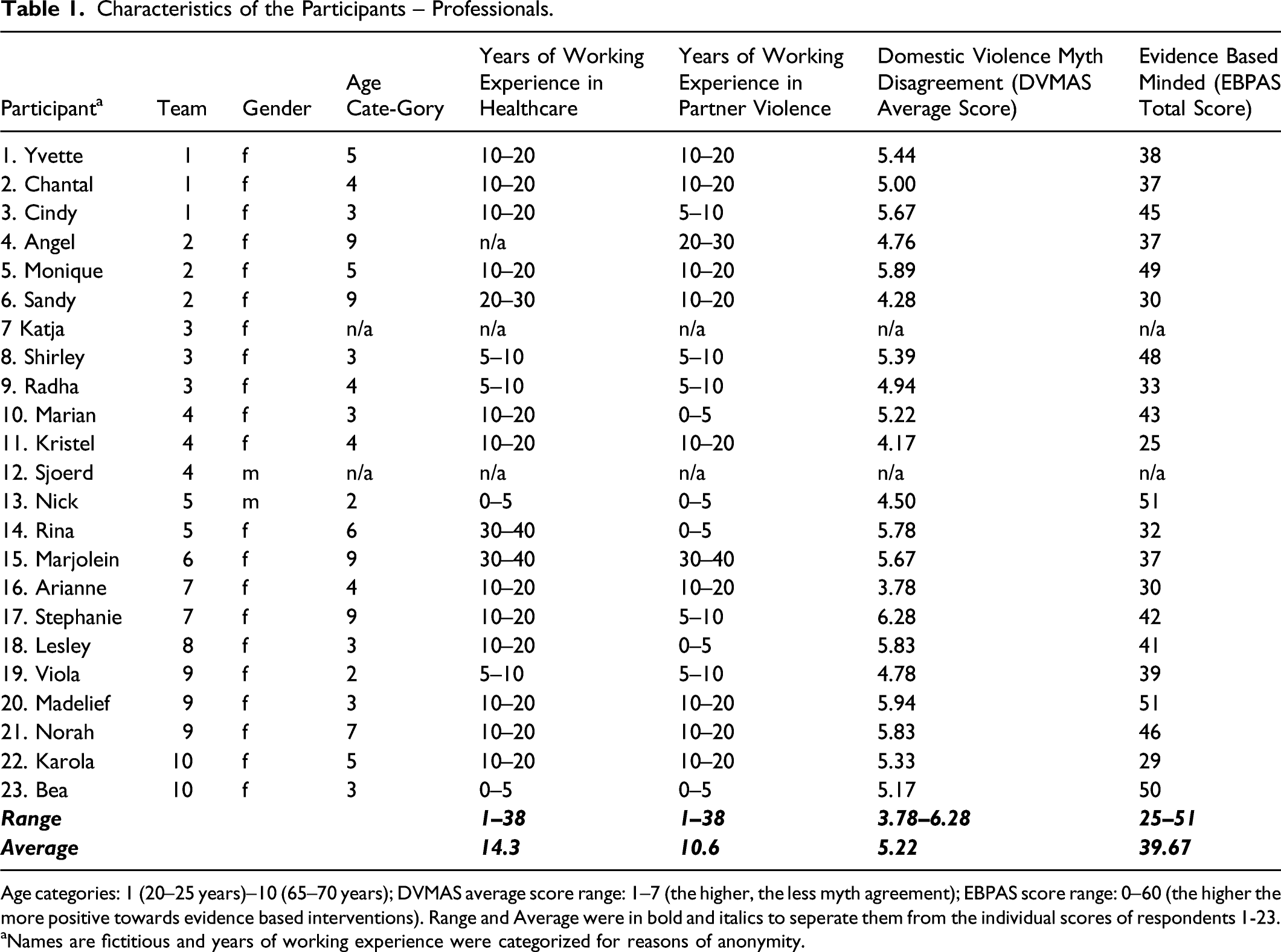
Age categories: 1 (20–25 years)–10 (65–70 years); DVMAS average score range: 1–7 (the higher, the less myth agreement); EBPAS score range: 0–60 (the higher the more positive towards evidence based interventions). Range and Average were in bold and italics to seperate them from the individual scores of respondents 1-23.
aNames are fictitious and years of working experience were categorized for reasons of anonymity.
Comparison with the Needs Framework
Need Factors Currently Assessed in Daily Practice, compared to the DIARI.

Dark grey = often assessed (assessed by >80%), medium grey = partly missed (assessed by 51–80%), light grey = often missed (assessed by 21–50%), white = structurally missed (assessed by 0–20%).
Characteristics of the Relationship
Interviewees explained what they assessed about the relationship. This included when clients met each other, what they originally liked about each other, and whether they wanted to stay together. Some asked clients how they saw their future together. Only a small percentage went further in addressing emotional or sexual involvement or the satisfaction experienced in the relationship. The questions mostly remained on the surface and the participants moved quickly toward practical decisions and actions. Rina explained she wants to know the steps both partners were willing to take: “How do they want to go further from here, together? Because, letting go immediately is quite difficult. How do you proceed from here? Do they want support? What needs to be done?”
A majority of the participants asked about the investment clients were willing to make to improve the relation, including time investment and working with the professional, using available interventions including psychoeducation, time-out methods, and interventions to stay or get back together without violence. Monique explained how she made such decisions: “Nowadays, shelter is only indicated if the risk screening shows staying at home is highly dangerous, in that it becomes irresponsible. Women do often want to leave then. To say: I do not trust it anymore. Nevertheless, sometimes there are situations: I am not happy about how things are at home, but I do not want to leave, I want to solve things with my husband. In that case, you can start a trajectory ‘Staying together without violence’.”
Social Context
All interviewees explained how they assessed the clients’ social context. The formal support network was mainly analyzed in this domain, followed by the informal support network of family and friends. Whether the informal network was familiar with the violence was assessed. Who might be available to talk or offer practical support when needed was considered. In the formal network, it was assessed if healthcare professionals and police officers were already involved in, or informed about, the partner violence and what information was available about the client from this network. The interviewees also frequently explored whether a client was open for support from the interviewee and other healthcare providers. Arianne described how she created a relationship with new clients: “Well, I would contact the woman; see if she would be open for support. I would share my worries and try to get her with me, in some way.”
Many interviewees said they would use the threat of child protection to push the client to accept their services and work on the home situation. Stephanie outlined how she stimulates behavioral change in the male perpetrator: “It is also the woman, right? She can also ask: what do you think? If your boyfriend does not change or your husband, you should stimulate him in the right direction. You can demand specific things to change first, before going further. Or via child protection, you can use that as pressure.”
Approximately about half of the interviewees assessed the role of the social, cultural, and religious norms of the client and her direct social environment. This assessment would include questions on what was accepted behavior in relationships according to the client, and the cultural pressure or influence of neighbors, parents, and sisters and brothers (in-law), grandparents and other family members determining the client’s decision-making.
Within the sub theme resources, the financial problems or lack of work or income were often assessed.
Nature and Pattern of Abuse
Whether there was severe or escalating abuse was frequently assessed. Interviewees explained that this is the first thing they check. They also wanted to know whether there was “actual partner violence,” although most did not explicitly define this. If the interviewees did not consider that there was a violent relationship, they would often refer the clients for couple’s therapy. The interviewees were particularly concerned to assess whether there was serious physical violence. They often performed a risk assessment to define the severity of the situation by checking a partner’s criminal status, previous police contacts, and possession of weapons. Stephanie explained how she determines the severity of the situation: “Well, do they get physical? You need to assess that… Or is it more verbal? … You need to ask several questions: Do you physically hurt each other or what happens exactly? Does it end with shouting and big mouths and threats? How does it look? You need to discuss that and learn what everyone’s perception is.”
Many interviewees explore the causes for fights and escalation, ask about triggers for the abuse, and discuss behavior and problems in other life areas. Marjolein explains how and why she explores these issues: “First, I check what triggers the quarrels. Then you can map the concerns. For instance, there are couples that have fights about money every day. In our safety plan, there is also an item included to help to detect all the triggers or whether it is pure…. So, you ask clients about that: if you argue, what is it about? How long is this been going on? What is your role?”
Approximately half of the interviewees paid attention to whether the woman experienced fear of the abuser. Half of the interviewees distinguished between physical and systematic and diverse abuse, including the general pattern of coercive control by the man over the woman in a broad number of life areas, including income and social life.
Finally, half of the interviewees paid attention to the frequency of the abuse, which was scored as chronic and frequent abuse, to separate onetime events from ongoing, daily violence. Intermittent abuse was assessed by a minority of the interviewees. Intermittent abuse includes the situation where periods of violence are followed by periods of harmony.
Characteristics of the (Female) Client
Interviewees regularly assessed the characteristics of the clients, including the mental health of the female client, and when needed, many made a referral to a psychologist. In this assessment, interviewees checked the file on diagnoses or asked the client about her psychiatric history. Some asked about stress factors that might explain the (bidirectional) violence. Nick explained which life areas he scans: “You ask about relations, psychiatric background, physical impairments, housing problems, family circumstances.” Monique explored the psychological problems of a female victim to understand why the violence occurs: “Whether there is a personality disorder that contributes to the development or consistency of the violence. That kind of information. So, you try to get some insight into the dynamics of the violence, actually.” The presence of diagnosed mental health problems was a key assessment for many interviewees.
Cognitive distortions and minimizations and traumatic history were assessed by a small proportion of the interviewees. Self-esteem and substance misuse were assessed by approximately one-third of the interviewees.
Coping was more frequently assessed. Around two-thirds of the participants undertook this type of assessment. They reviewed assertiveness, including self-respect and speaking up for yourself. It also considered the actions that the women took in dealing with their partner’s behavior, including sharing it with friends and family or seeking informal and formal help. These aspects were all are relevant need factors. Lesley explained how she assesses coping: “How is his behavior? How is hers? What did she already try to change it? … And, uh, yes, also, just, actually, what it does to her. Actually, not to push her to cry or something, but just to see: is she very resigned about it, very active, how does she react to it?” Stephanie mainly focused on independence and assertiveness: “It depends, what she needs. Is she a very independent woman, uh, can she plead for herself or does she let others tell her what to do or let others overrule her. If she let others overrule her and she is not so assertive that I could send her to a particular group. What does she need to become stronger or to say ‘no’?”
Characteristics of the Male Partner
Substance misuse was assessed by approximately half of the interviewees. Interviewees asked about the men’s addiction problems and the role of substance use as a trigger for the male violence or as a cause for arguments. Chantal explains why: “For instance, addiction, when there is constant argument about the number of beers the man consumes.”
Discussion
In the interviews, the participants shared their current routines in needs assessments and service planning, using vignettes with realistic case descriptions. Results were analyzed using the battered women’s needs framework and the accompanying assessment instrument, the DIARI, and its manual (Nicholls et al., 2017). The findings show that the current assessment and service provision focuses on the five main needs domains, which are characteristics of the relationship, social context, nature and pattern of abuse, characteristics of the (female) victim and—although to a lesser degree—characteristics of the male partner. However, these findings also highlight several important considerations for the advancement of knowledge on female victims’ needs-responsive care. The interviews in this study consider the topics that are shown to be related to decision-making and safety planning for battered females. They contemplate which of these topics are often disregarded in current assessments and healthcare planning. The findings are discussed by domain below, with the sub themes shown in italics.
Characteristics of the Relationship
When discussing the relationship with the client, many professionals asked about the relational history, the wish for continuation and current willingness to further invest in the relationship. Although all these questions are relevant, there is more information needed to fully understand the perspective of the female victim in this domain. Concerning the investment, further questions about shared finances and possessions, having children together, being married or living together, feelings for responsibility on making the relationship successful are needed to fully explore the women’s perceptions. The perceived level of investment in the relationship matters in decision-making. The greater the investment, the more difficult it is for women to leave a violent relationship (Nicholls et al.). Emotional and sexual involvement and satisfaction with the relationship received little attention in the assessments. These factors are, however, strongly related to the help-seeking behavior of battered females and are, therefore, important to assess. Women who feel love, hope, and a strong connection to their partner tend to stay or return to a violent relationship (Fanslow & Robinson, 2010; Griffing et al., 2002; Worth & Tiggemann, 1996; Zoellner et al., 2000). This mechanism is described in the traumatic bonding theory (Dutton & Painter, 1993), and the Stockholm syndrome (Dee et al., 1994). Before moving toward the stay or leave question, it is advisable to take more time to explore the needs factors that lay beneath that final decision.
Social Context
In the social context domain, formal support was assessed most often, followed by informal support. Interviewed professionals often explored which persons and institutions were available for support, who was informed, and who were or could be involved. In addition, the willingness of clients to accept support was often assessed. These are relevant themes to assess, as it has been established that battered women rarely seek help and if they do, this is only after a very long period of violence (Brewster, 2001; Freedy et al., 1994). These women often postpone help-seeking or remain discouraged from doing so. Women often explain they have had negative experiences with healthcare providers, police officers, and the legal system. They often feel that they have been treated rudely, judgmentally, or with hostility (Gauwiler, 2008). They state they were blamed or could not gain access to services (Meyer, 2015). Stigmatizing reactions worsen the mental health outcomes for female victims of partner violence (Overstreet et al., 2019). Others are afraid of the consequences, including losing parental rights over their children (Butts-Stahly, 1999) or feeling self-blame, shame and humiliation (Freedy et al., 1994).
Social, cultural and religious norms were explored less often. This factor relates to external influences of family, friends, and background, which affect the strategic decision-making process of the battered women. Women can hide the violence to prevent single motherhood, to pretend they are having a successful relationship, or to protect their own or family image (Raj & Silverman, 2002; Sayem et al., 2015). Women can have family or friends who push them to stay in the relationship (Gangoli et al., 2005; Gill, 2004; Sayem et al., 2015). After social pressure, ethnic background can influence perspectives and views on relationships and decision-making in partner violent situations. Women from ethnic cultures in which families have a traditional patriarchal orientation where divorce is not supported, prefer to seek help in formal rather than informal networks. Where there are extended families (in which several generations live together) women tend not to seek support at all (Sayem et al., 2015). Because of their cultural background, women can feel responsibility to foster the family ties (Gangoli et al., 2005; Gill, 2004). These areas are, therefore, relevant to explore further, in order to adapt the service provision plan to these factors.
Access to resources and the role of dependents, including children and pets, were seldom explored as factors in the decision-making process of the women. The interviewees often assessed financial problems, but as a trigger for the violence and not as a needs factor in women’s decision-making. Access to finance and housing are significant. This is a relevant factor, if the partner can control a woman’s income, if they are not allowed to work, or to put the house or renting contract in their name, or are not allowed to carry a house key. In addition, women can feel unable to access resources. The latter aspect was found to be related to more severe violence (Bornstein, 2006). Working status and financial dependence are known factors hampering the decision of women to leave a violent relationship (e.g., Black et al., 2001; Cole, 2001). Dependents are also known to influence women’s decision-making. This includes having children with the violent partner and the fear that leaving him might have consequences for the parental rights, and the relationship (related to contact arrangements) with the children (Butts-Stahly, 1999). The number of children, their (special) needs, and age are of influence due to the financial or practical consequences of leaving (Hendy et al., 2003; Triantafyllou et al., 2019). Children or pets can also be an encouragement to leave the partner, as his violent behavior also affects them (Hendy et al., 2003).
Nature and Pattern of Abuse
The severity of the abuse was most frequently assessed, mainly to determine whether health services were needed. Interviewees often mentioned that they wanted to determine whether there was real abuse, but were using unclear criteria for this determination. In this domain, interviewees most often assessed the risk of serious physical injury and used risk assessments to calculate the risk of physical violence toward the female.
Whether there was a situation of systematic and diverse abuse, was considered on a less frequent basis. This assessment includes overall dominance and control by the partner over the woman’s life, including her daily activities, social life, resources and behavior. Exploring all the areas of abuse is of relevance, as different forms of abuse can occur independently of each other (Marshall et al., 2000; Mouradian, 2001), can have different consequences for a woman’s mental health (Mechanic et al., 2008), and they can also trigger each other (Thompson & Kingree, 2006). Frequent physical violence more often leads to a woman leaving the relationship than frequent psychological violence (Anderson et al., 2014).
Causes for the fights were often assessed, including financial, mental health, addiction, and parenting problems. The reason for this assessment is that teams have relational counseling methods available. However, it is not a needs factor related to strategic decision-making. It can, therefore, have negative side effects if discussed in the wrong context. It can force women to make early decisions, and strengthen minimization, cognitive distortion, and identification with the partner (Gauwiler, 2008; Moe, 2007; Nicholls et al., 2017). Ideally, this issue should only be explored at a later stage.
Fear of the abuser was assessed by only half of the interviewees, meaning that half of the professionals did not address this topic in their client contacts. This fear factor is strongly related to the severity of the abuse (Leone et al., 2014), but can also exist when there is no physical violence. For instance, fear can also exist when the partner threatens violence or emotional abuse, intimidates or displays unusual behavior (such as risky driving, insinuations or veiled threats). It is recognized that IPV victims make deliberate decisions to remain in an abusive relationship because they believe and have been threatened, that the consequences of leaving may result in their own death or the death of their children (Cuomo, 2013).
The frequency of abuse was assessed by half of the interviewees and was mainly measured in the light of duration and repetition, focusing on whether the abuse was chronic and frequent. Interviewees seldom checked on intermittent abuse. Frequency is of relevance. The more frequent the physical violence, the larger the chance that a woman uses safety planning and informal strategies (Anderson et al., 2014). The more frequent the violence is, the more severe the mental consequences, including depression, post-traumatic stress disorder (PTSD), anxiety, self-harm, and sleep disorders (Dillon et al., 2013). Intermittent violence strengthens the emotional connection between victim and perpetrator due to traumatic bonding. In traumatic bonding, there is a cycle of tension building and explosive violence, followed by remorse and love, and a strengthening of the victim’s loyalty (Dee et al., 1994; Dutton & Painter, 1993). In comparison with women who experience a general pattern of power and control, women who experience situational violence are half as likely to search for help (Leone et al., 2014).
Characteristics of the (Female) Client
The professionals often checked on the existence of mental diagnoses and assessed the coping strategies of the female victims they supported. Mental health issues were often seen as a possible cause rather than a possible consequence of the violence. The results indicate that professionals seldom went further in assessing the mental wellbeing of the females. Partner violence often enhances the likelihood of developing mental health symptoms and disorders, including depression, anxiety, PTSD, suicidal tendencies, which all relate to the women’s decision-making processes (Sinko et al., 2019).
Trauma history was only assessed by one-third of the interviewees. Trauma history can lead to PTSD symptoms (Dutton, 2009), which have a negative influence on effective coping strategies and increase the likelihood of a repetition of victimization (Krause et al., 2008; Sinko et al., 2019).
Cognitive distortions and minimizations, low self-esteem, and substance use were assessed infrequently. These are known characteristics that can be the consequence of IPV and can seriously distort effective coping and help-seeking behavior by the female victim. Recent studies have suggested that victims very often blame themselves or project the violence onto external circumstances instead of blaming the perpetrating partner (Lim et al., 2015; Nicholls et al., 2017; Overstreet & Quinn, 2013). A 5-year follow-up study has demonstrated that self-esteem decreases in women with a violent partner and this was shown to have a causal relationship with poor coping strategies (Lerner & Kennedy, 2000; Zlotnick et al., 2006). Various studies have shown that substance use among battered women is a disengaging coping strategy (Kaysen et al., 2007; Rees et al., 2011; Ritter et al., 2014).
Traditional sex role beliefs were not assessed by any of the respondents. These beliefs influence views on responsibility for the man’s happiness and the subordinate role of the woman. They determine the cognitive beliefs and help-seeking behavior of the woman (Littrell & Bertsch, 2013).
On the contrary, coping is often assessed. Two-thirds of the interviewees took women’s assertiveness into account, along with their informal help-seeking behavior with friends and family. Additional consideration of disengaging strategies, such as denial, downplay, wishful thinking, self-criticism, and social withdrawal is recommended in the assessment of coping (Nicholls et al., 2017). Coping can be an effective starting point for exploring the abovementioned themes: mental health consequences, cognitive distortions, self-esteem and substance use issues. Previous research has indicated that symptoms demonstrated by a substantial portion of battered women are consistent with those of PTSD (Jones et al., 2001). Professionals who lack this knowledge may misinterpret symptoms as pre-existent psychopathology, which is a focus that is not only ineffective but can also make matters worse.
Characteristics of the Partner
Except for substance misuse, which was assessed by approximately half of the interviewees, the characteristics of the male partner were only slightly assessed. Substance use was mainly seen as a cause of violence, but can also be a reason for women to stay in the relationship when they feel responsible for their partner’s wellbeing or believe everything will change once the substance use is over (Cravens et al., 2015). Dependency, charming and manipulative, promises to change/claims of remorse and justification of the violence were not or hardly assessed by any of the respondents. Dependency binds a woman to her partner if she sees him as incapable or in need of support (Rhodes & McKenzie, 1998). A background of adverse childhood experiences can cause men to develop a personality of dependency, leading to a rejection-abuse cycle (Carrotta et al., 2015). The other characteristics of the partner, for example, being manipulative, can enhance women’s bonding or identification with the perpetrator and her cognitive distortion, and undermine strategic decision-making. It can also influence the image other people have of the partner, hampering social support. Reaching a “cognitive shift” is acknowledged as a gradual and complicated process needing intensive emotional work, and might only happen after leaving the relationship (Enander, 2011).
Strengths and Limitations
In our knowledge, this is the first study to explore the actual reasoning and perceptions on needs assessment of professionals working with victims of IPV. The results enhance our knowledge on what well known need factors are and what are not taken into consideration during needs assessments. The strengths of this study further include the sampling strategy, which was guided by two validated measures and proven to result in maximum variation. This enhanced the probability of saturation and theoretical generalizability (Glaser & Strauss, 1967). A limitation is, as is in every qualitative design, that no conclusions on causal relations between professional characteristics and assessment practice can be drawn upon the data. Neither are the results generalizable to all professionals working with victims of IPV. The findings do give us notion on what need factors are at risk to be forgotten in current need assessments.
Conclusion
In health services planning for battered women, service providers ask about the right domains, including: the characteristics of the relationship, social context, nature and pattern of abuse, characteristics of the female client, and—although to in a lesser degree—characteristics of the partner. Unfortunately, the sub themes within these domains are only partially considered, and sometimes superficially considered. Some topics that were not determined in the literature as relevant needs factors were seen as important by social workers, or assessed too soon, including the stay or leave question. These findings underline the realistic risk that staff members miss the actual reasons women stay with their partners or make certain choices in their help-seeking behavior. Incorrect needs assessments enhance the risk of female victims feeling unheard, and ineffective service provision, leading to care avoidance and low compliance with the services provided. In order to decrease the current high re-victimization rates, it is important to improve the daily practice in understanding the decision-making of female victims of IPV and improve the needs assessments. Teams are encouraged to take notice of the increasing research literature, including reviews and prospective studies that indicate the needs factors of relevance in the disengaging and engaging behavior of female partner victims. Translating this knowledge into everyday working is highly recommended. Use of evidence-based needs assessment tools and collaboration with experts-by-experience can be helpful in this area.
Footnotes
Acknowledgments
We would like to thank the research assistants Bianca Ligten and Jackeline Voskuil for the interviews they held. We also would like to thank the organizations and all participants who were willing to cooperate in this study.
Declaration of Conflicting Interests
The author(s) declared no potential conflicts of interest with respect to the research, authorship, and/or publication of this article.
Funding
The author(s) disclosed receipt of the following financial support for the research, authorship, and/or publication of this article: This work was supported by the Nederlandse Organisatie voor Wetenschappelijk Onderzoek grant number 432-13-805.

Author Biographies
Dr. Diana Roeg is head of research at Kwintes, organization for supported housing, and senior researcher at the Academic Center Mental Health in the department Tranzo, Tilburg University in the Netherlands. Before, she worked as senior researcher at Mental healthcare institute GGzE, at the research program Forensic Mental Health. Roeg is editor of the Dutch professional journal Participation and recovery, and also of the Dutch handbook for assertive outreach. She is member of the committee from the branch organization Valente for a national research agenda for supported housing and shelters, and chair of the work group Quality standard care avoidance for nurses from the Trimbos-institute and the Ministry of Health.
Dr. Ed Hilterman is sociologist and works as currently scientific adviser at the Expertise centre of Forensic Psychiatry in the Netherlands. From 2015 until 2018, he worked as senior scientific researcher at the GGzE Center for Child and Adolescent Psychiatry in The Netherlands. He is also director of a consultancy company specialized in applied research in the justice system in Barcelona, Spain. His research focuses on risk assessment and risk management. He is co-author of the SAPROF-Youth Version and also of the DIARI (Decision-making in Abusive Relationship Interview), a structured need assessment tool for victims of Intimate Partner Violence.
Prof. Dr. Chijs van Nieuwenhuizen is professor in Forensic Mental Health Care (Tilburg University), professor in Transforming Care for Youth ((Tilburg University) and visiting professor University College Ghent, Faculty of Education, Health and Social Work. At GGzE, she is clinical director of the Centre for Child and Adolescent Psychiatry, program leader of the Research group Forensic Mental Health Care and psychotherapist at De Catamaran, hospital for youth forensic psychiatry and orthopsychiatry. Van Nieuwenhuizen is, among other things, president of EFCAP (European Association for Forensic Child and Adolescent Psychiatry, Psychology and other involved Professions), chair of the Review commission nationwide juvenile justice instrument, member of the ZonMw committee “Research programme Mental Health Care” and member of the NWO committee “Reintegration in society of adolescents and adults with autism and psychosis.”