



Abstract
Rape myths are widespread and contribute to a rape culture that excuses and normalizes permissive attitudes surrounding rape and sexual assault. To combat rape culture and decrease sexual assault, many programs focus on reducing rape myth acceptance (RMA). To best assess outcomes of such prevention efforts, we must ensure we are accurately measuring this construct. Current RMA scales are decades old and focus almost exclusively on cisgender women. As such, they are outdated and leave out important experiences of cisgender men and gender diverse individuals. The Gender Inclusive Rape Myth Acceptance Scale (GIRMA) was developed to address such limitations in current measures. Two studies were completed to develop and establish preliminary validation of the GIRMA. Study One included 614 adults in the United States, recruited through Amazon's Mechanical Turk; Study Two included 414 adults in the United States, recruited in the same way. An exploratory factor analysis was conducted with an original pool of 73 items that included myths about the experiences of cisgender women, cisgender men, transgender, and gender diverse individuals. Parallel analysis indicated a single factor structure for measuring rape myths. A confirmatory factor analysis was conducted for Study Two, which supported the single-factor approach. These analyses resulted in a concise, robust, inclusive 18-item scale to measure rape myths. Model fit was excellent, as was reliability. Additionally, construct validity was supported through examining the relationship between the GIRMA and previously validated RMA and sexism scales. The GIRMA offers researchers the ability to fully assess the construct of rape myths in a short, psychometrically sound manner. Future research is needed to investigate the reliability of the GIRMA in other populations.
Rape, or any penetration of one’s vagina or anus by any body part or object, penetration of one’s mouth by any sex organ, or forced or coerced penetration of another person without the consent of the victim, is a social issue with far-reaching consequences. Rape can have tremendous negative impacts on survivors, including emotional, physical, and mental tolls (Resick, 1993). Depression, anxiety, and posttraumatic stress disorder (PTSD) are common occurrences following rape (Resick, 1993). Rape persists due to actions of individuals, but the existence of rape culture creates a climate where rape is excused and justified (Buchwald et al., 1993).
While often discussed theoretically, rape culture, or a culture that accepts rape myths (RM), normalizes sexual aggression, and excuses acts of sexual violence, has real-world impacts on individuals. Baum et al. (2018) studied the relationship between rape culture and rates of rape and found regions with higher levels of rape culture in media had higher levels of actual reported rape. Furthermore, these high rape culture areas also saw less persistence by police to catch rapists (Baum et al., 2018). This shocking result exemplifies why it is important to address rape culture at its core. One way to do this is through education that challenges and debunks RM. Before this can be done, however, we must be able to accurately measure RM in all the forms they take.
Rape Myths
Through a feminist lens, RM “can be understood to be cultural beliefs about rape that function to preserve society’s heteropatriarchal structure by prioritizing hypermasculinity and protecting traditional gender roles through placing blame on those who violate these norms” (Urban, 2021, p. 8). Rape myths create the basis for rape culture which excuses acts of sexual violence and places blame on victims rather than perpetrators. Traditional definitions and research regarding RM have been limited to RM about cisgender women. More recent developments in the field have included cisgender men as potential victims, but research in this area is still sparse and needs further development (Davies, 2002; Davies et al., 2008; Javaid, 2015; Sleath & Bull, 2010). Even more lacking than the literature regarding RM about cisgender men is literature regarding RM about transgender and gender diverse (TGD) individuals. This area is particularly understudied and little research into such RM exists.
Measurement of Rape Myths
Formal measurements of attitudes towards rape began with Field’s (1978) development of the Attitudes Towards Rape Scale. Rape myth–specific measurements emerged in 1980 with Burt’s Rape Myth Acceptance Scale (RMAS). Since the development of the RMAS (Burt, 1980), researchers have been attempting to develop a psychometrically and theoretically sound measure for measuring RM.
Illinois Rape Myth Acceptance Scale (Payne et al., 1999)
By far, the most in-depth study to develop an RMA scale was done by Payne et al. (1999) in the development of the IRMA. Payne et al. (1999) started with 120 items based on a literature review and expert consultation. The participants in Payne et al. (1999) studies were 780 undergraduate students in psychology or educational psychology. Items were scored on a 7-point Likert scale. The authors found RMA to be a cohesive construct that contains several distinct components. The authors narrowed down the item pool, resulting in the final 45-item IRMA that contained 40 RM across five components with five filler statements (Payne et al., 1999).
Overall, Payne et al.’s (1999) scale is psychometrically and theoretically sound. It remains the most highly used scale today, but issues with it persist. First, the scale was created only using college students, which limits generalizability. Second, the scale is now outdated, as it is over 20 years old, and current ideas about rape and rape myths have evolved. As Payne et al. (1999) argued, RMA is greatly dependent on the context of the culture in which it exists. Because some colloquial phrases were used during the creation of the scale, the language is now outdated and creates issues with validity. For example, in their development of an updated measure, McMahon and Farmer (2011) found entire subscales that were no longer endorsed by participants in their study. The items related to “she didn’t want it,” “rape is a trivial event,” and “rape is a deviant event” were removed due to cultural changes that suggest these beliefs are no longer largely held.
An Updated Measure for Assessing Subtle Rape Myths (McMahon & Farmer, 2011)
In 2011, McMahon and Farmer attempted to ameliorate the issue with RM being culture-bound by updating the IRMA. The authors argued the IRMA (Payne et al., 1999) was outdated due to it being developed decades before (McMahon & Farmer, 2011). As rape culture and sexism have been challenged more openly, RM have become more subtle and covert; current measures, however, do not reflect this change (McMahon & Farmer, 2011). To create this updated measure, the authors worked from the items in the IRMA (Payne et al., 1999), first meeting with focus groups to discuss victim blaming statements they commonly heard and to discuss reactions to the IRMA.
Following interviews with undergraduate and graduate students and a small panel of experts, McMahon and Farmer (2011) narrowed down the scale to 22 items. For validation of the scale, 951 first-year students completed the measure. Exploratory structural equation modeling was used to verify construct validity. Because three items did not significantly load into any factors, they were dropped, bringing the final scale to 19 items. The authors note that while some of the changes in wording were minor, they were needed to accurately depict current attitudes towards rape myths. This study effectively updated the IRMA (Payne et al., 1999); similar limitations, however, still exist. Most of the testing for the scale was completed with undergraduate students, which can be very different from the general population. Many changes chosen by McMahon and Farmer (2011) were made to make the scale more relatable to college students (i.e., changing “women” to “girls” in several items). Furthermore, recent attention to the #MeToo movement has increasingly created a more nuanced understanding of rape and sexual violence that dates this scale.
Male Rape Myths (Struckman-Johnson & Struckman-Johnson, 1992)
The first measure to explore RM related to the rape of men was the Male Rape Myths scale, developed by Struckman-Johnson and Struckman-Johnson (1992). This scale was first fielded to a group of 365 college students. The scale was somewhat modeled after Field’s (1978) scale and included 12 statements (Struckman-Johnson & Struckman-Johnson, 1992). These statements were scored on a 6-point Likert scale and included items both about men being raped by men and men being raped by women. Chapleau et al. (2008) explored the structure of this scale, finding a three-factor model as the best fit with myths separated into Denial, Blame, and Trauma subscales. The alpha coefficients for the three subscales ranged from .50 to .82 (Chapleau et al., 2008). The authors argued that while there is some preliminary psychometric data that makes sense for this scale, more development is needed.
Male Rape Myth Acceptance Scale (Melanson, 1999)
Melanson (1999) sought to create a psychometrically sound measure to study RM about men. In the development of the scale, the author surveyed 303 undergraduate students. Items were taken from previous scales (i.e., Struckman-Johnson & Struckman-Johnson, 1992), created, or adapted from RM about women. The initial pool of items included 80 statements scored on a 6-point Likert scale. Using item-total correlations, agreement rates, and item-criterion correlations, the author narrowed the final set of items to 22 (Melanson, 1999). The scale performed well psychometrically with a good internal consistency of .90 and a test–retest reliability of .89 at a 4-week follow-up. While psychometric properties of this scale were sound, some problems persist with the age of the scale and the fact items were derived from RM about women. Because RM about men and women are often based on sexual scripts and expectations of gender roles (Phillips, 2016), they are effectively different in terms of content. Items that simply change the gender of the victim may be insufficient to fully measure RM about men.
Rape Myth Acceptance Regarding Trans and Gender Diverse Individuals
While very little literature is available on attitudes towards rape of TGD individuals, even less exists regarding the measurement of RM for this population. In a review of the literature, no scales were found that measured this construct.
Current Study
It is clear the field of psychology is lacking necessary literature regarding RM about men and TGD individuals and an up-to-date measure for RM about women. Rape myths regarding cisgender men and women function similarly (Sleath & Bull, 2010), and may even be parts of a single construct (Davies et al., 2012). Rape myths stem from the same kind of oppression where, under the patriarchy, masculine heterosexism and hegemony are the top valued ideals (Javaid, 2015). Under rape culture, the experiences of survivors of rape are delegitimized by placing blame on the victim, especially when there has been a violation of traditional gender roles. This blame allows rape and sexual violence to be excused and the problem to persist through shifting responsibility from the perpetrator to the victim. As a tool of oppression, RM function to further build up the power and privilege enjoyed by White, heterosexual, cisgender, and traditionally masculine men. To better examine rape culture and the ways it impacts the lives of everyone living in it, a new scale is warranted that takes these factors into account.
Current scales are outdated, do not take into account the full scope of RM, were primarily developed using undergraduate students as participants, and need further psychometric validation. There are three main reasons a new, singular RMA scale is needed: 1. There is a need for greater gender inclusivity. 2. RMA is culture-bound and cultures have changed due to new ideas about gender roles and the #MeToo movement. 3. One psychometrically sound scale creates one resource to fully understand rape in its different forms.
Need for Gender Inclusivity
The most commonly used RMA scale, the IRMA (Payne et al., 1999), functions under the assumption that women are the only victims of rape. In doing so, rape of men and TGD individuals are functionally erased. While women do make up the majority of those who are raped, men also experience rape, and RM about men must be included in an inclusive scale. According to the 2015 National Intimate Partner and Sexual Violence Survey (NISVS), approximately 21.3% of women and 2.6% of men in the United States experience an attempted or completed rape during their lifetime (Centers for Disease Control and Prevention [CDC], 2015). Additionally, 7.1% of men reported being forced to penetrate someone else during their lifetime, something that is still not recognized as a form of rape in traditional definitions.
These reported rates are likely lower than actual rates of rape experienced by men (Davies, 2002; Javaid, 2015). Due to rape culture and self-blame, many men may be hesitant to disclose their victimization (Javaid, 2015). In a study that assessed for sexual victimization in college men, a startling 39% endorsed some kind of sexual victimization by a partner (Prospero & Fawson, 2009). This study looked at both penetration of the victim and forced penetration by the victim, either by force or verbal coercion. While limited to college men, this study shows a very different reality from the 2.6% reported in the NISVS (CDC, 2015). Transgender and nonbinary individuals report the highest rates of rape with a staggering 47% of participants in one study reporting being raped at some point in their life (James et al., 2016).
Continuing to exclude men and gender diverse individuals from research about rape denies the reality of many people and delegitimizes their experiences. To ameliorate this problem, RM about cisgender men, as well as TGD individuals, must be included in new scales to measure this construct. Inclusion of these kinds of RM in a new scale increases construct validity, as an RMA scale must also take these experiences into account to truly measure RM.
Rape Myth Acceptance and Recent Cultural Changes
Another issue with our current measures of RMA is the fact RMA is culture-bound (McMahon & Farmer, 2011; Payne et al., 1999). The IRMA (Payne et al., 1999), while revolutionary for its time, is now outdated (McMahon & Farmer, 2011). The language used in this measure no longer matches the language used in popular culture and does not match the way sex and rape are now discussed (McMahon & Farmer, 2011). While McMahon and Farmer (2011) worked to update the measure in 2011 to address more subtle RM, rape culture has had a dramatic shift since the development of this updated measure. Non-academic discussions of rape culture did not truly enter colloquial use until approximately 2013 (Phillips, 2016), after McMahon and Farmer’s (2011) development of the updated measure.
#MeToo and Recent Cultural Shifts
The #MeToo movement changed the rhetoric surrounding discussions of rape and RM and has changed the way rape culture is played out in society. This movement had monumental impact on the way sexual violence is discussed by making it big news for the first time (Jaffe, 2018). The way the movement caught fire on social media and spread across the world revealed the prevalence and magnitude of the problem of rape in ways that had not before been done (Lee, 2018). While it may be easy to write off the movement as a momentary attention to sexual violence, there have been real impacts of the #MeToo movement. With the visibility of the movement came a societal shift to better understand the dynamics of sex and power (Gill & Orgad, 2018). Through social media actions, rape culture was directly called out and questioned (Mendes et al., 2018). In doing so, this shift brought with it changes on many fronts including organizational, legal, policy, and cultural levels (Gill & Orgad, 2018).
The understanding of rape at a cultural level can be assessed through an examination of popular media depictions. While popular media continues to be a space for rape myths to be perpetuated, recent shifts have resulted in the focus of rape moving from stranger rape to more accurate and common scenarios, such as acquaintance rape, the impacts of rape on survivors, and the ways rape culture is present in today’s society (Phillips, 2016). The nuances and subtleties of rape are also more commonly accepted in the post-#MeToo world. There is now a more complex understanding of rape that has been expanded to include levels of coercion and other means besides physical force (Phillips, 2016).
It is clear the world today, especially society’s attention to rape and rape culture, is different than it was prior to the #MeToo movement. Because there have been these cultural shifts, culturally dependent measures are now outdated. As McMahon and Farmer (2011) argued in their paper, RM tend to become more subtle as rape-promoting attitudes become less socially acceptable. While victim blaming is still present in the post-#MeToo world (Lee, 2018), the forms it takes are now more subtle and need to be further explored. These cultural shifts also strengthen the call for a new RMA measure that is responsive to current rape myths.
Psychometric Reasons for a Single Scale
There are also psychometric foundations for having one unified RMA scale. When studying RM about men and women, Chapleau et al. (2008) found no significant difference between levels endorsement for RM about men and RM about women. These results have also been replicated by others. Sleath and Bull (2010) discussed the many similarities between men’s RM and women’s RM, which further supports the need for a single measure. Finally, Davies et al. (2012) found multicollinearity problems when using both the MRMS and the IRMA. The authors argue these high rates of multicollinearity suggest these measures are part of the same construct. If there is so much overlap between RM about men and women, a single scale for measuring RM is only logical.
The research in any given field can only be as strong as the scales used. Because RM and rape culture are so important and far reaching, it is vital to have adequate, up-to-date measures for RM. Due to these new developments, it is clear a new scale is needed to continue to produce quality research.
Study 1: Instrument Development Method
Participants
Participants were 614 adults over the age of 18 recruited from Amazon’s Mechanical Turk (Mturk). Of these participants, demographic information was only collected for 356 of them. For participants who provided demographic information, 30.1% (n = 107) identified as women and 69.9% (n = 249) identified as men. The average age of participants was 36.23 (SD = 11.20). Sixty-two percent (n = 221) of participants were heterosexual, 1.7% (n = 6) were lesbian, 0.3% (n = 1) were gay, and 35.7% (n = 127) were bisexual. Most participants indicated they were White (57.9%; n = 206), 24.2% (n = 87) identified as Black, 10.1% (n = 36) identified as Asian/Asian American/Pacific Islander, 2.1% (n =13) Hispanic/Latinx, 2% (n = 12) identified as Native American/Indigenous/Alaskan Native, and 0.2% (n = 1) identified as biracial. For education, 5.4% (n = 19) of participants had completed high school or equivalent, 7.4% (n = 26) completed some college, 4.3% (n = 15) completed a 2-year degree, 56.7% (n = 199) completed a 4-year degree, 25.9% (n = 91) completed a master’s degree or equivalent, and 0.3% (n = 1) had completed a doctoral degree.
Procedure
After the researchers gained approval from the University Institutional Review Board, the survey was distributed to potential participants via an online survey using PsychData. A goal of recruiting 730 participants was set to meet the recommendation of 10 participants per item for factor analysis (Field, 2013); a minimum of 450 participants was set to meet the goal of 6.5 participants per item as seen in development of similar scales (i.e., Payne et al., 1999). Participants were recruited using Mturk to avoid using a college student sample and increase generalizability. Participants first completed an informed consent document notifying them of risks and benefits of participating in this study. Participants then completed a demographic questionnaire, followed by the 73-statement pool of initial items.
Instrumentation
Along with a demographic questionnaire, the preliminary form of the Gender Inclusive Rape Myth Acceptance Scale (GIRMA) was used for this study.
The first scale we reviewed was Payne et al.’s (1999) IRMA. This scale is often used in studies of RM and remains the hallmark of RMA research. We also reviewed McMahon and Farmer’s (2011) updated form of the IRMA for subtle RM and considered the changes the authors made to Payne et al.’s (1999) scale. We then reviewed Struckman-Johnson and Struckman-Johnson’s (1992) Male Rape Myths scale to assess current items and consider new items to develop. In this process, we used Chapleau et al. (2008) review of the scale and recommendations for further development.
Due to a need to consider cultural changes that have occurred since the development of these scales, we created new items that are more culturally relevant. New items were created based on current research recommendations and expert consultation from professionals in the field.
In order to create new items, several steps were followed. First, extant literature was reviewed to examine what attitudes toward rape currently exist in popular society. For general rape myths, Phillips’s (2016) review of representations of rape culture in popular media was considered, as popular media can display the variety of attitudes present in society (Phillips, 2016). Many of the new items created were chosen due to the more nuanced understanding of sexual violence as a continuum from coercion to physical force instead of solely physical force (Phillips, 2016). For myths specific to cisgender men, Turchick and Edwards’s (2012) literature review of myths about the rape of men was consulted. In their literature review, Turchick and Edwards (2012) isolate myths about the rape of men in different medium throughout society and isolate many myths that were relevant to our new scale. Myths about the reactions of men to rape, what characterizes men who are raped, and how rape impacts men were discussed by the authors and included in the new items (Turchick & Edwards, 2012). Literature about the rape of TGD individuals was more difficult to identify, but studies about perceived severity of the rape of TGD individuals (i.e., Blackham, 2006; Davies & Hudson, 2011) provided insight for the development of new items.
Second, the researchers also drew from experience working with survivors in the field, which includes work with both cisgender and TGD survivors. Clinical experience working with survivors in individual therapeutic sessions, as well as working as prevention educators offered insight into current rape myths. Drawing from these experiences, new items were crafted to reflect the experiences of survivors and attitudes expressed by young adults who partake in prevention efforts.
In the process of writing the items, the reviewers considered wording used in previous scales (i.e., Payne et al., 1999; McMahon & Farmer, 2011). The format of these items provided a blueprint for the new scale items. Colloquial language was changed to reflect current use in items that were similar to those in previous scales. For items without previous parallels, the researchers crafted statements that were structured similarly to current items. Priority was given to myths identified in the review of the literature. Additionally, the authors attempted to include an equitable number of items for cisgender women, cisgender men, and TGD individuals. The authors reviewed the items for clarity before reaching to experts for additionally guidance. Finally, expert consultation was used to draw from the knowledge of those whose expertise further provides insight into rape myths through their own research and clinical experiences.
Expert Consultation. In the creation of new scale items, two expert consultations took place. For general expert consultation, we consulted with Dr Danica Harris who has worked with both survivors and perpetrators of interpersonal violence, such as rape, for several years. Expert consultation on items about TGD individuals came from Dr Theodore Burns, who specializes in TGD issues and is a member of the World Professional Association for Transgender Health. These experts were given the preliminary items for the scale and provided feedback on changes. Item-level analysis provided guidance in the revision of some items and creations of others. Through their clinical and research expertise, the consultants identified gaps in the proposed set of items and areas where wording may need to be changed. Through these consultations, some new items were created and the wording of others was changed.
After expert consultation for the content of the items, items were reviewed for clarity and understanding. While this was part of what the expert review provided, the researchers also worked with university sources of support for statistics and scale creation to ensure the items were worded clearly and offered potential to measure the construct.
Results
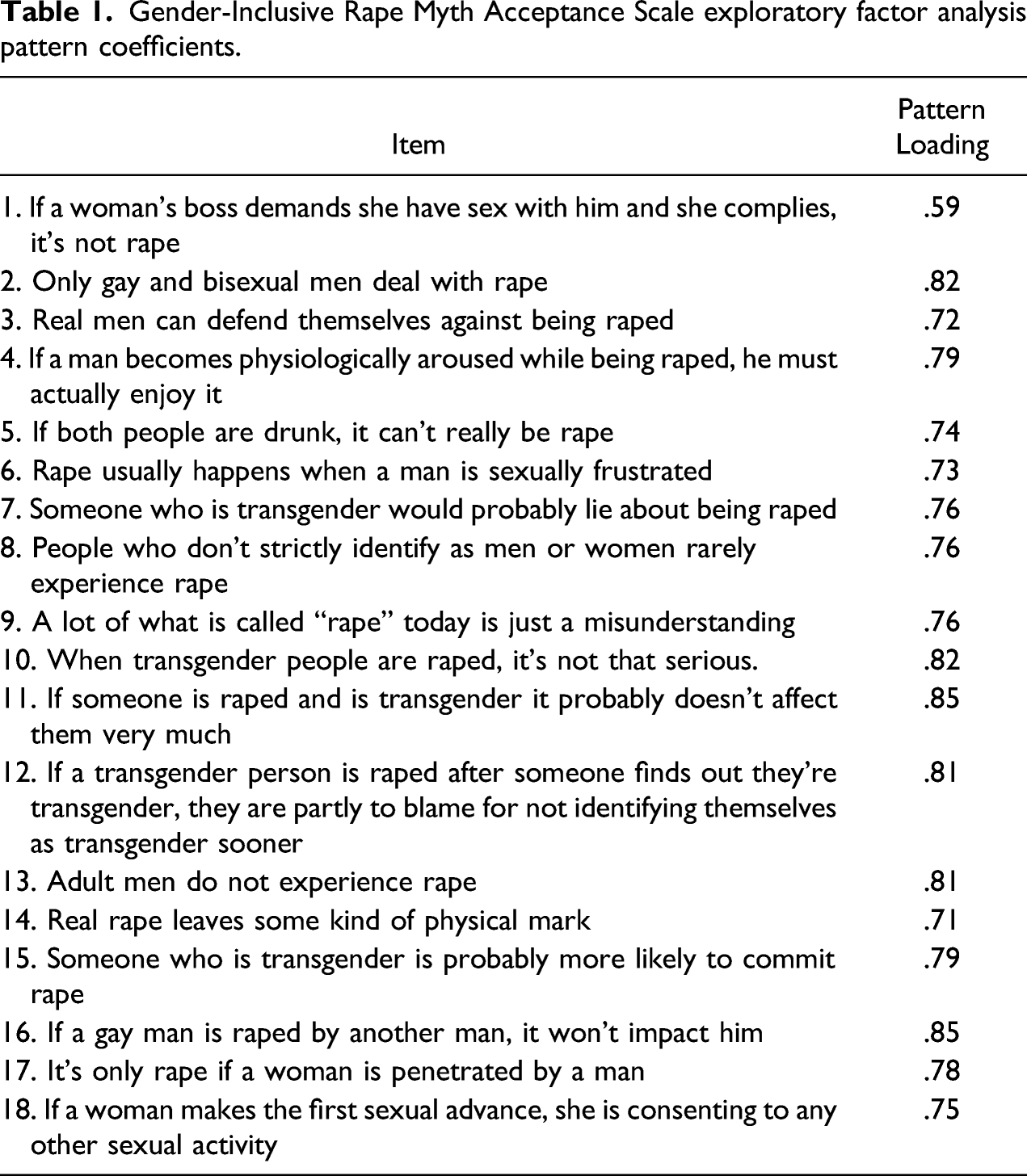
Gender-Inclusive Rape Myth Acceptance Scale exploratory factor analysis pattern coefficients.
Study 2
Participants
The sample comprised 414 adults over the age of 18 who were recruited from Mturk. Of these participants, 36.7% (n = 151) identified as women and 63.3% (n = 261) identified as men. The average age of participants was 34.81 (SD = 10.81). Seventy-five percent (n = 312) of participants were heterosexual, 2.4% (n = 10) were lesbian, 0.5% (n = 2) were gay, and 21% (n = 87) were bisexual, and 0.7% (n = 3) self-identified their sexual orientation. Most participants (n = 249) indicated they were White (60.3%), 5.8% (n = 24) identified as Black, 27.8% (n = 115) identified as Asian/Asian American/Pacific Islander, 4.4% (n = 18) identified as Hispanic/Latinx, 1% (n = 4) identified as Native America/Indigenous/Alaskan Native, 0.5% (n = 2) identified as multiracial, and 0.2% (n = 1) identified as biracial. For education, 0.5% (n = 2) indicated they had completed less than high school, 5.1% (n = 21) of participants had completed high school or equivalent, 7.6% (n = 31) completed some college, 5.1% (n = 21) completed a 2-year degree, 63.2% (n = 259) completed a 4-year degree, 16.6% (n = 68) completed a master’s degree or equivalent, and 2% (n = 8) had completed a doctoral degree.
Procedure
Similar to Study 1, Study 2 took place online through PsychData with participants recruited from Mturk. Participants first completed an informed consent form and demographic information. Following these measures, participants completed the GIRMA, IRMA (Payne et al., 1999), MRM (Struckman-Johnson & Struckman-Johnson, 1992), and the ASI (Glick & Fiske, 1996). As the GIRMA item pool was narrowed down after the first study, a goal of 300 participants was set for Study 2.
Instrumentation
Illinois Rape Myth Acceptance Scale Short Form (IRMA-SF; Payne et al., 1999).
The full IRMA is a 45-item questionnaire that measures levels of RMA for RM about women. The scale is scored on a 7-point Likert scale with higher scores indicating more RMA. Internal consistency of the scale is reported to be .93 (Payne et al., 1999). Internal consistency for subscales ranges from .74 to .84 (Payne et al., 1999). The short form version of the scale is a 20-item questionnaire. Parallel forms’ reliability was .97, p < .001, indicating the IRMA-SF is an excellent option for assessing rape myths while reducing test fatigue by shortening the survey. Internal consistency for the short form of the scale in this study was .96.
Male Rape Myths (MRM; Struckman-Johnson & Struckman-Johnson, 1992). This scale includes 12 statements that are scored on a 6-point Likert scale and include items both about men being raped by men and men being raped by women. Alpha coefficients for the three subscales (Denial, Blame, and Trauma) ranged from .50 to .82 (Chapleau et al., 2008). In this study, internal consistency was .42 for Denial, .94 for Blame, and .40 for Trauma.
Ambivalent Sexism Inventory (ASI; Glick & Fiske, 1996). The ASI measures levels of benevolent and hostile sexism. The scale consists of 22 statements scored on a 6-point Likert scale where higher scores indicate more sexism. Six studies were run in the development of the scale with internal consistency ranging from .83 to .92 (Glick & Fiske, 1996). Internal consistency with this sample was .92.
Results
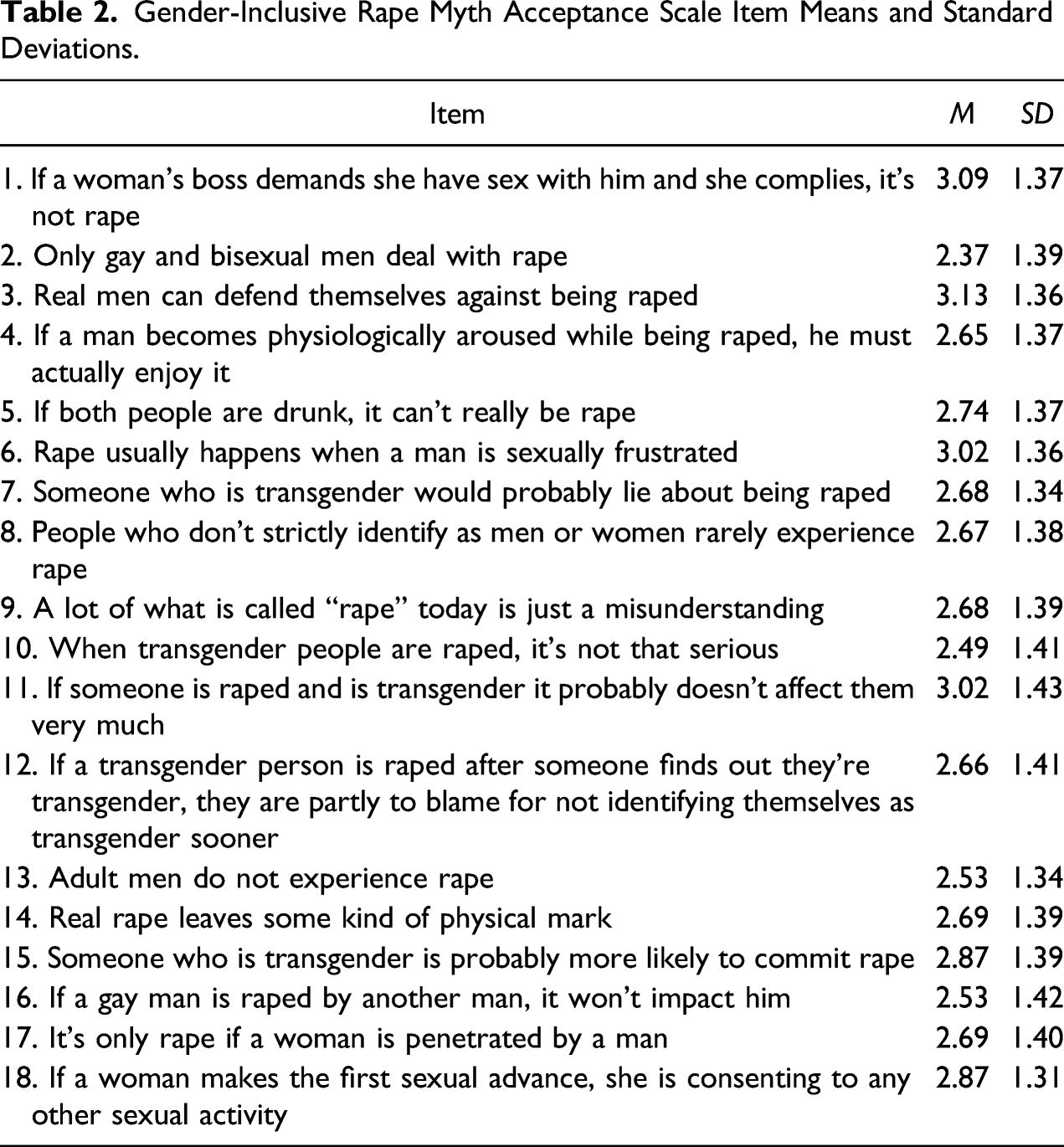
Gender-Inclusive Rape Myth Acceptance Scale Item Means and Standard Deviations.
Gender-Inclusive Rape Myth Acceptance Scale confirmatory factor analysis loadings.

Construct validity was determined by conducting correlation analysis to examine the bivariate relationship between the GIRMA, IRMA, the MRM, and the benevolent and hostile sexism scales on the ASI. All scales had strong positive correlations with the GIRMA. The IRMA was most strongly correlated with the GIRMA, r = .95, p < .001, followed by the MRM, r = .85, p < .001. Hostile sexism also had a strong positive correlation with the GRIMA, r = .69, p < .001, as did benevolent sexism, r = .59, p < .001. Regression analysis was run to determine if the ASI had predictive ability for the GIRMA. The model including both benevolent and hostile sexism accounted for 71.8% of variance in GIRMA scores. The model was significant, R2 = .72, F(2, 413) = 218.67, p < .001. Both predictors were significant positive predictors with hostile sexism being the stronger predictor, β = .52, t(413) = 12.13, p < .001. Benevolent sexism was also a positive predictor, β = .27, t(413) = 6.31, p < .001.
Demographic Comparisons
Several analyses were run to investigate potential differences in scale performance based on participants’ demographic characteristics, specifically gender, race, and sexuality. When examined based on gender, the internal consistency remained the same for both cisgender men and women, as did the correlation with the GIRMA. For correlation with the MRM, cisgender women had a weaker correlation, r = .85, p < .001 than cisgender men, r = .86, p < .001.
When examining scale performance based on racial ethnic identity, some differences existed. Due to small group sizes (n < 5), groups of participants who identified as biracial, multiracial, or Native American/Indigenous/Alaskan Native were not examined. Internal consistency analysis divided by racial ethnic identity revealed the highest internal consistency for participants who identified as Latinx/Hispanic, α = .99. Reliability coefficients remained constant for both White/European American and Black/African American participants, α = .98. Internal consistency for Asian/Asian American/Pacific Islander participants was α = .95. Variations on correlation with the IRMA and MRM also existed. When examining the GIRMA’s relationship with the IRMA, participants who identified as White/European American and Black/African American each showed identical correlations, r = .96, p <.001. Participants who identified as Latinx/Hispanic had a slightly stronger correlation, r = .97, p < .001. As with the correlations performed with all racial/ethnic identities included, the relationship between the GIRMA and MRM was weaker than the relationship between the GIRMA and the IRMA. Participants who identified as Latinx/Hispanic had the strongest correlation, r = .93, p < .001 followed by Black/African American participants, r = .86, p < .001 and White/European American participants r = .84, p < .001.
Finally, groupings based on sexual orientation were also formed to further test the validity of the scale across groups. Reliability for participants who identified as gay or self-identified were not examined due to small group sizes (n = 2 and n = 3, respectively). Reliability remained excellent for all other groups. Those identifying as lesbian returned a coefficient of .99 and participants who indicated they identify as bisexual or heterosexual had an alpha level of .98. Correlations remained similar across sexual orientation for both the IRMA and the MRM. For heterosexual and lesbian participants, r = .96 for the GIRMA/IRMA relationship. For participants who identify as bisexual, r = .93. Correlations between the GIRMA and the MRM were again weaker across groups. Participants who identified as bisexual had the weakest correlation, r = .80, followed by participants who identify as heterosexual, r = .86, and finally participants who identify as lesbian, r = .89.
Discussion
This study sought to develop a new, culturally attuned RMA scale that includes myths regarding the experiences of not only cisgender women, but cisgender men, and TGD individuals. In order to do this, the researchers consulted existing scales and experts in the field. The two studies conducted resulted in a concise, 18-item scale, the GIRMA. This is the first known RMA measure to include the experiences of people of all genders, as well as the most up-to-date scale today. Furthermore, the GIRMA was developed using samples from Mturk instead of college-based sampling, making the scale more generalizable.
The combined results of the Study 1 and Study 2 suggest the GIRMA is a good measure for understanding one’s level of acceptance of RM. While Study 1 began with 73 items, careful trimming of repetitive items resulted in a final 18-item scale that encompasses several different areas of RMA. The CFA, performed with the final 18-item scale, indicated the single factor approach for understanding RMA had good fit. Furthermore, internal consistency indicated the scale was reliable.
As expected, the scale was positively correlated with both Payne et al.’s (1999) IRMA and Struckman-Johnson and Struckman-Johnson’s (1992) Male Rape Myths measures. These relationships help establish construct validity for the new scale. The scale was also positively correlated with both hostile and benevolent sexism, constructs related to RMA.
Integration with Previous Research
The exploration of the structure of some previous scales has indicated multiple factors; other researchers have found a single factor. While we originally expected multiple factors to be present based on the inclusion of people of all genders, there is extant research that makes the finding of a single factor for the GIRMA unsurprising. As previously mentioned, both Chapleau et al. (2008) and Sleath and Bull (2010) have commented on the similarities between RM about cisgender men and women. Chapleau et al. (2008) have suggested the two may be one single construct, something that was supported by multicollinearity issues encountered by Davies et al. (2012) when trying to use both the IRMA and the MRMS. The findings by Davies et al. (2012) may also offer insight into the high level of correlation between the GIRMA and IRMA. While the correlation was higher than expected, the fact a single factor underlies rape myths of people of all genders would indicate a high level of relation between the IRMA that only measures myths about cisgender women and the GIRMA that measures myths about people of all genders.
In Study 1, parallel analysis indicated only a single factor was present in the GIRMA, despite the inclusion of myths about people of all genders. The EFA in Study 1 and the CFA in Study 2 further supported this finding, offering good evidence of a single factor for RMA despite gender differences.
Consistent with previous research and findings of studies using previous scales (Chapleau et al., 2007), sexism (measured using the ASI) showed predictive ability on the GIRMA. This finding also helps establish construct validity and indicates that the scale, while different from existing scales, still performs similarly when used with other measures that have been empirically linked to RMA.
Somewhat unexpectedly, levels of RMA regarding items about transgender and gender diverse individuals had the lowest mean with RMA regarding women had the highest level of support. While we expected the items regarding TGD individuals to have the most support, there are possible reasons for these results. First, the items about TGD individuals are the first of their kind and therefore have not undergone as many rounds of edits as items about cisgender women, which have been under development for decades. As RMA has become more subtle (McMahon & Farmer, 2011), the lower level of support for items about TGD individuals may be because these items are not as nuanced. Furthermore, sexism against women has been shown to be the strongest predictor of RMA (Aosved & Long, 2006; Suarez & Gadalla, 2010). Because of this, levels of RMA for items about cisgender women may continue to be the most believed.
Limitations and Strengths
While these two studies greatly expanded the RMA literature by creating a new, gender-inclusive scale using a sample other than college students, limitations still exist. First, the GIRMA, like other RMA scales, is a self-report scale. Social desirability bias may be at play and suppress actual levels of RMA. Additionally, while the authors attempted to be as thorough as possible in the creation of scale items, some limitations may exist based on identifying myths through a review of the literature instead of a content analysis of different forms of popular media. This limitation was ameliorated by reviewing literature that focused on identifying myths that are present in different aspects of society, but the possibility of overlooking some myths persists. Myths about TGD individuals were also difficult to identify due to the lack of research in this area. These myths will need further testing and development as research on rape and rape myths related to TGD individuals expands. Furthermore, using Mturk workers as a population is not fully representative of the general adult population in the United States. While Mturk workers were chosen to broaden the scope of the scale beyond college students, limitations with this chosen method of sampling still exist. Men and those with more education were overrepresented in our samples, which may somewhat limit generalizability. Finally, only two studies were conducted using new items. Future studies are needed to continue exploring the validity and reliability of the GIRMA.
These studies have provided new options for research regarding RMA through the creation of the GIRMA. This new scale allows for a fuller measure of RMA that exists by including the experiences of people of all genders. Additionally, the scale measures these constructs in a brief and concise way; the ability to use this scale in studies with less of an impact on test fatigue offers researchers a valuable new tool. While the correlation between the GIRMA and IRMA remained high, the two scales measure the same underlying construct. Added benefits of the GIRMA include increased representation of people of all genders in the scale, which provides a much needed diversified understanding of how rape impacts people of all genders. Other strengths of this study include large sample sizes in each study and a racially diverse sample that makes the results of the study more generalizable.
Recommendations
While the utility of the GIRMA in clinical settings may be limited, the brevity of the GIRMA allows for a quick screening of RMA that may be useful in psychoeducation. This scale also has the potential to be useful in the field of prevention work for sexual assault and rape, particularly on college campuses. Many interventions that aim to prevent sexual assault and rape on college and high school campuses focus on decreasing RMA (i.e., Fay & Medway, 2006; Lonsway et al., 1998). As such, the development of the GIRMA presents a way for clinicians working in the field of prevention to easily measure RMA in a more holistic way that is more sensitive to current beliefs core to rape culture. With the use of the GIRMA, more nuanced or specific RMs may be shown to be more prevalent in certain groups. Because this scale is more sensitive to the current culture and includes experiences of people of all genders, there is the possibility of new prevention programs being developed based on this research and future research completed using the GIRMA.
The GIRMA may also be used in clinical training and personal and professional growth for clinicians, as those working in the field are often called to examine personal biases and potentially harmful beliefs, including RMA. In clinical settings, the GIRMA could be used with perpetrators of sexual violence to examine core beliefs. Finally, the GIRMA may also be used in educational settings such as undergraduate or graduate courses that focus on trauma, interpersonal violence, or gender.
Future research is needed to offer additional support for the GIRMA. While the two studies conducted here offer preliminary validation, using samples with broader differences in demographic factors is necessary. Use of the scale with college populations would be beneficial to determine if the GIRMA can detect RMA in this sample. Furthermore, because cisgender men and those with more education were overrepresented in these samples, samples with more women and those without a bachelor’s degree or higher are also needed. A study examining the test–retest reliability of the scale would help further support the reliability. Future studies may use the GIRMA in place of multiple RMA measures that include experiences about men and women. This would decrease the number of questions needed to assess RM in all the forms they take, as well as offer a newer model of understanding RMA and measuring RMA.
Conclusion
The GIRMA is the first instrument to capture RM that exist about cisgender women, cisgender men, and TGD individuals. Because rape is an issue that impacts people of all genders, a scale that reflects this reality was desperately needed. Previously, research regarding RMA has been primarily limited to experiences of cisgender women with fewer studies on cisgender men and almost a complete lack of studies regarding TGD individuals. The development of the GIRMA invites a new generation of research regarding RMA and rape culture. The development of this scale opens the field to assessing for RMA more accurately and concisely and in a way that is more relevant to current culture and climate following movements such as #MeToo. As previously noted, this is the first RMA scale to date to include experiences of TGD individuals, which is particularly important; transgender and nonbinary individuals report the highest lifetime prevalence of sexual violence (James et al., 2016). It is vital for researchers to be able to measure attitudes about sexual violence against TGD individuals to better prepare prevention and intervention efforts.
In the two studies conducted, adults who were workers on Mturk completed the survey with over 600 participants in Study 1 and over 400 participants in Study 2. These numbers, along with choosing to not use a college student population, increase the generalizability of the scale and offers promise in future studies to validate the scale with different populations. These studies have offered preliminary validation of the structure, reliability, and validity of the GIRMA. While more studies are needed, this scale creates the opportunity to continue research in the area of RMA, a field of study vital to understanding and decreasing attitudes that create rape culture.
Footnotes
Declaration of Conflicting Interests
The author(s) declared no potential conflicts of interest with respect to the research, authorship, and/or publication of this article.
Funding
The author(s) disclosed receipt of the following financial support for the research, authorship, and/or publication of this article: Funding for this research was provided through Texas Woman’s University’s Center for Student Research student research grants and the Texas Psychological Foundation’s Jennifer Anne Crecente Memorial Grant.
