



Abstract
Keywords
Identifying factors related to parenting and early childhood development in low- and middle-income countries (LMIC) 2 is imperative as nearly half (49.6%) of 3- and 4-year-old children living in LMIC fail to meet their potential in the domains of cognitive, socio-emotional, and physical development (McCoy et al., 2016). A salient risk factor in this context is domestic violence (DV). In this study, we specifically focused on DV against women by men, as it constitutes a serious problem with global prevalence of 30% (Devries et al., 2013). The spill-over hypothesis postulates that negative interactions may transfer from marital to parent–child relations within a family system, as supported by meta-analytic findings on the significant association between overt marital conflict (physical and verbal aggression) and ineffective parenting (Erel & Burman, 1995; Krishnakumar & Buehler, 2000). Especially, mothers who experience physical domestic violence have been shown to be more likely to have decreased parental care such as lower warmth toward the child, decreased parenting effectiveness, less child-centered parenting, and higher controlling behavior (Levendosky & Graham-Bermann, 2001). Consequently, men’s DV toward women influence children’s maladjustment through parents’ use of harsh discipline and low parental involvement (Buehler & Gerard, 2002). Previous research also showed that men’s perpetration of DV is associated with their fathering behaviors. Fathers who engage in DV have been found to be less involved in activities with their children (Adhia & Jeong, 2019; Jeong et al., 2020), have lower parental confidence (Baker et al., 2001), and display increased hostile-coercive parenting behaviors (Fox & Benson, 2004).
Although the detrimental effects of the actual occurrence of DV and its role in parenting and child development are well documented in the literature (Hungerford et al., 2012; Renner & Boel-Studt, 2013), research on the effects of parents’ attitudes toward DV as an important risk factor to be addressed by preventive interventions is scarce. In this study, we aim to address this gap by investigating how men’s and women’s justifying attitudes toward DV may be related to parenting behaviors and early child development in LMIC.
Parental Involvement and Early Childhood Development in LMIC
Parental involvement and stimulation include several activities that support and stimulate children’s developmental processes, such as playing together with the child, reading with the child or storytelling, singing, drawing, and naming. By providing various opportunities for children to explore in a trustful environment, involved parenting supports children’s early development including literacy, cognitive, and social-emotional skills (Maggi et al., 2010). For example, a previous meta-analysis on print exposure in early childhood suggested that parents’ shared book reading is associated with better language development in preschool children (Mol & Bus, 2011). Similarly, another meta-analysis on father involvement in early ages found that the quantity of fathers’ positive engagement activities is associated with children’s increased general cognitive skills, lower levels of externalizing behavior, and better self-regulation and learning behaviors (McWayne et al., 2013). Furthermore, mothers’ and fathers’ greater involvement in home literacy activities has been found to longitudinally predict better reading and math skills and greater socio-emotional development including decreased negative behaviors and increased attention in preschool children (Baker, 2013).
The benefits of parental involvement are also shown among families living in LMIC. Several studies with LMIC samples examining the association between parental involvement and early childhood development found that mothers’ and fathers’ involvement in several activities with their preschool children were uniquely and positively associated with children’s literacy-numeracy, social-emotional, and learning development (Dede Yildirim & Roopnarine, 2017; Frongillo et al., 2017; Jeong et al., 2016, 2017; Tran et al., 2017). For example, Dede Yildirim and Roopnarine (2017) found that mothers’ and fathers’ engagement in activities supporting cognitive development such as reading books, naming, and counting with the child was positively associated with their 3- and 4-year-old children’s literacy skills in various Caribbean countries such as Dominican Republic, Belize, Barbados, and Guyana. They also reported that fathers’ but not mothers’ engagement in social activities such as playing with the child, singing songs, and taking the child outside is associated with children’s social development. Another study with a similar sample showed that children whose fathers were highly engaged in activities (i.e., 5–6 activities per day) received higher scores on the early childhood development index, compared to children whose fathers were moderately engaged (i.e., 1–4 activities per day) and children with unengaged fathers (Jeong et al., 2016). Similarly, in a cluster-randomized trial to test the causal and long-term effect of a responsive stimulation and nutrition intervention in Pakistan, it was found that 12-months-old infants whose mothers received a responsive stimulation intervention had significantly higher scores on cognitive, language, and motor development scales at 24 months of age compared to infants whose mothers received an enhanced nutrition intervention or control group infants (Yousafzai et al., 2014). Previous studies conducted in LMIC clearly indicated that, in such a context where children are subject to several adversities affecting their development, parental involvement critically contributes to children’s early development. Therefore, it is imperative to investigate the risk factors that may adversely impact parental involvement in this vulnerable context.
Attitudes Toward Domestic Violence as a Risk Factor for Impaired Parenting
One possible risk factor that may hinder parenting is attitudes toward DV. There are a couple of ways that attitudes toward DV could impact parents’ behavior. First, individuals’ actual behaviors are heavily influenced by their attitudes toward performing an act (Theory of Planned Behavior, Ajzen & Fishbein, 1970; 1977; Kernsmith, 2005). Findings from multiple countries showed that men’s justification of DV is one of the most significant predictors of men’s actual perpetration of DV (Abramsky et al., 2011; Flood & Pease, 2009; Hindin et al., 2008; Stith et al., 2004). In addition, women’s justifying attitudes toward DV may contribute to its continuity as previous studies showed that women’s condoning of DV is linked with women’s exposure to DV (Mugoya et al., 2015) and women who justify DV might be less likely to report it (Ali et al., 2019; Andersson et al., 2010). These destructive effects of DV on parenting and young children’s development have been consistently established by a large number of studies (Chiesa et al., 2018; Jeong et al., 2020).
Second and maybe more importantly, justifying attitudes toward DV is not only associated with the actual perpetration and victimization but also constitute resistance to changing violent practices and traditional gender roles. It is also a good indicator of gender inequity (Islam et al., 2015; Rani et al., 2004). Tolerating attitudes toward DV represents the subordination of women and men’s power over women. Such a power discrepancy in households is likely to create tension and interfere with parental functioning and child development. Supporting this view, one recent study conducted with a large sample of Ghanaian families found that parents’ high levels of justifying attitudes toward DV were associated with lower parental involvement in children’s learning activities such as reading to the child, assisting with the child’s schoolwork, or talking to child’s teacher about his/her progress (Kofinti et al., 2020). In line with this finding, another study conducted with married adults in Jordan found that high acceptance of DV was associated with lower family functioning (defined by acceptance, communication within family, expression of feelings, etc., Alzoubi & Ali, 2018). Taken together, previous studies suggested that justification of DV was associated with decreased parental involvement and increased dysfunction in the family. In the following section, we reviewed the related literature on why and how justifying attitudes toward DV might be related to paternal and maternal involvement.
Family as a System: Actor and Partner Effects
Father’s Justifying Attitudes Toward DV and Parental Involvement
Beyond perpetration of the behavior, men’s justification of DV might be linked with decreased parental involvement because of these men’s stronger beliefs in gender roles. It was shown that men who justified DV endorsed more traditional gender roles in which women were the main caregivers in the family and men did not need to deal with children (Bhanot & Senn, 2007). Similarly, it was shown that men endorsing egalitarian gender roles were more likely to engage in caregiving practices for their children (Kato-Wallace et al., 2014). Therefore, by avoiding participating in the childcare, men who justify DV might be less likely to engage with their children.
On the other hand, another group of studies found that mothers may compensate for exposure to violence in their parenting interactions by having increased maternal sensitivity and involvement with their children (Letourneau et al., 2007). For example, Levendosky et al. (2003) found that although domestic violence was associated with decreased maternal psychological functioning, parenting effectiveness of mothers was positively associated with their experience of domestic violence, suggesting a compensatory effect. Another qualitative study showed that mothers who were experiencing domestic violence made greater efforts to provide security and nurturance to their children (Buchanan et al., 2014).
Although there is empirical support on the associations between men’s perpetration of violence and mother’s parenting, our knowledge of the reflection of men’s attitudes toward DV on mothers’ parenting practices is very limited. Greater justification of DV by men implies patriarchal privilege (Rani et al., 2004) and this privilege is likely to create an atmosphere where women are to be punished by their transgression, but men do not have to take responsibility for poor behavior. Such an unequal and unjust environment is likely to diminish mothers’ mental health and parental involvement. Justification of DV by men entails men’s greater dominance and control over household resources (Yount et al., 2018). This gender power imbalance might also prevent women from realizing and reaching their full potential by taking their autonomy away and put mothers in a disadvantaged status in terms of mental health and functioning.
Mother’s Justifying Attitudes Toward Domestic Violence and Parental Involvement
Additionally, a growing body of evidence suggested that, in the context of domestic violence, maternal gatekeeping behaviors such as discouraging or preventing paternal engagement may be strategies for mothers to provide security for their children (Saini et al., 2017; Sano et al., 2008). Maternal gatekeeping or gate closing is generally defined as mothers’ attempts to inhibit fathers’ engagement in family work (Allen & Hawkins, 1999). In line with this view, it was found that mothers who were exposed to DV from their husbands showed greater gate closing behaviors to protect their children from fathers’ potential harsh/intrusive parenting behaviors (Zvara et al., 2016). Therefore, women’s justification of violence is likely to affect their beliefs regarding gender roles and their concerns of children’s exposure to violence; and as a result, mothers might inhibit fathers’ parental involvement.
Present Study
Justifying attitudes toward DV against women may significantly hinder mothers’ and fathers’ involvement in parenting activities through reinforcing traditional gender roles and negatively affecting parents’ functioning and involvement. This can eventually have a negative impact on children’s development. Investigating the justification of DV in LMIC in the context of parenting is especially important as LMIC are reported to have highly salient traditional gender norms and very high levels of acceptance of DV (Jewkes et al., 2002; Rani et al., 2004; Tran et al., 2016). Additionally, this investigation carries crucial importance as children living in LMIC may be subject to higher risk of inadequate family care that is found to be more likely to occur in low SES families in general, such as provision of books and play materials by parents, parents’ number of activities with child, and violent parental discipline practices (Frongillo et al., 2017). Yet, the literature on DV and parenting is mostly focused on the actual behavior. Additionally, policy and intervention efforts regarding men’s perpetration of DV in families in LMIC often attempt to change the behavior. However, justifying attitudes toward DV may be considered as a crucial risk factor for decreased maternal well-being and involvement and child development, to be addressed in early prevention efforts.
Another limitation of the DV and parenting literature was that few studies have used a dyadic approach, which accounts for the partners’ influence on each other’s parental involvement. In this study, we considered family as a dynamic system and use a dyadic interaction model. Specifically, we tested to which extent mothers’ and fathers’ justifying attitudes toward DV influenced their own and partners’ parental involvement, which then influenced their preschool children’s early development, by employing dyadic mediation modeling to data from 19 nationally representative LMIC samples. This study aimed to contribute to the emerging empirical support for promoting child development in LMIC by examining the effects of this largely ignored risk factor for lower parental involvement. We predicted that (a) fathers’ justifying attitudes would be negatively associated with their own involvement (i.e., actor effect, path a in Figure 1) and also (b) father’s justification of DV would be negatively associated with maternal involvement (i.e., partner effect, path a’ in Figure 1). Similarly for mothers, we predicted that (c) mothers’ justification of DV would be negatively associated with their own involvement (i.e., actor effect, path b in Figure 1) and also (d) mothers’ justifying attitudes toward DV would be negatively associated with paternal involvement (i.e., partner effect, path b’ in Figure 1). And in turn, maternal and paternal involvement would be positively linked with children’s scores on the early child development index. Proposed model. Note. a = actor effect on fathering, a’ = partner effect on mothering, b = actor effect on mothering, and b’ = partner effect on fathering.
Method
Participants and Data
We used the data from the Multiple Indicator Cluster Surveys (MICS) carried out by the United Nations Children’s Fund (UNICEF; UNICEF, 2011) to generate evidence on the well-being of children and women. Five waves of MICS data collection have been completed since 1995. Surveys and measurements were administered in face-to-face interviews by trained interviewers. In each round of MICS 1 , a nationally representative sample of households was selected by using the cluster-sampling technique. In this study, data from 19 low- and middle-income countries from three MICS rounds were conducted between 2010 and 2017, including families with 3–5 years old children (36–59 months). Country selection was restricted to include only LMIC determined by the cutoffs of the Human Development Index (HDI) defined by the United Nations Development Program (UNDP) (UNDP, 2015). Specifically, the countries included in the current study were Benin (n = 879), Mauritania (n = 657), Malawi (n = 1337), Senegal (n = 292), Cote D'Ivoire (n = 794), Guinea-Bissau (n = 475), Mali (n = 1347), Guyana (n = 261), Congo (n = 830), Swaziland (Eswatini) (n = 80), Sao Tome (n = 329), Cameroon (n = 702), Nigeria (n = 3075), Sierra Leone (n = 1054), Moldova (n = 122), Lao People’s Democratic Republic (n = 1782), Ghana (n = 589), Central African Republic (n = 1077), and Togo (n = 328). Although MICS was administered in many countries over the years, we have only included the countries in which the data on study variables were available. Therefore, the data from four countries (Togo, Ghana, African Republic, and Moldova) collected during MICS round 4 (between 2010 and 2012), 13 countries (Benin, Mauritania, Malawi, Senegal, Cote D'Ivoire, Guinea-Bissau, Mali, Guyana, Congo, Swaziland, Sao Tome, Cameroon, and Nigeria) collected during MICS round 5 (between 2013 and 2017), and two countries (Lao People’s Democratic Republic and Sierra Leone) collected during MICS round 6 (in 2017) were excluded. If the data were collected from the same country in more than one round, then we have included only the most recent data from that country.
For families with more than one child aged between 35 and 59 months, we have only included the older child into our sample. Due to a large number of missing values on men’s justification of DV, families with missing values on this variable were excluded (n = 13,285). The final dataset included data from 16,010 families living in 19 low- and middle-income countries. Of the whole sample, 48.6% of the children were girls and 50% were 4 year-olds. 44.8% of the mothers and 35.8% of the fathers had no formal education, 28.4% of the mothers and 29.3% of the fathers had primary school education as the highest education level, 20.3% of the mothers and 24.1% of the fathers had secondary school education as the highest education level, and 6.4% of the mothers and 10.8% of the fathers had high school education or higher level. 26.6% of the families were living in the poorest quintile, 23.2% were living in the second poorest quintile, 19% were living in the middle quintile, 15.9% were living in the fourth quintile, and 15.3% of the households were living in the richest quintile in their countries. The mean age for mothers was 29.68 (SD = 6.16) with a range of 15–49, and the mean age for fathers was 36.42 (SD = 6.98) with a range of 16–59. Finally, in 96.8% of the households, the head of the household was identified as male.
Measures
Early childhood development index
The mother or the primary caregiver of the child was asked to answer the questions on the child’s development and abilities. Ten binary items covering four developmental domains were used to assess early child development. The items were developed and selected by UNICEF based on a previous pilot testing conducted in Jordan, the Philippines, and Kenya (2011). Three items were used to measure language-cognitive development (i.e., whether the child knows the name and recognize the symbols of all numbers from 1 to 10, whether the child can identify or name at least ten letters of the alphabet, and whether the child can read at least four simple, popular words) and three items were used to assess the socio-emotional development (i.e., whether the child gets along well with others; whether the child kicks, bites, or hits others; and whether the child gets distracted easily). Finally, two items were used to measure physical development (i.e., whether the child can pick up a small object with two fingers, like a stick, or a rock from the ground and whether the child is sometimes too sick to play) and two items were measuring approaches to learning (i.e., whether the child follows simple directions on how to do something and whether the child is able to do something independently when given something to do). ECDI was found to be valid across many LMIC (McCoy et al., 2016). Several previous studies using MICS data also used ECDI total score as a child outcome (Jeong et al., 2016, 2017). All items were scored 1 (yes) or 0 (no), and the total score for one child ranged between 0 and 10. The mean score of ECDI was 5.55 (SD = 1.83).
Parental Involvement
Mothers were asked to report if the mother and the father of the child engaged in the six parental activities such as reading books, telling stories, singing songs, taking the child outside, playing with the child and naming, counting, and drawing with the child in the last 3 days. These items were developed and found to be valid during MICS round 3 (Hamadani et al., 2010; Kariger et al., 2012). The answer for each activity was coded either 1 (yes) or 0 (no). The possible range of parental involvement was 0–6, with an average of 1.94 (SD = 1.9) and 1.14 (SD = 1.56) for mothers and fathers, respectively.
Attitudes Justifying Physical Domestic Violence Against Women
Men and women were separately asked about their attitudes regarding if violence against women is justified in given situations. In five fixed response yes/no questions, mothers and fathers were asked for a husband, whether it is justifiable to hit or beat his wife in certain situations such as: (1) if she goes out without telling him, (2) if she neglects children, (3) if she argues with husband, (4) if she refuses sex with husband, and (5) if she burns the food. Answers were coded as 1 (yes) and 0 (no), higher scores indicating greater justification of violence against women. The possible range for attitudes justifying violence against women was 0–5, with a mean of 1.25 (SD = 1.7) and 0.67 (SD = 1.30) for women and men, respectively.
Means and Standard Deviations of Paternal and Maternal Justification of Domestic Violence (DV), Involvement, Education, Children’s Early Childhood Development Index (ECDI), Child Age, and Wealth Index Score by Country.
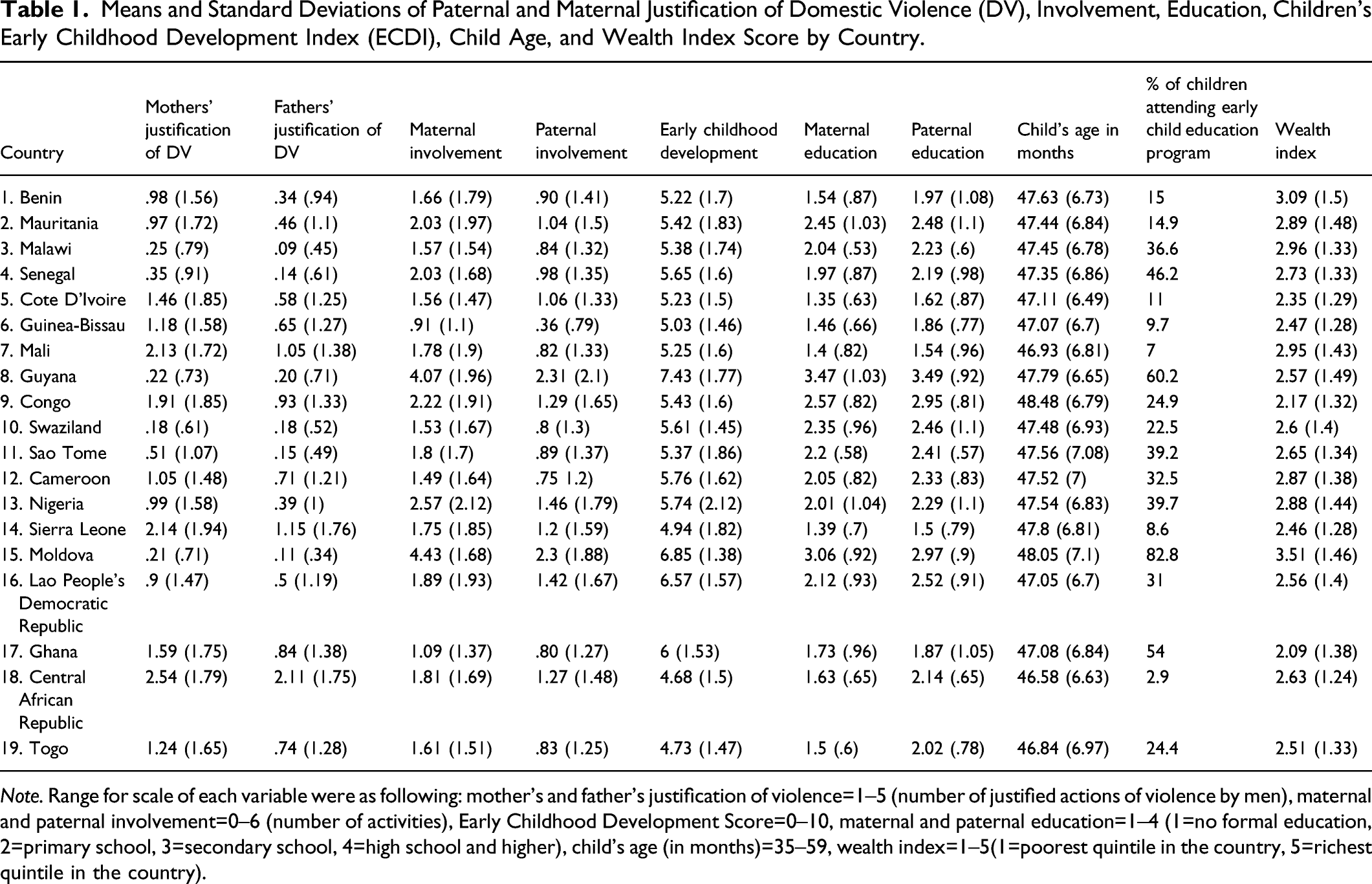
Note. Range for scale of each variable were as following: mother’s and father’s justification of violence=1–5 (number of justified actions of violence by men), maternal and paternal involvement=0–6 (number of activities), Early Childhood Development Score=0–10, maternal and paternal education=1–4 (1=no formal education, 2=primary school, 3=secondary school, 4=high school and higher), child’s age (in months)=35–59, wealth index=1–5(1=poorest quintile in the country, 5=richest quintile in the country).
Data Analysis
MPlus structural equation modeling software was used to test the actor–partner interdependence model (APIM) (Muthén & Muthén, 1998-2010). APIM is designed to examine interdependence within interpersonal relationships, showing both individual and partner effects. In these dyadic models, exogenous variables (i.e., women’s and men’s justification of violence) are correlated with each other (Cook & Kenny, 2005). Mother’s and father’s education levels, child’s attendance to early childhood education program (ECE), child’s age in months, and the wealth index of the family were added to the model as control variables. Correlation between error terms of maternal and paternal involvement was added to the model as described in APIMs, and covariances between all independent variables (including control variables) were freely estimated in the model. As we do not expect full-mediation, direct paths from attitudes justifying DV were also included in the model, leading to a just identified model (see Coutts et al., 2019 for examples and syntax on dyadic mediation analysis).
Finally, all analyses accounted for the sampling weights. Countries selected their samples based on the available recent national census. Each region in the country was divided into strata and clusters of households. Therefore, to account for the unequal probability of selection by region, cluster, and household, and to address non-response, data weights were calculated by the MICS team. We have used the children’s data weight in our analysis following previous studies using MICS data (Dede Yildirim & Roopnarine, 2017; Frongillo et al., 2017). Furthermore, we have used p ≤ .001 as criteria for statistical significance due to large sample size.
Results
Correlations among study variables.

*p < .05, ** p < .01, *** p < .001.
The results of the tested model showed that father’s justification of violence against women was negatively associated with his own parental involvement (actor effect, B = −.04, SE = .01, p = .001, and β = −.03). However, no association was found between father’s justification of violence and his partner’s involvement (partner effect, B = −.04, SE = .01, p = .02, and β = −.03). We found that mother’s justification of violence against women was negatively associated with her own parental involvement (actor effect, B = −.09, SE = .01, p < .001, and β = −.08), and it was also negatively associated with her partner’s parental involvement (partner effect, B = −.05, SE = .01, p < .001, and β = −.05). As expected, both paternal involvement (B = .09, SE = .01, p < .001, β = .07) and maternal involvement (B = .04, SE = .01, p <.001, β = .05) were positively associated with ECDI score (Figure 2). R2 values indicated that variance explained for paternal involvement, maternal involvement, and ECD were .005, .009, and .215, respectively. Model results. Note. Unstandardized beta weights and standard errors are presented. Control variables are mother’s and father’s education, child’s age, child’s attendance to early childhood education program, and household wealth index. Covariances between exogenous variables were estimated but not shown on the figure for simplicity. Solid lines indicate statistical significance at p ≤ .001. ** p < .01, *** p ≤ .001.
Indirect effects indicated that the association between father’s justification of violence and early childhood development score was mediated by their own parental involvement (indirect effect = −.004, p < .001, β = −.002, bias-corrected 95% CI: −.005 to −.002) but was not mediated by their partner’s parental involvement (indirect effect = −.002, p = .002, β = −.002, bias-corrected 95% CI: −.003 to −.001). Paternal involvement mediated 7% of the association between father’s justification of violence and child development. In addition, the association between mother’s justification of violence and early childhood development score was mediated by both mother’s own involvement (indirect effect = −.004, p < .001, β = −.004, bias-corrected 95% CI: −.005 to −.002) and paternal involvement (indirect effect = −.005, p < .001, β = −.004, bias-corrected 95% CI: −.004 to −.003). For the link between mother’s justification of violence and child development, maternal involvement mediated 9% and paternal involvement mediated 11.6% of this association.
Discussion
This study has investigated the associations between parents’ justifying attitudes toward violence against women, parental involvement, and early childhood development using data from large, nationally representative samples from 19 LMIC. Findings showed that fathers’ attitudes toward violence are negatively associated with paternal involvement while mothers’ attitudes toward violence are negatively associated with both maternal and paternal involvement in childcare. More specifically, greater justification of violence against women predicted decreased paternal involvement in men (actor effect); and in women, greater justification of violence against women predicted both decreased levels of maternal and paternal involvement (actor and partner effects). Moreover, paternal involvement mediated the link between paternal and maternal attitudes toward violence and child development, while maternal involvement only mediated the link between maternal attitudes toward violence and child development score. Our results suggest that justifying attitudes toward violence against women is a possible risk factor for ineffective parenting and child development in LMIC. Although previous literature demonstrated that experiencing violence negatively affects mothering, to the best of our knowledge, this is the first study investigating attitudes toward violence and parenting in relation to preschool children’s development with a dyadic mediation perspective. In our study, not only men’s but women’s justification of violence against women had a negative association with involved parenting. With regard to the partner effect of fathers, there was no significant association between fathers’ justification of DV and maternal involvement. One explanation for this lack of association can be the fathers' report of low levels of justification of violence in general. One previous study shows that for men, tolerance to partner violence is associated with unwillingness to report it (Gracia & Herrera, 2006). It is possible that fathers in our sample were hesitant to reflect their true level of tolerant attitudes toward violence against women due to social desirability. In some countries in our sample, justification levels are under one for both women and men, and in most of the countries, the mean scores are similar to previous findings. Previous studies using the same justification of domestic violence scale also found these low levels of justification for both men and women (Sardinha & Catalán, 2018).
Our findings were in line with previous studies which have suggested that DV is detrimental to parenting for both mothers and fathers (Chan et al., 2017; Jeong et al., 2020; Levendosky & Graham-Bermann, 2001) and which have identified justifying violence against women as a risk factor for negative parenting behaviors, such as harsh discipline in mothers (Lansford et al., 2013). Current findings extend the previous literature by establishing justifying DV against women as a risk factor for negative parenting behaviors such as decreased parental involvement of both mothers and fathers. Our results also re-emphasize the importance of parental involvement in LMIC. In line with previous studies (Dede Yildirim & Roopnarine, 2017; Frongillo et al., 2017; Tran et al., 2017), in our sample, we have found that fathers’ and mothers’ number of stimulating activities with their preschool-aged children predicted better early childhood development.
One strength of this study was the use of large, nationally representative data from LMICs, which are generally underrepresented in the literature of child development and parenting. Investigation of risk factors for child development in LMIC is crucial since millions of children who live in LMIC are exposed to multiple adversities such as poverty, lack of various stimulation, and education (Lu et al., 2016). One of these major adversities is violence. Although there is variability at the country level, in most LMICs, there is a high level of violence against women accompanied by a high level of its acceptance (Tran et al., 2016). Results from the current study suggest that fathers’ level of justification of DV was negatively associated with their involvement with their children, and similarly, mothers’ greater acceptance of DV might be damaging not only in their own parenting but also in paternal involvement. Programs aiming to increase parental involvement and early childhood development in LMIC might benefit from addressing components such as attitudes toward domestic violence against women as this construct is related to social norms around caregiving for fathers and has major implications for women’s psychological and physical health. Changing attitudes about acceptability of violence is a difficult and long-term work because these attitudes are rooted in patriarchal ideology evident in many societies, especially in LMICs. It should be noted that countries in our sample were mostly low on gender inequality index and the residing women justified violence more than men. Therefore, results of this study must be evaluated with caution since mechanisms proposed and tested in here might not be applicable to countries with greater gender equality.
It should be noted that the effect sizes detected in this study are considered to be small; however, effect sizes tend to be smaller in large sample studies compared to average or small scale studies and also in developmental research compared to other sub-disciplines (Schäfer & Schwarz, 2019). Therefore, usual benchmarks of small, medium, and large effects may not accurately represent the practical importance of the findings and can be misleading (Schäfer & Schwarz, 2019). Even small effects may contribute to policy making to maximize the developmental potential of children (McCartney & Rosenthal, 2000).
The current study has also several limitations, especially related to the dataset used. First, the associations described in the current study are based on cross-sectional data which is not appropriate to draw cause and effect relationships. For example, it is also possible that greater involvement in childcare would promote gender equality and lower approval for violence against women. However, this explanation is not likely, given the gender roles and attitudes are attained starting from very early ages and parenthood is experienced much later in adult life. Second, given the large sample size and coverage of multiple topics about child development, the measures used in MICS were generally not in-depth in nature. Several variables were measured as dichotomous, which leads to limited variability. Moreover, in MICS, although attitudes toward violence were reported by both mothers and fathers, parental involvement and child development were both mothers’ reports. Having multiple reports (from mothers and fathers) would have increased the confidence in the measurements. Especially, mothers’ reports on paternal involvement might not always be accurate and consequently, the bias results by undermining the actual father involvement (Charles et al., 2018). Third, similar to the reporting of actual perpetration of violence, approval of DV is generally underreported due to social desirability (Gracia & Herrera, 2006). For example, in a previous study conducted with 809 adults in Ethiopia, it was found that when asked directly by an interviewer about justification of DV, adults (especially men) reported lower levels of approving attitudes compared to when asked indirectly (Gibson et al., 2020). Therefore, we believe that social desirability may have been an influential factor when participants reported their level of justifying attitudes toward DV, and it is likely that the level of justification of violence against women is higher than reported. Furthermore, the measure of justification of violence in MICS focused on only physical violence against women; however, individuals might justify other types of violence such as verbal, psychological, sexual, or economic which were not included in the attitude assessment of the current study but may still contribute to this risk factor. Finally, information on relevant constructs for this study, such as marital satisfaction and conflict, was not available in the dataset.
Future studies would benefit from longitudinal designs and they should include in-depth measures of constructs used in this study for a more precise interpretation of these associations and recommendations for practice. The covariates used in the current study were limited to the available data collected in MICS. In future studies, in addition to attitudes toward violence against women, actual perpetration and victimization can be added to the model to investigate the independent predictive power of attitudes. Further investigation of different mechanisms is also needed in explaining the association between justifying violence against women and child development. Previous studies showed that domestic violence has detrimental effects on both the victim and the perpetrator (Chan et al., 2017; Jeong et al., 2020). Attitudes toward violence against women may be a risk factor for decreased parental mental health, which is also critical for parenting and early childhood development. Programs aiming to foster parental involvement might benefit from including prevention-focused modules addressing attitudes toward DV against women. Changing attitudes toward DV involves long-term efforts as these attitudes are rooted in the patriarchal ideology evident in many societies, especially in LMIC. However, this construct seems to be related to the social norms around fathers’ caregiving and has major implications for women’s empowerment and early childhood development. The current study presents empirical evidence for a targeted opportunity to transform these beliefs on violence against women as part of programmatic efforts promoting men’s and women’s roles as more involved parents.
Footnotes
Declaration of Conflicting Interests
The author(s) declared no potential conflicts of interest with respect to the research, authorship, and/or publication of this article.
Funding
The author(s) received no financial support for the research, authorship, and/or publication of this article.
