




Abstract
Sexual violence in sport is prevalent and represents a serious public health concern. The social-ecological model for health promotion has been used successfully as a framework to identify individual-to-policy level factors aimed at health promotion or disease prevention. The purpose of this review was to examine both published and non-published (publicly available) SVP efforts conducted within the context of sport and make recommendations for future practice. Grey literature search methods were utilized to conduct a review of publicly available documents. This included (a) a comprehensive Google search using unique search terms that would identify SVP efforts within sport settings and (b) a review of the publicly accessible websites identified in the previous step. Following the grey literature search, and using the SVP practices identified in step one, we conducted a supplementary literature search using scientific publication search engines to identify whether the SVP practices identified in step one had associated peer-reviewed publications. Finally, we assessed various characteristics of each SVP practice including the target population, age range of intended participants, and whether the SVP had associated peer review publications. This led to the identification of 35 unique SVP practices: 25 (71%) SVP practices were assigned to the Intrapersonal level, 6 (17%) were assigned to the Interpersonal level, 9 (26%) were assigned to the Organizational level, 3 (9%) were assigned to the Community, and 2 (6%) were assigned to the Policy level. This review uncovered several important findings including a lack of multi-level SVP practices within sport, a lack of SVP practices that target children, minimal programming aimed at specifically preventing perpetration, the need to elevate policy level action, and a lack of peer-reviewed literature. Ultimately findings suggest that sport organizations ought to prioritize sexual violence prevention using national organizations for guidance.
Introduction
Sport is a powerful sector in American society and culture. More than half of Americans describe themselves as sport fans (Jones, 2015) and almost 72% of children participate in sport (Aspen Institute, 2019). There are well established physical (Oja et al., 2015), psychological, and psychosocial benefits of sport participation (Eime et al., 2013). Many of these benefits are linked specifically to the social nature of sport, that is, positive interactions with peers and supportive adults (Oosterhoff et al., 2017). There are also broad level community benefits of sport in society like elevating community strengths beyond that of the sport networks themselves, including improved community capacity (Edwards, 2015), social connectedness (Hoye et al., 2015), social cohesion (Meir & Fletcher, 2019), and community involvement (Levermore, 2008; Nicholson et al., 2014). Further, sport has been linked to the sustainment of community development activities such as community members connecting through leisure activities (Schulenkorf, 2012). Lastly, sport has led to community development in socially and economically disadvantaged areas such as sport programming and social activities aimed at traditionally disadvantaged communities (Levermore, 2008).
Despite the positive outcomes of sport, it has been linked to less desirable outcomes such as sexual violence. A 2020 study of middle and high school students found sport-involved youth were more likely to be involved (both victimized and a perpetrator) in sexual violence than peers not involved in sport (Cheever & Eisenberg, 2020). Evidence also indicates that both male (21%) and female (31%) athletes experience sexual abuse (Brackenridge et al., 2008; Leahy et al., 2002). Sexual violence perpetration patterns vary within sport; some studies indicate teammates or other athletes as perpetrators (Basile et al., 2020; Cheever & Eisenberg, 2020) while other studies indicate coaches, teachers, or instructors as perpetrators (Brackenridge et al., 2008).
While sport is a central component of American society and contributes to the pervasiveness of sexual violence, it can also serve as a platform for prevention (Raj et al., 2017; Cheever & Eisenberg, 2020). Traditional peer-reviewed literature includes a variety of published studies on sexual violence prevention efforts within the sport. For example, some target important psychosocial factors within the athlete (e.g., Mentors In Violence 2021; Katz, 1995), some use bystander intervention strategies (e.g., Green Dot, 2021; Coker et al., 2015), and others target important relationships between players and coaches (e.g., Coaching Boys Into Men; Miller et al., 2012). To establish a more complete representation of SVP practices within sport, looking outside peer-reviewed literature is necessary. For example, while several interventions and system-level toolkits as well as other technical assistance resources have been developed in recent years, a thorough understanding of such SVP practices within the sport context is limited. To include the full landscape of SVP practices in sport, the purpose of this review was to examine both published and non-published (publicly available) SVP efforts conducted within the context of sport and make recommendations for future practice.
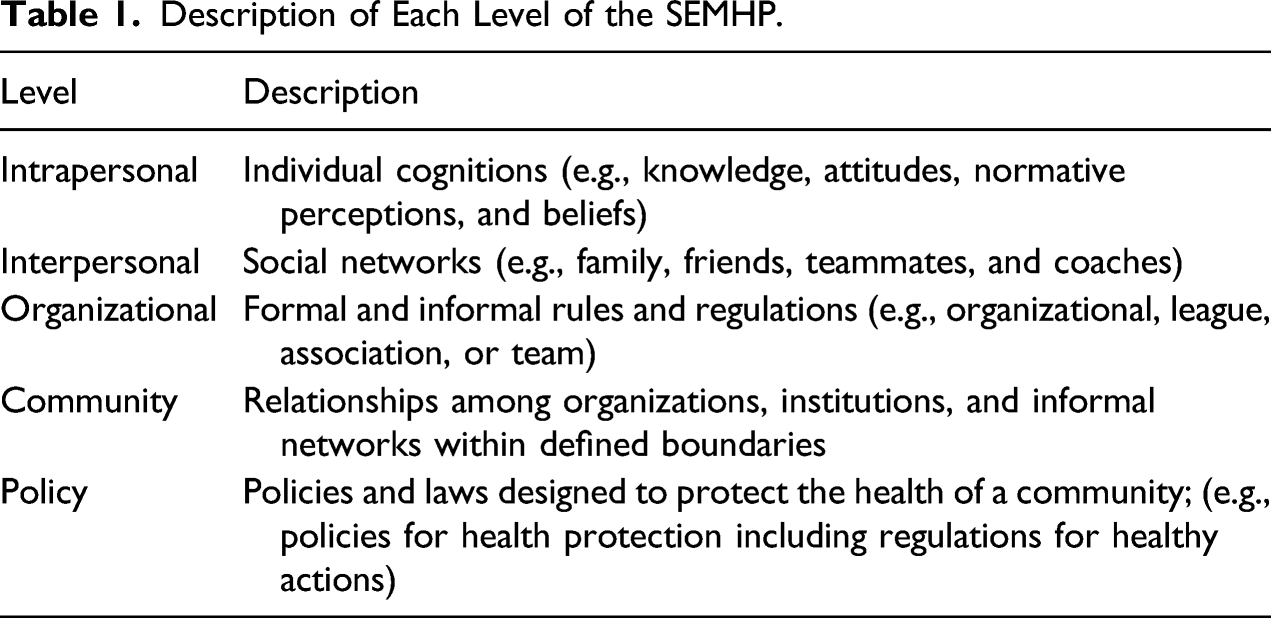
Description of Each Level of the SEMHP.
Methods
Data Collection, Selection Criteria, and Analysis
The purpose of this review was to conduct a broad grey literature search to examine SVP practices within sport and make recommendations for future practice. A grey literature review includes data or information that is external to traditional academic publications and includes but is not limited to public reports, policy literature, white papers, organizational websites, and government documents. It is possible that conducting a traditional search of only peer-reviewed publications could have resulted in the omittance of relevant SVP practices. Furthermore, because many sport organizations do not publish their SVP practices in peer-reviewed publications (e.g., scientific journals), we purposefully chose a grey literature review. It was our intent that using a grey literature review would help increase the likelihood of including a greater number of SVP practices within sport. Lastly, since sport reaches a broad range of audiences (children, adolescents, young adults, and adults), we use the term sexual violence prevention to include a range of types of sexual violence prevention such as child sexual abuse prevention for children, teen dating violence prevention for adolescents, and other sexual violence prevention effort for young adults and adults.
Our first step was to conduct a grey literature review which included (a) a comprehensive Google search using unique search terms that would identify SVP efforts within sport settings and (b) a review of the publicly accessible websites identified in the previous step. We used a variety of search term combinations using the following key words: sexual violence prevention, sport, interpersonal violence, sexual assault, sexual misconduct, and sexual abuse. For example, specific search term combinations included but were not limited to “sport and sexual violence,” “sexual assault and sport,” “sexual abuse and athletes,” and “interpersonal violence and sport.” We used three criteria to select SVP practices for review. SVP practices were included if: (a) the SVP practice targeted individuals involved in sport (e.g., athlete, coach, parent of athlete, and athletic administrator); (b) sufficient details of the SVP efforts were provided; and (c) the SVP practice(s) were implemented in the United States. In an effort to create an inclusive review and to elevate the importance of diversity we included SVP practices for analyses regardless of who the prevention effort was aimed at (e.g., gender, race, and age). Following the grey literature search, and using the SVP practices identified in step one, we conducted a supplementary literature search using scientific publication search engines (e.g., EBSCO and PsychINFO) to identify whether the SVP practices identified in step one had associated peer-reviewed publications. The purpose of step two was to identify the number of SVP practices that had at least one peer-reviewed publication, not to evaluate the scientific rigor of the studies or indicate demonstrated impact via evaluation.
Once the grey literature and supplementary peer-reviewed search was concluded, SVP efforts were assigned to one or more of the SEMHP levels based on SVP practice implementation. For example, if an SVP practice targeted intrapersonal level cognitions as well as aimed to promote social networks for the prevention of sexual violence, then it was included as both an Intrapersonal and Interpersonal level practice. Finally, we assessed various characteristics of each SVP practice including the target population (e.g., youth athletes, coaches, and collegiate athletes), age range of intended participants, and whether the SVP had associated peer review publications.
Results
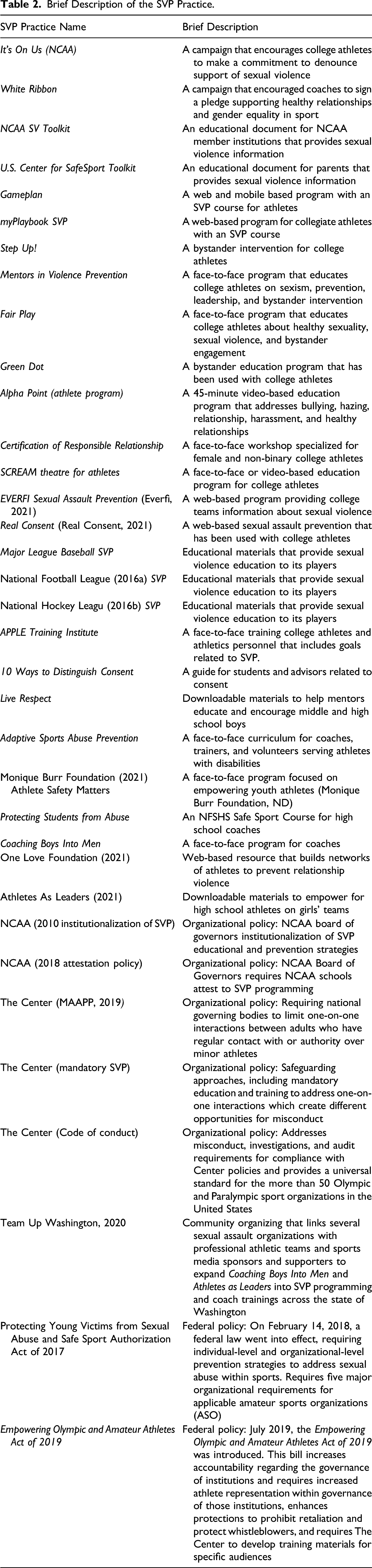
Brief Description of the SVP Practice.
Sexual Violence Prevention Practice Details.
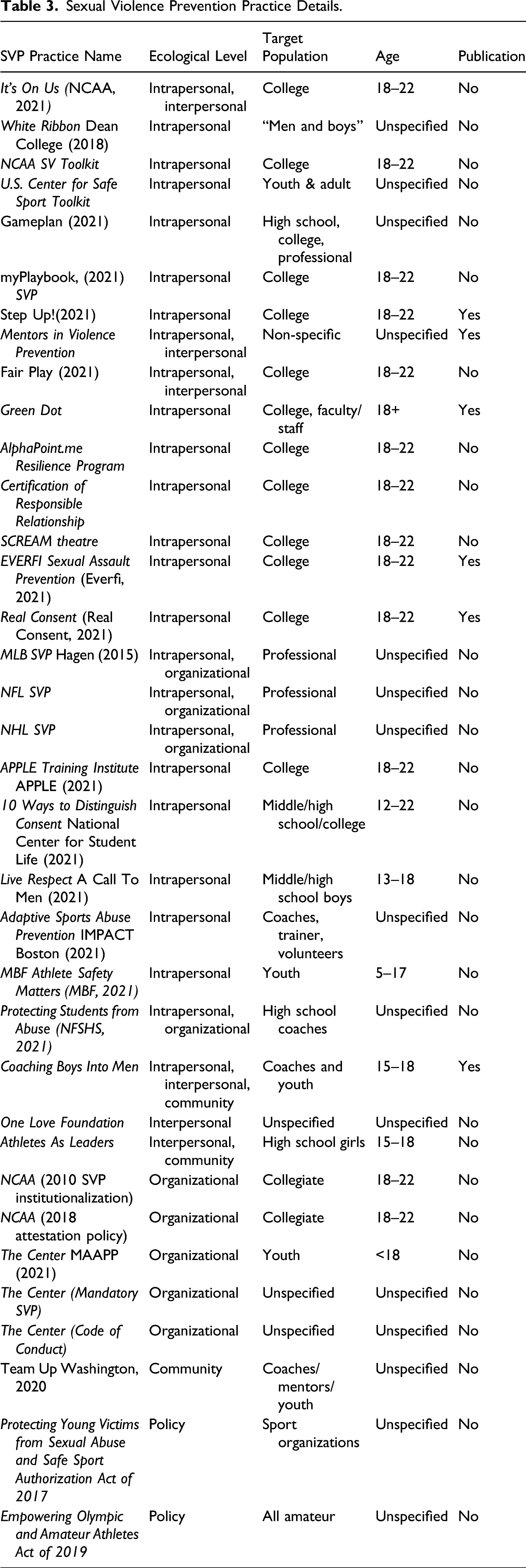
Of the 25 (71%) SVP practices assigned to the Intrapersonal level, the target population varied between youth, college, and professional athletes. Half (12) of the SVP practices were designed for 18–22-year-old athletes and 8 SVP practices did not specify an age range. Lastly, 5 (20%) of the intrapersonal level SVP practices had at least one associated peer reviewed publications. They include Step Up! (Orsini et al., 2019), Mentors In Violence Prevention (Katz, 1995), Green Dot (Coker et al., 2015), EVERFI’s Sexual Assault Program for athletes (Zapp et al., 2021), Real Consent (Salazar et al., 2018), and Coaching Boys Into Men (Miller et al., 2012). See Tables 2 and 3.
Next, this review uncovered 6 (17%) SVP practices that were assigned to the Interpersonal level. The target population varied between youth and college athletes and coaches. Three of the Interpersonal SVP practices were designed for 18–22-year-old athletes, 2 were designed for 15–18-year old athletes and their coaches, and 2 did not specify an age range. Lastly, 2 interpersonal level SVP practices had at least one associated peer-reviewed publications; Coaching Boys Into Men (Miller et al., 2012) and Mentors In Violence (Katz, 1995). See Tables 2 and 3.
This review did not intend on reviewing all localized Organizational SVP practices (e.g., local youth, high school, or professional leagues) that are implemented nationally. Instead, this review focused on national organizations’ SVP practices. Nine (26%) Organizational SVP practices were identified in this review. Three of the practices were led by professional sport leagues (NHL, MLB, NFL), one was led by and intended for high school athletes, two were led by the NCAA and were intended for collegiate student athletes, and three were led by the U.S. Center for SafeSport (The Center) (2018). Each organization has established misconduct and reporting policies and procedures. None of the SVP practices assigned to the Organizational level had associated peer review publications. See Tables 2 and 3.
This review uncovered 3 (9%) SVP practices that were assigned to the Community level. The target population for each of the Community level SVP practices was aimed at youth athletes. One specified that it was also for youth coaches (Coaching Boys Into Men, 2021), while another specified that it was for high school girls (Athletes as Leaders, 2021). Lastly, one of the community level SVP practices had at least one associated peer-reviewed publications; Coaching Boys Into Men (Miller et al., 2012). See Tables 2 and 3.
A state-by-state policy analysis was not conducted; however, the grey literature search uncovered 2 (5%) federal laws aimed at preventing sexual violence in sport. One of the federal laws targets SVP practices of sport organizations (United States Congress S.534, 2017) and the other federal policy aims to increase increases accountability (United States Congress S.2330, 2020) regarding the governance of institutions, including the USOPC and the National Governing Bodies and require The Center to provide education to coaches, trainers, doctors, young children, adolescents, adults, and individuals with disabilities (United States Congress S.2330, 2020). See Tables 2 and 3.
Discussion
Sexual violence research has grown over the last decade. Media attention about sexual violence has driven organizational rules for professional, collegiate, high school, and youth sport organizations. Such national attention has contributed to increases in federal funding for SVP, such as CDC’s Rape Prevention and Education Program that funded hundreds of SVP programs throughout the country, including those within sport, and led to policy changes at the National Collegiate Athletic Association (2021a; 2021b) and The Center (i.e., mandated SVP programming). Many of these advancements do not make it into traditional scientific journals; therefore, this grey literature review revealed a broader scope of SVP practice within sport.
This review uncovered a variety of important findings including a lack of multi-level SVP practices within sport, a lack of SVP practices that target children, minimal programming aimed at specifically preventing perpetration, the need to elevate policy level action, and a lack of peer-reviewed literature specifically outlining SVP measures within sport. The following discussion section will further explore these findings.
Multi-Level Approaches
Prevention efforts should simultaneously target multiple levels of the social-ecological model (Centers for Disease Control & Prevention, 2021a). This review uncovered that few SVP practices act across multiple levels of the SEMHP. Our findings suggest that most SVP practices within sport are occurring at the individual (i.e., intrapersonal or interpersonal) level. As noted by the CDC, targeting multiple levels of the socioecological model can increase the comprehensiveness of programming as well as increase potential for impact (Centers for Disease Control & Prevention, 2021a). Successfully conducting SVP across multiple levels of the SEMHP requires the establishment of partnerships between program developers, sport organizations, and policy makers to develop comprehensive approaches to SVP. Athlete-serving organizations should consider purposefully engaging in local and national partnerships to develop communities of practice (RALIANCE, 2021b). Communities of practice include formal or informal partnerships between the sport community and sexual violence experts. As with organizational prevention efforts, these partnerships should engage diverse groups (e.g., SVP advocates, sport organization administrators, coaches, athletes, parents, community leaders, law enforcement, and schools) as a means of enhancing community awareness and strengthening SVP practices. Furthermore, professional sport organizations can serve as key partners (RALIANCE, 2021b). Through such partnerships, sport organizations can develop a coordinated community response that engages multi-layered action, cooperation, and solidarity around SVP. Team Up Washington is a prime example of community driven efforts aimed at linking sexual assault organizations with professional athletic teams and sports media sponsors and supporters to expand Coaching Boys Into Men and Athletes as Leaders across the state of Washington. This multi-level approach exemplifies how partnerships between program developers, sport organizations, and state leadership can be used to establish a culture of caring that supports survivors and values safety and prevention within sport. Future SVP efforts within sport should attempt to go beyond individual-level efforts and attempt to establish community partnerships to implement efforts across multiple levels of the SEMHP.
Aiming SVP Efforts Toward Younger Athletes
Many sport organizations provide sport programming for young athletes; some as young as 5 years old. However, this review identified only three SVP practices within sport that implement efforts for athletes under the age of 15. Approximately half of the SVP practices identified in this review were intended for athletes 18 years or older (e.g., college athletes) and many others did not specify the intended audience age of their SVP programming; thus greater efforts are needed to deliver SVP practices that are intended for child athletes (i.e., ages 5–15). It is possible that SVP efforts for younger athletes are embedded within programs more broadly targeting social and emotional learning (SEL) outcomes; however, evidence of this is extremely limited and examples specifically for young athletes was not uncovered during our review. Importantly, SVP practices for young children do exist. Although not within the sport context, the Second Step Child Protection Unit has resulted in positive effects related to improved knowledge about child sexual abuse among elementary school aged children (i.e., ages 5–10). This program also aims to promote healthy relationships between students and teachers (Nickerson et al., 2019). Whereas the Second Step Child Protection Unit is teacher led and not intended to be delivered through sport, it could serve as a guide for developing sport specific SVP practices for young athletes. Additionally, the Centers for Disease Control and Prevention’s Preventing Child Sexual Abuse Within Youth-serving Organizations: Getting Started on Policies and Procedures (Saul & Audage, 2007) provides an overview of components of child sexual abuse prevention policies that youth-serving organizations can institutionalize. Efforts are currently underway to update the publication and provide new resources. The components in the 2007 resource span from screening adults and monitoring behavior to responding to child sexual abuse to prevention trainings and ensuring safe environments (Centers for Disease Control & Prevention, 2021b). Whereas these guidelines are not specifically for sport organizations, many of the organizational policy recommendations are adaptable to a sport environment, as many sport organizations are also youth-serving organizations. Additionally, through meaningful partnerships and communities of practice, sport organizations can collaborate with SVP experts to develop programming tailored for younger athletes or adapt current programming that would be more suitable for younger audiences. When doing so, it is critical that program developers pay close attention to the developmental stages of youth athletes they target so that educational content and materials are best understood and internalized by the young athletes. For example, when developing educational materials for young athletes, developers should tailor the educational content, imagery, language, reading level, and use of audio visual technologies to the young athlete’s cognitive and emotional level.
Efforts Specifically Targeting Perpetration
Sexual violence perpetration is a critical issue within sport (Cheever & Eisenberg, 2020). Whereas it was not a primary objective of this review, it appeared as though most SVP practices included in this review include practices to prevent victimization rather than specifically prevent perpetration. However, it is noteworthy that one SVP practice included in this review (Coaching Boys Into Men) has evidence of reducing likelihood of perpetration among program participants and has been found to be effective in reducing dating abuse at a 1 year follow-up among middle school male-identified athletes (ages 11–14) (Miller et al., 2013). Coaching Boys Into Men provides athlete mentors with skills to foster healthy masculinity in young male athletes; in turn serving as a strategy to prevent likelihood of future perpetration. For most other SVP practices included in this review it was difficult to discern whether the practice specifically targeted victimization, perpetration, or both. This may be the result of three critical issues, (a) sport organizations who are implementing perpetration prevention efforts may not be disseminating their practices or related findings publicly, (b) it may be the case that, in fact, there are few SVP practices within sport that are specifically attempting to prevent perpetration or target perpetrators, and/or (c) many sport organizations may not have the resources to conduct studies that include multiple measurement points as well as long-term follow-up measures of perpetration. Not only is it difficult to measure perpetration, but it is also challenging to measure perpetration within short-term periods (e.g., 6-month to 1-year follow up periods). Collectively this elevates the critical need for organizational partnerships between sport organizations and SVP experts both locally and nationally. Sport organizations need to be supported with through finances (e.g., money earmarked for SVP, including staffing), time (e.g., specific times throughout the year to directly discuss SVP), or other assets (e.g., connect to other community SVP prevention efforts) to prevent perpetration. Lastly, yet equally important, additional research is necessary to better understanding effective prevention of perpetration within the sport context.
Elevating Policy Level Action
As noted previously, much of the focus of SVP within sport is on the intra and interpersonal levels of the SEMHP. This review was done to provide a review of SVP practices at all levels of the SEMHP. Whereas a state-by-state policy review was not conducted, this review identified two federal laws related to SVP in sport. Safeguarding policies in sport must be a critical part of prevention. Policies and protocols to respond to sexual violence in sport are necessary, including responding to and investigating reports of sexual violence, supporting victims, and holding people accountable who support or commit acts of violence. Policies and practices to prevent sexual violence, including reinforcing bystander and champion behaviors, setting up mechanisms to reinforce values of respect, healthy relationships, and character are equally essential. Sport organizations should align policies and procedures that codify policies and practices to establish a connected enforcement mechanism for responding to and preventing sexual violence. Policies must be developed and informed by practice, and in turn, policies must also be translated into practice for those who are impacted by policy. For example, The Center convened an external advisory group to update the Minor Athlete Abuse Prevention Policies. The advisory group included survivors, parents, athletes, child sexual abuse prevention experts, public health experts, sport national governing bodies, and other interested constituents. Additionally, the Center’s audit and compliance team conducts regular and random audits to ensure that sport national governing bodies are implementing required policies. This level of accountability is necessary to ensure compliance with policies to both safeguard youth as well as other participants from abuse and hold organizations accountable when policies are not being followed (Johnson et al., 2020). Additionally, there are a lack of policies focusing specifically on proactive prevention within sport environments. Such prevention-focused policies should include codifying ongoing education and training requirements for athletes and coaches, establishing and enforcing codes of conduct that specifically target risk and protective factors for sexual violence, and creating accountability structures for coaches and athletes who have potentially committed an offense or broken a conduct code related to respect/equity.
Wide Dissemination of SVP Practices
This review uncovered few SVP practices with associated peer review publications; however, of those, several had multiple peer review publications (e.g., Green Dot, Coaching Boys Into Men, and Mentors in Violence Prevention). Whereas peer review publications of SVP practices are important, it is also critical for sport organizations to implement SVP practices, measure SVP impact, and disseminate the results of their work. Critically, SVP initiatives should have a development trajectory that helps move the initiative from newly established to empirically supported. Available findings, both peer reviewed and in the grey literature, allow for improvement of SVP practices over time. As SVP practices within sport grow, it will require ongoing research and evaluation efforts. There is very limited evidence of effectiveness of organizational, community, and policy-level efforts. Of the SVP practices with associated peer-reviewed publications, all but one was intrapersonal or interpersonal level practices. Coaching Boys Into Men, assigned to the intrapersonal, interpersonal, and community level, had multiple associated peer-reviewed publications. Dissemination of findings, measuring and disseminating impact serves as a collective benefit and should be done across all levels of the SEMHP. Specifically, greater efforts are needed to evaluate and disseminate the findings of community-, organizational-, and policy-level SVP strategies.
Diversity and Inclusion in SVP Practice
As with all SVP approaches, the intersecting identities of those participating must be carefully considered and included in the overall design of SVP strategies as well as during implementation and evaluation. As such, while conducting this review, we paid particularly close attention to whether the identified SVP practices used methods and/or strategies that either integrated or emphasized diversity and inclusion. Ultimately, this review did not identify culturally specific practices being currently used in SVP in sport. Current and future practices should consider the inclusion of tailored SVP practices based on social and cultural contexts (Basile et al., 2016). For example, if an SVP practice addresses erroneous social norms related to sexual violence, it would be beneficial to present back to participants tailored normative data that are relevant to the participant’s self-identified community. Additionally, careful consideration should be given to the setting of the SVP initiative and population of interest (Basile et al., 2016), including but not limited to gender, race, age, sport type (contact and non-contact; individual and team), ability (adaptive and able-bodied), sport level, community setting, and audience (coach, athlete, administrator, and parent).
Limitations
Whereas a grey literature search plan was purposefully selected to minimize the risk of omitting relevant and current SVP practices, we acknowledge the limitations of this methodology. First, it is possible that SVP practices were missed during this review because many organizations and program implementers do not publish their SVP practices in the peer-reviewed literature or publish on a web site. However, the sample of SVP practices included in this review reflects a representative range across all levels of the social ecology. Second, many local grassroots organizations, including rape crisis centers and others funded through Rape Prevention Education grants across the U.S., that have developed SVP practices in sport may not be publicly available. Third, this review did not evaluate every SVP program across each level of the SEMHP. For example, in this review SVP organizational practices were limited to policies from two large national sport organizations. The review only included national policies and did not examine state-level policies. Lastly, whereas this review did search peer-reviewed studies, this review did not assess the effectiveness of each SVP effort.
Conclusion
Sexual violence in sport remains a critically important public health issue (Alexander et al., 2011). Evidence from this review suggests that there is a lack of multi-level approaches to SVP within sport, a lack of SVP practices that target children, minimal programming aimed at specifically preventing perpetration, the need to elevate policy level action, and a lack of peer-reviewed literature specifically outlining SVP measures within sport. Sport organizations can prioritize sexual violence prevention using national organizations such as RALIANCE (RALIANCE, 2021a) which considers the important implications of the sport context and the CDC for guidance.
Footnotes
Declaration of Conflicting Interests
The author(s) declared no potential conflicts of interest with respect to the research, authorship, and/or publication of this article.
Funding
The author(s) received no financial support for the research, authorship, and/or publication of this article.
