




Abstract
Two objectives were formulated. The first was to establish whether characteristics such as self-esteem, perception of body image, and dating perpetration explain dating victimization. The second was to check if sex moderates the relationship between low self-esteem and dissatisfaction and if body dissatisfaction mediates the effect of low self-esteem on being a victim of dating violence (DV). A total of 1,409 Colombian adolescents and young adults, secondary and university students (42.5% men and 57.5% women), aged between 14 and 25 years (M = 18.6 years; SD = 2.8 years) participated. An explanatory correlational design was used, in which the Rosenberg Self-Esteem Scale, the Body Shape Questionnaire, and the Revised Dating Violence Questionnaire were applied. Six regression models were proposed for both men and women, where it was found that low self-esteem, body dissatisfaction, and violence exerted in the courtship explain the violence received. Also, through the moderated mediation analysis, a moderate conditional indirect effect was verified of low self-esteem in DV victimization (R2 = 0.052***) through body dissatisfaction, being higher in women than in men. The preceding points to the convenience of intervening on self-esteem and body image in adolescents and young victims of this type of violence and considering these aspects in prevention campaigns.
Dating violence (DV) has been defined as acts of control characterized by physical, psychological, and sexual assaults in a romantic relationship without cohabitation (Bolívar et al., 2017; Fernández-González et al., 2018; Karsberg et al., 2018). Furthermore, it has been recognized as a public health problem not only because of its high-reported prevalence (Martínez et al., 2016; Rey 2013; Rubio-Garay et al., 2017) but also due to its impact on adolescent and youth health (Choi et al., 2017; Cohen et al., 2018).
Regarding the prevalence of DV in Colombia, according to the National Observatory of Violence in 2017, 1,858 reports of DV cases were registered (1,621 women and 237 men; National Institute of Legal Medicine and Forensic Sciences (Instituto Nacional de Medicina Legal y Ciencias Forenses, 2018). Nevertheless, some research has been carried out with adolescents showing that DV is frequent in the relationships of Colombian couples young people. For example, Martínez et al. (2016) analyzed a sample of 446 students from public schools, finding that 75.9% reported having been a victim of DV by their partner, of which 50.7% corresponded to men and 49.3% women. Also, no statistical differences were found by sex. Similarly, Pérez-Ruíz et al. (2020) reported in a sample of 1,044 young Colombian university students between 18 and 27 that 93.2% had been victims of violence in their dating relationship, and 96.9% had practiced DV in the past 12 months.
Several authors report that DV is a multicausal phenomenon and various factors have been related such as substance use, suicidal behaviors, alcohol consumption, sexual risk behaviors, unwanted pregnancies, poor academic performance, low self-esteem, depression, anxiety, and alterations of eating behavior (Caballo et al., 2018; Banyard 0.0& Cross, 2008; Eshelman & Levendosky, 2012; Holmes & Sher, 2013; Howard et al., 2013; Silverman et al., 2004). Therefore, DV must be studied from a multicausal perspective, such as ecological theory (Bronfenbrenner, 1992; 2005). For Heise (1998), following Bronfenbrenner’s proposal, DV could be regulated by the interrelationships of psychological, social, and cultural factors from different systems: ontogenetic, microsystem, exosystem, and macrosystem. The ontogenetic system addresses individual biological, cognitive, emotional, and behavioral characteristics that can influence the microsystem, exosystem, and macrosystem to become DV victims (De Alencar-Rodrigues & Cantera, 2012). In this sense, one of the individual factors that can affect DV victimization is self-esteem (Pflieger & Vazsonyi, 2006; Preble et al., 2018; Van Ouytsel et al., 2017). According to Lewis and Fremouw (2001), self-esteem is an individual characteristic that can moderate the risk of DV and have a significant impact on the individual’s behavior, which is why some authors have included it both in prevention (Cornelius & Resseguie, 2007; Leen et al., 2013) and DV treatment programs (Guajardo & Cavazos, 2013; Villafañe et al., 2010).
Self-esteem has been studied as a predictor of dating violence. For example, studies have been found about the relationship between low self-esteem and DV victimization in adolescents and young people in Spain and the United States, in which low self-esteem has been associated with DV and therefore its self-concept and self-image of the victims have been affected (Capaldi et al., 2005; Foshee et al., 2004; Jezl et al., 1996; Moral et al., 2017; O’Keefe & Treister, 1998). However, the differences by sex regarding this association are not yet apparent.
Another variable that could be related to DV in adolescents from the individual level of the ecological model is the self-image, which is related to satisfaction with body image. Borda et al. (2016) point out that body image is formed from subjective evaluations, and in adolescents, it can be determined by how others perceive the person. A pessimistic vision of body image among adolescents and young people could be related to cognitive–social malfunction, which could favor depressive symptoms, and sexual behaviors such as the early initiation of sexual intercourse and inconsistent condom use (Baladia, 2016; Pasch et al., 2011). The discrepancy between society’s ideal image and the perceived body can lead to body dissatisfaction, which is considered one of the consequences of low self-esteem (Fernández et al., 2018). Farhat et al. (2015) found that body dissatisfaction was significantly associated with American adolescents’ DV victims. The aforementioned indicates that self-esteem and body satisfaction is related to victimization in dating relationships; however, some studies show contradictory findings where the relationship is not conclusive (Turan & Baki, 2020). Therefore, it is required to conduct more studies examining the relationship between these three variables.
Based on the previous, this research set two objectives: (a) to establish whether characteristics such as self-esteem, perception of body image, and perpetration of violence explain victimization between boyfriends in a sample of Colombian adolescents and young students; (b) check if sex moderates the relationship between low self-esteem and body dissatisfaction, in turn, if body dissatisfaction mediates the effect of low self-esteem on being a victim of DV. The following hypotheses were raised: (a) adolescents who have low self-esteem, dissatisfaction with their body image, and who have engaged in violent behaviors are more likely to be a victim in their relationship because young people with low self-esteem are more susceptible to tolerating abusive dating relationships; (b) The effect of low self-esteem (X) on victimization in DV (Y) is mediated by body dissatisfaction (M) and moderate (W) by sex (male or female).
Method
Design
The type of research in which this study is framed is observational and cross-sectional, of the correlational-explanatory type (Hernández et al., 2014) and is intended to determine the relationship between self-esteem, body image, and abuse among courtship variables in adolescent and young adult Colombian students.
Participants
This study included 1,409 adolescents and young adults in secondary and university education, of whom 599 (42.5%) were men and 810 (57.5%) were women from 14 to 25 years in age (M = 18.6 years; SD = 2.8 years). The sample was nonprobabilistic. The characteristics required for participation were: (a) have or have had a courtship relationship for a minimum of three months, in the last six months, (b) not living with their partner, and (c) without children.
Questionnaires
Revised Dating Violence Questionnaire (DVQ-R; Rodríguez-Díaz et al., 2017). This questionnaire is a reduced version of the Dating Violence Questionnaire (CUVINO, its acronym in Spanish) (Rodríguez-Franco et al., 2010) comprising 20 items that evaluate five dimensions of dating violence: (a) Violence by coercion: Explicit behaviors aimed at exerting pressure on the partner to force their will or their behavior; (b) sexual violence: Sexist, sexual behaviors, such as unwanted sexual games by the partner, as well as feeling compelled to perform certain sexual acts; (c) physical violence: blows, shoves, wounds, or indirectly through damage to objects with emotional significance for the victim; (d) violence by detachment: Behaviors associated to an attitude of indifference and discourtesy towards the partner and their feelings; and (e) violence by humiliation: Behaviors of personal criticism directed against the self-esteem and personal pride of the partner, neglect, and denial of support, and behaviors that tend to lower a person’s estimation.
The questionnaire was answered through a Likert-type scale with five response options (from Never: 0 to Always: 4) and validated in a sample of 6,138 Spanish men and women aged between 15 and 26 years old. The internal consistency of the five scales, evaluated with Cronbach’s alpha, ranged from .64 to .74. Confirmatory factor analysis was used to estimate the validity of the instrument, which showed good adjustment indices (TLI = .94; CFI = .95; RMSEA = .018, 95% C.I. = .016, .020). The internal consistency of the DVQ-R factors in the study sample showed adequate fit (physical, α = 0.83; sexual, α = 0.80; humiliation, α = 0.81; detachment, α = 0.83; and coercion, α = 0.77).
The internal consistency of the DVQ-R was calculated for the 1,409 adolescents and young adults who participated in this research, Cronbach’s alpha showed an adequate adjustment for the five factors that make up the instrument (physical, α = 0.711; sexual, α = 0.781; humiliation, α = 0.681; detachment, α = 0.698 and coercion, α = 0.670).
Body Shape Questionnaire (BSQ; Cooper et al., 1987; validated by Castrillón et al., 2007). This instrument comprises 34 items scored on a 6-point Likert-type scale (from Never: 1 to Always: 6), grouped into two factors, body dissatisfaction and weight concern. These factors evaluate the concern for body image, the dissatisfaction produced by the body itself, the fear of gaining weight, the self-devaluation due to physical appearance, the desire to lose weight, and the avoidance of situations in which physical appearance can attract attention.
In Colombia, the instrument was applied to a randomized sample of 1,939 preadolescent and adolescent women between 9 and 19 years of age, with both factors explaining 52.3% of the variance and yielding a general alpha of .95, while .95 was obtained for the body dissatisfaction factor and .92 for the weight concern factor (Castrillón et al., 2007).
For the particular case of this research (n = 1,409 adolescents and young adults), an adequate internal consistency was obtained from the BSQ instrument with Cronbach’s alpha (body dissatisfaction α = 0.963 and Concern for weight α = 0.948).
Rosenberg Self-Esteem Scale (Rosenberg, 1965). This comprises 10 items scored on a four-point Likert scale (between Totally disagree: 1 to Totally agree: 4) along two dimensions: (a) positive self-esteem, which includes positive statements about the personal worth, and (b) negative self-esteem, whose items contain negative phrases about this aspect. Ceballos-Ospino et al. (2017) applied this scale to 1,341 Colombian university students between the ages of 18 and 30; 50.7% of whom were men and 49.3% women, obtaining a total Cronbach’s alpha of 0.72. The positive self-esteem factor explained 32.3% of the variance, while the negative self-esteem factor explained 13.8%.
The internal consistency of the Rosenberg Self-Esteem Scale with Cronbach’s alpha statistic was estimated with the participants of this work (n = 1409 adolescents and young adults). The results showed adequate adjustment for the factors that make up the instrument (positive self-esteem, α = 0.844, and negative self-esteem, α = 0.713).
Procedure
The directors of secondary education institutions and universities were contacted to discuss the objectives and procedures of the research and requested their authorization to administer the instruments to the students of their educational institutions. Once this endorsement was obtained, the students were contacted in the classrooms, where the objectives, risks, procedures, and rights were explained to them, and an informed consent form was obtained from the students who agreed to participate, with the signature of the parents requested in the case of minors. The instruments were applied collectively during school hours, with the prior approval of the teachers in charge of the subjects. Participation was voluntary and anonymous, with the participants only reporting their sex, age, and course. The questionnaires were administered by a psychologist with a master’s degree in clinical psychology and two psychology students from the last semester.
Ethical Considerations
This investigation took into account Resolution Number 08430 of 1993 that establishes the scientific, technical, and administrative standards for health research, in light of which this research had minimum risk, as well as Law 1090 of 2006, which regulates the practice of psychology in Colombia, guaranteeing the following ethical principles and rights: (a) autonomy, explaining the objectives, risks, and procedures of the research, with each participant expressing in a format their voluntary acceptance to participate in it; (b) right to nonparticipation, where everyone had full freedom to abstain from answering totally or partially the questions in the questionnaires when the participant considered it appropriate; (c) confidentiality, where participants’ anonymity was guaranteed due to the importance and respect for the dignity and worth of the individual; and (d) right to information, where it was explained to them that they could request the information they deemed necessary in relation to the purposes, procedures, data collection instruments, and the projection and/or socialization of the investigation, when they considered it convenient.
Statistical Treatment
The data obtained were incorporated and analyzed in the SPSS version 22.0 program. The chi-square test was used to identify the participants’ origin’s independence and the difference in men’s and women’s age with the student’s t-test.
To test the first hypothesis, multiple regression analysis was used, using the method of successive steps with the following criteria: probability of F to enter ≤ 0.050, probability of F to exit ≥ 0.100. The variables included as independent were self-esteem, body satisfaction, violence exerted in the courtship, and as dependent, the violence received in the courtship. In each of the models, compliance with the assumptions of linearity, independence, homoscedasticity, normality, and noncollinearity was examined, considering for each of them the result of this evaluation and the impact on the interpretation of the final model.
To verify the second hypothesis of moderate mediation, an analysis was performed with SPSS, using Macro PROCESS v3.5 (model 7), developed by Hayes (2018). This method is based on the multiple linear regression analysis estimated by least squares. To approximate the distribution of the regression coefficient and estimate the indirect effect of the participant’s sex and construct confidence intervals (CI) to make the statistical decision on the significance of the observed effect, a resampling with 10,000 bootstrap samples was generated. The variables that made up the moderate medication model were self-esteem (0.5 = low self-esteem; −0.5 = high self-esteem) as an independent variable; body satisfaction as a mediating variable; sex (0.0 = female; −0.5 = male) and violence received in dating as a dependent variable.
Results
Bivariate Analysis
Analysis of the Sociodemographic Characteristics of a Group of 1,409 Adolescents and Young Adults from the General Population.
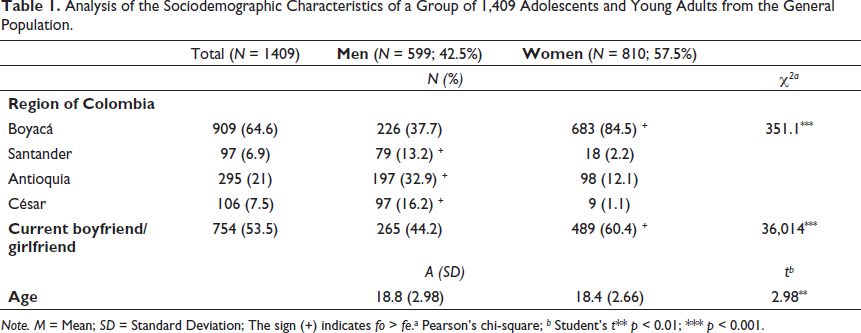
Note. M = Mean; SD = Standard Deviation; The sign (+) indicates fo > fe.a Pearson’s chi-square; Student’s t** p < 0.01; *** p < 0.001.
Analysis of the Differences Between Men and Women in Self-Esteem, Body Image, Violence Received and Inflicted.
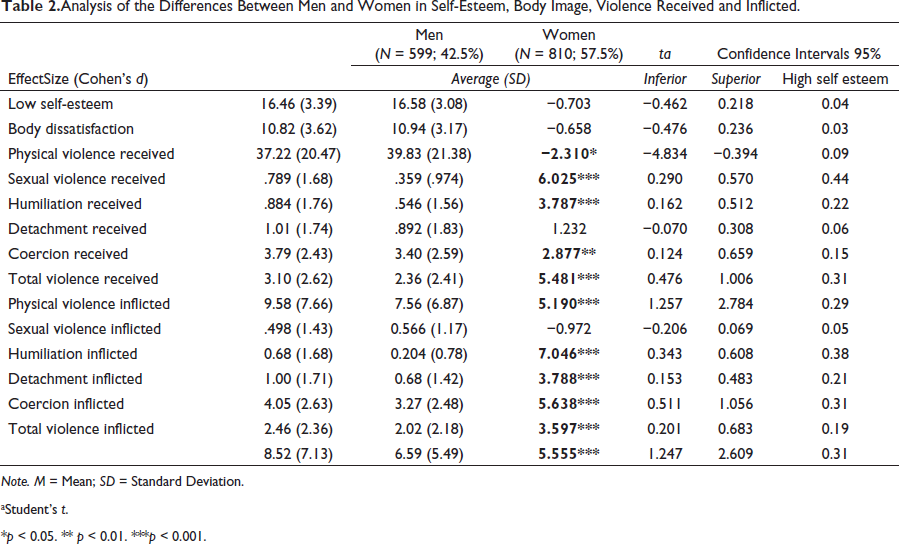
Note. M = Mean; SD = Standard Deviation.
aStudent’s t.
*p < 0.05. ** p < 0.01. ***p < 0.001.
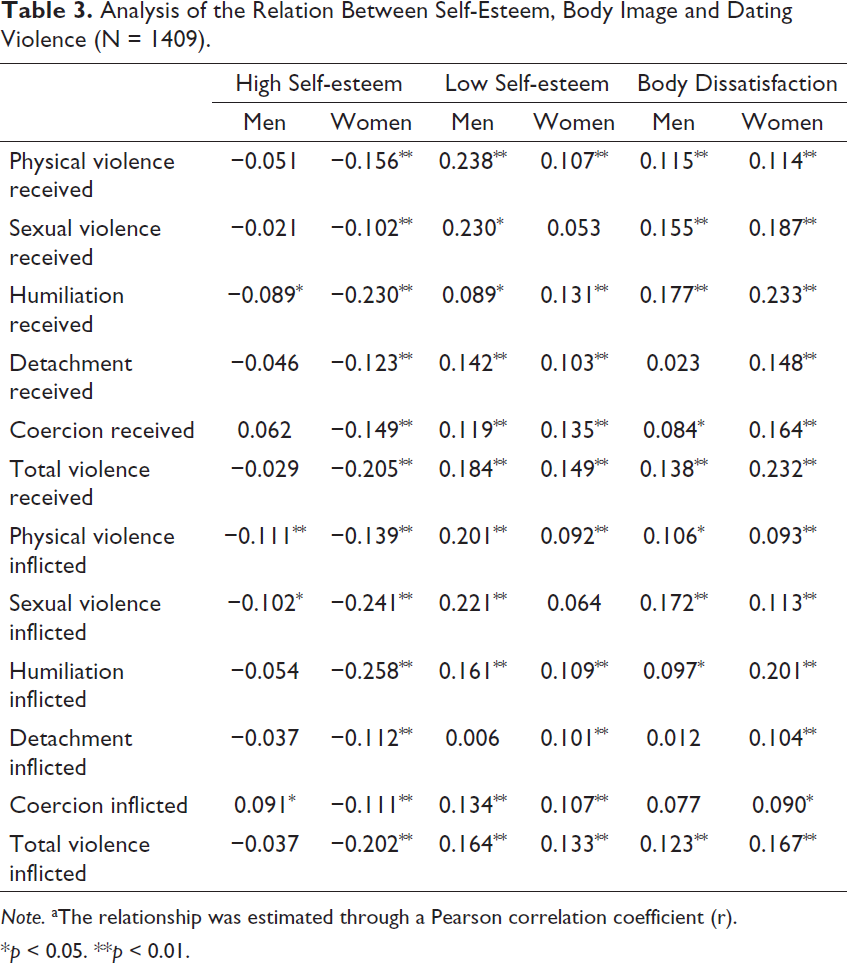
Regarding the analysis of the relationship between self-esteem, body image, and dating violence by sex, carried out through Pearson’s correlation coefficient, it was found in women that low self-esteem is positively and significantly correlated with the violence received and exercised of a physical nature, humiliation, detachment, and coercion. Likewise, it was found that high self-esteem is negatively and significantly correlated with all types of violence, both exerted and received. In relation to body dissatisfaction, all variables of violence received and inflicted that were analyzed were positively and significantly correlated in a weak manner with body dissatisfaction in women (Table 3).
Analysis of the Relation Between Self-Esteem, Body Image and Dating Violence (N = 1409).
Note. aThe relationship was estimated through a Pearson correlation coefficient (r).
*p < 0.05. **p < 0.01.
As for men, low self-esteem was directly and significantly correlated, albeit weak, with all forms of violence received and with physical, sexual, humiliation, and coercion exerted violence. Similarly, body dissatisfaction was positively and significantly correlated with violence received of physical, sexual, humiliation, and coercion; with the violence exerted, it was correlated with physical, sexual, and humiliation.
Multivariate Analysis
Using multiple linear regression analysis, for both men and women, various models based on individual-level variables (low self-esteem, body dissatisfaction, and violence) were examined within the framework of the ecological model, which could predict violence received in the engagement.
For the group of men, five of the six proposed models were made up of two predictor variables associated with the risk of being a victim of DV. In this way, physical violence received model retained the variables of physical violence inflicted (β = 0.77, SE = 0.030, 95% CI = 0.813–0.930) and low self-esteem (β = 0.08, SE = 0.012, 95% CI = 0.011–0,057), explained 61% of the variance. In contrast, the model of sexual violence received was estimated, and the following variables remained: sexual violence inflicted (β = 0.73, SE = 0.029, 95% CI = 0.717–0.831) and low self-esteem (β = 0.06, SE = 0.014, 95% CI = 0.006–0.059). Likewise, this model explained 56% of the criterion variance. Furthermore, the humiliation model retained the variables of inflicted humiliation (β = 0.73, SE = 0.028, 95% CI = 0.69–0.800) and body dissatisfaction (β = 0.10, SE = 0.002, 95% CI = 0.004–0.013). The model explained 56% of the criterion variance, showing collinearity indices close to 1. Subsequently, the variables of detachment inflicted (β = 0.68, SE = 0.027, 95% CI = 0.585–0.693) and low self-esteem (β = 0.12, SE = 0.020, 95% CI = 0.044–0.122) were retained in the model of violence by detachment, which explained 48% of the variance of criterion 1. In the coercion violence model, the variables of inflicted coercion (β = 0.74, SE = 0.030, 95% CI = 0.761–0.882) and body dissatisfaction (β = 0.10, SE = 0.013, 95% CI = 0.024–0.073) were retained, explaining 56% of the criterion variance. The model of total violence received retained the variables of total violence inflicted (β = 0.86, SE = 0.02,1 95% CI = 0.864–0.946), body dissatisfaction (β = 0.06, SE = 0.026 95% CI = 0.036–0.140), and low self-esteem (β = 0.06, SE = 0.042 95% CI = 0.056–0.221). This model explained 61% of the criterion variance, the highest in men of all the models analyzed.
Multiple Regression Analysis of Variables Associated With the Risk of Being a Victim of Dating Violence.
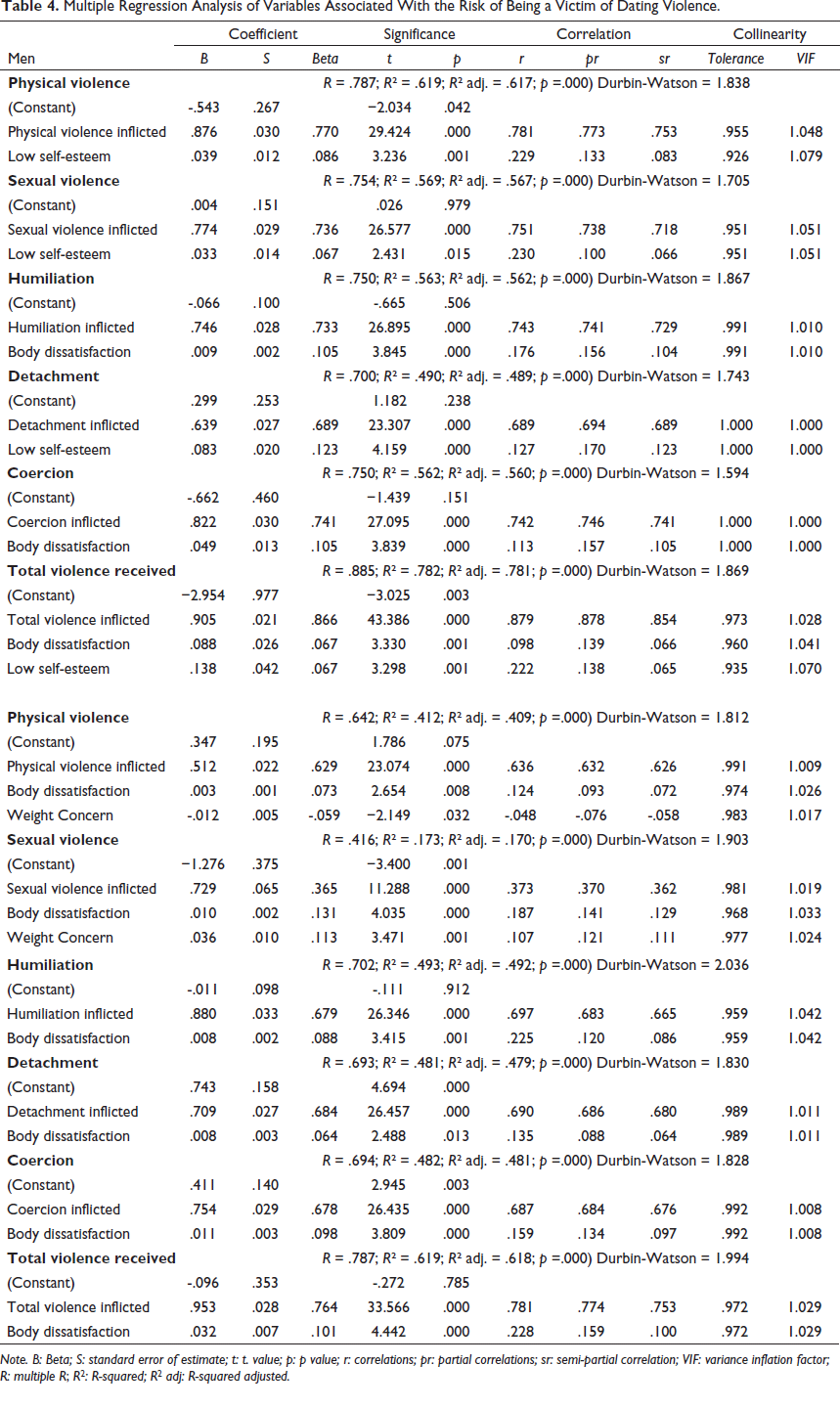
Note. B: Beta; S: standard error of estimate; t: t. value; p: p value; r: correlations; pr: partial correlations; sr: semi-partial correlation; VIF: variance inflation factor; R: multiple R; R2: R-squared; R2 adj: R-squared adjusted.
Moderated Mediation Analysis.
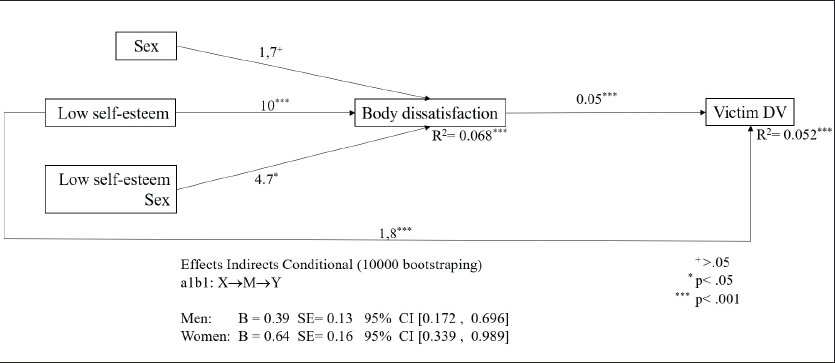
Regarding the second objective, which was to check if sex moderates the relationship between low self-esteem and body dissatisfaction and, in turn, if body dissatisfaction mediates the effect of low self-esteem on being a victim of DV, a (linear) association was found between the direct effect and the moderating variable, therefore, the indirect effect is moderated by gender for both men and women, as the sign of the index is positive, it means that the indirect effect occurs among people who have low self-esteem.
In this way, the integrated effects of low self-esteem, body dissatisfaction, and being a victim of DV revealed that low self-esteem exerts a statistically significant effect on DV victimization and body image dissatisfaction. Likewise, a significant interaction of low self-esteem with sex is shown in body image dissatisfaction. In turn, there is a significant effect of body dissatisfaction with being a victim of DV in the model. Finally, a moderate conditional indirect effect of low self-esteem in DV victimization (R2 = 0.052***) is verified through body dissatisfaction, being higher in women than in men (Preacher & Kelley, 2011; see Figure 1)
Moderated mediation model for prediction of DV with individual level variables of the ecological model.
Discussion
Dating violence is currently considered a public health problem, affecting mental and physical health (Exner-Cortens, et al. 2017; Natera et al., 2004). It is configured as a phenomenon influenced by both individual and sociocultural factors. This research had two objectives; the first was to establish if individual characteristics (low self-esteem, body dissatisfaction, and violence) within the ecological model framework could predict the violence received in dating. The second was to check if the sex moderates the relationship between low self-esteem and body dissatisfaction, in turn, if body dissatisfaction mediates the effect of low self-esteem on being a victim of DV. When comparing the frequency of violent behaviors in men and women, it was found that men report a significantly higher average of behaviors received of physical, sexual violence, detachment, and coercion from their partner. However, they also reported having exercised a significantly higher average of sexual violence, humiliation, detachment, and coercion towards their partner.
These results are partially consistent with those obtained in research carried out in other countries, such as those reviewed by Rubio-Garay et al. (2017) and Wincentak et al. (2017), which indicates that a higher proportion of men inflict sexual violence but a higher proportion of women inflict physical and psychological violence (Rubio-Garay et al., 2017; Ybarra et al., 2016).
The results also show statistically significant differences between men and women in relation with body dissatisfaction, which is inconsistent with the results of previous studies that women have greater dissatisfaction with body image (e.g., González-Carrascosa et al., 2013; Ramos et al., 2016).
These differences may be because social standards show thinness as a symbol of beauty, being valued positively. At the same time, fat is associated with factors of failure and social rejection, having a greater impact on the body image of women, such as shown by some studies (Ramos et al., 2003; Ramos et al., 2016; Puhl et al., 2017). Besides, another variable that could be associated is the stage of adolescence, where physical changes occur that increase concern for their body image in adolescents, reflecting in many cases low self-esteem, especially in women (De Ruiter et al., 2019).
Concerning being a victim of dating violence, the results in this research indicate a linear relationship in individual variables of the ecological theory such as low self-esteem, body dissatisfaction, and perpetration of violence, which explain dating victimization. These results agree with those of previous research, which indicates that perpetrating violence in dating relationships is configured as a situational factor, making it more likely that a member of the couple is a victim when they have previously engaged in violent behaviors in their relationship (Riggs & O’Leary, 1989; Rubio-Garay et al., 2015; Ulloa & Hammett, 2016).
Therefore, it is considered that the violence exerted is a predictor of the violence received (Fernández-González et al., 2017; López et al., 2012). Regarding self-esteem, it is one of the variables that has been related with greater consistency in the study of BV (Pflieger & Vazsonyi, 2006; Preble et al., 2018; Van Ouytsel et al., 2017). Finally, a correlation has been found between body image and DV victimization (Farhat et al., 2015). The previous findings verify the first hypothesis of this study, where it was proposed that adolescents who have low self-esteem, dissatisfaction with their body image, and who have engaged in violent behaviors, are more likely to be a victim in their relationship because young people with low self-esteem are more susceptible to tolerating abusive dating relationships.
Regarding the second hypothesis of this research, it was found that there is an effect of low self-esteem on victimization in DV, which is mediated by body dissatisfaction and has a moderate interaction due to low self-esteem and the condition of being a man or woman. This moderate measurement model could be related to the systems (ontogenic, microsystem, exosystem, and macrosystem) of interaction and the characteristics of the environment where dating violence occurs.
In the specific case of the study variables, it could be thought that adolescents who have individual characteristics such as low self-esteem and body dissatisfaction affect in a certain way the relationship with their microsystem and exosystem and increase the probability of being a victim. It is of special relevance in this study to understand that self-esteem and body image are assessments that each person makes about herself, based on her thoughts, sensations, and feelings, built with the interaction with her environment (microsystem, exosystem, and macrosystem). Therefore, it could be thought that adolescents who are victims of violent behaviors in their relationship allow them because they consider or perceive themselves as people who are not attractive in front of social standards, incapable of defending themselves and expressing themselves before the fear of doing anger their partner, which would lead to the acceptance of this type of violent behavior (Ackard & Neumark-Sztainer, 2002; Leen et al., 2013; Moral et al., 2017; Rubio-Garay et al., 2015).
Therefore, professionals who provide mental health services to adolescents and young adults subjected to DV should consider examining and/or intervening in self-esteem as well as other variables that have been consistently related to mistreatment in courtship, such as consumption of psychoactive substances, symptoms of anxiety, and depression (see Rubio-Garay et al., 2015). The strengthening of self-esteem should be considered in campaigns to prevent this form of violence and, presumably, campaigns on body image perception, although more studies are needed of the relationship between this and DV. However, since the correlations were weak, it is possible that other variables playing a role in the relationship between DV, self-esteem, and body image should be examined in further studies.
The sample size, the participation of men and women, and the use of previously validated instruments in Colombia are among the strengths of this study. As weaknesses, the correlational nature of the study should be mentioned, since it does not allow us to determine whether the variables examined are risk factors and/or consequences of the DV; the participation of students, because it limits the generalization of the results to out-of-school adolescents and young adults; and the self-report nature of the instruments employed, as they are susceptible to biases generated by the limitations of human memory and social desirability.
Footnotes
Declaration of Conflicting Interests
The author(s) declared the following potential conflicts of interest with respect to the research, authorship and/or publication of this article: The research team declares that it does NOT have conflicts of interest of a personal, family, intellectual, or financial nature that could inappropriately influence the process and the results of this study.
Funding
The author(s) received no financial support for the research, authorship and/or publication of this article.

Author Biographies
César is also a senior researcher in MinCiencias, Colombia. He is interested in study dating violence in adolescents and young adults.