



Abstract
The present study examines participant attitudes regarding whether a victim of IPV should forgive an offending partner and whether they should stay or leave a violent relationship. A total of 562 participants completed the study, which entailed responding to factorial vignettes online. Participants were primarily heterosexual, female, non-Latino, and White, with an average age of 21.75. Using logistic regressions, participants were significantly more likely to think the victim should forgive the perpetrator if the perpetrator was female and for less severe acts of aggression. Multinomial logistic regressions found that respondents were significantly less likely to state “yes” or “it depends,” compared to “no,” as to whether the victim should leave the relationship when the aggression was more severe and were more likely to say a male victim should stay in a violent relationship than a female victim. Qualitative analyses found three main themes regarding whether a victim should forgive: (1) context matters; (2) forgiveness is best … with caveats; and (3) questioning how often violence had occurred. With regard to whether a victim should leave an aggressive relationship, two main themes emerged: (1) situation matters … especially the relationship context and (2) questioning whether the violence had occurred before. This study provides insight into attitudes, by those external to a couple, regarding forgiveness and leaving a relationship after an instance of relationship aggression and has implications for both practitioners and policymakers. The constructed views about leaving a relationship may spill over into decisions regarding whether to implement policy surrounding IPV. Practitioners should also be cognizant of the varying definitions of forgiveness when working with clients who have experienced IPV as a practitioner’s definition of forgiveness may not necessarily align with a client’s definition.
Keywords
Attitudes about staying in a relationship and forgiving, especially by those who are external to the couple, are relevant because personal beliefs about what to do in a relationship both inform and are informed by normative beliefs and cultural attitudes about what should be done (Gergen, 1994). Studies have also shown the importance of attitudes about IPV, with attitudes about IPV being linked to actual incidences of IPV (Gage & Hutchinson, 2006; Johnson & Das, 2009). Graffunder et al. (2004) have noted that it is necessary to have an understanding of attitudes toward violence as these attitudes can help to have an understanding of the social context and norms surrounding IPV. According to social constructionist theory, individuals’ views about the world are based on perceptions that are partly derived from received truths: “Individuals are born into a society that has already ascribed meaning and helped shape our sense of self, even before we develop the power of speaking our subjective truth” (Puig et al., 2008, p. 141). These received truths are reflected in general attitudes, which may inform attitudes regarding forgiveness and staying or leaving a relationship after an act of IPV has been committed. Taken together, how the collective group views IPV has implications for how individuals who experience IPV may react to the offense. Therefore, gaining an understanding of how those outside the relationship view IPV may have ramifications for how an individual who experiences IPV may react. In this study, we examined outsider attitudes regarding whether a victim of IPV should or should not forgive the offending partner and whether they should stay or leave the violent relationship. Throughout this article, we use the term “outsider attitudes” to refer to the perceptions of those who are not members of the couple.
For this article, we are defining IPV as any act of psychological or physical aggression against a romantic partner. Psychological aggression includes verbal abuse, threats, and yelling. Physical aggression includes minor non-contact acts (e.g., throwing items, trashing a room), minor contact (e.g., slapping, pushing), and severe contact (punching, assault with a weapon). Physical and psychological violence are conceptually different in action and in some outcomes (e.g., psychological violence cannot result in physical injury). Otherwise, psychological and physical violence are similar with regards to victim mental health outcomes. Both are associated with PTSD, depression, and low self-esteem (e.g., Bogat et al., 2003; Spencer et al., 2019).
Gaining an understanding of the attitudes that individuals external to the couple hold regarding whether victims of an act of aggression should forgive or not, or if they should leave or stay in a romantic relationship, can help to clarify the social contexts within which victims and their offenders make judgments about what to do in their own relationships. Uncovering these attitudes may also be helpful for social policymakers and practitioners working with individuals who have experienced IPV (Yamawaki et al., 2012). For example, policies do not always align with challenges individuals are facing. If attitudes about leaving are more complex, contradictory, or ambiguous than, “They should just leave”, then helping victims, practitioners, and policymakers understand cultural attitudes more fully may help reduce inadequate practices and policies for victims. Similarly, gaining knowledge about cultural attitudes regarding forgiving aggressive romantic partners would provide practitioners information about the social frameworks within which romantic partners make decisions about whether to forgive, or to seek forgiveness, after an act of aggression.
Attitudes About Forgiving After an Aggressive Act
Attitudes about forgiveness by individuals not directly involved in the aggression (i.e., outsiders such as friends or family) may influence whether a person experiencing aggression forgives the partner because victims may look to friends or family for advice about what to do. Forgiveness can be defined in several ways. In this article, we specifically focus on forgiving in response to an offense (e.g., IPV), which is typically defined as a reduction in avoidance and revenge, and increases in benevolence (e.g., feelings of goodwill) toward the offender (McCullough et al., 1998). However, in accordance with social constructionism, which guided the present study, we allowed participants to construct their views of what forgiveness entails after an offense.
Reconciliation and empathy are two constructs with links to forgiveness. Empathy entails being able to see the perspective of another individual and is one of the strongest correlates of forgiveness (Riek & Mania, 2012). In the case of forgiveness, being empathetic toward the perpetrator entails a greater likelihood of forgiveness. This is not synonymous with excused behavior, but rather empathy warrants an understanding of why a perpetrator behaved in the manner they did. To forgive or not creates a paradox—forgiving another person makes one feel better (e.g., Toussaint et al., 2008) and yet, forgiving may increase the likelihood of future violence (e.g., Tsang & Stanford, 2007). Therefore, reconciliation comes into play with forgiveness. IPV scholars have deemed forgiveness and reconciliation as separate constructs (e.g., Freedman, 1998; Freedman & Enright, 1996), but in the social constructions of the public, these constructs may be intertwined when thinking about IPV. Widespread social constructions of forgiveness in intimate partner aggressions may instead follow Baumeister et al.’s (1998) supposition that forgiveness may help to perpetuate bad behavior. While forgiveness does not require reconciliation, there may be a concern that forgiving an abusive partner may lead to staying with an abusive partner. As such, we expected participants to note empathy and reconciliation in their responses.
Gender also plays a role in forgiveness. Women may be more prone than men to forgive abuse because forgiving is seen as part of a constellation of feminine traits that promote relational stability and satisfaction, part of the women’s domain (MacLachlan, 2009). Indeed, women forgive more frequently than do men (Miller et al., 2008; Toussaint et al., 2008). Cultural expectations that women should forgive can be problematic for women in violent relationships—women who forgive abusers are often depicted by others as troubled and “failing” because “…such women cannot possibly forgive and meanwhile possess (let alone express) self-respect” (MacLachlan, 2009, p. 194). Attitudes extant in the general culture create an additional paradox—women are expected to be forgiving but may be seen as stupid or weak if they forgive an abusive partner. Uncovering the meanings that individuals ascribe to forgiveness may help to unpack these gendered paradoxes.
Little research has been done regarding outsiders’ attitudes regarding forgiveness of a perpetrator for less severe acts of aggression. The current study will use vignettes depicting varying levels of violence (i.e., yelling, throwing a drink, slapping, and punching). To our knowledge, little research exists that assesses outsider attitudes about forgiveness in the context of aggressive behaviors. One of few notable exceptions is a study by Gauché and Mullet (2005) that used a series of vignettes to examine participants’ views on whether forgiveness was favorable or unfavorable in cases of aggression in the workplace and during a soccer match. They specifically included five vignettes: (a) attitudes of others about forgiveness, (b) social proximity, (c) cancelation of consequences, (d) apologies, and (e) intent to harm. Relevant to the present study, they found that participants found forgiveness more favorable when they were encouraged to forgive by those socially close to the individual. The present study extends upon these findings by: (a) examining violence in romantic relationships, (b) asking participants what the victim should do rather than what the participant would do, and (c) using a mixed-methods framework to include open-ended (i.e., qualitative) and quantitative responses.
Attitudes About Staying or Leaving
Research on deciding to leave romantic relationships often has centered on commitment and investment in the relationship as primary factors in whether an individual remains in the relationship (Rusbult, 1983; Rusbult & Martz, 1995). The investment model posits that people who have greater relationship satisfaction, stronger commitment, more alternatives (e.g., other available partners, a desire to be single), and larger investments in the relationship are less likely to leave a romantic partner (Rusbult, 1983; Rusbult & Martz, 1995). Individuals who are more committed to the relationship are less likely to leave abusive partners, even when satisfaction is lower (Rusbult & Martz, 1995).
Psychological abuse also has been associated with higher relationship investment (Edwards et al., 2011). Follingstad et al. (2012) found that women who experienced physical and sexual abuse in addition to psychological abuse had similar relationship investment levels compared to women who only experienced psychological abuse, emphasizing how psychological abuse is also linked to higher relationship investment. Higher investment was primarily associated with more self-sacrificial and self-punitive behaviors combined with a desire for connection over isolation (Follingstad et al., 2012) as well as psychological distress and avoidance coping (Edwards et al., 2011).
Commitment and time investment also may affect whether an individual chooses to leave an abusive situation. Women in long-term abusive relationships used more sacrificial behaviors than women in newer romantic relationships (Katz, Tirone, & Schukrafft, 2012). Similarly, women in long-term abusive romantic relationships were more committed when they lacked a positive support system, saw themselves as dependent and incompetent, had more attachment anxiety, and were more neurotic (Follingstad et al., 2012). Interestingly, in this study, which focused on women in abusive relationships, there was a large group of women who had high to moderate levels of commitment who did not match any of the above descriptors, and who were in relationships lasting 17–20 years on average. Therefore, we propose that outsiders’ attitudes about whether an individual should leave after an aggressive act may include the investment model factor of how long the couple has been together and other factors related to commitment (e.g., feelings of attachment to the partner). Outsiders may view relationship investments and commitment as important when considering whether an abused individual should continue a relationship.
It also may be that the severity of the aggressive act is relevant when forming attitudes about leaving or staying. For instance, it may be seen as normative for romantic partners to raise their voices during a disagreement, so yelling may not be an action worthy of ending the relationship. Physical aggression (e.g., hitting, kicking) may elicit a different response and, for some individuals, may be reason enough to think the relationship should be ended. Gender of the aggressor and the victim also may be part of the relevant social context—attitudes about men’s acts of aggression may be seen as more egregious than women’s, in part because men are often larger and stronger and the threat of men’s physical violence may be seen as having greater costs (e.g., injury) than when women are the aggressive partners (Nazroo, 1995). When asked about gendered aggression in the context of violence, most people believe women are less likely to use physical violence and more likely to be verbally aggressive than men (Rolfe et al., 2006).
Present Study
The present study examined attitudes about forgiveness and leaving a relationship after aggression in a public setting. We specifically focused on attitudes by those external to the couple (i.e., outsider attitudes). The study builds upon previous research (Ermer et al., 2021; Roach et al., 2020). The research questions were: (1) Does the level of violence (i.e., yelling, throwing a drink, slapping, punching) affect outsider attitudes about whether or not a victim should forgive?; (2) Does the level of violence affect outsider attitudes about whether or not a victim should leave a violent relationship?; (3) Does the gender of the aggressor affect outsider attitudes about forgiving the aggressor and leaving a violent relationship?
Method
Participants
The 562 participants were part of a larger study that examined attitudes regarding aggression (see Ermer et al., 2021). The respondents were primarily heterosexual (94%), female (67%), non-Latino (96%), and White (75%). A total of 13% identified as Black/African American. Participants ranged between the ages of 18 and 70 (M = 21.75, SD = 7.05).
Procedure
Recruitment predominantly took place via a weekly university announcement and in classrooms at a large Midwestern University. Respondents also were recruited via Facebook through a university department’s page and personal pages. Respondents clicked on a link that led to a Qualtrics survey. Respondents then gave electronic consent and completed the survey.
Study Design
Multiple segment factorial vignettes (MSFV) is an experimental design that enables researchers to manipulate independent variables within a hypothetical scenario (Ganong & Coleman, 2006). MSFV designs allow participants to share their attitudes about a situation without having to respond to how they personally would act or think. Therefore, MSFVs are meant to assess pure attitudes rather than socially desirable ones. A MSFV design contains a series of vignettes and segments of additional information and questions within the vignettes.
Segments and Response Options Within Vignette 1 in the Present Study.
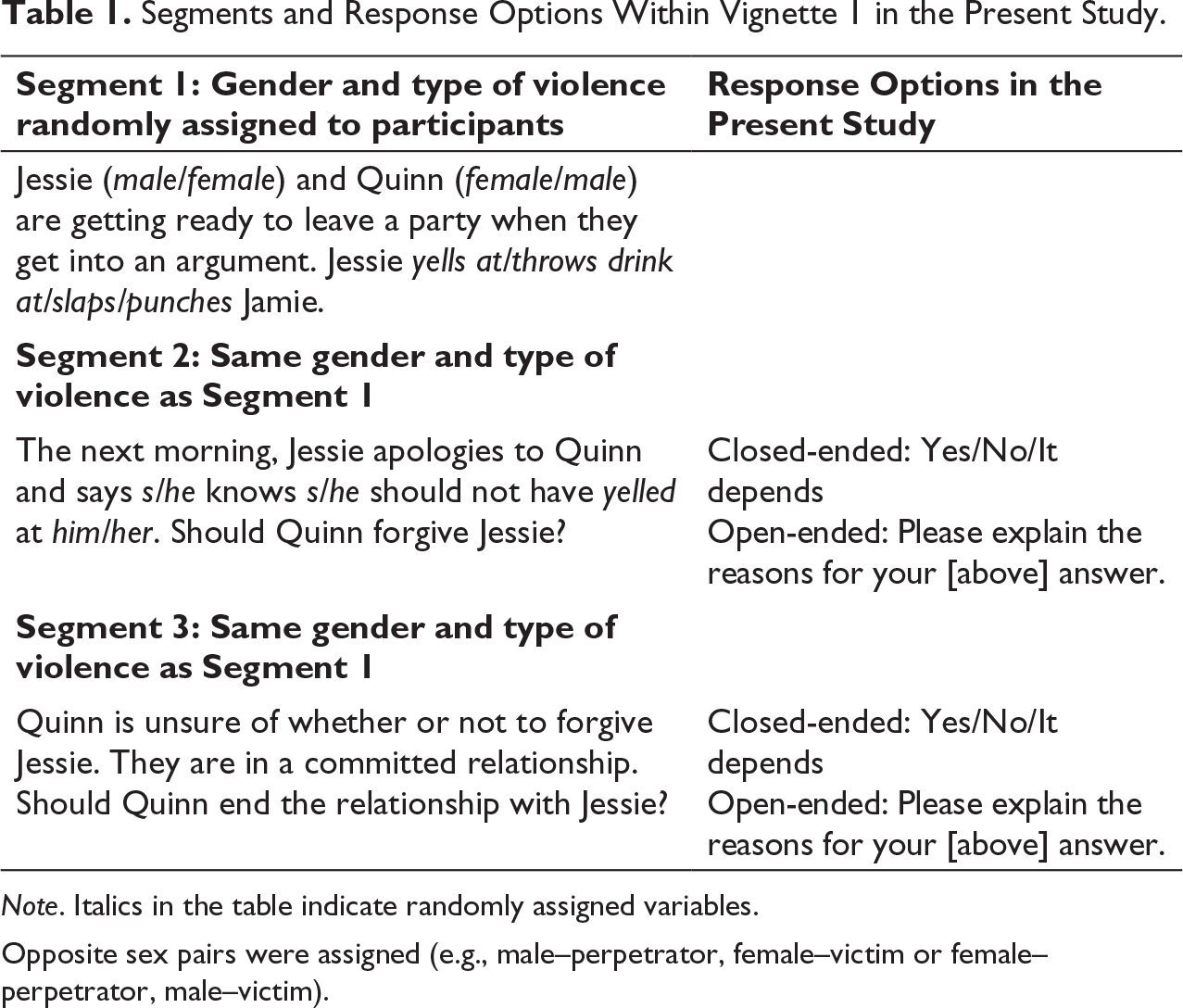
Note. Italics in the table indicate randomly assigned variables.
Opposite sex pairs were assigned (e.g., male–perpetrator, female–victim or female–perpetrator, male–victim).
Gender and severity of violence were randomly assigned in the Qualtrics survey. Participants either received a vignette where the perpetrator of IPV was (1) male or (2) female. The vignette also randomly assigned the type of IPV used: (1) yelling, (2) throwing a drink, (3) slapping, or (4) punching. Therefore, the study used a 2 (gender) × 4 (level of violence) MSFV design for a total of eight manipulation possibilities. The relationship was portrayed as heterosexual (i.e., opposite-gender couples) in every instance to prevent the sexuality of the couple from being a primary variable of consideration. Acts of violence and perceived severity were based on the Revised Conflict Tactics Scale (Straus et al., 1996). Yelling was chosen to represent psychological violence, throwing a drink represented a non-contact act of physical violence, slapping was a minor physical act of violence, and punching was a severe act of violence.
Demographic Information of Participants in Each Group.
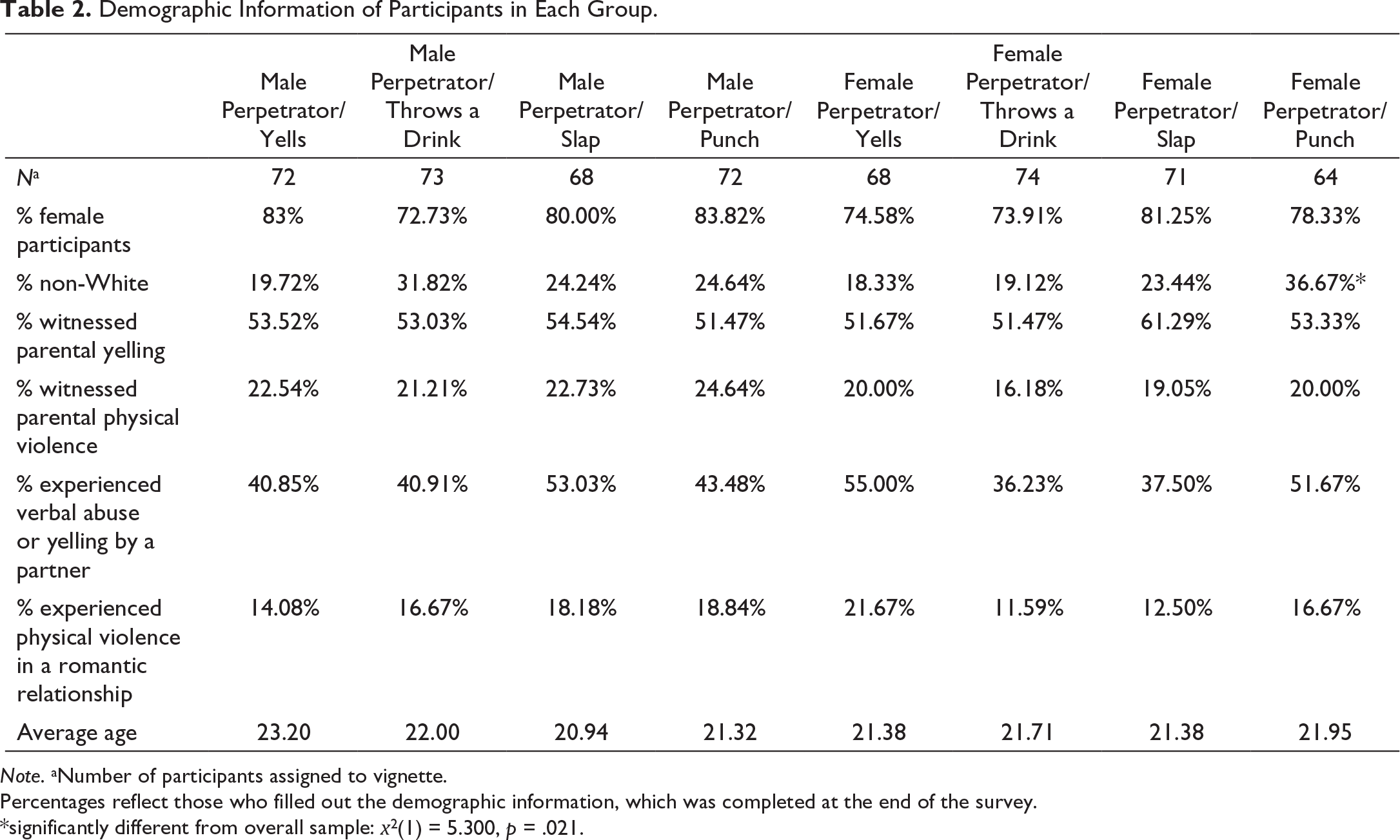
Note. aNumber of participants assigned to vignette.
Percentages reflect those who filled out the demographic information, which was completed at the end of the survey.
*significantly different from overall sample: x2(1) = 5.300, p = .021.
In segment one, the independent variables were gender of the perpetrator and level of violence: “Jessie [male (or female)] and Quinn [female (or male)], are getting ready to leave a party when they get into an argument and Jessie slaps (or yells or throws a drink at or punches) Quinn.” Results from segment one were published in Ermer et al. (2021). Participants were directed to a new screen with segment two, which continued with the addition of an apology: “The next morning Jessie apologizes to Quinn and says he (or she) knows he (or she) should not have slapped her (or him). Should Quinn forgive Jessie?” Closed-ended options to answer the question were yes, no, and it depends, which was followed by a prompt to “explain the reasons for your answers” and a text box for participants to write in their answers. Once completed, respondents were directed to a new screen with segment three. It is revealed that the couple is in a committed relationship: “Quinn is unsure of whether or not to forgive Jessie. They are in a committed relationship. Should Quinn end the relationship with Jessie?” which was followed by the same closed-ended options and open-ended options given in segment two.
Analytical Plan
Logistic regressions were conducted in SPSS for each segment of the closed-ended responses. We selected logistic regressions as our analytical choice because the outcome variable was categorical since participants responded with “yes,” “no,” or “it depends” to the questions on forgiveness and leaving a relationship. It is recommended that logistic regressions be used when an outcome variable is categorical (e.g., Smithson & Merkle, 2013). Odds ratios were used to understand the logistic regression findings (Szumilas, 2015). Odds ratio values closer to one indicate that an effect has a smaller magnitude. Odds ratios less than one, such as .25, indicate that the variable of interest is “associated with lower odds of outcome” whereas odds ratios greater than one, such as 1.34, are “associated with higher odds of outcome” (Szumilas, 2015, p. 227).
We conducted a total of two logistic regressions (see Table 3). The first binomial logistic regression asked, “Should Quinn forgive?” The second multinomial logistic regression asked, “Should Quinn leave the relationship?” These two questions served as the dependent variables, with participants responding “yes,” “no,” or “it depends” (see respective results sections for additional details on outcome variables). In both logistic regressions, respondent race, respondent gender, respondent age, whether the respondent had experienced yelling or physical violence at home, and whether the respondent had experienced yelling or physical violence in a romantic relationship were all included as covariates. The type of violence (yell, throws a drink, slap, or punch) and the perpetrator’s gender (male, female) were entered into both equations as independent variables. For type of violence punch served as the reference group and male served as the reference group for perpetrator gender.
Odds Ratios of Whether Forgiveness Should Occur (N = 501) or Whether Quinn Should Leave the Relationship (N = 499).
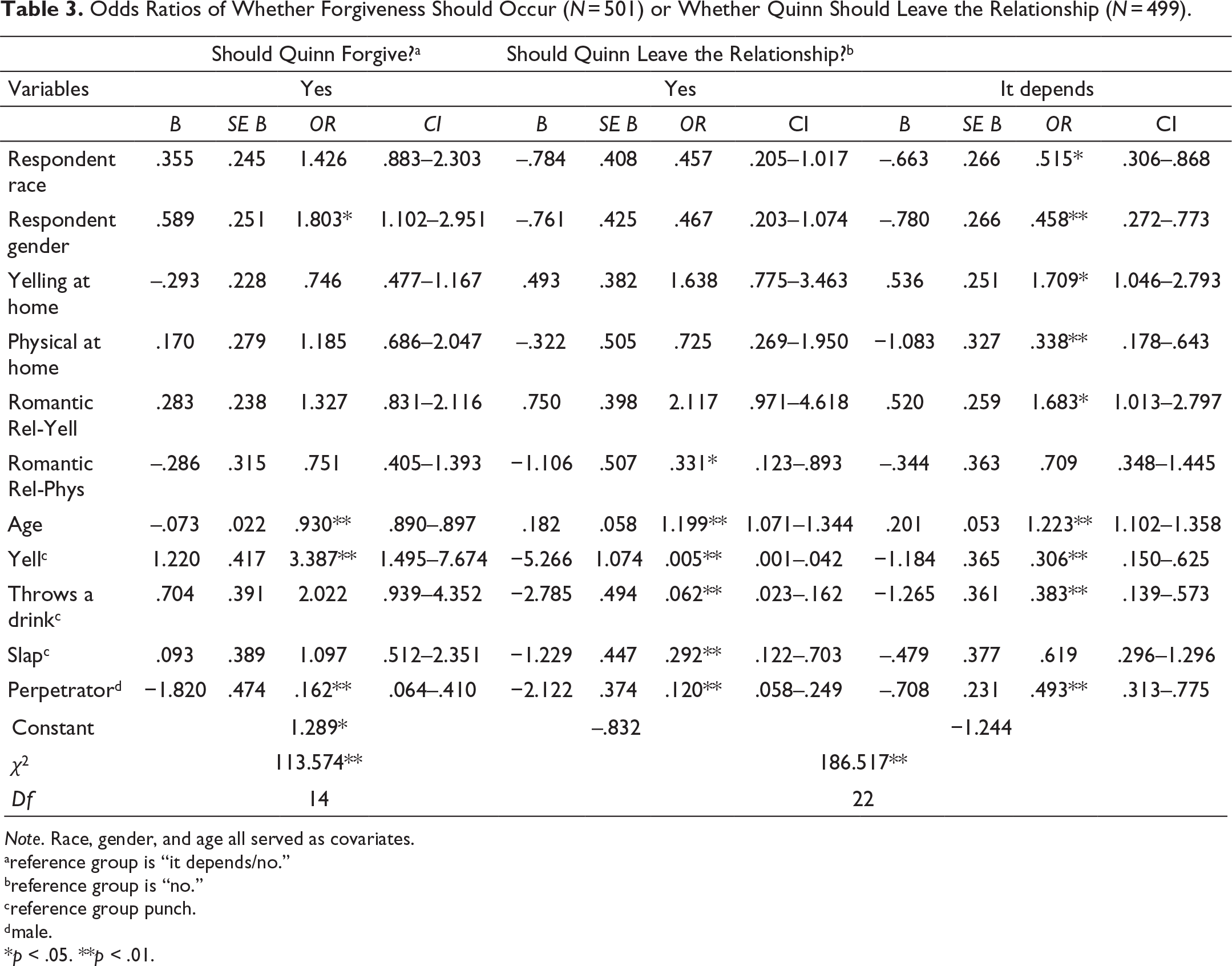
Note. Race, gender, and age all served as covariates.
areference group is “it depends/no.”
breference group is “no.”
creference group punch.
dmale.
*p < .05. **p < .01.
Written responses were coded using an inductive coding scheme. A member from the research team created initial codebooks using the inductive approach since there was no existing codebook (Thomas, 2006). This first step created codes using the respondents’ words to summarize the main themes seen in their responses (Thomas, 2006). Two other researchers then independently coded the written responses using the codebooks. The second step involved two researchers who discussed individually coded responses, code definitions, discrepancies in coding, overlaps in coding, and links between the codes and research questions (Thomas, 2006). Disagreements were resolved via consensus. The third step involved combining codes with shared meanings to create themes that represented the prevalent and often shared constructs and topics which were observed in the written responses (Thomas, 2006). As before, one member of the research team created the themes from the initial codes, and then other research team members independently examined the codes and themes. Disagreements between team members were discussed until consensus was reached.
Results
In line with other mixed-methods research, the results section is written so the quantitative and qualitative results from segment two (forgiveness) were sectioned together and the results from segment three (commitment) were included together. Quality mixed-methods research allows the benefits of both quantitative and qualitative research to inform the topics of interest in an integrated and meaningful way (Creswell & Tashakkori, 2007). As such, it is necessary to present the quantitative and qualitative findings together rather than in separate sections.
Forgiveness in the Context of IPV
Segment two asked whether the victim should forgive the perpetrator with closed-ended responses of “yes,” “no,” and “it depends.” Only 59 respondents (10.5%) did not think the victim should forgive. In contrast, 243 respondents (43%) stated the victim should forgive. Consequently, since there were so few “no” responses, the answers “no” and “it depends” were combined and served as the reference group along with “punched” (level of violence) and “male” (perpetrator) in the binomial logistic regression analysis. Participants were significantly less likely to think the victim should forgive the perpetrator if the perpetrator was male (OR = .162, p < .001). Participants were more likely to think the victim should forgive if the perpetrator yelled (OR = 3.387, p = .003) as compared to a perpetrator who punched. There was no significant difference in attitudes about forgiveness between the perpetrator who slapped (OR = 1.097, p = .811; see Table 3) or threw a drink (OR = 2.022, p = .072; see Table 3) and the perpetrator who punched.
Participants were prompted to provide the reason(s) for their closed-ended responses and were provided a text box in which to write their responses (see Table 1 for study protocol). Participants open-ended responses were essentially describing why they chose their closed-ended response of “yes,” “no,” or “it depends.” Three themes were found in the qualitative analysis: (1) context matters; (2) forgiveness is best … with caveats; and (3) questioning how often violence had occurred. Themes are shown in Table 4.
Most Frequent Themes in Response to the Open-ended Questions.
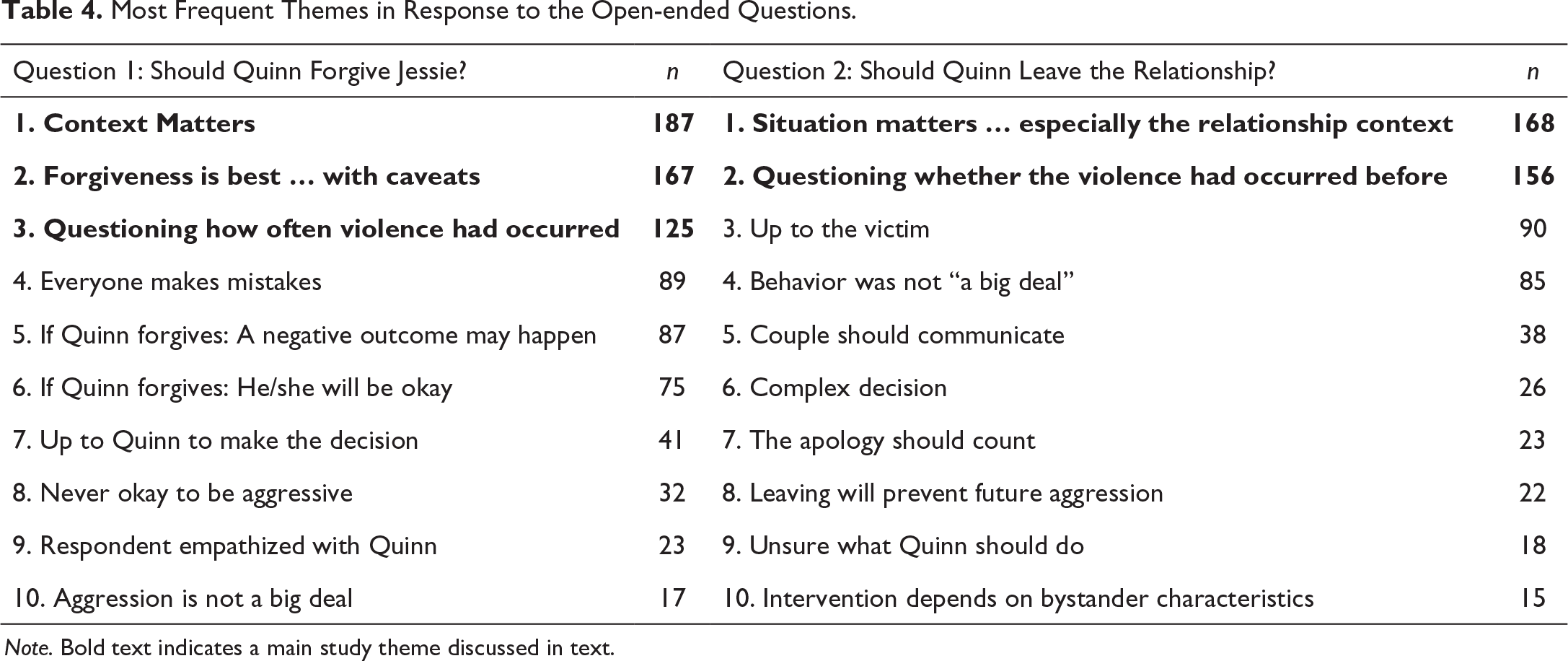
Note. Bold text indicates a main study theme discussed in text.
Context matters.
This theme (n = 187) referred to a variety of situational factors that respondents thought might influence the decision to forgive, such as strength of the couple’s relationship, severity of the aggression, and sincerity of the perpetrator’s apology. For example, a participant who received the female perpetrator, slapped version of the vignette stated, “Relationships are complex. People make mistakes. I cannot know enough to determine whether or not forgiveness is appropriate. Too many factors are involved for me to make this judgment.” The vignette described the perpetrator apologizing, so many participants were concerned about whether the apology was sincere. As evidenced by one respondent who received the female perpetrator, thrown drink version, “It depends on how sincere Jessie actually is and how bad the fight was and continued to be after throwing the drink.”
Severity of the aggression may be a strong factor regarding whether forgiveness should occur. Participants who read about more severe aggressions mentioned other situational elements less often, suggesting that they thought the aggressiveness of the act was enough justification to not forgive. When assessing whether forgiveness was merited, participants may deem the severity of aggression as more important compared to other situational factors.
Forgiveness is best … with caveats.
Overall, 167 participants thought forgiveness was the best course of action, with statements about the power of forgiveness and how one should “always forgive.” As one participant who had read the male perpetrator, thrown drink vignette noted, “Forgiveness is key to happiness.” Participants often stressed conditional forgiveness (i.e., conditions necessary before forgiveness occurs; Kelley, 1998). For example, a participant who received the male perpetrator, punch vignette stated, “…forgiveness should be given but she needs to break ties with him.” Many respondents who noted forgiveness is best also included empathetic responses. For example, a participant who received the female perpetrator, yell manipulation vignette discussed, “Couples get into fights. A lot of people act impulsively. If everyone I have yelled at before didn’t forgive me after … I’d be a lonely person.” Some participants believed forgiveness was best but recognized that forgiveness does not condone the behavior, nor does it mean the couple should stay together. One person who received the male perpetrator, punch vignette wrote, “She should forgive him so she doesn’t have to live with anger and for her own well-being, but she should never forget, and she should remove him from her life permanently.”
Questioning how often violence had occurred.
In this theme participants (n = 125) directly questioned whether the violent act was a one-time occurrence or whether it had happened repeatedly in the past. This theme was applied relatively evenly across gender and aggression types with the exception of the vignette versions in which a female perpetrator yelled at her partner; fewer respondents questioned how often the violence had occurred when the female was the perpetrator compared to when the male was the perpetrator. As noted by one participant, “It depends on how often she does it. If it is once in a blue moon and her apology is sincere, then yes. If she is always violent toward him, then no.”
Participants largely expressed concerns that forgiveness could perpetuate the violence. As noted by a participant who received the male perpetrator, punch vignette, “…if it was the first time he hit her then yes [she should forgive]. If this wasn’t the first time then no [she shouldn’t forgive], because he’s just going to do it again in the future even after apologizing.” Similarly, another participant who received the male perpetrator, punch manipulation stated, While she probably shouldn’t (your partner should NEVER hit you), I’d bet she does as couples let each other get away with a lot of things. However, if this is a common occurrence, she may be risking physical violence again if she doesn’t forgive him.
This theme has implications for the distinction between forgiveness and reconciliation as many participants discussed how the aggression might continue to occur if the victim was to forgive.
Leaving in the Context of IPV
Segment three asked if the victim should leave the perpetrator. A multinomial logistic regression was conducted to assess the likelihood that participants would respond “yes,” “no,” or “it depends” to the question regarding whether the victim should end the relationship. The response “no” served as the reference group. Respondents were significantly less likely to respond “yes” to the question, “Should the victim end the relationship?” when the aggression inflicted on the victim was yelling (OR = .005, p < .001), throwing a drink (OR = .062, p < .001), or slapping (OR = .292, p = .006) compared to punching. A similar pattern held for individuals who reported “it depends,” with the exception that there was no significant difference when the perpetrator slapped as compared to punched (OR = .619, p = .204). Respondents were less likely to say that a male victim should leave the relationship (OR = .120, p < .001) or “it depends” (OR = .493, p = .002; see Table 3) in comparison to “no” (i.e., respondents were more likely to say a male victim should stay in a violent relationship).
When respondents were asked “why” they selected their answer choice, counted codes indicated 107 participants (19.0%) thought that the victim should potentially stay in the relationship while 132 participants (23.5%) thought that the victim should leave. Individuals who commented that the victim should stay in the relationship were evenly dispersed across vignette versions, except a larger number who received the male perpetrator, punch vignette (n = 40) thought the victim should leave the relationship in comparison to other groups. Two main themes emerged in our analyses: (1) situation matters … especially the relationship context and (2) questioning whether the violence had occurred before (see Table 4). In addition, it should also be noted that roughly 1 in 6 participants thought that the decision to leave was up to the victim (n = 90) and did not view the behavior (i.e., yell, throw a drink, slap, or yell) as a “big deal” (n = 85).
Situation matters … especially the relationship context.
Situational factors relevant to the relationship itself were important when considering whether or not a person should leave. This theme occurred 168 times and encapsulated a number of factors, including the level of commitment (n = 34) and strength of the relationship between the couple (n = 113), which highlights situational factors relevant to the relationship itself are important when considering whether or not a person should leave. As noted by one participant who received the male perpetrator, thrown drink manipulation, “If they are in a committed relationship then they should know that couples go through things and it’s normal that they should work through them without giving up on the relationship.” Another respondent who received the male perpetrator, thrown drink manipulation wrote, “…they should give it time and talk it out. If they’re that committed, then taking time to think about things and cool down won’t affect them much.” As noted by an individual who received the female perpetrator, thrown drink manipulation, ”Relationships always have tension at times, but if they have a good relationship he will forgive her,” further elaborating how relationship factors may matter when considering whether a victim should leave.
Questioning whether the violence had occurred before.
Participants (n = 156) also wondered whether this was a recurring event or the first time that aggression had happened in the relationship. It should also be noted that this theme co-occurred with the situation matters … especially the relationship context theme 51 times. As noted by a participant who received the male perpetrator, thrown drink manipulation: It depends if this is a reoccurring trend with Jessie. Does he do things like this that are violent or mistreat Quinn then apologize for it later frequently? If this is a reoccurring habit for Jessie, then Quinn should consider leaving him because that is an abusive relationship and not good for Quinn to be in mentally, emotionally, or physically. If this is the first time it has happened or things like this rarely happen, she shouldn’t end the relationship because of it.
Discussion
This study provides insight into the attitudes of an outsider regarding forgiveness and leaving a relationship after an instance of relationship aggression. Respondents were more apt to think an individual should forgive a perpetrator for less severe aggressions and if the perpetrator was male. Similarly, in our regression analyses, respondents were more likely to think that the individual should leave the relationship when the perpetrator was male. Respondents also reported that the individual should leave the relationship when more severe aggressions took place. Some forms of aggression are not seen as behaviors to be concerned about (i.e., yelling, throwing drinks), while other behaviors merit concern (i.e., slapping, punching). This suggests that individuals believe it is acceptable to tolerate some level of relational aggression, as long as it does not reach the threshold of physical contact.
Gender of the perpetrator consistently affected attitudes about forgiveness and leaving a relationship in our regression analyses. Forgiveness tends to be associated with femininity (Norlock, 2008), which may also be why participants were less likely to respond that a male should be forgiven. Participants may be drawing upon the belief that men are more likely to harm women in acts of aggression and that forgiveness may perpetuate aggression more in males than females. Indeed, men are more likely than women to perpetrate acts of aggression that are severe (Johnson & Leone, 2005). Participants may have viewed a female as needing to leave the relationship for fear of her safety. However, it is detrimental for men to downplay female perpetrated acts of aggression. Men who experience acts of IPV perpetrated by a female may be less apt to leave a relationship if friends and family members do not take the IPV seriously.
Forgiveness
Participants were mixed about whether the victim should forgive in the quantitative findings. The qualitative findings provided some insight into why participants were unsure of whether forgiveness should have occurred. For example, the three main qualitative themes (e.g., forgiveness is best … with caveats, context matters, questioning how often the violence had occurred) imply some semblance of uncertainty by the participants. While we cannot fully understand why participants had such mixed viewed on whether forgiveness should occur in the context of this study, we can turn to prior literature to help explain this finding. It should be noted that the vignette included the perpetrator apologizing for his or her actions. Apologies are often viewed as increasing the likelihood of forgiveness (e.g., Eaton & Struthers, 2006; Gauché & Mullet, 2005), which may have influenced participants who stated that forgiveness should occur. The open-ended responses were fairly straightforward, with some emphasizing the importance of forgiveness in their responses. Our study indicated conditional forgiveness, forgiveness that is granted only after certain stipulations have been met, was common for participants who thought forgiveness was important. Conditional forgiveness has been associated with poorer health outcomes and mortality than other types of forgiveness (Toussaint et al., 2012) and, therefore, may not necessarily be the best course of action.
It is noteworthy that respondents expressed concerns regarding the potential for future aggression if the victim was to forgive. Interestingly, those who believed that forgiveness was important tended to disentangle both forgiveness and reconciliation from one another (e.g., “forgive but do not forget”). However, many who wondered if violence had previously occurred also had concerns about the aggression occurring again, alluding to the possibility of reconciliation if forgiveness was to occur. Given research that shows how victims are more likely to return to their abusers if forgiveness occurs (Tsang & Stanford, 2007), it does not come as a surprise that participants expressed concerns about abuse recurring after forgiveness. This finding aligns with the findings of Gilbert and Gordon (2017), who found that women who experienced severe abuse were more likely to forgive if they minimized the severity of the violence. Many participants focused on the victim needing to leave, ignoring forgiveness altogether in their open-ended responses. To these individuals, forgiveness may potentially be viewed as irrelevant in the situation because safety was a greater concern. The open-ended responses by participants exemplify how the meanings ascribed to forgiveness have ramifications for whether reconciliation should occur.
Social constructionism can serve as a framework to better understand the distinctions between forgiveness and reconciliation. How individuals operationalize the meaning of forgiveness may play into whether they view reconciliation as being a pre-requisite for forgiveness. This observation is largely based on responses from participants who gave responses that fell into the “questioning how often violence had occurred” theme, which stressed concerns regarding the safety of an individual if they forgave. To an extent, this theme implies that reconciliation with an abuser may be a concern if forgiveness occurs. Prior research has noted that many individuals tend to conflate forgiveness with reconciliation even though forgiveness does not necessarily require interpersonal interactions (Freedman & Chang, 2010). How individuals think about forgiveness and reconciliation may also be framed by collectivistic versus individualistic world views. Those who hold more collectivistic world views believe that interpersonal interactions are necessary for forgiveness to occur as compared to those with a more individualistic world view (Hook et al., 2012). A person with a more individualistic world view may ascribe to forgiveness as intrapersonal and occurring within the self; no reconciliation is needed. The associations between forgiveness and reconciliation merits further research. Scholars should be aware that individuals link reconciliation and forgiveness; scholars’ social constructions of these two terms may be different than the people being studied.
In summary, our results demonstrated that some individuals value forgiveness, even if they believe the violence can happen again. Participants who emphasized the importance of forgiveness often noted that the individual can forgive and still know the action (i.e., aggression) is not okay. Those who did not feel that forgiveness should occur had a predominant concern that forgiveness would condone the aggressive behavior. The complex view of forgiveness portrayed by participants may mean individuals may experience additional psychological burdens when making the decision to forgive should they ever be in a similar situation.
As noted by MacLachlan (2009), there is an expectation for forgiveness to occur, especially among women, yet forgiving may make an individual appear weak. The present study largely aligns with these points. Additionally, the expectation to forgive may place the burden of a transgression onto a victim (e.g., Burstow, 1992), which was a concern raised by participants in their open-ended responses. However, McKay et al. (2007) proposed that forgiveness, specifically forgiveness therapy, can align with a feminist framework as long as precautions are taken. As stated by McKay et al. (2007), “for forgiveness to be genuine female clients should view forgiveness as an informed choice they are making not a gender-related mandate” (p. 24). Additionally, when working with victims, practitioners should make sure to distinguish between reconciliation and forgiveness (Freedman & Enright, 1996). Our findings largely corroborate these stances due to the concerns raised by participants, but also emphasizes how forgiveness, when disentangled from reconciliation, may help individuals process experiences for themselves.
Leaving a Relationship
Much like with forgiveness, attitudes were decidedly mixed about whether a victim should leave the relationship, with slightly more than half (55%) of the study participants stating that the victim should leave. Participants were aware of multiple factors to be considered by an individual deciding whether to leave a relationship after a public act of relationship aggression. One of the most common open-ended themes aligns with the investment model (e.g., Rusbult & Martz, 1995). The theme, “situation matters … especially the relationship context,” includes main components of the investment model including relationship satisfaction, length of the relationship, and commitment as phenomena to consider regarding whether the victim should leave the relationship. In a review by Anderson and Saunders (2003), commitment and relationship satisfaction emerged as strong predictors of whether an individual left a relationship; therefore, it is not surprising that our respondents mentioned these. Interestingly, alternatives to the relationship were not mentioned nor did participants tend to believe the victim should admonish the abusive behavior. This is noteworthy, as victims are often blamed for returning to an abusive partner (e.g., Yamawaki et al., 2012), yet the present findings suggest a much more complex story of how individuals perceive victims of IPV.
Given the stigma associated with staying in an abusive relationship, we had not expected that respondents would discuss nuances regarding whether an individual should leave a relationship as they did. However, this may reflect that the MSFV is working to dissuade participants from reporting socially desired responses. Some respondents downplayed the severity of aggressions, as evidenced by the number of participants who reported that the behavior portrayed was “not a big deal.” However, respondents identifying multiple reasons why individuals should not end the relationship (e.g., commitment, relationship quality, how many times the aggression has occurred) points to how complicated the decision to leave an abusive relationship is and the many factors that a person is believed to consider when making their decision (e.g., Rusbult & Martz, 1995).
Implications
The findings from the present study have implications for both practitioners and policymakers. For example, one of six noted that the decision to leave the relationship was up to the victim, which may imply that leaving a relationship (even a violent one) is a private issue. This view may spill over into decisions regarding whether to implement policy surrounding IPV and potentially damper the extent to which policy should be implemented in relationships in which IPV occurs. The present study also highlights how individuals hold varying definitions of forgiveness. Disentangling forgiveness from reconciliation may potentially enable individuals to forgive without feeling the need to return to a relationship characterized by IPV. However, this is a rather delicate area for practitioners to forge as forgiveness is associated both with future violent episodes while simultaneously being beneficial for one’s health (e.g., Toussaint et al., 2008; Tsang & Stanford, 2007). Practitioners should also be cognizant of the varying definitions of forgiveness when working with clients who have experienced IPV as a practitioner’s definition of forgiveness may not necessarily align with a client’s definition.
Strengths and Limitations
Strengths of the present study include utilizing a MSFV to assess attitudes regarding relationship aggression. Participants were randomly assigned to different conditions on the basis of the MSFV design. We also examined two topics, forgiveness and leaving an abusive relationship, that are highly contentious in IPV literature. Limitations include using a mostly college-aged population and only opposite-sex couples in the MSFV. In addition, cultural norms often restrict individuals from having an opinion about a romantic relationship other than their own as romantic relationships are often viewed as “private” (e.g., Coontz, 1993)., therefore responses to the vignettes may be downplayed or restricted by participants. Views on relationship aggression could differ among a sample of participants, especially among a much more diverse age range, a different region within the United States or around the world, and when evaluating aggression in gay and lesbian relationships.
Conclusion
Whether to forgive a perpetrator and when to leave a relationship are not simple decisions. The respondents were spilt, except when aggression was more severe, and the reasons given for whether victim should for leave or stay were multiple and complex. The present findings provide insight into why victims may struggle with decisions about staying or not; their family and friends may not be helpful, given that there seems to be no consensus on what to do in such situations. Forgiveness is also surrounded by complex attitudes and beliefs. Concerns were brought up as to whether forgiveness may perpetrate further acts of aggression, which may partially contribute to the ambivalent responses given by participants. However, the strong impetus to forgive underlies an important distinction regarding how individuals define forgiveness as either intrapersonal or interpersonal, or as both, in some cases. In instances where an individual ascribes to a strong interpersonal definition of forgiveness, a concern over whether reconciliation and the potential of future abuse may become more predominant. Disentangling these multitude of definitions is necessary to further research on forgiveness in the context of complex phenomena, including relationship violence.
The results presented indicate that participants view relationships as complicated, with many factors influencing a decision about forgiveness and whether to stay or leave a relationship characterized by aggression. Social constructionism posits that our attitudes and norms are socially constructed, which means that understanding views about relational aggression is necessary. The present study, which sheds light on how individuals view forgiveness and leaving behaviors in the context of an abusive relationship, has implications for programs that tailor to individuals who have experienced abusive relationships. Gaining an understanding of how individuals view forgiveness and leaving a relationship in the context of relationship aggression is necessary. It enables individuals to gain a better understanding of behavior, which is necessary before dispelling myths associated with relationship aggression.
Footnotes
Declaration of Conflicting Interests
The author(s) declared no potential conflicts of interest with respect to the research, authorship, and/or publication of this article.
Funding
The author(s) received no financial support for the research, authorship, and/or publication of this article.
