




Abstract
Childhood maltreatment (CM) and insecure attachment styles may partly explain grief severity following romantic breakup. Empirical studies examining the factors that could possibly explain this association, however, remain sparse. The present study tested whether the relations among CM, attachment styles, and romantic breakup grief severity could be explained by emotional suppression in Iranian college students. In a cross-sectional study, 239 Iranian college students (ages 18–45; M = 24.11, SD = 15.29; 50.6% women) with a recent romantic breakup experience were recruited from University of Tabriz. Participants completed a diagnostic interview and self-report battery, including the Persian version of the Child Abuse Self-Reported Scale, Revised Adult Attachment Scale, Romantic Breakup Grief Inventory, and Weinberger Adjustment Inventory. Structural equation modeling was used to empirically explore the relations among variables. Results indicated that those who reported higher levels of CM also reported higher levels of romantic breakup grief. Attachment closeness showed a significant negative and direct effect on romantic breakup grief severity. However, attachment anxiety was positively associated with greater levels of romantic breakup grief. Bootstrapping results showed that CM might affect romantic breakup grief severity via emotional suppression. Furthermore, attachment closeness and attachment anxiety exerted indirect effects on romantic breakup grief severity through emotional suppression. Clinical and empirical implications are discussed.
Keywords
Introduction
Emerging adulthood is a developmentally optimal time for seeking companionship and love, including the development of an intimate, mutually satisfying relationship with a romantic partner (Hawley et al., 2015). Romantic relationships are a central aspect of college students’ lives, and such relationships have the potential to fulfill individuals’ fundamental needs for belonging (Baumeister & Leary, 1995; Braithwaite et al., 2010; Hawley et al., 2015). Unfortunately, maintaining romantic relationships can be challenging and dissolution can occur, resulting in a host of possible negative outcomes (Reimer & Estrada, 2020; Tan et al., 2015). While grief is a normative reaction to relationship loss, including loss to breakup, the severity, and duration of grief is an important consideration. A romantic breakup, like other stressful life events, can generate a range of psychological problems that exist on a continuum. Anxiety, depression, grief, bereavement, sleep disturbances (e.g., insomnia), and suicidal ideation following a romantic breakup have been commonly documented in college students (Field, 2017; Field et al., 2009; Reimer & Estrada, 2020).
Romantic breakup in college students can also lead to experiencing negative emotions, such as frustration, rage, and aggression (Briere & Runtz, 1990; Fisher et al., 2010; McCarthy et al., 1997; Perilloux & Buss, 2008; Sbarra & Emery, 2005), cognitive intrusions such as unwanted intrusive thoughts/images that are difficult to control, and attempts to avoid or suppress associated emotions and thoughts (Field et al., 2009; Fisher et al., 2010; Perilloux & Buss, 2008; Saffrey & Ehrenberg, 2007). Understandably, romantic breakups are described as emotionally painful events, which college students identify as a common source of severe psychological distress (Crandall et al., 1992; del Palacio-González et al., 2017; Field, 2017; Field et al., 2009; Harris, 2015). Evidence implies that, far from being trivial, the severity of grief following romantic breakup can adversely affect functioning among college students (Francoeur et al., 2019; Hawley et al., 2015). Despite a growing literature suggesting that college students frequently experience grief following the end of a romantic relationship, the phenomenon is understudied (Cohen & Finzi-Dottan, 2012; Cooley et al., 2014; Lavner & Bradbury, 2017; Servaty-Seib & Taub, 2010).
An emergent literature has identified child maltreatment (CM) as a risk factor for grief severity following a breakup (Francoeur et al., 2019). Emerging empirical literature has demonstrated links between CM and grief severity following romantic breakup (DiLillo et al., 2007; Francoeur et al., 2019; Rellini et al., 2012; Seehuus et al., 2015; Vaillancourt-Morel et al., 2019). CM refers to any act of commission or omission that results in harm, potential for harm, or threat of harm to a child, such as physical, emotional, or sexual abuse, as well as physical or emotional neglect (Briere & Scott, 2014; Jaffee, 2017; Leeb, 2008). Indeed, CM may partly explain difficulties in adjustment marked by grief and bereavement following a romantic breakup (Vaillancourt-Morel et al., 2019). In this respect, the powerlessness, breach of trust, or disregard experienced secondary to CM early in development may contribute to the difficulties in adjustment to a romantic relationship breakup, thus manifesting in greater grief severity (Freyd & Birrell, 2013; Herman, 2015; Vaillancourt-Morel et al., 2019).
Attachment orientation provides one potential correlate of CM that may have important effects on romantic breakup grief severity (Baer & Martinez, 2006; Bakermans-Kranenburg & Van Ijzendoora, 1997; Briere et al., 2012; Busuito et al., 2014; Maunder & Hunter, 2012; Widom et al., 2018). An empirically supported, dimensional model of adult attachment styles proposes secure attachment style and two converging dimensions of insecure attachment styles, including anxious attachment and avoidant attachment (Fraley & Shaver, 2000; Shaver & Hazan, 1987). Research has linked CM with insecure attachment styles in adulthood, romantic relationship problems, and great grief severity and related psychological adjustment problems following a breakup (Briere et al., 2012; Roisman et al., 2005; Roisman et al., 2002; Sroufe, 2005; Widom et al., 2018). Results from prospective longitudinal studies show that maltreated children have greater difficulties feeling safe in intimate relationships during adulthood, at least partly due to insecure attachment styles, and these difficulties may manifest in greater grief severity following the termination of romantic relationships (Briere et al., 2012; Waters et al., 2000).
Despite widespread acknowledgment of the impact of CM and insecure attachment styles on grief severity following romantic relationship dissolution, relatively few studies have sought to disentangle the nature of the mechanisms potentially maintaining these associations. Empirical studies examining the factors that could possibly explain these associations, however, remain sparse. It has been suggested that, due to the long-term and pervasive negative impact of early CM and insecure attachment styles on grief symptom severity following romantic breakup, there may be cognitive-affective factors, malleable via intervention, that affect this relationship (Robinson et al., 2019).
One important factor that might account for the association between CM and grief severity following romantic breakups is emotional suppression (Bradbury & Shaffer, 2012; Milojevich et al., 2018; Rellini et al., 2012). Emotional suppression has long been seen as a maladaptive response to a variety of adverse internal states associated with maltreatment, including intrusive thoughts/images, memories, emotions, sensations, and urges (Lavi et al., 2019). Emotional suppression has been noted as a potential mediating factor in the relation between CM and adult romantic relationships (Bradbury & Shaffer, 2012; Liu et al., 2019; Milojevich et al., 2018). Emotional suppression involves modulation of the outward expression of emotion (Gross & Levenson, 1993). Particularly, it involves inhibiting the behavioral expression and thoughts associated with experiencing an emotion, meaning that suppression may decrease the behavioral expression of negative emotion, but may not in fact reduce the experience of negative emotions. As such, negative emotions may continue to linger and remain unresolved (Gross, 2014; Gross & Levenson, 1993; Sheppes et al., 2015; Wenzlaff & Wegner, 2000).
Emotional suppression tends to be a fairly common coping style in maltreated individuals (Balan et al., 2017; Gross & Levenson, 1993; Heleniak et al., 2016; Jennissen et al., 2016; Lavi et al., 2019; Weissman et al., 2019). Suppression may be an emotion regulatory technique employed by survivors of CM to cope with intense negative emotions stemming from challenging interpersonal circumstances. The emerging literature on emotional suppression suggests that suppression might act as an important explanatory factor in the association between CM and romantic relationship functioning that could partially explain symptoms of grief severity following breakups (Bradbury & Shaffer, 2012; Milojevich et al., 2018; Weissman et al., 2019). Although prior research has linked CM with adult romantic breakup grief severity, there remains a dearth of literature on potential explanatory or mediating factors. In addition, few studies have examined emotional suppression in this context, despite the documented relevance of suppression as a common form of coping with negative emotions reported by CM survivors (Jennissen et al., 2016; Lavi et al., 2019).
The purpose of this study was to examine the mediating role of emotional suppression in the association between CM severity and attachment styles with romantic breakup grief severity in Iranian college students. To the best of our knowledge, this will be the first study to examine the extent to which emotional suppression statistically mediates the association between CM severity and romantic breakup grief severity. Understanding the possible role of emotional suppression in the association between CM severity and Iranian college students’ romantic breakup grief severity could have important implications for planning both prevention and intervention programs. Based on the conceptual and empirical literature, it was hypothesized that:H1: CM and attachment styles will have direct effects on romantic breakup grief severity.
H2: Emotional suppression will statistically mediate the relations of CM and attachment styles with romantic breakup grief severity.
Method
Sample and Procedure
Participants were comprised of 239 college students with recent romantic breakup experiences recruited from the University of Tabriz in Iran from September through November 2018. The mean age of participants was 24.11 (± 15.29) years with a range of 18–45 years. Approximately 49.4% of the sample identified as male and 50.6% as female. In terms of relationship status, 35.2% were married and 64.8% were single. The highest educational attainment was reported as an undergraduate degree for 59%, and graduate degree for 41%. The majority of them were unemployed (84.3 %). Eighteen participants were excluded due to incomplete and outlier data relevant to the main study variables. The inclusion criteria were: age 18 years or older and the experience of a romantic relationship breakup in the last three months. Exclusion criteria included a history of substance use and a history of psychiatric disorders.
First, a semi-structured interview was conducted using the Persian version of the Structured Clinical Interview for DSM-IV Axis I Disorders (SCID-I; (First et al., 2002; Mohammadkhani et al., 2013). Participants who met the eligibility and exclusion criteria were then asked to complete the questionnaire battery. To reduce the participants’ response bias, the Revised Adult Attachment Scale (RAAS) was administered first followed by the Child Abuse Self-Reported Scale (CASRS), Weinberger Adjustment Inventory (WAI), and finally the Romantic Breakup Grief Inventory (RBGI). Duration of questionnaire completion was estimated at 40 minutes. All study procedures were approved by the Research Ethics Committee of the University of Tabriz.
Measures
Childhood maltreatment.
CM was measured using the Child Abuse Self-Reported Scale (CASRS; (Mohammadkhani et al., 2003) which is a 38-item scale that measures four types of maltreatment, including emotional abuse (14 items), neglect (11 items), physical abuse (8 items), and sexual abuse (5 items). Items were scored on a 4-point Likert scale (0 = Never to 3 = Always). Scores are obtained by summing the items; the neglect subscale (items 15–25) is reverse-scored. The range of scores for maltreatment subtypes is as follows: emotional abuse: 0–42, neglect: 0–33, physical abuse: 0–24, and sexual abuse: 0–15. Mohammadkhani et al. (2003) reported good internal consistency (α = .87 to .95) and temporal reliability (r = .82 to .89) of the CASRS in an Iranian sample. In our study, the CASRS demonstrated excellent internal consistency (α = .96).
Attachment styles.
Adulthood attachment styles were assessed using the Revised Adult Attachment Scale (RAAS; (Collins & Read, 1996), which is an 18-item self-report measure. Each item is rated on a 5-point Likert scale ranging from 1 (not at all characteristic of me) to 5 (very characteristic). The RAAS has 3 subscales including closeness, dependence, and anxiety that underlie the three attachment styles (i.e., secure, anxious, and avoidant, respectively). An advantage of the RAAS over other attachment measures is that it evaluates attachment on a continuous scale, rather than using a categorical approach (Collins & Read, 1990; Ravitz et al., 2010). This scale has demonstrated excellent psychometric properties (Collins & Read, 1996). The reliability of RAAS in an Iranian sample was good (r = .89), and its convergent validity with the State Adult Attachment Scale (SAAS) was .92. In the current study, the RAAS demonstrated good internal consistency across the closeness (α = .86), dependency (α = .78) and anxiety subscales (α = .82).
Romantic breakup grief severity.
Romantic breakup grief severity was measured with the Romantic Breakup Grief Inventory (RBGI; (Dehghani, 2010), a 45-item inventory with a general scale and three subscales measuring the severity of cognitive, emotional, and behavioral symptoms of grief following a romantic breakup. The items are scored using a 5-point Likert scale ranging from 1 (strongly disagree) to 5 (strongly agree). Total RBGI scores range from 45 to 225, with higher scores indicating greater romantic breakup grief symptom severity. Dehghani (2010) developed and validated this inventory in Iranian university students based on the Love Trauma Inventory (LTI; (Rosse, 2007). In a student sample, the RBGI has demonstrated good internal consistency (α = .81) and test-retest reliability (r = .83; Dehghani et al., 2011). In the present study, this inventory had excellent internal consistency (α = .95).
Emotional suppression.
WAI (Weinberger & Schwartz, 1990) was used to measure emotional suppression. This scale contains 81-items rated on a 5-point scale from 1 (false) to 5 (true). The WAI contains three subscales, including distress, self-restraint, and defensiveness. The self-restraint and defensiveness subscales measure the severity of emotional suppression, and we thus used only the self-restraint and defensiveness subscales in our study. The psychometric properties of the WAI have been confirmed by Weinberger and Schwartz (1990). In the current study, the WAI had a good internal consistency (α = .81). Heshmati and Caltabiano (2020) reported acceptable construct validity and internal consistency (α = .82) of the WAI in an Iranian sample.
Data Analytic Plan
The data were analyzed using SPSS-22 and Amos-18 software. Questionnaire data were initially checked for missing item responses. Overall, .009% of items were missing from the questionnaire data. A single imputation using the expectation-maximization algorithm was therefore utilized to replace these missing items. Descriptive statistics and bivariate correlations were examined. A structural equation modeling (SEM) approach was used to examine the effects of CM severity, attachment closeness, attachment anxiety, and attachment dependency on romantic breakup grief severity via emotional suppression. Gender (0 female, 1 male) was included as a covariate. Data were assessed for normality, and the results of uni- and multivariate coefficients of skewness (sk) and kurtosis (ku) showed a normal distribution of the variables. Bootstrapping methods were used for testing the significance of the indirect effects (Preacher & Hayes, 2004). An indirect effect was considered to be significant at the .05 level if the bias corrected (BC) 95% confidence interval (CI) from 2,000 samples did not include zero. Goodness of fit for the model was determined using the Chi-Square (χ2), Goodness of Fit Index (GFI), Adjusted Goodness of Fit Index (AGFI), Comparative Fit Index (CFI), and Root Mean Square Error of Approximation (RMSEA). For the GFI, AGFI, and CFI, the lower limits were .9. A RMSEA value smaller than .08 was considered indicative of an adequate model fit (Hu & Bentler, 1999).
Results
Descriptive Statistics and Correlations
Pearson correlations (see Table 1) revealed that attachment closeness was negatively associated with romantic breakup grief severity (r = −.32, p < .01). In addition, attachment anxiety was positively correlated with romantic breakup grief (r = .32, p < .01). CM severity and emotional suppression were both positively correlated with romantic breakup grief severity (r = .50 and r = .34, p’s <.01, respectively). However, there was no significant association between attachment dependency and romantic breakup grief severity. Gender was significantly correlated with emotional suppression (r = .15, p < .05) such that women were more emotionally suppressive compared to men (female M = 161.18 SD = 18.70 vs male M = 156.56, SD = 16.87), reported more CM experiences (female M = 61.93 SD = 19.75 vs male M = 52.72, SD = 14.04) and more anxious attachment (female M = 12.55 SD = 3.85 vs male M = 11.56, SD = 3.58). There were no differences between the men and women with regard to other research variables.
Descriptive Statistics and Bivariate Correlations Among Key Study Variables.
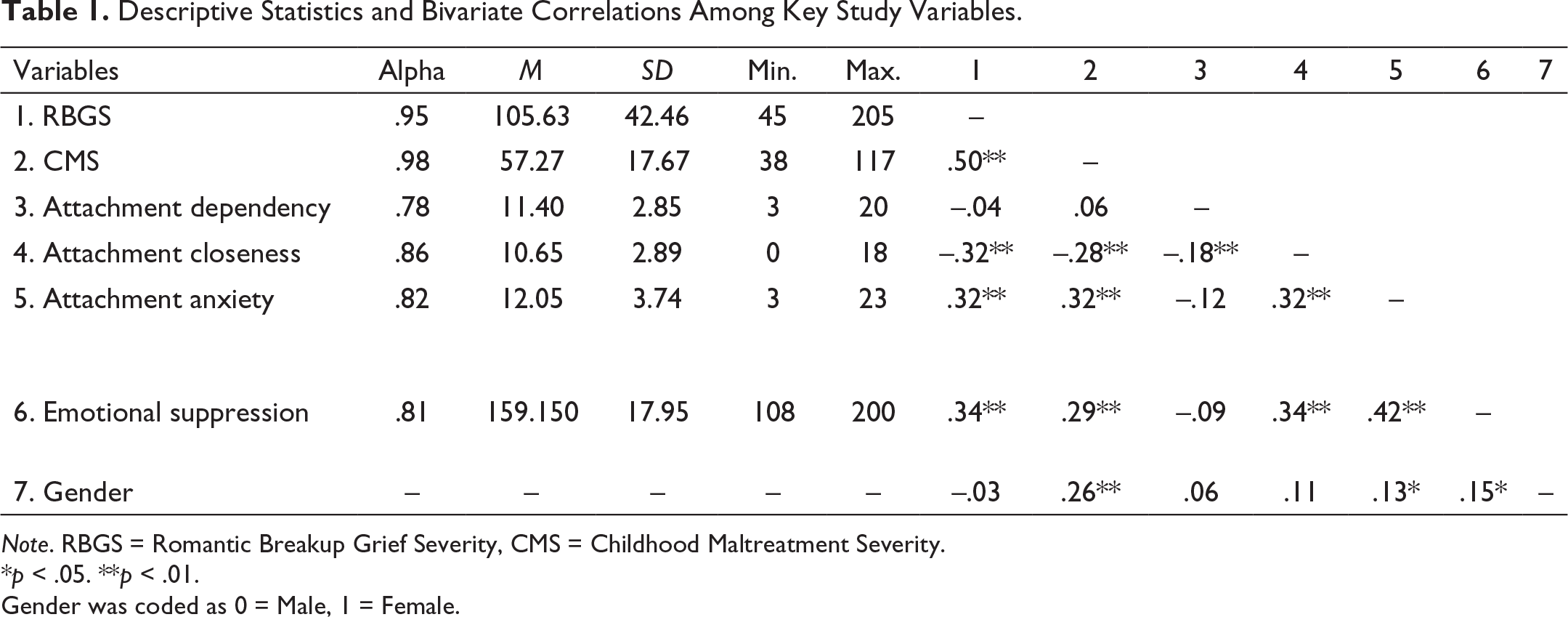
Note. RBGS = Romantic Breakup Grief Severity, CMS = Childhood Maltreatment Severity.
*p < .05. **p < .01.
Gender was coded as 0 = Male, 1 = Female.
Model Fit Indices
CM severity and attachment styles were the predictor variables, emotional suppression was the mediator variable, and romantic breakup grief severity was the criterion variable. Of all the demographic variables, only gender had a significant relation with the mediator. Therefore, it was included as covariate. This model had sufficient goodness-of-fit: χ2 = 23.11, df = 4, p = .000; GFI = .97, AGFI = .87; CFI = .92; RMSEA = .08.
Total and Direct Effects
Please see Figure 1 for a depiction of the model. When emotional suppression was excluded from the model, CM severity significantly predicted romantic breakup grief (β = .45, p < .01; i.e., path c1 in Figure 1). Without emotional suppression in the model, the relation of attachment anxiety and romantic breakup grief severity remained significant (β = .15, p < .05; i.e., path c3 in Figure 1). Also, when emotional suppression was excluded, attachment closeness predicted romantic breakup grief (β = −.17, p < .01; i.e., path c2 in Figure 1). CM severity (β = .43, p < .01; i.e., path c′1 in Figure 1), attachment closeness (b = −.14, p < .05; i.e., path c′2 in Figure 1) and attachment anxiety (β = .13, p < .05; i.e., path c′3 in Figure 1) significantly predicted romantic breakup grief severity with emotional suppression in the model. Direct and total effects of attachment dependency on romantic breakup grief severity were not significant.
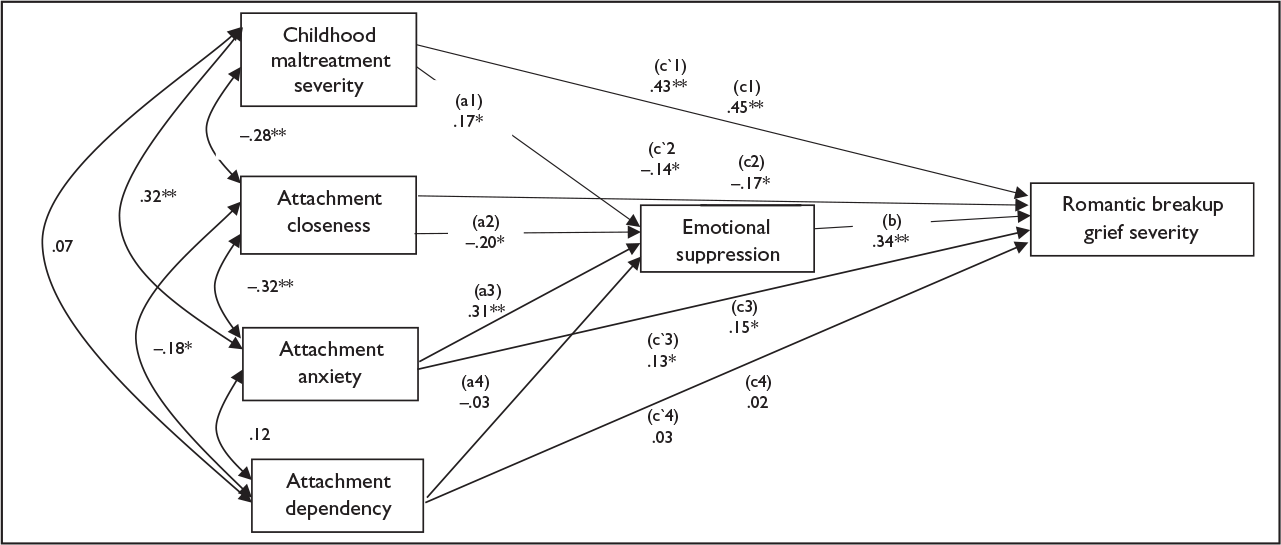
Note. All the parameters are standardized.
CM severity significantly predicted emotional suppression (β = .17, p < .05; i.e., path a1 in Figure 1). Higher levels of CM severity were related to higher levels of emotional suppression (and vice versa). Also, the association between attachment closeness and emotional suppression was significant (β = −.20, p < .05; i.e., path a2 in Figure 1). This association was in the predicted direction. As hypothesized, the pathway from attachment anxiety to emotional suppression was significant (β = .31, p < .01; i.e., path a3 in Figure 1). Emotional suppression significantly predicted romantic breakup grief (β = .34, p < .01; i.e., path b in Figure 1). Heightened emotional suppression was related to greater romantic breakup grief severity (and vice versa). The direct effect of attachment dependency on emotional suppression was not significant.
Indirect Effects
As shown in Table 2, the bootstrapping results suggested that the indirect effect of CM severity on romantic breakup grief severity through emotional suppression was significant and this effect remained significant after controlling for gender (β = .06 [CI: .01 to .12]). Given that the direct effect of CM severity on romantic breakup grief severity is significant with the presence of emotional suppression, emotional suppression partially statistically mediates this relation. Alternatively, attachment closeness had a statistically significant indirect effect on romantic breakup grief severity via emotional suppression and this effect remained significant after controlling for gender (β = −.07 [CI: −.02 to −.13]). Finally, the indirect effect of attachment anxiety on romantic breakup grief severity via emotional suppression was significant, and this effect remained significant after controlling for gender (β = .11, [CI: .06 to .17]).
Standardized Total, Direct and Indirect Effects of Childhood Maltreatment and Attachment Styles on Romantic Breakup Grief Severity.
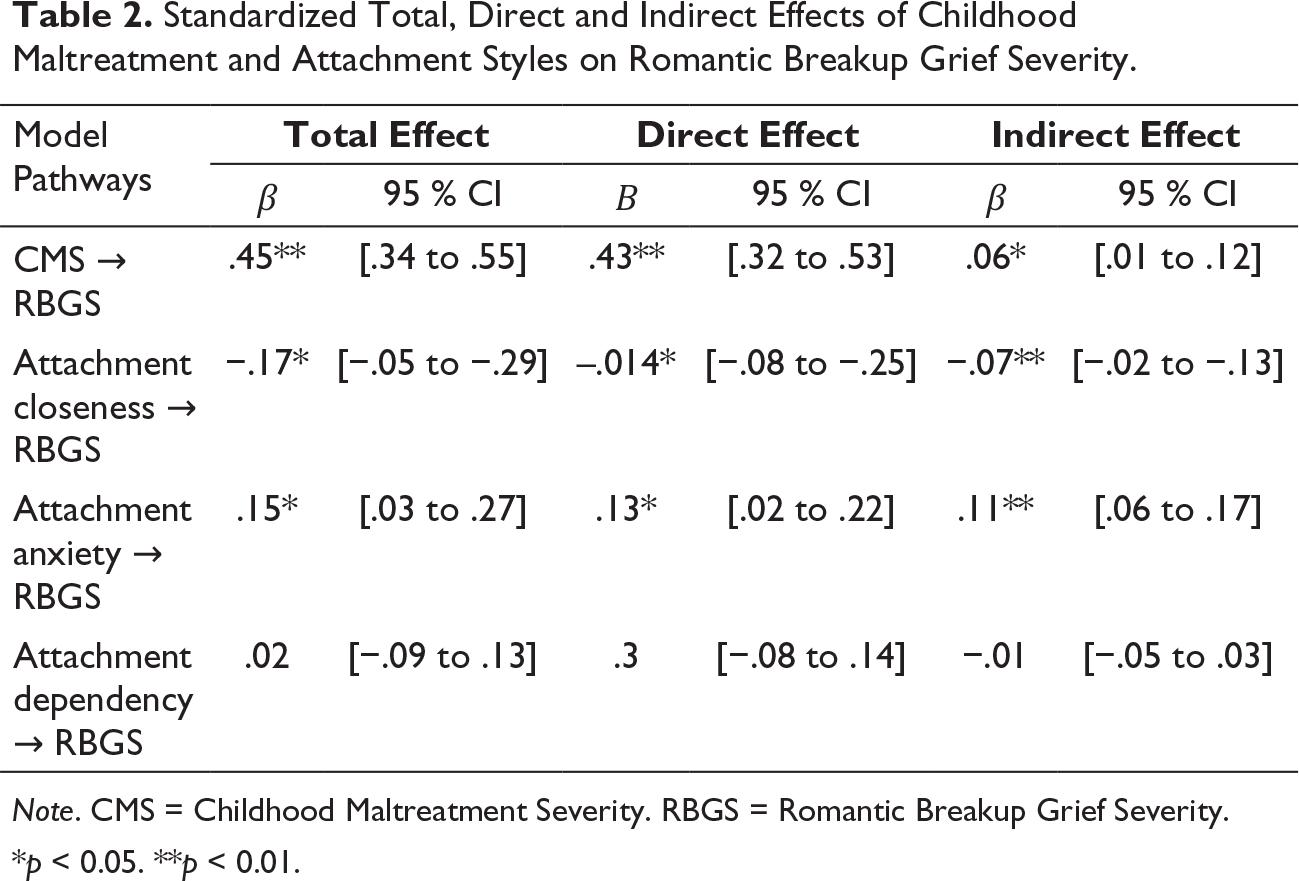
Note. CMS = Childhood Maltreatment Severity. RBGS = Romantic Breakup Grief Severity.
*p < 0.05. **p < 0.01.
Discussion
The aim of this study was to examine the mediating role of emotional suppression in the association of CM severity and attachment styles with romantic breakup grief severity in Iranian college students. Our first hypothesis was supported and findings showed that, as expected, CM severity and attachment styles had direct effects on romantic breakup grief severity. This finding is consistent with previous evidence documenting that harsh and adverse experiences in childhood can be associated with severe psychological symptoms, particularly more severe grief symptoms, following breakup. Indeed, CM severity may partly explain adjustment problems related to grief and bereavement symptoms following a breakup (DiLillo et al., 2007; Vaillancourt-Morel et al., 2019). Furthermore, there is a solid literature documenting that individual differences in the ways that individuals manifest grief following romantic breakup may be related to early experiences in childhood (McCarthy & Maughan, 2010). CM has been documented as predicting worse coping strategies (i.e., emotional suppression) in adult romantic relationships particularly in the context of romantic conflicts or breakups (Francoeur et al., 2019). It has been theorized that the cognitive-affective impact of CM may manifest in several aspects of subsequent adult romantic relationship problems and breakups (Milojevich et al., 2018; Weissman et al., 2019).
The experience of maltreatment as a child has been said to impair a survivor’s ability to develop compatible coping strategies when confronted with problems in romantic relationships and grief symptoms following romantic breakup. A history of maltreatment in childhood may produce confusion about normative romantic relationships, negative attitudes regarding the function of intimacy, fear of intimacy, and adverse reactions when engaging in romantic relationship breakup (Briere & Runtz, 1990; DiLillo et al., 2007; Noll et al., 2003; Paradis & Boucher, 2010). Attachment theory (Bowlby, 1969, 2008) has been proposed as one explanation for the relation between CM and problematic mental health outcomes following adulthood romantic breakups. Recent findings have also emphasized the influence of early intimate relationships, usually with parents, on one’s subsequent relationship difficulties and adjustment problems with grief following a breakup (Maunder & Hunter, 2012). The quality of childhood emotional connections with parents leads to the development of secure attachment styles, which are thought to remain relatively stable from childhood through adulthood (Bowlby, 1969; Waters et al., 2000). Adult attachment theory proposes that expectations and responses to problems in the interpersonal situations learned in the context of early childhood relationships provide a model for relatively stable patterns of adjustment with relationship problems in adulthood (Widom et al., 2018).
Indeed, results demonstrated that attachment styles have direct effects on romantic breakup grief severity. This is consistent with previous findings (Baer & Martinez, 2006; Reiser et al., 2019; Widom et al., 2018) that highlight the importance of attachment styles on romantic relationship problems in adulthood and adjustment problems following a breakup. Attachment closeness (i.e., secure attachment style) showed a significant negative and direct effect on romantic breakup grief severity. Adults with secure attachment style may be more likely to define their romantic relationship as cheerful, pleasant, and trusting, and highlight their aptitude to accept their spouse notwithstanding their mistakes (Widom et al., 2018).
However, results also showed that attachment anxiety had a direct effect on romantic breakup grief severity, and this insecure attachment dimension was positively associated with greater levels of romantic breakup grief. One explanation for this finding is that adult survivors of CM may have difficulties feeling safe in intimate relationships and harbor fears of loss (attachment anxiety) that, in turn, may lead to adult romantic relationship difficulties, breakups, and greater difficulties coping with grief following romantic breakup (Briere et al., 2012). Attachment anxiety includes fear of interpersonal rejection, the need for approval, and concern about the availability of others. Adults with anxious attachment styles may have a strong wish for intimacy with their partners but may lack confidence in their partners’ reciprocity of care and love. Adults with an anxious attachment style thus may become obsessive and hypervigilant to potential loss and may be viewed by others as demanding or “needy” (Kassel et al., 2007). Indeed, fear of loss is a possible outcome of early negative relational experiences that involve betrayals of trust, threats to vulnerability, and punished or unmet dependency needs (Kapeleris & Paivio, 2011).
Furthermore, consistent with hypothesis, CM and attachment styles might affect romantic breakup grief severity via emotional suppression. Results demonstrated that emotional suppression mediates the relations of CM and attachment styles with romantic breakup grief severity. This is consistent with previous research demonstrating that harsh and adverse experiences in childhood are associated with increased use of emotional suppression and diminished emotional expressiveness (Balan et al., 2017; Gresham & Gullone, 2012; Heleniak et al., 2016; McLaughlin & Lambert, 2017; Weissman et al., 2019). Accordingly, this is also consistent with findings from clinical experimental psychology that demonstrated higher rates of emotional suppression (as well as defensiveness) and diminished emotional expressiveness are associated with mental health symptoms, including severe grief symptoms, following romantic breakup (Giese-Davis et al., 2008; Gresham & Gullone, 2012). More recently, theoretical and empirical research regarding CM has begun to identify emotional suppression as an important mediator between CM severity and grief severity following romantic breakup (Bradbury & Shaffer, 2012; Liu et al., 2019; Milojevich et al., 2018).
Moreover, regarding the mediating role of suppression in the association between attachment styles and romantic breakup grief severity, findings demonstrated that, as expected, higher level of secure closeness predicted lower emotional suppression, while higher insecure anxiety predicted greater emotional suppression in the context of romantic breakup grief. Results were consistent with our prediction that students’ use of emotional suppression serves as a pathway through which CM and attachment styles may relate to students’ grief symptom severity following romantic breakups. Findings documented that CM severity could affect romantic breakup grief severity in students with insecure anxiety attachment styles via emotional suppression. Previous studies have also documented that higher levels of alienation and lower levels of trust and communication in close relationships (i.e., insecure anxiety attachment style) predicted the use of more pathological coping (i.e., emotional suppression) in grief episodes following romantic breakups (Biesecker, 2002; Gresham & Gullone, 2012).
Students with histories of CM exhibited higher levels of insecure anxiety attachment style and greater emotional suppression and reported more grief symptoms following romantic breakup. However, emotional suppression and insecure anxiety attachment style were strongly correlated, suggesting that anxious attachment and emotional suppression are highly interrelated and may bidirectionally evolve over time, contributing to greater risk for more severe grief reactions following relationship breakups. This accords with an attachment and emotion suppression perspective, as individuals with high insecure anxiety attachment styles may tend to experience more intense negative emotions and resort to emotion suppression to regulate their emotional experiences (Mikulincer et al., 2003). Paradoxically, chronic emotional suppression or avoidance may lead to increased emotional (e.g., grief) severity over time. College students with CM histories and with insecure attachment styles may experience more intense emotions following a romantic breakup, perhaps contributing to, but also resulting from, emotional suppression. Findings support the proposed models and indicate that emotional suppression may account for the association between CM histories and attachment style with romantic breakup grief severity. Furthermore, female students reported more severe CM histories and may be more likely to report insecure attachment styles and may thus be at heightened risk of greater breakup grief severity.
Notably, while death-related grief and loss are typically honored, grief resulting from the end of a romantic relationship often is not acknowledged to the same extent (Reimer, 2019), particularly in Iranian cultures. Cultural norms of expression or suppression of emotions differ significantly in Iran compared to Western countries and this should be considered when interpreting results of this study. For example, individuals from Western cultures may be more open to emotional expression and reporting compared to individuals from Asian cultures, including Iran, and this expression may result in greater validation and social support. In contrast, emotional expression related to CM and/or romantic breakup grief severity may be less accepted among Middle Eastern or Asian cultures. Furthermore, maladaptive ways of coping that may be associated with more severe romantic breakup grief manifestations, such as substance use or reckless behavior (e.g., sexual risk-taking), may not be relevant to students in Iranian cultures. In Iran, the culture places great value on pietism, devoutness, and abstemiousness. Sex is taboo, and alcohol and drugs are rigidly controlled (Ghorbani et al., 2014; Noroozi et al., 2014). Therefore, it is possible that manifestations of emotions following romantic breakups among college students in Iran might be culturally specific. For example, college students in Iran with histories of CM and greater romantic breakup grief severity may be more likely to internalize and under-report symptoms due to perceived or actual mental health stigma and undervaluing of the impact of non-marital romantic relationships on functioning. Notably, no other published studies have assessed the role of CM and emotion regulation with regard to romantic breakup grief severity in a Middle Eastern culture. This study was conducted in an understudied population of college students in the Middle East, and replications and extension of this work in Iran and other Middle Eastern cultures are warranted to more clearly understand the role of cultural norms and stigma on mental health and relationships.
Some limitations of the present study warrant mention. First, we used a correlational and cross-sectional design, which prevents us from making definite statements in terms of causality or temporality among variables examined. Moreover, all measures used were self-report questionnaires, and therefore, method variance cannot be ruled out. Relatedly, the measures were administered in the same order to all participants. To reduce priming and response bias, future studies might randomize or counterbalance measures across participants. Second, we recruited a nonclinical sample, which did not allow for generalizability of our results to clinical populations. Furthermore, levels of CM reported in this sample may ostensibly be lower than those reported in clinical samples, particularly those who are treatment-seeking or who suffer from post-traumatic stress. Future research, adopting longitudinal designs and clinical samples of individuals with more variable levels of CM is needed. Third and relatedly, the study was based on an Iranian college student sample, and results thus may not generalize to college students from other cultures. However, Iranian adults are relatively understudied with regard to mental health, and no studies to date have examined the associations of CM, attachment styles, and romantic breakup grief severity in Iranian college students. Fourth, the study did not query the duration or commitment level of the dissolved relationships, and this is an important factor to consider in examining etiological and maintenance processes relevant to grief severity. Emotional recovery from long-term committed relationships may indeed be expected to be longer and more arduous than recovery from more short-term, less committed relationships. Finally, data on sexual orientation or same-sex relationships were not collected. Research on same-sex relationships in Middle Eastern cultures, including Iran, is scant, given the perpetuation of significant cultural discrimination and stigma. However, future work might explore these issues further as a step toward social justice and emotional and physical safety for diverse populations worldwide.
Implications
The present investigation builds upon extant literature documenting that romantic breakup grief severity may be associated with histories of CM and insecure attachment styles. This study extended the literature by examining these associations in an understudied Iranian sample, providing cross-cultural replication of the studies conducted in Western cultures and cultural considerations for future work. The early detection and treatment of CM are critical to ameliorating the possible effects of insecure attachment, maladaptive emotion regulation practices, and severe and prolonged romantic breakup grief. This study also suggests that mental health clinicians working in university counseling centers could use emotion regulation techniques as an adjunct technique (Zemestani et al., 2016) for modifying emotional suppression in the treatment of students with CM histories and severe grief symptoms following romantic breakups. Assessment of CM histories and attachment styles may be helpful in clinical contexts wherein adults are seeking treatment for relationship issues. Replication and extension of this work with clinical and more diverse samples and more rigorous methodologies are necessary before more definitive conclusions can be drawn. This line of inquiry has great potential to contribute meaningfully to our understanding of grief symptom presentations in romantic relationship contexts, particularly in Middle Eastern cultures.
Footnotes
Declaration of Conflicting Interests
The author(s) declared no potential conflicts of interest with respect to the research, authorship, and/or publication of this article.
Funding
The author(s) received no financial support for the research, authorship, and/or publication of this article.
