



Abstract
Peer sexual violence is a significant social problem that affects adolescents and can lead to negative mental health and developmental consequences. Peers are a significant source of influence for adolescent behavior. For example, recent studies show training teens to be bystanders can be an effective prevention strategy to reduce peer violence and harassment. Peers can also promote risky behaviors including substance use and violence. The current study examined how sexual violence-specific risk and protective attitudes (e.g., denial of peer sexual violence and positive peer prevention norms) and behaviors (alcohol use and bystander actions to prevent peer sexual violence) clustered within peer networks cross-sectionally and over time. Participants were 1,499 7th−10th graders who took surveys during an academic year and who reported having opportunity to take action as bystanders to peer sexual violence. Participants took surveys 6 months apart online in schools. Questions included nomination of best friends to capture information about peer networks. Social network analyses indicated that there was weak but significant clustering of positive prevention attitudes such as bystander denial and marginal clustering on reactive bystander behaviors to address sexual assault. For comparison, alcohol use and academic grades were analyzed and found to also cluster in networks in these data. These findings suggest that for early adolescents, peer bystander training may be influential for some key bystander attitudes and reactive sexual violence prevention behaviors as individual behaviors are not independent of those of their friends.
Introduction
Adolescence is a key developmental period for preventing the initiation of problematic health behaviors, such as sexual violence and alcohol use, which can have lasting negative consequences into adulthood (D’Amico et al., 2020; Hale & Viner, 2016; Peeters et al., 2019). Research consistently documents the high rates and deleterious outcomes associated with sexual violence among youth (Basile et al., 2020). Moreover, researchers have begun to identify risk (e.g., alcohol use) and protective (e.g., readiness to engage in positive bystander action) factors for experiences of sexual violence (Banyard, 2011; Tharp et al., 2013).
One key source of both risk and protective factors is peer relationships (Banyard & Edwards, 2016; Fasick, 1984; Foshee et al., 2011; Valente et al., 2004). During adolescence, teens spend more time with peers, which can enhance risk by modeling and promoting risky behaviors (Hoorn et al., 2014). Peers can also promote healthy choices through positive peer deviance, which occurs when members of high-risk groups display protective factors or low risk behavior (e.g., receive good grades in school and abstain from alcohol use). When youth engage in positive peer deviance, they are opposing the norm and can counteract negative risk factors (Walker et al., 2007). For example, Foshee et al. (2011) found that youth reported lower levels of physical dating violence perpetration when they had friend networks that on average held more prosocial beliefs.
Bystander intervention (third parties who are not victims or perpetrators but observers who can step in to interrupt risk or who can proactively model and promote positive social norms) is an important way that peers can influence one another and seems to be a positive prevention mechanism, particularly in terms of behaviors that model healthy relationship norms (Bush et al., 2019). Research suggests that youth in high school report high levels of opportunity to intervene in instances of peer sexual violence (with ranges from 12% to 85% depending on the type of situation) (Rothman et al., 2019; Waterman et al., 2020; Authors Masked), and that adolescents and young adults are most likely to disclose a victimization to peers, not adults (Campbell et al., 2015; Orchowski & Gidycz, 2012). Research is needed to better understand younger adolescents (e.g., middle school students) and bystander intervention; most research on bystander intervention has been conducted with young adults or adolescents in the later years of high school.
Increasingly, prevention researchers are interested in using social network analysis to understand the ways in which youth peer groups may influence attitudes and behaviors in positive and negative ways (Valente et al., 2003, 2004). Social network analysis goes beyond examining perceptions of peers’ attitudes and behaviors and objectively examines the extent to which attitudes and behaviors cluster within participant defined networks (Fujimoto & Valente, 2012; Lakon & Valente, 2012; Petering et al., 2016). Indeed, social networks can be important for behavior in a number of ways—through the structure of the network (and how embedded an individual is within the network or across networks), as well as through influence (how mean levels of network members’ behaviors or attitudes can promote change in individuals to be more like the group) (Valente, 2005, 2010).
Social network analyses have helped researchers and practitioners design prevention strategies that capitalize on ways that peers influence one another (Hunter et al., 2019; Pickering et al., 2018; Valente, 2012). This may enhance prevention effectiveness as messages are promoted by key peer influencers (Valente, 2010, 2012). For example, in one study of a tobacco use prevention program in schools, several different implementation methods were used, and greater effectiveness was found for identifying peer leaders through social network analysis and having those peer leaders facilitate prevention with students in their social networks, then using peer nominated leaders but randomly assigning students they taught (Valente et al., 2003, 2006). Several prevention programs reduce sexual violence and harassment by engaging and training peer bystanders (Coker et al., 2017; Edwards et al., 2019). Bystanders can act during a situation of sexual violence to prevent or stop it (reactive bystander behavior). Bystanders can also take action in the absence of sexual violence to change social norms to be intolerant of sexual violence by using social media to promote healthy relationship messages or starting prevention conversations (proactive bystander behavior) (Banyard et al., 2015). Yet, to date, we know little about the ways in which bystander attitudes and behaviors cluster within social networks of adolescents. Do youth think and act like their close friends? If so, we may want to alter the ways we deliver bystander-focused prevention programing to focus more on networks.
Theoretical Underpinnings
Theories of social norms (Chung & Rimal, 2016; Orchowski, 2019; Perkins & Berkowitz, 1986) and social learning (Bandura, 2001) have been researched in relation to prevention and may help explain the importance of peer networks for sexual violence prevention. These theories describe how individual behavior is influenced by observing important role models such as peers and by perceptions of what a person thinks their peers value and do (Rothman et al., 2019). Youth and young adults who think their peers accept using violence and coercion are at risk for interpersonal violence perpetration in the same way that youth who perceive that their peers are using alcohol are more likely to use it themselves (Burk et al., 2012; Garthe et al., 2017; Swartout, 2013). Misperceptions of peer norms facilitate risky sexual behaviors like sexting (Maheux et al., 2020). In the field of juvenile crime, positive social deviance models describe how having at least one peer who is high achieving decreases negative outcomes like delinquency (van Dommelen-Gonzalez et al., 2015). Peer influence also affects physical health including body image and exercise (Kenny et al., 2017; Montgomery et al., 2019), smoking, alcohol use (Huang et al., 2014; Jules et al., 2019), and suicide (Jules et al., 2019; Kenny et al., 2017; Montgomery et al., 2019; Wyman et al., 2019).
Another theory relevant to the current study of youths’ social networks is diffusion of innovation theory (Rogers, 2002). This theory describes how changes in ideas and behaviors start with a small group of innovators and early adopters who are open to innovations (about 16% of a community/group/population). These individuals then diffuse the new information and model new behaviors. Several prevention programs for sexual and related forms of violence among youth (see e.g., Green Dot) are grounded in the idea that prevention programs enhance diffusion (Cook-Craig et al., 2014; Gidycz et al., 2011). For example, bystander intervention training started with a focus on disrupting situations of risk for sexual violence but has since expanded to a more proactive focus on training youth to promote positive prevention and healthy relationship norms within their social network (Rothman et al., 2019). The theory suggests that we will find clustering of sexual violence-related attitudes and behaviors within networks.
Adolescence and Social Networks of Peers
Developmental research using frameworks like the social development model (Catalano et al., 1996) documents that social networks are particularly salient for adolescents but also that their composition changes (Veenstra & Dijkstra, 2011). For example, in childhood and early adolescence, parents and teachers have more influence over risky behaviors like substance use initiation, while later in the teen years, peers become more important influencers. Peers in adolescence can be a source of stress and promote risky behaviors (Doom et al., 2017; Authors Masked). Peers can also enhance protective factors and positive choices (van Rijsewijk et al., 2016).
Research has shown links between peers and risk and protective factors for sexual violence specifically. For example, positive social norms that are intolerant of violence are related to decreased perpetration of peer violence (Banyard et al., 2020a) and also promote proactive bystander helping (Banyard et al., 2020b). One study of Green Dot’s high school curriculum found that increased helpful bystander intervention behaviors were a variable through which rates of violence decreased over time as a result of the program (Bush et al., 2019).
Social network analysis is a theoretical perspective and a set of techniques used to understand relationships between people and other units, such as organizations or states, how those units interact, and how they affect behaviors. A social network approach consists of individuals nominating people who make up their social network. For example, researchers focused on youth may map the links between students based on their nominations to understand the structure of the social network of a group of youth. Social networks are complex and can be measured in different ways (e.g., researchers might ask youth to nominate their best friends and may calculate the size of someone’s friend network, the number of connections they have to friends in different networks, or the extent to which individuals within a network look similar on certain attitudes and behaviors).
To date, these different components and various ways of measuring networks have mainly been examined in the sexual violence field in terms of victimization and perpetration, not attitudes or bystander behaviors related to sexual violence as in the current study (Katerndahl et al., 2013). These studies provide a framework for the ways we might examine networks and sexual violence prevention behaviors including bystander intervention. For example, researchers found that measuring network characteristics across community settings like church and school (e.g., network diversity or the number of different social roles a person inhabits across social settings) can protect men from perpetration of sexual assault (Kaczkowski et al., 2017). More important to bystander intervention, several studies showed that attitudes like rape myth acceptance or acceptability of partner violence cluster in friend networks (Sandberg et al., 2018; Swartout, 2013). Swartout’s study found young college men whose high school male peer networks had strong rape myth acceptance and hostility toward women showed higher levels of those attitudes themselves. The finding was not just about how attitudes might cluster among friends (e.g., groups of friends have similar attitudes) but also about how measuring the nature of the networks themselves affected outcomes. Within the sphere of close friends, young men who were part of close knit, small, friend networks where a small group knows one another well overall held fewer of these negative prevention-related attitudes (Swartout, 2013). Attitudes in models of bystander intervention to prevent sexual assault are not dissimilar from constructs Swartout measured, suggesting that network analysis may help us better understand bystanders (McMahon, 2010).
Current Study
There is an urgent need to take a closer look at the variety of attitudes and behaviors that may occur in adolescent peer social networks as a platform for prevention innovations. As such, the current study used social network analysis in a sample of 7th through 10th graders to examine adolescent network influences on bystander attitudes (i.e., bystander denial of need for prevention and social norms for prevention), proactive behaviors (i.e., modeling positive prevention behaviors on social media), and reactive behaviors (i.e., responding to unwanted touching and sexual photo sharing) specific to sexual violence. We also compared these network associations with participants’ reported academic grades (Frank et al., 2008) and alcohol use (Huang et al., 2014), two individual outcomes demonstrated in the past to have network influences. In addition, we use a longitudinal design of two waves to better understand not just how individuals’ and friends’ attitudes are associated but how changes in individuals’ and friends’ attitudes are associated. Careful examination of the role of peers in promoting healthy or unhealthy choices is critical for improving prevention effectiveness for adolescents.
Aim 1: We hypothesized that students would name friends with similar levels of sexual violence prevention attitudes (social norms and denial of sexual violence as a problem) and bystander behaviors.
Aim 2: Examine the association of changes in individual sexual violence-specific proactive and reactive behaviors with their friends’ changes in those behaviors. We hypothesized that an individual’s attitudes would change in a similar direction over time to their friends’ average change.
Aim 3: Examine the association of individuals’ change over time during high school in individual academic grades and alcohol use with individuals’ friends’ change over time in academic grades and alcohol use. We hypothesize a positive association between individuals’ change and friends’ average change, replicating previous research (thus, demonstrating these data are not unusual).
Method
Research Design and Setting
These data are part of a larger multiple baseline study to evaluate a youth-led sexual violence prevention project. Data collection for the current analyses took place over 1 year: Fall 2017 (W1), Spring 2018 (W2). The average number of days from W1 to W2 was 180. Two waves were used in order to demonstrate changes in friends’ behavior being associated with changes in individuals’ behavior. This longitudinal strategy helps us understand temporal ordering of these changes, getting us closer to casual inference.
Participants
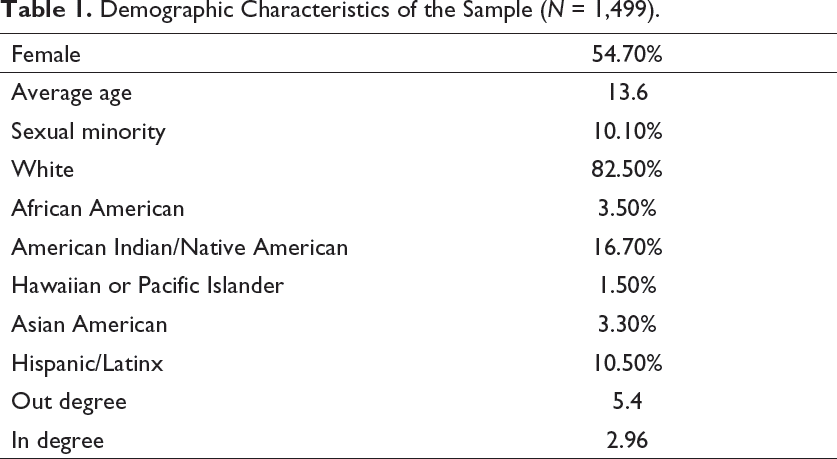
Participants were 1,499 students (grades 7 through 10) from eight schools (five middle schools and three high schools) in one school district in South Dakota who completed surveys near the start and end of the academic year. The percentage of students who were female was 54.7% with an average age of 13.6 years at W1 (Table 1). A subsample, 10.1%, identified as a sexual minority (as defined as gay, lesbian, or bisexual). The sample was 82.5% White, with 16.7% identified as American Indian/Native American, 10.5% as Hispanic/Latinx, 3.5% as African American, 3.3% as Asian American, and 1.5% as Hawaiian or Pacific Islander (the total exceeds 100% because respondents could select more than one ethnicity). Students named an average of 5.4 friends, many of whom were non-participants, thus resulting in an average in-degree score of 2.96. We invited all students in grades 7 to 10 (n = 4,172) at the beginning of the Fall 2017 semester to enroll in the study; the first survey occurred between October 2017 and December 2017. These grade levels across middle and high school were the focus of the study because this is a key age group for the development of peer sexual assault, because this study was nested within a larger study of prevention program effects, and because we needed students at baseline who would remain in the school district during the three-year follow-up of program implementation and evaluation.
Demographic Characteristics of the Sample (N = 1,499).
At study initiation, of the 4,172 eligible students 1 (as reported by the school district), the majority (n = 3,257; 78.0%) of youth returned the consent forms, and of those who returned the forms, the majority (n = 2,667; 81.8%) of guardians gave permission for their student to take the survey. Of the students whose guardians gave consent, most took the survey (n = 2,232; 83.6%). At Wave 2 (W2), 1,920 students were retained from Wave 1 (W1; 85.6%). Of these 1,920 students, 1,499 were included in current analyses due to missing data on one or more of the outcome variables (students who never witnessed a sexual violence episode and so could not report reactive or proactive behaviors were among those dropped).
Procedures
Written parental consent and student assent were required for youth to complete the survey. We used intensive recruitment procedures such that the consent forms were sent to parents in multiple ways (i.e., via their students from school, mailings, and email), and we called and conducted home visits to households in which consent forms had not been returned. We also devised multiple ways in which the consent forms could be returned (e.g., email, text, and in person).
The survey was administered on computers in school by trained research staff. All students had unique logins that were created in part so that students could access the survey only with parental permission. Students received a small incentive (e.g., fruit snack, pencil) and were entered to win one of 20 US$100 gift cards, which increased to US$150 for W2. Students who missed the in-school survey (n = 526) were sent a letter in the mail requesting that they take the survey online; instructions were provided on how to take the survey online. Return rate of these out-of-school surveys was 2.7% (n = 14).
Attention Checks
We used three questions to identify students who were not paying attention (henceforth, inattentive responders): “Do you have more than 10 kids?” “Are you over 9 feet tall?” and “This question is to make sure the survey is working OK. Please pick the answer below that says Cat.” Across waves, 2.7%–4.9% answered one or more questions incorrectly; 0.2%–1.4% answered two or more questions incorrectly, and <0.1–0.4% answered three questions incorrectly. We defined inattentive responders as participants who got two or more questions wrong at one or more waves. In the current article, there were only two in the subsample used in analyses and, thus, they were retained.
Participant Attrition Analysis
We conducted a series of chi-square and t-test analyses to understand patterns in attrition based on demographics and key study variables. We compared participants who completed Wave 1 and participants who completed Wave 2 to participants who did not complete that subsequent wave. Participants who completed Wave 2 were more likely to be White, less likely to be Native American/American Indian, and younger than participants who did not complete Wave 2. Groups did not differ on other measures related to the current article.
Measures
Demographics.
Youth responded to questions about their age, gender (0 = woman/girl; 1 = man/boy), and race/ethnicity using two questions: one about choosing a racial category (White, African American, Native American, Hawaiian or Pacific Islander, Asian, or Latinx/Hispanic) (0 = non-White and/or Hispanic; 1 = non-Hispanic White) and the other about sexual orientation (0 = heterosexual; 1 = sexual minority, as defined as gay, lesbian, or bisexual).
Social network nominations.
Youth were asked to list up to seven best friends in grades 7–10 in the district, as well as up to three adults in the community who are most trusted. We chose the best friend wording, given research suggesting youth identified as best friends have the most influence on behavior (Valente et al., 2013). Nominations for youth were limited to seven based on practical limitations, participant burden, and past work showing most people maintain a small group of close friends (Burt, 1984). If a student entered a best friend’s name that did not automatically generate a match from the roster, the survey was programmed such that it would record a text entry of the student nomination, which was later matched to the roster when possible. Students named an average of 5.4 friends.
Bystander behavior.
For each of the four reactive behavior items in which participants responded affirmatively with the opportunity to take action, we asked participants how they responded. Participants were presented with the following types of behavior and asked to select all of the things they did in response to witnessing the experience: (a) “Did nothing/ignored what was happening”; (b) “Laughed, took a video, or showed that you did not think what was happening was a big deal”; (c) “Tried to make the situation stop by using distraction, such as dropping something to make a noise; starting a random conversation”; (d) “Get help from another teen, parent, and/or adult”; (e) “Said something or tried to stop the person doing the hurtful behavior”; and (f) “Said something or tried to help or support the person who was being hurt.” For each of the response behaviors, students were asked to select one of the following response options: 0 = 0 times, 1 = 1–2 times, 3 = 3–5 times, 6 = 6–9 times, or 10 = 10 or more times. Scores were computed by setting everyone at zero and subtracting one for each report of (a) or (b) as indicative of passive (doing nothing) and active harm that both contribute to contexts that condone violence and adding a point for each report of (c), (d), (e), or (f). Thus, scores ranged from −2 to 4, and because not all students reported seeing or hearing about a student touching or grabbing another sexually, there are more missing data on these measures than the others. We used responses at the item level for the four reactive behaviors. Of note, our scoring approach is consistent with the bullying literature in which bystanders can be defenders, assistants, and/or reinforcers (Monks & O’Toole, 2020; Salmivalli, 1999; Sutton & Smith, 1999).
Social norms for sexual violence prevention.
Three items were used to assess youth’s perceptions of injunctive norms related to sexual violence prevention. These items were adapted from earlier work with middle and high school samples for this study (Edwards et al., 2018). The three items included: (a) “My friends think that it is important for adults to talk to students about healthy relationships”; (b) “My friends think that students should show that it is NOT okay to joke or make fun of people’s bodies”; and (c) “My friends think that students should talk about how to stop sexual assault (sexual assault is any sexual thing that happens when someone doesn’t want it to happen).” Students used a 4-point Likert scale ranging from 1 = strongly disagree to 4 = strongly agree to indicate their perceptions of injunctive norms. Higher scores across all three items reflected more prosocial norm perceptions about prevention behaviors. Composite scores were created by calculating the mean. Cronbach’s alpha for these items was .69.
Bystander denial.
We used the Denial subscale of the Readiness to Help Scale (D-RHS; Banyard et al., 2014; Edwards et al., 2018) to assess the extent to which students rejected the role that they could play in preventing relationship abuse and sexual assault (e.g., “There is not much need for me to think about relationship abuse and/or sexual assault among middle and high school students.”). Response options ranged from 1 = strongly disagree to 4 = strongly agree. The mean of the items was calculated, so that higher numbers are indicative of higher denial of responsibility in situations of relationship abuse and sexual assault. In the current study, the Cronbach’s alpha was .59.
Academic grades and alcohol use.
We used a number of items from the Youth Risk Behavior Surveillance Survey (YRBS; Centers for Disease Control and Prevention, 2014; Eaton et al., 2012), including items measuring academic grades and alcohol. One question enquired about grades in school during the past 6 months with response options as follows: 1 = Mostly A’s, 2 = Mostly B’s, 3 = Mostly C’s, 4 = Mostly D’s, and 5 = Mostly F’s; these were recoded because a higher score reflects better grades. Alcohol use was measured by asking students “During the past 30 days, on how many days did you have at least one drink of alcohol?” Any alcohol use was coded 1, while non-use was coded zero.
Analytic Plan
All eight schools within one school district were included in the study, five middle schools and three high schools. Students were allowed to make friendship nominations to anyone in the school district; hence, some ties span across schools. To address aim 1, we examined individual and average friends’ scores at W1 and W2. To address aims 2 and 3, we conducted nine regression equations predicting changes in a) three proactive behaviors and prevention attitudes (proactive bystander behaviors, social norms, and bystander denial), (b) four reactive behaviors (responding to unwanted touching, photo sharing, sexual violence, and sexual rumors), and (c) two comparison behaviors (academic grades and alcohol use). Each model estimated the outcome at W2 as a function of its lagged variable from W1 to model change, a common set of demographic variables (sex, age, and ethnicity/race), and the friends’ averages on each outcome at W1 and W2. Out- and in-degrees scores were included to act as controls for being in the network. Out-degree represents the number of friends named by an individual; in-degree represents the number of times an individual is named by others. In other words, the association between bystander behavior and network exposure could be a function of simply having more out- or in-degree nominations; hence, in-degree and out-degree control for this possibility. We do not apply stochastic actor-oriented models (SAOMs) to these longitudinal data for several reasons: (a) SAOMs work well for dichotomous outcomes but not for scales; (b) Ragan et al. (2019) have shown that estimating peer influences through regression-type models does not provide biased estimates; and (3) SAOMs are useful for demonstrating structural tendencies such as reciprocity and transitivity, but we are not interested in those aspects of these data, as we wish to focus on whether sexual violence attitudes and behaviors cluster within friendships (Snijders et al., 2010). We replicated analyses including school as a clustering variable with no noticeable effect on the results and, thus, find within-school clustering is not responsible for the associations reported here. We choose to report the non-clustering results in order to be able to report beta coefficients, which are intuitive measures of the magnitude of associations and can be compared within equations.
In the results, we report the conventional p-value cutoffs for statistical significance or .05 and .01 but also report marginally significant results at the .10 level for several reasons: the associations are not expected to be strong, yet they have clinical significance; the sample sizes we analyze are not particularly large; and we feel this novel line of research warrants reporting all associations.
Results
Aim 1: Describing Individual and Average Friends’ Scores
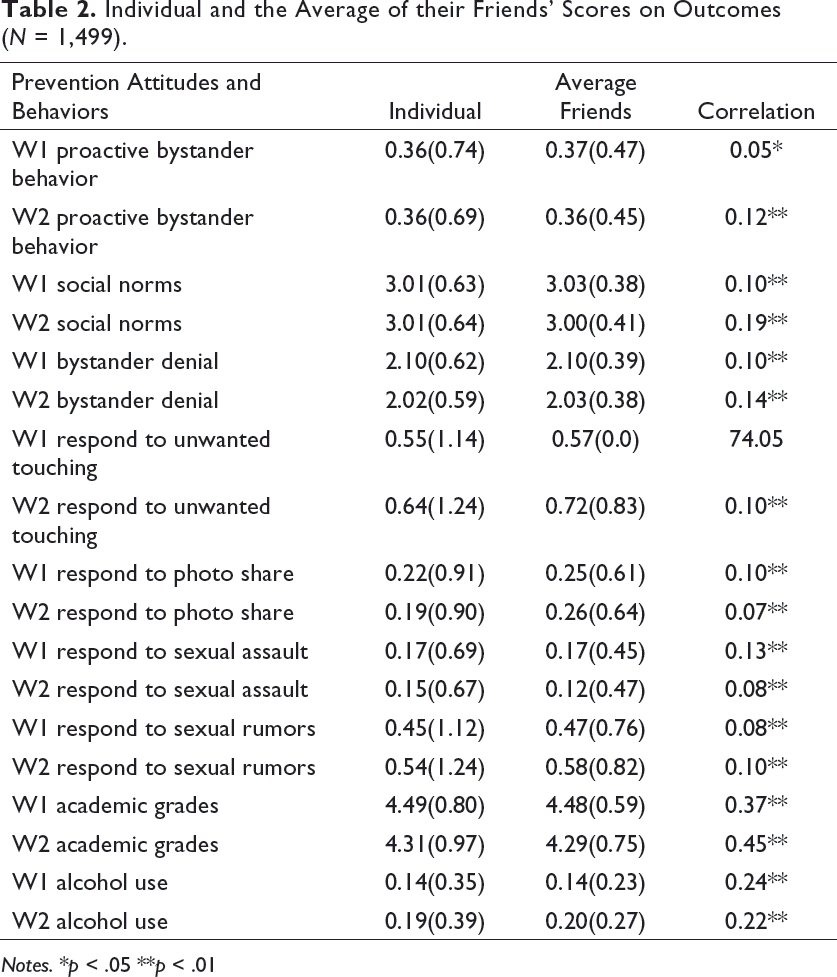
Table 2 shows that bystander denial decreased slightly over time from W1 to W2 by 0.08 with friends’ reported denial also decreasing by 0.07. Taking action in relation to unwanted touching increased by 0.09, with the friends’ reported averages also increasing by 0.15. Taking action in response to unwanted photo sharing decreased slightly by 0.03. Actions related to sexual assault decreased by 0.02 and friends’ reported averages decreased by 0.05. Finally, bystander action related to responding to the spread of sexual rumors increased by 0.09, with friends’ reported averages increasing by 0.11. Students’ reported academic grades declined by 0.18, with friends’ reported grades declining by 0.20. Alcohol use increased by 0.03, with friends’ reported alcohol use increasing by 0.04. Proactive behaviors and social norms were unchanged.
Individual and the Average of their Friends’ Scores on Outcomes (N = 1,499).
Notes. *p < .05 **p < .01
For all outcomes, the friends’ average is about the same as the individual respondent’s, which is to be expected due to homophily in friendship choices (like associates with like). Individual variances on these measures, however, are larger than friends’ variances (SD) because individual variances are calculated across the whole sample, whereas friends’ variance (SD) is the average of the friends’ scores, thus aggregating across people who will generally have similar characteristics. In other words, the sample variance is calculated across a more heterogenous group, whereas friends’ average is calculated across a more homogenous group.
Aim 2: Examining the Association of Friends' and Individuals' Sexual Violence-Specific Attitudes and Behaviors
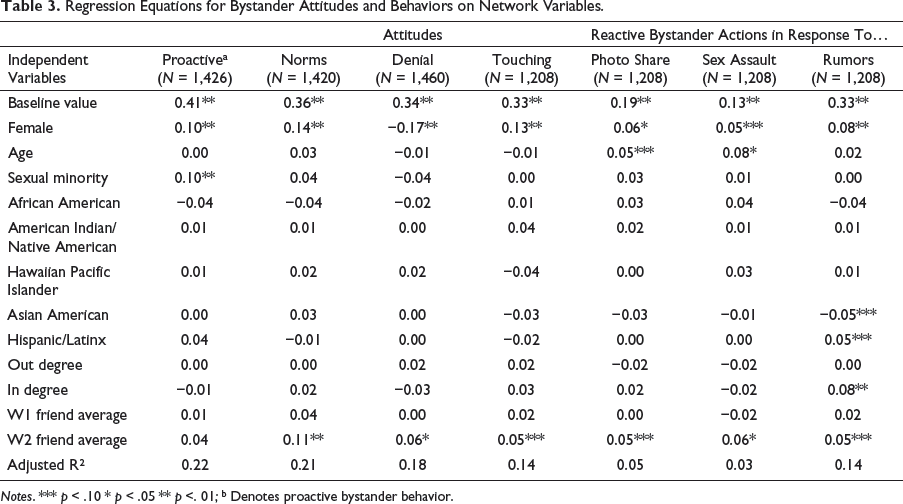
Table 2 also reports the correlations between individual behaviors and their friends’ averages. They are all weak and statistically significant, with the exception of W1 (unwanted touching). Table 3 reports the regression analysis results for prevention attitudes, proactive behaviors, reactive behaviors, academic grades, and alcohol use. For all models, W1 outcomes were significantly associated with W2 ones as expected. For most models, being female was significantly, positively associated with proactive and reactive bystander behaviors. For example, being female was significantly associated with reporting more proactive bystander behavior (β = 0.10, p < 0.01). Bystander denial had a negative coefficient because this measure has a negative valence, measuring whether participants think sexual violence is not a problem. Age was not significantly associated with any proactive behaviors except one reactive measure (sexual violence [β = 0.08, p < 0.01]). Identifying as a sexual minority was significantly, positively associated with bystander behaviors (β = 0.10, p < 0.01). Ethnicity was not significantly associated with proactive or reactive behaviors. Out-degree and in-degree were not associated with proactive or reactive behaviors with the exception that in-degree was positively associated with actions to respond to sexual rumors (β = 0.08, p < 0.01).
Regression Equations for Bystander Attitudes and Behaviors on Network Variables.
Notes. *** p < .10 * p < .05 ** p <. 01; b Denotes proactive bystander behavior.
There was no significant association for peer clustering regarding proactive bystander behaviors. Changes in friends’ average score on the prevention attitudes measures were weakly and positively associated with changes in report of such attitudes. With regard to social norms and bystander denial, W2 friends’ average was significantly associated with individuals’ social norms (β = 0.11, p < 0.01) and bystander denial (β = 0.06, p < 0.01), respectively. This finding indicates homophily or clustering on these attitudes, as adolescents who increased or decreased these reports had friends who also changed their reports. For reactive behaviors, the clustering was marginally significant and varied by situation assessed. Specifically, W2 friends’ average was marginally associated with the adolescents’ individual respondent’s changes in report for taking action against unwanted touching (β = 0.05, p < 0.10), photo sharing (β = 0.05, p < 0.10), and sexual rumors (β = 0.05, p < 0.10) and was significant for sexual assault (β = 0.06, p < 0.05). Note, however, that for three of these associations, the probability levels do not meet the standard criteria (p < 0.05) for accepting a conclusion of statistical significance.
Aim 3: Association of Friends’ Grades and Alcohol Use With Individual Grades and Alcohol Use
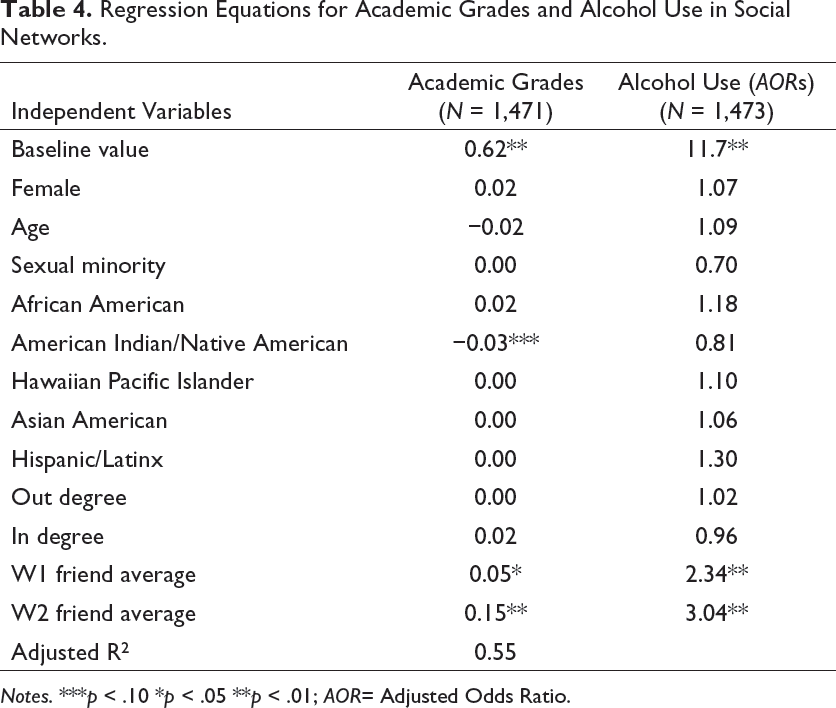
Table 4 reports the results for academic grades and alcohol use. Friends’ academic grades at baseline (β = 0.05, p < 0.05) and friends’ academic grades at follow-up (β = 0.15, p < 0.01) were significantly, positively associated with increases in self-reported academic grades. Similarly, for alcohol use, friends’ use at baseline (AOR = 2.34, p < 0.01) and friends’ use at follow-up (AOR = 3.04, p < 0.01) were positively associated with increased likelihood of alcohol use.
Regression Equations for Academic Grades and Alcohol Use in Social Networks.
Notes. ***p < .10 *p < .05 **p < .01; AOR= Adjusted Odds Ratio.
Discussion
The purpose of the current study was to examine how sexual violence attitudes and behaviors (i.e., bystander denial, perception of social norms supporting prevention, reactive and proactive bystander actions) clustered within networks of middle and high school students and to compare that clustering to academic grades and alcohol use, which have shown robust clustering in previous social network analyses (Frank et al., 2008; Huang et al., 2014). Overall, there was strong homophily on academic grades and alcohol use, as found in previous research, and weaker evidence of homophily on reactive bystander behaviors and attitudes (positive social norms that peers support prevention and bystander denial of peer sexual violence). Homophily is the rate at which people with the same attributes are connected to one another, and here, we see homophily on sexual violence indicators. There was no significant support for homophily for proactive bystander behaviors (using social media and having prevention-oriented conversations).
Compared to the replicated significant clustering for use of alcohol, the more varied and less significant network clustering of sexual violence prevention behaviors may be related to how visible these different types of actions are and how available they are to peers to be observed. Alcohol is commonly consumed with friends and is a behavior that may be more contagious because of observation and proximity. Reactive bystander behavior is more complex and may be something that happens in smaller groups (2–3 peers), or when a bystander is alone without peers, which would suggest that there is less chance to observe the behavior and less strong effects of networks. Research with adults suggests that one-third of sexually violent events occur in the presence of a bystander (Lukacena et al., 2019; Planty, 2002), and adolescents report high levels of opportunity to help across the continuum of peer sexual violence (Waterman et al., 2020). Bystanders are present in almost two-thirds of emotional and physical dating violence victimization, again in mainly adult samples (Black et al., 2008; Hamby et al., 2016). More research focused specifically on adolescents is needed. Furthermore, research is needed to better understand the extent to which positive bystanders are taking action alone versus in a situation where other peer bystanders are observing their helping. Thus, even if teens are taking preventive actions, there may be less opportunity for their peers to see them modeling these helpful behaviors (part of the mechanism through which diffusion in networks happens). Future research may find more robust peer effects for different forms of peer violence (e.g., bullying).
The Role of Development
As dating and intimate relationships increase as youth transition from middle to high school (Orpinas et al., 2013) and parental monitoring decreases (Bachman et al., 1997), youth may be presented with increasing opportunities for exposure to their friends’ attitudes and behaviors specific to sexual violence. Indeed, the broader developmental literature finds that the nature and salience of peer relationships and their influence change during adolescence and are particularly strong later in this developmental phase (Doom et al, 2017). Although research with college samples has found homophily on sexual violence-related attitudes (Swartout, 2013), these may be less pronounced in the younger sample studied here. Furthermore, it is possible that bystander behaviors, even with increasing age, do not cluster within networks. They may cluster situationally in a moment if there is opportunity, such as when many people are present and one person steps in to help and others pitch in, but less overall in specific best friend networks. Indeed, research on “diffusion of responsibility” (Darley & Latane, 1968) suggests that peers may elect not to help when others are present, and thus, it may be understood that inaction clusters more in friend networks than actions, as measured here. As an extension, this may also be the case if a bystander sees someone else intervene, though this specific scenario is less studied. Having a friend who steps in to be an active bystander may make others in the peer network feel less responsible for taking action themselves and lowers the mean actions of those in network and lessens the effect size in our analyses compared to the robust clustering of things like grades and alcohol use. More research is needed to better unpack these findings. The current study was able to examine changes in individual attitudes and behaviors in relationship to changes in friends’ views across baseline data. Our findings explore more developmental or natural situational variation in these relationships since the data were collected prior to any prevention strategy implementation.
Reactive Bystander Behaviors and Attitudes Cluster in Networks
On the other hand, there were some marginally significant findings for reactive bystander behaviors. Consistent with theories of social norms and social learning theory, youth who see their friends engaging in these types of behaviors are themselves more likely to engage in them, which is a promising finding. Interestingly, proactive bystander behaviors did not cluster within networks. This was surprising, given that these are largely public behaviors such as having conversations with friends and social media posts about the unacceptability of sexual violence. However, these were also relatively infrequent behaviors in our sample. Again, sample selection with half of students being in middle school may be a factor in these findings as peer conversations about healthy dating relationships and sexual behavior may emerge more often among older adolescents and emerging adults (Tolman & McClelland, 2011; Waterman et al., 2018).
The indicators of bystander attitudes measured in this study did, in fact, cluster within networks. More specifically, as adolescents’ friends’ ratings of bystander denial and social norms changed so too did those of individuals. Although these findings might seem to contradict the findings regarding bystander behavior, it is likely that friends’ attitudes about sexual violence are more apparent to others than youths’ actual bystander behavior, which may not be as observable for reasons described above.
Consistent with previous research, alcohol use and grades did cluster in friend groups. Clustering or homophily, the tendency for adolescents to share attitudes and behaviors, may be stronger for observable and more objective measures such as academic performance or alcohol use than for sexual victimization attitudes and behaviors. Again, because sexual violence attitudes and behaviors are sensitive in nature, they may be less strongly diffused through peer networks (though we did find some of them were related to networks over time). It also may be that older youth, who are more engaged in intimate relationships and may have more frequent contact with instances of peer sexual violence, show more diffusion in networks (see e.g., the diffusion of attitudes like rape myths found by Swartout, 2013, in a college sample). Bystander behavior may be more a function of individual characteristics such as household influences (i.e., parental monitoring), especially for younger youth. Risk behaviors, such as alcohol use, are observable and more likely to spread through peer networks.
Implications
Sexual violence prevention needs to be multifaceted and should focus on individual as well as peer networks. The current findings do suggest that reactive bystander-focused prevention for adolescents that focuses on attitudes and skills for stepping in when risk for sexual violence is present might benefit from being conducted in the context of peer groups rather than just broad classroom-based curricula. This is exemplified by Coaching Boys into Men, which trains youth who are on the same sports team and who thus may be more likely to consider one another as social network members and friends than the more variable group of students who are assigned to a classroom together in school (Miller et al., 2016). Given that alcohol use followed a similar pattern, de-siloing and developing prevention strategies that target both of these content areas using a peer network approach may be helpful. Research on tobacco use prevention highlights how social network analysis can be used to diffuse key prevention messages within specific youth networks (Valente et al., 2003). Recent work highlights how prevention practitioners might identify peer leaders and their social networks for prevention diffusion (Edwards et al., 2020; Valente & Pumpuang, 2007). On the other hand, more proactive bystander actions may require a different set of prevention strategies to activate. This work reinforces studies that suggest that for adolescents, peer education for prevention, which solely relies on teachers and other adults as prevention program facilitators, may be more effective (Kelly, 2004; McMahon et al., 2014; Weisz & Black, 2010; Wiist & Snider, 1991; Wyman et al., 2010; Zambuto et al., 2020).
Limitations
There are limitations to the current study. Given the silence that surrounds this topic and in some cases, the lower prevalence of sexual victimization compared to other peer violence like bullying, there can be considerable missing data when students are not in a situation where they have the chance to help (Waterman et al., 2020). The current sample included younger teens who may not yet be experimenting with dating or sexual initiation. Even among adolescents who are sexually active, discussions about these issues and topics like sexual violence may take place more often in smaller friend groups of one or two closest friends rather than a fuller social network node. Furthermore, there is variability in networks related to exposure, all of which affects sample sizes and power. It is unclear how missing network data affect these results; since nearly half of the nominations were to non-participants (2.44 of the 5.4 nominations made), the network exposure terms are calculated only from the participants. If non-participants have higher sexual violence rates, then the exposure terms are underestimated and coefficients for those reporting proactive and reactive behaviors underestimated. Replicating exposure effects on alcohol use and academic grades, however, gives us confidence that the coefficients are reasonably accurate estimates of the associations. Another limitation with regard to missing data is that we use somewhat different samples in the same analyses, indicating comparisons across models should be done with caution. Further research with larger samples is needed.
Other limitations include concerns about measurement and sampling. Several measures showed low reliability, which is consistent with calls in the field for ongoing measurement development (McMahon et al., 2017). Measurement of bystander behaviors is still a relatively new field, and future research should continue to develop new questions to better capture youths’ experiences. In the current study, the nomination form for social network analysis used the term “best friend,” while the social norms measure indicated “friends.” Consistency in future research may be warranted. We did not measure other sexual violence-related attitudes, such as rape myths, which may cluster within networks, and we know rape myths are key predictors of sexual violence perpetration (Edwards et al., 2011) and bystander non-action (McMahon, 2010). Furthermore, there may be a problem in the current study with sample selection. The younger adolescent sample in the current study (grades 7–10), half of whom were in middle school, may have less access to peers’ views related to sexual relationships and limited exposure to actual instances of sexual violence in particular. These behaviors may become more apparent in older high school samples. Our sample was also largely White and from a more rural part of the United States. Although there were a number of Native American youth in our sample, it is possible that the findings from the current study will not generalize to samples of youth who are more diverse (e.g., African American youth). Finally, we did not examine bystander behaviors associated with other forms of youth violence, like bullying, which may be more observable to youth.
Conclusion
In sum, the current study sheds light on the extent to which sexual violence attitudes and behaviors cluster within the social networks of middle and high school youth. Some evidence was found for homophily specific to sexual violence attitudes and bystander behaviors, which suggests that these behaviors operate similarly within social networks to more observable behaviors like alcohol use, though with smaller effect sizes. Future research is needed to further understand these nuanced and complex relationships, which could inform the extent to which bystander-focused prevention programs are implemented within the context of social networks.
Footnotes
Acknowledgments
We owe a great deal of gratitude to our school and community partners and project staff. Without these individuals, this project would not have been possible.
Declaration of Conflicting Interests
The author(s) declared no potential conflicts of interest with respect to the research, authorship, and/or publication of this article.
Funding
The author(s) disclosed receipt of the following financial support for the research, authorship, and/or publication of this article: Funding for this study was provided by the U. S. Centers for Disease Control and Prevention’s (CDC), National Center for Injury Prevention and Control, Grant #U01-CEO02838. The findings and conclusions in this manuscript are those of the authors and do not necessarily represent the official position of the CDC.
