




Abstract
This cross-national research investigated nationally representative adolescents from South Korea and the United States, explored similarities and differences in latent profiles of bullying victimization between countries, and examined individual- and school-level variables that predict such latent profiles supported by the Social Disorganization Theory. The fourth-grade sample of the 2015 Trends in International Mathematics and Science Study from South Korea (N = 4,669) and the United States (N = 10,029) was used to conduct a latent profile analysis based on eight items of the bullying victimization questionnaire. Multilevel logistic regression was conducted using latent profiles as dependent variables. Independent variables include individual-level (material goods, school absence, academic interest, school belonging) and school-level (concentration of affluent families, school resources, the severity of delinquency, academic commitment) factors. More similarities existed than differences in the latent groups of bullying victimization between South Korea (rare, low-moderate, verbal-relational-physical, and multi-risk) and the United States (rare, low-moderate, verbal-relational, and multi-risk). Evidence for school-level variables as predictors of bullying victimization profiles was stronger for adolescents in the United States, with a concentration of affluent families and severity of delinquency being significant in four of the six models. For the South Korean sample, the severity of delinquency predicted bullying victimization in only one model. Examination of both individual- and school-level factors that predict unique bullying victimization experiences grounded in Social Disorganization Theory may be informative for addressing key areas of intervention—especially at the school-level context in which victimization primarily takes place and where anti-bullying intervention programs are often provided.
Keywords
Introduction
Bullying is a global phenomenon; however, there is a lack of cross-comparative research as most research has been conducted in Europe or North America. Except for a few (e.g., Bradshaw et al., 2017), most studies are based on a single-country sample, limiting our ability to gain insights on cross-national perspectives on bullying. These cross-national studies primarily focus on examining prevalence or descriptive statistics in bullying and lack a detailed examination of key factors that predict bullying. Both individual characteristics and contextual-level characteristics are imperative for understanding predictors of bullying experiences, but relatively less attention has been given to the latter (Azeredo et al., 2015). Particularly, the school is an important setting in which children spend most of their time (No et al., 2017); victimization primarily occurs within or near school grounds (Ministry of Education, 2019). School-level indicators of disorder such as the school’s low socioeconomic status (Winnaar et al., 2018), lack of emphasis on academic success (Winnaar et al., 2018), and high prevalence of rule-breaking (Bradshaw et al., 2009) are likely to facilitate an environment that is conducive to bullying. Identifying school-level indicators that are associated with greater risk for bullying victimization is crucial for guiding school-based initiatives against adolescent bullying (Bradshaw et al., 2009).
Multiple forms of bullying victimization exist, including verbal, physical, and relational. However, less is known about how they are experienced together and to varying degrees. The use of person-centered analytic approaches (e.g., latent profile analysis [LPA]) may help identify latent subgroups of individuals that share similar patterns of bullying victimization, even when experienced by only a few individuals. Such information can be used for understanding the co-occurrence of different forms of bullying victimization.
The current study examines nationally representative adolescent samples from South Korea and the United States. In the first stage of analysis, latent profiles of bullying victimization were identified to explore existing similarities and differences between the countries. In the second stage of analysis, multilevel logistic regression was used to examine individual- and school-level variables that are associated with membership in such latent profiles. Exploring similarities and differences in subgroups of bullying victimization across countries may improve our understanding of the socio-cultural aspects of bullying.
Bullying From a Cross-national Perspective: South Korea and the United States
In South Korea and the United States, bullying has gained research interest from the mid-to-late 1990s (Hymel & Swearer, 2015; Koo et al., 2008). As an effort to eradicate bullying in South Korea, the Act on the Prevention of and Countermeasures Against Violence in Schools was enacted in 2004 and was later fully amended in 2008 (Prevention of and Countermeasures Against Violence in Schools Act of 2004). In the United States, anti-bullying laws or policies have been passed in all U.S. states by 2011 (Federal Partners in Bullying Prevention, 2018). Despite the common interest in bullying, the two countries differ in terms of social-cultural orientation. South Korea is recognized as a collectivist society, in which individuals are highly dependent on the goals or norms of the group (Triandis, 2001). In addition, despite the growth in the influx of immigrants and the increasing presence of multicultural families, South Korea is a homogeneous society that highly values common bloodline and culture (Shin, 2006). The United States, on the other hand, represents individualism, which prioritizes individual attitudes in determining behavior (Triandis, 2001) and has a racially and ethnically diverse population, consisting of Whites, African Americans, Hispanics/Latinos, American Indian/Alaska Native, Asian, Hawaiian/Other Pacific Islander, two or more races (United States Census Bureau, 2020).
As culture provides information and cues about shared norms and values that guide individual behavior (Triandis, 2001), the social-cultural differences between South Korea and the United States may form different qualities of interpersonal relationships among peers. Studies have found that bullying is not exclusively an individual behavior, but more often involves a group of peers (Salmivalli, 2010). When consistent with group norms, bullying may be considered acceptable (Ojala & Nesdale, 2004). Furthermore, the desire to form close friendships and to attain in-group membership seems to motivate assistance or reinforcement of bullying behavior (Owen et al., 2000). Therefore, countries with greater emphasis on group dynamics and relationships (e.g., South Korea), relative to those with less emphasis (e.g., United States), may manifest such features of the social culture in the definition of bullying victimization, the specific types experienced, and predictors of such experiences.
The importance of group norms and relationships, relative to the individual self, may be embodied in the different definitions of bullying and its most common forms in South Korea and the United States. The term bullying is an Anglo-Saxon, Northern European term, such that the nature of bullying embodies its socio-cultural context (Canty et al., 2016). Although the definition of bullying has evolved to include repetition, intentionality, harmful behavior, and power imbalance (Olweus, 2013), it has often been conceptualized as a subcategory of aggression that overlaps considerably with violence (Smith et al., 2004). Based on findings from a U.K. sample, Smith et al. (2004) found that compared to other languages, bullying in English was more likely to imply physical and verbal bullying than social exclusion (Smith et al., 2004). When asked directly about what constitutes bullying in Canada, children and adolescents’ general harassment (46.6%) and physical aggression (24.3%) were mostly identified (Vaillancourt et al., 2008).
Group-oriented behavior is strongly represented in the definition of bullying in South Korean research literature. Ostracism of in-group members against out-group individuals is considered as a unique feature of South Korean bullying (Kwon, 1999). The term wang-tta (“extreme ostracism”) or jipdan-ttadolim (“group isolation”) is a type of group-based or relationship-based method that implies isolation and segregation of a particular individual from a social group (Koo et al., 2008; Kwon, 1999). These terms, which involve the group most closely resembles the general definition of bullying in South Korea (Koo et al., 2008). Ostracism is a representative form of South Korean bullying behavior to the extent that the term “bullying” and wang-tta or jipdan-ttadolim is often found to be used interchangeably in the South Korean research literature (Koo et al., 2008; S. H. Lee et al., 2016).
Ostracism among South Korean youth seems to be much more complex than experiences of social exclusion that have been reported in Western countries. For example, S. H. Lee et al. (2016) suggest that there are two distinct victims of social exclusion in South Korea—“loner/outcast” and “relational” ostracism. The “loner” or “outcast” are isolated from most peers in the classroom. These victims are typically targeted by bullies due to their different physical appearances or behavioral manners, or limited social ability (J. Lee et al., 2016); this group characterizes the “typical” bully victims in the Western literature. In contrast, victims of “relational” ostracism are more prevalent and experience subtle indirect forms of bullying. This victimization group is formed as a result of interpersonal conflicts in close-knit adolescent peer cliques that do not necessarily involve a power imbalance (J. Lee et al., 2016). This view, unique to South Korea, is in contrast to the power imbalance that is typically observed between the dominant bully and subordinate victim that is found in Western societies (Olweus, 2013).
Despite the difference in the definitions and nature of bullying in South Korea and the United States, the types of bullying reported by victims exhibit a similar pattern. For example, the most prevalent bullying victimization experience among 10-18 year-olds in South Korea (fourth grader to high school senior) was verbal aggression (35.6%) and ostracism (23.2%), followed by cyberbullying (8.9%), stalking (8.7%), physical assault (8.6%), and other (15%; Ministry of Education, 2019; percentage is relative to total victimization experience). In the United States, common forms of victimization (multiple responses possible), according to School Crime Supplement data of 12–18 year-olds, are subject of rumors; (65.8%); name-calling and teasing (64.4%); pushing, shoving, tripping, or being spit on (26.2%); exclusion from activities on purpose (25.7%); and threats (19.3%; U.S. Department of Education, 2019). In both countries verbal aggression was highly prevalent; but group-based ostracism was ranked higher than other forms of victimization in South Korea, whereas physical aggression was more highly ranked in the United States. Such prevalence statistics, however, are limited in providing the concurrence of multiple types of bully victimization and thus require methods that identify unique victim groups.
Individual- and School-level Predictors of Bullying Victimization
Socio-cultural differences across South Korea and the United States may not only shape unique experiences of bullying victimization, but it may also influence the degree to which school-level factors are linked to such behavioral patterns. The bulk of existing literature has identified individual characteristics that predict bullying victimization in South Korea and the United States. For example, in general, boys (Moon et al., 2007), from lower SES backgrounds (Moon et al., 2007), who are more involved in delinquency (Lee & Chung, 2013) and exhibit lower academic achievement (Wynne & Joo, 2011) are more likely to be victimized. However, such individual-level predictors of bullying victimization may also change depending on the specific type of victimization experienced, and thus warrants a closer examination.
Less attention, however, has been paid to school-level factors, despite the significance of understanding contextual-level risk factors for bullying experience (Azeredo et al., 2015). Social Disorganization Theory (Shaw & McKay, 1942) may be a useful framework to further elucidate the importance of concurrently examining individual- and school-level predictors of peer victimization. According to the theory, a disorganized community has a high rate of population turnover, shows little solidarity, and lacks social cohesion or integration. Neighborhoods with a high concentration of poverty are more likely to experience disorganization due to decreased ability to control or monitor individual behavior. In such an area, social control from conventional institutions (such as family, school, church, community organizations) is weak and incapable to regulate youth behaviors that occur in the community (Shaw & McKay, 1942).
Similarly, a disordered school environment may increase the risk of developing attitudes and behaviors that are related to bullying (Bradshaw et al., 2009). Schools provide support and care for most of the day. It is also a place to help youth create a sense of community by sharing values and norms among their members. In other words, schools are communities, such that an organized school with supportive relationships, shared goals and norms, commitment, and involvement among members may shape positive youth behavior (Payne et al., 2003). On the other hand, a disordered school environment has been associated with negative youth outcomes, such as a reduced feeling of safety, greater retaliatory attitude, increased bullying (Bradshaw et al., 2009), and victimization (Wynne & Joo, 2011).
School-level indicators of disorder, such as the high concentration of low-SES students and rate of suspension (Bradshaw et al., 2009), lack of school safety, and high prevalence of behavioral problems (Richard et al., 2012), as well as limited school resources and low commitment to academics (Winnaar et al., 2018) may be useful for understanding youth risk behavior that often occurs within school grounds, such as bullying victimization. Prior research examining school-level factors have focused on the school’s organizational characteristics, such as school type, student-teacher ratio (Bradshaw et al., 2009), school-size (Wei et al., 2010), policies (e.g., anti-bullying programs), male/female ratio (No et al., 2017) or interpersonal aspects such as teacher-student relationship (Wei et al., 2010). Despite the possibility of distinct social-cultural contexts in shaping peer victimization experienced by children and adolescents, no known study has identified whether a difference exists in patterns of victimization between South Korea and the United States.
Method
Sample
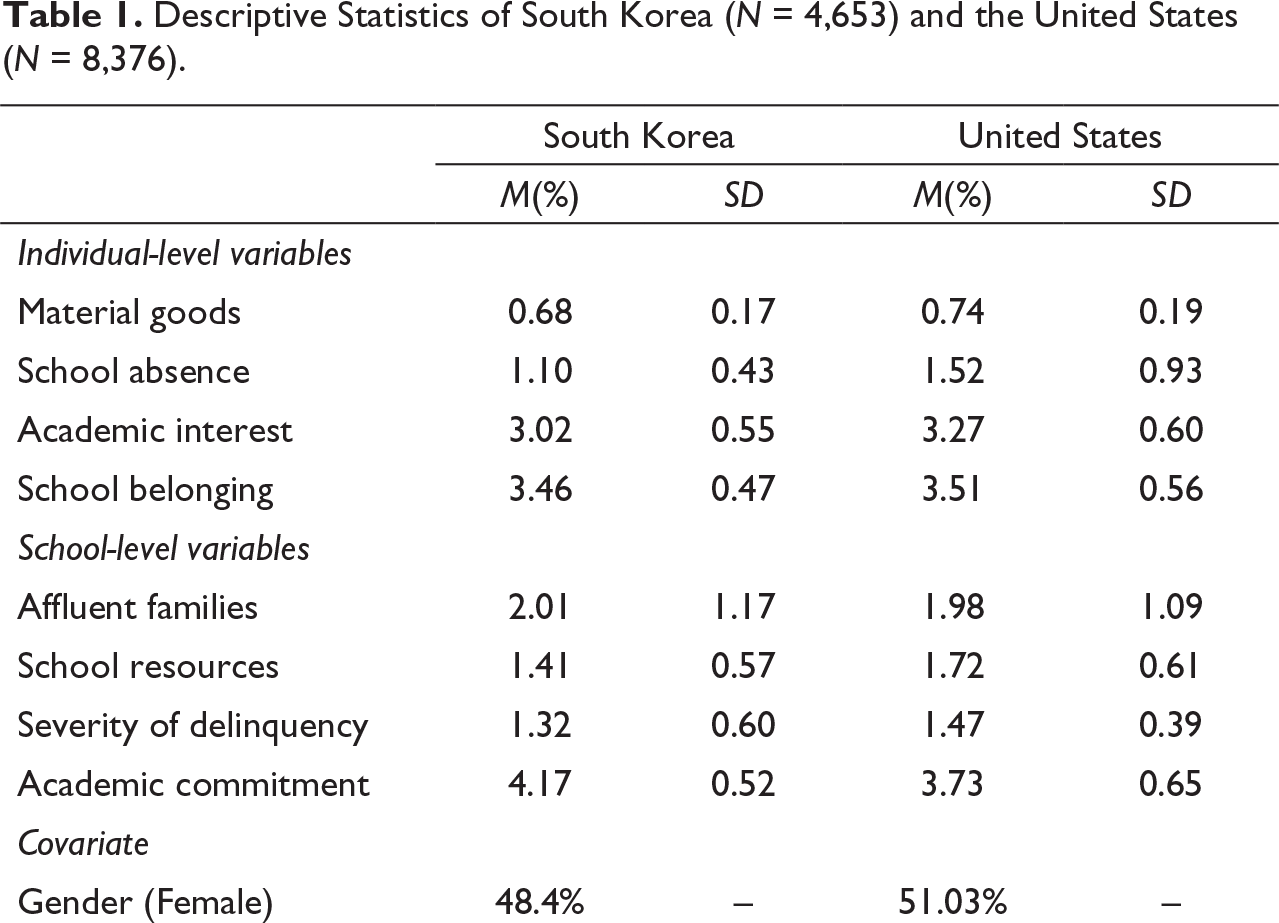
The current study used data from the Trends in International Mathematics and Science Study (TIMSS), which have been collected every four years since 1995 by the International Association for the Evaluation of Educational Achievement. TIMSS measures mathematics and science achievement, knowledge, and skills of nationally representative fourth and eighth graders in more than 60 countries. TIMSS also collects contextual information, such as home environment, school climate, and school system from students, parents, teachers, and principals. This study analyzed data from the sixth wave of TIMSS, which was collected in 2015. For this study, fourth-grade students from South Korea and the United States were examined (Table 1). The original sample size in the TIMSS data for South Korea and the United States were 4,669 and 10,029, respectively.
Descriptive Statistics of South Korea (N = 4,653) and the United States (N = 8,376).
Instruments
To measure bullying victimization, fourth-graders were asked to report how often they experienced the following eight forms of bullying at school (αKorea = .804, αU.S. = .878): (a) I was made fun of or called names; (b) I was left out of games or activities by other students; (c) someone spread lies about me; (d) something was stolen from me; (e) I was hit or hurt by other students; (f) I was made to do things I didn’t want to do by other students; (g) someone shared embarrassing information about me; (h) I was threatened by others. The response options were reverse-coded: never (1), a few times a year (2), once or twice a month (3), and at least once a week (4) such that a higher score indicated more frequent victimization.
A broad range of individual- and school-level measures were selected to represent the multiple dimensions of school climate within the institutional environment, safety, academic, and community domains (Wang & Degol, 2016). These dimensions include characteristics of the school environment that affect students’ experience at school, including bullying victimization. This study included individual-level factors, such as material goods, school absence, interest in academics, and a sense of belonging that correspond to school-level domains. Material goods was measured by taking the average of several binary variables: no (0) and yes (1) that were available at the youth’s home. Those items include three common goods (e.g., computer or tablet, own room, mobile phone), four country-specific items for South Korea (e.g., digital TV, home theater/audio equipment, dehumidifier, air conditioner), and one country-specific item for the United States (e.g., VCR/DVD/Blu-Ray player). School absence was measured ranging from never or almost never (1) to once a week or more (4). Academic interest was measured by taking the average of youth’s interest in math and science. This 4-point Likert scale ranged from disagree a lot (1) to agree a lot (4). Finally, a school belonging was measured, ranging from disagree a lot (1) to agree a lot (4). Sample items included (a) I like being in school, (b) I feel safe when I am at school, and (c) I feel like I belong at this school. Sex, a covariate, was measured as males (0) and females (1).
School-level variables include affluent families, school resources, delinquency, and academic commitment, which were reported by the principals of each school. To measure the concentration of affluent families, participants were asked what percentage of students of the school population came from economically affluent homes. Responses were 0 to 10% (1) to more than 50% (4). School resources were rated on a 4-point Likert scale, not at all (1) to a lot (4) for how instructional material, supplies, space, systems are well-equipped. The severity of the delinquency variable measured the severity of deviance (e.g., absenteeism, cheating, vandalism, theft) ranging from not a problem (1) to serious problem (4) in school. Academic commitment measured the academic expectations or commitment of teachers, parents, and students in the school, ranging from very low (1) to very high (5).
Design
The current study is based on a two-step analysis. In the first stage, we used LPA to identify profiles of bullying victimization among fourth-grade students in South Korea and the United States based on youth’s report of the frequency of eight bullying victimization items. Students were assigned to a single profile based on the highest probability of class membership. This hard classification method was applicable because entropy was over .9 in all cases (Wang et al., 2017). Person-centered analytic methods are ideal for identifying behavioral patterns of subgroups with varying degrees of risk. In contrast to variable-centered methods, such as regression or structural equation modeling that estimate the size and statistical significance of the relationships among independent and dependent variables, person-centered methods (e.g., cluster analysis, latent class analysis, LPA) can classify individuals who report similar patterns on a set of items into subgroups, such that there are within-group homogeneity and between-group heterogeneity (Jung & Wickrama, 2008). In using LPA, the current study will be able to derive subgroups of adolescents who share patterns of bullying victimization and further use this information to compare unique versus common patterns of victimization in South Korea and the United States. This is a methodological advantage over variable-centered approaches that focus on patterns regressing to the mean and hence, are limited in examining specific patterns of victimization experience.
Since there is no single statistical test that discerns the best model, several indices are used to determine the optimal number of latent profiles including the Akaike Information Criterion (AIC), Bayesian Information Criterion (BIC), Sample-size Adjusted BIC (ABIC), entropy, Lo Mendel Rubin Likelihood Ratio Test (LMR), and Bootstrap Likelihood Ratio Test (BLRT). The selection of the best fitting model was determined by the following (Jung & Wickrama, 2008; Nylund, Asparouhov, et al., 2007): A lower information criterion indicates a better fit of the data to the model. Also, an entropy value that approaches 1.00 represents a better model fit. LMR and BLRT play a role in comparing hierarchical results through statistical tests between the null hypothesis and alternative hypothesis. When the probability of the likelihood ratio tests is greater than .05, the null hypothesis that the k-class model better fits the data than the k–1 model cannot be rejected and, thus the k–1 model can be adopted. Class proportions should be no less than 1%; parsimony and theoretical interpretability should also be considered. In the second stage of the study, we performed a series of multilevel logistic regression models with random intercepts using latent profiles of bullying victimization as a binary dependent variable and individual- and school-level variables as independent variables. Multilevel logistic regression models are an extension of the typical logistic regression model for the hierarchical data structure and are appropriate for describing the clustered structure of the data in which individuals (Level 1) are nested within schools (Level 2), and thereby provide accurate estimates of individual standard errors.
Results
Latent Profile Analysis
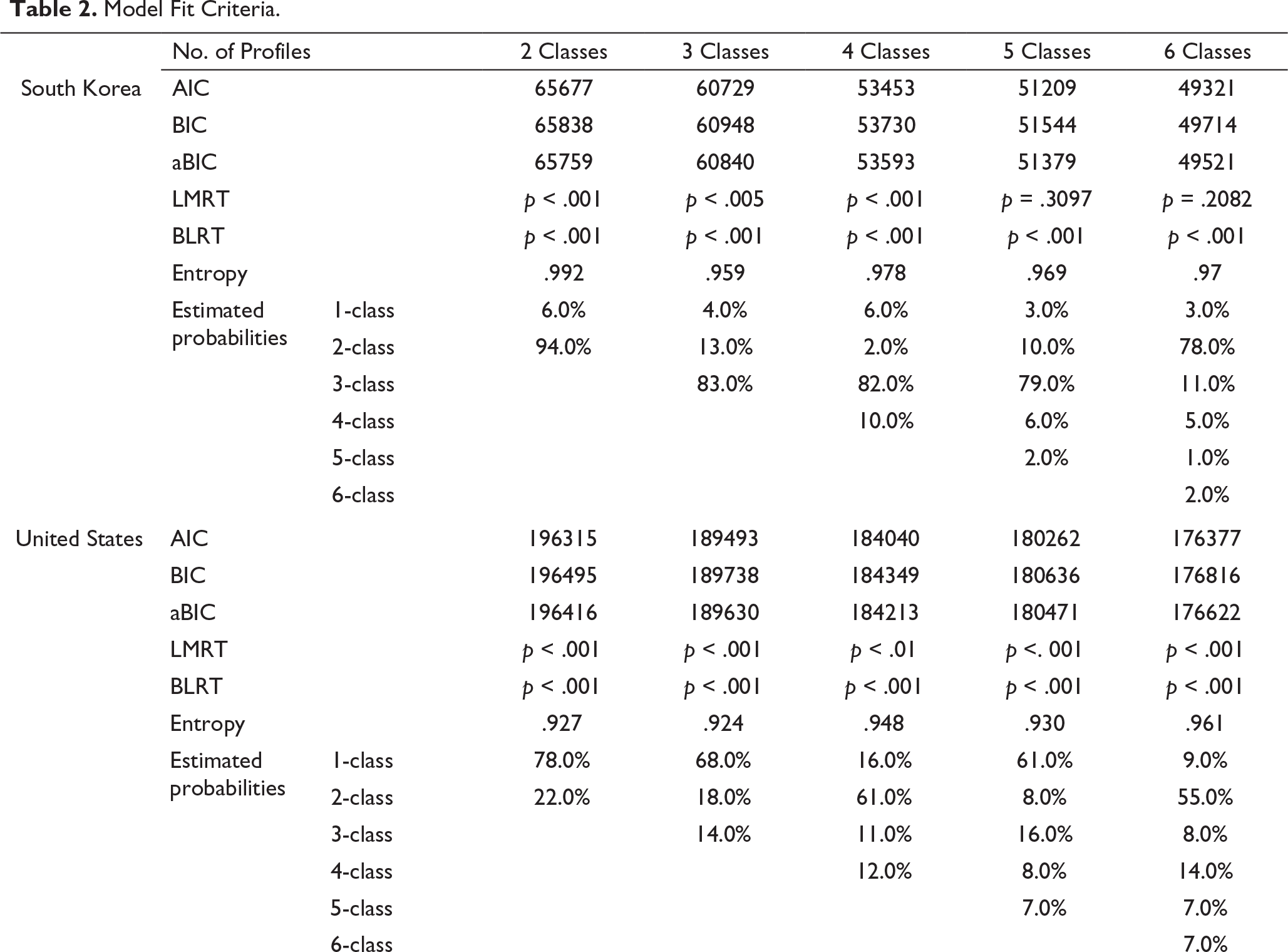
LPA was conducted on 4,668 South Korean youths (from 149 schools) and 9,842 U.S. youths (from 250 schools); youth with missing information on all eight indicators of victimization were eliminated from the analysis, whereas others with partially missing data were handled with Full Information Maximum Likelihood estimation. The 4-class model was selected as the best-fitting model in South Korea and the United States (refer to Table 2). In the South Korean sample, all information criteria declined as classes gradually decreased. The p-value of the LMRT was not significant in the 5-class model, indicating that the 5-class model is not significantly better than the 4-class model. Entropy for Class 2 through Class 6 was above .90. For the U.S. sample, although the AIC, the BIC, and the aBIC values declined as more classes were added, the rate of decrease diminished after the fourth latent class was added. The p-value of LMRT and BLRT was significant in all class models (p < .01). Entropy was above .90 in all five class scenarios. After inspection of class distributions and interpretability, the 4-class model was selected.
Model Fit Criteria.
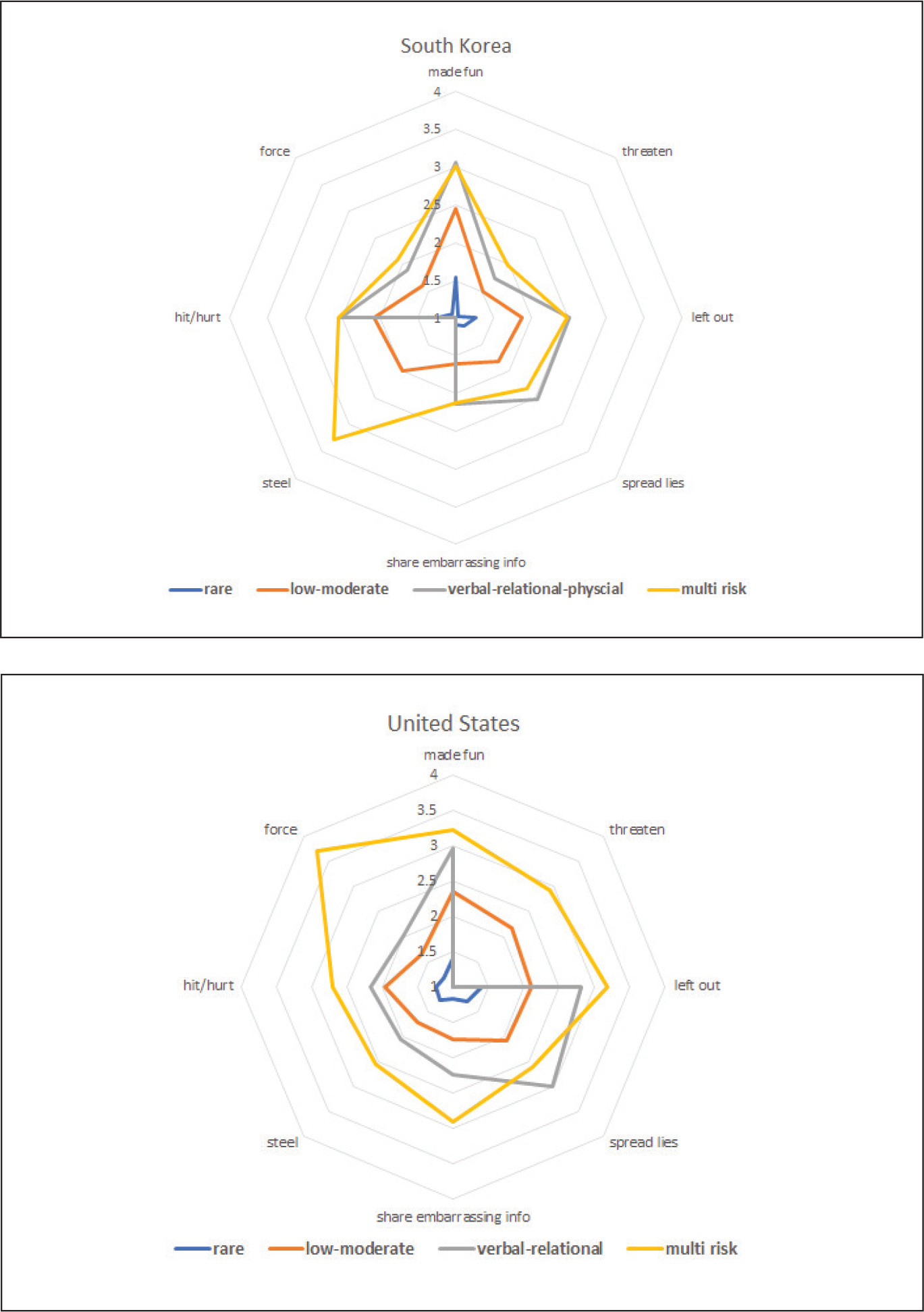
The features of the four classes are presented in Figure 1 and in Table 3. Depending on the victimization type and severity of bullying, latent groups were named as rare, low-moderate, verbal-relational-physical, and multi-risk in South Korea, and as rare, low-moderate, verbal-relational, and multi-risk in the United States. Similar forms of bullying victimization emerged in both countries. The rare group, which experienced hardly any of the eight victimization items, accounted for most adolescents (82% in South Korea and 61% in the United States, respectively). Also, many students in the low-moderate group experienced victimization a few times a year for most items. Scores ranged from 1.51 (“threatened”) to 2.45 (“made fun”) in South Korea and 1.6 (“force”) to 2.34 (“made fun”) in the United States. The distribution of the low-moderate group was the third highest in South Korea (6%) and the second highest in the United States (16%).
In South Korea, two latent groups scored similarly on all victimization items but diverged in the “steal” category. Both latent groups showed especially higher scores for the experience of “made fun,” “left out,” “spread lies” and “hit/hurt,” all of which are typical of ostracism, but the verbal-relational-physical (10%) scored low on “steal” whereas the multi-risk (2%) group also scored high on “steal.” In the United States, the verbal-relational group (11%) primarily experienced relational violence such as “made fun,” “left out,” and “spread lies.” Another group of adolescents who also suffered from physical and personal violence such as “hit/hurt” and “threaten” was named as a multi-risk group (12%).
The 4-class results representing bullying victimization.
Descriptive Summary of Bullying Victimization Items by Latent Profiles.
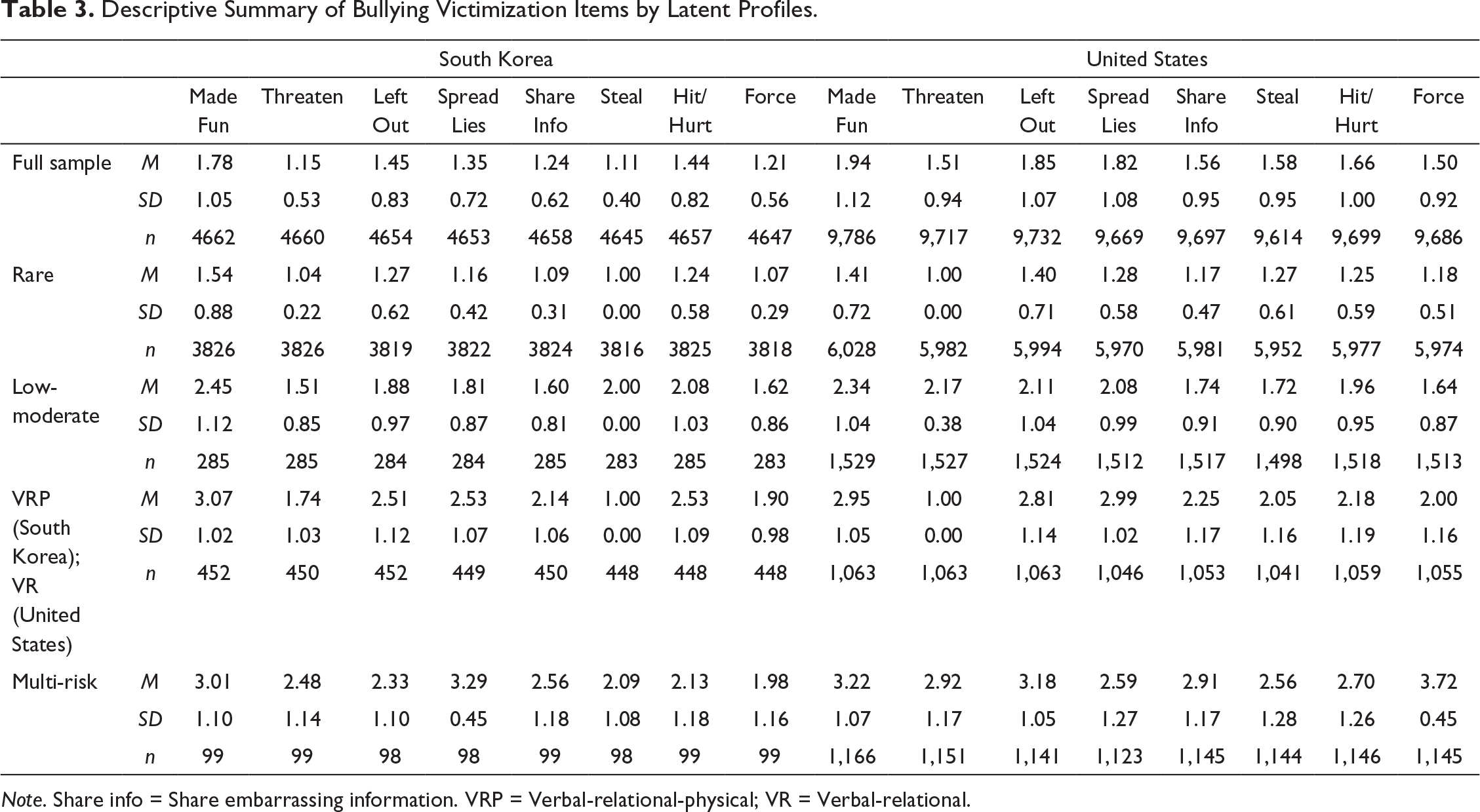
Note. Share info = Share embarrassing information. VRP = Verbal-relational-physical; VR = Verbal-relational.
Multilevel Logistic Regression
Multilevel logistic regression was conducted on 4,653 (from 149 schools) in South Korea and 8,376 (from 248 schools) in the United States who had no missing data on all key variables used in the model (results presented in Table 4). Females were more likely to belong to the less risky latent group than males in both countries. In South Korea, females were less likely to belong to the verbal- relational-physical group than the rare (B = −.692, p < .001) or low-moderate (B = −.508, p < .01) groups and were more likely in the multi-risk group than the verbal- relational-physical group (B = .484, p < .05). In the United States, females were less likely to belong to the multi-risk group than the rare (B = -.212, p < .01) or verbal-relational (B = -375, p < .001) groups but were more likely in the verbal-relational group than rare (B = 146, p < .10) or low-moderate (B = .268, p < .01) groups.
For individual-level factors, there was some support that more material goods predicted membership in the low-moderate group rather than the rare group in South Korea (B = .891, p < .05) and membership in the low-moderate (B = .345, p < .10) or verbal-relational (B = .353, p < .10) group than to the rare group in the United States. High school absence rate generally increased the likelihood of belonging to the higher risk profile in both countries. For example, in South Korea, more absence was associated with being in the low-moderate (B = .214, p < .10) and relational-physical (B = .371, p < .001) groups than to the rare group. Similarly, in the United States, more absences increased the likelihood of belonging in the verbal-relational group than to the rare (B = .187, p < .001) or low-moderate groups (B = .132, p < .01), and membership in the multi-risk group compared to the rare (B = .159, p < .001) or low-moderate (B = .117, p < .01) groups. Higher interest in academics increased the likelihood of verbal- relational-physical (B = .375, p < .001) and multi-risk (B = .407, p < .10) than the rare group in South Korea; In the United States, academically-inclined youth were more likely to belong to the low-moderate group (B = .125, p < .05) and the multi-risk group (B = .214, p < .01) than to the rare group (B = .117, p < .10).
Sense of belonging to the school predicted group membership for all but one. The higher the sense of belonging to school, the more likely youth belonged to the rare group than the victimization group. In South Korea, the higher the sense of belonging, the higher the probability of belonging to the rare group than low-moderate (B = −.873, p < .001), relational-physical (B = −1.170, p < .001), and multi-risk (B = −1.575, p < .001) groups. Higher sense of belonging was associated with membership in the low-moderate group compared to the verbal- relational-physical (B = −.304, p < .10) and multi-risk (B = −.774, p < .01) groups and to the verbal- relational-physical group than the multi-risk group (B = −.412, p < .10). In the United States, the higher the sense of belonging to the school, the more likely youth were to belong to the rare group than the low-moderate (B = −.826, p < .001), verbal-relational (B = −.778, p < .001), and multi-risk groups (B = −1.085, p < .001); youth were more likely to belong to low-moderate group (B = −.380, p < .001) and verbal-relational (B = −.377, p < .001) than multi-risk group.
For the school-level factors, neighborhood affluence did not predict victimization in South Korea, but increased the likelihood of belong to rare (B = −.135, p < .01), low-moderate (B = −.169, p < .001), and verbal-relational (B = −.156, p < .001) groups than the multi-risk group in the United States. School resources reported significant group differences only in South Korea. Higher school resources were more likely to predict membership in the rare (B = −.396, p < .10) and low-moderate group (B = −.406, p < .10) than the multi-risk group. In South Korea, higher delinquency predicted membership in the multi-risk group rather than the rare group (B = .351, p < .05). In the United States, youth were more likely in the low-moderate group (B = .446, p < .001) and the multi-risk group (B = .384, p < .01) than the rare group, and membership in the verbal-relational group than the rare group (B = .201, p < .10). However, higher delinquency predicted membership in the low-moderate group than the verbal-relational group (B = −.264, p < .10). Academic commitment was significant only in the United States. The higher the academic commitment, the higher the likelihood of low-moderate group than the verbal-relational (B = −.184, p < .10) and multi-risk groups (B = −.168, p < .10).
Results of Multilevel Logistic Regression for South Korea (N = 4,653) and the United States (N = 8,376).
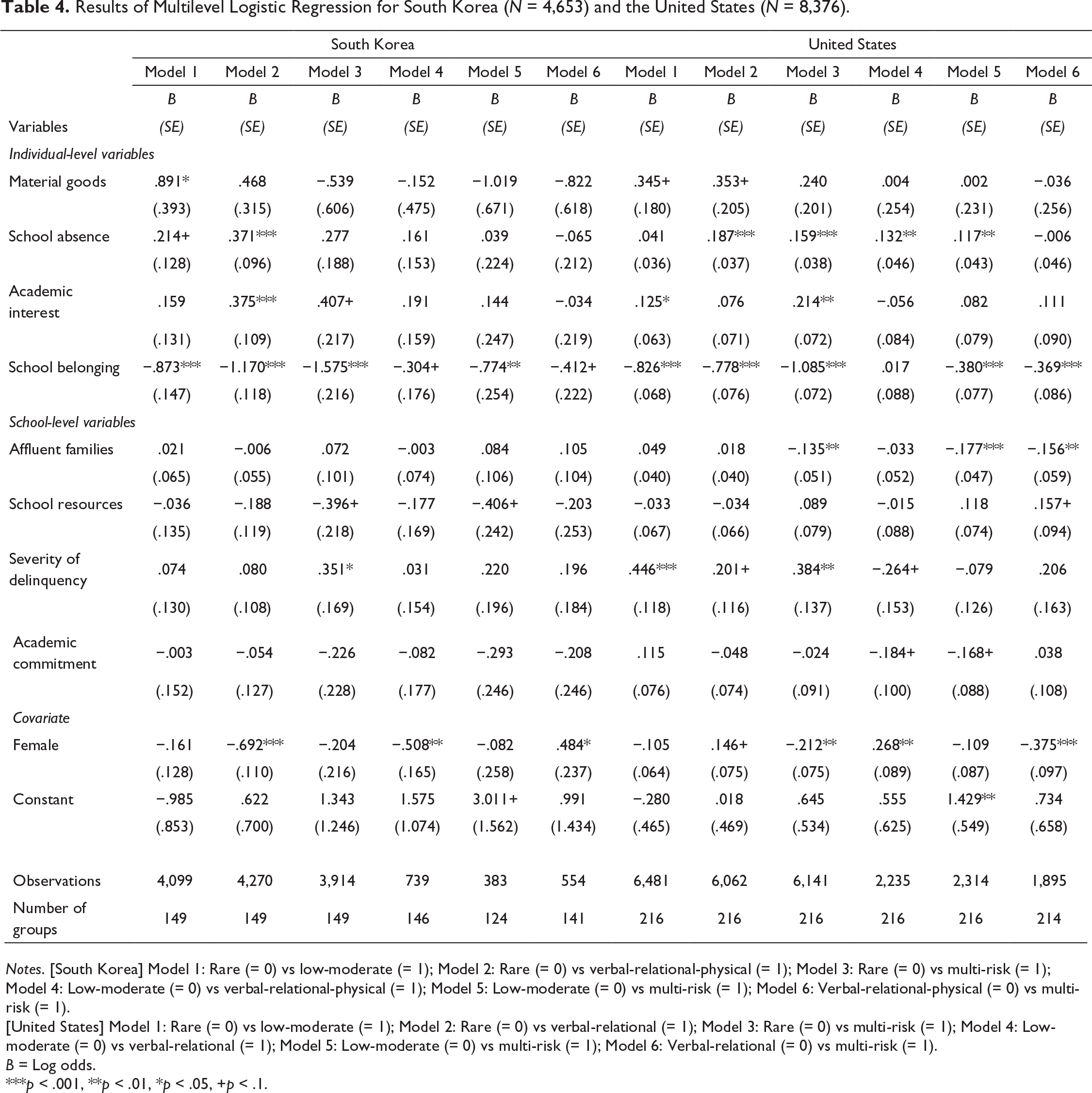
Notes. [South Korea] Model 1: Rare (= 0) vs low-moderate (= 1); Model 2: Rare (= 0) vs verbal-relational-physical (= 1); Model 3: Rare (= 0) vs multi-risk (= 1); Model 4: Low-moderate (= 0) vs verbal-relational-physical (= 1); Model 5: Low-moderate (= 0) vs multi-risk (= 1); Model 6: Verbal-relational-physical (= 0) vs multi-risk (= 1).
[United States] Model 1: Rare (= 0) vs low-moderate (= 1); Model 2: Rare (= 0) vs verbal-relational (= 1); Model 3: Rare (= 0) vs multi-risk (= 1); Model 4: Low-moderate (= 0) vs verbal-relational (= 1); Model 5: Low-moderate (= 0) vs multi-risk (= 1); Model 6: Verbal-relational (= 0) vs multi-risk (= 1).
B = Log odds.
***p < .001, **p < .01, *p < .05, +p < .1.
Discussion
The current study used nationally representative data of fourth-grade adolescents in South Korea and the United States to identify patterns of bullying victimization and examined individual and school-level predictors by applying the Social Disorganization Theory. Although the current study was guided by the idea that socio-cultural differences in South Korea and the United States may affect the experiences of particular forms of bullying victimization and its related individual- and school-level factors, initial hypotheses were only partially supported. Specifically, there were more similarities than differences in bullying victimization experience between South Korea and the United States. Although mean scores for each bullying victimization item were greater in the United States sample than that of the South Korean sample, being made fun of by others (verbal), being left out and the target of spreading lies (relational) were most frequently experienced in both countries. Concerning latent subgroups of bullying victimization experience, the verbal-relational-physical profile emerged in the South Korean sample, whereas the verbal-relational profile was identified in the United States sample. Such results are contrary to the assumption that relational forms of bullying victimization are more prevalent in South Korea due to its group-oriented culture, and physical forms are more common due to their definitional connection with violence (Smith et al., 2004). South Korean adolescents most commonly experienced verbal aggression and ostracism (Ministry of Education, 2019). However, it is possible that although physical bullying victimization is not most salient, it often co-occurs with other types of victimization such as verbal aggression and ostracism. In the United States sample, the relatively young age of the study sample may account for the low presence of physical experience. Prior work has shown that bullying victimization tends to peak when individuals reach 11 to 13 years of age (Eslea & Rees, 2001). Given that the study was conducted on fourth graders (8 to 10-year-olds), bullying victimization may have been underreported because they have not yet reached the peak age of bullying risk.
Another between-country similarity was that the majority of students in South Korea the United States rarely experienced victimization (percentage of the rare group: 82% in South Korea and 61% in the United States). Only a small number of children experienced frequent levels—ranging from once or twice a month to at least once a week—of bullying victimization. The presence of a large group of rarely victimized youth was consistent with other prior studies using person-centered methods. In the United States, results from a study of nationally representative 12- to 18-year-olds showed that 77.3% were in the non-victimization group (Barboza, 2015). Similarly, in South Korea, a nationwide study of 4th to 12th graders revealed that 90.2% were in the non-victimization group (Lim et al, 2016). These results may reflect the recent declining trend in bullying victimization in both countries, as well as in other countries. According to national data of elementary school students in South Korea, the rate of bullying victimization decreased from 15.18% in 2012 to 3.60% in 2019 (Ministry of Education, 2019). Similar patterns have been reported in the U.S. data on primary and secondary school students (U.S. Department of Education, 2018, 2019). The National Crime Victimization Survey reported a steady decline in the percentage of youth who reported being bullied: In 2007, 31.7% of youth (ages 12–18) reported being bullied. In 2017, it was only 20.2%.
It is important to consider the possibility of underreporting of bullying victimization experiences, particularly when using self-administered data. Although a declining trend in bullying and a large presence of adolescents who rarely experience victimization was found in our study, students might have shown a tendency to underreport their bullying experiences to adults as they get older. As studies have shown, minority and male adolescents, as well as those who perceive their school as being tolerant of bullying are especially less likely to report when bullied (Lai & Kao, 2018). Research on the severity and complexity of bullying as well as factors that might influence students’ reports of bullying is warranted. There is evidence that the age of first involvement in bullying and victimization has declined over time (Hong, 2011). However, the specific forms of bullying (e.g., bias-based bullying) have also emerged due to increasingly diverse student populations in both countries (Hymel & Swearer, 2015).
For individuals in the multi-risk group, victimization experience was not concentrated in a single victimization item, For individuals in the multi-risk group,. In other words, youth who were involved in bullying victimization seemed to endorse a wide range of indicators. This finding is consistent with prior research that has reported small variations across different items of bullying victimization, especially for the subgroup of youth who are likely to experience high levels of victimization. Similarly, research has also observed class distinction by the frequency or severity of victimization, rather than type. For example, in a study of public middle school students in a low SES area in Los Angeles, California, in which sixth-graders were surveyed over three years, three classes differed in the severity of victimization experience, rather than type (Nylund, Bellmore, et al., 2007). Specifically, the victimized group had a high probability of experiencing bullying victimization on all six items (called bad names, talked about, picked on, hit and pushed, property theft/damage, laughed at) than the sometimes victimized group and the low victimized group (Nylund, Bellmore, et al., 2007). In another study of sixth and tenth graders across the United States, the all-types victims group experienced higher levels of five types of victimization (i.e., physical, verbal, social exclusion, rumor spreading, and cyber) than the non-victims group who reported extremely low probability of endorsing any of the five victimization items (Wang et al., 2010). These results suggest that most vulnerable youth tend to experience a cluster of various types of victimization rather than only one or a combination of particular types of victimization. Given these results, practitioners and educators should recognize that some youth, especially those in the high-risk group, might be experiencing multiple types of victimization, even when certain types of victimization (e.g., verbal, social) may be less detectable (Hymel & Swearer, 2015). Therefore, anti-bullying programs that assess a wide range of victimization types are needed, as the literature suggests that physical and psychological distress may increase when adolescents experience multiple types of victimization (Bradshaw et al., 2013; Wang et al., 2010).
Results from multilevel logistic regression analysis provided partial support for the Social Disorganization Theory but were not consistent with the second hypothesis that school-level factors are more salient for predicting bullying victimization in South Korea than in the United States. Evidence for school-level variables as predictors of victimization profiles was stronger for adolescents in the United States, with a concentration of affluent families and severity of delinquency being significant in four of the six models. For the South Korean sample, the severity of delinquency predicted victimization in only one model. The relatively small variation across elementary schools in South Korea in terms of resources or student characteristics compared to the United States may account for this finding, but further research on distinct features of schools in the two countries is warranted. The severity of delinquency at the school-level was a strong predictor for membership in subgroups of greater victimization experience for both countries. In South Korea, adolescents with delinquent experience might be perceived as “trouble-makers” or “deviants” who do not conform and thus are marginalized by peers. In the United States, those who are committed to their studies may be victimized because they are perceived as “nerds” or “geeks” (Peterson & Ray, 2006). A detailed account of personal characteristics that constitute each subgroup of bullying victimization is necessary for future research.
Limitations
Several limitations of the current study should be acknowledged, many of which may provide avenues for future research. First, items for victimization to derive latent profiles in the study were primarily based on offline bullying experiences. The use of smartphones, social media, and other innovative technological platforms as a means of bullying, however, is a growing phenomenon among adolescents in South Korea and the United States (Bauman & Bellmore, 2015; Kim & Han, 2016). For example, in the case of South Korea, ka-tta (ostracism occurring in online chat platform), tte-ka (harassment against an individual by multiple members within a single chatroom) are prevalent forms of bullying victimization, and offline and online forms of bullying often occur simultaneously (Kim & Han, 2016; Kim et al., 2020). Understanding these emerging forms of bullying victimization, with the advent of new technological devices in different countries is necessary for examining the unique experiences of bullying victimization (Bauman & Bellmore, 2015).
Also, TIMSS, a dataset that was used for this study, is a large-scale international dataset of fourth-grade children that is representative of each country (LaRoche et al, 2016). Analytic results, however, cannot be generalized to other regions in the world, as this study focused on comparing bullying victimization experiences in South Korea and the United States only. Furthermore, it is unclear whether the study results can be replicated with other age groups, as there is evidence that bullying victimization and its predictors differ across developmental stages (Bradshaw et al., 2013; Nylund, Bellmore, et al., 2007). For example, the distribution of the most vulnerable victimized class in sixth grade substantially decreased by eighth grade (Nylund, Bellmore, et al., 2007) and specific forms of victimization (e.g., cyber, sexual) was more prominent for high school-aged youth than middle school-aged youth (Bradshaw et al., 2013). Extension of similar analyses that encompass a diverse range of countries and age groups may broaden our perspective on designing country-specific anti-bullying programs.
Three of the four bullying victimization profiles in South Korea and the United States shared the same names due to the similarly ranked patterns of bullying victimization experience—rare, low-moderate, and multi-risk— but the corresponding profiles are not identical. Thus, it is important to note that the effect-sizes of the individual- and school-level predictors cannot be directly compared. There is a possibility that the greater presence of the rare group in South Korea, compared to the United States, is an artifact of measurement error. TIMSS is based on data collected from translated versions of a uniform questionnaire across multiple countries. Translating the term bullying across different languages is challenging, as well as identifying culture-specific items that constitute bullying behavior (Smith et al., 2002). Using a translated uniform survey may be limited in accurately capturing the locally meaningful expressions of victimization, as well as the nuanced differences in the meaning of each victimization item between South Korea and the United States. Also, due to the small size of some profiles, results of logistic regression may be subjective to small-sample bias. Although the logistic regression models meet the 10 events per predictive variable rule (Peduzzi et al., 1996), the multilevel nature of our data structure may require more rigorous standards of a sample size to avoid biased results (Moineddin et al., 2007). Finally, in using cross-sectional data, causal inferences cannot be made from the results. For example, a sense of school belonging, and individual-level factors that predict membership in the rare group over other latent groups may indicate that a higher sense of belonging leads to lower victimization. However, it may also indicate that youth with low levels of victimization experience will develop stronger bonds to school and a sense of belonging or even suggest a bidirectional relationship (Wormington et al., 2016). Future longitudinal studies are warranted to determine the temporal sequence and make directional interpretations of the study findings.
Conclusion
Despite these limitations, the key strength of the current study is its contribution to advancing our understanding of heterogeneous subgroups of bullying victimization, as well as individual- and school-level predictors of such experiences from a cross-national perspective. More specifically, the current study was one of the first to directly compare latent profiles of victimization in South Korea and the United States and attempt to explain the differences based on socio-cultural characteristics. Examination of both individual- and school-level factors that predict unique victimization experiences grounded in the Social Disorganization Theory may be informative for addressing key areas of intervention—especially at the school-level the context in which victimization primarily takes place (Ministry of Education, 2019) and where anti-bullying programs are often provided (Ttofi & Farrington, 2011). Cross-comparative research is critical in that social and cultural differences across countries limit our ability to translate research findings and implications for practice from one context to another (Espelage & Swearer, 2003). Identifying patterns of bullying victimization can inform researchers and practitioners of ways to target and support unique groups of students. Also, comparing and contrasting similarities and differences that highlight the uniqueness of each country’s bullying victimization experience may facilitate the development of tailored interventions that are sensitive to each country’s needs.
Footnotes
Declaration of Conflicting Interests
The author(s) declared no potential conflicts of interest with respect to the research, authorship, and/or publication of this article.
Funding
The author(s) disclosed receipt of the following financial support for the research, authorship, and/or publication of this article: This work was supported by the Ministry of Education of the Republic of Korea and the National Research Foundation of Korea (NRF-2016S1A5A2A03925702). This work was supported by the Research Resettlement Fund for the new faculty of Seoul National University.
