



Abstract
Intimate partner sexual violence (IPSV) is a common yet hidden form of violence. It is primarily perpetrated against women by their male partners and is associated with a range of serious mental and physical health outcomes. Despite these harms, it is chronically under-researched. In particular, the overlaps between IPSV and psychological abuse in relationships are poorly understood. Extant literature has focused primarily on the relationship between IPSV and physical violence, neglecting the fact that IPSV often involves verbal or emotional coercion, threats or blackmail rather than the use of ‘force’. In this paper, we draw on reflexive thematic analysis of qualitative interviews with n = 38 victim/survivors of IPSV to explore how they understood the relationship between sexual and psychological abuse in their heterosexual relationships. Four themes were developed from this analysis: 1. I felt like I couldn't say Nno’; 2. I felt degraded and worthless; 3. Letting me know who’s boss; and 4. Making me feel crazy. These themes broadly correspond to four distinct patterns or interactions between IPSV and psychological abuse. Our findings strongly suggest that the relationship between sexual and psychological abuse in relationships is far more complex than previous research would indicate. Psychological abuse is not simply a tool to obtain sex and sexual violence is not only used as a mechanism of psychological control. Instead, the two forms of abuse interact in ways that can be unidirectional, bi-directional or simultaneous to develop and maintain an environment of fear and control and erode women’s self-worth.
Introduction
Intimate partner sexual violence (IPSV) is defined as any sexual act performed against a person’s will within the context of a current or previous relationship (Bagwell-Gray et al., 2015; World Health Organization, 2013). Although the majority of the extant research on this topic focuses on rape or sexual assault with physical force (Bagwell-Gray et al., 2015), IPSV encompasses a broad range of behaviours including: the use of verbal coercion and threats to obtain sex (Jeffrey & Barata, 2021); pressure to use or participate in pornography; sexually degrading comments; and sexual touching or penetration while asleep (Bagwell-Gray et al., 2015; Tarzia, 2021b). Robust prevalence data for IPSV is lacking globally; however, systematic reviews suggest that at least 10% of women in countries such as the US and Australia may have experienced IPSV in their adult lifetimes (Cox, 2016; Logan et al., 2015). Elsewhere, studies have reported rates of up to 48% (Gage & Hutchinson, 2006; Garcia-Moreno et al., 2006). These estimates, however, are likely to grossly under-represent the scale of the problem due to shame, stigma and under-reporting (Wright et al., 2021).
Despite the prevalence of IPSV, research specifically focused on the topic has been scarce when compared with intimate partner violence or sexual assault more broadly. Ground-breaking qualitative research in the 80s and early 90s (Basile, 1999; Bergen, 1995; Finkelhor & Yllo, 1985) provided the beginnings of a much-needed evidence base around women’s lived experiences of IPSV, highlighting the continuum of sexually coercive behaviours that can occur in relationships in addition to rape itself. This work also foregrounded how societal attitudes and heterosexual scripts can be mobilised to undermine women’s resistance to IPSV by normalising male sexual dominance (Gavey, 2019). The momentum from this period, however, has not been maintained in the intervening years. In the main, IPSV has tended to be incorporated under the umbrella of intimate partner violence (IPV) or sexual violence, ignoring its unique context and dynamics (Logan et al., 2015; Tarzia, 2021b). However, Diana Russell (1990) argued against this trend as far back as 1990, suggesting that IPSV ought to be treated as a distinct form of violence. Recent qualitative research on the ‘invisible impacts’ of IPSV (Tarzia, 2021a) supports this argument, suggesting that it is a combination of betrayal and loss of trust, the unique sexualised nature of the violence and its dehumanising aspects, and the lingering impact on future relationships and women’s sense of sexual wellbeing that set IPSV aside from other forms of violence in relationships. Other researchers have also attempted to disentangle IPSV from other forms of violence (Jeffrey & Barata, 2021; Tutty & Nixon, 2021; Wright et al., 2021), however, there is still a long way to go before we truly understand this complex and hidden phenomenon.
One aspect of IPSV that is particularly poorly understood is its relationship to other forms of violence in relationships. This is despite growing recognition that different types of violence frequently co-occur and that it is patterns of behaviours that matter more than individual incidents (E. Stark, 2007). In particular, the relationship between IPSV and psychological abuse (otherwise known as psychological violence, emotional abuse or coercive control 1 ) has been severely neglected. The vast majority of research examines the relationship between sexual and physical violence, suggesting that there is an association between IPSV and increased risk of serious injury or homicide (J. Campbell & Soeken, 1999; McFarlane et al., 2005). Yet, Logan and colleagues (2015) have highlighted that there are clear overlaps between types of IPSV that are non-physical – such as sexual coercion – and psychological abuse. Indeed, in their 2007 qualitative study of forced sex and coercive behaviour, they describe an ‘under-researched dimension of sexual abuse ...which more closely resembles psychological abuse within a sexual context’ (p. 72). Some quantitative research (Mitchell & Raghavan, 2019; Wandera et al., 2015) has attempted to examine co-occurring IPSV and psychological abuse, yet, this work does not give us an in-depth understanding of how these intersecting forms of violence might be experienced by women. Qualitative studies on this topic – which have the potential provide this insight – are rare. Most research addresses only limited aspects of psychological abuse such as verbal degradation (Ptacek, 2016) or coercive tactics used by perpetrators to obtain sex (e.g. Faustino & Gavey, 2022; Finkelhor & Yllo, 1985; Logan et al., 2007; Ptacek, 2016). Little is known about other more complex ways that sexual and psychological abuse might intersect in relationships. Furthermore, no studies have explored how the two forms of abuse work together and the impacts of this combined assault on women. Addressing this gap, the current paper explores the interactions between IPSV and psychological abuse in relationships through analysis of in-depth qualitative data from interviews with women victim/survivors in Australia. We take a feminist sociological approach to the topic of IPSV that recognises how sexual scripts and social norms under patriarchy can shape and construct sexual behaviour including sexual violence (Gavey, 2019).
Materials and Methods
This paper draws on findings from the Beyond Silence study, an Australian-based project focused on understanding women’s experiences of IPSV and improving help-seeking and support.
Recruitment and Data Collection
The details of recruitment and data collection procedures for this study have been reported elsewhere (Tarzia, 2021a, 2021b, 2021c; Tarzia & Tyler, 2021). In brief, adult women self-selected to participate and were recruited via social media using sensitive and safe methods (Tarzia et al., 2017). We utilised ‘soft’ language in study advertisements that invited women who had been in a relationship where ‘things happened in the bedroom that [they] did not want’ or who had ‘felt pressured, unsafe or afraid during sex with a boyfriend, girlfriend, husband or partner’ to take part in the study rather than referring to IPV or sexual assault (Harned, 2005). Interested women who clicked on the advertisements were directed to an online expression of interest form where they were asked to provide their first name, safe telephone number and safe email address (that an abusive partner did not have access to). A total of 80 women lodged expressions of interest. These women were then sent the study plain language statement and contacted by a research assistant to arrange a time to be interviewed. Thirty-eight women returned a signed consent form and participated in an interview. The others were either unable to be reached via telephone or email or unable to participate due to scheduling conflicts.
In-depth, unstructured interviews (Corbin & Morse, 2003; Low, 2007) were conducted with participants. Unstructured interviews are a flexible and dynamic form of data collection that – if done correctly – can elucidate rich and detailed narratives (Johnson, 2002). Although conversational in style, the researcher typically says as little as possible, only asking questions where necessary for clarification or to expand upon something the participant has said. In this case, the participants were asked a single question: ‘Can you tell me about a time when something happened in the bedroom that you did not consent to?’ alongside any background information about the relationship that was necessary to understand the context of the abuse. Follow-up questions were different for each interview and guided by the participant’s story (Low, 2007). Given that unstructured interviews tend to place greater control in the hands of the participant, some researchers have argued that they can be a particularly empowering form of interviewing for vulnerable participants or for those whose voices have traditionally not been heard (Corbin & Morse, 2003). Interviews took place either in person at The University of Melbourne or via telephone and lasted between 22 minutes and 83 minutes (average length 45 minutes). All interviews were audio recorded and transcribed verbatim by a professional transcription service.
Ethical Issues
Undertaking in-depth interviews about sensitive issues such as sexual and intimate partner abuse requires a trauma-informed approach (R. Campbell et al., 2019). Rebecca Campbell and colleagues (2019) helpfully outline the ways that trauma-informed principles can be specifically incorporated into research with survivors of sexual violence. These include: ensuring transparency (e.g. in recruitment materials and consent forms); maximising participant agency and choice (in terms of what to share and how much to share); minimising power dynamics within the research encounter (by reframing the interview as a collaborative undertaking); being respectful of participants’ experiences and using active listening techniques to demonstrate empathy; taking all possible steps to avoid re-traumatisation; and soliciting participant input into research processes wherever possible.
The first author (who undertook all the interviews) has a great deal of experience in conducting research with survivors of sexual and intimate partner violence and utilised all of the strategies outlined above. Although some of these techniques are more challenging to enact over the telephone, it is still possible to undertake successful trauma-informed interviews without being physically in the same room. This has been discussed elsewhere in more detail (Tarzia, 2021a), but an example is to focus on conveying empathy and engagement via tone of voice and verbal cues (e.g. ‘Mmm-hmm’, ‘Yes, I understand what you are saying’, ‘Please could you tell me a little more about X’.). No substantial differences were noticed in terms of rapport-building or quality of data between the telephone interviews and those undertaken face-to-face. Indeed, it has been suggested that for some people, the telephone may be preferable since it provides an additional layer of distance (Mealer, 2013) when speaking about traumatic events.
Distress protocol was developed that outlined strategies for supporting participants who became upset at any point. On conclusion of their interview, all participants were given referral cards with contact details for local and national sexual assault and IPV services in case they needed additional support beyond the interview encounter itself. In addition, given that the research focused on sexual violence perpetrated by an intimate partner, there were safety concerns to consider. For instance, although we requested that participants utilise a ‘safe’ email address for all study communication and provided them with instructions on how to create a new Gmail or Yahoo account, all emails sent to participants referred to a ‘women’s health study’ and came from a generic email address. When communicating by telephone, an initial check was always conducted to ensure that the participant was able to talk privately. In reporting the results, we have used pseudonyms for all participant names. Ethical approval for the research was received from The University of Melbourne's Human Ethics Research Committee (#1749979).
Analysis
Braun and Clarke’s reflexive thematic analysis (Braun & Clarke, 2019, 2021) was chosen for analysis of the interview data. Reflexive thematic analysis is an inductive method of analysis where codes and themes are developed by the researcher based on patterns of shared meaning across the dataset. The reflexivity of this approach lies in the acknowledgement that themes are generated by the researcher as part of the process of engagement with and interpretation of the data (Braun & Clarke, 2021). In other words, themes are not passively waiting to be identified. The researcher is encouraged at all times to reflect on how their own values, background, assumptions and theoretical position/s may impact on their coding decisions. Reflexive thematic analysis is a flexible and adaptable method which is particularly well-suited to topics where there is minimal prior knowledge (Nowell et al., 2017) or when the interest is how personal experiences sit within broader socio-cultural contexts (Braun & Clarke, 2021).
There are six main steps to reflexive thematic analysis: familiarisation; coding; generating initial themes; reviewing and developing themes; refining, defining and naming themes; and writing up (Braun & Clarke, 2021). The first author read and re-read the transcripts multiple times, taking notes if necessary, before commencing an initial round of descriptive coding. Themes were then generated based on the researcher’s interpretation of the data. The researcher reviewed, adjusted and refined the themes further until they were deemed to be an accurate representation of the women’s experiences. Although some other pattern-based qualitative analysis methods require the involvement of multiple authors in the coding process, reflexive thematic analysis does not (Braun & Clarke, 2021). This is because the focus of reflexive thematic analysis is not on validity or reliability; rather, as outlined above, it celebrates the researcher’s active involvement in the creation of themes and understands the role that subjectivity plays in this process (Braun & Clarke, 2019).
While ‘validity’ is not a core part of reflexive thematic analysis, trustworthiness is still a critically important component. The first author aimed to promote trustworthiness by striking a balance between becoming ‘embedded’ in the data and stepping back at regular intervals to reflect on the themes and the assumptions that may have shaped them. Additionally, the second author (who is clinically trained with a research background in IPV and health) reviewed and contributed to refinement of the overarching themes, providing a ‘sounding board’ that enabled further reflection by the first author. This increases the likelihood of the themes being a true representation of the data. As additional measures of trustworthiness, careful record-keeping of analytical decisions was undertaken using the software program NVivo12. In reporting the findings, participant quotations have been used (verbatim except for edits to correct grammar and to shorten the length of text) with the meaning preserved as authentically as possible to support thematic development. Where possible, a diversity of participant responses has been utilised to demonstrate the presence of themes across the dataset (Noble & Smith, 2015).
As the majority of the analysis was undertaken by the first author, particular care was taken to reflexively examine the potential influence of the researcher’s position on how the data were interpreted. The first author is a feminist sociologist working in the health sciences. Consequently, the issue of IPSV is approached from an ecological perspective that acknowledges both the systems of male power that scaffold violence against women and the multiple community, relationship and individual factors that facilitate it (Heise, 1998; Tarzia, 2021b). This position no doubt impacted on how the analysis was undertaken and it is important to acknowledge this here.
Results
Thirty-eight women participated in an interview for this study. The majority were educated, employed and aged between 18–49 years (three participants were aged between 50 and 65 years). Around one third received some form of pension or benefit as their main source of income. Only one participant was still in the abusive relationship referred to in their interview; two thirds were not currently in a relationship and the remainder were in a relationship with a new partner. None of the participants identified as Aboriginal or Torres Strait Islander and all spoke English as a first language. Although not all of the participants currently identified as heterosexual, without exception the perpetrator of the IPSV was a male intimate partner.
Through the use of reflexive thematic analysis, we developed an understanding of how sexual and psychological abuse are jointly utilised by male perpetrators of IPSV in order to maintain dominance over, and control of, their female partners. Below, four key areas in which sexual and psychological abuse intersected are described with supporting quotations from participants: 1) I felt like I couldn't say ‘No’; 2) I felt degraded and worthless; 3) Letting me know who’s boss; and 4) Making me feel crazy.
I Felt Like I Couldn’t Say ‘No’
This theme – which focused on the myriad ways that perpetrators subtly (and not-so-subtly) coerced and blackmailed their female partners into acquiescing to sex – was the most well-represented across the data. Coercion and blackmail took many forms depending on the context of the woman’s relationship. For some, sex was ‘negotiated’ within a relationship that was recognisably psychologically, financially and sometimes physically violent: He was really controlling. Emotionally, physically and sexually. He was convinced from day one that I wasn’t a virgin.…I don’t know where he got that from…Yeah, he used to punish me all the time for that. ‘Oh, because you’ve been sexually active you won’t mind if we do this. You won’t mind if we do that’. I didn’t know how to say no. (Diana)
Many of the participants, however, did not label their relationships as ‘violent’ and reported no physical violence outside of the context of the bedroom. Instead, they described ways in which their emotions were manipulated by their partners in order to obtain sex. He was never physically aggressive outside of I guess what he did to me while we were in the bed together, which I found really hard because it’s sort of like - I don’t know. I feel a bit strange about it because you hear about all this domestic violence where people get beaten and their ex is really aggressive and really abusive, whereas my ex wasn’t like that…[But] in the bedroom he was really quite forceful and he would use those emotional manipulations, just making me feel bad. (Kelly)
Psychologically abusive tactics varied, but included a spectrum of behaviours from the perpetrator withdrawing emotionally through to the use of overt psychological aggression to pressure women into sex: There was no affection, if there was no sex there was no - like if I, I almost felt like I couldn’t say no or else he wouldn’t even speak to me a lot of the time. (Elaine) I couldn’t deal with the sulking because I just - I’ve got this people pleaser type of personality at the best of times, and it would just - it just made me very, very anxious if he was in one of those moods. (Trish) I felt that whenever he wanted sex, if I didn’t give it to him that would trigger him to be aggressive. It was forced consent I guess you could call it, where I felt like I didn’t actually have the option to say no, because then he would react in a nasty way. (Holly)
The use of guilt was another common tactic of sexual coercion. Many women described feeling like their sole role in the relationship was to please their partner sexually and it was clearly implied that if they failed to perform their assigned role, the relationship would be under threat. He’d sulk and…say[] that he’d get blue balls and that sort of thing. He’d talk about how other women want to have sex all the time and how I used to let him have anal but now I never do; just how bad it made him feel and he doesn’t feel loved and that his love language is physical affection and I wasn’t showing him enough physical affection. (Kelly) He would threaten to go out and pay for it [sex]…[He’d say] ‘This is why men have affairs’. (Lottie) He would be, I guess, just verbally coercive…[He would] guilt me into it beforehand, yeah, saying that it was what I was supposed to do, or that I had done something wrong and so this was how… I could make up for it, and that kind of thing. (Matilda)
These tactics created an environment for women where saying ‘No’ became effectively impossible. It was far easier and safer for women to acquiesce to the perpetrator’s demands for sex rather than endure his emotional blackmail and coercion. When used in this way, psychological abuse became a vehicle through which the perpetrator was able to compel women to have sex.
I Felt Degraded and Worthless
This theme, which was also a strong one within the data, outlines the way that psychological abuse and sexual violence were used in tandem to make women feel worthless, degraded and ashamed. The psychological abuse (primarily in the form of verbal remarks on women’s appearance or sexual performance) served to render women less able to resist the sexual violence, whilst the sexual violence in turn reinforced and physically confirmed the perpetrator’s derogatory views. He’d tell me that I was frigid and unattractive and ugly, and then would force me to have sex with him anyway… I’d say, ‘I’m not really feeling it tonight’, and then suddenly all of my clothes would be off and he’d be having sex with me. (Sasha) …One time he told me I was repellent. I remember particularly thinking about that word, ‘repellent’, like a mosquito, you know. I was repellent, he couldn’t have sex with me. I’d sort of be putting on something nice so I looked good and he’d sort of look me up and down and say, ‘I don’t like that kind of thing’. (Ava) He would have sex with me and then sit there. ‘You fucking cunt. You fucking frigid fucking fat whale’. (Jana)
Several women mentioned being compared unfavourably to previous sexual partners, which they found distressing and embarrassing. [He would talk about] things like how tight I was because I’d had a child or yeah… how I performed. He kind of almost rated it against other partners he had had. We lived in a small town so I knew his partners as well… I think when I look back, he was just trying to manipulate me to have anal sex with him, which I didn’t want to do. So making me feel inadequate about my body because I’d…delivered vaginally and so I wasn’t, yeah, tight enough for him. (Bronwynn)
Several women commented that the constant erosion of their self-worth through negative comments led them to believe that they were the ‘lucky ones’ who were fortunate to have had the perpetrator as a partner. This made them feel less able to complain about or resist their partner’s unwanted sexual advances. It’s that perfect storm of him always making me feel like I’m the one lucky to have him even though he’s the one treating me and my family with ultimate disrespect. (Charlotte) Maybe it was because my self-esteem was so completely low - yeah, I’d probably put it down to that. I was fearful of even speaking. (Felicity) If he ever thought that I was getting too confident…he would tear me down and make sure I - or try to make me feel like he was the only one that loved me and no one else did and stuff like that. (Cilla)
For these women, psychological abuse and sexual violence were experienced in a co-occurring cycle, reinforcing their sense of degradation and shame through a combination of verbal and sexual behaviours. This vicious cycle served to further weaken their capacity to resist the violence or leave the abusive relationship.
Letting Me Know Who’s Boss
The third theme developed from the analysis explores how sexual violence was used to reinforce the perpetrator’s psychological dominance and control. In most cases, the relationships described by these women already incorporated a range of controlling and psychologically abusive tactics; sexual violence was described as an additional tactic that served as a physical ‘reminder’ of the perpetrator’s control. One participant, who was viciously sexually assaulted by her partner, reflected that: I had moved back in with some friends… and they had recognised that he [partner] was isolating me from them and everybody else, and when he bought this business and moved out of the city, they said, ‘If you go out there, we’re really worried about what will happen to you’. It makes sense for you to come and live with us, stay here in the city close to work… I think… that act [of sexual violence] came from him losing control of me to a degree because I was no longer living in the house with him and I was only going out there on the weekends…He was going to make sure that I knew he was still the boss. (Trish)
Another woman similarly narrated how her much older partner had used sex as a way of punishing her for not paying him sufficient attention: He had anal sex with me and I didn’t want to. I didn’t get any forewarning or any conversation about it. I couldn’t pull away. It was painful. It was confusing…I think it may have been him asserting control over me. We’d been out to a pub that night and I was dancing with another girl and there were guys in the vicinity and I wasn’t paying him any attention. (Cilla)
In the most extreme cases, sex was harnessed by the perpetrator as a vehicle for psychological torture. Women described not knowing when the next assault would be coming, which left them in a state of constant fear. I’d go to bed every night [thinking] my God is this going to happen again? Is he going to do it to me tonight? Is tonight going to be the night? This constant fear that you live in, is this going to happen tonight? Am I going to sleep or is this going to hurt? Is going to be more forceful tonight, is it going to be more painful? Just all these things that went through your head constantly, living in that from day to day. (Narelle) I’ve spent so many years… being afraid at night because I just don’t know whether or not I’m going to be raped again. (Joan) With the [physical] abuse, it was obvious that it was coming. With the sexual abuse, you just never knew when he was going to [do it] - it was very sporadic. So there wasn’t really any characteristics that he would show, that I would know it was going to happen. He was really sinister and really sadistic. (Rhonda)
For these women, psychological abuse and sexual violence were used concurrently to create an environment of fear and control. In many cases, the sexual violence was used as a tool to punish women’s ‘transgressions’ or to reinforce the boundaries of the perpetrator’s psychological dominance.
Making me Feel Crazy
The final theme explores the intersection between sexual violence and ‘gaslighting’ – a now well-recognised form of psychological abuse. Gaslighting is described in the literature as emotional manipulation, where the victim/survivor is made to question their thoughts, memories, and sense of reality (Sweet, 2019). In many ways, the context of sexual violence lends itself particularly well to gaslighting, given that it typically occurs in private where others cannot confirm events or behaviours. Many of the women in this study, for example, outlined how their partners completely denied the sexual violence ever happened, making them question whether their memories of the events were authentic: I did bring it [the sexual violence] up once - in a text, and he’s like, oh well - he basically just said, ‘Well that didn’t happen so, whatever’. (Allie) I told him never to do it again and he said that he wouldn’t, but he blamed it on me that I was prudish every time. Then he would do it again, he would deny ever having done it before and he would then say that I was kind of delusional or something. (Ava)
One woman, whose partner repeatedly accused her of masturbating and planted hidden cameras in her bedroom to ‘catch’ her out, described how her perception of reality was completely distorted by the perpetrator’s accusations: The accusations, they nearly drove me insane, like to the point of where I nearly ended up in a psychiatric unit because I couldn’t - because he used to accuse me of all this stuff and I used to say I’m not doing it. But then he would tell me I’m such a liar that I wouldn’t know the truth if it slapped me in the face. (Kaitlyn)
Several women similarly described how they began to doubt their own sexual desires. A lot of the time they make you think [the sex] is what you want. But it’s not. Like they have this way of projecting things, and because they’re so manipulative, they put it in a way that you’re sort of like okay with it. But really, deep down, you’re not and you don’t want to do it. (Rhonda)
Women also mentioned that their partners deliberately cultivated an image of being the ‘good guy’ when out in public. This meant that they were constantly receiving positive validation from other people, which made them doubt their own impressions even more. There’d be grand gestures. Things that were very generous and very visible and that people would praise him, like, ‘Oh…You’re so lucky. He’s such a great guy.’ He’s also very tall and good-looking, so I think he gets away with a lot because of that. So, yes, he was really invested in this good guy [image]. Still is very invested in it. (Lottie) He would be so good when people were around and when it was just me and him at night-time it was a complete - you know, I’d sleep outside (Kaitlyn)
In this theme, psychological abuse in the form of gaslighting can be seen as a way to deny and minimise the sexual violence, as well as weakening women’s motivation to disclose.
Discussion
This study explored the interactions between IPSV and psychological abuse as described by women victim/survivors in Australia. It is one of the few studies to explicitly examine the relationship between these two forms of violence in a qualitative way, although previous qualitative research has certainly explored elements of these intersections (Bergen, 1996; Finkelhor & Yllo, 1985; Logan et al., 2015) and some quantitative studies have attempted to address it directly (Mitchell & Raghavan, 2019; Wandera et al., 2015). Our findings suggest that there is a strong and complex relationship between psychological abuse and IPSV within women’s abusive heterosexual relationships. Figure 1 outlines four main patterns for this interaction based on our analysis. These patterns are not mutually exclusive; in some relationships, all four of these patterns might be observed, whilst for others, only one or two might occur. It may also be the case that other patterns exist which were not recognised by this particular sample, given that the women were predominantly educated, of white Australian background, employed and had left the abusive relationship. Interactions between sexual violence and psychological abuse in relationships.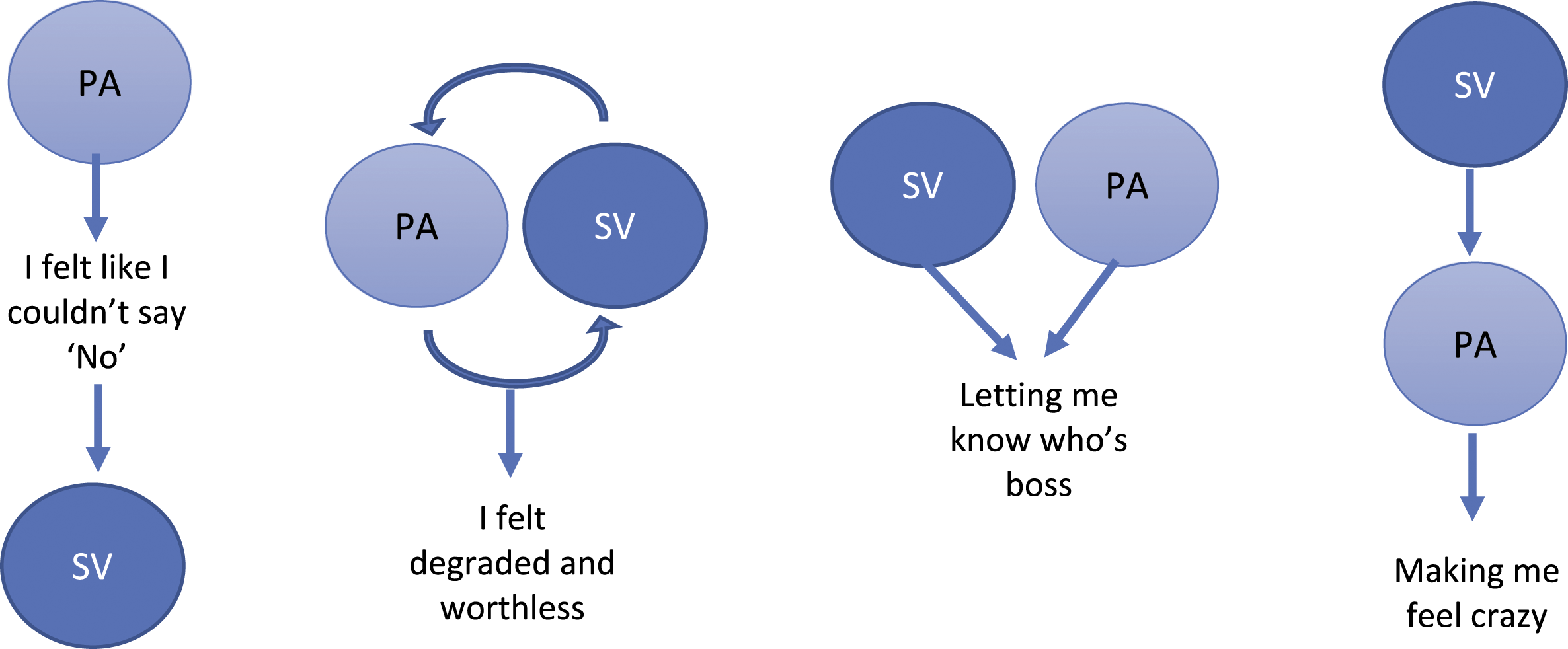
In the first interaction, psychologically abusive tactics such as emotional blackmail, guilt, ‘freezing out’ and threats were used to compel women to acquiesce to unwanted sex. This was an extremely common experience amongst the participants, and one that is supported by the extant literature (Bagwell-Gray, 2021; Basile, 1999; Easteal & McOrmond-Plummer, 2006; Logan et al., 2007). There are several reasons why these psychological tactics may be so effective at coercing women into unwanted sex. First, as argued elsewhere (Tarzia, 2021c), women often feel responsible for fixing ‘sexual problems’ in their relationships and undertake ‘emotional labour’ in order to protect their partner’s feelings. Suggestions by the perpetrator that they are uncaring or selfish for withholding sex may play directly into this tendency as well as their desire to maintain the relationship. Similarly, there remains an undercurrent within many societies that women have an obligation to sexually service men (Tarzia, 2015); this may mean that women do not see their partner’s coercive behaviour as problematic until it becomes more severe. These findings support assertions by Logan and colleagues (2007) that the notion of ‘consent’ in a relationship characterised by psychological and/or physical abuse is problematic.
A second key finding of our study was that psychological abuse and IPSV interacted in a bi-directional way. Women reported that their partner’s psychological abuse and verbally-degrading tactics made them feel worthless; this sense of worthlessness was then compounded by being treated like a sexual object which, in turn, made them more likely to believe the insults. The use of sex as a weapon of psychological destruction has been previously described in research relating to the behaviour of soldiers in conflict settings (Baaz & Stern, 2009; L. Stark & Wessells, 2012), but far less so in the context of IPSV. Logan and colleagues (2007) did identify degradation as a key component of non-physical IPSV, however, their focus was more on how the sexual acts themselves were experienced as degrading rather than the interaction between sexual and psychological tactics. Starratt et al. (Starratt, Goetz, Shackleford, McKibbin, & Stewart-Williams, 2008) examined the relationship between men’s partner-directed insults and sexual coercion, finding that insults to the woman as a person and accusations of infidelity were significant predictors of sexual coercion. Again, however, their findings did not illuminate the relationship between the two forms of abuse. The most commonly reported discussion of degradation in the relationship context is found in the literature on image-based sexual abuse (McGlynn et al., 2020) and non-consensual pornography (Eaton et al., 2020). These studies generally highlight the ways that perpetrators attempt to publicly shame their partners through the use of sexual or pornographic imagery. Our findings, however, speak to a more private and internalised use of psychological abuse to induce shame.
In the third pattern, IPSV and psychological abuse were simultaneously applied by the perpetrator in order to reinforce his dominance within the relationship. Women reported instances where sex was used as a punishment for ‘transgressing’ the boundaries of the perpetrator’s control. In extreme cases, they reported sex and psychological abuse being used to inspire terror. In some, but not all cases, physical violence was also incorporated into the mix. Few previous studies have explored the use of sex as a form of punishment in abusive relationships, with notable exceptions being the work of Bagwell-Gray (2021) and Logan and colleagues (2007). Participants in Logan’s study, for instance, described similar themes of power and control being exerted through sexual dominance. They also briefly mention the threat of further sexual violence as a tool of psychological control.
The final pattern identified through our analysis was the use of gaslighting and other psychologically manipulative tactics to deny that sexual violence had taken place, making women question their sanity and sense of reality. Whilst the use of gaslighting as a tactic of psychological abuse has been established within the literature (Boxall & Morgan, 2021; Sweet, 2019), few studies have examined it in the context of IPSV. Yet, the private nature of IPSV makes it particularly susceptible to gaslighting, particularly when, as many women in this study described, the perpetrator is outwardly charming and respected in the community. Fear of not being believed is a critical barrier to help-seeking for all survivors of sexual violence (Patterson et al., 2009; Wright et al., 2021); the use of gaslighting by perpetrators of IPSV plays into this fear, making women even less likely to seek support or disclose the abuse.
The findings of this study have important implications for research and policy. Previous research on IPSV and psychological abuse has largely explored types of sexual coercion in relationships (Basile, 1999; DeGue et al., 2010; Logan et al., 2007; Mitchell & Raghavan, 2019; Starratt et al., 2008) and tactics that are used by perpetrators to obtain sex. This body of research sees psychological abuse as a tool for the sexually-motivated perpetrator. Similarly, coercive control research (Boxall & Morgan, 2021) suggests that sexual and physical violence are tools of psychological control. In either scenario, the relationship is unidirectional and relatively straightforward. Looking at our model, however, it is clear that this kind of unidirectional relationship was only seen across two of the themes in our analysis: ‘I felt like I could not say “no”’ (where psychological abuse was used to blackmail or threaten women into having sex) and ‘Making me feel crazy’ (where sexual violence occurred and was subsequently denied by the perpetrator as a form of gaslighting). In the other two themes, psychological abuse and IPSV occurred in a bi-directional or simultaneous way, with the interplay between the two being far more complex than previous research has indicated.
From a practice perspective, given the close relationship between IPSV and psychological abuse described by the women who took part in this study, we suggest that those working with women victim/survivors should consider asking about sexual violence if psychological abuse is disclosed and vice versa. In particular, psychological tactics designed to degrade and elicit shame and feelings of worthlessness ought to be considered a red flag for IPSV. Practitioners should also consider that sexual violence in relationships can be used as a form of psychological torture; it is therefore critical to address women’s symptoms of post-traumatic stress, anxiety, depression and other mental health problems if they disclose IPSV. Practitioners may need to be proactive about raising the subject of IPSV with women, considering that more subtle sexually coercive tactics such as blackmail and emotional manipulation may not be recognised by victim/survivors as ‘abusive’. Additionally, the perpetrator may be denying that the IPSV occurred. Finally, it is important to be aware of how psychologically abusive tactics may affect a woman’s ability to provide meaningful consent to sex. As the findings of this study suggest, women may not feel able to say ‘no’, even when they are fearful and distressed by their partner’s behaviour.
The findings presented in this article shed light onto an important but neglected area of research. Understanding the intersections and interactions between IPSV and psychological abuse is particularly critical in the current post #MeToo climate, with more women coming forward to disclose experiences of sexual violence. Our study has many strengths, including a rich and robust dataset, a commitment to prioritising the voices of victim/survivors and an interdisciplinary approach to analysis. However, some limitations must also be acknowledged. All but one of the women who participated in this study had left the relationship where the IPSV occurred; they were therefore reflecting back on their past experiences with the benefit of hindsight and distance. Furthermore, despite efforts to recruit a diverse sample of women, the self-selecting study population was predominantly white, educated, heterosexual and English-speaking. Our findings should thus be interpreted with some caution.
Conclusion
This study is the first to deeply explore women’s experiences of the complex tactics of sexual and psychological abuse used by partners. It reveals that services need to understand that it is not sufficient to explore the behaviours of partners alone but rather the meaning for women of those behaviours. Moreover, it highlights the need for research and practice to consider more thoroughly the complex interactions between psychological and sexual violence and the patterns through which they contribute to an environment of fear and control for women. The findings open up new avenues for future research that will be critical to understanding women’s experiences and support needs. In particular, research with more diverse groups of women is needed to explore the relevance of the patterns identified in this study.
Footnotes
Acknowledgments
We would like to acknowledge the contributions of the women who participated and hope that this research reflects their strength and resilience.
Declaration of Conflicting Interests
The author(s) declared no potential conflicts of interest with respect to the research, authorship, and/or publication of this article.
Funding
The author(s) disclosed receipt of the following financial support for the research, authorship, and/or publication of this article: This research was funded by an Australian Research Council Discovery Early Career Researcher Award (DECRA) DE170100080.
