



Abstract
Peer-to-peer aggression and bullying is a social phenomenon and is related to social structures in the school. In-group membership as well as construction of the other and differentiation from other potential groups is an important predictor of one’s social identity. Social Dominance Orientation is an important addition to social identity theory as it examines both issues of social dominance and social egalitarianism and is related to out-group denigration. In this study, we examined whether social dominance theory (both the dominance and egalitarian forms) will add to the prediction of physical and relational aggression among adolescents. Using a bias-corrected 3-step approach, we used Latent Profile Analyses to examine the responses of 1617 Israeli adolescents on measures of social dominance and egalitarian orientation, salience of their social groups and moral disengagement. Based on the analysis, we identified four classes of respondents, which can be broken down into two distinct categories: high social dominance and moral disengagement and high social egalitarianism. We compared male and female adolescent respondents and group salience. We then compared the four latent profiles on the two distal variables of physical and relational peer-to-peer aggression. Findings have theoretical and applied relevance to further investigating issues of group dynamics and construction of the other as potential predictive factors in understanding peer-to-peer aggression and bullying.
Introduction
Social Dominance Orientation as a Predictor of Peer-to-Peer Aggression Among Adolescents
According to Waller and Staub (Staub, 2003; Waller, 2002), one’s individual and collective worldview regarding social hierarchies, one’s construction of the “other” via us-them thinking, and moral disengagement predict intentional harm-doing. School-based peer-to-peer aggression is a subset of this intentional harm doing among adolescents and is a source of concern for both parents and professionals and has long been seen as a central cause of social adjustment problems (Anderson & Bushman, 2002). School-based peer-to-peer aggression is a socially based phenomena and a by-product of social functioning and construction of the other (Charters et al., 2013; Cillessen & Rose, 2005; Espelage et al., 2003; Rodkin & Berger, 2008), supplemental to moral disengagement (Gini, 2006; Gini et al., 2014; Hymel et al., 2009; Vaillancourt et al., 2003).
Construction of the Other
Social Identity Theory (SIT, Tajfel, 1982; Tajfel & Turner, 1979) relates to the individual’s sense of membership in a particular group and how one identifies with those and other groups. Membership and identification act as the basis of social categorization, where the individual develops an identity through the comparison and overlapping of in-groups vis-à-vis out-groups. Between-group comparisons are instrumental for developing social identity and understanding one’s place in the social world (Tarrant et al., 2001). Adolescents will designate some groups as being of higher status and some of lower status, based on their own proximate, or desired, in-group (Oakes et al., 1994). Understanding the ascendancy or denigration of different groups exacerbates or inhibits group identification (Brown & Lohr, 1987) along with the adoption and assimilation of common in-group beliefs (Turner, 1982). Such beliefs and norms influence the individual’s interpersonal behavior (Hogg & Turner, 1987) and, appear to be related to levels of between-group aggression (Charters et al., 2013); however, the saliency of these beliefs in predicting peer-to-adolescent aggression and bullying remains unclear.
In-group identity exerts a moderating influence on youth aggression (Merrilees et al., 2013). Strongly identifying with an in-group can increase aggression and the endorsement of aggressive responses towards out-groups (Fischer et al., 2010). The use of SIT to understand aggression has led to a number of important predictions. For instance, as an individual’s social identity becomes more salient, his or her appraisal of social stressors will be affected by the views of members of his or her in-groups. Further, social identity salience is a powerful determinant of whether an external stressor is seen as threatening (Haslam & Reicher, 2006). Out-group perception and bias has been linked to reduced levels of empathy (Struch & Schwartz, 1989), in-group favoritism, and aggression against the outgroup. In the school aggression and bullying context, we hypothesize that strong in-group identification will be linked with outgroup denigration. SIT has traditionally examined in-group favoritism resulting from the positive evaluation of one’s social group and the need to enhance one’s positive social identity in relation to group membership. Out-group bias can be attributed to the elevation of the in-group or denigration of the out-group, or both (Levin & Sidanius, 1999). In our view, understanding out-group denigration may add a significant component to the theoretical understanding of youth aggression and bullying.
Social dominance theory emphasizes the role of social dominance orientation (SDO) in driving in-group favoritism and out-group denigration (Levin & Sidanius, 1999). SDO posits the existence of a basic desire to establish and maintain social stratification where complex social groups are structured via social hierarchies, with several groups on the top and at least one group on the bottom (Sidanius & Pratto, 2001). Sidanius and colleagues (Ho et al., 2012) break down SDO to include two latent variables: intergroup dominance (SDO-D) and intergroup egalitarianism (SDO-E). Intergroup bias (Levin & Sidanius, 1999) and preferential evaluation of the in-group relative to the outgroup are conceptually and empirically distinct from between-group egalitarianism (Tajfel & Turner, 2004). We know of no studies that examine in-group favoritism and outgroup denigration vis-à-vis egalitarianism and their effects on school violence, bullying, intentional harm doing, and victimization. Despite the fact that research among adult respondents has consistently found that male adults exhibit more pronounced dominance SDO than adult females (Bosak, 2019; Sidanius & Pratto, 2001), gender based differences in SDO in youth have not been examined in relation to peer aggression or bullying. Hence, one of the goals of this research was to examine gender differences in both SDO dominance and egalitarianism and how these latent traits predict peer-to-peer and school-based aggression.
Social dominance has been explored as potential sequelae of peer-to-peer bullying (Reijntjes et al., 2016). For example, Reijntjes et al. found that bullying leads to increased social dominance. Similarly, Goodboy et al. (2016) described bullying as a display of social dominance. However, the extent to which social dominance orientation is comorbid with different types of bullying for adolescent males and females has not been examined. Accordingly, we ask whether SDO can be differentially associated with different types of bullying by adolescents.
Clearly, social dominance is an especially salient concept in Israeli society, where a long-standing conflict and military occupation is endemic to Israeli society. SDO has been examined among Israeli adults (see Ho et al., 2012); however, we know of no studies which link SDO and peer-to-peer aggression (Malkin & Ben Ari, 2013).
Moral Disengagement
Bandura (2015) described four general categories of cognitive processes which allow individuals to actively restructure perceptions of intentional harm-doing in order to retard guilt and self-censure. This model of moral disengagement (MD) has been gaining steady traction in understanding why bullies and their assistants (Salmivalli, 2010) are able to consistently torment their classmates while observing levels of distress they are causing to their peers (see Bussey et al., 2015). MD has been linked to bullying, primarily as a cognitive dissonance reducing mechanism (Weisenthal, 2021) and previous research demonstrates that youth engage in frequent moral disengagement when explaining peer aggression (Gini et al., 2015) and that MD is negatively correlated with a myriad of prosocial behaviors (Jiang et al., 2020; Thornberg & Jungert, 2014).
Peer-to-peer Aggression in the Schools
The school-based violence literature has primarily been associated with direct physical aggression (Olweus, 1993) and indirect, or relational bullying (Crick et al., 2001). Despite the fact that physical aggression seems to be more prevalent among boys, both as aggressors and victims, relational aggression appears to be more prevalent among girls. Crick and Grotpeter (1996) described relational aggression as acts which rely on social relationships in order to hurt the other person. Methods include spreading rumors, threats of social ostracism, or making friends with another child as “punishment” for behavior deemed “unacceptable” (Pellegrini, 1998). Despite the fact that Underwood (2003), expanded the use of the term relational aggression to social aggression to include both verbal and nonverbal behaviors, in this study, we use the term “relational bullying” since such bullying can be either direct or indirect (or overt or covert) and is, by nature, always socially based (Björkqvist, 2001). We predict that SDO-D will be highly correlated with both types of aggression for males, yet primarily related to relational aggression for females; whereas, SDO-E will be associated with lower frequencies of aggressive behaviors.
Research Goals
Taking into account the impact of social status and moral disengagement in predicting aggression, the additive effect of social dominance orientation remains unclear. The primary aim of this study is to examine whether SDO dominance and egalitarianism add to our understanding of the psychological mechanisms engendering physical and relational peer-to-peer aggression and bullying (Goal 1). A secondary aim is to examine whether SDO, and moral disengagement along with in-group identification, gender and age can be used to understand aggressor classes or profiles (Goal 2). Accordingly, we investigated whether social dominance theory can enhance our understanding of physical and relational school-based peer-to-peer aggression. We hypothesized a positive relationship between one’s social dominance orientation as described by perception of the exclusivity of the social group, physical, and relational aggression. Lastly, we hypothesized that social dominance and moral disengagement will predict levels of aggression, and that this prediction will be different for different levels of social identity for males and females and will vary by age.
Methods
Data Analytic Procedure
To examine our hypotheses regarding the influence of social dominance orientation and moral disengagement on physical and relational aggression, we proceeded in five steps. Initially, in the instrumentation phase, we conducted a series of exploratory and confirmatory analyses of each scale and subscale using STATA as well as tests of internal consistency via McDonald’s ω (Hayes & Coutts, 2020) using the ω module in STATA (Shaw, 2020). Initially the entire sample was randomly divided into two equally sized sub-samples and an exploratory factor analysis (EFA) with varimax rotation was performed on the first sub-sample in order to verify the published structure of the instrument. We then conducted a confirmatory factor analysis (CFA) on the second sub-sample to validate the EFA structure. Next, we conducted two hierarchical regression analyses to determine whether both SDO variables add to the prediction of physical and relational aggression. Third, we conducted a series of latent profile analyses (LPA, Bray et al., 2015) using LatentGold software (Vermunt & Magidson, 2019). We conducted LPAs that specified one to eight classes, and accepted the latent class structure with the best model fit as indicated by the Bayesian Information Criteria (BIC), the Akaike Information Criteria (AIC), the log-likelihood scores, and entropy R2 as outlined by Nylund et al. (2007). Posterior class memberships were used to evaluate the validity of the LPA classification into posterior probability groups, in the fourth stage of data analysis, we conducted a multinomial logistic regression to examine whether grade level (age), gender, and physical and relational aggression could predict posterior class membership. In the fifth stage of the analyses, membership in groups based on the LPA posterior values were used to examine physical and relational aggression levels.
Instrumentation
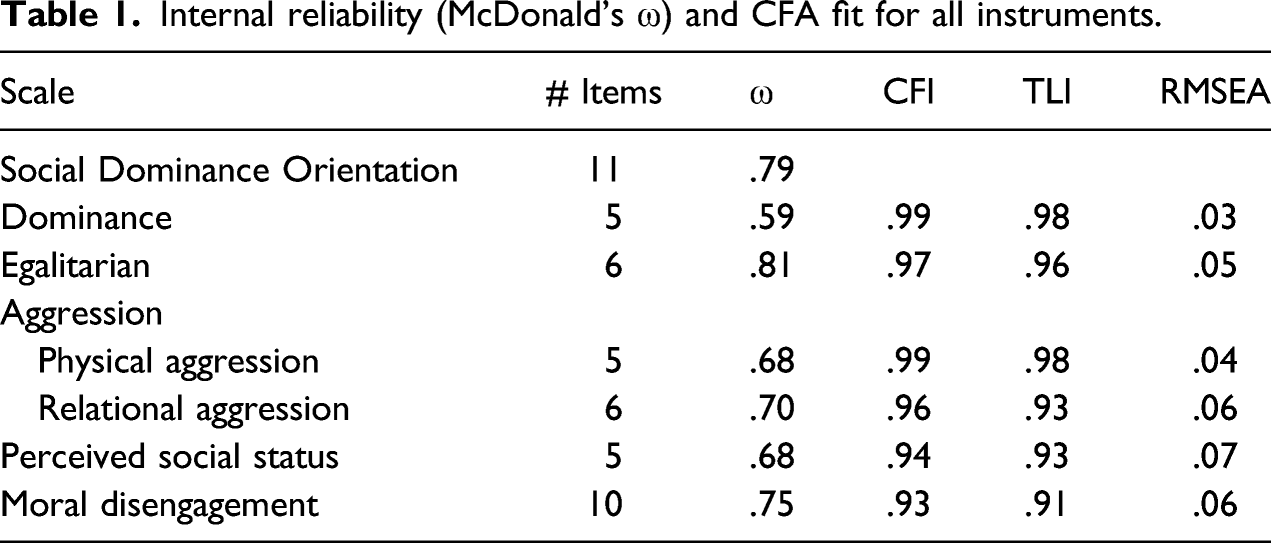
Social Dominance Orientation (Sidanius & Pratto, 2001) is a scale divided into dominance and egalitarian orientation (SDO-D and SDO-E, respectively). Since SDO scales were originally written to examine aspects of political dominance, we choose to include only items which were clearly linked to adolescents’ experience in school aggression. Accordingly, from the SDO(16) (Ho et al., 2012), we included 11 items. Items are ranked on a six point Likert type scale (“don’t agree at all” to “completely agree”). The EFA showed that these items fit the two dimensions (Ho et al., 2012), with one neutral item, and explained 41% of the variance. For the five items of the dominance scale (SDO-D), the internal consistency (McDonald’s ω = .59) and the confirmatory factor analysis (CFA) showed excellent model fit (CFI = .99, TLI = .98, RMSEA = .03). For the egalitarian scale (SDO-E), the six items had a good internal reliability of ω = .81, the CFA showed that the latent model fit the items (CFI = .97, TLI = .96, RMSEA = .05).
Physical and Relational Aggressor Scale (Gumpel, 2008). Aggressor scales were derived from subscales of the School Violence Inventory (SVI), a comprehensive self-report of school aggression, victimization, and social structure and is composed of two subscales: physical and relational aggression. The EFA showed that the items fit the two dimensions and explained 57% of the variance. All items were scored on a three-point frequency type scale (0 = never to 2 = usually). The physical aggression scale consisted of five items and had an internal consistency of ω = .70. The CFA showed that the data fit the latent model (CFI = 0.99, TLI = 0.98, RMSEA = .04). For the relational aggression items, the six items had an ω score of .68, and fit the latent model well (CFI = 0.96, TLI = 0.93, RMSEA = .06).
Perceived Social Standing. We created a unidimensional six-item scale of respondents’ perceptions of their own social status. To verify this structure, we first conducted an exploratory factor analysis with varimax rotation which accounted for 53% of the variance, McDonald’s ω = .66 and the items fit the unidimensional latent model (CFI = .94, TLI = .93, RMSEA = .07).
Internal reliability (McDonald’s ω) and CFA fit for all instruments.
Results
Participants
Following approval by our institutional IRB, questionnaires were given to 1661 students, yielding 1617 valid questionnaires (98.6% response rate); 46.78% of the questionnaires were collected in 10 middle schools in Israel, and the remaining 53.23% were collected on-line in an electronic survey distributed via each school’s internal social media platform. All respondents were enrolled in the general education system. The sample population included students from the seventh to ninth grade (approximately age 12–15). Gender distribution was skewed, with more girls responding than boys (1039 or 64.25% vs. 578 or 37.75%, respectively).
Missing Data and Outliers
We examined data for missing values. Initially, we examined the mean time for questionnaire completion for web-based responses (12.5 minutes) and deleted any respondents whose response time was less than one minute. Next, we examined all non-categorical data for missing values and determined that missing values were randomly distributed among all measures with no systematically distributed missing variables based on Little’s MCAR analysis with 5% of missing values as a threshold. Perhaps due to the fact that the MD scale was the last scale in the questionnaire, more than 5% of the data were missing; hence, data imputation was not calculated for this scale. Instead, when using this scale we used pairwise deletion to correct for missing values. Likewise, no data imputation was calculated for missing categorical data (gender, grade, school type). For the remainder of the dataset, we used the “mice” package (Multivariate Imputation by Chained Equations) in R (van Buuren & Groothuis-Oudshoorn, 2011). We further examined our data using margin plots, and finally used the predictive mean method (PMM) to impute missing data where appropriate.
Data were also assessed for multivariate outliers using a Mahalanobis Distance Test (Tabachnik & Fidell, 2019). Mahalanobis distances were used to examine the distance of each case from the centroid of all cases by generating a χ2 value for each case (El-Masri et al., 2020) using the number of independent variables as the degrees of freedom (Tabachnik & Fidell, 2019). Outliers based on the Mahalanobis distance based on a χ2 (67) > 108.53 distribution were removed. In all, we removed 151 outlying respondents from further analysis.
Hierarchical Linear Regressions
In order to verify our initial hypothesis that SDO has an additive value in the prediction of physical and relational aggression, we performed two hierarchical linear regressions where the first block consisted of social status and moral disengagement, and the second block consisted of SDO-D and SDO-E. The linear combination of these variables predicted physical aggression, F (4, 1586) = 81.92, p < .001, R2 = .17. The addition of the two SDO variables significantly changed the regression equation, ΔR2 = .07, F (2, 1856) = 66.28, p < .001. The linear combination of these variables also predicted relational aggression, F (4, 1586) = 68.10, p < .001, R2 = .15. Again, the addition of the two SDO variables caused a significant change in the R2, ΔR2 = .15, F (2, 1586) = 82.43, p < .001.
Latent Profile Analysis
We next conduced a latent profile analysis based on three indicator variables: the two SDO scales (dominance and egalitarianism) and moral disengagement while using gender, grade and social status as covariates using the LatentGOLD software (Vermunt & Magidson, 2019) and based on the biased-adjusted 3-step approach (Bakk et al., 2016). The approach encompasses three analytical steps. In the first step, latent clustering models are determined and the most appropriate model is selected. In the second step, respondents are classified into clusters determined in the first step. Cluster membership is determined by posterior probabilities. In other words, instead of assigning each respondent to a specific latent cluster, membership is based on the probabilities of being in any of the identified clusters (rather than a binary fixed factor member/not-member classification). Cluster identification is verified via a multinomial logistic regression based on these posterior probabilities. In the third step, the researcher examines the relation between the clusters (now called “classes”) with extant variables of interest. In our case, class membership was compared to physical and relational aggression scores. SDO-D, SDO-E, and MD were entered as continuous indicators. In order to address sample heterogeneity across grade-level, gender, and social status, these variables were included as inactive covariates. Grade and gender were entered as nominal covariates, and status was entered as a numerical covariate.
Bayesian Information Criterion (BIC), Akaike’s Information Criterion (AIC), VLMR and entropy R2 for classes 1–8, N = 1,640, SDO-D, SDO-E, MD with three inactive covariates (Gender, Grade, Status).

NPAR: Number of parameters, LL: Log Likelihood (model), AIC: Akaike information criterion, BIC: Bayesian information criterion, VLMR: Vuong-Lo-Mendell-Rubin adjusted likelihood ratio test.
Latent class marginal means are shown in Figure 1, where Cluster 1 accounts for 51.93% of the respondents, Cluster 2, accounts for 21.39% of the respondents, Cluster 3 accounts for 14.43% of respondents, and Cluster 4 accounts for 12.24% of the respondents. As is evident from Figure 1, the four groups differed in the two SDO measures and in a less pronounced manner on the MD measure. Clusters are bimodal in their SDO-D and MD scores. Clusters 2 and 3 have the highest SDO-D and MD scores as well as the lowest SDO-E scores. Clusters 1 and 4 have the lowest SDO-D scores and have the highest SDO-E scores. To better understand response patterns, we named the four clusters based primarily on responses to the three scales. The second and third clusters show higher SDO-D and MD scores, while the first and fourth clusters have higher egalitarian scores, lower dominance, and moral disengagement scores. Accordingly, we name these two groupings as more anti-social (clusters 2 & 3) versus more pro-social (clusters 1 & 4). Higher dominance and moral disengagement are associated with lower egalitarianism and vice versa. Latent class marginal means (N = 1573), SDO-D, SDO-E, MD with three inactive covariates (Gender, Grade, Status).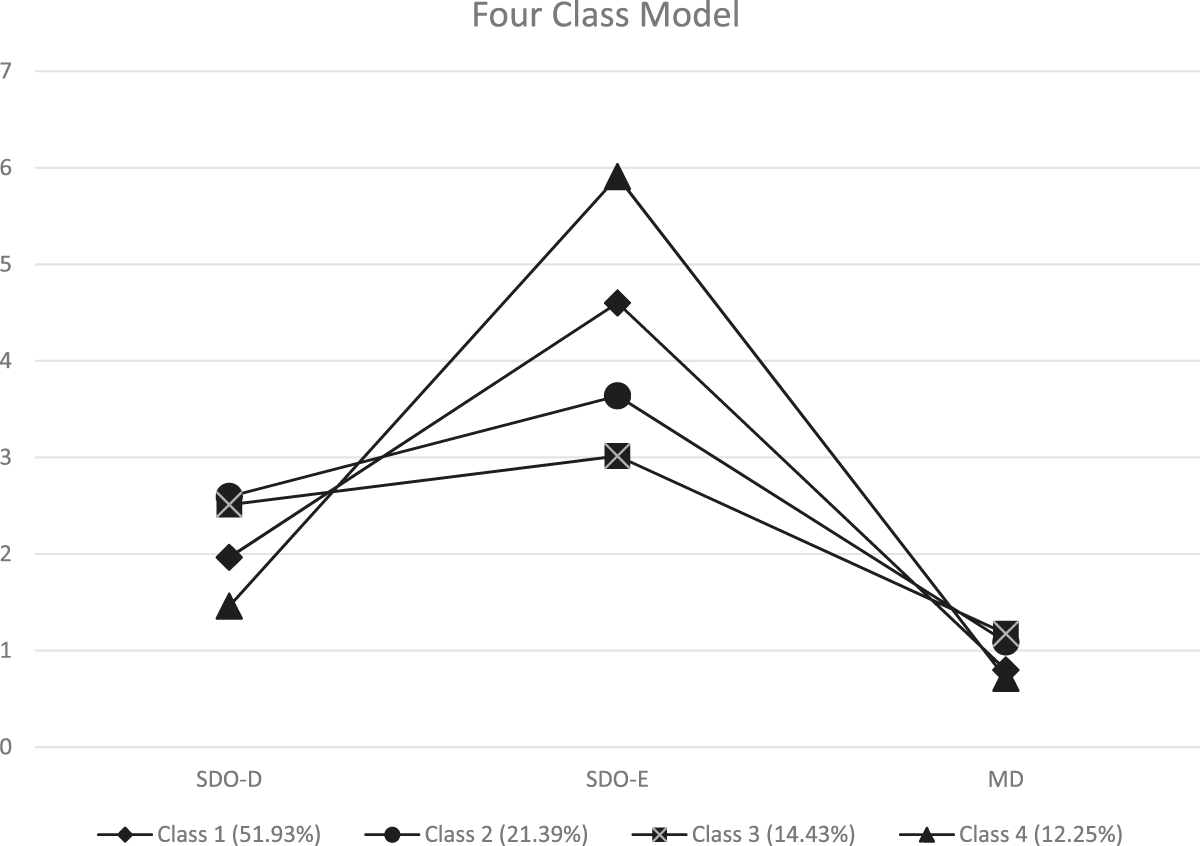
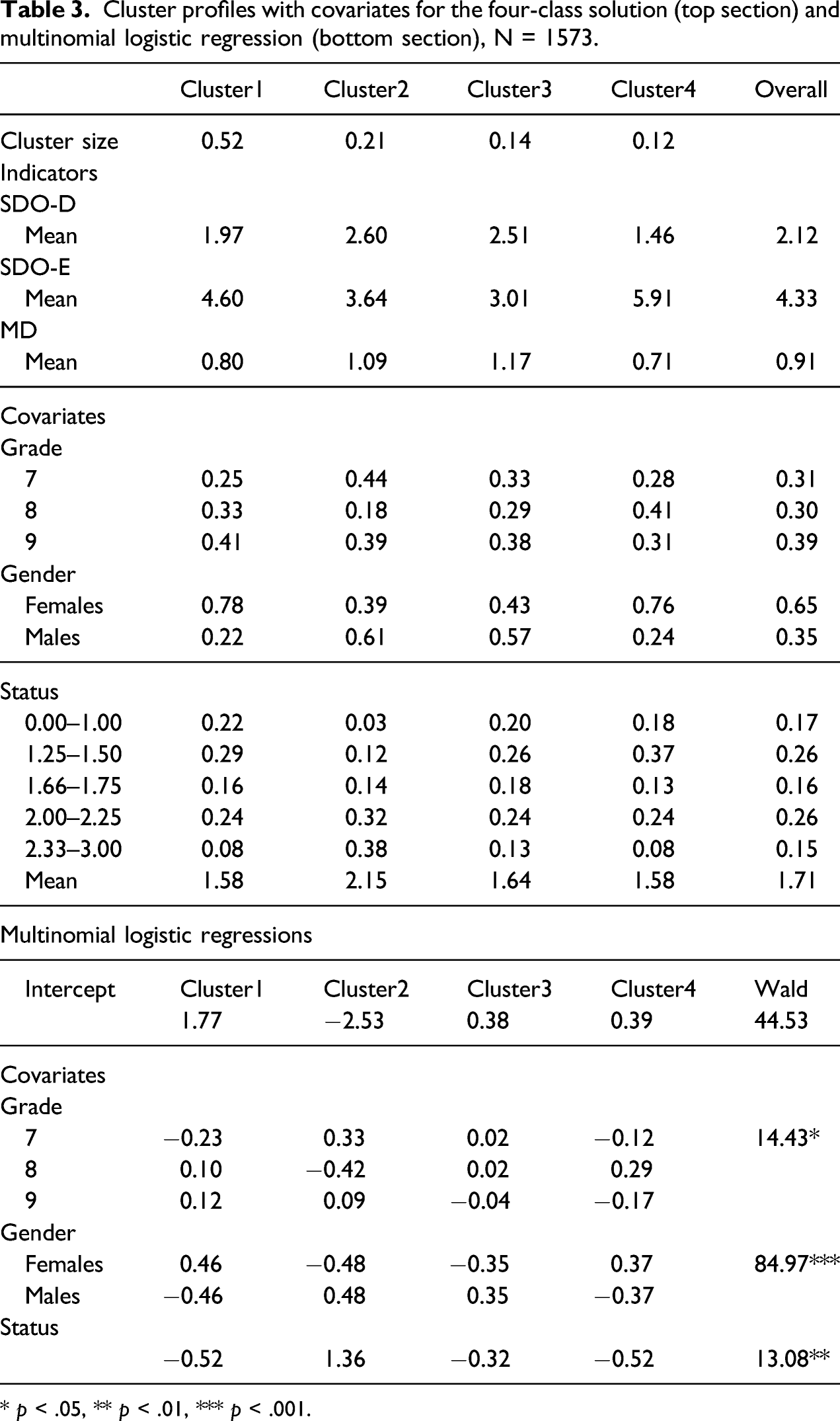
Cluster profiles with covariates for the four-class solution (top section) and multinomial logistic regression (bottom section), N = 1573.
* p < .05, ** p < .01, *** p < .001.
Despite the fact that 64.59% of respondents were females, they are over-represented in the first and fourth pro-social clusters and under-represented in the second and third anti-social clusters. Male respondents comprise 35.41% of the sample and are highly over-represented in the second and third anti-social clusters. Respondents with low social status (scores between 0 and 1) are under-represented in the second anti-social cluster, versus respondents with high social status (scores between 2.33 and 3) are also under-represented in this second cluster. To sum up the relationship between the covariates and the four clusters: seventh and eighth grade males are over-represented in the anti-social clusters, and females are over-represented in the pro-social clusters.
Multinomial Logistic Regression
To further evaluate this four-cluster solution, we conducted a step-2 multinomial logistic regression using the posterior class as the base outcome to determine the extent to which membership in the clusters could be predicted (see the bottom section of Table 2) based on the three covariates of grade, gender and status. Wald tests were significant for all covariates and an examination of Table 3 shows that seventh grade males were less likely to be members of the first cluster, while eight grade females were less likely to be in the second cluster and females and males were less likely to be in the third or fourth cluster, respectively. Seventh grade males and all females were most likely to be in the second or fourth cluster, respectively.
Within and Between Group Differences
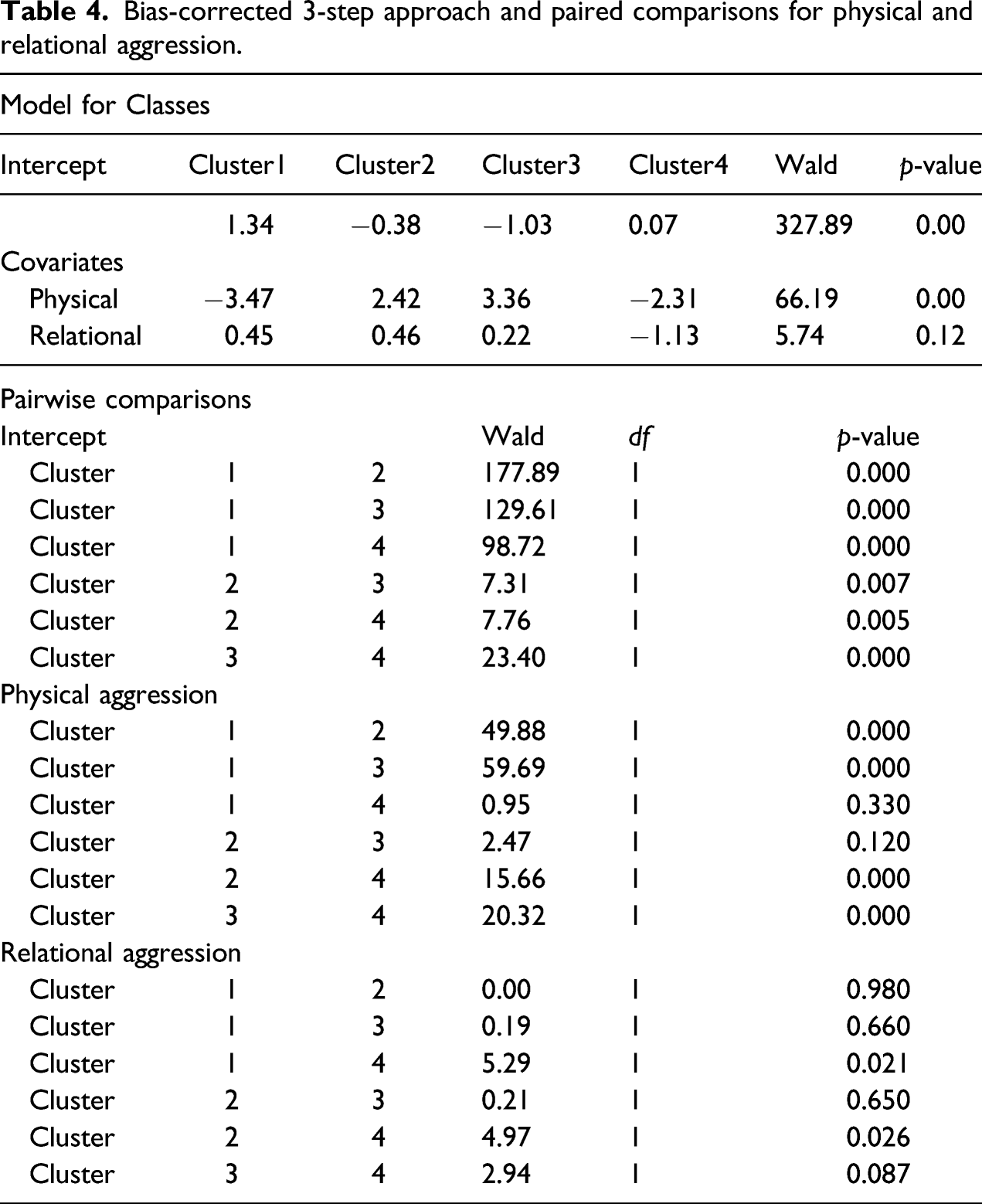
Bias-corrected 3-step approach and paired comparisons for physical and relational aggression.
Discussion
A primary goal of this study was to examine the additive effect of both types of social dominance orientation in predicting school-based peer-to-peer aggression and bullying (Goal 1). Result of the hierarchical linear regressions clearly indicates that both types of SDO do, indeed, have an effect on both physical and relational aggression. SDO appears to have less of an effect on physical aggression (ΔR2 = .07) than on relational aggression (ΔR2 = .15). This may be a link with previous studies which show that SDO is related to social stratification and inequality among adults (Sidanius & Pratto, 2001). This finding may also be attenuated by the fact that the SDO questionnaire (Ho et al., 2012) was originally developed for adult respondents. Future research should continue to refine this SDO instrument.
Once we established that SDO is a predictor or both types of aggression, our secondary goal (Goal 2) was to examine whether SDO-D and SDO-E, along with MD can add to our understanding of physical and relational bullying. The examination of the four respondent classes shows clear differences between the classes, with gender and age-based differences between them. It appears that despite the four classes can be divided into two SDO-D groups (high/low), yet these differences are less pronounced when examining MD. However, there is a distinct difference in SDO-E between the groups, where the group with the lowest SDO-D is also the group with the highest SDO-E. The same holds true for the second lowest SDO-D group. In partial agreement with our hypothesis, SDO-D was associated only with physical aggression. Additionally, as predicted, SDO-E was associated with lower levels of physical aggression, primarily for female respondents. These results fit well with other studies of the relationship of MD and aggression (see Obermann, 2011) and suggest that it is not the dominance orientation which is the strongest predictor, but rather one’s egalitarian beliefs. This finding is interesting. Individuals with the highest levels of egalitarian beliefs were also those with the lowest levels of moral disengagement and physical peer-to-peer aggression. We postulate that, perhaps, these respondents highly value equality and conformity and perhaps have a negative view of others who are different from them. Future studies should further address this issue of the relationship between egalitarianism and perceptions of the other who does not fit into this worldview, and should further develop SDO scales specifically dealing with social stratification in school based peer-to-peer aggression.
Despite the fact that the four class solution best fits the data, the substantive differences between the classes are less than perfectly differentiated. For instance, the fourth and smallest of the classes, which included 12.25% of respondents, are individuals with the lowest SDO-D and highest SDO-E scores as well as low moral disengagement scores. These results indicate that high SDO-D and its inverse (low SDO-E) are part of a behavioral pattern in combination with moral disengagement, which appear to predict physical aggression. Future research should continue to investigate measures of in-group and out-group perceptions for adolescent respondents. As our instrument to evaluate perceived social status did not specifically measure saliency of the in-group or out-group denigration (Levin & Sidanius, 1999), future research should more clearly examine the saliency of in-group identification vis-à-vis out-group denigration.
Interestingly, membership in the latent class groups shifted differentially between the three age groups of respondents for male and female respondents. Younger males were over-represented in the anti-social classes and females were over-represented in the pro-social classes for both physical and relational aggression. This finding is interesting in lieu of the large literature regarding gender differences in peer-to-peer physical and relational aggression (c.f., Björkqvist et al., 1992). These findings are to be expected as previous research has delineated a reduction in different types of aggression as a function of age ((Gumpel, 2008); Olweus, 1978). Stability of externalizing behavior problems in youth has been investigated in both young children (Olino et al., 2018) and adolescents (Andershed et al., 2018) and appears to be mediated by increased levels of narcissism (Reijntjes et al., 2016) or Callous-Unemotional (CU) traits (Frick & Dantagnan, 2005). Past research has explored the relationship between the dark triad (narcisism, machiavellianism, and psychopathy, Baughman et al., 2012), CU, and stability of severe behavioral problems and has examined the relation between CU and juvenile psychopathy (Frick et al., 2003). Future research should more clearly examine the relationship between SDO, CU and the dark triad and explore the predictive additive effects of these variables on school based peer-to-peer aggression. Specifically, based on our findings, more research is needed to examine the potential mitigating moderating effects of egalitarianism on youth aggression.
This study has several significant limitations. Data were collected through self-reports and we have no way of knowing whether respondents are under- or over-reporting their physical and relational aggression. Such potential bias is endemic to correlational studies of school based bullying and certainly alternative forms of data collection should be used to further verify findings. For instance, Gumpel et al., (2014) and Zioni-Koren (2021) examined the use of qualitative methods to further examine the social vagaries of school based bullying. Additionally, we examined physical and relational aggression rather than different participant roles (Salmivalli, 2010). A more nuanced examination of perpetrators of physical and relational aggression may further shed light on the use of SDO to examine bystander roles (Steffgen et al., 2013). Lastly, we combined data from paper-and-pencil and electronic questionnaires. Early research on comparing traditional paper-and-pencil and electronic surveys among behavior disordered youth found that the ease of responding using electronic surveys may inflate the self-reported prevalence rates of delinquent behaviors (Turner et al., 1998). Despite a growing literature of the equivalence of these two methodologies (c. f., Lucia et al., 2007), we know of no study which combined the two methodologies in the same data set and so this may be a potential source of bias.
Of course, this study was conducted in Israel among Israeli Jewish adolescents. As a state engaged in a long and protracted conflict, issues of social dominance are central in society and have been examined in the context of Israeli adults (Levin & Sidanius, 1999; Malkin & Ben Ari, 2013). The social context of this study must be understood within the wider social complexity of Israeli society. Future research should compare Israeli youth (both Jewish and Arab) with youth in other countries in order to ascertain the universality of these findings as well the mediating effects of national political circumstances on issues of dominance and egalitarianism.
In an attempt to further understand different participant roles and why some adolescents are active aggressors or bullies, while others are passive observers, we suggest that understanding group psychology is vital to both the theoretical understanding and prevention of willful harm doing in schools. Specifically, the inverse relation between prosocial egalitarianism and dominance has policy implications specifically in lieu of the recent increased emphasis on social emotional learning and bullying (i.e., Nickerson et al., 2019). Theoretically, the use of LPA methodologies is a powerful tool in theory development and we recommend its continued deployment in understanding complex pro-social and anti-social behaviors. Bullying, as a social phenomenon (Salmivalli et al., 1996), is intricately related to other aspects of one’s relationship with the group and with other groups. The focus on in-group relations and out-group denigration while examining the construct of the other (Staub, 2003) are central issues in understanding bullying from within a group social-coercion framework (Doll & Swearer, 2006). It appears that the twin concepts of social dominance and social egalitarianism may be important to developing a deeper understanding of bystanding (Weisenthal, 2021) and passively observing the other as she or he is tormented by peers.
Footnotes
Declaration of Conflicting Interests
The author(s) declared no potential conflicts of interest with respect to the research, authorship, and/or publication of this article.
Funding
The author(s) received no financial support for the research, authorship, and/or publication of this article.
