



Abstract
Despite the fact that intimate partner violence (IPV) occurs within intimate relationships, we know relatively little about the characteristics of those intimate relationships, and even less about how IPV changes across time within different relationships. We use the Relationship Dynamics and Social Life (RDSL) study, based on a random sample of 1003 18–19-year-old women residing in a Michigan county. Women were interviewed weekly for 2.5 years, resulting in an age range of 18 through 22. We estimate hybrid “within-between” regression models, which allows us to directly compare the same woman’s risk of experiencing IPV across her different relationships, varied in terms of resources, balance of power, conflict, childbearing, relationship type, and duration. Our analyses demonstrate that power imbalance in intimate relationships, non-monogamous and unstable relationships, relationships with men who are not the father of a woman’s existing children, and serious relationships (especially stayover and cohabiting) place young women in their late teens and early twenties at particularly high risk of multiple dimensions of IPV. Our fixed-effects modeling strategy isolated the increase in IPV risk that is due to these characteristics and experiences within intimate relationships from the risk due to young women being at high risk of IPV for other reasons who might tend to choose these types of relationships. The elevated risk of IPV in relationships with these characteristics and experiences supports a causal link between them. Our research supports the potential efficacy of interventions that reduce conflict, equalize power within relationships, and encourage women—especially young mothers—to delay serious relationships.
Violence between intimate partners is a significant public health problem and an important social issue. Approximately one-third of women in the United States experience some form of violence from an intimate partner in their lifetime, with over 70% of women first experiencing intimate partner violence (IPV) before the age of 25 (Breiding et al., 2014). These early experiences with IPV may set the stage for additional experiences with IPV later in life, as young people who experience IPV during adolescence are more likely to experience violence in their adult relationships than those who do not (Cui et al., 2013; Lehrer et al., 2006; Smith et al., 2003).
We make three contributions to understanding the characteristics of intimate relationships in which IPV is most likely to occur. First, we investigate multiple dimensions of IPV, including disrespect, threats of violence, and physical assault, to determine whether young women who are at risk of one dimension of IPV are similarly at risk for other types. Second, we integrate family violence theories (i.e., resource theory) and feminist theory to develop a comprehensive set of hypotheses about intimate relationships, which are the micro-structural system in which IPV occurs (Lawson, 2012). Third, we separate differences in the risk of IPV victimization that result directly from intimate relationship dynamics from those that are associated with a woman’s socioeconomic or demographic position and the resulting types of partners and relationships in which she tends to be involved.
Theoretical Framework
Although many young relationships do not include IPV, and most young male partners do not perpetrate violence, we begin with the premise of the family violence perspective, which emphasizes that interpersonal relationships involve conflict (Gelles & Straus, 1979). Using this framework, the question we investigate is which conflicts turn violent? We draw on two theories to develop hypotheses about this question: resource theory (Allen & Straus, 1980; Goode, 1971) and feminist theory (Dobash & Dobash, 1979). The main tenet of resource theory is that resources confer power, and power decreases the need for force to attain one’s goals. Therefore, we would expect those with fewer resources to be more likely to perpetrate violence than those with more resources. In contrast, feminist theory posits that IPV against women is a manifestation of male dominance over women that is ubiquitous in mixed-gender relationships. Men’s greater resources relative to women’s confer them with power in the relationship, and power facilitates violence. The combination of these theories allows us to examine specific relationship characteristics and experiences—resources and the balance of power, conflict, childbearing history, relationship type, and duration—that can increase or decrease a woman’s risk of IPV victimization.
Resources and the Balance of Power
Feminist theory posits that conflict is more likely when men have more resources than women do. Indeed, relationships with age and educational differences between partners have higher levels of IPV (Abramsky et al., 2011; Giordano et al., 2010; Magdol et al., 1998), likely because of resulting power differentials, decreased communication, and related conflict (Magdol et al., 1998; Stets & Strauss, 1990). More generally, male dominant behavior is associated with lower quality relationships (Sadikaj et al., 2017), which in turn have higher levels of IPV. However, resource theory and feminist theory lead to discordant predictions in terms of resources—while feminist theory predicts that men with more resources, particularly relative to women, will perpetrate more IPV, resource theory predicts that men with fewer resources will be more likely to perpetrate IPV. Incorporating both resource and feminist theories, we hypothesize that women will experience more IPV with partners who have few resources compared to partners with more resources (resource theory), but that the risk of IPV will be particularly high when women have even fewer resources than their partners (feminist theory).
Conflict
Relationship conflict and dissatisfaction are proximal determinants of IPV—relationships with more frequent conflict and less overall satisfaction involve more IPV than relationships with less frequent disagreements (DeMaris et al., 2003; White & Chen, 2002). The most common motives for IPV among young people are anger, jealousy, and retaliation; nonmonogamy and breakups may be particularly powerful predictors of IPV (Giordano et al., 2010; Halpern-Meekin et al., 2013; Jackson et al., 2000; Johnson et al., 2015). Thus, we hypothesize that IPV will co-occur with other indicators of conflict, including break-ups and non-monogamy.
Childbearing History
Childbearing generates high levels of conflict (Belsky & Kelly, 1994; Belsky & Pensky, 1988; Stamp, 1994; Tomlinson et al., 1990), which likely increases the risk of IPV. The presence of children from a prior partner may create family boundary ambiguity, which can decrease relationship quality and stability (Stewart, 2005) and increase stress and conflict (Berger & Bzostek, 2014; Boss & Greenberg, 1984), leading to IPV (Abramsky et al., 2011). The investment model (Rusbult, 1980) posits that individuals stay in relationships, including violent relationships, despite low satisfaction and plausible alternatives because of what they would lose if the relationship dissolves, and a shared child is a particularly important investment in a relationship. Thus, relationships with shared children are more likely to persist than others, even when they are violent or when relationship satisfaction is low (Kelley & Thibaut, 1978). An important shared experience, such as a pregnancy, may also be considered an investment, even if it does not lead to a birth. Based on this logic, we hypothesize that a shared pregnancy or birth may increase the risk of IPV via discouraging the dissolution of stressful or conflictual relationships, and that the presence of a child from a prior relationship may increase the risk of IPV via increasing stress and conflict.
Relationship Type
An exposure model suggests that time-intensive relationships entail a higher risk of IPV because spending time together increases exposure to the risk of IPV by providing additional time for conflict to arise (Gaertner & Foshee, 1999; Magdol et al., 1998; Neufeld et al., 1999). For example, a woman with a potentially violent partner with whom she spends a few evenings per week is less exposed to the risk of IPV than a woman with a potentially violent partner whom she sees every day, by the simple virtue of spending less time with him. Based on an exposure model, we hypothesize that women will experience more IPV in their more time-intensive relationships than in their less time-intensive relationships.
We posit two more general principles about relationship type. First, although social norms encourage dominance and aggression by men toward women, violence is more likely to be sanctioned and discouraged in public than in private. This suggests that being in a relationship that includes spending time together at home (i.e., coresidence) may increase the risk of IPV by providing a private environment, compared to going to a movie or a party together in a public setting (Magdol et al., 1998). Second, some relationship activities are more likely to generate conflict than others or are more likely to generate intense conflict, and that may be more likely to turn violent. The activities in relationships that are coresidential—for example, a shared household and with a division of household labor—may be particularly likely to generate conflict and thus lead to IPV. Indeed, some research suggests that cohabiting relationships are particularly violent (Brown & Bulanda, 2008; Magdol et al., 1998). We hypothesize that women will experience more IPV in their coresidential relationships than in their non-coresidential relationships.
Duration
Although violent relationships dissolve more quickly than non-violent relationships largely because of low relationship satisfaction (DeMaris, 2000; Shortt et al., 2006), not all violent relationships dissolve. If women are more likely to dissolve short-term violent relationships than long-term violent relationships, and conflict increases while satisfaction decreases over time, delaying the dissolution of a violent intimate relationship may increase a woman’s exposure to IPV (e.g., Frederick, Lever, Gillespie, & Garcia, 2017). Indeed, cross-sectional research found that violent relationships were more likely to be long-term rather than short-term (Giordano et al., 2010). We hypothesize that we will observe more IPV in long-term than in short-term
Individual Factors
Many other individual characteristics of both women and men influence the risk of IPV victimization and perpetration. For example, rates of IPV are higher among socioeconomically disadvantaged groups (Benson et al., 2003; Capaldi et al., 2012; Cunradi et al., 2002; Foshee et al., 2004; Spriggs et al., 2009; Thulin et al., 2021), African-Americans (Brown & Bulanda, 2008; Caetano et al., 2005; Capaldi et al., 2012; Halpern et al., 2009; Rickert et al., 2002), young people who engage in risky sexual behaviors (Gover, 2004; Halpern et al., 2009), and sexual and gender minorities (Pittman et al., 2020; Walters et al., 2011). Childhood exposure to violence, mental health problems, and substance use are also linked to higher rates of IPV (Brown & Bulanda, 2008; Capaldi et al., 2012; Devries at al., 2014; Gover, 2004; Halpern et al., 2009; Lehrer et al., 2006; Linder & Collins, 2005 Nowotny & Graves, 2013; Shen & Kusunoki, 2019). These past experiences and individual-level characteristics, however, are not our focus in the current study. Our analytic strategy separates the differences in IPV risk into one component that can be attributed to these enduring characteristics and past experiences of individual women and another component that can be attributed to the structural characteristics of intimate relationships and women’s experiences within them.
Current Study
In this paper, we investigate the nature of the intimate relationships that involve IPV, using innovative hybrid “within-between” statistical models based on 2.5 years of longitudinal data from the Relationship Dynamics and Social Life (RDSL) study. The RDSL study collected detailed weekly information about the occurrence of multiple dimensions of intimate partner violence victimization (disrespect, threats of violence, and physical assault). Each woman in the random, population-based sample reported on all of her intimate relationships throughout the 2.5 years study period. Thus, the dataset includes the weekly time-varying characteristics of each young women’s intimate relationships and her experiences within them.
We directly compare the same woman’s risk of experiencing IPV across her different relationships, varied in terms of resources, balance of power, conflict, childbearing, relationship type, and duration. Because this approach compares different relationships entered into by the same woman (the “within” component), the coefficients represent a woman’s risk of IPV when she is in one relationship with a specific set of characteristics compared to her relationship(s) exhibiting other characteristics—for example, a coresidential relationship versus a non-coresidential relationship. The RDSL data also allows us to analyze the dynamics of IPV among Black and white women, and among women with different socioeconomic characteristics.
Methods
Data
The RDSL study began with a representative, random, population-based sample of 1003 women residing in a Michigan county who were ages 18–19 at the time of the baseline interview. The sampling frame was the Michigan Department of State driver’s license and Personal Identification Card (PID) database. 1
The first component of data collection was a baseline face-to-face survey interview conducted between March 2008 and July 2009, which assessed sociodemographic characteristics, intimate relationship characteristics and history, and pregnancy history. At the conclusion of the baseline interview, respondents were invited to participate in weekly surveys for a 2.5 years follow-up period. Thus, the full age range represented in the data is 18 through 22 years. The five-minute weekly phone or web survey assessed the dynamics within young women’s intimate relationships, including IPV.
Of the 1003 women who completed the baseline interview, 95% (953) completed two or more weekly surveys. Although we refer to the period between surveys as “one week” (i.e., weekly surveys) as a shorthand, time between surveys varied with a median and mode of 8 days. Only 9% of surveys were completed two or more weeks after the prior surveys.
The follow-up component concluded in January 2012, resulting in 58,594 weekly surveys. 84% of baseline interview respondents participated in the weekly surveys for at least 6 months, 79% for at least 12 months, and 75% for at least 18 months. (See Barber et al. (2016) for a fuller description of attrition in the RDSL study.)
We limit our analyses to women who reported any intimate partnership during the study period and to those weeks when they were in such a relationship. This resulted in a final analytic sample of 910 women. Nearly half (43%) reported only one intimate relationship, but 19% had two relationships, and 38% had three or more relationships. This resulted in a total of 2623 relationships, which were reported during 35,786 weekly interviews.
Measures
Each week, a series of questions ascertained whether the respondent had a partner of any kind during the prior week. For each new partner not discussed in a prior survey, they provided initials or a nickname. 2 If the partner was different from the most recent survey, but had been discussed in a prior survey, they chose from their list of initials/nicknames to link surveys about the same partner across time, regardless of breakups.
Intimate partner violence
We conceptualize IPV as psychological aggression and physical assault by a partner towards the respondent. Each week, respondents were first asked, “Did you and [Partner Name] fight or have any arguments” during the period since the last survey. Respondents who answered yes were asked about three specific types of IPV: 1) disrespect—whether the partner swore at the respondent, called her names or insulted her, 2) threats—whether the partner threatened her with violence, and 3) physical assault—whether the partner pushed, hit, or threw something at her that could hurt her. We created three separate weekly-varying dichotomous indicators reflecting each type of behavior.
Resources and the balance of power
RDSL includes measures of the balance of power across three different types of resources: control over decision-making, education, and age. Whether the partner ever dominated decision-making varies weekly and is coded 1 in all weeks after the first time (if ever) the woman indicated that her partner decided “what to do or where to go when you go out?” rather than indicating that she decided, or they both decided (Manning et al., 2009; Wildsmith et al., 2015) and 0 for all weeks before the partner dominated decision-making (or all weeks if the partner never dominated decision-making). The next three measures vary across relationships, but not across weeks within relationships. We compare women’s educational attainment to their partner’s education at the beginning of their relationship to create a three-category measure of education difference: partner had more education, equal education (reference category), or partner had less education (Manlove et al., 2011; Manning et al., 2009; Wildsmith et al., 2015). We also include partner’s education, which was reported categorically at the time the partner was first mentioned, but converted to years: dropped out of high school (11), graduated from high school but not enrolled in post-secondary education (12), enrolled in post-secondary education (14), and graduated from a 4-year university (16). Age difference between the partners is coded in months by subtracting the respondent’s exact age from the partner’s age (Kusunoki & Upchurch, 2011; Manlove et al., 2011, 2014; Manning et al., 2009). Respondent’s age varies weekly and is coded in months and computed based on the state-level driver’s license and PID records used for sample selection.
Indicators of conflict
The RDSL dataset includes two indicators of other aspects of conflict, each of which varies weekly and is coded 1 in all weeks after the first occurrence (if it ever occurred) and 0 in all weeks before the first occurrence, or in all weeks if it never occurred. The first measure indicates whether the couple ever broke up and reconciled, where a woman reported that she and that partner broke up but then also reported a relationship with that same partner during a later week (Halpern-Meekin et al., 2013). Partner was nonmonogamous indicates whether the woman ever reported that her partner had sex with someone else (Hock-Long et al., 2012).
Childbearing history
We include two indicators of childbearing history. First, a weekly varying indicator of whether the couple had a pregnancy or birth together in a prior week, which is coded 1 for the week she reported a pregnancy or birth and all subsequent weeks, and 0 for all weeks before the pregnancy or birth (or all weeks if there was no pregnancy or birth). We combined pregnancies and births, because they were similarly associated with IPV in our analyses. Second, an indicator of whether the woman had a birth with a prior partner is coded 1 if she reported any births before she reported the partner, and is coded 0 if she did not. This latter measure varies across relationships but not across weeks within a relationship.
Relationship type
To identify the type of relationship the respondent had with the partner, RDSL asked a series of questions each week to define the three most serious relationship types: engaged/married, cohabiting (shared address), and “stayovers” (slept in the same bed at least three nights out of the prior seven; Jamison & Ganong, 2011)—whether she was engaged to be married, whether she was married, whether she lived in a place “separate from where your partner lives,” and how many nights she spent “all night sleeping in the same bed” during the prior week. (We combined engaged with married because these categories are conceptually similar, and their coefficients were very similar in our analyses.) One additional question—whether she and her partner had “agreed to only have a special romantic relationship with each other, and no one else” (Carter et al., 2013; Higgins et al., 2012; Hock-Long et al., 2012)—distinguishes whether the remaining relationships were committed (to monogamy) dating or uncommitted (reference category). Each week, relationship type was coded to one of these five categories.
Relationship duration
Relationship duration indicates the total amount of time—including before and after any breakups—with the partner. It varies across weeks and is coded in exact months.
Stable individual characteristics
We include four indicators to control for individual demographic and socioeconomic characteristics: race (Black/non-Black), highly religious, receiving public assistance at the time of the baseline interview, and high school grade point average. We include four dichotomous indicators to control for family background: family received public assistance during childhood; biological mother had her first birth as a teenager; mother’s education was less than high school; and grew up with one biological parent only (no stepparent) or with extended family members. We include two dichotomous measures of adolescent experiences as of the baseline interview to control for early sexual behavior: age at first sex less than 17 and more than two sex partners. These measures vary across women, but not across relationships or weeks.
Total number of weekly interviews
One additional variable—total number of weekly interviews—controls for repeated assessments and attrition, and refers to the total number at the end of the study period. Thus, it varies across women, but not across relationships or weeks.
Analytic Strategy
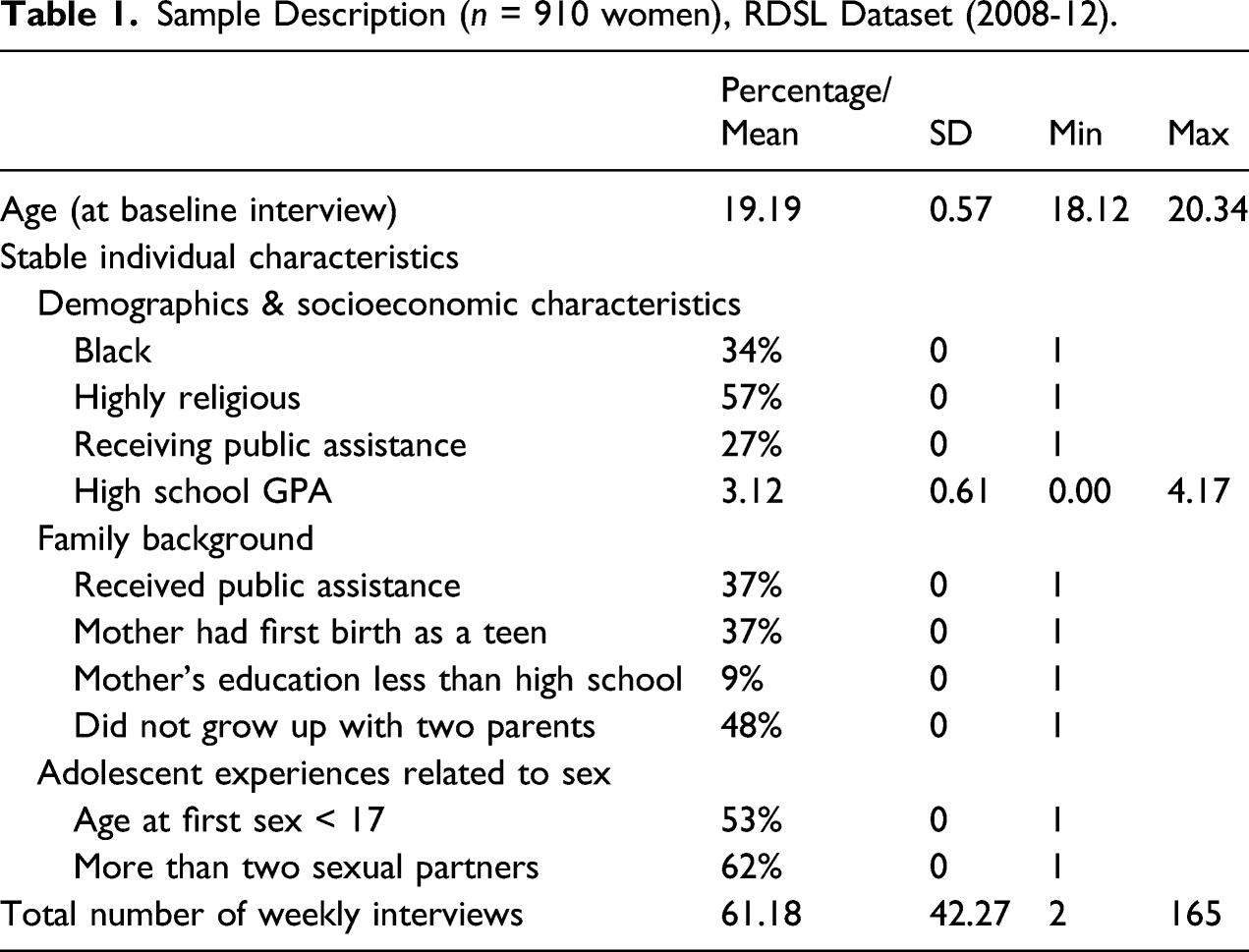
Sample Description (n = 910 women), RDSL Dataset (2008-12).
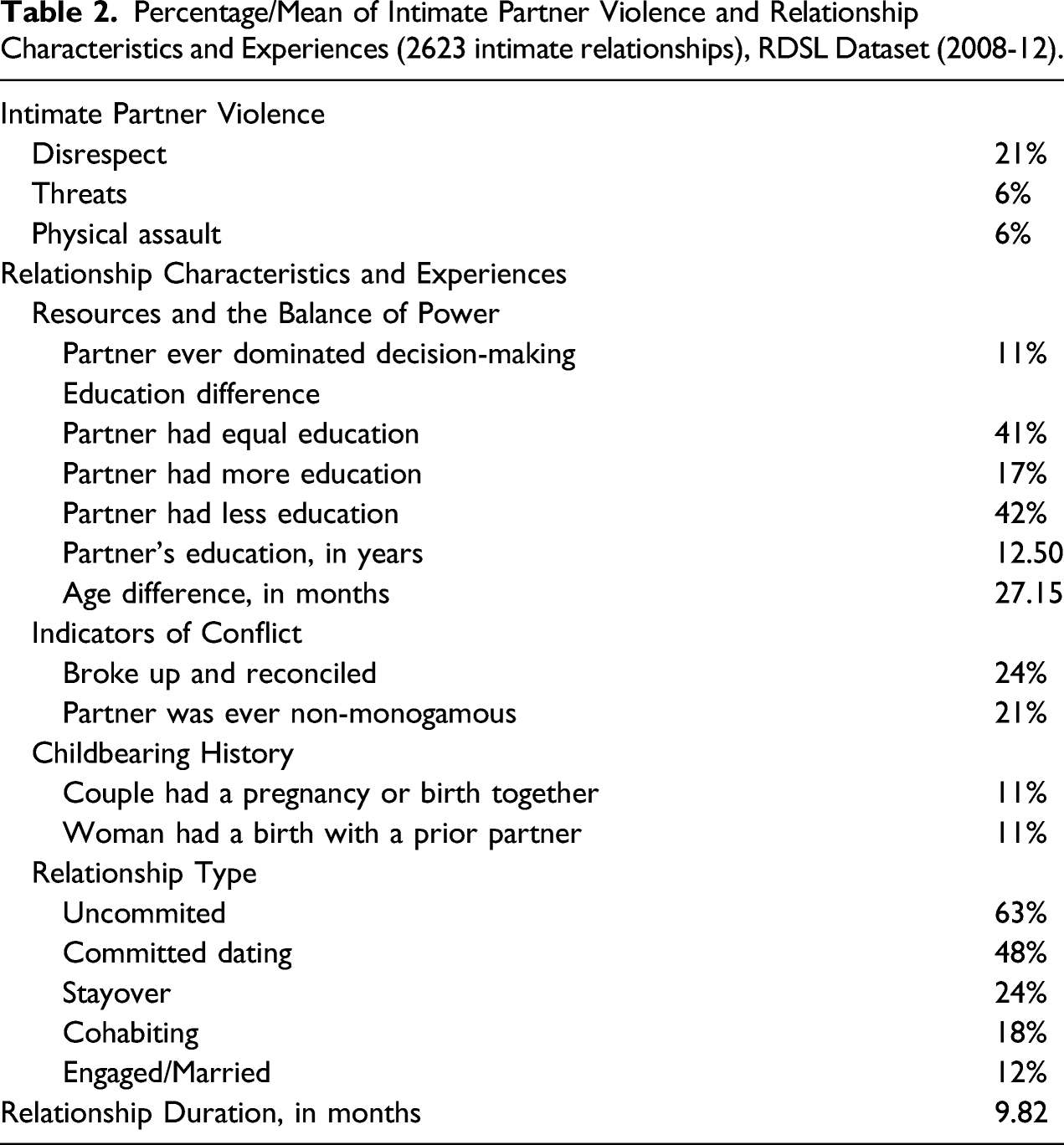
Percentage/Mean of Intimate Partner Violence and Relationship Characteristics and Experiences (2623 intimate relationships), RDSL Dataset (2008-12).
Fixed-Effects (Within-Woman) Coefficients from Within-Between Logistic Regression Models of the Weekly Log-Odds of Experiencing Disrespect, Threats, and Physical Assault, by Relationship Characteristics and Experiences (unexponentiated coefficients, standard errors in parentheses).
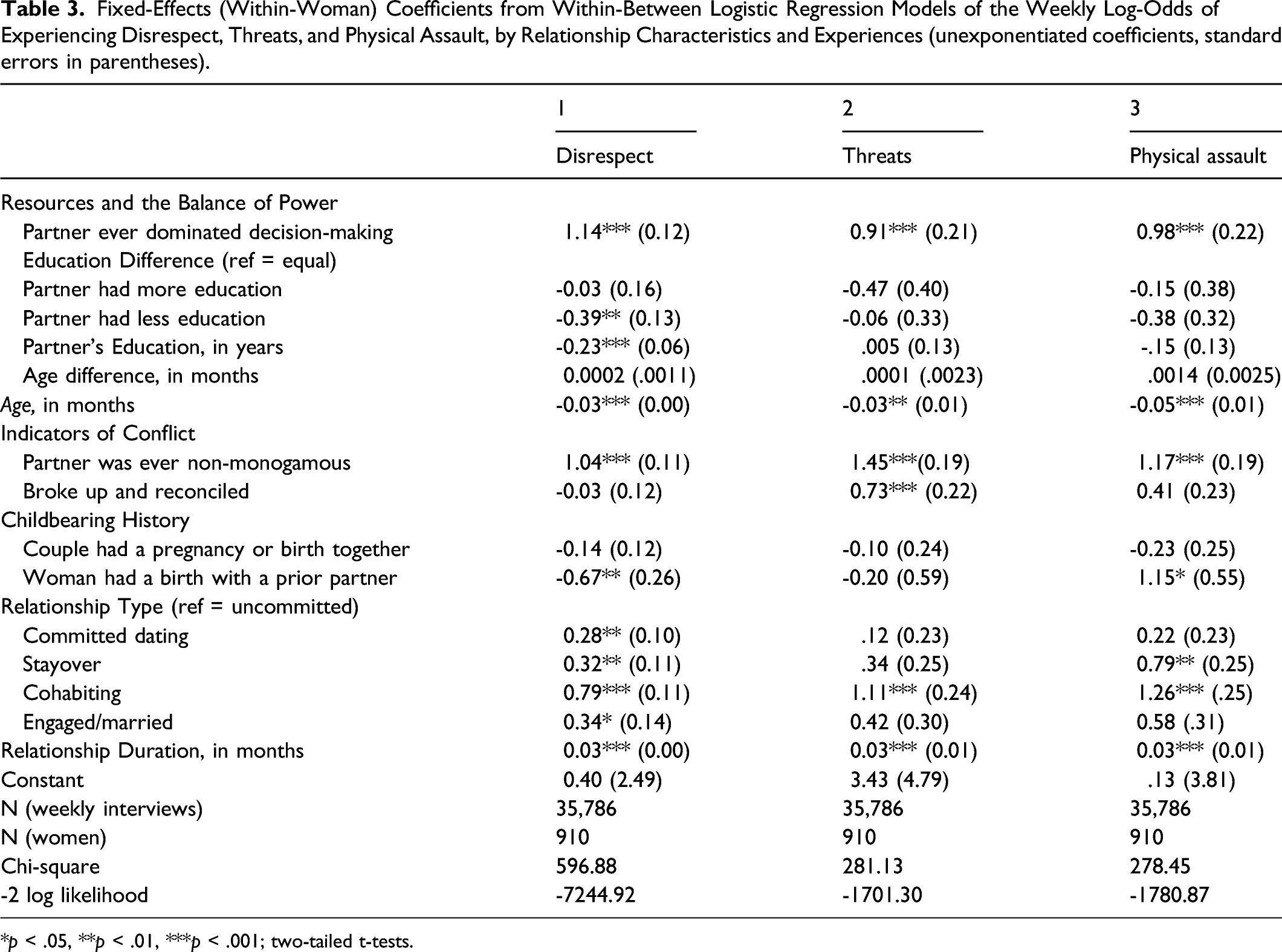
*p < .05, **p < .01, ***p < .001; two-tailed t-tests.
We present three sets of models: (1) whether the woman was disrespected by her partner; (2) whether she was threatened by her partner; and (3) whether she was physically assaulted by her partner. The unit of analysis for all models is the person-week. Positive coefficients indicate higher log odds (which translates to higher odds and higher probability) of experiencing IPV and negative coefficients indicate lower log odds (which translates to lower odds and lower probability) of experiencing IPV.
Appendix A presents the “between-women” (random-effects) coefficients that compare the overall log-odds of IPV across women with different individual characteristics for each dependent variable. Recall that the coefficients in Table 3 represent the differences in the log-odds of IPV for the same woman across her different relationships (fixed-effects coefficients). In contrast, the coefficients in Appendix Table A1 represent the differences in mean (across all her relationships) log-odds of IPV between women, depending on their stable (time-invariant) individual characteristics. Traditional fixed-effects models estimate differences in the dependent variable according to characteristics that vary across the unit of analysis (i.e., weeks), but because they hold all woman-level characteristics constant in the models—by comparing across all weeks within each woman—woman’s stable characteristics (e.g., race, religiosity, socioeconomic position) do not vary across those relationships. Although the hybrid specification simultaneously estimates the between-women differences using random effects, note that these models are adjusted for the relationship experiences of each woman. In other words, the coefficients represent differences between women, controlling for their relationship experiences.
Results
Sample Characteristics
Table 1 presents the characteristics of our analytic sample of 910 ever-partnered women. The average age at the time of the baseline interview was 19.19 years (range 18.12–20.34, SD 0.57). In all, 34% percent reported their race as Black. More than half (57%) were highly religious. Over one-quarter (27%) of women were receiving public assistance at the time of the baseline interview. The average high school GPA was 3.12 (range 0–4.17, SD .61).
Over one-third (37%) of women’s families received public assistance during their childhood or had a mother who was a teen when she had her first child. Few (9%) had a mother with less than high school education. Almost half (48%) reported growing up in a family arrangement other than two parents.
Over one-half (53%) were younger than age 17 at first sexual intercourse. Over 60% (62%) had two or more sexual partners before the baseline interview.
Prevalence of Intimate Partner Violence
The top panel in Table 2 presents percentages for the three dichotomous indicators of IPV. Note that although the IPV variables vary weekly in our analyses, here we present the proportion of relationships that ever included IPV, for descriptive purposes. Disrespect occurred in 21% of women’s intimate relationships. Threats of violence and physical assault each occurred in 6% of intimate relationships.
Intimate Relationship Dynamics
Table 2 also presents the characteristics of the relationships; again, even when the variables are time varying in our models, we present relationship-level summaries here for ease of interpretation. Overall, the vast majority of decision-making was collaborative—men ever dominated the decision-making in only 11% of intimate relationships. In most intimate relationships, men had equal (41%) or less (42%) education than the woman herself; men had more education in only 17% of relationships. On average, partners had slightly more than a high school education (12.5 years). The mean age difference was 27.15 months (2.26 years) older than the woman.
Most relationships (76%) were stable; only 24% ever broke up and reconciled. Similarly, most partners were monogamous; women reported that their partner ever had sex with someone else in only 21% of relationships.
In all, 11% of intimate relationships included a pregnancy or birth at some point during the study period. Women entered 11% of their intimate relationships with a child from a prior partner.
Most intimate relationships changed type at least once during the study period. In all, nearly two-thirds (63%) of relationships were ever uncommitted (to monogamy) at some point, nearly half (48%) were ever committed dating relationships, about one-quarter (24%) were ever “stayovers,” about one-fifth (18%) ever cohabited, and slightly more than one in seven (12%) were ever engaged or married. The mean total duration of relationships was 9.82 months. This is an underestimate because many relationships were ongoing at the end of the study period (i.e., right-censored).
Intimate Relationship Dynamics and Intimate Partner Violence
Table 3 presents the fixed-effects coefficients from our within-between logistic regression models of the weekly log-odds of experiencing IPV—disrespect (column 1), threats (column 2), and physical assault (column 3). For continuous independent variables (duration, age difference, partner’s education, and age), these coefficients represent the difference in the log-odds of experiencing IPV between weeks when a woman’s relationships are coded one unit higher (i.e., 1 month longer in duration) than other weeks. For dichotomous independent variables (couple had a pregnancy or birth together, woman had a birth with prior partner, broke up and reconciled, partner dominated decision making, partner was non-monogamous), the coefficients represent the difference in the log-odds of IPV during weeks during or after the experience (i.e., the week of the pregnancy/birth and all subsequent weeks) versus weeks before the experience. For categorical variables (relationship type, education difference), the coefficients represent the difference in the log-odds of IPV during weeks her relationship was coded to that category (i.e., cohabiting weeks) versus weeks when her relationship was coded to the reference category (i.e., uncommitted weeks).
Resources and the balance of power
IPV tended to occur in relationships with an imbalance of power, especially partner-dominated decision-making. The log-odds of experiencing disrespect, threats, and physical assault were all higher for a woman during weeks in her relationships after her partner ever dominated decision-making. The coefficient of 1.14 for disrespect indicates that a woman’s log-odds of being disrespected were 1.14 higher after her partner ever dominated decision-making compared to weeks before the partner ever dominated decision-making or during weeks with partners who never dominated decision-making. This translates to 3.13 times higher odds of disrespect, and 76% higher probability of disrespect. Similarly, the log-odds of being threatened were 0.91 higher (2.48 times higher odds and 71% higher probability) and physical assault were 0.98 higher (2.66 times higher odds and 73% higher probability).
A woman’s log-odds of experiencing disrespect were lower while she had a partner with more education—0.23 lower per additional year (1.26 times higher odds and 56% higher probability)—compared to while she had a partner with less education. However, the log-odds of IPV were additionally 0.39 lower if the partner had less education than the woman herself. Thus, women were least likely to experience IPV when they had even more education than a highly educated partner.
There were no differences in the log-odds of threats or physical assault depending on partner’s education (relative or absolute), and no differences in the log-odds of any dimension of IPV depending on the age difference between the woman and her partner. However, women had lower log-odds of all three types of IPV in relationships at older versus younger ages. Even during the RDSL’s relatively short study period, the log-odds of IPV declined sharply—for example, the coefficient of -.05 for physical assault means that the log-odds of physical assault were 1.2 lower at age 20 than at age 18, which translates into 3.32 times lower odds and 53% lower probability.
Indicators of conflict
Disrespect, threats, and physical assault were more likely during weeks when the partner was non-monogamous. The coefficients of 1.04, 1.45, and 1.17 translate to 2.83, 4.26, and 3.22 times higher odds and 74%, 81%, and 76% higher probability, respectively. The log-odds of being threatened were also higher during weeks after a relationship broke up and reconciled compared to weeks before the relationship, or weeks during a relationships that remained continuously together. However, neither disrespect nor physical assault were more prevalent in reconciled relationships compared to stable relationships.
Childbearing history
In terms of the log-odds of IPV, weeks after a pregnancy or birth did not differ overall from weeks before the pregnancy or birth or weeks during relationships that never included a pregnancy or birth. While women had 1.15 higher log-odds (3.16 times higher odds and 76% higher probability) of physical assault during relationships they entered after having a child with a prior partner compared to their relationships prior to that birth, they had 0.67 lower log-odds (0.51 times lower odds and 64% lower probability) of being disrespected. The log-odds of being threatened did not vary according to any indicator of childbearing history, either shared or from prior relationships.
Relationship type
In terms of relationship type, the log-odds of being disrespected were between 0.28 (committed dating) to 0.79 (cohabitation) higher while a woman was in a committed relationship of any type than while she was in an uncommitted relationship.
Additional models not shown in Table 3 varied the reference category to compare cohabitation to each other relationship type and estimated that the log-odds of disrespect were particularly high—higher than any other relationship type—while cohabiting (all p-values < .001). Similarly, the log-odds of being threatened were higher while cohabiting than while in any other relationship type (all p-values < .001, not shown in tables), but non-cohabiting relationship types were indistinguishable from each other in terms of the log-odds of being threatened. The log-odds of being physically assaulted were also highest while cohabiting (all p-values < .001, not shown in tables). Finally, the log-odds of being physically assaulted were also higher while in stayover relationships than in all other non-cohabiting relationship types (all p-values < .001, not shown in tables), but not as high as in cohabitations. These differences in IPV for cohabiting (and stayover) relationships were quite large—for example, 1.26 higher log-odds of physical assault translates 3.53 times higher odds and 78% higher probability.
Relationship duration
The log-odds of all types of IPV were also higher in the later months of a relationship compared to the earlier months. For example, the log-odds coefficient of 0.03 translates to .36 higher log-odds (1.43 higher odds and 59% higher probability) at 18-months duration compared to 6-months duration.
Between-Women Differences in Intimate Partner Violence
One key strength of the within-between regression models is that they estimate both within-woman (fixed-effects) coefficients (Table 3), and between-women (random effects) coefficients. We present the between-women coefficients in Appendix Table A1.
When we adjust for how the relationship characteristics and experiences from Table 3 vary according to women’s stable individual characteristics (listed in Table 1), those demographic, socioeconomic, family background, and adolescent sexual experiences are largely unrelated to their overall log-odds of experiencing IPV. The two exceptions are that Black women have lower overall log-odds of being disrespected than non-Black women, and women who first had sexual intercourse before age 17 have higher log-odds of being disrespected than women who delayed sexual intercourse until age 17 or older.
Discussion
This study examined how a woman’s risk of IPV victimization changed across time as her intimate relationships changed, and throughout her different intimate relationships. Our models showed elevated rates of IPV in power-imbalanced relationships relative to power-balanced relationships, particularly after a partner ever dominated the decision-making in the relationship. This is consistent with feminist theory positing that dominant men are more likely to perpetrate IPV. We found limited evidence that partners’ education—both their level of education and the gap between the women’s and their partner’s level—was related to women’s IPV victimization. Although other studies have shown that less educated partners are more likely to perpetrate IPV than more educated partners (Costa et al., 2015) most studies are unable to compare how a woman’s experiences change over time, and thus are unable to distinguish whether less educated partners’ are more likely to perpetrate IPV (which we do not find evidence for) or less educated partners are more dominant and thus appear to be more likely to perpetrate IPV. Although less educated partners may be more likely to perpetrate IPV, this difference is not apparent throughout a relationship, but only if and when they dominate decision-making. Consistent with other research, we also found that multiple dimensions of IPV co-occurred with non-monogamy, and threats co-occurred with breaking up and reconciling (Giordano et al., 2010; Halpern-Meekin et al., 2013; Jackson et al., 2000; Johnson et al., 2015). However, again, past research has been unable to document whether non-monogamy and break-ups are associated with higher levels of IPV because of the other characteristics of relationships that include non-monogamy or break-ups (e.g., personality differences between partners), or because of other individual-level characteristics or experiences that predict both non-monogamy and breaking up, on the one hand, and IPV, on the other hand (e.g., low levels of mental health). However, our fixed-effects models implicitly controlled for all stable individual- and relationship-level characteristics, and documented that higher levels of IPV occur after a woman suspects her partner of non-monogamy or after a break-up followed by reconciliation.
Young women experienced more physical assault but less disrespect in the relationships they formed after having a child with a prior partner than in their pre-childbearing relationships. Interestingly, they did not experience more physical assault or less disrespect while they were in a relationship with the father of their child; physical assault was only more prevalent, and disrespect was only less prevalent in their subsequent relationships. This is consistent with our hypothesis that the presence of another man’s child presents an especially risky context for men’s violent behavior, but inconsistent with our hypothesis that a shared pregnancy or childbirth would increase the risk of IPV more generally. This is particularly important because high rates of marital and cohabitation dissolution, followed by re-partnering (Raley & Sweeney, 2020), mean that many children live with their mother and a male partner who is not their father. Although these children may witness less disrespect in their mothers’ relationships, they are likely to witness more physical violence than children who remain living with their fathers.
We found that women had higher probability of experiencing multiple dimensions of IPV (disrespect, threats, and physical assault) while they were in more serious relationships (committed dating, stayovers, cohabiting, and/or engaged/married) than while they were in less serious relationships (casual or uncommitted dating). This is consistent with the exposure model—the hypothesis that spending a lot of time together increases exposure to the risk of IPV. Another indicator of relationship seriousness—long duration—was also associated with higher risk of IPV. This is consistent with our logic that declining relationship satisfaction increases IPV over time. IPV was particularly likely while cohabiting, and physical assault was also particularly common while “staying over.” The uniquely high rates of IPV in cohabiting and stayover relationships are consistent with existing research (Brown & Bulanda, 2008; Magdol et al., 1998; Wiersma et al., 2010), and with our idea that the specific activities involved in these relationships—for example, the household division of labor—produce more conflict than activities in non-coresidential or less serious relationships.
Interestingly, once we adjusted for their intimate relationship characteristics and experiences, women’s stable individual characteristics, including demographic characteristics, socioeconomic position, family background, and most adolescent experiences with sex were unrelated to the risk of experiencing any of the dimensions of IPV we analyzed. This may appear to contrast with prior research demonstrating that Black, disadvantaged, and sexually experienced women experience more IPV than other women (Halpern et al., 2009; Rickert et al., 2002). However, what our models actually suggest is that these individual characteristics are not related to the risk of IPV beyond their association with the types of intimate relationships that different young women experience. Thus, our analysis builds on those studies by showing why those groups experience higher rates of IPV: because they have more serious and/or coresidential or stayover relationships at a young age, young childbearing and subsequent relationships with men who did not father their child, conflictual relationships, dominating partners, and less educated partners, all of which are associated with higher risk of at least some types of IPV.
An important exception to this pattern is that Black women experienced less disrespect than white women. It may be that Black women’s partners are actually less disrespectful because power differentials in Black women’s intimate relationships are in their own favor more frequently or to a greater degree than in white women’s relationships, or because Black women dissolve their relationships with disrespectful partners more quickly than white women. Or, pressure to fit the Strong Black Woman archetype, which dictates that Black women remain resilient in the face of adversity may lead Black women to minimize disrespect they do experience in their relationships (Baker et al., 2015). It may also be an artifact of measurement error. For example, it could be that Black women have a different interpretation of “disrespect” than white women, or it may be that Black women have greater tolerance for such behavior and are less likely to interpret their partners as disrespectful. Or, because the Black women in our sample spent less time in partnered intimate relationships for reasons other than disrespect or other forms of IPV, they were less exposed to the risk of experiencing disrespect. This finding is particularly interesting because it highlights the benefit of a complex and nuanced view of IPV that considers more than just physical assault. Additionally, it highlights the diversity within Black women’s intimate relationships and fights the stereotype that Black women have lower quality relationships than white women (Fisher & Coleman, 2017; Gillum, 2007). Further research should explore how and why Black women experience substantially less disrespect than white women in their relationships, regardless of the nature of those relationships.
Another exception is that women who were relatively young (less than age 17) when they first had sexual intercourse experienced more disrespect than women who were older, similar to what other studies have shown (e.g., Halpern et al., 2009; Rickert et al., 2002). This is important because subsequent relationship characteristics and experiences do not provide a full explanation for why women who become sexually active at a young age experience high levels of disrespect in their relationships. We speculate that this link may be due to more permissive social or cultural norms about sexual activity, which may also be associated with tolerance of disrespect from sexual partners, or with unmeasured characteristics of the subsequent partners that young sexual initiators tend to have. For example, young age at first vaginal intercourse is associated with drug and alcohol use (Sandfort et al., 2008) and personality problems (Magnusson et al., 2015), both of which may also lead to high levels of fighting and disrespect. Thus, further research should explore the unique characteristics of these young women’s relationships that engender particularly high levels of disrespect.
Limitations
Although the RDSL sample was randomly selected and population-based, it is representative of young women in a single county in Michigan, which decreases the generalizability of the results. The county has only a small number of Latinas—we hope that our research motivates future studies on populations that include more Latinas. However, in terms of cohabitation, marriage, age at first birth, completed family size, non-marital childbearing, and teenage childbearing, Michigan is not an outlier (Lesthaeghe & Neidert, 2006).
Another limitation of the RDSL study is that it did not interview male partners, and thus lacks information about IPV perpetration from the male partners’ point of view, as well as information about male partners’ experiences with IPV victimization. Although both men and women may perpetrate IPV, IPV against women remains more prevalent and harmful and women suffer the non-injury-related burden such as undesired pregnancy (Barber et al., 2016; Reed et al., 2010).
Conclusion
Our analyses demonstrate that power imbalance in intimate relationships, non-monogamous and unstable relationships, relationships with men who are not the father of a woman’s existing children, and serious relationships (especially stayover and cohabiting) place young women in their late teens and early twenties at particularly high risk of multiple dimensions of IPV. Our fixed-effects modeling strategy isolated the increase in IPV risk that is due to these characteristics and experiences within intimate relationships from the risk due to young women being at high risk of IPV for other reasons who might find themselves in these types of relationships. Thus, in addition to targeting interventions at the sociodemographic groups that are most likely to experience IPV, our research supports the potential efficacy of interventions that reduce conflict, equalize power within relationships, and encourage women—especially young mothers—to delay serious relationships.
Footnotes
Acknowledgments
The authors gratefully acknowledge the Survey Research Operations (SRO) unit at the Survey Research Center of the Institute for Social Research for their help with the data collection, particularly Vivienne Outlaw, Sharon Parker, and Meg Stephenson. The authors also gratefully acknowledge the intellectual contributions of Heather Gatny and Robert Melendez as well as the other members of the original RDSL project team, William Axinn, Mick Couper, and Steven Heeringa, and the National Advisory Committee for the project, Larry Bumpass, Elizabeth Cooksey, Kathie Harris, and Linda Waite.
Declaration of Conflicting Interests
The author(s) declared no potential conflicts of interest with respect to the research, authorship, and/or publication of this article.
Funding
The author(s) disclosed receipt of the following financial support for the research, authorship, and/or publication of this article: This research was supported by three grants from the National Institute of Child Health and Human Development (NICHD) (R01 HD050329, R01 HD050329-S1, PI Barber; R03 HD080775, PI Kusunoki) and a population center grant from the NICHD to the University of Michigan’s Population Studies Center (P2CHD041028).

Notes
Appendix
Random-Effects (Between-Women) Coefficients from Within-Between Logistic Regression Models of the Weekly Log-Odds of Experiencing Disrespect, Threats, and Physical Assault, by Stable Individual Characteristics (unexponentiated coefficients, standard errors in parentheses) *p < .05, **p < .01, ***p < .001; two-tailed t-tests. Note. Coefficients are from the same models presented in Table 3.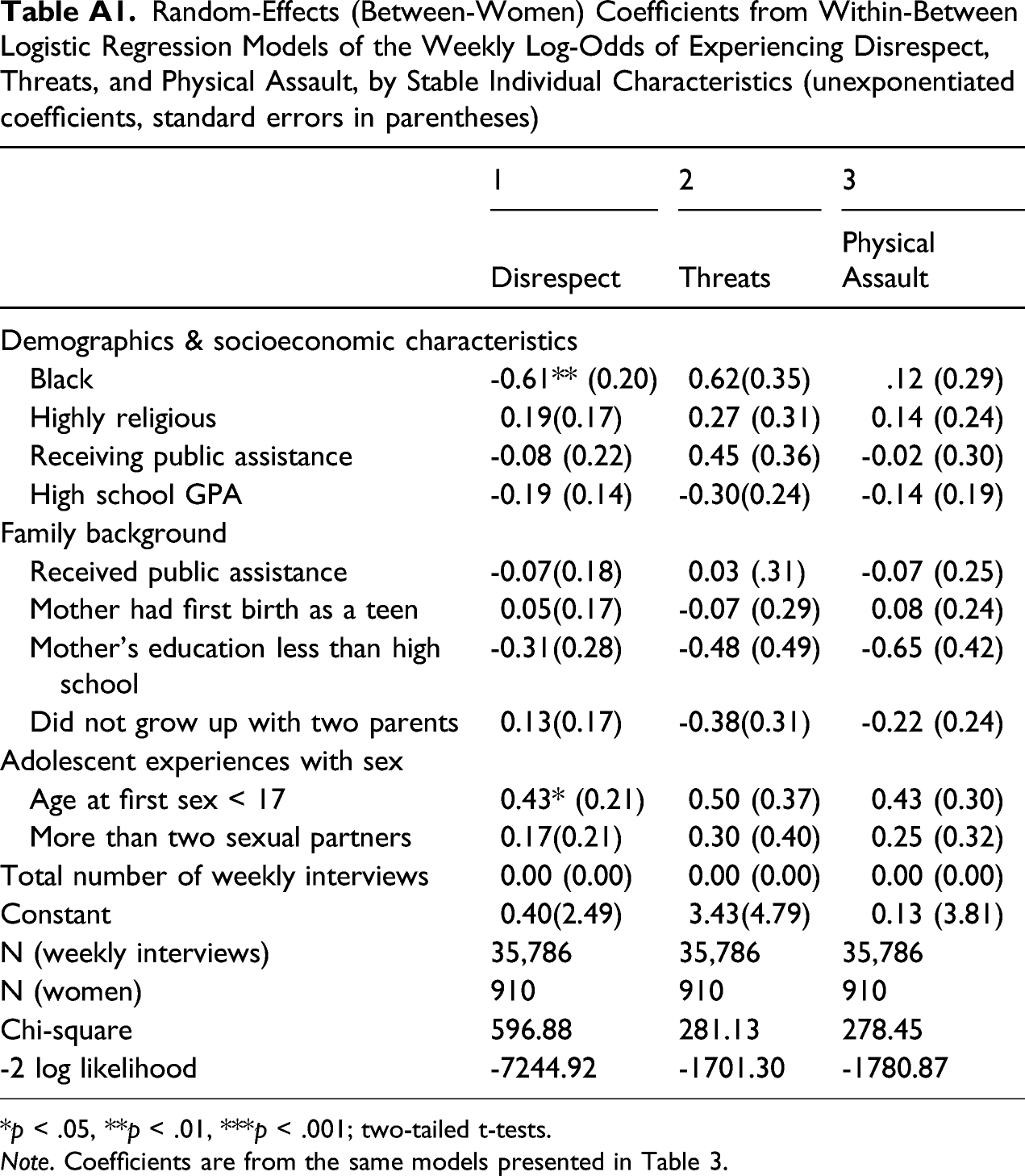
1
2
3
Disrespect
Threats
Physical Assault
Demographics & socioeconomic characteristics
Black
-0.61** (0.20)
0.62(0.35)
.12 (0.29)
Highly religious
0.19(0.17)
0.27 (0.31)
0.14 (0.24)
Receiving public assistance
-0.08 (0.22)
0.45 (0.36)
-0.02 (0.30)
High school GPA
-0.19 (0.14)
-0.30(0.24)
-0.14 (0.19)
Family background
Received public assistance
-0.07(0.18)
0.03 (.31)
-0.07 (0.25)
Mother had first birth as a teen
0.05(0.17)
-0.07 (0.29)
0.08 (0.24)
Mother's education less than high school
-0.31(0.28)
-0.48 (0.49)
-0.65 (0.42)
Did not grow up with two parents
0.13(0.17)
-0.38(0.31)
-0.22 (0.24)
Adolescent experiences with sex
Age at first sex < 17
0.43* (0.21)
0.50 (0.37)
0.43 (0.30)
More than two sexual partners
0.17(0.21)
0.30 (0.40)
0.25 (0.32)
Total number of weekly interviews
0.00 (0.00)
0.00 (0.00)
0.00 (0.00)
Constant
0.40(2.49)
3.43(4.79)
0.13 (3.81)
N (weekly interviews)
35,786
35,786
35,786
N (women)
910
910
910
Chi-square
596.88
281.13
278.45
-2 log likelihood
-7244.92
-1701.30
-1780.87