



Abstract
The Illinois-Rape Myth Acceptance-Short Form (IRMA-SF) is a widely used scale measuring people’s endorsement of rape myths. However, it uses heavily gendered wording and makes gender-based assumptions that may affect its generalizability to various subgroups of people, including sexual and gender minorities who may view gender constructs outside of the heteronormative gender binary. This study validates the psychometric properties of a modified form of the IRMA-SF that is gender inclusive. Participants were adults with a range of sexual orientations and gender identities. Two sets of data were merged and then the sample was randomly split with a 20/80 weight. Data in the 20% split were used for exploratory factor analyses. Data in the 80% split were used for confirmatory factor analyses. According to the exploratory factor analysis, we found a theoretically predicted one-factor model was best (41% variance explained). Further, we found acceptable absolute model fit according to the confirmatory factor analysis (RMSEA = .07, p < .001; SRMR = .06) but unsatisfactory incremental fit (CFI = .82). These model issues were likely due to a floor-effect of low item variability which may call into question the utility of this scale in determining differences in rape myth acceptance overall. Overwhelmingly, participants in this study rejected rape myths. Researchers should explore the use of gender inclusive wording with an updated rape myth scale for use with sexual and gender minorities and, perhaps the general population, as some of these statements may be lacking in cultural relevance.
Keywords
Between 18–22% of women in the general U.S. population have experienced rape in their lives (e.g., Black et al., 2011; Tjaden & Thoennes, 2006). Prevalence rates of sexual assault experienced by men tend to be lower than for women but are still cause for concern. According to a review of the literature by Peterson et al. (2011), studies of male 1 sexual assault victimization prevalence rates vary depending on the definitions and measurements used. Although many people conceptualize sexual assault as the penetration of one’s own body, some federal definitions account for a victim being forced to penetrate someone else’s body. About 4.8% of men report being made to penetrate someone else (Black et al., 2011). Similar to women, men are also often victimized by male perpetrators (Black et al., 2011; Bullock & Beckson, 2011). In comparison, there are far fewer studies on female perpetrated rape and same sex rape (Russell & Hand, 2017). Additionally, with a 47% lifetime prevalence (James et al., 2016), transgender and nonbinary communities may have higher rates of sexual assault than cis women or cis men.
Discussions of sexual assault often include the concept of rape myths. Rape myths, which often reflect the gendered realties of sexual assault, gained attention in the 1970s by researchers (e.g., Feild, 1978), sociologists (e.g., Schwendinger & Schwendinger, 1974), feminists (e.g., Brownmiller, 1975), and in the public (Burt, 1980; Edwards et al., 2011). For decades since, researchers have sought to identify and define beliefs, attitudes, stereotypes, and assumptions that influence how society conceptualizes rape. Burt (1980) defined rape myths as “prejudicial, stereotyped, or false beliefs about rape, rape victims, and rapists” (p. 217). Noticing a lack of clarity in this non-gendered definition, Lonsway and Fitzgerald (1994) redefined rape myths as “attitudes and beliefs that are generally false but widely and persistently held, and that serve to deny and justify male sexual aggression against women” (p. 134). Existing literature has established how rape myths function (Brownmiller, 1975; Burt, 1980; Lonsway & Fitzgerald, 1994), factors that may predict adherence to rape myths (Barnett et al., 2018; Malamuth, 1981) or predict sexual violence (Loh et al., 2005), how rape myths may perpetuate occurrences of sexual victimization (Brownmiller, 1975; Lonsway & Fitzgerald, 1994), and how rape myths are maintained by society at the institutional level (Edwards et al., 2011). Researchers and activists have made important advances in increasing awareness about rape myths, but the focus has historically remained on how rape myths serve to protect what is assumed to be male perpetrators and harm what is assumed to be female victims. There is little research about rape myth acceptance across different subpopulations that may extend beyond the heteronormative gender binary (Johnson et al., 2021).
More recently, researchers have begun to identify subtle and nuanced ways in which rape myth attitudes are evolving (e.g., that rape can happen with same sex perpetrators and victims), but there may be a lack of validated scales to accurately assess this (McMahon & Farmer, 2011), especially among different subgroups of people. Even Payne et al. (1999)—the creators of a widely used rape myth scale—note that their measure (Illinois Rape Myth Acceptance Scale; IRMA) may not operate the same across cultures. McMahon and Farmer (2011) assert that the language used in most rape myth measures and educational programing is outdated. Because item wording in instruments can affect their psychometric properties, alter data, and impact generalizability, we suggest possible alterations to rape myth measurement. We do this especially with respect to how it functions in sexual and gender minority (SGM) communities. 2
History of Rape Myth Measurement
Burt (1980) introduced the 19-item Rape Myth Acceptance Scale which provided researchers with an instrument to measure beliefs, attitudes, and stereotypes surrounding rape. Although this measure had been one of the most widely used in research (Lonsway & Fitzgerald, 1995), several other measurement tools which differed in psychometric structure have also been used. Payne and colleagues (1999) identified the numerous flaws in the way rape myth acceptance was measured prior to the late 1990s, highlighting a lack of consistent conceptualization of important terms. For example, Payne and colleagues (1999) identified 23 different scales which measured different variables. They offered a solution to this measurement jungle by streamlining the relevant factors into a new scale, the IRMA, a 45-item tool representing the rape myth construct and exploring its influences. The IRMA, as well as its short-form (IRMA-SF), are now some of the most widely used scales for measuring rape myth acceptance.
The IRMA is conceptualized as a hierarchical model containing both a general component and the following seven sub-components: (1) She asked for it; (2) It wasn’t really rape; (3) He didn’t mean to; (4) She wanted it; (5) She lied; (6) Rape is a trivial event; and (7) Rape is a deviant event. The development of the IRMA helped to improve item wording, content validity, and criterion-related validity in measuring rape myth acceptance, which previous scales had not yet successfully and consistently achieved (Lonsway & Fitzgerald, 1995; Payne et al., 1999). The IRMA-SF, the twenty-item short-form complement to the IRMA, was introduced as a more parsimonious scale that assessed only general rape myth acceptance, not any of the seven IRMA sub-scales specifically. Due to its brevity and ease of use, we selected the IRMA-SF for use in the present study.
More recent work has focused on updating the language of the IRMA scale and testing it in specialized populations. For example, McMahon and Farmer (2011) updated the IRMA with college students using more subtle language than the original IRMA measure. This subtle language created more variability in scores. Then, Johnson et al. (2021) created a gender inclusive version of McMahon and Farmer’s (2011) scale, which retained item variance, good model fit, and strong internal consistency, but because this scale is so new, it has not yet been widely tested across a variety of settings. Additionally, Schulze et al. (2019) created the Identity Inclusive Sexual Assault Myth Scale by modifying the original IRMA with both gender inclusive language and gender reversed language (e.g., “If a girl acts like a slut…” changed to “If a guy acts like a man whore…,” p. 114). This scale also included new items that assessed rape myths specific to SGM communities (e.g., “Because they never turn down sex, gay men cannot be raped” p. 214). While Schulze et al.’s (2019) new scale is the first to attempt to make a measure that is more gender inclusive, its focus on SGM experiences might limit its utility in the general population (Johnson et al., 2021). Due to the continued popularity of the original IRMA-SF measure by Payne et al. (1999), we ultimately elected to modify the IRMA-SF to test whether gender inclusive language may impact the original scale’s reliability and validity.
Gendered Wording Critique
The IRMA presumes rape myths are disproportionally more biased against women than men. As such, gendered conceptualizations of rape and gendered language exist in the measure. This gendered language has evolved in the literature over the last few decades, though. For example, changes in the popular Sexual Experience Scale by Koss et al. (2007) removed the gendered language from the scale’s prompts assessing for sexual assault. Yet, when it comes to rape myths, gendered language in measurement has not changed much since the 1990s until very recently (Johnson et al., 2021). In fact, one of the latest attempts to update rape myth measurement explicitly states that the authors “maintain the focus on male perpetrators and female victims” (Thelan & Meadows, 2021, p. 7). The aforementioned redefinition of rape myths by Lonsway and Fitzgerald (1994) itself holds that rape myths are false beliefs used to justify male aggression toward women. Expectedly, the language used in the IRMA and IRMA-SF is heavily gendered (e.g., “If a woman is raped…” and “When men rape…”) and perpetuates a focus on male perpetrators and female victims. This could create limitations in its generalizability across subgroups, specifically for SGMs (Johnson et al., 2021).
The SGM community may assign different meaning to concepts such as gender, gender roles, sexual scripts, or other social assumptions related to rape myth acceptance (e.g., Gabb, 2022; Levitt & Hiestand, 2005). Similarly, anyone who may have been sexually victimized by an individual of the same sex may also find the gendered assumptions in the IRMA scale unrepresentative of their experience. Schulze and Koon-Magnin (2017) stated that “different backgrounds and perspectives because of sexual orientation, combined with an increased risk of sexual assault victimization, may result in markedly different perceptions about rape and sexual assault” (p. 162–163). Using a scale that contains gendered language and relies heavily on gender stereotypes may not be a valid measure to use to assess SGM participants’ experiences. Even Payne and colleagues (1999) themselves call for future research to focus on the cross-cultural applicability of the scale.
Not only might a gendered scale lack validity when used with SGMs, it may be harmful to this population to continue talking about rape myths in a narrow, non-inclusive way. An important component of advocacy for SGMs is recognizing that having this marginalized identity may put one at greater risk to: (1) be sexually victimized, (2) receive more blame for violating heterosexist norms, and (3) experience inhibited healing processes after being victimized due to internalized rape myths or by lack of support (Canan et al., 2019; Chen et al., 2020; James et al., 2016; Rothman et al., 2011; Schulze & Koon-Magnin, 2017). If the societal discussion of rape myths focusses only on gendered concepts, which may not be generalizable to the SGM community, it may be harder for these individuals to report their experience of sexual violence and receive support.
Rape Myth Acceptance in Sexual Minorities
Researchers have begun to call attention to the importance of studying rape myth acceptance with SGMs and have specifically begun considering the application of the IRMA in research within this community (Schulze & Koon-Magnin, 2017; Wilson & Newins, 2019). Using the IRMA, researchers have determined that sexual minority individuals tend to have lower levels of rape myth acceptance (Schulze & Koon-Magnin, 2017; Wilson & Newins, 2019), and sexual minority individuals who are female are more likely to acknowledge their experiences of sexual violence as rape than their heterosexual counterparts (Wilson & Newins, 2019). Schulze and Koon-Magnin (2017) found that sexual minority respondents were more accepting of some rape myths than others, but they also found intragroup differences among sexual minorities in perceptions of sexual violence. For example, sexual minority men were more likely to believe rape myths than sexual minority women, and queer respondents demonstrated the least amount of support for rape myths compared with other sexual minority groups.
Although Schulze and Koon-Magnin’s (2017) work is important in its assessment of rape myths among sexual minorities, these researchers stopped short of measuring the psychometric properties of the scale in the SGM community in their paper. Instead, according to the methods of their paper, the IRMA-SF is assumed to be a valid measurement for rape myth acceptance in sexual minority populations. This is a potentially problematic assumption given that the scale was crafted on gendered assumptions which may not be endorsed by SGM communities as frequently. Being able to measure rape myth acceptance more accurately for those who view this problem outside of the concrete gender binary is helpful for inclusivity and generalizability.
The Current Study
Payne and colleagues (1999) suggest that the reliability and validity of measures “…depend on wording that is clear and uniformly understood by all respondents, yet this is often not the case with rape myth scales” (p. 7). Additionally, Schulze and Koon-Magnin (2017) suggest, “Given that sexual orientation is a strongly implied (and sometimes explicitly stated) component of many rape myths, failure to assess the role of sexual orientation in understanding rape myths is an important oversight” (p. 160). Despite this, the potential distinction for how subgroups such as the SGM community understand rape myths has not yet been addressed in Payne and colleagues’ (1999) IRMA-SF measure, although it has been addressed in more subtle measures of rape myth acceptance (Johnson et al., 2021; McMahon & Farmer, 2011). This motivates the present research for exploring how a gender inclusive update to the IRMA-SF language might affect the psychometric properties of the scale in sexually diverse and gender diverse populations. Given that prior research has not yet assessed this specific scale with gender inclusive language, the goal of the present study is to assess the structure and psychometric properties of a gender inclusive modified form of the IRMA-SF.
Method
Procedure: Two Samples
This study was part of a larger, two-phase study which assessed sexual assault and sexual orientation. Therefore, both phases of data collection oversampled for lesbian, gay, and bisexual identities. Surveys for both samples were created by the same research team and largely contained the same measures; items that differed between samples are not reported here.
The first sample (n = 933) was collected in the Summer of 2016 via a national survey disseminated by Qualtrics Online Survey Company (QualtricsXM, 2020) using a quota-based sampling design. Participants in the Qualtrics’ pool who met the study’s eligibility requirements (18+, cisgender women or transgender individuals who identify as lesbian, bisexual, or heterosexual) were invited to participate in the study until relatively equal quotas of lesbian, bisexual, or heterosexual groups were obtained. Cisgender men were excluded from this phase due to sampling costs. To aid in recruitment, consistent with Qualtrics’ and other opt-in panels’ practices, Qualtrics offered incentives (e.g., cash, airline miles, gift cards, redeemable points, and sweepstakes entrances) to participants for completing the survey.
The second sample (n = 1384) was recruited via social media, specifically targeting cisgender women, transgender individuals, and cisgender men who identified as lesbian/gay, bisexual, and heterosexual. This was done in the Spring and Summer of 2017 using the same online survey instrument hosted on the Qualtrics survey platform as the first sample. As an incentive, participants could be entered into a drawing to win one of ten $50 electronic gift cards.
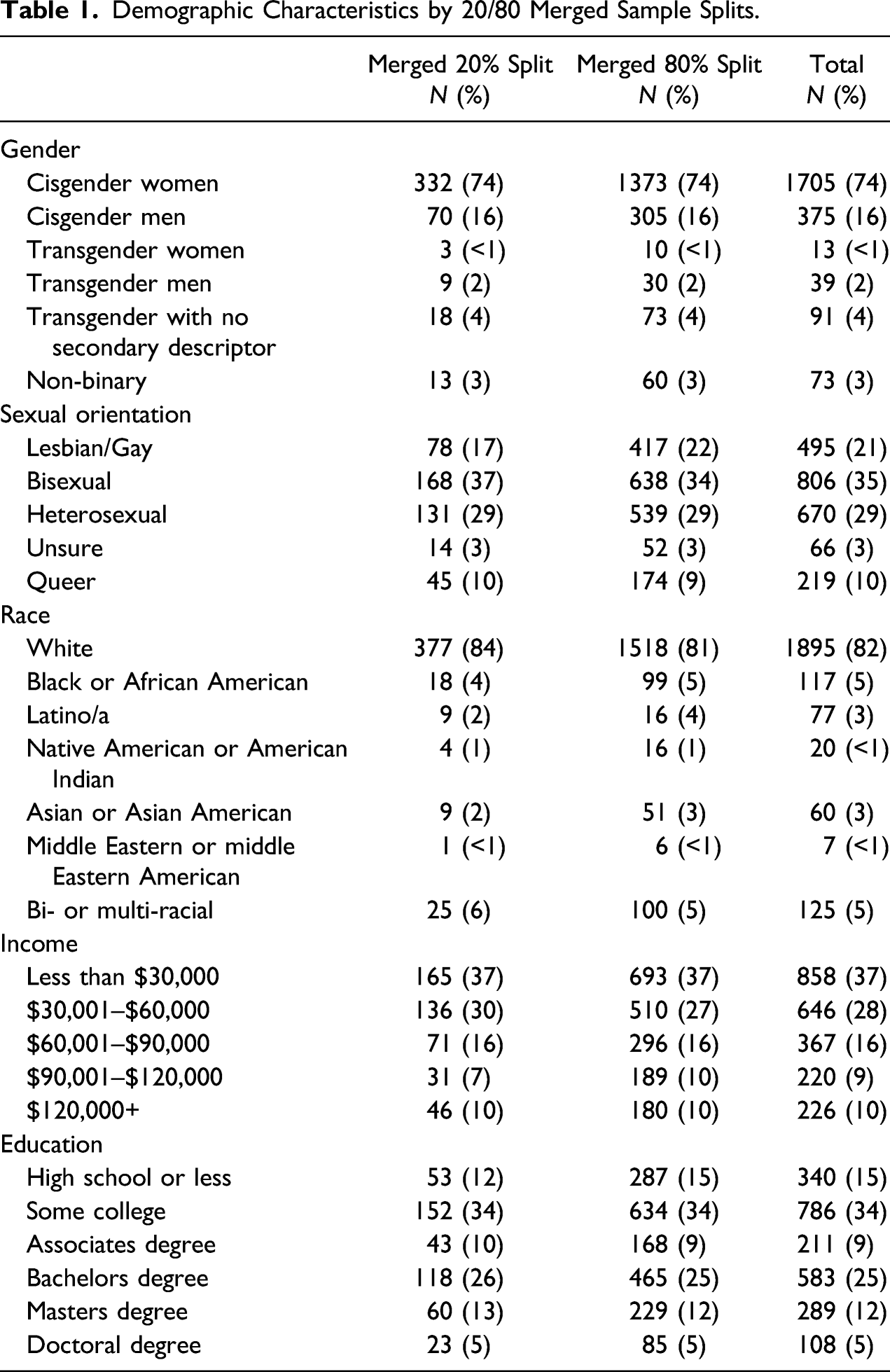
Data from these two samples were merged and randomly split with a 20/80 weight using the Random Sample Cases function in SPSS 24. Data in the 20% split (n = 449) were used for exploratory analyses. Data in the 80% split (n = 1868) were used in the confirmatory analyses. Chi-square comparisons on key demographic variables (gender, race, sexual orientation) ensured that the split samples did not significantly differ from each other. The study protocol was approved by the Institutional Review Board at the host institution prior to survey dissemination.
Participants
Demographic Characteristics by 20/80 Merged Sample Splits.
Measures
Modified Illinois Rape Myth Acceptance-Short Form
We used the IRMA-SF (Payne et al., 1999), a twenty-item scale assessing participants’ agreement with common myths about rape using a 5-point Likert scale from “Strongly disagree” to “Strongly agree.” Example items in the original scale include: “A woman who ‘teases’ men deserves anything that might happen,” “If the rapist doesn’t have a weapon, you really can’t call it a rape,” and “Rape happens when a man’s sex drive is out of control.” Most of these items describe women as victims of rape and men as perpetrators. A few items do not acknowledge gender. No items describe men as victims or women as perpetrators of rape. Three of the 20 items are categorized by Payne et al. (1999) as filler items, which are not scored. All non-filler items are scored in the same direction creating a composite score range of 17–85, with higher scores representing higher levels of rape myth agreement.
mIRMA-SF Item Loadings in Exploratory Factor Analysis One-Factor Model.

aIndicates filler item not used in scale calculation.
The preliminary modified IRMA-SF (mIRMA-SF) was first reviewed by an expert panel (n = 6) of sexual health researchers and researchers with expertise in gender and sexual orientation. Panelists were both women and men who worked both in and outside of academia. After several rounds of revisions, the survey was then cognitively pre-tested for wording feedback and comprehensive answer options using a small focus group (n = 5) of SGM college students who identified as women, transgender, or genderqueer. After additional revisions, the survey was pilot tested (n = 20) with members from the general population; these pilot participants took the surveys privately and provided written feedback via email. People in this group represented a range of ages (23–68 years old), differing racial identities, several sexual orientation identities, politically liberal and conservative ideologies, and a range of educational and income levels. After incorporating this additional feedback, the survey was reviewed again by the same panel of six sexual health researchers and revised accordingly.
Data Analysis
Although participants could stop the survey at any time, they could not skip questions as the survey software would not allow a participant to progress to the next page until they responded to all the questions on the current page. This resulted in an all-or-none response pattern for the mIRMA-SF where participants either answered all the items or quit the survey entirely. Any participant who did not complete the mIRMA-SF were excluded from analyses. No missing data were imputed.
Between group differences of rape myth acceptance were analyzed with two ANOVAs using the complete merged dataset (n = 2317). The first ANOVA compared rape myth acceptance across four sexual orientation categories (heterosexual, lesbian/gay, bisexual, and queer). The second ANOVA compared rape myth acceptance across three gender categories (cisgender men, cisgender women, transgender/non-binary individuals). Games-Howell post-hoc tests were performed in both analyses due to homogeneity of variance assumption violations.
An exploratory factor analysis was conducted using the 20% (n = 499) split of the merged dataset. A theory-driven model of one factor was explored and compared with a data-driven model (based on eigenvalues) of three factors. Total variance explained and factor loadings were used to determine the best model. Principal component analysis was used due to non-normally distributed data—most items have a heavy positive skew. Additionally, oblique rotation was performed for the three-factor model because we predicted that underlying factors would be correlated given the original IRMA-SF items were correlated. Finally, Cronbach’s alpha scores were used to assess scale reliability.
Confirmatory factor analysis (CFA) was conducted using the 80% sample split (n = 1868) in MPlus using a robust Maximum Likelihood estimation in MPLUS version 7.31. The CFA was run as a singular model to confirm previous theoretical arguments on a single factor structure and based on the single factor result of the EFA. Additionally, the authors explored alternate model construction to obtain better fit using a combination of modification indices provided by the software and knowledge of the theoretical underpinnings of the scale. The established a priori guidelines to determine model fit were in accordance with Hu and Bentler’s (1998) guidelines for fit indices (SRMR <.08, REMSEA <.06, and CFI >.95).
Results
Rape Myth Acceptance Across Sexual Orientation and Gender
Rape myth acceptance differed between sexual orientation groups (F[3, 2186] = 27.78, p < .001). Heterosexuals (M = 25.36, SD = 8.39) had the highest rape myth acceptance compared with all other groups, and queer individuals (M = 19.61, SD = 4.40) had the lowest. The only non-significant comparisons were between lesbian/gay individuals (M = 23.40, SD = 9.02) and bisexuals (M = 23.64, SD = 8.19).
Rape myth acceptance also differed across genders (F[2, 2314] = 23.52, p < .001). Post-hoc tests revealed that all groups differed from each other with cisgender men having the highest rape myth acceptance scores, (M = 25.42, SD = 6.97), cisgender women with lower scores (M = 23.70, SD = 8.62), and transgender/non-binary individuals having the lowest scores (M = 20.75, SD = 6.84).
Exploratory Factor Analysis
The mIRMA-SF had excellent internal consistency (α = .91) between the 17 scored items used in the merged 20% split sample.
One-factor model
A theory-driven, one-factor model explained 40.7% of the overall variance. All items loaded satisfactorily (loadings .426–.844) on the single factor. See Table 2 for factor loadings.
Three-factor model
A three-factor model that was selected using eigenvalues explained 52.1% of the overall variance. However, factor loadings for most items in this model predominately loaded on the first factor. Four items cross-loaded on the first factor and either the second or the third factor. These items were “It is usually only people who dress suggestively that are raped” (Factor 1 and 2), “If the rapist doesn’t have a weapon, you really can’t call it rape” (Factors 1 and 2). “Many people secretly desire to be raped” (Factors 1 and 3), and “Although most people wouldn’t admit it, they generally find being physically forced into sex a real ‘turn on’” (Factors 1 and 3). No items loaded exclusively on either Factor 2 or Factor 3.
Confirmatory Factor Analysis
Descriptive Statistics for 80% Sample (N = 1868).
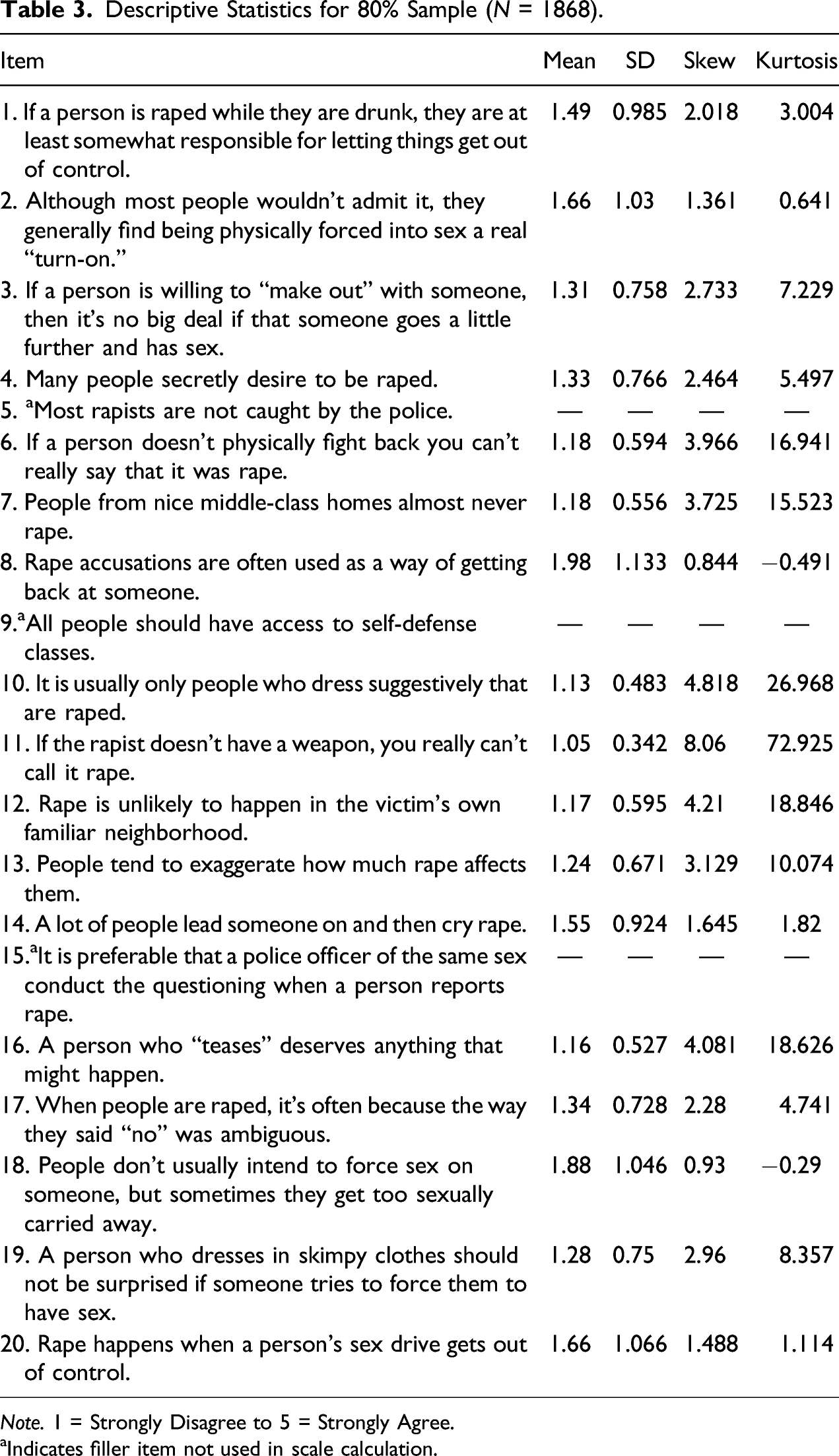
Note. 1 = Strongly Disagree to 5 = Strongly Agree.
a Indicates filler item not used in scale calculation.
The theory-driven, one-factor model was selected for further testing. The base model of 17 items loading on a single factor indicated acceptable absolute fit (RMSEA = .07, p < .001; SRMR = .06) but unsatisfactory incremental fit (CFI = .82), explaining 39% of the variability in the latent variable (Hu & Bentler, 1998). Modification indices were consulted, indicating four correlations between items. When the model was run with the additional four correlations, good absolute fit (RMSEA = .05, p = .59; SRMR = .05) and acceptable incremental fit (CFI = .90) was present. Though incremental fit improved, one of the four correlations did not fit theoretical underpinnings among the items. Therefore, the modified model was rejected, and Figure 1 represents the item loadings for the base model with no correlations between items. CFA baseline model with 17 items loading on a single factor.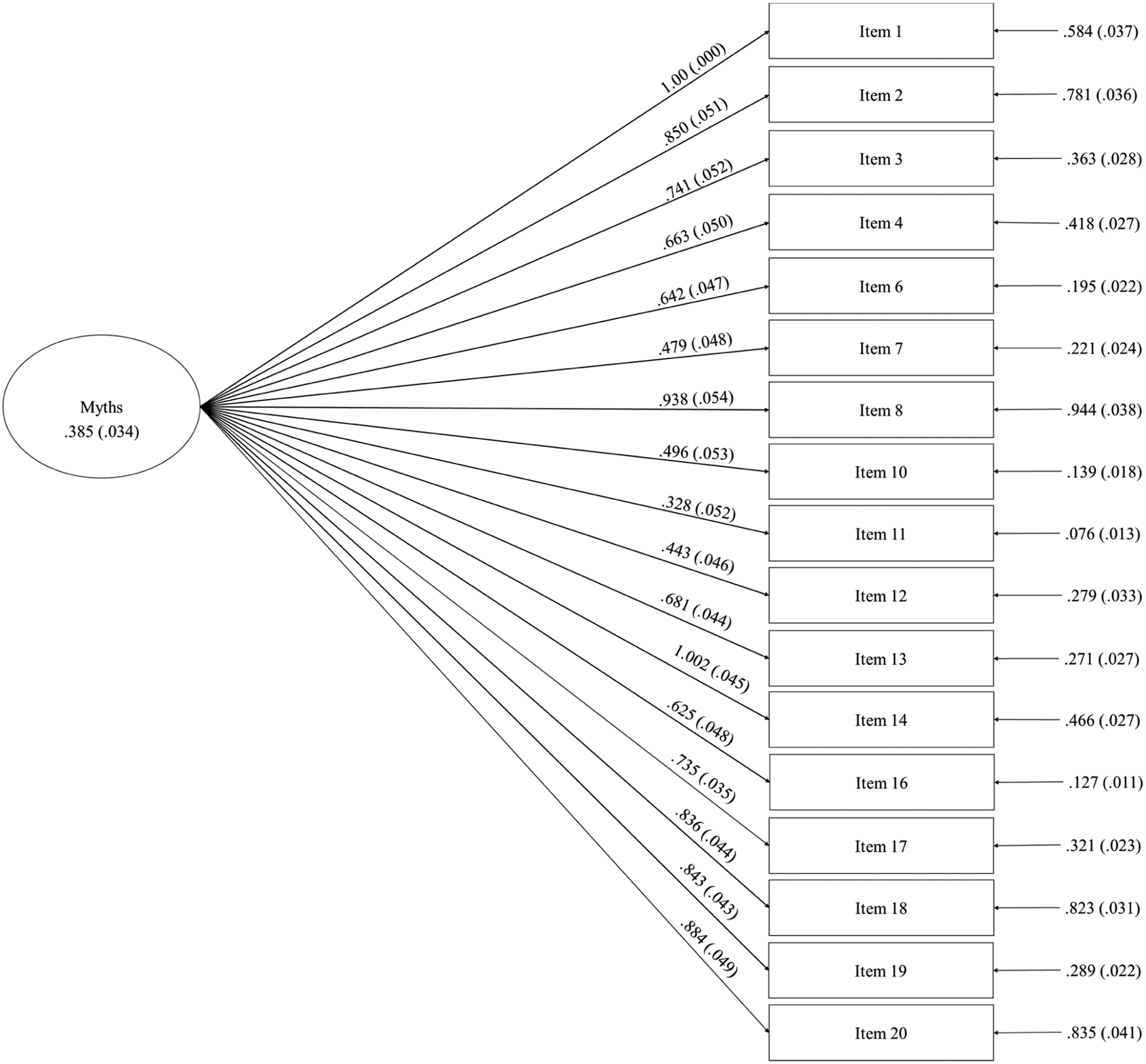
Discussion
This study is the first to explore the validity of a modified, gender inclusive version of the IRMA-SF to measure rape myth acceptance. We did this using a sample with an over-representation of SGM individuals to lend evidence to its validity and generalizability across these populations. According to our exploratory factor analysis, there was satisfactory item loading on a single, theoretically predicted factor as well as strong internal consistency (α = .91) between items. In comparison, the original IRMA-SF had a similar internal consistency (α = .87; Payne et al., 1999) and also used a one-factor model. Based on the model derived from the first split of the data, we conducted a confirmatory factor analysis using a second split of the data and found acceptable absolute fit but unsatisfactory incremental fit. This inability for the final model to hold its structure is likely do to the extremely low variability of item responses—most people selected “Strongly Disagree” for most items in the scale.
Initially, we considered that low item variability might be due to the sample makeup. Previous research has indicated that sexual minority individuals have lower levels of rape myth acceptance, generally, although differences exist between sexual minority men and sexual minority women (Schulze & Koon-Magnin, 2017). Our findings were similar to Schulze and Koon-Magnin (2017) with heterosexuals and cisgender men having the highest rape myth acceptance compared with SGM and cisgender women. However, even these groups had relatively low levels of rape myth acceptance—27.78 average (heterosexuals) and 25.36 average (cisgender men) on a 17–85 pt scale. This led us to consider alternative explanations.
One possible explanation may be that, despite Payne et al.’s (1999) update to previous rape myth scales, the IRMA-SF items are now over two decades old. Given the increased awareness of rape culture (e.g., Friedman & Valenti, 2008; Harding, 2015), societal attitudes may have shifted in recent years, resulting in less endorsement of certain rape myths. Given this, when responding to items on a survey, people may also be driven by social desirability, suggesting how they should answer, even if they do indeed endorse some form of rape myth. In fact, in a focus group run by McMahon and Farmer (2011), participants even made comments such as “No one would say that” in reaction to certain items on the original IRMA, particularly pertaining to myths about women wanting to be raped (p. 74). McMahon and Farmer (2011) suggest that some overt rape myths are becoming less socially acceptable, while other rape myths are still endorsed.
The Future of Rape Myth Acceptance Measurement
Gerger et al. (2007) critiqued the lack of variability and heavy skew in data distribution of the IRMA. Gerger et al. (2007) then presented their own updated scale, the Acceptance of Modern Myths About Sexual Aggression Scale, which results in normally distributed data. Unfortunately, despite this strength, this scale is used far less often than the IRMA scale, perhaps due to translation issues to English from the scale’s original German language (Thelan & Meadows, 2021). Nevertheless, 22 of the 30 items in Gerger et al.’s (2007) scale contain explicit gendered assumption like “When a woman starts a relationship with a man, she must be aware that the man will assert his right to have sex” (p. 439). Therefore, the issue of finding a contemporary scale with validated gender inclusive language remains.
Similarly, a few years later McMahon and Farmer (2011) updated the IRMA with more subtle language that reflected common rape myths at the time of their publication. Their systematic process yielded a 22-item scale that cut some of the IRMA scale’s overt items (e.g., “Many women secretly desire to be raped”). The remaining items were modified with more subtle or updated language (e.g., “When women go around wearing low-cut tops and short skirts, they’re just asking for trouble” became “When girls go to parties wearing slutty clothes, they are asking for trouble”). Because McMahon and Farmer (2011) used college populations in their work, they changed their gendered language to say “girl” and “guy,” which they found to be more commonly used than the IRMA scale’s original “woman” and “man” language. Nevertheless, of their 22 items, only two items are gender neutral—“If both people are drunk, it can’t be rape” and “If the accused ‘rapist’ doesn’t have a weapon, you really can’t call it rape” (p. 77). This again does not give the field a validated scale with gender inclusive language. Most recently, Thelan and Meadows (2021) took McMahon and Farmer’s (2011) subtle scale and attempted to adapt it further by inserting 10 items about sexist beliefs as distractor items in hopes that it would decrease social desirability bias, allowing respondents to feel okay endorsing the rape myth items. Ultimately, they found no meaningful difference in their new adaption and state the one explanation for this may be declining rates of rape myth acceptance. Because their work is adapted from McMahon and Farmer’s (2011) subtle scale, it holds the same critique of heavily relying on gendered language.
At the same time as Thelan and Meadows (2021) work, Johnson et al. (2021) also modified McMahon and Farmer’s (2011) subtle scale, but they did so with more gender inclusive language. This scale is promising as it was not tested exclusively on college students, retains item variance, has good model fit, and has strong internal consistency. Even so, given this scale’s recent introduction to the literature, it has yet to be widely tested by other research teams.
Ultimately, as it presently stands, there seems to be no contemporary measure for rape myth acceptance that both reliably yields enough variability, uses gender inclusive language in all items, and has been widely tested. This is certainly an area that warrants further research.
Limitations, Strengths, and Future Directions
One limitation within our research is the inability to compare mIRMA-SF responses directly to original IRMA-SF; we only included the modified version in our measures. An important future direction to further validate the mIRMA-SF can compare data sets of the same respondents taking both the original IRMA-SF and the mIRMA-SF to explore if the responses remain consistent.
One strength of the current study is that providing gender inclusive terms may inherently shift measurement items to be more single-barreled, potentially removing unintended respondent confusion. For example, if a participant reads the scale item “If someone is raped while drunk, that person is at least somewhat responsible for letting things get out of hand” as opposed to “If a girl is raped while she is drunk, she is at least somewhat responsible for letting things get out of hand,” research may find that people adhere to rape myths surrounding alcohol use and intoxication without having to consider gender as a confounding variable. This may be helpful, for example, in informing rape prevention programs regarding how alcohol use relates to perceived accountability (McMahon & Farmer, 2011). Similarly, if a participant reads the scale item “If a person doesn’t say ‘no’ the person can’t claim rape” instead of “If a girl doesn’t say ‘no’ she can’t claim rape,” this may create an opportunity to more deeply examine thoughts surrounding consent and where prevention education may be lacking in this area. Therefore, when gender neutral terms are provided in measuring these beliefs and attitudes, it may present an opportunity to focus explicitly on other variables (e.g., alcohol and consent). The consequence of this practice, however, is that researchers lose the ability to explore stereotypical beliefs that people may hold about gender in a sexual violence context. Although a more gender inclusive scale helps us expand contexts in which we can assess sexual violence, we need to consider that gender is a risk factor for sexual violence. This is a difficult tension to navigate for researchers, but it is one that likely requires further attention.
Likewise, if a participant responds to the scale item “People from nice middle-class homes almost never rape” instead of “Men from nice middle-class homes almost never rape,” data may be revealed which highlights myth adherence to stereotypes and biases against low socioeconomic status being associated with assumed higher likelihood of being a perpetrator. Some research indicates that the degree to which rape myths are accepted can shift depending on the privileged or majority status of the perpetrator to maintain the status quo of protecting advantaged, higher status individuals against being seen as rapists and allowing them to get away with sexual violence (Chapleau & Oswald, 2013; Martinez et al., 2018). This is important information to examine in future work, especially as we notice individuals with lower perceived status and/or racial minorities experiencing harsher punitive legal punishment than people who hold more privileged statuses. Future research looking at these privileged statuses directly should examine the ways rape myths are used as a tool to keep other marginalized populations at a disadvantage.
Conclusions
Since the 1980s, researchers (Burt, 1980; Payne et al., 1999) have defined rape myth acceptance and streamlined methods for its measurement but with a heavily gendered focus. As attitudes and beliefs begin to shift and expand, the importance of continuing to re-assess the language of measurement tools is clear. In this study, we found that a modified gender inclusive IRMA-SF held the same psychometric properties as the original IRMA-SF using an exploratory factor analysis, but the model did not fit well using a confirmatory factor analysis. This is likely due to a floor-effect of low variability in item response. We, along with other researchers (McMahon & Farmer, 2011; Gerger et al., 2007), speculate that this low variability is caused by both the age of the scale and the societal shifts regarding rape myths in the last two decades as well as social desirability bias. Therefore, researchers may consider avoiding use of the IRMA-SF and, instead, conduct new studies using alternative measures such as Johnson et al.’s (2021) scale.
Footnotes
Declaration of Conflicting Interests
The author(s) declared no potential conflicts of interest with respect to the research, authorship, and/or publication of this article.
Funding
The author(s) disclosed receipt of the following financial support for the research, authorship, and/or publication of this article: This work was supported by the American Psychological Foundation’s Roy Scrivner Memorial Research Grant.
