




Abstract
Promising community-level approaches to addressing interpersonal violence have increased in popularity over the last few decades. However, the shift towards community-based research has not necessarily extended to all graduate program pedagogies, especially given the range of disciplines from which researchers of interpersonal violence hail. Coupled with the fact that many new doctorates relocate to unfamiliar communities to secure their tenure-track positions, junior faculty may find the task of forming and maintaining rewarding community partnerships to be daunting at best. This article focuses on the process of embarking on community-based research as a new faculty member within a new community. In this article, three tenure-track assistant professors of a psychology department within an urban, Midwestern-based university reflected on their own experiences establishing community-based research collaborations after relocating for their positions. Personal narratives focused on experienced challenges and successes related to building mutually beneficial relationships with community organizations of relevance to addressing interpersonal violence (e.g., victim response services, healthcare providers, school systems) were written. Individual narratives were then compiled and six overarching themes (i.e., establishing initial connections, messaging and marketing one’s research to gain buy-in, overcoming misperceptions and distrust, maintaining relationships as an external partner, conducting research with community organizations, balancing community-based research and academic demands) related to challenges and multiple associated strategies and lessons learned were identified. Implications of this article for researchers of interpersonal violence who are building careers in a new community are discussed. Some of these implications include the need for increased mentorship, trainings and resources that are specifically targeted to junior faculty’s unique needs, and changes to departmental and college level infrastructures that better support and reward community-based research.
Keywords
Introduction
The field of interpersonal violence is of growing interest to researchers in the academy, in part bolstered by the publicizing of high prevalence rates of victimization, particularly among college students and their college-aged peers in the community (Black et al., 2011; Krebs et al., 2016; White House Task Force to Protect Students From Sexual Assault (US), 2014). As knowledge of interpersonal violence has improved, it has become increasingly clear that focusing on individuals at risk for potential victimization and/or perpetration as a means for prevention is limited (Banyard, 2015; Morton et al., 2019). Instead, many researchers have turned to community-level approaches to address these issues (Banyard et al., 2017; DeGue et al., 2012; Morton et al., 2019).
Drawing from frameworks such as Bronfenbrenner’s (1979) Social Ecological Model, which views social issues through a lens that moves beyond the individual to the micro-, meso-, exo-, and macrosystems in which they live, the use of community-focused methodological approaches has increased across disciplines (Koller et al., 2019). For example, Participatory Action Research (PAR), one of Community Psychology’s core practice competencies (Dalton & Wolfe, 2012), has gained traction as a particularly valuable approach to community-based research collaborations (Anyon et al., 2018; Chevalier & Buckles, 2019). PAR involves researchers making concerted efforts to give community stakeholders an active voice in the research process, involving stakeholders in decision-making from planning to publication (Abma et al., 2017; Chevalier & Buckles, 2019). PAR’s particularly empowering approach incorporates issues of diversity and inclusion into the research design, frequently resulting in more successful translations of research to practice or policy (Abma et al., 2017). PAR is considered one form of Community-Engaged Scholarship (CES), a values system that recognizes engaged partnerships between the community and university teaching, research, and service as integral to community improvement and social justice (Beaulieu et al., 2018; Morton et al., 2019).
In a 2011 World Development Report, researchers identified engaging communities in the design and implementation of prevention initiatives as one of five emerging lessons in preventing interpersonal violence worldwide (Willman & Makisaka, 2010). Likewise, the authors of a systematic review of 20 studies using PAR to address domestic violence concluded that “community-based research is a promising and needed approach to create programs that support DV survivors in ways that celebrates the strengths, wisdom, and lived experiences of survivors, advocates, and other community members” (Ragavan et al., 2019, p. 153). However, not all researchers engaged in the interpersonal violence domain have been trained in CES-centered approaches to research, like PAR, or have previous experience in community collaboration (Doberneck et al., 2017; Grassetti et al., 2020). The interdisciplinary nature of the field, typically seen as one of its assets (Backes, 2013; Morton et al., 2019), may contribute to inconsistencies in research methods training, with researchers graduating from a wide variety of disciplines including sociology, social work, women’s studies, policy, psychology, education, health, and more. For those whose graduate training in CES was minimal or lacking, the task of forming community partnerships may feel daunting or somewhat immobilizing (Morton et al., 2019). Others may have networking skills that make them more comfortable reaching out to establish these connections, but may later be met with unexpected pitfalls and faux pas throughout the process. Even those who have worked on community collaborative research while earning their degrees may struggle to effectively establish, navigate, and maintain these relationships after setting out on their own (DiGirolamo et al., 2012), particularly if they relied on a mentor’s well-established relationships.
Sharing their own stories and missteps, Goodman and colleagues (2018) described how the struggles of well-intentioned domestic violence researchers combined with insufficient guidance led to their development of “Power Through Partnerships: A CBPR Toolkit for Domestic Violence Researchers,” a resource for researchers aiming to use PAR to address domestic violence. Their guide offers an overview of PAR’s values and practices and how they might be applied to address domestic violence in the community (Goodman et al., 2017). Their toolkit is one of a handful of prescriptive guides specific to interpersonal violence researcher-practitioner partnerships that have emerged over the past decade (e.g., Davidson & Bowen, 2011; Sullivan et al., 2017) following the success of evaluations of various community-based initiatives. One could reason that the nature of scientific writing has contributed to the existence of more prescriptive advice within the literature than reflective narratives of researchers’ experiences. Shaw and colleagues (2016) argue that the interpersonal violence literature “tells how to form these partnerships, but does not show how it is actually done in practice … researchers have offered numerous insights into what should be done to form and be successful in operating researcher–practitioner partnerships and why, but case studies of what has actually been done—and to what successes—are generally lacking” (p. 1479). In recent years, some interpersonal violence researchers (e.g., Ghanbarpour et al., 2018; Wojcik et al., 2021) have contributed articles to the literature that outline lessons learned in specific researcher-practitioner case studies that may be useful to researchers pursuing similar partnerships. While these articles are less prescriptive than the aforementioned guides, providing the kind of nuanced examples of PAR principles in action that can perhaps best be attained from rich reflective personal narratives, they are specific to only one project and not to a researcher’s experience as a whole.
Existing guides in the interpersonal violence literature also do not specifically attend to the intricacies that may arise from being a junior faculty member. For example, issues related to conducting PAR can become further complicated when considering the number of researchers who relocate to secure an academic position. Geographic mobility has long been a prominent feature of the academic career, with many newly granted PhDs relocating to accept a faculty contract (Kulis & Sicotte, 2002; Morrison et al., 2011; Rosenfeld & Jones, 1987). Decreasing tenure lines, budgetary constraints, and a reliance on adjunct positions have not discouraged students from seeking a career in the academy, resulting in a tenuous job market in which a willingness to relocate, sometimes great distances, has nearly become a requisite for candidates wishing to get on the coveted tenure track (Dickey, 2019). The COVID-19 pandemic has only strengthened this reality with some fields noting a 70% decrease in new faculty positions compared to pre-pandemic opportunities (Langin, 2020). Thus, most junior faculty find themselves launching their careers in unfamiliar communities. Juggling the pressure to quickly establish a program of research with taking the time necessary to learn about a new community’s cultures, unique strengths and needs, and how best to engage with local organizations can be challenging for new faculty (Lusk, 2018), making guidance specific to this cohort of researchers of particular importance.
While strategies related to establishing community research partnerships not specific to interpersonal violence are outlined in several other literatures (e.g., Chevalier & Buckles, 2019; Springer & Skolarus, 2019), the authors of this article were not able to locate extensive guidance specific to, and drawing from the lived experiences of, newly relocated junior faculty. For example, an article focused on conducting research in school systems—a frequent community partner of interpersonal violence researchers—includes advice on processes for gaining approval and consent in the schools and stresses the need for incorporating patience, flexibility, follow-through, and reciprocity into one’s work. Missing, however, is discussion specific to those who may be viewed as outsiders within the community (Alibali & Nathan, 2010). Other articles on community-based research (e.g., Nyden, 2003; Springer & Skolarus, 2019) dedicate only a paragraph to challenges faced by junior faculty and lack concrete examples, while many articles focused on mentoring and supporting junior faculty research (e.g., Gillespie et al., 2005; Morrison-Beedy et al., 2001) lack any mention of community-based research at all. While the guidance given both inside and outside the interpersonal violence literature is valuable, providing more nuanced information on the challenges and potential accompanying solutions related to conducting community-based research as newly relocated junior faculty is needed, as is guidance that utilizes researchers’ experiences as applied examples. The current article aims to address the need for coverage of junior faculties’ experiences.
The Current Article
The current article aims to contribute to the literature on CES in the field of interpersonal violence by providing firsthand accounts and reflections from three recently relocated tenure-track junior faculty members engaged in community-based research. Using the researchers’ applied experiences as examples, challenges and successes specific to forming and maintaining community partnerships will be highlighted and discussed. While themes related to challenges and key lessons learned related to strategies will be identified, the primary purpose of the paper is to provide summaries of three junior faculties’ experiences with establishing and maintaining community research partnerships, rather than to discuss all possible experiences that any junior faculty member could encounter. Thus, any takeaways leading to guidance for junior faculty are likely not all-inclusive and should be viewed in light of the limitations of the researchers’ viewpoints, backgrounds, and experiences. The overarching goal of this article is not to provide prescriptive advice, but rather to share helpful information derived from experience with junior faculty invested in conducting interpersonal violence research that translates to practice within their new communities.
Method
Authors
The authors were three tenure-track junior faculty members of a doctorate-granting psychology department located within a R2 urban, Midwestern-based university at the time of writing this article. The authors each hail from different areas of the U.S. and all relocated to a new state when accepting their positions. All three authors are in their thirties and identify as Caucasian, heterosexual, cisgender women. Each of the authors have experience working in at least one community setting of interest to researchers of interpersonal violence, including school systems, healthcare, and community-based nonprofits or other victims’ services. However, level of expertise in interpersonal violence varied by author, ranging from solely conducting research on interpersonal violence, to a secondary concentration in teen dating violence, to a focus on the healthcare systems that frequently serve victims. Two of the authors are trained clinical psychologists who were both working in a community-clinical psychology program at the time that this paper was written, while the other author is a trained social psychologist working in a community psychology program.
Procedure
A quasi-systematic approach was used for the development of this article. To begin, each individual author free-wrote narratives of the challenges and successes they experienced related to community-collaborative research since joining the faculty at their institution. This individualized reflective practice approach was used during the composition of the narratives to encourage new understandings and critical thinking around one’s past experiences (Boud et al., 1985; Bradbury et al., 2012). Next, the authors relied on several principles of qualitative analysis, namely conventional content analysis (Hsieh & Shannon, 2005) and thematic analysis (Braun & Clarke, 2006), identifying categories and themes across the three narratives. The authors intentionally chose not to adhere to a specific formal approach or to employ outside coders, instead viewing the analysis of the narratives as an iterative process and a natural continuation of their reflective practice.
Still, synthesizing the narratives was a semi-structured process. First, personal narratives were merged into a singular document and experiences were categorized based on an initial observation of the most prominent features of the experience. Next, after reading through the categorized document several times as a group, more nuanced main themes related to challenges and associated strategies for overcoming challenges within the combined narratives were identified. The authors’ review of the narratives focused on both major and minor features of experiences in this step, sometimes resulting in individual components of experiences falling under different themes. During the process of identifying themes, discussions among the authors helped shape the team’s understanding of these themes to obtain a consensus on inclusion criteria, naming conventions, and hierarchical structure. As themes were discussed, authors also sometimes remembered additional experiences that were in line with some of their colleagues’ experiences that they had not thought of during the initial free-writing stage. These additional examples were incorporated into the data and then themes were revisited and revised as necessary.
Results
Identified Challenge Themes, Associated Strategies, and Key Lessons Learned
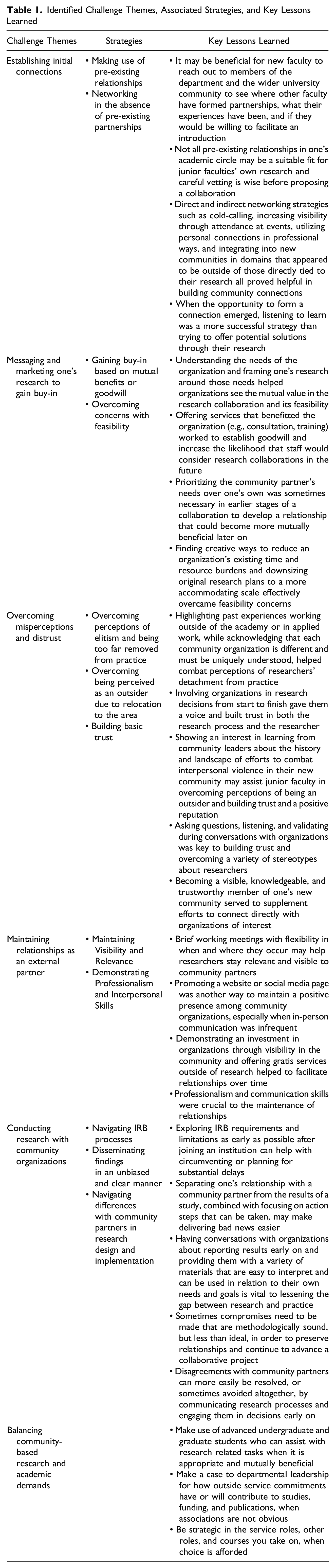
Challenge #1: Establishing Initial Connections
The first theme identified by the authors was about the challenge of establishing an initial connection with community organizations as a new faculty member. Establishing relationships with potential collaborators can be daunting for new faculty, with some junior faculty feeling at a loss for how to get started. For this challenge, strategies related to (1) using pre-existing relationships and (2) working without pre-existing relationships emerged.
Strategies for making use of pre-existing relationships
In the authors’ experience, one way that junior faculty can form initial connections is by making use of senior faculty’s established relationships, especially when those relationships previously involved collaborative research projects. For example, one author formed a successful community partnership with a local health clinic after being introduced to its director by a departmental colleague. In this instance, the colleague had a long-standing and productive research relationship with the director and facilitated a joint introductory meeting with the new faculty member. The joint meeting was particularly successful in that the “warm hand off” by the respected colleague allowed for an immediate inheritance of trust in the new faculty member and more quickly opened the door to a working relationship. In fact, the meeting ended with a solid plan for a collaborative research project.
It is important to note however, that some established community relationships that appear to be a good opportunity at first glance might ultimately not be worth pursuing. This may be particularly true in relation to interpersonal violence, as individuals from a range of backgrounds with variable knowledge of evidence-based practices and varying definitions of what “evidence-based” means tend to take up the cause. For example, an author was made aware of a colleague’s relationship with a newly-created nonprofit that served survivors. After an introduction at an event held by the nonprofit, it became apparent that the organization was not using practices supported by empirical research. The author later learned from another local victim services organization that it was not recognized by the state sexual and domestic violence coalition due to its problematic programming and materials. This new information resulted in an ethical and practical dilemma over whether to work with the organization in order to help them improve the quality of their services, or to align with other local organizations more respected in the field. Both of these options had potential social implications at the department and community levels. The organization in question ultimately closed its doors within a year. However, had the junior faculty member been aware of the prevalence of short-lived, non-evidence based organizations aimed at survivors in her new community, something that was not prominent in the community from which she hailed, she would have been more cautious. She wishes that she had taken a much closer look at the organization’s webpage or waited until she had a better understanding of the landscape of organizations in her new community before engaging with them. Junior faculty may be at a disadvantage when it comes to understanding unique community dynamics. Thus, utilizing a variety of resources to evaluate potential community partners for suitability before requesting an introduction or proposing a collaboration may help to mitigate any undesirable social consequences.
Strategies for networking in the absence of pre-existing partnerships
As mentioned previously, not all of the pre-existing partnerships that authors encountered were appropriate and, in some cases, they were non-existent. In these situations, other points of connection had to be established, often requiring the use of networking skills. One of the authors researched community organizations that served survivors in the area and cold-called or emailed their executive directors for meetings and/or tours. This same author also attended interpersonal violence related events in the area (e.g., Take Back the Night), where relevant organizations were present and introduced themselves to staff who were in attendance. Potential collaborators were also found simply by the authors integrating themselves into their communities and forming personal connections. For example, one author discovered that a friend’s daughter was a schoolteacher and was willing to reach out to several local principals on their behalf to set up initial introductions. Another author found their first community collaboration through a happenstance connection that began on a neighborhood app, highlighting that potential partnerships can form in unlikely spaces and one should be on the lookout for opportunities anywhere. In another example, an author was able to connect with a local school principal by offering parent-training groups at a local child-care facility. Whether during a brief introduction or a longer meeting, the authors found that it was often most useful to use the time to get to know the organization and the challenges they faced. In other words, the focus of the encounter was on obtaining information about the potential community partner rather than presenting one’s research or pitching a collaboration. This strategy may be particularly important for newly relocated faculty who might be perceived as outsiders. Relatedly, it’s important to remember that many of the nonprofits who serve victims are underfunded and understaffed. Risking time and effort on a perceivably young researcher from across the country may understandably not be a priority. In the authors’ experience, an initial focus on the community partner helped build trust and set the stage for potential collaborations down the line.
Challenge #2: Messaging and Marketing One’s Research to Gain Buy-In
The second theme identified by the authors involved the challenge of how to sell one’s research to community organizations in order to gain buy-in for a research partnership. Most of the organizations of interest to interpersonal violence researchers are either limited in time and resources (e.g., rape crisis centers, domestic violence centers) and/or have multiple priorities outside of victimization (e.g., school systems, healthcare), making selling key stakeholders on the need for one’s research expertise potentially difficult. Two types of strategies related to this challenge emerged, (1) those based in mutual benefits or goodwill, and (2) those that addressed feasibility concerns.
Strategies for gaining buy-in based on mutual benefits or goodwill
The authors found that identifying research that could be mutually beneficial to all parties was overall most successful in convincing organizations to collaborate. Finding these mutually beneficial projects often hinged on listening to and considering the community partner’s priorities and needs instead of leading with one’s own agenda, even when needs and priorities seemingly fell outside the scope of interpersonal violence research. This may be particularly relevant when working with organizations that interface with victims, but for whom it is not their primary focus (e.g., hospitals, school systems). Specifically, asking the organization what their needs were, how they struggled, and conversely, what their strengths were, served as an informal needs assessment that could directly or indirectly relate to a research project. For instance, one of the authors asked a health clinic director what might help her clinic run more effectively and efficiently. The clinic director wanted to understand how patients and providers perceived the clinic and their services offered. While not central to the junior faculty member’s initial goal, measures of these perceptions were included in the subsequent research project to make it more beneficial to the organization.
Based on their experiences, the authors also noted that sometimes the benefits to the researcher needed to come later in a relationship, for the sake of building one. For example, one of the authors wrote a grant with a newly established organization to help set up and evaluate a community-based forensic medical services program. Much of the small grant’s budget was allocated to implementation of the program, over its evaluation. Thus, the researcher agreed to evaluate the program at a reduced rate in exchange for publication from the evaluation. The initial pilot will result in data that the collaborators can use to apply for a larger grant with which the researcher can be more appropriately compensated. Similarly, one researcher established relationships in the local school district by first offering her intervention program to a limited number of schools for free, if they were willing to allow her to complete a publishable program evaluation. The authors noted having also offered educational talks or trainings, consulting work, or even a formal needs assessment at no cost to organizations. These methods were intended to establish goodwill, show an investment in the community organization, and develop a working relationship leading to more mutually beneficial collaborations in the future. Further, the authors reported offering incentives (e.g., gift cards, school supplies) to participating organizations and/or their constituents in order to demonstrate appreciation for their time.
Strategies for overcoming concerns with feasibility
Most of the organizations that work with survivors of interpersonal violence are understaffed and overburdened. Even when an organization can see the benefits in a research collaboration, they may still feel that the costs are too high. Thus, the authors found that presenting a research project in a way that framed the collaboration as a means to reduce burden and address their concerns was particularly helpful to gain buy-in. Taking the time to listen to an organization’s needs, like in the example of the health clinic director in the last section, was often the first step to understanding what messaging might address feasibility concerns. One author was actually able to even remove an existing burden from an organization’s to-do list entirely, freeing up resources to collaborate on additional research. In this example, the author conducted a needs assessment for a local crisis center that was required by one of the organization’s major grantors, effectively removing the burden of the assessment from a staff that was already stretched too thin. In addition to linking research projects to organizational needs, the authors found it helpful to present research ideas that were small, manageable, and did not require a large time, resource, or personnel burden. For example, instead of seeking to evaluate a large-scale program, one author began with a small-N pilot program, which aimed to assess the feasibility of implementing a larger program in the participating school district. While anyone engaging in community-based research may face feasibility challenges, junior faculty may lack the experience to draw from to creatively reframe, rescale, and re-message their research, particularly if it is necessary to do so quickly over the course of a conversation. Likewise, researchers who are new to PAR principles may take an all or nothing approach to involving community partners in the research process, rather than acknowledging the array of different ways and varying degrees to which overburdened organizations may be involved. Collectively, the authors found that flexibility around initial “asks” and expectations about reciprocity was often required in order to help gain buy-in.
Challenge #3: Overcoming Misperceptions and Distrust
The third challenge identified by the authors was finding ways to overcome misperceptions and distrust related to researchers and academia. The authors found that this was particularly challenging following a recent relocation, given that they were unfamiliar with the community history and could be perceived as an “outsider.” Three different types of strategies for addressing this challenge emerged from the authors’ reflections, including those for (1) overcoming perceptions of elitism and being too far removed from practice, (2) overcoming being perceived as an outsider due to relocation to the area, and (3) building basic trust.
Strategies for overcoming perceptions of elitism and being too far removed from practice
In the authors’ experience, academics often have the unfortunate reputation of being too far removed from the actual practice of community organizations, thereby perpetuating the idea of the “ivory tower” in which researchers reside. Even if it is not explicitly stated, the authors have experienced perceptions that academics do not have comparable work experience and perhaps could not fully understand the day-to-day operations and issues inherent in victim services, healthcare, or schools. This perception can sometimes be further amplified by new junior faculty’s enthusiasm over advancing their own research agenda for the first time or expectations around how much their expertise and degree will be valued by others. In the past, and to some extent currently, studies on interpersonal violence also frequently did not involve relevant community organizations in their research design, likely leading to further assumptions about a separation between research and practice. To overcome these concerns, the authors made efforts to explicitly highlight a) experiences working as providers in applied settings, b) experiences of working with stakeholders (e.g., teachers, principals) in applied settings, or c) a desire to understand the inner workings of the organization, despite a lack of practical experience. For example, one of the authors has previously worked as a clinician in a health clinic and made it clear that she understood the time demands placed on providers and how they could impact research implementation. Another author had several years of experience working in nonprofit management prior to entering graduate school and references this in her discussions with community organizations. Further, even if one has relevant applied experiences, the authors found that it was not always best to make assumptions regarding the lived experiences of those who work in the community. Therefore, regardless of previous experience, the authors decided to ask questions, listen, and validate. In some cases, the authors chose to shadow individuals at the organization to get a sense of how the organization operates and the demands placed on employees. In addition to highlighting shared experiences and getting to know the organization, the authors also found value in treating community partners as “co-researchers” who have an active role in the research process. For example, one author used a PAR approach when evaluating patient and provider experiences at a local health clinic. Clinic leaders were involved in every step of the research process, from formulating the research questions, choosing study protocols and materials, and overseeing implementation. In this instance, the community partners were particularly helpful in tailoring survey questions and recruitment methods that would best fit the target population of patients. Collaboration resulted in shortening the survey, changing language to be more accessible to patients, and recruiting participation in person in order to increase likelihood of completion. Using a collaborative approach gave the community partners a stronger voice and an equal say in the research project. While faculty are experts on the research process and the scientific literature, the organization is an expert on their organization and the larger community, and therefore they have invaluable insight into how to make projects more accessible and applicable.
Strategies for overcoming being perceived as an outsider due to relocation to the area
Another issue related to overcoming the divide between researchers and practitioners that the authors spoke to in their reflections pertains to the perception of being an outsider due to recently relocating to the area. All three of the authors moved to the area without personal or professional ties, which is a typical scenario for many junior faculty. While the authors found the surrounding community to be welcoming and open, they remained cognizant of the fact that they may not be aware of the history of each particular organization and that many executive directors and leaders had been involved in their positions for several years, even decades. In the authors’ experience, community members engaged in the prevention and response to interpersonal violence tend to be a tightknit group of dedicated advocates and service providers who are known to each other, despite changes in personnel that can occur over time. A bad first impression can have an undesirable ripple effect. As such, the authors found it helpful to avoid rushing into providing recommendations for research and again focused on asking questions about the organization, its history, and recent changes in the community. In essence, the authors did not presume to be experts on the organization or the community.
In one example, learning about the history of the community unveiled dynamics that would not have been immediately apparent to one of the authors. Through speaking with community leaders, it was learned that the prominence of religion in the area created both opportunities and challenges to addressing interpersonal violence and in particular, sex trafficking, which had become a popular mission for various communities of faith. The ways in which this community dynamic had impacted resources for victims and funding decisions for nonprofits over the years was information that could only be gleaned through discussions with those who had been working in the community for decades. Community leaders were also able to speak to positive and negative past experiences of working with researchers at the university. Speaking with these leaders helped the author to gain a better understanding of the complex history of addressing interpersonal violence in the community, while also demonstrating her investment in understanding the community. This experience highlighted a need to be mindful of the cultural landscape and how one’s research ambitions may be perceived by others.
Strategies for building basic trust
The authors found that the same ripple effect among interpersonal violence community organizations that could follow a bad first impression could also follow a good first impression. Thus, creating a trusting bond with one organization’s leader often led to trust from other organizations’ leaders by way of personal recommendations. This reflection by the authors suggests that junior faculty should not underestimate the value of “word-of-mouth” as a relatively quick and powerful means of building a reputation for being trustworthy in their new communities. Open conversations with these leaders also helped to reveal areas of mistrust that could either be verbally addressed or mindfully attended to by researchers when communicating and working with the organizations. For example, while talking with one community leader, an author discovered that a researcher’s past approaches to collaborating with several interpersonal violence-related organizations in the community had made them wary of partnering with other researchers from her institution in the future. The author was able to use the details provided about what went wrong in these instances to inform her work with the organizations and to attend to the immediate concerns of the leader with whom she was speaking. Following this positive experience, the author was nominated to serve on a local board.
In addition to listening, asking questions, and generally not making assumptions, the authors found that another effective way to build basic trust within the community was through simply becoming a visible, knowledgeable, and reliable member of that community. For example, some of the authors joined local boards and organizations, volunteered at local agencies and fairs, and attended community events to facilitate both name recognition and positive reputation. One of the authors joined the state coalition against sexual and domestic violence. In the authors’ experience, truly becoming a member of the community they were now living in helped others see them as a trustworthy peer and a reliable resource.
Challenge #4: Maintaining Relationships as an External Partner
A fourth theme that the authors identified was the challenge of maintaining relationships with community partners after making initial connections. Two types of strategies aimed at addressing this challenge that emerged were, (1) maintaining visibility and relevance to the organization, and (2) demonstrating one’s professionalism and interpersonal skills.
Strategies for maintaining visibility and relevance
One shared strategy that the authors relied on to maintain positive working relationships with community partners was scheduling periodic meetings. Because organizations typically do not have much time to spare and are in high demand, the authors have found success in scheduling brief working meetings and being flexible in when and where meetings occur. For example, one author has scheduled 7:30 a.m. meetings to be able to connect with a school principal or teacher before the school day begins. Of course, if meeting with a partner over breakfast, lunch, or dinner, it is nice to offer to cover the cost of the meal. The authors have found success in using start-up funds to pay for these meals, though they acknowledge that this is not always possible for all junior faculty, particularly those in other fields. While one-on-one meetings are useful, they are also not always feasible. Another author reported using personalized emails and scheduling phone check-ins with community partners when necessary. Alternatively, promoting a website or professional social media page can be another way to maintain a positive presence in the community, especially when communication is infrequent. This approach may be particularly useful for staying connected to overtaxed crisis centers and domestic violence shelters, where repeated requests for meetings may be more cumbersome than helpful. For example, one of the authors hosts her own webpage representing her research lab, as well as an associated social media presence. Her lab’s Facebook account follows the pages of various local community nonprofits and stakeholders related to interpersonal violence and re-shares their informational posts and events. She has been able to delegate the management of these pages to graduate students and one of her students even designed a lab logo that could be used to establish consistent branding for the lab’s web presence.
The authors also found success in staying visible by investing in community organizations over time. Similar to strategies identified when making initial contact and building trust with community partners, the authors found activities such as attending community events, participating in board meetings, and volunteering at fairs to be another helpful way to facilitate relationships over time. Further, the authors have found that offering services over time, even in the absence of a formal evaluation, can be useful in maintaining a relationship. For example, one author offers schools a consistent clinical service every school year, which allows schools to still benefit from the partnership without placing additional demands on teachers or students by requiring them to participate in research evaluations. She has found the schools are more receptive to future research projects when they find value in the service being provided and can trust that there will be continuity in what their staff and students can expect. Another author has connected a local crisis center with a student in the doctoral program to provide them with needed community outreach planning and services via an unpaid practicum placement.
Strategies for demonstrating professionalism and interpersonal skills
When trying to maintain the quality and engagement level of an ongoing relationship with a community organization, the authors have found the “soft skills” of being collegial, consistent, following through with deadlines and promises, and being responsive to communication are useful in demonstrating competence and reliability. While the use of these skillsets may appear obvious, they can easily get lost in the frenetic pace of one’s first year on the tenure-track. Junior faculty trying to juggle the multiple priorities in their new roles may forget to use extra care when communicating with external partners and apply social norms of communication within the academy or specific to their department that do not necessarily translate to their community (e.g., brief emails sans salutation). Relatedly, the authors have found being humble and seeking the organization’s input on an issue they might have more experience with to be a critical skill in maintaining relationships over time. Essentially, seeing them as an equal partner and seeking out their expertise is useful in maintaining egalitarian partnerships. Finally, showing appreciation for an organization’s assistance and time is useful. The authors are proponents of sending personalized thank you cards and have found that staff receiving cards are more apt to remember your name and provide assistance in the future.
Challenge #5: Conducting Research with Community Organizations
The fifth overarching theme that the authors identified was related to navigating challenges in the actual research process itself. In their narratives, the authors described lessons learned during the research process by attempting strategies related to, (1) navigating multiple Institutional Review Boards (IRB), (2) disseminating project findings that are clear and unbiased, and (3) navigating the differences that naturally arise with community partners during the study.
Strategies for navigating IRB processes
Working with multiple IRBs can be a new and unexpected reality for junior faculty working with certain organizations. One of the authors learned that her university lacks a reciprocal IRB agreement with the local school district. The local school district is quite large and has its own designated research administrative team. In her first year, the author sought consultation from the school district and university for clarity on what order the IRBs should be approved. Furthermore, she contacted faculty who had previously worked in the school district for exemplar IRB applications. Because each entity had different policies and procedures in place for conducting research, if the first IRB approved the project and the second IRB asked for modifications, the IRB proposal would need to be reapproved by the first committee. Indeed, the need for re-approval happened. She learned that even in the best of circumstances, it can take several months before projects are approved from both organizations, particularly when research involves vulnerable populations and full committee review. As such, when working with multiple IRBs, the author learned to start much sooner than her projected study start date. She also found it useful to meet pre-emptively with community partners prior to submitting the IRB. She used these meetings to: (1) learn what terminology community partners preferred and how they defined constructs she was interested in evaluating, (2) seek their advice and recommendations for getting a study approved, (3) learn what initiatives were currently being conducted in the content area in order to not be redundant, (4) understand district-wide priorities so that these could be emphasized in the submission and linked to the goals of the research study, and (5) identify areas of potential risk from the perspective of the community stakeholders and brainstorm solutions to these risks so that they could be preemptively covered in the IRB process.
Another author found when arriving at her new institution that there was no process to apply for exemption from certain IRB mandated reporting requirements under Title IX when conducting research on interpersonal violence. While not specific to community-based research, community work was still impacted, as students can be a part of community samples. She arranged a meeting with the IRB and the Title IX coordinator to explain the need for such a process and to discuss the documentation necessary to implement it. The author was able to supply samples of documentation from her previous institution and to put them in touch with one another for a consultation meeting so that a process could eventually be implemented. In addition, this same author received strong pushback on some of her first IRB applications, with committee members expressing fears that participating in interpersonal violence research would cause further harm to victims. There had not been substantial research conducted in this area at the institution prior to the junior faculty member’s hire. Concerns about research with victims initially caused the delay of several studies, and like the author navigating multiple IRBs, she learned to begin her projects sooner. However, with time the researcher built trust and demonstrated the quality of her work to IRB committee members so that the process of approval ran much smoother and expediently.
Strategies for disseminating findings in an unbiased and clear manner
Mutually beneficial partnerships should be considered beneficial regardless of the outcome of the study. However, presenting unflattering results of a program evaluation to an organization can feel particularly uncomfortable (and risky) when interacting with newly established community partners. This may be especially true for a junior faculty member trying to build a good reputation in their new community. While the authors understand that knowing what does not work is just as important as knowing what does work, and can effectively communicate that fact to community partners, this does not always make for easy conversation. In a program evaluation that involved one of the authors, the findings revealed a less than idyllic picture of the agency’s prevention program; however, the findings also provided immediate feedback to the agency on how they should best reallocate their resources. The author found it helpful to compartmentalize the relationship she had with the individual community partner with the task of conducting a fair and unbiased evaluation. She also found organizations were more receptive to unflattering results when provided with specific recommendations for what was working well and what steps could be taken to improve areas that were not working as well.
Additionally, the authors have learned the importance of keeping one’s audience in mind when disseminating research findings. More than one of the authors have heard firsthand from community partners how frustrating it can be when researchers present a barrage of academic jargon and statistics that the organization does not have the background to interpret. It is important for junior faculty to keep in mind that most organizations serving victims are not run by a staff of PhDs. An approach that a junior faculty member might not consider at the outset of a relationship with a community partner is to have an explicit conversation about what types of information will be included in later reports, or to even provide previous examples of de-identified summaries to potential partners to help build trust, as one of the authors does. The authors’ final reports also include plain language and are written concisely with limited research citations. Some of the additional components provided to community partners by the authors have included, (1) a graphical representation of findings with statistical analyses used in the evaluation explained using laymen’s terms; (2) specific recommendations for applying the findings to practice; (3) fact sheets, infographics, and summaries that can be shared with community stakeholders and potential funders; and (4) copies of any relevant peer reviewed journal articles, as they can be inaccessible to those outside of the academy. One of the authors has shared copies of published studies that explicitly acknowledge the school district in the study to demonstrate gratitude for their partnership and allow them to see their participation in advancing science. While supplying all of these materials to organizations can take time away from tenure-related goals, the authors have learned that their investment in work that addressing social issues like interpersonal violence will result in broader impacts if they do the extra work to bridge dissemination gaps between research and practice.
Strategies for navigating differences with community partners in research design and implementation
Another issue that arose in reflections related to conducting research, was how to handle differences with the community partner that occur during a study’s development or implementation. In the authors’ experience, community partners tend to be more knowledgeable about issues of feasibility and generalizability, while researchers tend to be more knowledgeable about issues of internal validity and standardization. As with strategies related to gaining buy-in, sometimes researchers need to make concessions for the sake of the overall study and preserving relationships. For example, when one of the authors served as a consultant for a large agency, stakeholders were concerned about the length of the well-established, valid instrument that she had selected. As such, she elected to make research-informed decisions about how to reduce the length of the measure in a way that made it feasible for participants to complete and still maintained the integrity of the construct she was trying to assess. She consulted measurement studies that examined the individual contribution of each item and selected the items with the greatest reliability. Similarly, another author experienced differences with an organization when serving as a research consultant for the development and evaluation of an interpersonal violence prevention program. While those invested in developing the program understood the need for evaluation, they did not necessarily understand the need to consider the evaluation in the program’s design. While the author advised best practices, they were not always in line with the organization’s design goals. Again, an acceptable, though not necessarily methodologically ideal, compromise needed to be reached. One of the challenges of community collaborations can be navigating such difficult decisions, particularly as junior faculty who may not have had to exhibit this level of flexibility in research conducted while earning their degrees. The authors have found that compromise and flexibility are critical; in their experience, being willing to identify an acceptable alternative was often necessary in order to meet the needs of stakeholders and move forward with projects.
In the authors’ experience, well-intentioned community partners are also not always familiar with the process of research, including the IRB and grant submission process. In some cases, organizations might ask researchers to make changes or do things that would be in violation of the IRB (e.g., beginning data collection or changing a protocol without IRB approval). For instance, after solidifying the methodology of a project with a community partner, one author was asked to start collecting data immediately given concerns regarding the availability of staff at the clinic to help with implementation. In this case, an immediate start of the project was preferable to the clinic to guarantee success; however, it was impossible for the researcher given that IRB approval had not yet been granted. While the necessity of the delay was communicated to the partner at that time, the authors learned that educating the partner on the front end about the research process would have circumvented the issue altogether.
In another example, one of the authors noticed a potential discrepancy between what was outlined in their funded grant proposal and what was occurring on site. Approaching the partner about the discrepancy was delicate, as the community partner was viewing it through the lens of what was practical for visitors to their location, while the researcher was viewing it through the lens of their study aims and potential confounding factors. Through careful discussion and an understanding of their different perspectives, they were able to work towards a compromise and submitted an amendment to the grantor. While the compromise might not have been ideal from a research perspective, the need for internal validity had to be balanced with the need to maintain a successful and positive collaborative relationship.
Through shared experiences, the authors have learned engaging partners in a way that makes them feel valuable and equal is a critical component of establishing mutually beneficial community-based partnerships. Ultimately, they are the experts in their own organization and navigating differences that arise involves acknowledging their strengths and experiences with the organization. When partners are included in the beginning stages of research, one is more likely to anticipate and solve problems before they occur. The authors have also learned that navigating differences with community partners is easier when a solid relationship foundation has been built. Viewing problems as opportunities for improvement has permitted the authors to feel grateful (rather than upset or panicked) when issues are brought to their attention. In fact, one of the authors encourages community partners to provide feedback regularly and to let her know what is and is not working at various points throughout the school year.
Challenge #6: Balancing Community-based Research and Academic Demands
The sixth and last challenge theme that the authors identified related to conducting community-based research involved shouldering academic demands. In the authors’ experience, community-based researchers who are junior faculty are tasked with multiple and competing demands, including establishing new research connections, continuing to publish, developing and teaching new courses, managing some level of departmental service requirements, and advising undergraduate and graduate students. While the authors reported having little success with strategies to master the challenge this early in their careers, discussion of this challenge appeared across all three narratives, warranting its inclusion in the main themes.
Much of the authors’ time early on was spent initiating and building relationships with community partners, a time-intensive process that is not immediately fruitful. For example, small sacrifices at the beginning stages of research, such as offering free services, will ideally pay off in the long-term with the opportunity to collect and publish data, but these opportunities may take months or even years to fully develop. Thus, the authors had to make decisions on how frequently they could “afford” to offer free services or focus on meet and greets, though they were sometimes able to involve advanced undergraduate and graduate students to assist with this workload. One author noted that trying to make the time to finish manuscripts from existing data that she brought with her to her new university, while also maintaining a steady stream of networking efforts in her new community for future research collaborations was challenging. Publication goals in her first year as junior faculty felt palpable, even though her first semester was largely focused on simply establishing her research lab.
Goals are often driven by one’s expectations as new faculty. While all of the authors of this article work (or worked at the time of writing this article) within a community psychology or community-clinical psychology doctoral program where conducting community-based research is valued, even in these programs there can still be differences of opinion about how one prioritizes their time spent working towards this overarching goal. For example, one of the authors was recently advised to reduce her service commitments outside of the academy. However, outside service can indirectly or directly benefit one’s research productivity. In the case of this author, who serves on the state coalition against sexual and domestic violence board of directors, her board membership and shared connections helped to establish trust with a potential new community partner resulting in her being awarded a community research grant. Following senior faculty’s advice, the author chose not to run for an officer position on this same board. Drawing from this specific example, it may be helpful to articulate to departmental leadership how each of one’s outside service commitments have contributed to studies, funding, and publications when those associations are less obvious. Moreover, it may be even more important to articulate how these service commitments might contribute to future research goals; it is possible that departments with few researchers engaged in community-based research might not understand the value of the time spent establishing initial community connections.
Of course, the authors have also found that it is necessary to be strategic in the roles that one seeks and accepts in the community as a junior faculty member juggling multiple priorities. This may be particularly true for women and members of minority groups who tend to receive more frequent requests and social pressure than those with more privilege in the academy. These issues can be particularly prominent with departments where community-based research may be less appreciated and seen as risky to maintaining a steady stream of new publications. Likewise, junior faculty might be strategic in their course selections. When afforded choice of courses one can teach, a strategy one author found useful was to craft a course that aligned well with research initiatives. In this course, she was able to focus on areas of interpersonal violence that were relevant to her expertise and to assign familiar literature, which ultimately reduced the time burden she spent on prepping a new course. She has also framed this course to be a “service learning” course, which created opportunities for undergraduate students to get involved with community partners to help maintain positive collaborations while also earning course credit.
Discussion
The current article aimed to provide nuanced personal accounts and key takeaways from the experiences of three psychologists engaged in community-based research as junior faculty who relocated to begin their careers. Several themes related to challenges experienced were described, as well as types of strategies that were attempted to overcome these challenges and the resulting lessons learned. Many of the strategies indicated by the authors were consistent with approaches based in Participatory Action Research (PAR) (Chevalier & Buckles, 2019). It is the authors’ recommendation based on this finding that new faculty hoping to begin community-based research on interpersonal violence who do not have a background in Community-Engaged Scholarship (CES) principles and methodologies consult the literature on approaches like PAR. It is of note that none of the authors themselves received degrees from community psychology programs that taught PAR, instead bringing backgrounds in social and clinical psychology with them to their new university. Learning about PAR as new faculty served to validate and strengthen some of the approaches that they arrived at naturally, while informing new strategies that might be used to address remaining challenges. Given the interdisciplinary nature of interpersonal violence research, it is likely that many researchers are unfamiliar with CES strategies and may benefit from seeking them out prior to embarking on community-based research.
Another implication that arose in the process of developing this article was the necessity to consider the unique needs and challenges of junior faculty engaged in CES. While many resources exist on community-based research, most fail to explicitly address the stressors related to being a junior faculty member (e.g., Nyden, 2003; Springer & Skolarus, 2019), such as relocation and adjustment, navigating the competing goals and demands of pre-tenure, and limited experience with forming new community relationships on one’s own, to name a few. While reading each other’s accounts and developing themes and categories, the authors commented on how helpful it would have been to have been privy to such narratives prior to beginning their faculty positions. While all of the authors agreed that mentorship programs for untenured faculty may help, more resources such as this article that can be read prior to beginning a faculty appointment are needed. In particular, a desirable next step related to this need would be to compile the narratives from a larger, more diverse pool (both in regard to field and social identities) of junior faculty. Including junior faculty who have experienced joint community collaborative projects with researchers from other disciplines within or outside of their institution may be of particular value. Once a reasonable number of experiences are collected and analyzed, a broader goal could be to create a more prescriptive guide for junior faculty based on the breadth of experiences. Although the authors recognize that similar issues, such as navigating differences in research design and implementation, can be experienced by all faculty, including those with tenure, it is those who are new to the process of independent research and facing dilemmas for the first time that are in need of more focused support.
In addition to new resources aimed at this population of burgeoning researchers, future empirical research is also needed to better understand how best to support junior faculty in their community-based research endeavors. Such research could have implications for matters like mentorship programs, decisions about how time, start-up, and other funding should be allocated, or departmental and college-level infrastructure changes needed to better support this kind of CES. For example, senior colleagues in administrative roles (e.g., departmental chairs) when hiring a junior scholar in IPV could advocate for a reduced teaching or service load to better allow for time to establish community connections. Department heads might also help normalize CES by setting up expectations for time spent away from the office connecting with the community, or by encouraging all senior faculty to make time to assist with introducing junior faculty to existing relevant community contacts. Further, tenure and promotion standards might need to be adjusted to allow and reward junior faculty for the time needed to build the kinds of community relationships that result in longstanding successful research partnerships. Fieldwork, especially involving vulnerable populations such as victims of interpersonal violence, usually produces fewer publications than lab-based research over time, especially as one is working to gain entry into community settings (Teufel-Shone, 2011). Therefore, the authors believe that tenure and promotion committees should consider as an outcome the degree to which faculty are able to build partnerships in the community.
Finally, inherent within the applied field of interpersonal violence research is the desire to contribute to social change (Morton et al., 2019). Without the tools they need, junior faculty are at a disadvantage when it comes to successfully translating their work to practice. While some guides for interpersonal violence researchers exist (e.g., Davidson & Bowen, 2011; Goodman et al., 2018; Sullivan et al., 2017), more opportunities to learn and practice methods for conducting community-based research both in graduate school and as faculty development are needed. Explicit guidance on how to navigate community relationships from initial conversations to the dissemination of findings as new faculty in a new community is imperative, particularly when it comes to talking about one’s work in ways that practitioners find helpful and providing findings in formats that can be easily interpreted and applied by those working directly with victims.
Limitations
There were several limitations in the current article. Most salient, were the limited perspectives and identities represented by the authors. While each of the three authors had experience working with different types of organizations of interest to interpersonal violence researchers, they were all psychologists working at the same R2 Midwestern University at the time of writing this article. In their short time at the institution, the authors also had not yet formed interdepartmental research collaborations that could have lent additional voices and perspectives to this article. These limitations may make the lessons learned and presented in the article less generalizable to junior faculty of other fields. The department in which they work also has a strong CES focus, potentially making their experiences less generalizable to even other psychology faculty if they work in departments without a community program or less community-based work. Further, the social identities of the three authors were very homogenous, representing little racial, ethnic, sexuality, or gender diversity, among others. This is particularly important, as BIPOC and other minority groups face additional barriers to achieving tenure in the academy and likely have some unique challenges related to engaging in CES. A more diverse pool of authors would be necessary to provide a more complete and useful article for a wider variety of junior faculty.
A potential limitation of the article is also its experiential narrative focus. Because the article was couched in lived experiences, advice for readers could only be guided by those limited experiences and are not intended to be comprehensive in nature. Creative new ideas for strategies to address challenges would emerge in conversations over the course of the development of this article, but they were not included in the article unless they could be directly tied to an actual experience working with community partners. Similarly, ideas for challenges that were likely relevant to other researchers and disciplines, but that the authors had not yet experienced were also excluded. It was the authors’ goal to only share lessons that they learned over the course of their first few years embarking on CES rather than to assume the role of experts offering prescriptive advice across disciplines (e.g., Goodman et al., 2017).
Conclusion
This article discussed just some of the many challenges that can present when junior faculty engage in community-based research. Based on the authors’ experiences and lessons learned, it is also clear that there are strategies that can be implemented to successfully overcome such challenges. Despite all of the differences in goals, priorities, and roles that the authors noted in this article related to researchers and their community partners, perhaps the biggest takeaway was that overarching goals were often the same and that fruitful partnerships and careful compromises could result in impactful research and community change.
Footnotes
Declaration of Conflicting Interests
The author(s) declared no potential conflicts of interest with respect to the research, authorship, and/or publication of this article.
Funding
The author(s) received no financial support for the research, authorship, and/or publication of this article.
