




Abstract
Sexual and dating violence (SDV) is a social and health but preventable public issue. Most evidence-based prevention programs have been evaluated using an in-person delivery mechanism. Project Dream, Own and Tell (DOT) is a 13- to 18-week SDV prevention program targeting youth from traditionally underserved communities in New York City that shifted from in-person to online delivery in response to social distancing requirements during the COVID-19 pandemic. The aim of the current study was to understand how youth perceive learning SDV prevention in an online environment (acceptability and feasibility of the online DOT program). A mixed methods triangulation design was used including responses to Ecological Momentary Assessments (n = 25), a brief post survey with Likert-scale items (n = 18), and semi-structured interviews with 12 participants. The sample comprised Latinx/Hispanic, Asian American, Arab American, and African American youth between the ages of 15 and 21 from urban communities. Youth indicated both strengths and challenges of the online format. Strengths included ease of fitting the program into their schedules, avoiding long commutes, and the potential to create a safe online space for participants to engage in sexual violence prevention discussions and thus, feel less exposed. Challenges included internet connectivity issues, difficulties in building trustworthy relationships with other participants when not sharing the same physical space, some characteristics of the program’s activities, and the lack of adequate space from which to attend the program (i.e., shared spaces). Findings suggest that synchronous online prevention program delivery is a feasible and acceptable strategy for engaging adolescents in relationship violence prevention.
Sexual and dating violence (SDV) is a widespread and serious public health problem during adolescence (Taquette & Monteiro, 2019), and even more pervasive among youth who confront lower opportunity structures and intersecting forms of oppression (Edwards et al., 2015). A growing body of research shows that SDV can be prevented, and that prevention is more cost effective than intervention and response (Debnam & Temple, 2021). To date, most SDV prevention programs, particularly those focused on adolescents, are delivered in person in school-based settings (e.g., Safe Dates Project, Foshee et al., 2004; Shifting boundaries, Taylor et al., 2013) while few are community-based after-school programs (Start Strong Boston, Beatriz et al., 2018; Coaching Boys into Men, Miller et al., 2012). Overall, these are multi-week and multicomponent programs that focus on teens’ attitudes and behaviors by increasing their understanding of SDV and the influence of societal norms on this type of violence, equipping them with skills to promote healthy relationships and active bystander intervention (e.g., Beatriz et al., 2018; Rizzo et al., 2018; Taylor et al., 2013). Several programs also aim to change aspects of the school environment and include training of parents and community members, new school policies, and hotspot mapping (Safe Dates, Foshee et al., 2004; Shifting boundaries, Taylor et al., 2013). Importantly, evaluations indicate that some of these programs are less effective among youth who experience marginalization due to aspects of their social identity and less effective for older students (Coker et al., 2020; Waterman et al., 2021) and highlight the need for tailoring (Wesche et al., 2021). The current study took a first step in evaluating a SDV prevention program designed specifically for and with older adolescents with historically marginalized identities and in particular, examined the utility (acceptability) of an online synchronous delivery method.
Research identifies that effective SDV prevention programs need to promote and support behavioral change, not just knowledge and attitude changes (De La Rue et al., 2017; Lee & Wong, 2022). To this end, researchers have suggested that prevention programs should especially incorporate skill-building components (e.g., practical training to improve communication, negotiation, or problem-solving skills by using role-playing or modeling), address the role of bystanders and gender (De La Rue et al., 2017; Lee & Wong, 2022), and engage youth in meaningful social change campaigns within their communities (Beatriz et al., 2018). Promising SDV prevention programs include a skill-building component as part of their curriculum and programs (Foshee et al., 2004). For example, Shifting Boundaries (Taylor et al., 2013) found effectiveness not for classroom-based curriculum but for broader school policy and environment changes. To date, most of these lessons learned have come from in-person prevention programs. We know less about the impact, acceptability, and feasibility of these prevention strategies in an online environment.
Project Dream, Own and Tell (DOT) is an innovative, multicomponent primary sexual violence prevention model, designed to engage youth from historically under-resourced communities who traditionally may not have access to mainstream sexual health or violence prevention information (authors masked for review). During the DOT program youth have weekly conversations for several weeks about harmful social norms that promote SDV and the influence of mainstream media. Weekly sessions also include skill building to increase self-efficacy related to seeking consent and solving relationship conflicts, being a helpful bystander, and feeling empowered to create community change around SDV prevention. The last several sessions are devoted to planning and implementing innovative youth-led, community-oriented activities unique to creating SDV change in the specific communities they are from. Hence, within its curriculum Project DOT includes various key aspects that have been noted to prevent SDV perpetration and victimization among youth, promote youth leadership and mobilization skills and start the conversation about SDV prevention in their communities (Basile et al., 2016). Preliminary outcome analyses of Project DOT delivered in an in-person meeting format are promising (authors masked for review).
Since March 2020, the COVID-19 pandemic impacted programs and services implemented by community-based organizations designed to prevent violence (Altheimer et al., 2020). Similarly, when the pandemic started social distancing measures that were put in place affected the way Project DOT was implemented. To fill an urgent need to keep supporting youth during this time, Project DOT practitioners sought for innovative ways to adapt the program and continue youth SDV prevention. For these reasons, they moved prevention delivery to a synchronous online delivery format.
Before COVID-19, some programs were already being delivered online with literature showing that SDV prevention programs may be effectively adapted to an online format which can create a higher potential of diffusion (Kleinsasser et al., 2015; Murta et al., 2020). Some examples of computer-tailored interventions to prevent SDV are (a) TakeCARE, a 20-minute bystander intervention program for college students (between 18 and 23 years old) that uses videos and discussions about risk scenarios and bystander behaviors (Kleinsasser et al., 2015); (b) Teen Choices, a three-session web-based multimedia intervention that delivers individualized guidance on dating violence knowledge, healthy relationship skills, and bystander behaviors depending on the youth (9th, 10th, and 11th graders) history of dating violence (Levesque et al., 2016); and (c) STRONG, a parent-son SDV prevention program with several online activities across 4 weeks mainly focusing on healthy relationship knowledge, emotion regulation, and communication among seventh and eighth graders (Rizzo et al., 2021). Findings from these programs are promising, with STRONG found to be both acceptable and feasible to implement with urban families, Teen Choices found to reduce the odds of dating violence victimization and perpetration at 6 and 12 months (Levesque et al., 2016), and TakeCARE found to increase bystander behaviors at postintervention and after 2 months (Kleinsasser et al., 2015). However, no study has analyzed how a SDV prevention program that engages youth for several weeks requiring ongoing communication and action works in an online context.
With changes in program implementation, it is critical to rigorously study a SDV prevention program’s acceptability and feasibility (Edwards & Hinsz, 2014). Acceptability is the perception that an intervention is satisfactory, and feasibility is the perception that an intervention can be successfully used within a specific setting. Proctor et al. (2011) have described that acceptability and feasibility are indicators of whether an intervention will be implemented effectively. To this end, this study examines acceptability and feasibility of a multi-week and multicomponent online SDV prevention program (Project DOT) targeting youth from underserved communities in New York City, using a mixed methods triangulation design including data from an Ecological Momentary Assessment (EMA) conducted during the program and semi-structured interviews and post survey both administered after the program. Therefore, the purpose of this study is to determine how acceptable (Aim 1, including views of what was valuable about the program being online) and feasible (Aim 2, including participants’ reflections about challenges and barriers to attending the online program and suggestions for overcoming these challenges) moving SDV prevention online is among youth who attended the program.
Methods
Sample
A total of 50 youth from two urban neighborhoods in New York City were invited to join three online Project DOT groups, including one group that took place in summer 2020 and two groups during fall 2020. Thirty-nine of these youth completed the Project DOT program (n = 11 in summer and n = 28 in fall) (see Supplemental Appendix 1). For the present study, youth that participated in the summer group were eligible for the interviews while youth that participated in the fall were eligible for the interviews, post surveys, and the bi-monthly EMA surveys.
Smartphone-based EMA
All youth that participated in fall were invited to participate in a total of eight short surveys every 2 weeks. Overall, 25 participants (ranging from 15 to 21 years old, M = 16.8, SD = 1.4) answered at least one short survey (5% or 20.0% did all EMA surveys and 8% or 32.0% did all EMA but one). Because some participants dropped out over the course of the program, EMAs were just sent to those participants who were still attending Project DOT (n = 28 participants at the end of the program). The completion rate at each time point ranged from 50.0% to 64.3%.
Semi-structured interviews
Thirty-nine youth completed the program, thus qualifying them to participate in the interviews. A purposive subsample of 12 attendees (4 participants from each of the three Project DOT groups) were invited to take part in interviews about their experience in the program. Participation rate was 100%. This subsample included 12 Project DOT attendees ranging from 15 to 21 years old (M = 17.3, SD = 1.6), 66.7% of them females and who identified themselves as African American (33.3%, n = 4), Asian American (25.0%, n = 3), Latinx/Hispanic (25.0%, n = 3), mixed race/ethnicity (8.3%, n = 1), or Arab background (8.3%, n = 1). Regarding their program participation rate, eight of them (66.7%) attended all the sessions and four (33.3%) missed three sessions, equally distributed between fall and summer groups.
Online post survey
All youth that completed the fall Project DOT program were invited to complete the post survey (n = 28), with a completion rate of 69% (n = 18). The mean age of participants was 16 years (M = 16.7, SD = 1.2 years, range = 15–20 years). Three quarters (76.5%, n = 13) of the sample identified themselves as females, and the remaining participants as males (23.5%, n = 4). Regarding sexual orientation, most participants were heterosexual (82.4%, n = 14) while almost 20% were bisexual or pansexual (17.7%, n = 3).
Procedure
Youth were recruited to participate in the Project DOT program through flyers disseminated by a partner community-based organization and screened through an online application and phone call to ensure they met eligibility requirements (age, affiliation with target community, and adequate technology and space to participate remotely). While the program was implemented online, the target communities for the DOT groups in the present study were defined geographically, so eligibility requirements included youth from a particular geographic neighborhood in New York City, either by residence or affiliation with the community-based organization implementing partner. Either consent from youth above 18 years old or parental consent and youth assent were required to participate in all aspects of this study.
Smartphone-based EMA
Using Qualtrics, a link to a short survey was sent every 2 weeks by SMS text message. For the current study, we examined a total of eight short surveys that were sent from the second week (October 2020) to the end of the program (January 2021). Youth were assigned a confidential code that they were asked to type into each survey, so that responses could be linked over time but de-identified in the dataset. Names associated with each code were kept separate from the data and destroyed after incentives were sent out at the end of data collection. Participants were allowed 2 days to complete each EMA after it was sent. After the last EMA was closed, participants who answered 80% or more of the surveys based on their participant code received an electronic gift card incentive of $80.
Semi-structured interviews
Using a semi-structured interview guide, 12 youth were interviewed for an average of 30 minutes each. Previous evaluation research with similar aims has demonstrated that saturation could be achieved with this number of interviewees (Kerr et al., 2010). Project DOT facilitators recruited participants from the pool of youth that completed the program, purposively sampling with respect to gender and number of sessions attended. Each interview was conducted in English using an online video-call platform by trained researchers. Each participant received an electronic gift card incentive of $15 at the end of the interview. All interviews were audio-recorded and transcribed using a transcription service.
Online post survey
Three months after the program, a survey link was emailed to participants, as part of a bigger project examining the impact over time of Project DOT. After the 15-minute online survey, youth received a $20 electronic gift card incentive.
Project DOT
The online Project DOT program, delivered by the New York City Alliance Against Sexual Assault, targets youth between the age of 15 and 21 from underserved communities (predominantly urban low income African American, Latinx, LGBTQIA, and South Asian youth) to create change to reduce SDV among their peers and in their communities through a healthy relationship, consent, and bystander intervention focused prevention and community engagement curriculum. Project DOT is based on the situational-cognitive model of SDV prevention (Casey et al., 2017) and Diffusion of Innovation theory with youth as community change agents (Cook-Craig et al., 2014). DOT includes three core components: an 8 to 10 session Educational and Leadership Curriculum (including key components of bystander intervention training), a youth-led social media campaign (to impact social norms), and a 5- to 8-week community mobilization practicum. Program facilitators consisted of two NYC Alliance staff (one being a Youth Educator who was a DOT Alum) with one to two partner community-based organization staff representing the community in attendance at each session.
The Project DOT curriculum offers experiential learning in which youth are able to vocalize and challenge systems of power and control that create cycles of violence in their lives, such as harmful social norms that influence SDV. During the online version of Project DOT, the 8 to 10 weeks Educational and Leadership Curriculum takes place in weekly, 2-hour synchronous sessions on Zoom, with light assignments (i.e., one-page worksheets) in between sessions. The activities are facilitated as large and small group discussions, individual reflections, and team building exercises in two to four breakout rooms, or in pairs. In these 8 to 10 weeks youth create a healthy relationship framework as they deconstruct gender roles, cultural stereotypes, and societal norms particular to youth in their communities. Participants also discuss how to be a positive bystander and the importance of respecting consent (Casey et al., 2017). Using a strength-based model, the curriculum then guides youth to identify their core leadership strengths and values as they relate to sexual violence prevention by using examples of leaders in their community who they admire. During this phase, youth also participate in leadership development sessions to improve their ability to be effective diffusers of prevention messages. This work was guided by the theory of Positive Youth Development (Lerner et al., 2011) and implemented with a range of exercises, including Identity Mapping, Reflective Journaling, and Leadership Mapping, which allow youth to explore their own leadership styles, and identify their strengths, vulnerabilities, and skills as leaders.
The program continues with a focus on creating community-level impact. Participating youth are supported by staff to utilize their newly acquired understanding of SDV prevention and leadership skills to develop and facilitate a community-oriented campaign, an adult engagement initiative and/or a community mobilization project of their choice. During their time in the Project DOT program, the youth in this study participated in either a social media campaign designed to reach their peers with messaging of healthy relationships, consent and bystander intervention, and/or adult engagement activities such as teach-in’s, Hot Spot mapping, or community-based participatory research projects that empower residents of their communities. One such community-based participatory research project completed was Photovoice, wherein youth decided on discussion questions that were important to answer to address SDV in their community and subsequently took and shared photos with the group that represented their perspectives on these questions and subtopics. Group discussions around the photos and topics resulted in collective youth perspectives on SDV issues in the community and potential actions that could be taken to address these particular issues. The project culminated in youth sharing selected photos and themes to adult and peer community members in an online community exhibit. The goal of the community mobilization segment overall is to foster positive social norms around consent and healthy relationships as well as promote positive bystander behavior in a manner that is sensitive to the culture of the communities they belong to. The Project DOT program finally culminates as participants debrief their experience and celebrate their successes. Youth are offered stipends for participating in the program as interns (up to $200 depending on their level of attendance). These stipends are different from the compensation received after completion of the research tasks (i.e., interview and surveys). Youth received these stipends as credit gift cards at the end of the program.
Measures
Smartphone-based EMA
We used five items included in a larger EMA questionnaire administered every 2 weeks, regarding Project’s DOT feasibility and acceptability. Four items assessed barriers and facilitators to attending the online program such as their connectivity and technology, safe space to work, ability to complete virtual homework, whether they felt empowered or comfortable in participating with response options ranging from always to never (5-point Likert scale), and one item assessed overall satisfaction, with options ranging from one star to five stars (5-point Likert scale). Each item was assessed at every EMA timepoint throughout the program (with a total of eight timepoints).
Semi-structured interviews
A semi-structured interview guide was used to provide youth flexibility when sharing their experiences and to help us understand the feasibility and acceptability of the online Project DOT program. Using semi-structured methods in data collection is helpful in addressing research problems that have not been exploited (Padgett, 2008). To understand feasibility, some questions included: What made them sign up to participate in the online DOT program? If they would have signed up if the program would have been delivered in-person? Did the online format make it better or harder to learn new things? To understand acceptability some questions included: What was their overall experience in the project DOT program? And what they liked about the DOT program being online?
Online post survey
Three months after youth completed the program, a survey created ad hoc was administered online as a follow-up. The post survey included questions about the feasibility and acceptability of the online program (e.g., participants’ perceptions of the online program, recommendations and changes about the online program, barriers and facilitators to attending the online program), as well as about the components of Project DOT’s logic model (e.g., perception of social norms and sexual violence prevention, attitudes toward gender, sexual consent and rape, readiness to help and bystander efficacy and action). In the current study, we used data regarding the online program’s acceptability and feasibility.
Data Analysis
Quantitative data was analyzed using SPSS v.26. Descriptive statistics (i.e., percentages, frequencies, means, and standard deviations) are provided for closed-ended questions in which participants rated the online Project DOT program both in the EMA and post survey. Qualitative data from the semi-structured interviews was analyzed using content analysis (Elo & Kyngäs, 2008). Once interviews were conducted, the first author and a second research team member examined the data separately and familiarized themselves with it. They then used a process of open coding to identify the first set of inductive codes. Researchers worked separately and then discussed similarities and differences. This resulted in a combined set of agreed upon categories that also combined any first level codes that were similar. This reduced list of categories was listed and described as part of a coding guide that was created by these two-research team members. Then the first author and an additional, independent third research team member (who was not part of the initial coding and category development) applied these categories to all of the interviews separately. Agreement on scoring codes for each interview from this work ranged from 74% to 96% with an average agreement rate of 82% across the 12 interviews. The research team reviewed and discussed overall themes that captured the distribution of categories that were found across interviews (Braun & Clarke, 2006).
Results
Aim 1: Acceptability
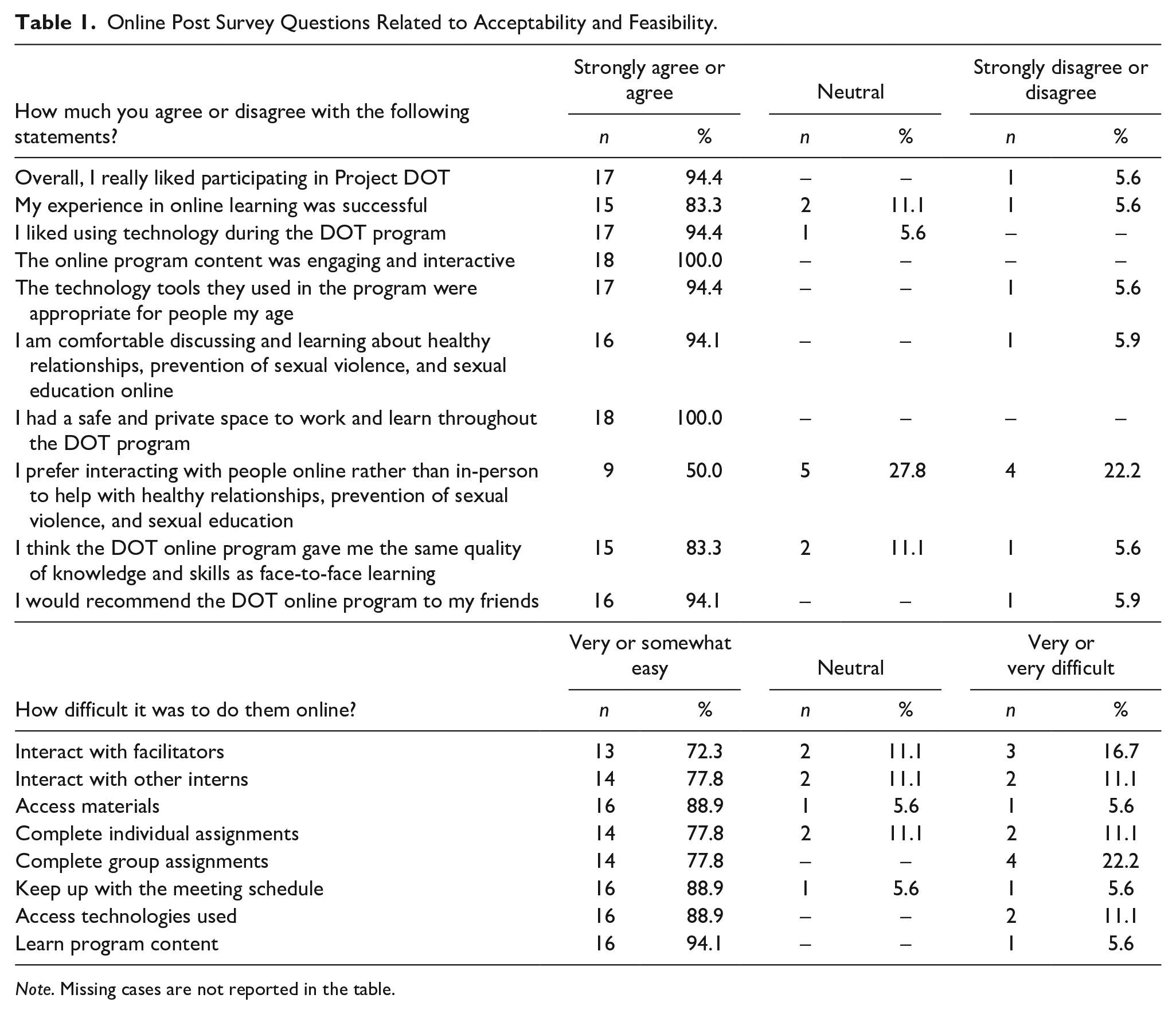
A key goal of this pilot study was to examine whether youth perceptions of the online prevention program were satisfactory (acceptability). Overall, based on the post survey findings, 94.4% (n = 17) of youth were satisfied with their participation in Project DOT. Similarly, data from the EMA showed that youth consistently rated online Project DOT with more than four stars out of five (ranging from a mean of 4.5 to 4.9 and standard deviation ranging from 0.3 to 1.0). In particular, post survey data showed that most participants (83.3%, n = 15, see Table 1) agreed or strongly agreed that their experience in the online learning opportunity was successful, while two (11.1%) of them were neutral to that statement and one (5.6%) participant strongly disagreed. Most participants also reported that they would recommend the DOT online program to their friends (94.1%, n = 16, see Table 1).
Online Post Survey Questions Related to Acceptability and Feasibility.
Note. Missing cases are not reported in the table.
As shown in Table 1, out of 18 survey respondents a majority (94.4%, n = 17) liked that the program was delivered online (“I liked using technology during the DOT program”), except for one (5.6%) participant that was neutral. Also, almost all participants agreed or strongly agreed that the technology tools they used in the program were age-appropriate (94.4%, n = 17), with only one participant strongly disagreeing (5.6%). In addition, all youth participants (n = 18) agreed or strongly agreed that the program content was engaging and interactive.
Supporting the post survey and EMA results, positive feedback about the online program was also found in the semi-structured interviews. Half of participants highlighted that the most remarkable aspect of Project DOT being online was its accessibility and convenience in terms of balancing the program with their other duties and responsibilities, being able to join the program from wherever, having a comfortable space where they can connect to the program, and avoiding weather conditions and commuting. Participants shared: “I was able to attend it within the comfort of my home”; and, “I just feel like it was easy to access for more individuals being online. There’s just really not really an excuse not to join. In person, there’s a lot of things keeping you going for the most part. Online, you can join at the very last minute or something like that before it starts. You have a lot of time to prep.”
Youth also discussed that the online program fostered the creation of a safe space for them to participate and disclose their experiences, opinions, and questions (41.7%, n = 5) and allowed different ways to engage in the program. They attributed this in part to the skill of the program facilitators whom they described as helpful, passionate, and leaders that created a good environment. Participants illustrated this point through the following quotes: “I definitely enjoyed basically being able to use Zoom to your comfortability. So, if you don’t feel comfortable showing your face, you don’t have to. If you feel comfortable using the chat, you could. If you didn’t want to speak, you didn’t have to. So, it was definitely nice to be able to adjust it to how you’re comfortable in doing the program”; “I liked online because sometimes you might be having a bad day, or you’re just very uncomfortable, you’re able to turn off your cameras, it’s what makes you feel comfortable. But if you were in-person, you would have to stand up in front of everyone and just put yourself out there. But I liked that you could be safe behind your screen and just text or use the microphone. And that just really makes me comfortable.”
The latter point is consistent with results in the post survey and EMA. Throughout the program, data from the eight EMA indicated that between 88.2% and 100.0% (n = 15 and 17, respectively) of youth felt empowered and/or comfortable participating in the program, always or most of the time. In the post survey, most participants agreed or strongly agreed that they were comfortable discussing and learning about healthy relationships, prevention of sexual violence, and sexual education online (94.1%, n = 16, see Table 1).
Online versus in-person program’s preference
When interviewed about what made them sign up to participate in the online program, youth reported two main reasons: (1) because understanding and addressing sexual violence was a personal interest for them and something which they believed would benefit themselves in the future (83.3%, n = 10); and (2) because they were interested in the internship opportunity (33.3%, n = 4). Just one participant mentioned that the reason they joined the program was partially because it was delivered online (8.3%).
Additionally, youth discussed their preferences and reasons for engaging in the current program online versus in-person. In the post survey (see Table 1), half of participants (50.0%, n = 9) agreed or strongly agreed with the following statement “I prefer interacting with people online rather than in-person to help with healthy relationships, prevention of sexual violence and sexual education,” whereas four of them disagreed (22.2%) and five youth neither agreed nor disagreed (27.8%). Similar findings were found in the interviews with youth describing a wide range of preferences (i.e., online, in-person, or both formats). On the one hand, youth who pointed out a preference for the online format valued its convenience in terms of being able to join it from anywhere and balancing other responsibilities (41.7%, n = 5), the ability to do tasks more efficiently and avoid distractions (25.0%, n = 3) and the safe space it created which made participants feel less exposed (8.3%, n = 1). One participant mentioned that they preferred the online solution due to the current COVID-19 pandemic (8.3%, n = 1). On the other hand, youth expressed that the main benefits to participate in a future in-person Project DOT would be to experience the interactions with facilitators and peers (25.0%, n = 3) and that some tasks could be done faster and in a more enjoyable manner without technical issues (25.0%, n = 3).
However, when asked about their preference for program delivery, some participants indicated that both online and in-person options were acceptable and had both positive aspects and drawbacks. In this regard, half of participants (n = 6) expressed that they would participate in either an in-person or online edition, since they perceived that the online format helped achieve similar goals as if it was delivered in-person (41.7%, n = 9) and that the safe space that was created online could be generated in-person as well (8.3%, n = 1). One participant described: “I don’t think it made it better or harder. I think it was just like natural learning [. . .]. Because I just made sure that I was focused, and I was engaging in conversations and answering questions. [. . .]. I felt like I was face to face, just over the computer, I felt like I was still gaining the same thing.”
This was consistent with what youth reported in the post survey (see Table 1), where most participants agreed or strongly agreed (83.3%, n = 15) that the online program gave them the same quality of knowledge and skills as face-to-face learning, with one youth disagreeing (5.6%) and two being neutral to the statement (11.1%).
Aim 2. Feasibility
Data from the semi-structured interviews, EMAs, and post survey sought to examine youth perceptions about the success of Project DOT being used within a specific setting (feasibility), including their reflections about challenges and barriers when participating in the program, and changes and recommendations to improve Project DOT’s online experience.
Barriers and challenges to doing prevention online
Youth discussed four aspects related to the online version of Project DOT that were challenging when participating in the program and suggested changes to improve it. First, through the interviews, participants pointed out that communication with program facilitators and other participants was challenging, as well as interactions while working in groups (66.7%, n = 8). Their reflections included overall that being online hindered them from experiencing trust and openness at the same pace they would have experienced if the program was held in-person. One youth remarked: “Because it’s hard to get to know people through your screen, and put your trust out there into people that you may not know very well. And definitely, only being able to see someone through a screen, only hearing their voice, only knowing them through chat, it’s hard to just put that trust or make those bonds between them. Versus as if it was in person where you see them once a week, and you’re in person. You know them more on that level.”
However, data from the post surveys did not show the same results as the interviews, since most youth reported that interactions with facilitators (72.3%, n = 13) and other interns (77.8%, n = 14) were very or somewhat easy (see Table 1).
Another challenge that half of youth discussed was related to the online program activities. Overall, participants remarked that activities were sometimes long or discussions slow, the need for adding more interactive lessons, use of social media, and to clarify homework with advanced time. Youth valued teamwork and strongly recommended its use to broaden participants’ perspectives and suggested setting clearer rules and receiving monitoring from program’s facilitators when working in groups. Again, data from the post surveys did not present these as a challenge. As shown in Table 1, more than three quarters of the participants found completing individual and group assignments very or somewhat easy (77.8%, n = 14), with four (22.2%) of them reporting that completing group assignments was very or somewhat difficult. In addition, most youth found it very or somewhat easy to learn program content (94.1%, n = 16) and keep up with the meeting schedule (88.9%, n = 16). Data from the EMA was consistent with the post survey, where almost all youth (between 92.9% and 100.0% across all timepoints, n = 13 and 18, respectively) reported that they were able to complete the homework for the program.
Moreover, while an advantage of online prevention is that youth do not need transportation and time to get to a physical space, and youth who are diffused geographically can participate together, given that a central component of Project DOT is a community change project, one participant mentioned the challenge of trying to design a community project when not all participants lived in the same place and/or had the same target audience in mind. One youth explained: “Well, to make it easier, like I said, linking up in a certain spot where we can all work together as one in one time. Because, we’re working on a project where we have to make posters and one of my group members live all the way in [one neighborhood] and I’m here in [another neighborhood]. So that puts a strain on how we disperse the information in the community. But at the same time it gets dispersed because you got some information in [one location], they got some here in [another location].”
Additionally, youth referred to other practical elements that were challenging when attending the online program. During the interviews, more than half of participants highlighted that internet connectivity issues prevented them from being fully attentive. One indicated that the lack of knowledge of technology tools they used during the program was also a barrier. However, most of the survey sample reported that it was somewhat or very easy for them to access materials or technologies used online (88.9%, n = 16 in both cases, see Table 1). In this regard, data from the EMA showed that, throughout the program, between 94.1% and 100.0% (n = 16 and 18, respectively) of them consistently reported that they were always or most of the time able to connect with the technology necessary to access Project DOT. All youth (n = 18, see Table 1) agreed in the post survey that they had a safe and private space to work and learn throughout the program. Similarly, across all timepoints, most participants reported in the EMA (between 85.7% and 100.0%, n = 12 and 18, respectively) they always or most of the time had a safe space to work and connect to Project DOT. However, during the interviews two participants expressed that being at home and sharing spaces with relatives sometimes made it difficult for them to be fully focused. This may be a particular challenge for prevention programs that involve conversations on difficult topics like SDV.
General challenges and barriers to Project DOT program
During the interviews, youth highlighted other challenges that were unrelated to the online format of the program but provided feedback about Project DOT as a culturally responsive SDV prevention strategy. Participants (66.7%, n = 8) shared that attending Project DOT required time and effort, and that sometimes they were not able to attend the sessions or do the homework. In this regard, balancing work and school alongside the DOT program posed a challenge to participants. Additionally, some explained that Project DOT challenged youth to have interesting but difficult conversations about SDV (25.0%, n = 3). In particular, youth remarked that these conversations presented topics that were sometimes difficult to understand or that could trigger SDV survivors. Two participants shared: “Sometimes thinking, I would say thinking in general, because some of the things really required us to think outside the box. That was a little challenging, but I got through it”; and, “Well, definitely like when we’re talking about topics, there are a lot of trigger words for me. So, it was just like; certain conversations would make me feel very uncomfortable. Sometimes I would have to just log out of Zoom and just take like 5 or 10 minutes, and then just come right back. And it was just like; sometimes, some conversations are really hard. And it’s a good thing that the conversation has no limits, but for other people, it could be triggering.”
Discussion
This pilot study assessed the acceptability and feasibility of the online version of an innovative and culturally response SDV prevention program for older adolescent youth from underserved and urban communities. It is key to assess the acceptability and feasibility of online SDV prevention programs since this will inform whether an intervention could be implemented effectively (Proctor et al., 2011). Overall, this study suggests that from youth participants’ perspectives online Project DOT is feasible and acceptable.
Participants valued Project DOT’s curriculum and its use of technology tools adapted to their age. A majority reported that the online learning opportunity was successful and empowering, and they felt comfortable discussing about healthy relationships and SDV online. Youth also noted that the online format was helpful for balancing busy schedules or preventing them from long commutes and helped increase access to prevention. As one of the most-liked aspects of the online program, youth remarked that they were able to build trusting relationships and practice new conversations and skills in the online environment. In this regard, they highlighted the potential of the online environment to be engaging and a judgment free atmosphere where youth can learn and share their experiences. Participants partially attributed the creation of this safe space to the program’s facilitators. This finding is consistent with previous in-person SDV prevention programs with adolescents or college students, which pointed out that this feedback should be used to enhance facilitators’ trainings (Edwards et al., 2021; Waterman et al., 2020). Additionally, the creation of this safe space could be related to the fact that the online format allowed youth different ways to engage in the program (e.g., use the chat to talk, turn the camera off). Future studies should examine the impact that the ability to regulate one’s participation online has on the program (e.g., creation of safe space, communication). Several prevention programs are effectively using online spaces to reach young people (Kleinsasser et al., 2015) and the current findings support this modality to increase the diffusion of prevention messages. Interview data from the current study suggests that youth are interested in SDV prevention and online delivery is one more tool for giving them access to it.
Indeed, the current findings are consistent with previous research that indicated computer-based SDV prevention programs to be feasible and acceptable from youth and young adults’ perspectives (Newins & White, 2021; Rizzo et al., 2021), showing that online programs are good alternatives to those in-person. Hence, these results pointed out that transferring in-person SDV prevention programs, such as the multi-week Project DOT, online was an acceptable and valid solution during the COVID-19 pandemic. In addition, the current youth perspective about the SDV prevention program being online pointed out new advantages of this format such as its capacity to let participants engage in different ways and in turn, feel less exposed. This adds up to the promising research on using online SDV prevention programs (e.g., Rizzo et al., 2021), which may democratize access to SDV prevention among youth.
Youth were also clear that a number of aspects could be changed to improve feasibility. For example, youth noted problems with high quality internet access that at times disrupted their participation or that of other group members. Another barrier to online intervention was not having an adequate space from where to join the sessions (i.e., shared spaces), as well as some of the characteristics of the program’s activities (e.g., long or slow discussions). They also highlighted that the facilitators were skilled at building trust even via an online platform but acknowledged that building trust and connection with other participants could be challenging when not sharing the same physical space. Participants pointed out that online communication was more challenging when teamwork was needed. As mentioned by Edwards et al. (2021) youth’s feedback about programming components should be used to refine and improve prevention programs. Moreover, youth also noted challenges that the online version of Project DOT shares with in-person programs: having conversations about SDV can be difficult even with the convenience of online meetings; and balancing their attendance with other duties including family, jobs, and schoolwork can be challenging. However, maybe the most important problem for SDV prevention delivered online is that even the most engaging online program cannot satisfy those participants who really want to experience in-person interaction.
Limitations and Future Directions
This study has several limitations. The recurrence of themes in the qualitative interview data gave us confidence that we reached saturation, however the small sample of survey participants suggests that we likely did not capture all youths’ perspectives and/or were the ones that felt more positive about the program and the online format. In addition, sociodemographic data was mainly asked in the post survey, not having the same information for the EMA or interviews. In this regard, since we did not match youth who participated in the EMA and post survey to avoid concerns about identifying individual participants, we missed some sociodemographic information to have a better understanding of each subsample. Additionally, some disparities in the results could be explained by the fact that those participating in the post survey, EMA, and interview may not be the same youth. Further, youth self-selected to participate in Project DOT knowing that it would be in an online format, and that it will require their commitment for 13 to 18 weeks. Thus, our sample likely may also overrepresent youth who have easy access to the internet and who are comfortable working in online spaces. In addition, information about the reasons for youths who were unable to enroll is not available. A broader study would be needed to understand the acceptability of online programming for a wider sample of youth, as well as initial barriers when joining this online program.
Methodologically, it should be considered that our findings, regarding barriers and challenges to doing prevention online, were mixed with youth reporting more challenges in the interviews than in the post survey or EMAs. On the one hand, negative responses across several survey items were reported by the same participant, which may suggest that their views are not widely shared across participants. On the other hand, mixed findings are likely the result of several factors including that somewhat different groups of participants made up the sample in each method and thus each method may simply have captured the views of different people. Interviews also permitted interaction with a researcher, which may have led participants to share different feedback about the program. Challenges may have been difficult to express in short answer boxes on a survey and easier to describe in the more open-ended conversation of an interview format.
The current study is also a first step and focused on process evaluation goals. Future work should compare the impact of prevention delivered online versus in-person on key behavioral outcomes like perpetration, victimization, and bystander intervention. Furthermore, examining whether a hybrid format of SDV prevention program is feasible and acceptable (including in-person and online activities) may help tailor new implementation formats that adapt to youth needs and requirements (e.g., by doing the community-oriented activities in-person). Future studies should also examine if the addition of community-oriented activities (i.e., photo-voice used in Project DOT aiming to create SDV change in youth’s communities) increases the efficacy of the program.
Supplemental Material
sj-docx-1-jiv-10.1177_08862605221111421 – Supplemental material for Rethinking Dating and SEXUAL Violence Prevention for Youth During the Pandemic: Examining Program Feasibility and Acceptability
Supplemental material, sj-docx-1-jiv-10.1177_08862605221111421 for Rethinking Dating and SEXUAL Violence Prevention for Youth During the Pandemic: Examining Program Feasibility and Acceptability by Anna Segura, Michelle Henkhaus, Victoria Banyard, Lena M. Obara and Gena C. Jefferson in Journal of Interpersonal Violence
Footnotes
Acknowledgements
Acknowledgments go to the youth and community partners who are at the center of this work.
Declaration of Conflicting Interests
The author(s) declared no potential conflicts of interest with respect to the research, authorship, and/or publication of this article.
Funding
The author(s) disclosed receipt of the following financial support for the research, authorship, and/or publication of this article: This grant was funded in part by a Community Design for Health and Wellness grant from the Rutgers University Interdisciplinary Research Group, Office of Research and Economic Development.

Supplemental Material
Supplemental material for this article is available online.
Author Biographies
References
Supplementary Material
Please find the following supplemental material available below.
For Open Access articles published under a Creative Commons License, all supplemental material carries the same license as the article it is associated with.
For non-Open Access articles published, all supplemental material carries a non-exclusive license, and permission requests for re-use of supplemental material or any part of supplemental material shall be sent directly to the copyright owner as specified in the copyright notice associated with the article.
