




Abstract
This empirical work focuses on social norms as a way of transmitting psychological violence in young people, which could be affecting the effectiveness of preventive programs in dating violence. These programs are effective in changing beliefs, but new intervention approaches are in demand due to the former’s limitations in achieving behavioral changes. The main objective of this study is to demonstrate that some dimensions of psychological violence are transmitted as a descriptive social norm, without any need of victimization. In a sample of 1,265 people (18–25 years old) and through two different studies, we explored the perception of prescriptive and descriptive social norms in situations of coercive control applied to three contexts (Study 1), isolation and domination (Study 2), under the hypothesis that coercive control is passed on as a descriptive social norm between peers. Characteristics describing diversity are taken into account. The results in frequency and Structural Equation Model analysis confirm the main hypothesis, because both perceptions are not correlated. Social norms no covariate with social characteristics. Same cannot be said of isolation and domination, leading to three conclusions for prevention. (1) Not all psychological violence works the same. Coercive control starts from a primary cognitive process that requires complementary actions, based for example on the cognitive hierarchy among social norms; (2) Preventive programs are often based on “prescribed” behaviors, related to the consequences they have on victims, whereas the descriptive social norm found in this study does not correlate with victimization, unless control is applied to specific contexts. Therefore, an additional effort in prevention could go deeper with more specific behaviors that show both the different types of psychological violence and the contexts of application; (3) Finally, at the policy level, results found call for the need for preventive efforts on psychological violence in the 18 to 25 age group and specific awareness campaigns.
Keywords
Introduction
Preventive programs in dating violence are a priority because it is considered a public health problem at the international level, due to its prevalence and its consequences on the development of young people (De La Rue et al., 2017; McNaughton et al., 2016; Piolanti & Foran, 2022). Content such as myths of romantic love, roles and sexist beliefs, improvement of personal and social skills for relationship management, conflict resolution techniques, and now cyber-violence, among others, have been applied. Different contents and techniques are based on different empirical evidence. It is important to follow the recommendations for the design of prevention programs of international organizations such as the World Health Organization (WHO, 2017) or United Nations (UN, 2020) because they recommend that violence prevention programs utilize a social–ecological framework that addresses individual, relationship, community, and societal-level factors (Bronfenbrenner & Evans, 2000). The aim of this work is to study the social norms in young couples’ relationships.
Reviews have shown those programs are effective, but on very different objectives: some of them decreased acceptance of violence; some increased self-efficacy to resist violent conflict and increased intention not to act violently; others increased perception and improved attitudes against violence, decreased acceptance of aggression and increased help-seeking (Villa-Rueda et al., 2022). However new interventions are needed due to the limitations of existing programs to achieve behavioral changes, since it seems that, although programs produce changes in beliefs, these are not reflected at the behavioral level in young people (Cornelius & Resseguie, 2007; De La Rue et al., 2017; Fernández-González et al., 2020). Some researches link certain knowledge gaps to the lack of effectiveness of preventive programs (Wagers, 2015) and the United Nations (UN, 2020) has recommended to highlight attention to social norms, because of their effect on the impact of prevention programs, providing that influencing social norms at the community level is a fundamental aspect of violence prevention and delving into them is proposed as a measure to advance the development of gender equality.
Problem Statement
Social Norms
Focus Theory of Normative Conduct (Cialdini et al., 1991; Schultz et al., 2007) proposes that social norms are a way of identifying in-group what people should actually do and believe, representing perceptions of how people “should” behave or be. This would occur in two different ways: with descriptive social norms and with injunctive/prescriptive social norms. While descriptive social norms refer to perceptions of what is usually done in a given situation, prescriptive or injunctive social norms, refer to perceptions of what is approved or disapproved in the culture of reference, perhaps because there is a law or perhaps because there is a social sanction. This model has its development in the scope of preventive public health programs, which have provided normative information as a primary tool for changing socially significant behaviors, such as alcohol consumption, drug use, disordered eating, gambling, littering, and recycling. It was included by the UN (2020) in the explanation of the etiology of gender violence. Paluck and Ball (2010), who have developed these ideas in gender-based violence prevention programs, believe that people learn what they believe is normative in their environment in two different ways. Thus, for example, men would learn that physical violence perpetration on women is forbidden (as a prescriptive norm), but they are allowed and even encouraged to engage in other behaviors (as a descriptive norm), such as controlling the network of relationships, controlling the clothes they wear when they go out, or what activities they can/cannot do in their free time. Therefore, descriptive norms would teach behaviors that must be done, since that is what the group does. Injunctive norms forbid or discourage behaviors, whereas descriptive norms set an expectation that encourages others to follow them (Paluck & Ball, 2010), affecting the order of priority at the cognitive level among different beliefs. Injunctive and descriptive norms represent separate sources of motivation for action and authors have shown empirical evidence of the differential effect of one and the other, and also a distinct relationship between intentions and behavior (Schultz et al., 2007).
The perception of prevalence is commonly referred to as the descriptive norm governing a behavior (Cialdini et al., 1991). In other words, when a behavior is widespread, it is understood as a descriptive social norm. Descriptive norms provide a standard that people do not wish to deviate from: people measure the appropriateness of their behavior by how apart they are from the norm; to “be deviant” is to be above or below the norm. Thus, when researching a construct based on social norms, these two ways of measuring must be taken into account: one for descriptive norms and the other for injunctive norms, since both have particular rules in the way they are transmitted (Paluck & Ball, 2010). Some research has considered descriptive and injunctive norms (McNaughton et al., 2016) but we do not know any questionnaires in psychology about these.
This research aims to study some dimensions of psychological violence and its form of transmission among peers as a key element that could be affecting the effectiveness of prevention programs, because social norms have been little studied as a factor in intimate partner violence (IPV) and it is necessary to further understand their role in young people’s IPV (Aizpurua et al., 2021).
Psychological Violence
Previous research shows that psychological violence within IPV precedes and is always present when physical violence occurs (O’Leary, 1999; Perles et al., 2019). O’Leary (1999) gives a definition as “acts of recurring criticism and/or verbal aggression toward a partner, and/or acts of isolation and domination of a partner. Generally, such actions cause the partner to be fearful of the other or lead the partner to have very low self-esteem” (p. 19). The author highlighted both the behaviors and the consequences of these behaviors, thus supporting the damage they caused (Krug et. al., 2002, p. 97). Researchers agree that psychological violence has a complex dimension, understood as a whole that includes categories of very different behaviors that can be grouped into (Cantera et al., 2009; Delgado, 2010, 2014; Delgado & Mergenthaler, 2011): control, isolation, harassment, jealousy, disqualification, affective indifference, emotional manipulation, sexual pressure and neglect, threats, and domination. These authors made a theoretical review to include these variables as a set that can be found in the relationships of young people.
Coercive Control
It is considered a key variable in explaining the process and its development of IPV (Crossman & Hardesty, 2018; Dutton & Goodman, 2005; Fanslow & Gulliver, 2015; Heise & Fulu, 2014; Stark, 1995, 2007), but there is a lack of research that delves deeper into the description of Coercive Control (CC) processes, measures frequencies and specific types (Gulliver & Fanslow, 2016) and applies specifically to young people. It is even claimed that control is present in all IPV, being defined by CC theories as a continuum that groups different behaviors (Dutton & Goodman, 2005; Hardesty et al., 2015; Johnson, 2006, 2008; Stark, 2007). So, CC is a construct very difficult to operationalize for study (Fanslow & Gulliver, 2015) and we should also keep in mind that, like in any other violent behaviors, depends on the context of application (Delgado, 2010; Johnson, 2008; Johnson & Leone, 2005). The concept has even been used to distinguish between types of IPV (Johnson, 2008). Stark (2007) defines Coercion as “the use of force or threats to compel or dispel a particular response” (p. 228), while Control refers to “structural forms of deprivation, exploitation, and command that compel obedience indirectly” (p. 229). When coercion and control occur together, he argues, the result is a “condition of unfreedom and autonomy and personhood as well as to physical and psychological integrity” (p. 205) that is experienced as entrapment. Then, CC is a concept that is sometimes applied to a set of psychological violence aimed at coercion (Stark, 2007), but that, at other times, is used as a specific type of psychological violence (Cantera et al., 2009; Delgado 2010, 2014). CC has been applied, too, as a typical behavior base of cyber-violence (Martínez-Soto & Ibabe, 2022; Zweig et al., 2014), but in contrast, we think this is a form of perpetration, and not a different type of violence. In this work, we use CC defined as a set of tactics designed to regulate the behavior of another person, restricting the personal freedom so as to achieve a certain outcome for the benefit of the exerciser (agent), but which does not necessarily result in conflict and need not be perceived or defined as violent by the recipient; it can extend to severe forms of deprivation and exploitation (Crossman & Hardesty, 2018; Stark, 2007). These tactics are used with the aim of restricting the other person’s actions based on behavioral gender stereotypes with damaging implications for the receiver (victims). Defining behaviors in a specific way can be very broad, but it causes damages to victims.
On the other hand, Control is also a positive, adaptive, and desirable process in human beings because control functions as a powerful internal motivator leading people to act because of their need to have a general sense of control (White, 1959), and the need to perceive themselves as autonomous agents with the capacity to influence important aspects of their environment. People need control as a mechanism of internal homeostasis, which they try to keep by applying innumerable psychological resources (Martin-Sanz, 2011). Perceptions of control have been related to personal autonomy and self-efficacy: having control enhances variables such as well-being, performance, positive emotions and self-esteem; conversely, the perception of lack of control is related to anxiety and depression, through learned helplessness and psychological reactance (Peña, 2004). In addition, being a powerful internal motivator, control has also been considered a basic social motivator, directly related to power (Fiske, 1993; Fritsche et al., 2013). It is activated especially under uncertainty, in order to reduce the internal imbalance caused by this uncertainty (Friestche et al., 2013). It should be noted that, all incipient couple relationships are characterized by novelty and uncertainty, regardless of age. But especially young people have less knowledge to provide them with primary control (self-control) over the situation. Thus, incipient couple relationships are situations in which a secondary control would be needed, that provided by the peer. Thanks to this information, it is possible to recover a certain internal homeostasis. We think that control is an essential cognitive process but it turns into violence when it crosses the boundaries of the partner’s autonomy in decision-making.
Victimization
Victimization, along with perpetration, is a typical IPV research variable. Recent research shows among men, a history of IPV perpetration and victimization generally predicted decreased perceptions that acts were abusive; however, among women, histories of IPV perpetration and victimization were generally unrelated to abuse perceptions (Dardis et al., 2017). It is necessary to consider “in line with the role of self-referential processing outlined in gender schema theory, the extent to which behaviors are considered abusive may also vary based on one’s own experience with IPV” (Dardis et al., 2017, p. 3249). Thus, we tested victimization as a form for evaluation about social norms in IPV, because we believe that the lack of identification as a possible victim can also affect the adhesion to preventive messages, so we could take into account contents applied to different contexts that facilitate this identification.
Emerging Adults
Research maintains that the period between the ages of 18 and 25 is considered a separate phase of life known as “emerging adulthood” (Arnett, 2007) and characterized by identity exploration, instability, self-focus, feeling in-between, experiencing a range of possibilities, gradual attainment of responsibility and independent decision making (Arnett, 2007). In this range of age, new metacognitive skills are acquired, as higher executive functions are developed, such as cognitive flexibility, inhibitory functions, self-regulation of behavior, but social interactions in groups are still determinant for these processes at these ages due to the effect of the continuous flow of information that social feedback entails (Canet-Juric et al., 2016). We assume that the cognitive construction of what a couple is evolves with the interaction between cognitive changes, the information obtained from experience and friendships, the expectations placed on interpersonal relationships and the development of one’s own life projects. Thus, the configuration of couples in emerging adulthood (Arnett, 2007) may differ from the adolescent stage.
The Current Study
We know that preventive programs increase knowledge about IPV, from the point of view of what cannot be done because the law forbids it and because some behaviors are not morally acceptable. In other words, preventive programs are focusing on making prescriptive social norms. We hypothesize that there are group (community) norms in society that promote behaviors legitimized by the frequency, thus coercive control would be transmitted through peer groups as a descriptive norm. Descriptive norms are not taken into account in preventive programs (Paluck & Ball, 2010). Finding descriptive social norms in CC implies that just the opposite message is being conveyed: that in fact CC is the correct behavior, which poses a serious problem for the gains made in couple equality. But there is no research about this.
This finding would support a complementary approach to what is being done and could include contents aimed at that descriptive norm in different ways, for example, with the objective of increasing primary control in couple relationships through developing the contents of healthy relationship programs (teaching that having a partner is important but not at any price; ingredients that usually work in positive relationships, diversity in the way of expressing love and contents of autonomy development).
In our research we expect to find that CC functions as a social norm among young people because it is relayed by peers in a non-violent way, as a desirable type of behavior to follow. For example, some young people might interpret that CC as a sign of love. Since the outcome achieved is desired, it becomes a behavior to be followed (descriptive norm), rather than a behavior to be rejected or morally reprehensible (injunctive norm). In this case, although it is a behavior that may be morally reprehensible, the consequence it produces and the fact that it is performed in a common way (descriptive norm) will cause to be reproduced over other social norms.
We expect that young people perceive CC with a high frequency, not attributable to specific sociodemographic characteristics, because it is transmitted as a social norm. They are generalized behaviors because they are transmitted as what should be done (descriptive social norm) to obtain a desirable result, for example, to show that the partner matters or to be able to keep the partner; but not because young people perceive it as morally acceptable behavior. We do not believe that it is a matter of acceptance of violence, but it just disengages itself from violence to carry it out. If this were the case, identifying oneself as a victim of this CC would not be related to it as a descriptive norm, but rather as a prescriptive norm.
The focus of this paper is to study the perception of CC and its frequency in order to infer whether it is conveying descriptive or prescriptive social norms. It is necessary to check (confirm) that this does not depend on sociodemographic variables. We have included only a possible selection about many variables. It is also interesting to know if the same is true for other dimensions of psychological violence. We want to check whether the perception of what happens in groups of friends as bystanders is somehow related to victimization. Therefore, this study addresses three primary objectives: (1) To find out the frequency of the perception of CC in heterosexual relationships in a young population, in order to determine the descriptive social norm; (2) If it is transmitted as a social norm, it would be independent of sociodemographic characteristics as age, sex, sexual orientation, education level, or occupation, among others, because it tends to occur in the whole population; and, (3) To look for differences or likeness between the CC and other dimensions of psychological violence.
Method
This study explores social norms between 18 and 25 years of age. In this range, given that this study does not receive funding, a relatively accessible sample of students on university campuses was chosen. This prevents us from generalizing the results obtained but we are using a robust theoretical framework. If the main hypothesis holds, these results will support future analysis of other samples to obtain more generalized conclusions.
Procedure
This work is part of a larger project in which we are working on the design of a preventive program for young people between 18 and 25 years of age. Other instruments were used but they are out of the scope of this paper. The main objective of this work is to measure coercive control, considering it a key and complex variable in itself. For which we conducted Study 1; once preliminary analyses had been carried out, we considered it important to be able to compare it with what happens in other dimensions of psychological violence. For this reason, we proceeded to a new study (Study 2) following the same process but studying other dimensions; in this case, isolation and domination were chosen. The scenario methodology used to expose the observation situations, as described below, is complex to incorporate several dimensions at once, so we decided to use one sample at a time.
Sample
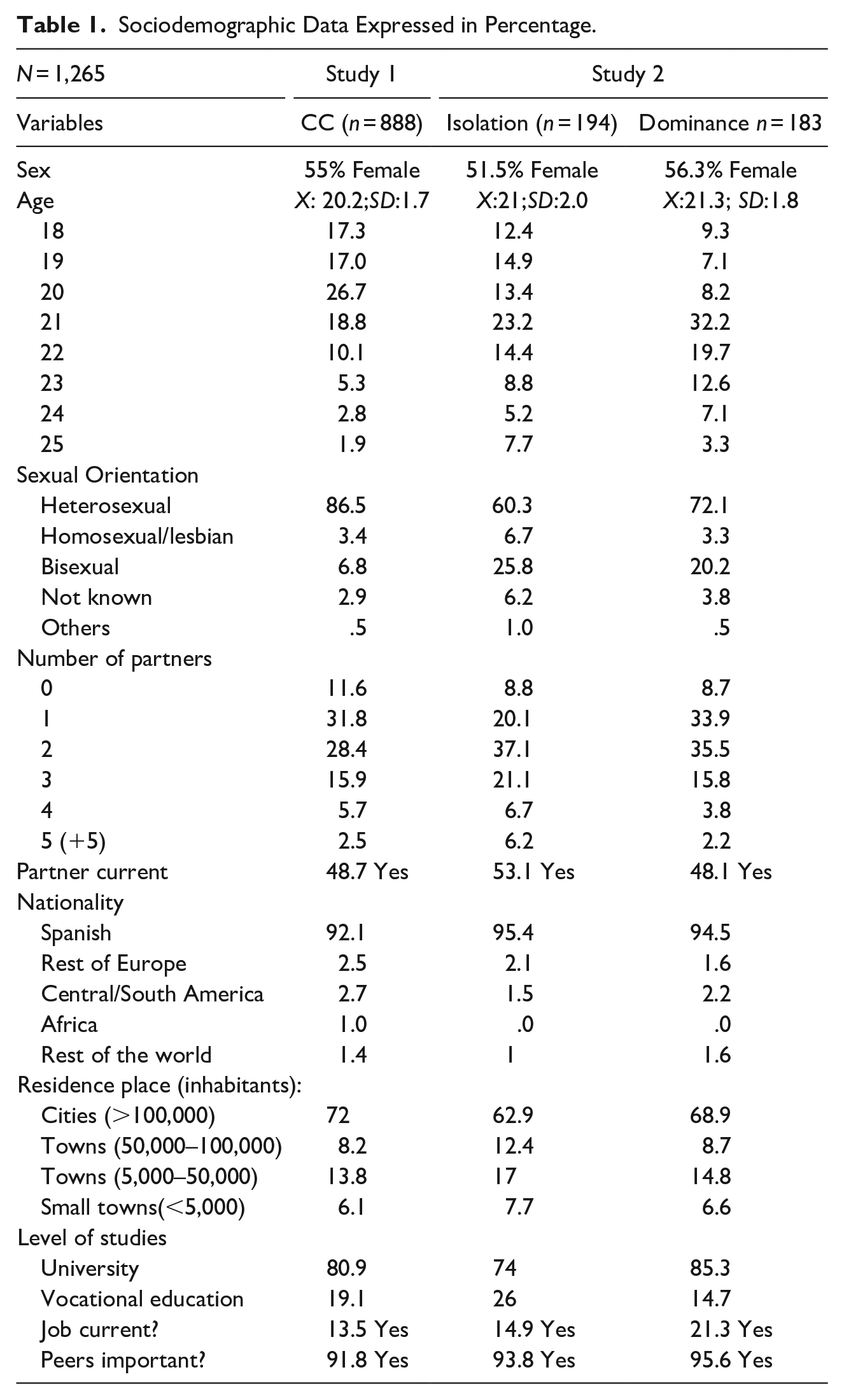
We used a stratified probabilistic method for sampling, according to age and level of education. The sampling was random, because we made requests for participation to school management and teachers and some of them declined the request. The students participated voluntarily. We collected 1,265 people as participants. According to each study, the sample size consisted of 888 participants in Study 1, and 377 participants in Study 2, and focuses on comparing CC to other psychological violence dimensions such as isolation and domination. Table 1 shows percentages for sociodemographic data.
Sociodemographic Data Expressed in Percentage.
Criteria Sample and Diversity
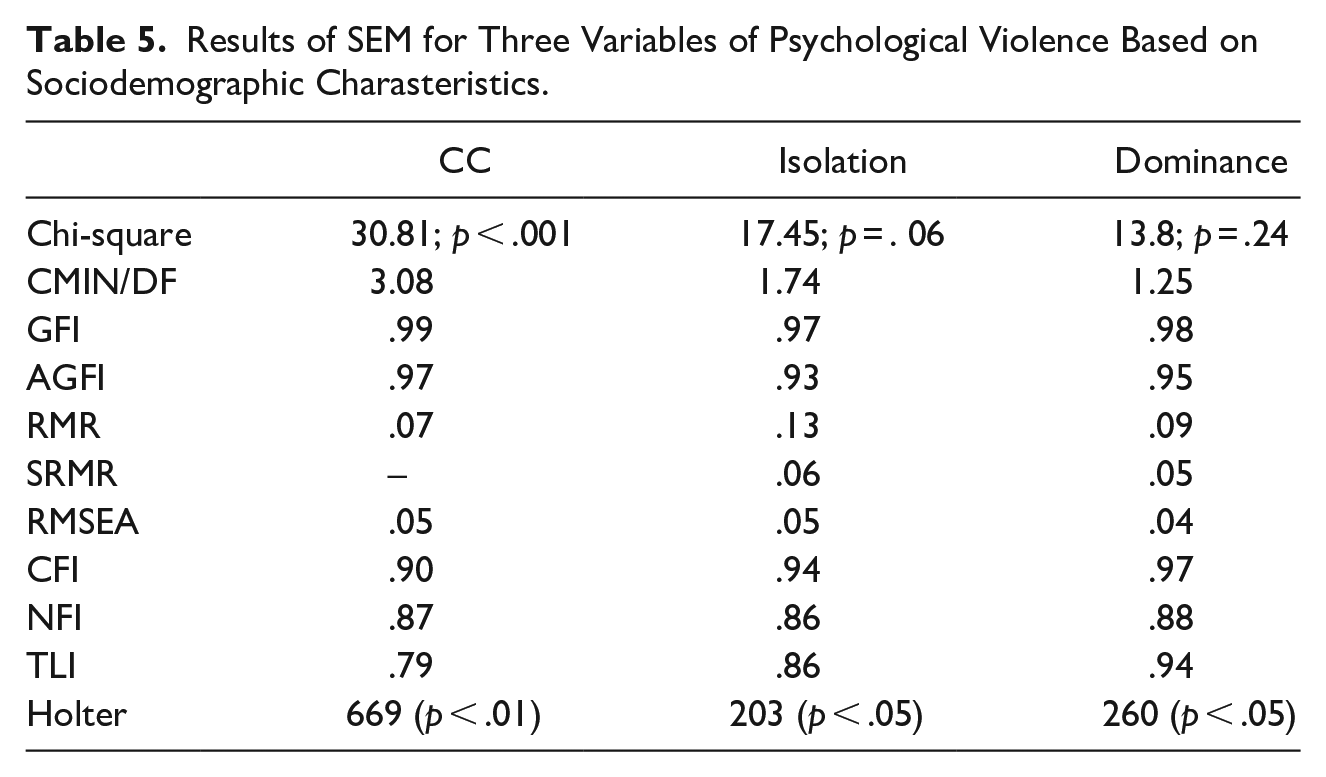
The sample segmentation criterion for the study was to prioritize that the participants had sufficient life experience to be able to assess the situations presented, on the understanding that, although couple relationships appear long before the age of 18, they are not generalized and it is more difficult to identify the subtle differences between types of behavior in teens, according to our experience. In this age range, in Spain, the population has been educated in democratic values and in a society with laws that promote gender equality public policies. The reason for focusing the segmentation criterion in heterosexual couples is that being an exploratory study, it is easier to draw conclusions on it, rather than basing it on LGTB+ relationships, which, being less frequent, make it more difficult to generalize the results initially. But studies based on sexual orientation and sexual diversity will be needed in the future. Respecting cultural diversity in Spain, immigration referred to Central/South American and North African countries, principally. In this work there is sexual diversity and immigrant participants, but the sample is not controlled (Bent-Goodley, 2021). Statistical analysis with SEM, in the Holter index, show that the sample size is adequate for objectives (Table 5).
Measured
Dependent Variables
Dependent variables are social norms measures through “habituality” and “normality”. They have been assessed as bystanders, identifying the experience of CC in their peer group. Following the Focus Normative Theory (Cialdini et al., 1991; Schultz et al., 2007), we need to measure a construct for which a specific scale does not exist. We asked two questions differentiating between the “normal” concept (legal/morally acceptable norm) and the “habitual/usual” concept, which is the most frequent behavior (it happens frequently although it is not morally acceptable). We intend to avoid the bias of social desirability, by not giving an opinion about oneself, but we also include a score on victimization, because it is a benchmark on the prevalence of IPV. In order to define situations to be explored, we used the items described for CC in psychological violence scales (Cantera et al., 2009; Delgado, 2010, 2014). But CC variable is context sensitive (Delgado, 2014; Johnson, 2008); we applied CC to different situations identified as relevant (Cantera et al., 2009): (1) Social relationships: who she/he goes out with when she/he is not with her/his partner (α = .57); (2) Leisure time: what she/he does when she/he is not with her/his partner (α = .72); and (3) Personal image: how she/he dresses when she/he is not with her/his partner (α = .56). Although α is low, it is based on a validated scale. We need to operationalize the CC variable but there is no agreement on the exact behaviors it encompasses. These situations are used as we are conducting an exploratory study; in the future these may be more specific or include other items.
Independent Variables
We collected social demographics data, such as age, sex of participants, sexual orientation, current partner, number of partners, nationality, places of residence, studies’ level, current job, important peers. The percentages of the participating sample according to the variables can be seen in Table 1. CC, measures in relationship, leisure and personal image are taken as independent variables too, to better describe the coercive control variable. Study 2 used the same social demographics. Variables were previously correlated to be included in structural equations model.
Covariates
We use participant’s sex and participant’s abuser as covariates in study 1. To check objectives, we study covariance between Social Norms and Social Demographics, as constructs in three samples.
Scenario Methodology
To minimize the bias of social desirability, typical in the study of perceptions and especially in IPV, we have used the scenario methodology proposed by Seelau and Seelau (2005), where the idea is to describe a scene of an everyday situation that we want to investigate and what happens to an individual or group of subjects—in this case, in dating relationships. This methodology is similar to the situational methodology used in emotional intelligence assessment (Mayer et al., 2002). The situations proposed in the scenario methodology were, prior to the first study, subjected to content validity with a qualitative inter-rater test, in an independent sample of 60 young people in second course of Psychology Grade, with sociodemographic characteristics similar to the final sample. With the conclusions drawn, the scenarios were modified to make them as realistic and meaningful as possible for the final sample. Thus, the same situation was changed to apply to each type of CC studied, under the following scenario: “Andrea, 20, and Fran, 21, have been dating for six months. Last Saturday they had an argument because . . ..” The situations used in the ad hoc survey were as follows: 1. CC situation applied to the context of social relationships: “the friendships that one partner has and what he/she does because he/she has some friends who have a bad reputation and hang out with other people of the opposite sex. He/she doesn’t want him/her to talk to others and has (explicitly) forbidden him/her to go out with those friends.”; 2. CC situation applied to free/leisure time: “one partner is continuously looking at the other partner’s things to find out what he/she does in his/her free time: his/her cell phone, Facebook or Instagram account to see who he/she talks to, how long he/she is online, and what he/she does when they are not together. It is justified by arguing that a couple should have no secrets.”; 3. CC situation applied to personal image: “one partner went out partying with friends and the other insisted on asking him/her to send him/her photos via WhatsApp to find out what he/she was wearing.”
These situations were presented by sex of the abusers: in cases of men abusers and in cases of women abusers, resulting in six possible surveys. Participants randomly answered a single survey with one type of situation. Then, participants were asked: (1) To what degree do you consider this event habitual among your friends? (Habituality) (2) To what degree do you consider this event could occur to you? (Victimization) (3) To what degree do you consider this event normal? (Normality). Estimating reliability with McDonald’s Omega (ω) was .73 (Hayes & Coutts, 2020).
Study 2 was used to compare CC’s measures with other dimensions of psychological violence: isolation and domination were taken into account among others possible, with no defined criteria. Same scenario methodology procedure was used in a specific way for each variable than Study 1, and same questions were asked to assess: habituality, normality, and victimization, and we used the same control variables. There was a version with a male abuser and a version with a female abuser. In dominance McDonald’s Omega (ω) was .69, and .63 for isolation, for three measures.
Isolation’s scenario: “Andrea, 20, and Fran, 21, have been dating for six months. Last Saturday they had an argument because one partner went out with his/her friends and the other partner wants him/her to go out only with him/her or with whom he/she says and how he/she says.”
Dominance’s scenario: “Andrea, 20, and Fran, 21, have been dating for six months. Last Saturday they had an argument because one partner had a date with some friends and the other partner got angry because he/she wanted to go to the movies with him/her. He/she told him/her to cancel the outing with his/her friends because he/she was her boyfriend/girlfriend and that is a priority; then, the other partner cancelled his/her plan with his/her friends.”
Instruments
There is no validated scale to measure social norms for psychological violence. We make an ad hoc instrument about measures of variables, as it was aforementioned, following the criteria of the Ethical Committee of Experimentation of the University of Malaga (accepted num. 64/2017). An online and face-to-face survey was delivered in Malaga (Spain) between 2018 and 2020, which participants answered anonymously and voluntarily, on the basic instruction that “the aim was to study couples’ relationships.” It was disseminated among students at the Campus of the University of Malaga and a Vocational Training Centre. Each document given to each participant consisted of (a) Sociodemographic data; (b) The scenario with a single type of CC, measuring the habituality, normality perception, and victimization, with a scale of 7 values (0 = not at all; 1 = very little; 2 = slightly; 3 = somewhat; 4 = quite a lot; 5 = a lot; 6 = totally/extremely).
Statistical Analysis
IBM SPSS Statistics 25 and Amos 25 was used for data analysis and SEM model. The effect size was calculated with the statistical program G*Power 3.1.9.7, interpreted with the work of Cárdenas and Arancibia (2014).
Results
Frequencies of CC and descriptive social norm.
To know the frequency of the perception of CC we determined by the mode statistic (Mo), the most frequent response, following the authors (Cialdini et al., 1991). Table 2 states the perception of habituality in total sample (Mo = 4) indicates that CC is quite a lot frequent among 18 to 25 years old; means indicates that the perception of CC is not understood to be normal but habitual. Therefore, habituality will be the perception determined as the descriptive social norm. Mode results are supported by median and mean results. Also depending on the context in which the CC is applied, we can observe how this habituality manifests itself differently in terms of control of social relations and control of leisure time. The CC applied to social relations and control of leisure time would be working as a descriptive social norm with Mo = 4, but this is not the case in personal image control, where perception of normality (Mo = 0) and perception of habituality (Mo = 0) are not distinguished. Taking Cronbach’ α we can take higher reliability results applied on Leisure time (α = .72). Men perceive CC of leisure time as more habitual and women perceive more CC in social relationships, but with no significant difference. Although both situations are very similar (and the frequency of responses confirms this), we should bear in mind that control in social relations included an express prohibition to relate to certain people; control of leisure time did not.
Frequencies of Central Tendency in CC: Mode Indicates Descriptive Norms.

p < .05. **p < .001.
Regarding victimization, mode is zero in three types of CC, but looking at the mean is lower than habituality but higher than normality, as can be seen in Table 2. Correlates significances more important with normality. In habituality, we find accumulative frequency of 23.2% who identify themselves as victims (rated as somewhat, quite a lot, a lot, totally), compared to 9.9% in case of perception of normality of CC; 55.1% of people perceive CC as habitual to different degrees.
2. To verify that CC is transmitted as a descriptive social norm, behavior must occur independently of sociocultural characteristics.
ANOVA test was carried out using the perception of habituality, normality, and victimization, as shown in Table 3. No significant differences were found for the perception of CC based on the sociocultural characteristics studied, but there are some differences about habituality in Isolation on sex, current job current, number of partners. Current partner shows differences for victimization of Isolation and Dominance, too. We used SEM to check the effects of sociodemographic variables. The inter-varibales correlations that were significant in some dimension of psychological violence were included in the overall SEM, but the covariances, finally, are not significant, as seen in Table 4.
ANOVAs for Variables of Sociodemographics Included in Study 1 and 2.
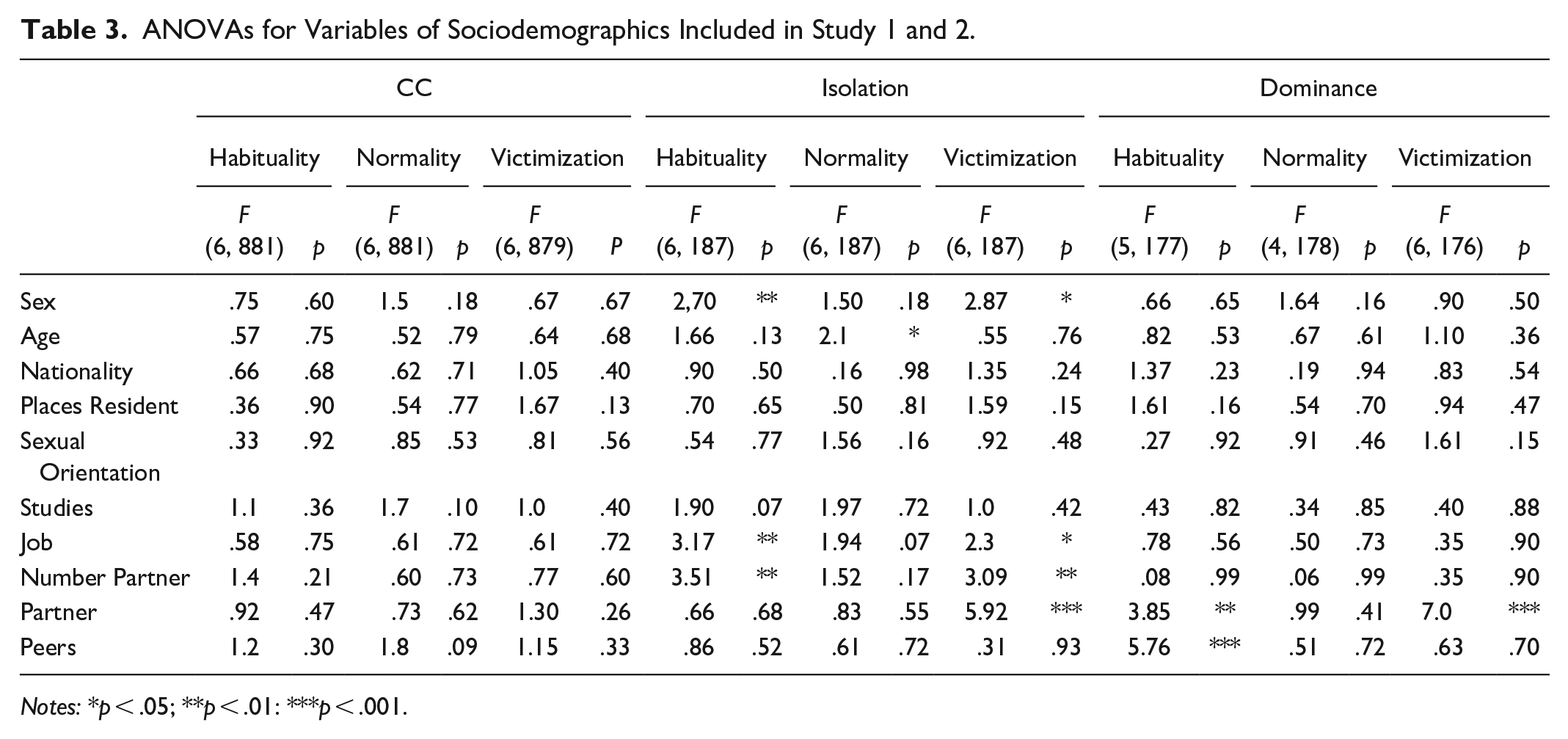
Notes: p < .05; **p < .01: ***p < .001.
Parameter estimates in Structural Equation Modeling.
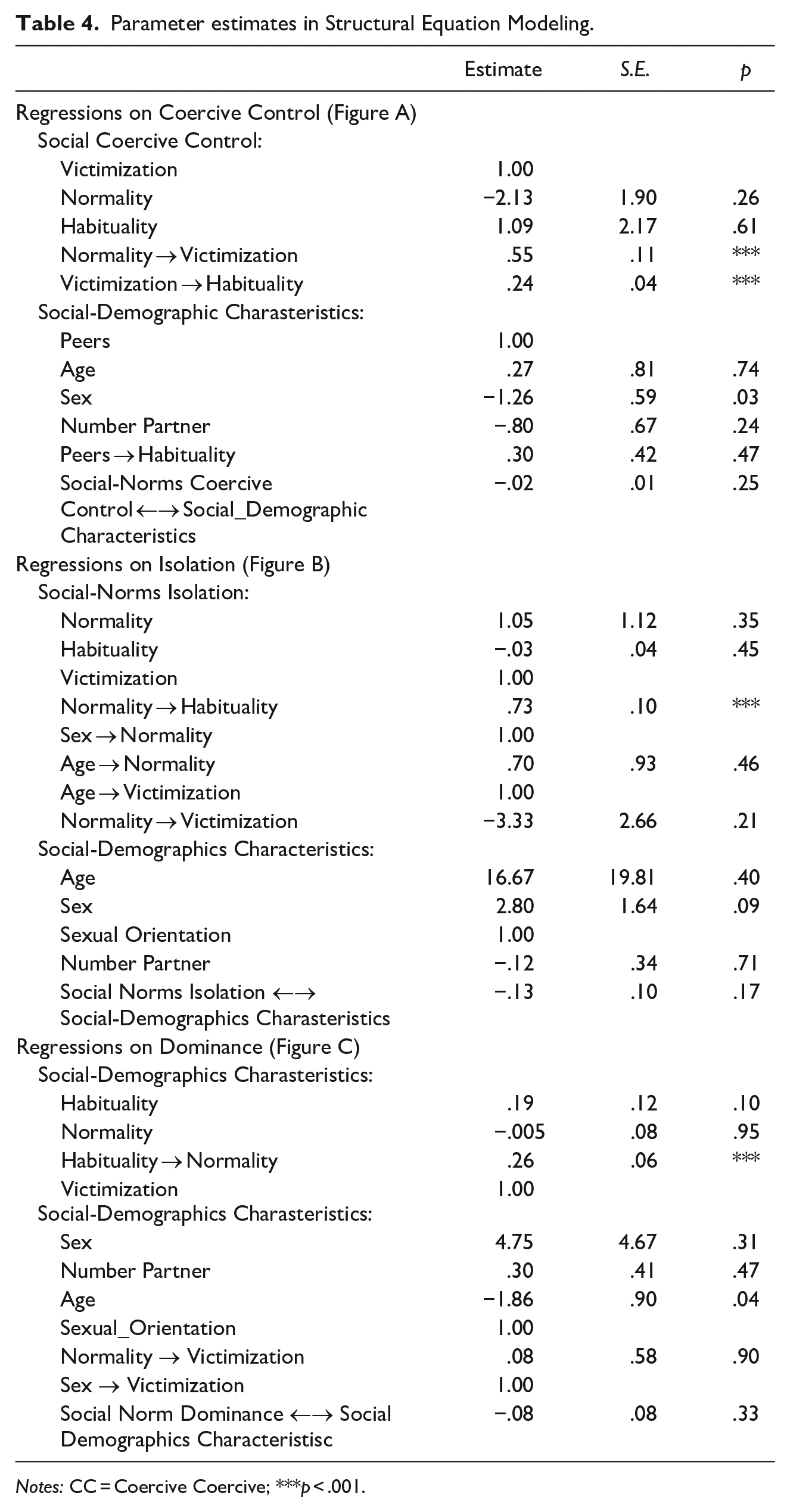
Notes: CC = Coercive Coercive; ***p < .001.
Additionally, in relation to CC’s types and sociodemographic variables, Multivariate Analysis of Variance (MANOVA) were performed applying CC to social relationships (X = 3.0; SD = 1.7), leisure time (X = 2.7; SD = 1.8), and personal image (X = 2.2; SD = 1.9) for CC, taking into account different social characteristics as a random factor, and no differences were found except for some according to place of residence: F (8, 872) = 2.61; p = .008; f = .24. Post hoc Tukey analysis determined that CC applied to personal image is perceived less in large municipalities (>100,000 inhabitants): X = .6; SD = 1.8; it is perceived most in small municipalities (5,000–50,000 inhabitants) X = 2.8; SD = 2.0. However, as in the previous case, sample size is not being controlled, so was not considered. Complementarily, we analyzed the role of sex in participants and abusers with a MANOVA of habituality of the three types of CC: differences were observed with an adequate effect size (f = .46), according to Cárdenas and Arancibia (2014): F (2, 882) = 15.97; p < .001; f = .46. CC applied to social relationships is the most habitual and CC on personal image is the least perceived. No differences are observed in the sex of the abuser among the three contexts: F (2, 882) = .89; p = .40; f = .35; but it is significance in the case of the sex of the participant: F (2,882) = 2.94; p = .05; f = .37. If we go deeper into the analysis according to the sex of the participant, we find differences in the MANOVA in the six situations considered: F (5,876) = 3.63; p < .003; f = .35. In this case, we have to measure habituality in more detail, due to it being a descriptive norm.
Because we find some correlation between victimization and normality, with higher or lower intensity depending on the situations: especially, normality (injunctive norm) correlates with women controlling their partners’ personal image r(128) = .55; p < .001. In this case, sample is quite small, so we analyze in the SEM and specially regression analysis in Table 4 to test a possible prediction factor regarding participant’s sex and normality. But models with participant’s sex shows no significances, as shown in Table 4.
3. To compare CC with other dimensions of psychological violence, 1 first compares mode in isolation, dominance, and CC. Results shows CC’s mode is much higher (Mo = 4) than isolation (Mo = 0) and dominance (Mo = 0). There is no distinction between normal and habitual.
We used Structural Equation Models to address aspects such as the differential functioning of the items and to control the effect of covariates in order to provide more robust results that allow us to lay the foundations for potential significant interventions as is shown in Figure 1. Three models were computed using maximum likelihood. Modeling the effect of the different variables, according to the previous correlation matrix, the model is fitted and the coefficients estimated, giving rise to three different results as can be seen in Figure 1(a) to (c). Model with CC showed an appropriate goodness of fit index (.99) but Chi-Squared was affected by the lack of relationship between the habituality and normality, in Table 5, adding important peers as a variable not present in models B and C. This result supports the main idea of the study on the transmission of CC as a social norm, transmitted by peers. Estimates (see Table 4) about regressions on CC shows than habituality and normality are not significant, checking the results of objective 1; These results confirm than normality predicts victimization: β = .55; SE = .11; p < .001; and victimization predicts habituality: β = .24; SE = .04; p < .001. With respect to regressions on Isolation, normality predicts habituality β = .73; SE = .10; p < .001; and on dominance, habituality predicts normality β = .26; SE = .06; p < .001. Therefore, the results show that the manifestation of coercive control is indeed different from other dimensions of psychological violence. We suggest that the modes and means in Isolation and in Dominance are lower due to these being transmitted as injunctive norms.
Results of SEM for Three Variables of Psychological Violence Based on Sociodemographic Charasteristics.
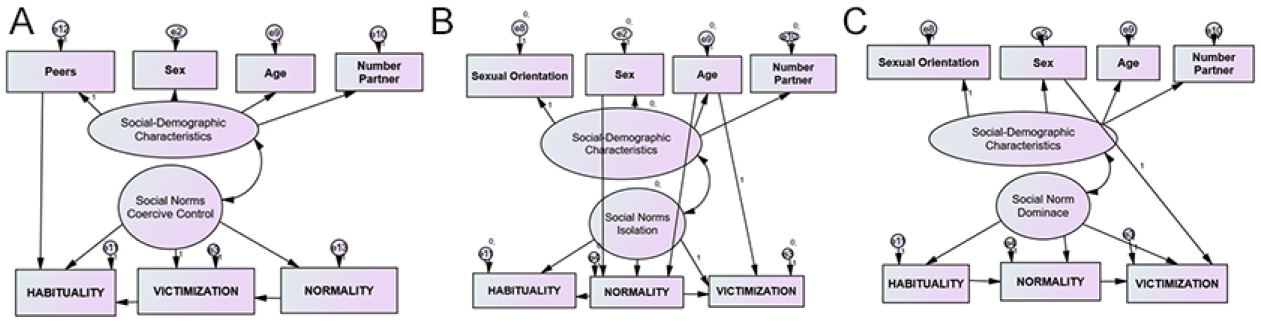
Structural Equation Model (SEM) for psychological violence variables rated as social norms (A) for Coercive Control, (B) for Isolation, and (C) for Dominance.
Discussion
The study of social norms has had a high impact on prevention programs in other areas, but has not been sufficiently considered in IPV in young people. The purpose of this paper is to study social norms as a form of transmission of psychological violence, especially in the case of CC, which is considered to be a key explanatory factor in the development of IPV in adults. Our hypothesis was that if it is transmitted as a social norm, we can work on it specifically in preventive programs by applying the rules of priority they are based on, and we have found that the frequencies in the perception of CC between peers indicate that it is indeed transmitted as a descriptive social norm, following the Focus Theory of Normative Conduct (Cialdini et al., 1991). But this result does not show in all context situations: it holds for the CC applied to social relationships and leisure time, but not when applied to personal image. Neither does it hold for the other dimensions of psychological violence, isolation, and domination. CC is perceived as a behavior that is not normal, it is prescriptive (is forbidden by the law or it is not socially accepted), but it also can be found as a descriptive behavior: a habitual behavior between peers. The main contribution of this work derives from this finding: we think that CC is considered an appropriate behavioral standard (Cialdini et al., 1991) as a repeated behavior among peers, and that this occurs in situations that generate uncertainty (in relationships of young couples where it is not clear how to respond), which activate secondary control mechanisms that substitute primary control mechanisms. It must be noted that some people rely on the group (or on what the group transmits) as a way of preventing threats to their own personal (primary) control, and that in these cases they prefer to follow the opinion of the group rather than their own (Fritsche et al., 2013). Therefore, we should accept that CC as a descriptive social norm could occur even in people with egalitarian beliefs or people opposed to IPV. We believe that the role of the descriptive norm is more important than a simple moderating role for sexist beliefs, as McNaughton et al. (2016) have proposed. We consider that, at least in the case of CC, it is present as a descriptive social norm because it is based on control, which is a basic cognitive process in humans. And that is why it is not found in other forms of psychological violence, which would just be perceived as prescriptive behaviors.
Thus, we have a type of coercive control behavior in force among young people, with a potential negative impact on health in the medium and long term, which is present in perpetrators and victims of violence, albeit in different forms. Limitations in freedom and in personal decision making have important consequences for victims and should not be minimized for several reasons: (1). Because they have been found at the basis of psychopathological disorders (Peña, 2004); (2) Because they promote tolerance to aggression in couples and increase in the number of aggressions (Arriaga et al., 2016; Vucetic et al., 2021), being the perfect breeding ground for future violent behaviors in the couple (Dutton & Goodman, 2005); (3) Because CC intensifies in time and space over the milestones achieved by the couple along the relationship (Crossman & Hardesty, 2018; Johnson & Leone, 2005). The frequency of CC as a descriptive norm shows that preventive programs are not working on them, which justifies the importance of incorporating these aspects into preventive programs.
On the other hand, the results indicate that the frequency of subjects who could be identified as victims of CC is generally around 23.2%, with higher scores in leisure time CC. It should be kept in mind that the figures on victimization in IPV are relative, and could even be higher, considering that the victimization itself in IPV affects this identification (Dardis et al., 2017). Our results on victimization support this idea because they are related to a higher normality of the event being assessed. Victimization is related to prescriptive social norm; victimization is related to descriptive social norm when the context of application of the CC and the sex of the abuser are taken into account. A lack of identification as a potential victim may also affect the effectiveness of preventive messages, so specifying different situations/contexts of application of the form of violence may facilitate this identification as victims. And this could be extended to work on the different dimensions of psychological violence, as they are different. In this way, we will also reinforce or have an impact on the primary control of individuals, bearing in mind that preventive programs are usually based on “prescribed” behaviors because of their effect or consequences on victims. If the subject does not identify himself as a possible victim, it is difficult for the message to be self-referential.
The importance of CC as a specifically descriptive social norm is due to its implications for the practice and policies in the design of preventive programs, since it is transmitted in the group because of its specific function: CC works as a behavioral guide that replaces primary control in the uncertainty of incipient relationships. Therefore, if we reinforce the primary control in individuals with specific contents on couple relationships, we decrease the dependence on the group opinion. Because, in addition, as it is functioning as a descriptive social norm, there are certain practical implications to consider. For example, a social norm (controlling my partner’s social relationships) combined with other social norms (e.g., with the social acceptance of violence in general, with the acceptance of gender-based violence in particular, with norms about what is appropriate for women and what is appropriate for men—gender stereotypes, etc.) can be reinforced, can lose effectiveness and even cease to have any effect. For that reason, the same controlling behavior will not be equivalent for men and women in all societies. It will depend on the rest of the norms that are operating at each moment. In this sense, and following the contributions of Paluck and Ball (2010), as an individual-level process, a social norm can be applied according to personal beliefs or in accordance with other social norms, and its application will depend on the relative position adopted when combined with those other social norms, since some social norms may stand out from others under different factors. Thus, the way in which CC is effectively realized will depend on how this prioritization is established at the individual level. So, if we enhance primary control over couple relationships, this secondary social norm could possibly decrease in importance and preventive programs would gain effectiveness.
Lastly, regarding its implication in policies, frequency data show that coercive control is quite frequent between the 18 and 25 age range and that is being transmitted as a social norm, regardless of sociocultural characteristics (including sexual orientation and sex), and although we could expect it to be happening earlier, in ages 14 to 17, we believe that these are cognitive processes more related to incipient adulthood (Arnett, 2017), at least in terms of free decision making, but those contents on healthy relationships can be integrated at an earlier age. Previous research had already shown how social norms between peers can increase gender-based violence (Aizpitarte et al., 2017); and considering the effect of social norms on belief settings, as pointed out by Paluck and Ball (2010), it is very important to bring these findings into preventive programs.
The findings of this study suggest that CC strategies are so prevalent that they are part of young people’s behavioral repertoire, supporting Crossman and Hardesty’s (2018) findings that control is present in all couple relationships.
Limitations
Social norms and CC are extremely complex processes, and CC is a very difficult variable to operationalize (Fanslow & Gulliver, 2015; Hardesty et al., 2015). We have explored social norms as a form of CC transmission in young people applied to preventive programs and we have chosen to select certain sociocultural variables, leaving out some others such as religion, economic status, or political affiliation, which could be taken into account in the future. When we investigate CC with the scenario method, we encounter the hurdle of not being able to add many variables to the situation to have a better control over which variable we are measuring, but the risk is leaving out important variables. Nevertheless, there are very interesting works that take into account a wide variety of correlates simultaneously (Dardis et al., 2017) and that should be taken alternatively in consideration.
On the other hand, we wanted a balanced number of participants by type of CC, without having to control the sample for sociocultural variables (type of studies or nationality), causing a small effect on the difference in means, which we have ignored in the conclusions. However, in the future it would be appropriate to take sample sizes into account when analyzing these or other sociocultural variables. Furthermore, the sample is not representative of society as a whole since they come mostly from on-campus students and we infer are medium-high class, the conclusions should be taken with caution if they are not applied to similar samples. Similar research should be taken into account in other contexts of origin and different socio-economic level.
Conclusions
In order to prevent violence in young couples, a proper understanding of how this phenomenon starts and how it develops is necessary (Díaz-Aguado, 2014). This research explores mechanisms that may have implications for prevention and in sum wants to put the focus on: (1) Control, which can be called “natural” or “adaptive,” is a very important process for human beings which cannot be refused, but that can become coercive and violent when it is imposed on one of the partners, implying restrictions in personal decision-making processes, adding negative consequences for the recipients, and with an important impact on their health (Hardesty et al., 2015); (2) CC is psychological violence but it behaves differently from other similar dimensions, or at least, it is different from isolation and domination; (3) Working on control should be a priority for professionals in prevention, since it is present in perpetrators and victims (although in different ways); (4) The importance of CC being transmitted as a descriptive social norm is that it fulfills a specific function—to guide behavior in a situation of uncertainty where primary control cannot be applied; and that social norms work within a system of priorities to shape people’s belief systems and behavior. Therefore, the improvement of preventive programs should, on the one hand, include a systematization of contents that provide greater primary control to both members of the couple; and, on the other hand, use the indications of Paluck and Ball (2010) on transmission and priorities in interaction with other social norms (that rule over other behaviors) that they establish. Finally, as a consideration for policy implications, according to its frequency, CC is a violent behavior that occurs between the ages of 18 and 25, when it is very appropriate to carry out preventive programs, because this is when greater responsibilities and independence in decision making are being acquired (Arnett, 2007). On the other side, awareness campaigns should be directed to the relationship dynamics among emerging adults. Finally, public funding is needed to conduct studies on samples not easily accessible.
Footnotes
Acknowledgements
We want to express our gratitude to all the teachers who contributed to the collection of data in the University of Málaga, especially professor Ricardo Vázquez, PhD., and all those teachers and Director of the Vocational and Technical College “Politécnico Jesús Marín” because, thanks to their involvement, we have achieved a varied sample that supports the generalization of the conclusions. Special thanks to the reviewers for their contributions to improve the quality of this article.
Declaration of Conflicting Interests
The author(s) declared no potential conflicts of interests with respect to the authorship and/or publication of this article.
Funding
The author(s) received no financial support for the research and/or authorship of this article.
Ethical Approval
The study is in compliance with ethical standards. The study was approved by Ethical Committee of Experimentation of the University of Malaga (CEUMA), number 64/2017.
