



Abstract
Using data from a cross-national survey conducted on representative samples of populations from 10 European countries (n = 10,766), the present study is the first one to empirically measure the validity of Christie’s influential ideal victim model. We use a range of scenarios built around common types of anti-LGBT violence to verify the extent to which the public’s empathy for victims is contingent on the victim’s identity and the circumstances of the crime. The results provide strong evidence that, when applied to this group of victims, the rules of the ideal victim work, adequately moderating the public’s emotional reactions. We found that all victims receive relatively high levels of empathy, but the further the victim is from the ideal, the less support they can count on. Thus, even though no victim is “rejected,” a clear hierarchy of victimization emerges. As a group, LGBT people suffer from an empathy deficit, but there also are considerable variations within this group, with a lesbian attacked by extremists receiving the most, and a drunk transgender person receiving the least empathy from the public. The study contributes to the development of theory by embedding the ideal victim model in a broader sociological paradigm of dramaturgical analysis. Since our research shows that the victim’s LGBT status decreases the levels of empathy (being seen as a type of stigma), we call for more attention to be paid to the actor’s identity in Goffman’s framework. Implications for practice and further research are offered.
Not all victims were born equal. Across the globe, societies attach different weights to different types of victimization, recognizing the suffering and blamelessness of some more than others. In the social sense, being a victim “means ascription of a special social status” based on formal and informal rules which vary across cultural units (Strobl, 2010, p. 6). As such, the meaning of victim is socially constructed and is reflective of power imbalance and stereotypes in society.
One of the best know blueprints for the stereotypical image of the victim was proposed by Christie (2018 [1986], p. 12), who argued that the ideal victim would be “a person or a category of individuals who—when hit by crime—most readily are given the complete and legitimate status of being a victim.” This “ideal” can be typified by a baby beaten by their parents or a frail old woman robbed on the street. On the other end of the hierarchy of victimization, we can find “low-status, powerless groups,” such as the homeless, sex workers, refugees and people with substance abuse issues and other marginalized communities, traditionally seen by the dominant majority as “troublesome or distasteful” (Carrabine et al., 2009, p. 161). Despite being at high risk of victimization, members of these groups often face difficulties in being recognized as victims. Unlike the innocent baby, their “victim status can be spoiled by doubts concerning appropriate behaviour or the character of the victim” (Strobl, 2010, p. 11).
The image of the victim as “ideal” lacks support in actually recorded crime statistics (Walklate, 2011, p. 183). To our knowledge, Christie never explained how he came up with his idea, while the model lacks embeddedness in broader sociological paradigms. Nonetheless, it is widely present in the media, perpetuating narrow and simplistic understandings of good victims and bad offenders (e.g., Smolej, 2010). It has also permeated some criminal justice systems, for example, requiring the injured party to cooperate with the police and refrain from “any reprehensible activities” (Strobl, 2010, p. 11). Within academia, Walklate (2007, p. 51) observes that the processes of obtaining the victim label have generated a research agenda in victimology, focused on “the behaviour of individual victims and the extent to which their behaviour puts them at a greater or lesser risk of victimization.” Yet, despite the ongoing growth of victimology as a field, the ideal victim model is far from being empirically verified. As such, rather than a validated theory, Christie’s reflections remain a set of common-sense principles which may or may not hold, particularly if we look outside of the West. Existing studies do not tell us, for example, how important particular aspects of the crime (e.g., the victim and offender identity) are in determining empathy or quickly one “loses” support depending on the circumstances of the crime. If the hierarchy of victimization is real, is it also universal? How far can one stray from the ideal to be still considered a victim? Are those on the bottom receiving any sympathy at all? Considering that Christie’s model has been around for decades, a careful study looking to validate its claims is needed.
One category of victims—lesbians, gay men, bisexual, and transgender people—is particularly suitable to contribute to this endeavor. Whereas anti-LGBT violence is a global phenomenon (Blondeel et al., 2018), social and legal approaches to this kind of victimization vary remarkably between states and cultures. In 2020, 48 United Member States protected sexual orientation within their hate crime laws, while many more (69) continued to criminalize consensual same-sex conduct (ILGA, 2020), mostly through colonial-era laws. Constructing sexual and gender minorities as “deviant, dangerous and/or morally suspect” (Donovan & Barnes, 2018, p. 96) provided justification for discriminatory laws and practices. In recent years, the legal and social situation of LGBT people has improved, but even in the European Union and the United Kingdom, which have become international champions of equality, the social situation of LGBT varies. Negative attitudes and discourses about LGB, and, particularly, trans people remain a challenge (e.g., Pearce et al., 2020). Many LGBT Europeans experience violence (FRA, 2013). Despite high numbers of incidents, most cases are not officially reported, as victims fear police harassment or doubt that their experiences will be taken seriously.
In the above context, the public view on who deserves empathy, and to what extent LGBT people can be seen as legitimate crime victims, is particularly troublesome and worth investigating in a systematic manner. It may be then, surprising, that only a handful of, mainly small n, US-based studies set out to empirically test the claims surrounding the “model” victim, blame attribution, and sympathy for LGBT victims. These studies are often focused on hate crime laws and their results that can be described as inconclusive. Some research (e.g., Cramer et al., 2010) suggests that LGB victimization may be recognized socially, finding that anti-LGB hate crimes offenders were punished more severely and blamed more than other perpetrators. Most studies, however, found higher blame, lower empathy, or lower support for hate crime laws to be a result of victims being identified as LGBT. For example, Lyons (2006) found that gay and lesbian victims were held more accountable for their actions than straight victims. In a study by Plumm et al. (2010), a gay man attacked in a local (non-gay) bar is blamed more readily than one assaulted in a gay bar, even without provocative behavior. Cabeldue et al. (2018, p. 3657) found that “more negative views of legislation/minority group protection were associated with elevated victim blame, as well as lower perpetrator blame and sentencing recommendations.” Most of these studies link the response to anti-LGBT victimization with the respondents’ attitudes toward LGBT as a group (e.g., Lyons, 2006) or ideologies known to be associated with prejudice, such as right-wing authoritarianism (Bacon et al., 2021).
Taken together, there seems to be a growing body of evidence that negative attitudes impact the public perceptions of victimhood and the distribution of empathy. Nonetheless, existing studies were not designed to measure the validity of the “ideal victim” concept as such. Their explanatory power is further limited due to their limited scale, covering convenience samples from one country at a time. Considering cultural differences, the notions developed in Anglo-American studies may not always apply to the rest of the world, despite often being treated as universal. Thus, there remains a need to test whether Christie’s theory accurately predicts how the European publics perceive victims depending on the context of the victimization, which this study sets out to do, using the example of anti-LGBT violence. Specifically, we aim to (1) measure the changes in the levels of empathy for victims by manipulating the victims’ identities and the circumstances of the crime; (2) contribute to the development of theory by embedding the ideal victim model in a broader sociological paradigm (the dramaturgical analysis); and (3) provide highly generalizable findings due to high-quality, large n samples from 10 countries. In the following sections, we discuss the place of the “ideal victim” in the broader “victim frame” and critique the applicability of such a model in relation to anti-LGBT violence. Then, we describe the methods and hypotheses and present the results of the current study. In the last section, the results are discussed in the context of existing and future research. Recommendations for criminal justice practice are offered.
Theoretical Framework
Victims as Actors
The hierarchy of victimization (Carrabine et al., 2009, p. 161) is a core concept in victimology. Christie’s “ideal victim” model received a lot of attention from academics, but the extant scholarship on the model is rarely embedded in broader social science paradigms. We propose to situate Christie’s model within the context of Goffman’s (1990 [1956]) dramaturgical analysis. This paradigm is suitable as the victim status is granted by an audience (the public, the lawmakers, and the courts) following the strategic use of the “victim frame” by activists, media, and the victims themselves.
Within Goffman’s framework, social interactions take place on a stage where actors try to gain the audience’s approval using costumes and props. Actors are not passive performers of imposed roles; rather, they are cynical strategists who strive for the best possible presentation of themselves. Their activities consist of constructing frames, that is, definitions of reality which allow people to make sense of objects and events (Goffman, 1975). Within each frame (e.g., that of a victim), the actor creates the role for themselves. Importantly, audiences have their own expectations of how the role should be performed. Failing to meet the audience’s expectations may lead to confusion, and bad actors may be sanctioned (Stets & Turner, 2005, p. 28).
In the case of the victim frame, the audience’s expectations of the center stage are summarized in Christie’s “ideal victim.” The extent to which an individual victim resembles the ideal determines whether they are included in the frame or fall outside of it to become “rejected victims” (Strobl, 2010, p. 7). The distance from the center denotes the hierarchy of victimization. Our interpretation of the victim frame is illustrated in Figure 1 below.
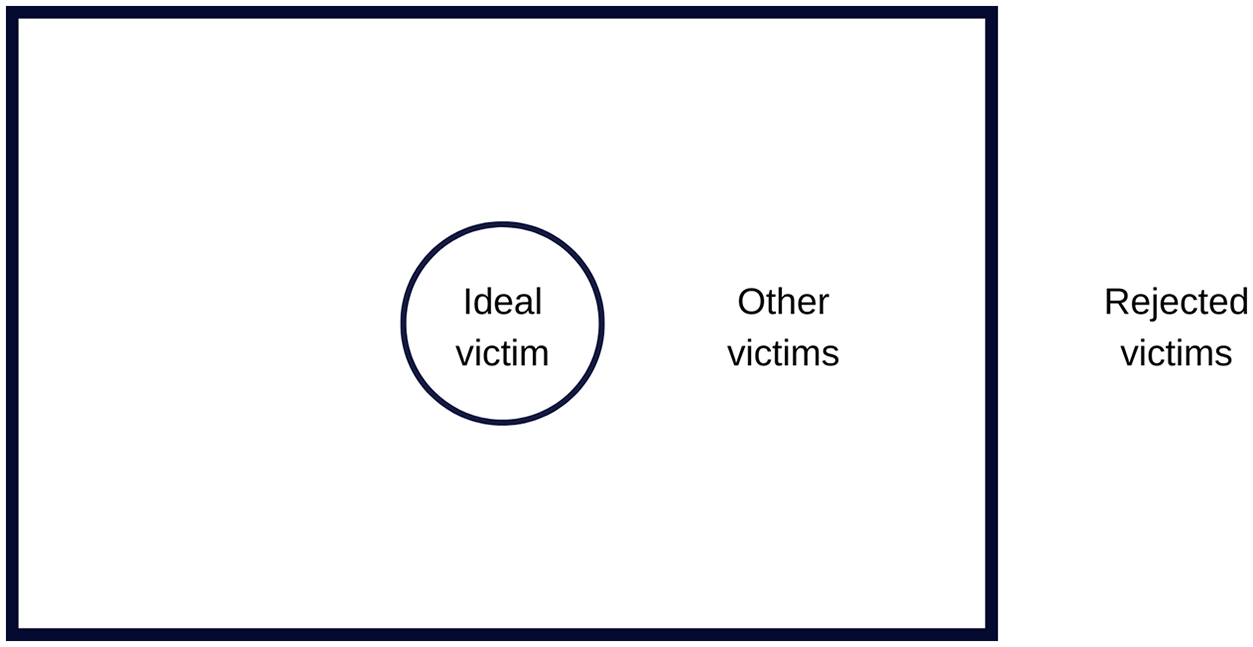
The victim frame.
Importantly, for victims to be judged as deserving of recognition and granted sympathy, their moral worthiness must be ascertained (Clark, 1997, p. 22). This is where Christie’s respectable or neutral activity fits within Goffman’s framework, and this is where the many problems with recognizing LGBT victims as deserving moral (and state) support lie.
Whereas generally suitable for understanding the process of labeling someone as a victim, the dramaturgical approach may be critiqued due to its focus on the “face” (a mask) which the actor puts on while on the stage. For Goffman, the actor’s real identity is irrelevant. In the context of anti-LGBT violence, there may be a considerable power imbalance between the actors, depending on both parties’ social status. In hate crime, the actor’s (real or perceived) identity is usually the object of the perpetrator’s prejudice. Therefore, even if someone strives to be recognized as a victim, for the audience, oftentimes, they are, first and foremost, LGBT.
LGBT People as (Non-)ideal Victims
Christie’s “ideal” victim model may be summarized as follows:
(1) The victim is weak compared to the offender;
(2) The victim is carrying out a respectable or neutral activity;
(3) The victim could not possibly be blamed;
(4) The offender is big and bad;
(5) The victim is unknown and unrelated to the offender.
Apart from the above, to successfully claim the status of an ideal victim, the victim needs to be powerful enough to make their case known—which may be difficult if they are opposed by counter-powers so strong that the victim cannot be heard (Christie, 2018 [1986], p. 14). Below, we briefly engage with the key premises of this model and its existing critiques in the context of anti-LGBT violence.
The first characteristics—weakness and defenselessness—imply the victim’s passive response to the attack. While some victims may be able (and willing) to fight back, research suggests that a strong reaction from the victim may lessen the chances of receiving empathy and being granted the (hate crime) victim status (Erentzen et al., 2021). This characteristic has also a gender and sexuality dimension. Donovan and Barnes (2018, p. 92) argue “[t]hat ideal victims are female – and conventionally feminine – is explicit in Christie’s (1986) analysis, while their heterosexuality is implicit.” Such assumptions may mean that, for example, the vulnerability of a victim perceived as a man (even though they are not) may not be recognized by the public.
The principle of non-relatedness means that giving empathy to the victim is easier when it does not involve the need to understand the, often complex, relationships between the victim and the perpetrator. In this context, the popular image of anti-LGBT violence as “stranger danger” fits well within the theory, but violence within the family is problematic, as the pre-existing relationship between the parties influences our perception of innocence (or even who the real victim is).
Respectability and blamelessness are equally cumbersome, as the two attributes may largely overlap. While Mason-Bish (2018, p. 50) argues that “[m]any hate crime victims – particularly those who receive public attention and sympathy – are described as being engaged in neutral or respectful activities either before or at the time of their attack,” in reality, some contexts of anti-LGBT victimization may prove less susceptible to positive press than others. This is highly contingent on societal attitudes. For example, whereas in some parts of Europe Pride parades are banned, framed as “freak shows” and threats to morality, elsewhere, such celebrations receive broad state and public support.
Finally, the “big and bad” argument and the group’s ability to be heard in order to gain recognition are also cumbersome. The ideal offender is “a human being close to not being one” (Christie, 2018 [1986], p. 19). Literature suggests, however, that some hate crime perpetrators see themselves as (self-proclaimed) defenders of normalcy, disciplining minorities for transgressions against gender, sexuality, or other norms (e.g., Perry, 2001). If someone is convinced that they are defending their families from danger, are they indeed “big and bad” in the eyes of the public, particularly one that shares these sentiments? Furthermore, while, in some states, anti-LGBT victimization gained visibility, elsewhere, few cases ever come to the public attention. In this context, we should remember that, as Walklate (2007, p. 77) observes, the ideal victim model is not a static notion, as “[n]ew ‘victimizations’ can be recognized and responded to.”
All in all, when it comes to anti-LGBT violence, we are dealing with both victims and offenders who, to use Christie’s words, are “not-so-ideal.” As the image of LGBT people varies across time and space, so does their ability to claim the victim status. Ultimately, it makes the operationalization of models such as the ideal victim particularly cumbersome, making this study even more relevant.
The Present Study
Hypotheses
As the previous section observes, when Christie’s framework is applied to real-life scenarios, many attributes, such as the respectability of the victim’s behavior and the victim’s blameworthiness, overlap. This complexity, together with the language issues discussed below, increases the difficulty of devising an empirical study aimed at testing the theory.
Since our goal is to test the validity of the ideal victim model using the example of anti-LGBT violence, our general hypothesis is that empathy for victims depends on their identity and the circumstances of the crime. In other words, we expect that the closer someone is to the stereotype of the ideal victim, the more empathy they should receive. Specifically, we hypothesize that empathy will change based on: (H1) the victim’s weakness compared to the offender; (H2) how respectable the victim’s activity is; (H3) the victim’s blameworthiness; (H4) the victim/offender relationship; (H5) how “big and bad” the offender is.
Under the hypothesis about the victim’s weakness in relation to the perpetrator (H1), we expect to observe a higher empathy for scenarios involving lesbians than for scenarios involving gay males. Regarding the respectability of the victim’s activity (H2), we predict that empathy for the victims assaulted while shopping (which could be seen as either a neutral or respectable activity) will be higher than for the victims described in the reference case, that is, walking on the street, which we construe as a situation which does not relate to any of the principles of the ideal victim, and, even more so, than empathy for a sex worker assaulted by their client (construed as an example of a non-respectable activity). By posing the victim-blaming hypothesis (H3), we predict that empathy for people assaulted near a bar or at a Pride event will be lower than for someone assaulted on the street. Moreover, assuming that nonheterosexual orientation or transgender identity can be considered a stigma we expect that, overall, LGBT victims will receive less empathy than heterosexual (and presumably cisgender) persons assaulted in comparable circumstances. Under the hypothesis on the relationship between the victim and the perpetrator (H4), we expect that empathy for someone assaulted by a “complete stranger” will be higher than in the reference case. Conversely, we predict that someone attacked by a family member will receive less empathy compared to a street assault. According to the “offender is big and bad” hypothesis (H5), we anticipate that victims assaulted by members of a far-right extremist organization will receive more empathy than the reference case where the identity of the offender is not described.
Tool
The current study reports data from a broader public opinion survey (n = 10,766) concerned with attitudes toward LGBT people and hate crime, wherein one of the blocks of questions measured empathy for victims. Respondents (see the description of the sample below) were randomly assigned to one of three routes differentiated by the victim’s identity—lesbian (including same-sex couples among women), gay (including same-sex couples of two men), or transgender route. A fourth—bisexual—route was added in Ireland and the United Kingdom which is not reported in this study. Respondents were asked to indicate the level of empathy for the victim(s) in different situations using a scale from 0 to 10, where 0 meant “no empathy at all,” and 10 meant “complete empathy.” The vignettes were elaborated based on Christie’s ideal victim model. They involved the most common types of anti-LGBT violence, but, for practical reasons, the bias motivation was not explicitly mentioned.
The study used the following vignettes:
Heterosexual couple physically assaulted after holding hands on the street (reference case 1).
Lesbian/gay man/transgender person physically assaulted by a group of far-right extremists.
Lesbian couple/gay couple/transgender person physically assaulted while shopping.
Lesbian/gay man/transgender person physically assaulted by a complete stranger.
Lesbian/gay man/transgender person physically assaulted by a member of their family.
Lesbian couple/gay couple/transgender person physically assaulted after holding hands on the street (reference case 2).
Lesbian/gay man/transgender person participating in [national name of Pride event] who is physically assaulted by counterdemonstrators.
Drunk lesbian couple/gay couple/transgender person physically assaulted near a bar.
Transgender sex worker physically assaulted by a client.
There are three possible limitations related to the vignettes. First, the routes were not symmetric: the question about the heterosexual couple (reference case 1) was asked only in the lesbian and gay routes, as we believed that the number of responses would sufficiently establish the level of empathy for straight victims vis-à-vis LGBT victims (the results confirmed our assumption). The “vacant slot” in the transgender route was filled with a question about a transgender sex worker assaulted by a client, which is a specific example of anti-trans violence that is also illustrative of the rule on respectability. Second, the choice of the respectable/neutral activity (shopping) may not be immediately understood as different from the reference case (walking on the street). An example of a clearly respectable activity, for example engagement in charitable work, could have been more clear-cut. Nonetheless, the results show that respondents differentiated between the two types of activities along the lines we predicted. Third, the study suffers from a narrow range of sexual orientations and gender identities and a rather simplistic opposition between straight and LGBT identities which overlooks the fact that people in same-sex relationships may also be bisexual and implicitly assumes that straight victims are also cisgender. These heuristics are a result of a compromise: since in public opinion research every question generates costs, we needed to select cases which would provide the most meaningful results. Additionally, considering that the research was carried out in populations with diverse levels of LGBT awareness, including less-known terms might be confusing for participants, which would have adverse effects on the quality of the data collected.
Due to the multinational nature of the study, the questionnaire, developed in English, was subject to ex ante harmonization, including the agreement of terminology and the localization of some expressions, such as the local names of Pride events. In this context, the standardization of the concept of “empathy”—a dependent variable in the block of questions about the ideal victim’s model—was a challenge. The discussion focused on finding the right words whose meaning was between “compassion” (used in past research, but potentially stigmatizing) and “empathy,” believed to be incomprehensible to respondents in some countries. Taking this into account, local partners have translated the questions to obtain similar meanings in all countries using synonymous expressions of “compassion” (e.g., medeleven in Dutch), “sympathy” (e.g., симпатия in Bulgarian), or “compassion and empathy” (współczucie i empatia in Polish).
The research tool was subjected to a pretest on a sample of 50 people. The pilot did not bring any changes to the content of the questionnaire. A consortium of polling agencies managed by Kantar was commissioned to carry the survey out in accordance with the relevant professional standards. The study received ethical clearance from the University of Limerick.
Participants
The survey was carried out in nine member states of the European Union (Belgium, Bulgaria, Croatia, Hungary, Ireland, Italy, Lithuania, Poland, and Slovenia) and the United Kingdom. The total sample size was 10,766 respondents, making it the largest empirical, transnational research on the ideal victim model to date. Further details about the sample are given in the Supplemental Appendix. These populations were selected to represent cultural and geographic variation within the region, while promising a sufficient level of understanding of key terms, such as gay, lesbian, and transgender. The 10 countries represent diverse approaches to anti-LGBT violence—including those less (e.g., Bulgaria) and more (e.g., Belgium) inclusive in terms of legal frameworks and social acceptance (European Commission, 2015). The mix of data collection techniques was based on computer-assisted web interviewing (CAWI) as a leading technique due to its low social desirability bias, that is, the respondent’s tendency to present themselves in the best possible way. In countries where it was not possible to ensure the appropriate quality and representativeness of data collected using CAWI (e.g., due to low Internet penetration), in-person and telephone interviewing techniques were used. The sampling scheme was based on the quotas for gender, age, education, and region. The base sample size was set at 1,000 respondents; lowered for Slovenia due to its small size and increased for Ireland and the United Kingdom, where the scope of the survey was extended.
Results
The study results show significant differences between the levels of empathy for crime victims depending on the victim’s identity and the circumstances of the attack. In terms of identities, there is a clear order in which most empathy is provided to straight (and presumably cisgender) victims, followed by lesbian, gay, and transgender victims (see Figure 2 below). In terms of the circumstances of the attack, we see that, among LGBT victims, those targeted by extremists receive the most empathy, while drunk victims assaulted near a bar receive the least empathy for their victimization. We observe, however, that, despite significant differences, the means for all vignettes remain high (above 6 on a scale of 0–10, see Figure 2 below), suggesting that there is some generalized empathy for all the victim categories included in the study.
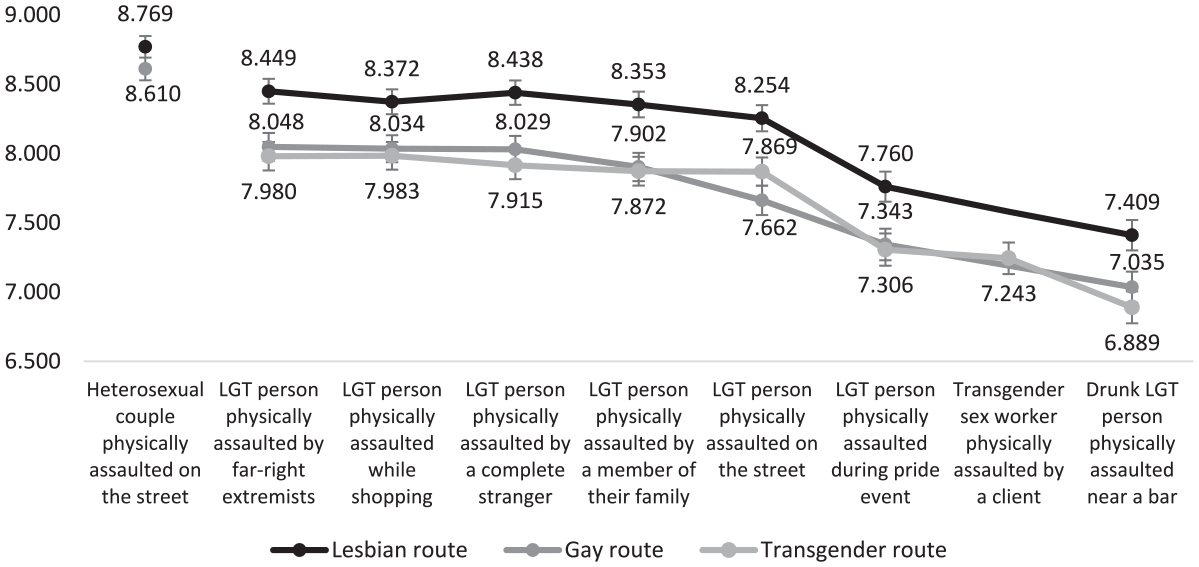
Comparison of the average empathy for lesbian, gay, and transgender victims attacked in different circumstances. Empathy for a heterosexual couple assaulted on the street as a reference case.
To verify our hypotheses (H1–H5), a mixed ANOVA model was carried out, in which eight scenarios were indicated as a within-subject factor, while countries and the drawn route were indicated as a between-subject factor. Because of the differences in the questions on the transgender route discussed earlier, a separate model was developed for the route involving lesbians and gay men and a separate model for the route concerning trans people. The model relating to lesbians and gay men is discussed first, followed by a specific focus on empathy for trans victims.
There was a significant main effect of scenarios on empathy (F(7, 39620) = 608.73, p < .001,
In order to deepen the above conclusion that empathy for crime victims depends on the victim’s identity and the circumstances of the attack, post hoc tests were carried out, thanks to which we can determine which scenarios weakened, and which strengthened, empathy. The post hoc test is based on a comparison of the estimated marginal means (EMMs), that is, means adjusted to the remaining means in the model; for unadjusted means see descriptive statistics in Figure 2 above and in the appendix. Tables 1 and 2 show the differences between the EMM of the vignettes on a lesbian couple, gay couple, or a trans person assaulted on the street (the reference case 2, which does not include any ideal victim rule) and EMM for the remaining vignettes. Such a construction of the test means that if for a given scenario, a negative result of the difference of the EMMs was obtained, the scenario strengthens empathy. Conversely, a positive result means a weakening of empathy.
Comparison of the EMMs Between Reference Case 2 and Other Scenarios for the Lesbian and Gay Route.
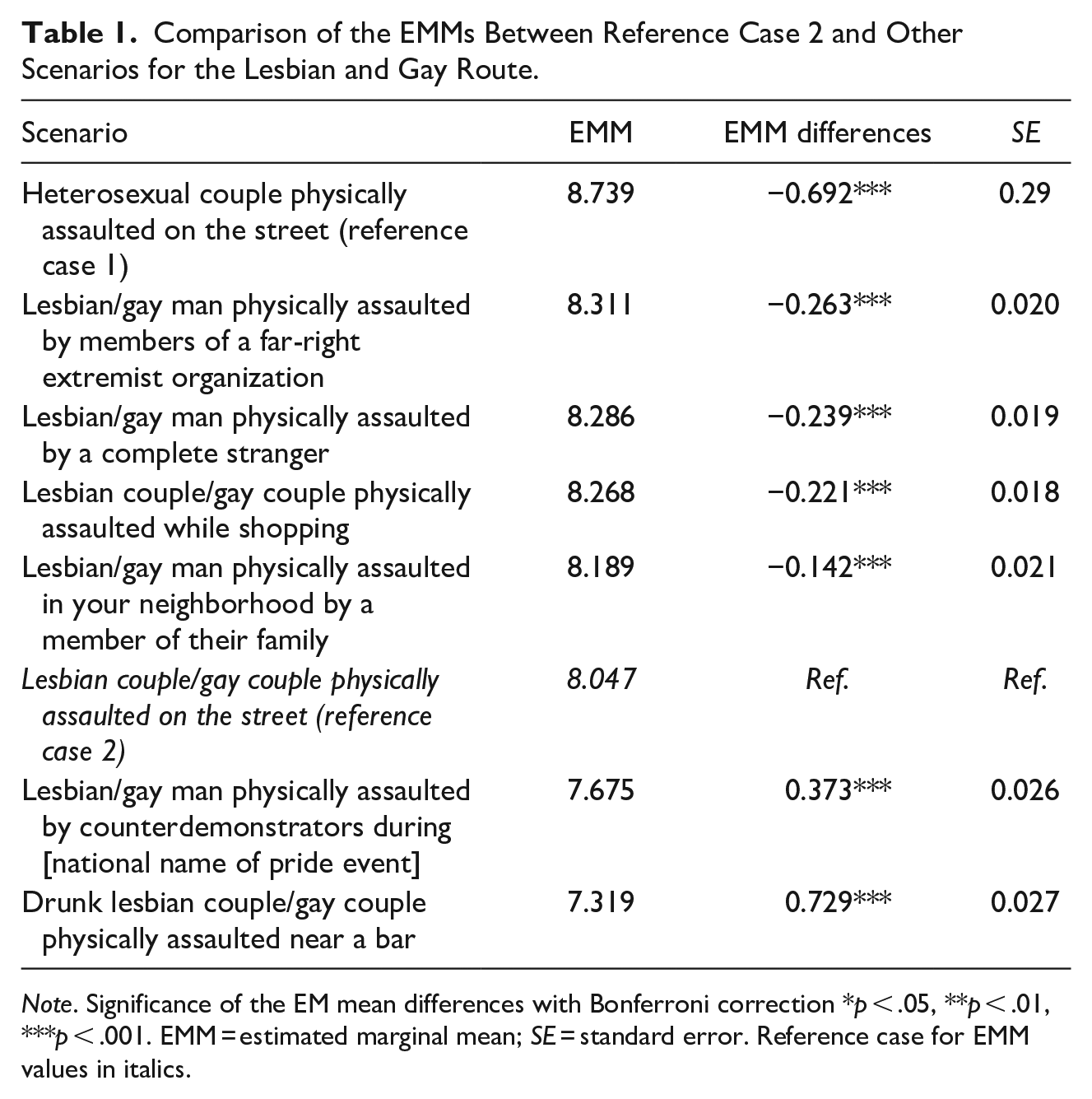
Note. Significance of the EM mean differences with Bonferroni correction *p < .05, **p < .01, ***p < .001. EMM = estimated marginal mean; SE = standard error. Reference case for EMM values in italics.
Comparison of the EMMs Between Reference Case 2 and Other Scenarios for the Transgender Route.

Note. Significance of the EM mean differences with Bonferroni correction *p < .05, **p < .01, ***p < .001. EMM = estimated marginal mean; SE = standard error. Reference case for EMM values in italics.
Although examining between-country and between-person variation was not our aim, we note several important regularities. First, empathy for a heterosexual couple holding hands was found to vary significantly less by country (F(9, 6052) = 36.65, p < .001,
Overview of Results
Hypothesis 1: Empathy for Crime Victims Depends on Their Weakness Compared to the Offender
We verified the first hypothesis (H1) by comparing mean empathy for the lesbian and gay route scenarios, making the drawn route another between-subjects factor. Results show that the average empathy for female victims (EMML = 8.29, SE = 0.04) is higher than for male victims (EMMG = 7.92, SE = 0.04), and the difference is statistically significant (EMML − EMMG = 0.368, SE = 0.061, p < .001). The finding supports the hypothesis.
Hypothesis 2: Empathy for Crime Victims Depends on How Respectable the Victim’s Activity Is
The second hypothesis (H2) is related to the victim’s behavior and respectability. The results show that the average empathy for the scenario involving the victims assaulted while shopping (EMMS = 8.27, SE = 0.34) is higher than for the scenario that did not consider any of the ideal victim rules (reference case 2: EMMR2 = 8.05, SE = 0.36) and this difference is significant (EMMR2 − EMMS = −0.221, SE = 0.018, p < .001). This means that victims involved in a neutral activity receive, on average, more empathy than the reference case.
Hypothesis 3: Empathy for Crime Victims Depends on Victim Blameworthiness
According to the third hypothesis (H3), the victim who could be blamed for their actions receives less empathy. In line with our predictions, the average empathy in vignettes involving a drunk gay man or lesbian assaulted near a bar (EMMD = 7.32, SE = 0.38) or a participant of a Pride parade attacked by counterdemonstrators (EMMP = 7.68, SE = 0.39) is lower than average empathy for the scenario that did not consider any of the ideal victim rules (reference case 2: EMMR2 = 8.05, SE = 0.36). These differences are significant (EMMR2 − EMMD = 0.729, SE = 0.027, p < .001; EMMR2 − EMMP = 0.373, SE = 0.026, p < .001). Moreover, the average empathy for a heterosexual couple attacked in the street (EMMR1 = 8.74, SE = 0.29) turned out to be higher than for a lesbian/gay couple in the same situation (EMMR2 = 8.05, SE = 0.36), and the difference is statistically significant (EMMR2 − EMMR1 = −0.692, SE = 0.029, p < .001). This suggests that a nonheterosexual sexual orientation constitutes a social stigma and, as such, leads to victim blaming.
Hypothesis 4: Empathy for Crime Victims Depends on the Victim/Offender Relationship
The fourth hypothesis (H4) concerns the relationship between the perpetrator and the victim. It is predicted that, if the victim is unknown to the offender, then the victim should receive more empathy. The average empathy in the scenario involving an offender who is a complete stranger (EMMCS = 8.29, SE = 0.33) turned out to be significantly higher than the reference case 2, that is, the scenario that did not involve any of the ideal victim rules (EMMR2 − EMMCS = −0.239, SE = 0.019, p < .001).
However, the vignette about being assaulted by a victim’s family member worked in a different way than we expected. While we predicted that the possibly complex relationship between the victim and the offender will lead to decreased empathy, domestic violence victims received more empathy (EMMF = 8.19, SE = 0.35) than in reference case 2, and this difference is statistically significant (EMMR2 − EMMF = −0.142, SE = 0.021, p < .001). While the result may be confusing, we can interpret it in the context of the growing awareness of domestic violence, which has been a subject of much legislative and campaign work in Europe. It should also be noted that the problem of domestic violence affects women and girls in particular (FRA, 2014). In our study, while female respondents were more generally more empathetic than males (Mw = 8.29 vs. Mm = 7.53), the differences in average empathy between male and female respondents were higher for the domestic violence scenario (MFw − MFm = 0.85) than for all scenarios overall (Mw − Mm = 0.77). This suggests that female respondents related to this vignette more than males, possibly because they had a better understanding of the problem. Still, in the context of this study, we conclude that this vignette did not accurately measure the rule concerning the victim/perpetrator relationship. At the same time, the vignette that directly refers to “stranger danger” confirms the rule.
Hypothesis 5: Empathy for Crime Victims Depends on How “Big and bad” the Offender Is
The last hypothesis (H5) involves unambiguously “big and bad” attackers, represented by members of a far-right organization, whose advantage is due to their higher numbers and their extremist motivation. We predicted that, in this case, empathy for victims will increase. The results show that, indeed, the average empathy for this vignette (EMME = 8.31, SE = 0.34) is higher than in reference case 2 involving a street assault (EMMR2 = 8.05, SE = 0.36). The difference is significant (EMMR2 − EMME = −0.263, SE = 0.020, p < .001). We can, therefore, state that this hypothesis was confirmed.
Situation of Transgender Victims
When it comes to the ideal victim rules, the model prepared for the transgender route vignettes (Table 2 above) brings us almost identical conclusions to the model for the lesbian and gay routes. The main effect of the scenarios on empathy (F(7, 19194) = 264.85, p < .001,
In the trans route, almost all scenarios worked, as expected, in the same way as for the gay and lesbian routes—respectively weakening or strengthening empathy. The difference in the average empathy for transgender victims in vignettes involving domestic violence and assault by a stranger, and the average empathy for the reference case of assault on a transgender person in the street was not statistically significant. Consequently, we cannot say that such a relationship in the case of transgender people strengthens or weakens empathy. However, it should be noted that the lack of statistical significance was also influenced by the smaller number of observations (n = 2,752) than in the model calculated for the lesbian and gay route (n = 5,680), as well as the use of the conservative Bonferroni correction in the statistical test. Concluding, the hypothesis regarding the effect of the victim/perpetrator relationship on empathy remains unconfirmed for the transgender route.
The transgender route also included a case of a transgender sex worker being assaulted by their client to further verify the hypothesis that empathy for crime victims depends on how respectable the victim’s activity is. As we expected, the EMM for the transgender sex worker scenario (EMMSW = 7.32, SE = 0.06) turned out to be lower than the mean for the reference case 2 (EMMR2 = 8.91, SE = 0.05), and this difference is statistically significant (EMMR2 − EMMSW = 0.589, SE = 0.038, p < .001).
The results for the scenarios involving assaults on people engaged in shopping, as well as the scenario involving an assault on a transgender sex worker, all together support the hypothesis that empathy for crime victims depends on the respectability of their activity. Victims engaged in a neutral (or respectable) activity receive more empathy, while victims judged negatively for engaging in non-respectable behavior receive less empathy.
Summing up, the results suggest that, when applied to victims of anti-LGBT violence, the rules of the ideal victim work, moderating (strengthening or weakening) empathy for victims depending on the victim’s identity and the circumstances of the attack, except for the vignette involving domestic violence. We also found that the stigma related to the LGBT identity decreased empathy for victims, with transgender victims receiving, on average, the least empathy.
Discussion and Conclusions
This paper is the first attempt to test empirically all aspects of Christie’s (2018 [1986]) stereotype of the ideal victim. Using data from a large n, cross-national survey on empathy for LGBT victims of crime, the study provides strong evidence for the existence of a hierarchy of victimization, in which LGBT people affected by violence are judged less favorably than others, with the levels of empathy being further determined by the victim’s identity and the circumstances of the crime. The findings have implications for the theory and the practice of working with crime victims.
Within academia, considerable efforts have been put into understanding how someone’s personal or behavioral characteristics may put them at a greater or lesser risk of victimization (Walklate, 2007, p. 51) and how such factors may influence the public recognition of one’s victimhood. Scholars (e.g., Donovan & Barnes, 2018; Mason, 2014) suggested that LGBT victims may be far from what Christie (2018 [1986]) described as the ideal victim, suffering from a “credibility deficit.” A handful of studies (e.g., Lyons, 2006; Plumm et al., 2010) provided empirical support for various elements of the theory. To date, however, much of the model remains a set of “common-sense” rules, suffering, in addition, from not being grounded in broader social science paradigms. The current study addresses these issues by situating the ideal victim model within Goffman’s (1990 [1956]) dramaturgical analysis and empirically verifying each of the model’s principles. There are three primary contributions we try to make.
First, we believe that embedding the model in the dramaturgical analysis allows for a deeper understanding of how the rules work and how empathy is granted to victims in different scenarios. We build upon Goffman’s framework showing that the actor’s identity may be more important than previously suggested. Our research shows that the victim’s LGBT status (which we interpret as a type of stigma) significantly decreases the levels of empathy. In other words, once the public learns that the victimized individual belongs to the LGBT minority, they attach negative points to the performance, regardless of what the victim does or how bad the offender is. For this reason, we argue that, contrary to Goffman’s original framework, the actor’s identity is key in determining the reaction of the public. If one suffers from stigma, their ability to convincingly play the role (of a victim) is always affected.
Second, our study provides empirical evidence for each of the ideal victim’s rules separately, as well as combined. The further the victim is from the ideal, the less empathy they can count on. For example, people attacked while drunk around a bar (which implies blame) garner significantly less empathy than victims attacked doing something neutral, whereas female victims are seen by the audience as weaker (and granted more empathy) than men. While this study used the example of LGBT victims, we believe that the rules would work similarly for other marginalized and minority groups. Each time, however, the empathy will be affected by factors such as the respondents’ prejudices and awareness of different groups’ social predicament. It is likely, for example, that victims of racist violence would, as a group, score better than LGBT people due to better social recognition of the harms of racism. At least one study (Lyons, 2006) suggests so.
Third, our study has confirmed that LGBT victims are treated less favorably than others. Still, it shows that, despite differences between scenarios, all victims received relatively high levels of empathy from the audience. On its own, this finding is a novelty, considering that most literature has focused on explaining how LGBT people do not fit the script of the ideal victim rather than describing the boundaries of the victim frame. In terms of theory, the results suggest that even the least victims are seen by members of society as deserving; they fit in the frame and none of them can be classified as “rejected” victims (Strobl, 2010, p. 7).
One factor that could have caused the high empathy scores is the fact that, by design, our study indicated who, in each scenario, was the person(s) being assaulted, implicitly suggesting that they are the victim(s). Translating this to criminal justice practice, we believe that acknowledging the victimization of LGBT people by representatives of the system should lead to granting the victim status by society. As such, the institutions have an important role to play in fostering a more empathetic and victim-friendly society. Meanwhile, there is ample evidence that institutions fail in their duty to support and protect vulnerable and “unpopular” victims, such as people who experienced anti-LGBT violence (e.g., Walters et al., 2020, p. 1552). Professional services should be aware of this and pay particular attention to the needs of victims who do not immediately spark sympathy. Criminal justice and victim services should be mindful of possible implicit biases related, for example, to gender and sexuality, which may inhibit their ability to effectively assist vulnerable victims, including sex workers.
Like every study, the current research has some limitations. First, the vignettes impose the understanding of who the victim in each case is, as opposed to questioning whether they are a victim at all. Furthermore, provided with multiple scenarios, the participants may have been prone to differentiating the levels of empathy between them, despite the fact that they were free to assign equal points in all scenarios should they choose to do so. Second, the study design focused on measuring empathy. The significant difference between LGBT and non-LGBT victims is interpreted as a result of stigma, but the study does not include a measure of stigma as such. Future research may build upon it by measuring the relationship between the level of prejudice (e.g., social distance) and empathy for victims. Finally, our research, although it controls it, does not explain the difference in empathy between countries. Therefore, there is space for further research with multi-level models involving also second-level variables, describing the characteristics of given populations, which could explain these different outcomes.
Supplemental Material
sj-docx-3-jiv-10.1177_08862605221139196 – Supplemental material for Not Ideal, But Still Acknowledged: A 10-Country Survey on Empathy for Victims of Anti-LGBT Violence
Supplemental material, sj-docx-3-jiv-10.1177_08862605221139196 for Not Ideal, But Still Acknowledged: A 10-Country Survey on Empathy for Victims of Anti-LGBT Violence by Piotr Godzisz and Jacek Mazurczak in Journal of Interpersonal Violence
Research Data
sj-sav-1-jiv-10.1177_08862605221139196 – Supplemental material for Not Ideal, But Still Acknowledged: A 10-Country Survey on Empathy for Victims of Anti-LGBT Violence
sj-sav-1-jiv-10.1177_08862605221139196 for Not Ideal, But Still Acknowledged: A 10-Country Survey on Empathy for Victims of Anti-LGBT Violence by Piotr Godzisz and Jacek Mazurczak in Journal of Interpersonal Violence
Research Data
sj-sps-2-jiv-10.1177_08862605221139196 – Supplemental material for Not Ideal, But Still Acknowledged: A 10-Country Survey on Empathy for Victims of Anti-LGBT Violence
sj-sps-2-jiv-10.1177_08862605221139196 for Not Ideal, But Still Acknowledged: A 10-Country Survey on Empathy for Victims of Anti-LGBT Violence by Piotr Godzisz and Jacek Mazurczak in Journal of Interpersonal Violence
Footnotes
Acknowledgements
The authors would like to thank Dominika Bulska for statistical advice and Professor Kazimierz M. Słomczyński for comments on the early draft of this paper. We would also like to acknowledge the contributions of all researchers and other colleagues involved in the “Call It Hate” project, particularly Dr Giacomo Viggiani, who contributed as Project Manager, and Melanie Stray, who contributed as Senior Researcher.
Credits
Both authors have equally contributed to this study and should be treated as co-first authors.
Declaration of Conflicting Interests
The author(s) declared no potential conflicts of interest with respect to the research, authorship, and/or publication of this article.
Funding
The author(s) disclosed receipt of the following financial support for the research and/or authorship of this article: This publication is based on the findings of the research conducted within the transnational, collaborative project “Call it Hate: Raising Awareness of Anti-LGBT Hate Crime,” co-funded by the Rights, Equality, and Citizenship Programme (2014–2020) of the European Commission (grant agreement JUST-REC-DISC-AG-2016-04-764731). The analysis of the data was supported by the funding provided by the European Union’s Horizon 2020 research and innovation programme under the Marie Skłodowska-Curie grant agreement no. 895099-ENTER.

Supplemental Material
Supplemental material for this article is available online.
Author Biographies
References
Supplementary Material
Please find the following supplemental material available below.
For Open Access articles published under a Creative Commons License, all supplemental material carries the same license as the article it is associated with.
For non-Open Access articles published, all supplemental material carries a non-exclusive license, and permission requests for re-use of supplemental material or any part of supplemental material shall be sent directly to the copyright owner as specified in the copyright notice associated with the article.
