



Abstract
Adolescent gang participation has been noted as a major public health concern. Therefore, researchers have placed a growing emphasis on identifying processes that propel adolescents toward gang membership. Previous studies have highlighted as relevant risk factors victimization experiences as well as neighborhood conditions, which reflect sociopolitical and socioeconomic disparities and precipitate social disorganization. However, research to date has not considered potential dynamic interrelations among these risk factors, which are suggested by an integrated trauma-informed developmental-ecological perspective. Additionally, given that minoritized youth are disproportionately represented in gangs and differentially exposed to many of the risk factors for gang membership, it is important to examine whether gang membership pathways are similar or distinct across racial and ethnic groups. In order to address these gaps, the present study examined longitudinal self-report data, including neighborhood conditions (Baseline), direct and witnessed victimization (12-month follow-up), and gang membership versus nonmembership (24-month follow-up) gathered from 1,284 adolescents identified as serious offenders (22% non-Hispanic White, 36% Latinx, and 43% African American) who participated in the Pathways to Desistance Study. Findings from structural equation modeling showed that pathways toward gang membership were similar across racial and ethnic groups. Results further demonstrated that neighborhood conditions increased the likelihood of adolescent gang participation through direct and witnessed victimization. These findings highlight the value of examining gang membership from an integrated trauma-informed developmental-ecological frameworks. Further, these findings emphasize the need for prevention and intervention initiatives at different levels of the social ecology.
Keywords
Adolescent gang membership has been identified as a major public health concern with substantial personal and societal costs (Mendez et al., 2020; see Beresford & Wood, 2016; Kerig et al., 2013, for reviews). Among these costs, evidence shows that gang participation during adolescence predicts increases in mental health difficulties, criminal behavior, and incarceration during adulthood (e.g., Connolly & Jackson, 2019; Gilman et al., 2014a). Additionally, annually, a large sum of federal funding is allotted to youth gang prevention and intervention. For example, from 2017 to 2019, the Office of Juvenile Justice and Delinquency Prevention distributed approximately $16.5 million to improve gang programs across communities in the United States (Harp, 2020). Given these significant consequences, research that elucidates the pathways compelling adolescents to participate in gangs is needed to inform effective prevention and intervention efforts.
Previous research has suggested that poor neighborhood conditions, which tend to reflect ongoing sociopolitical and socioeconomic disparities occurring in the broader social ecology, may be a key mechanism propelling youth to join gangs (e.g., Bronfenbrenner, 1979; Suárez-Orozco et al., 2018). Neighborhoods with adverse conditions resulting from systemic segregation, oppression, structural inequalities, and disinvestment of resources, may be characterized by adults fighting loudly, open use of drugs in the streets, inadequate supervision of youth, abandoned buildings or tagged by graffiti, streets littered with trash, and overt commission of crimes, are posited to foment social disorganization in communities (Cahill et al., 2019; Kephart, 2022; Shaw & McKay, 1942, 1969; see Kubrin & Weitzer, 2003; Kubrin & Wo, 2016, for reviews). In turn, social disorganization in neighborhoods disrupt social systems that help control adolescent problematic behaviors, leading youth to turn to alternative systems, such as gangs (Blasko et al., 2015; Hill et al., 1999; Gilman et al., 2014b; Merrin et al., 2020; Papachristos & Hughes, 2015; see Kubrin & Weitzer, 2003; Kubrin & Wo, 2016, for reviews). Aligning with this proposition, several studies have linked elevated levels of adverse neighborhood conditions with gang membership among adolescents. For instance, in a seminal study of risk factors for gang participation, Hill and colleagues (1999) found that school-age children who lived in neighborhoods with high adversity were three times more likely than their peers to become gang members during adolescence. Gilman et al. (2014b) later utilized the same school-based longitudinal data to show that living in a neighborhood with adverse conditions during childhood predicted a twofold greater likelihood of joining a gang during adolescence, even after accounting for the effects of other antisocial risk factors. A recent longitudinal study also demonstrated that neighborhood adversity predicts a 30% increase in the vulnerability of first-time gang entry (Merrin et al., 2020). Overall, growing evidence underscores the role that adverse neighborhood conditions may play for adolescent gang membership.
Another relevant factor derived from a more recent trauma-informed perspective on gang participation (Beresford & Wood, 2016; Kerig et al., 2013; Kerig & Mendez, 2022) is direct and witnessed victimization. Adolescents who experience direct and/or witnessed violence occurring in their homes or communities may perceive gang life as a means of escape from this victimization (Melde et al., 2009, 2012; Swaner, 2022; for a review see Kerig & Mendez, 2022). Several cross-sectional studies demonstrate that adolescents who identify as gang members report heightened levels of childhood victimization, including sexual and physical abuse and exposure to domestic and community violence (e.g., Cepeda et al., 2016; Kerig et al., 2016; Petering, 2016; see Kerig & Mendez, 2022, and Raby & Jones, 2016, for reviews). Emerging prospective evidence also indicates that these forms of victimization are linked to increases in adolescent gang participation (e.g., Kubik et al., 2019; Madan et al., 2011; Merrin et al., 2020). For instance, Merrin et al. (2020) reported that prior exposure to direct and witnessed victimization increased by 18% the risk for first-time gang entry. Further, using a longitudinal dataset, researchers have found that prior cumulative direct and witnessed victimization predicts persistent gang involvement trajectories among adolescents (Kubik et al., 2019). Taken together, in addition to neighborhood conditions, the empirical literature has garnered support for the putative roles of direct and witnessed victimization as processes linked to adolescent gang membership.
A substantial body of research also indicates that adverse neighborhood conditions and victimization experiences are strongly linked to one another (e.g., Butcher et al., 2015; Coulton et al., 2007; Gibson et al., 2009). For instance, in a systematic review of 25 studies, Coulton and colleagues (2007) found that high neighborhood adversity was consistently related to physical and sexual abuse, as well as neglect. Butcher et al. (2015) also showed that adverse neighborhood conditions were associated with direct victimization and witnessing of community violence. More recently, researchers further found that children who lived in neighborhoods with concentrated adversity were at elevated risk for victimization by peers (i.e., bullying) (Choi et al., 2021). However, despite these significant connections, research on the role of neighborhood conditions and victimization experiences on gang membership has to date not examined the putative dynamic and transactional associations amongst these variables, which exist at different levels of adolescents’ social ecology (Bronfenbrenner, 1979; Marshall, 2013; Mascolo et al., 2016). Importantly, scholars have posited that distal factors, such as adverse neighborhood conditions, may exert influence on gang participation primarily through factors that are proximal to the adolescent, such as victimization exposure (Bronfenbrenner, 1979; Suárez-Orozco et al., 2018; Thornberry and Krohn 2001; Thornberry et al., 2003). Thus, from a trauma-informed developmental-ecological perspective (Kerig & Mendez, 2022), an unanswered question in the current literature concerns whether direct and witnessed victimization experiences help precipitate the link between adverse neighborhood conditions and adolescent gang membership.
An additional important consideration that has not yet received sufficient attention in the literature concerns whether the risks and mechanisms influencing adolescents’ gang membership are similar across ethnic and racial groups. Although a considerable number of non-Hispanic White youth also endorse gang membership (Esbensen & Carson, 2012; Esbensen & Winfree, 1998), there continues to be a disproportionate representation rate of African American and Latinx adolescents among gang participants (Bradshaw et al., 2013; Mendez et al., 2020; Pyrooz et al., 2013; Wojciechowski, 2021). Indeed, empirical work shows that African American and Latinx adolescents are at elevated risk of becoming gang members (e.g., Esbensen & Carson, 2012; Gilman et al., 2014b; Merrin et al., 2015). For instance, in a large sample of middle and high school students, Merrin et al. (2015) found that, relative to non-Hispanic White youth, African American adolescents evinced 6.49 greater odds of joining a gang, and those that identified as Latinx evinced 4.93 greater odds. In addition, minoritized youth are disproportionately exposed to both distal and proximal risks for gang participation, including living in adverse neighborhood conditions precipitated by sociopolitical and socioeconomic disparities and experiences of victimization (e.g., Abram et al., 2004; Hwang & Sampson, 2014; Roberts et al., 2011; Wright et al., 2014). Given these disparities, it is important to examine whether risk processes relevant to gang membership, which are particularly heightened among minoritized youth, operate in similar ways across racial ethnic groups (Mendez et al., 2020).
Current Study
To address these gaps in the literature, the present study examined whether neighborhood conditions, which may reflect socioeconomic and sociopolitical disparities, functioned as a risk factor for adolescent gang membership. Further, the study tested whether direct and witnessed forms of victimization amplify those risks and help explain the relation between neighborhood conditions and gang membership. Lastly, the current study examined whether there were differences in these processes among specific ethnic and racial groups (i.e., African American, Latinx, and non-Hispanic White adolescents). Based on previous theoretical and empirical literatures, we hypothesized that (a) neighborhood conditions as well as direct and witnessed victimization would be significantly related to gang membership; and that (b) both direct and witnessed victimization would help explain the association between neighborhood conditions and gang membership. In addition, we explored whether there were similarities or differences in the pathways toward gang membership for African American, Latinx, and non-Hispanic White youth.
Method
Procedures and Participants
Data for this study were drawn from the Pathways to Desistance project (Mulvey et al. 2004; Schubert et al. 2004), a longitudinal study of young serious offenders. This dataset was obtained through the Inter-university Consortium for Political and Social Research, an organization connected with a wide number of educational institutions that provides access to publicly available studies to promote equitable and effective use of social science data. The research team of the Pathways to Desistance project reviewed court records in Phoenix and Philadelphia from November 2000 to January 2003 to identify youth between the ages of 14 and 17 who had committed a felony offense, weapons misdemeanor, or sexual assault, which qualified them for enrollment in the study. Of the youth approached, 20% declined to participate. A total of 1,354 youth were enrolled and followed over the span of seven years, with data collection ending in March 2010. Participants were contacted every 3 to 6 months to improve retention rates. For detailed information about the process of recruitment, retainment, and characteristics of participants at baseline, including those that declined participation, please see Mulvey et al., (2004), and for information on the final technical report for this project see Mulvey et al. (2014).
Legal guardians provided consent and youth assent. Baseline interviews were conducted within 3 months of contact with the juvenile justice system or the adult criminal justice system. Follow-up interviews were conducted every 6 months for the first 3 years and then annually. These adolescents were compensated incrementally for their participation unless they were in a secure facility that did not allow it. Researchers read the questions aloud, and adolescents could respond aloud or utilize a keypad to ensure privacy. The institutional review boards of participating universities approved all study procedures. The Pathways to Desistance project provided an ideal opportunity to answer our critical research questions given that it assessed a range of forms of violence exposure and antisocial behaviors, as well as gang membership. In addition, this dataset has been widely used in research investigating adolescent mental and behavioral health over time (e.g., DeLisi et al., 2016; McCuish et al., 2020; Testa et al., 2022; Wojciechowski, 2020); therefore, the study design has demonstrated reliability and validity. However, to our knowledge, researchers have not tested an integrated trauma-informed ecological perspective on adolescents’ gang memberships or examined whether potential pathways to gang participation are distinct across racial and ethnic groups.
The current study used data from baseline and the 12-month and 24-month follow-up interviews. The baseline data were collected from 2000 to 2003, the 12-month follow-up occurred from 2001 to 2004, and the 24-month follow-up data were collected from 2002 to 2005. The percentage of completion of the time points did not fall below 90% for these follow-up interviews. The analysis included the 1,284 youth who identified a specific race or ethnicity (22% non-Hispanic White, 36% Latinx, and 43% African American) during baseline. Of the participants, 87% were boys and 13% were girls. The ages ranged from 14 to 19 (M = 16.03, SD = 1.14) years during baseline. Fifty-three percent were recruited from Philadelphia and 47% from Phoenix.
Measures
Racial and ethnic identity
Adolescents self-identified their racial and ethnic identities at baseline. They were given the option to identify as African American/Black, Caucasian/White, Hispanic/Latinx, or Other.
Neighborhood conditions
The Neighborhood Conditions Measure (Sampson & Raudenbush, 1999) was used at baseline to assess the tangible markers of social disorganization in the neighborhood surrounding the adolescent’s home (Mulvey et al. 2004). This self-report measure includes 21 items assessing neighborhood disorganization conditions in the social (e.g., adults fighting loudly, people using needles to inject themselves with illegal substances) and physical (e.g., abandoned buildings, gang tagging, or graffiti) domains on a Likert-type scale from 1 = Never to 4 = Often. An additional question was added to capture the proportion of time adolescents spend in their neighborhood, ranging from none of my time to all of my time. Higher scores on this measure indicate high adverse neighborhood disorganization conditions. The Pathways to Desistance dataset provides a total score for this measure, which is the mean score of all 21 items. Participants needed to answer at least 16 of the 21 questions to receive a mean total score. This measure was reported to have excellent internal reliability at baseline (α = .94) by the research team.
Direct and witnessed violence victimization
Experiences of direct and witnessed violence victimization were assessed during the 12-month follow-up interview using a modified version of the Exposure to Violence Inventory (Selner-O’Hagan et al., 1998). The modified version was created for the Pathways to Desistance project to assess whether or not youth (0 = no or 1 = yes) had experienced a range of seven witnessed and six direct violent events, including sexual assaults, suicides, and shootings, and the frequency of exposure to each violent event. The current study utilized the subscale scores created by the Pathways to Desistance team, which summed the number of endorsed direct violent acts and witnessed violent events. The Pathways to Desistance research team reported that witnessed violence victimization demonstrated good internal reliability (α = .78), whereas direct violence victimization had poor reliability (α = .53). However, poor reliability is not uncommon for scales of victimization experiences, which do not necessarily co-occur with one another and may or may not reoccur.
Gang membership
Gang participation was assessed through self-report of whether youth identified as gang members (0 = no or 1 = yes) during the 24-month follow-up interview. Researchers have demonstrated the validity and efficacy of self-nomination as a measure of youth gang membership (e.g., Decker et al., 2014; Esbensen et al., 2001).
Control variables
Biological sex was assessed during the baseline interview as a dichotomous item (0 = Male or 1 = Female). In addition, adolescents’ age at baseline varied and was used as a control variable. Age was reported in years rounded up. As previously mentioned, youth were recruited from Phoenix and Philadelphia, which are cities with different demographics and thus, the enrollment site was treated as a control variable.
Data Analysis
All analyses were conducted using SPSS version 27 and Mplus version 7.11 (Muthén & Muthén, 1998–2016). All variables of interest were inspected for normality, homoscedasticity, and potential outliers. The data inspection revealed that, although baseline neighborhood conditions were normally distributed, direct and witnessed violence victimization were positively skewed, and thus served more as count variables with overdispersion. Gang membership versus nonmembership was a dichotomous indicator. Therefore, these nonnormal variables were handled accordingly. There were no detected outliers. Missing data ranged from 0.2 to 9.2%, and given that this was less than 10%, no missing data replacement method was used in SPSS. However, missing data were handled using Full Information Maximum Likelihood in Mplus (Enders, 2010). Notably, there was very low attrition for this dataset. Bivariate correlations were calculated among the study variables. Multivariate analysis of variance (MANOVA) and χ2 analyses were conducted to examine differences among the variables across ethnicity and race.
Path analysis within a structural equation modeling framework was used to examine the model. Variables were treated as observed, and the robust Maximum Likelihood estimator was used. Further, gang membership was designated as categorical, and direct and witnessed violence victimization were designated as count to address the non-normality of these variables. Given the complexity of the analyses and the categorical/count nature of these variables, the multigroup analysis for race and ethnicity was conducted using the KNOWNCLASS function, and the type of analysis was designated as MIXTURE. In addition, a MONTECARLO integration was needed. The MODEL CONSTRAINT command was utilized to assess the indirect effects.
Common indicators of fit, including the χ2 goodness of fit test, the comparative fit index, standardized root mean square residual, and root mean square error of approximation, are not available when examining categorical variables and using the KNOWCLASS function. However, the relative fit between the constrained model (with associations among paths constrained to be the same across race and ethnicity) and unconstrained model (with associations allowed to differ based on race and ethnicity) was examined using the log-likelihood ratio testing/Satorra-Bentler scaled χ2 difference method (Satorra & Bentler 2001), in which a significant χ2 indicates improved fit. The Akaike Information Criterion (AIC; Akaike 1987) and Bayesian Information Criterion (BIC; Sclove 1987), whose lower values suggest better fit, were also used. Further, the fit of individual paths and direct and indirect effects were determined using their statistical significance and related 95% confidence intervals (CIs).
Results
Descriptive Statistics and Differences Based on Ethnicity and Race
Adolescents in the present study reported an average of 2.36 neighborhood conditions markers, with a standard deviation of .75. Forty-eight percent of the adolescents reported at least one experience of witnessed victimization and 14% at least one direct victimization event during the 12-month follow-up. Ten percent of the participants endorsed being a gang member at 24 months. See Table 1 for bivariate correlations among the study variables.
Bivariate Correlations Among Study Variables.
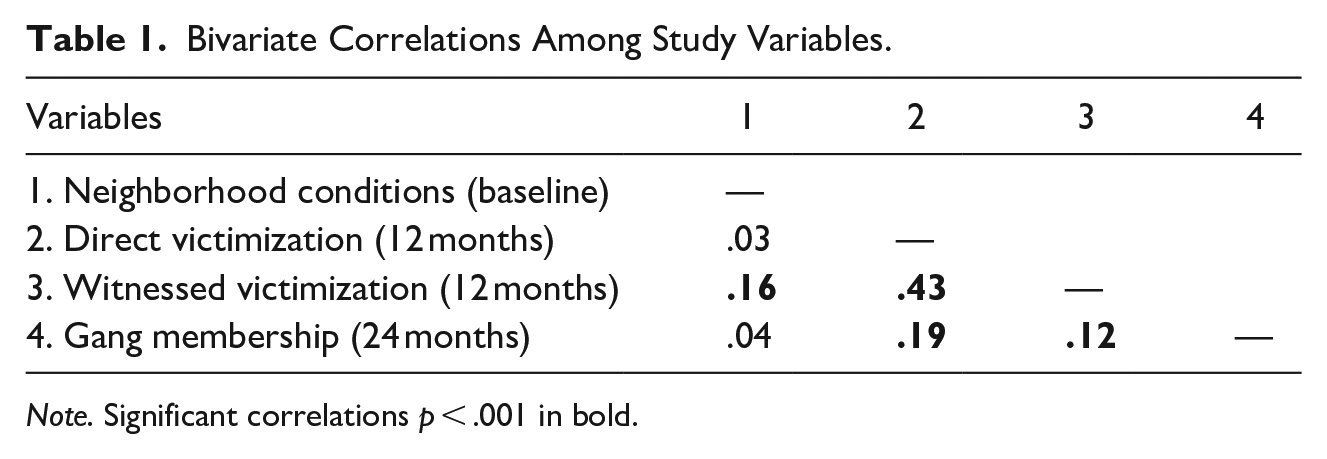
Note. Significant correlations p < .001 in bold.
A MANOVA was conducted to examine differences in baseline neighborhood conditions and direct and witnessed violence victimization at the 12-month follow-up across race and ethnicity. Results showed a significant overall main effect of race and ethnicity based on Wilks’ Lambda, λ = .91, F(6, 2388) = 20.11, p < .001, η2 = .048. Following a Bonferroni correction (p = .02), there were also significant main effects of race and ethnicity on neighborhood conditions at baseline, F(2, 1196) = 43.97, p < .001, η2 = .066, and on witnessed victimization at 12 months, F(2, 1196) = 46.05, p < .001, η2 = .018. However, there was no significant main effect for direct victimization during the 12-month follow-up, F(2, 1196) = 2.35, p = .034. Post hoc tests indicated that African American adolescents reported higher adverse neighborhood conditions relative to Latinx youth and that both groups reported higher adverse neighborhood conditions than non-Hispanic White adolescents. African American adolescents also reported higher witnessed victimization than both Latinx and non-Hispanic White youth. See Table 2for detailed statistical information regarding post hoc analyses.
MANOVA Mean Differences Based on Race and Ethnicity.
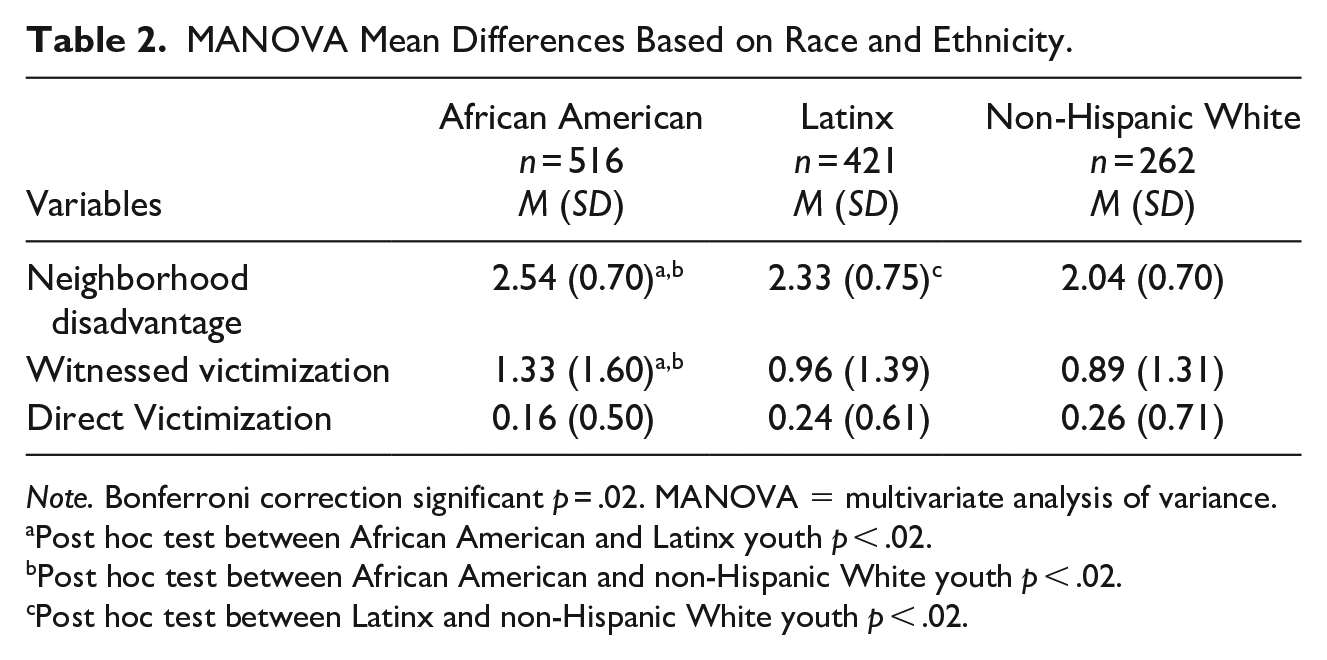
Note. Bonferroni correction significant p = .02. MANOVA = multivariate analysis of variance.
Post hoc test between African American and Latinx youth p < .02.
Post hoc test between African American and non-Hispanic White youth p < .02.
Post hoc test between Latinx and non-Hispanic White youth p < .02.
A series of χ2 tests were conducted to examine whether gang membership differed across race and ethnicity. Results indicated that, among the 114 adolescents who endorsed gang membership at 24 months, the percentage of Latinx youth (68%) was statistically higher from the proportion of African American, 25%; χ2(1) = 35.51, p < .001, and non-Hispanic White youth adolescents, 8%; χ2(1) = 31.34, p < .001. There was no difference in the proportion of gang members who identified as African American and non-Hispanic White, χ2(1) = 1.68, p = .195.
Path Model and Indirect Effects
For the present analyses, the model constraining the paths to be the same across African American, Latinx, and non-Hispanic White adolescents demonstrated better relative fit than the model allowing paths to differ as indicated by decreasing AIC (unconstrained model = 7998.90; constrained model = 7972.23) and BIC (unconstrained model = 8280.83; constrained model = 8110.63) values and a nonsignificant log-likelihood ratio test, χ2(28) = 30.01, p = .363. This suggests similar pathways toward gang membership for youth across ethnicity and race; therefore, the results corresponding to the constrained model are reported (see Figure 1).
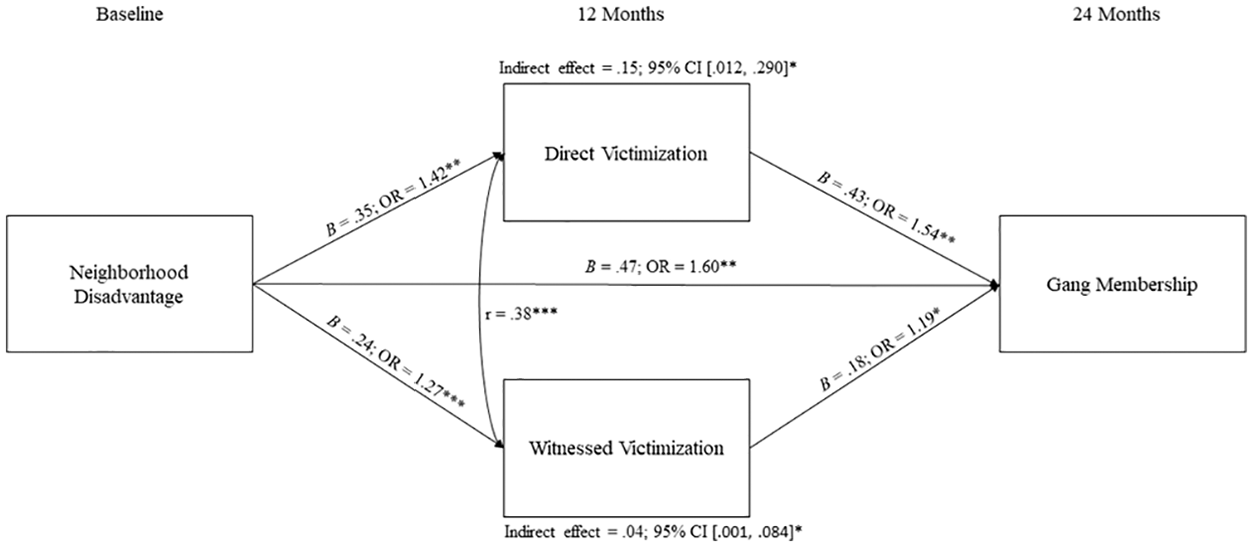
Model with paths constrained to be equal across race and ethnicity.
Results from the constrained model show that, after controlling for age, gender, and recruitment site, baseline neighborhood conditions significantly predicted 12-month direct, B = .35, p = .001, odd ratio (OR) = 1.42, 95% CI [.134, .568], and witnessed victimization, B = .24, p < .001, OR = 1.27, 95% CI [.130, .354], and increased the likelihood of 24-month adolescent gang membership, B = .47, p = .004, OR = 1.60, 95% CI [.154, .784]. In turn, direct, B = .43, p = .002, OR = 1.54, 95% CI [.153, .708], and witnessed, B = .18, p = .027, OR = 1.19, 95% CI [.020, .332], victimization at 12-month increased the likelihood of gang membership at 24-month for adolescents. There were significant indirect effects between neighborhood conditions and gang membership through direct victimization, unstandardized indirect effect = .15, p = .033, 95% CI [.012, .290], and witnessed experiences, unstandardized indirect effect = .04, p = .044, 95% CI [.001, .084]. The total indirect effect from neighborhood conditions to gang membership through a combination of the direct and witnessed victimization paths was also significant, unstandardized total indirect effect = .19, p = .008, 95% CI [.051, .337].
Discussion
Adolescent gang membership has been identified as a critical public health concern with numerous detrimental consequences for individuals and society at large (e.g., Connolly & Jackson, 2019; Gilman et al., 2014a; Harp, 2020). A growing body of empirical work suggests that adverse neighborhood conditions, which likely reflect sociopolitical and socioeconomic disparities within the broader social ecology, and victimization experiences may function as relevant risk factors propelling youth toward gang membership (Blasko et al., 2015; Cahill et al., 2019; Gilman et al., 2014b; Kephart, 2022; Hill et al., 1999; Kubik et al., 2019; Merrin et al., 2020; Papachristos & Hughes, 2015; Wojciechowski, 2021). However, the literature to date has not incorporated an integrated trauma-informed developmental-ecological perspective, which suggest dynamic interconnections among distal and proximal factors that confer risk and resilience for gang membership versus nonmembership (Bronfenbrenner, 1979; Kerig & Mendez, 2022; Marshall, 2013; Mascolo et al., 2016; Suárez-Orozco et al., 2018; Thornberry et al., 2003). In addition, few studies have examined whether these factors result in similar or different trajectories toward gang participation for youth from distinct racial and ethnic backgrounds. To address these gaps in the literature, the present study examined the relation between neighborhood conditions and gang membership through experiences of direct and witnessed victimization and tested whether these paths differ based on race and ethnicity.
As with previous studies (e.g., Bradshaw et al., 2013; Hwang & Sampson, 2014; Wright et al., 2014), African American and Latinx adolescents in the present study reported higher levels of adverse neighborhood conditions at baseline relative to non-Hispanic White youth. Further, African American youth endorsed more adverse neighborhood conditions than Latinx adolescents. Similarly, African American adolescents reported more witnessed victimization at the 12-month follow-up relative to both Latinx and non-Hispanic White youth. Surprisingly, there were no significant differences regarding witnessed violence between Latinx and non-Hispanic White adolescents and for direct victimization across race and ethnicity, which is a finding inconsistent with previous research (e.g., Abram et al., 2004; Roberts et al., 2011; Wright et al., 2014). However, in partial support of past empirical work (Merrin et al., 2015; Wojciechowski, 2021), Latinx adolescents were more likely to be gang members at 24 months post-baseline relative to their African American and non-Hispanic White peers. Taken together, these findings highlight the value of attending to disparities in risk factors for problem behavior, such as gang membership across racial and ethnic groups.
Despite the disproportionality of adverse neighborhood conditions among African American and Latinx adolescents and the higher level of witnessed victimization for African American youth, in the present study, the model with paths constrained to be equal across racial and ethnic groups demonstrated better relative fit to the model allowing for differences. This finding indicates that trajectories toward gang membership are similar across race and ethnicity, which builds on previous research highlighting cumulative trauma exposure as a risk for gang involvement regardless of race or ethnicity (Mendez et al., 2020). Future studies seeking to explain ethnic and racial disproportionalities in gang membership may benefit from examining potential mechanisms that are more tightly intertwined with race, ethnicity, and culture, such as racial and cultural discrimination, ethnic identity, and acculturation (Barrett et al., 2013; Hautala et al., 2016; Knight et al., 2012).
In the constrained model, aligning with our propositions, neighborhood conditions during baseline and direct and witnessed victimization at 12 months individually predicted gang membership at the 24-month follow-up. These findings are consistent with prior theory, including the social disorganization hypothesis (Shaw & McKay, 1942, 1969) and more recent trauma-informed frameworks on gang membership (Beresford & Wood, 2016; Kerig et al., 2013; Kerig & Mendez, 2022), and existing empirical evidence (Gilman et al., 2014b; Hill et al., 1999; Kubik et al., 2019; Merrin et al., 2020). Moreover, the current study found that direct and witnessed victimization mediated the relation between neighborhood conditions and gang membership. These results expand our existing knowledge and underscore the value of an integrated trauma-informed developmental-ecological perspective for elucidating the dynamic interrelations among risk and resilience factors at different levels of the social ecology (Bronfenbrenner, 1979; Kerig & Mendez, 2022; Marshall, 2013; Mascolo et al., 2016; Suárez-Orozco et al., 2018; Thornberry et al., 2003). Notably, the indirect effect for direct victimization was particularly strong, which may reflect the fact that direct experiences of violence are aspects of a youth’s microsystem, the level of the environment most proximal to the individual. In contrast, witnessing violence may be conceptualized as occurring within the mesosystem, which is a more distal level of the social ecology. Further, these findings provide additional support for the assertion that distal factors in the environment may exert their influence on youths’ behaviors through proximal factors. Ultimately, future studies seeking to better understand adolescent gang membership will benefit from continuing to investigate the interconnections of diverse risk and protective factors at different levels of the social environment. In particular, future work that examines more directly the effects of socioeconomic and sociopolitical factors on neighborhoods, victimization, and gang participation would help advance the field.
The present study has a number of strengths, including leveraging a publicly available dataset of a large and diverse sample of adolescents involved in the juvenile justice system, which increased the likelihood of gang membership endorsement. Additionally, this dataset utilized a longitudinal design, which allowed the present study to examine an integrated trauma-informed developmental-ecological model of gang membership over time. However, several limitations should be considered. For example, for this study, the last data collected was in 2005, making the data 17 years old. Thus, potential cohort effects may limit the internal validity and generalizability of these findings to newer generations. Specifically, given that the historical, socioeconomic, and sociopolitical shifts that have occurred within the broader ecology, and within different communities since then, such as frequent school mass shootings, Obama’s and Trump’s administrations, several refugee crises, and the COVID-19 pandemic (www.historycentral.com), were not accounted for in the present study. The field would benefit from future studies seeking to confirm these findings by leveraging up-to-date information on sociological, economic, and ecological factors. Similarly, participants in this project were identified as serious offenders, which may also limit the generalizability of the current findings to justice-involved youth with less severe offenses and youth in the wider community. In addition, given that African American, Latinx, and non-Hispanic White adolescents were the only ethnic and racial groups for which the dataset included a sizable sample, the present study was not able to examine putative differences across other minoritized groups, including Native Americans and Asian Americans. In a similar vein, this project grouped Latinx adolescents into a single category, precluding examination of differences among youth from distinct Latinx backgrounds, such as those identifying as Mexican American or Puerto Rican. Though well-established as a valid method to assess gang participation (Esbensen et al., 2001), the binary measure of gang membership is another relevant limitation given that it does not allow an in-depth understanding of the degree of youth involvement and embeddedness in the gang (James, 2022). Future work may benefit from adopting these alternative more nuanced measures of the type and depth of youth participation in gang activities (Pyrooz et al., 2019). Lastly, the data used in the present study included only adolescent self-reports and a single measure of each construct, and thus was vulnerable to monoinformant and monomethod biases. Future studies would benefit from leveraging data collected across different social ecological levels, particularly within the broader environment (e.g., effects of laws, regulations, and policies, historical events, country-wide socioeconomic conditions) within a highly diverse sample to address these limitations.
Despite these limitations, the present findings suggest several research implications. Primarily, these findings highlight the need to continue examining interrelations among the mechanisms that propel adolescents toward gang participation. For example, it would be beneficial for future studies to elucidate the community and family processes linking adverse neighborhood conditions to direct and witnessed victimization, as this information may provide important considerations for early gang prevention. It is plausible that low levels of social capital and cohesion within a neighborhood with concentrated adversity may heighten adolescents’ risk of witnessing community violence (e.g., Sampson, 1992; Rankin & Quane, 2002). Similarly, parents living in a neighborhood with adverse conditions may experience high levels of parenting stress and economic instability. These parental stressors may lead to adolescents having more unstructured time without supervision within neighborhoods, leading to heightened vulnerability to witnessed and direct victimization within the community (e.g., Atunes & Ahlin, 2014; Sampson, 1992, Vigil, 1988). Additionally, parenting adversities may increase the risk that children will experience direct victimization within the family (e.g., Atunes & Ahlin, 2014; Sampson, 1992). In turn, another relevant direction for future research will be to examine the putative paths from victimization experiences to adolescent gang membership, which may provide further insights for prevention and treatment. Aligning with the recent trauma-focused approach to gang involvement (Beresford & Wood, 2016; Kerig et al., 2013; Kerig & Mendez, 2022), posttraumatic reactions that follow victimization experiences, and their disruptive effects on emotional, social, moral, and behavioral systems, may propel youth toward gangs (Kerig & Mendez, 2022 Wojciechowski, 2021). Similarly, youth may turn to gangs for protection from victimization (Decker et al., 2012; Kerig et al., 2013; Wojciechowski, 2021), both within the community and the family. However, evidence indicates that far from shielding youth from further harm, gang membership is related to increased ongoing victimization (Melde et al., 2009, 2012). Therefore, another fruitful line of research may be to test the bidirectional relations among neighborhood conditions, victimization, and gang participation (Kerig & Mendez, 2022; Krohn et al., 2011).
Additionally, effective prevention and intervention efforts geared toward gang membership may benefit from attending to multiple levels of the social ecology. In particular, the present study highlights the need to focus prevention programs on the community level, which may help shift adolescents’ attention toward prosocial influences that may both compete with the pull of local gangs and decrease youth victimization (Abdul-Adil & Suárez, 2022; Lenzi et al., 2012). Interventionists looking to create such programs will benefit from working with service system coalitions and residents to base these preventative measures on the communities’ needs and strengths (Abdul-Adil & Suárez, 2022; Lasker et al., 2003). In addition, preventative programs geared toward assessing and addressing needs at the family level, particularly for families from neighborhoods with concentrated adversity, may help decrease youth victimization experiences and the attraction of gang life (Abdul-Adil & Suárez, 2022; Cornelissen et al., 2018; Posick & Rocque, 2015). Given the relevant role of victimization in pathways to gang involvement, interventions also are likely to be more successful when they are trauma-informed (Kerig & Mendez, 2022). Indeed, a nascent but growing body of evidence supports the use of trauma-informed interventions at the community level, including neighborhoods and hospitals, to dissuade gang violence and encourage gang desistance (e.g., Dierkhising & Kerig, 2018; Roman et al., 2017). It is worth noting that concentrated adversity within communities and levels of violence exposure also reflect broader factors in the youths’ environment, such as socioeconomic and sociopolitical disparities. Thus, preventative efforts at this level of the social ecology may be most helpful.
Conclusion
In conclusion, using a large and diverse sample of serious offenders, the present study examined mechanisms propelling adolescents toward gang membership from an integrated trauma-informed developmental-ecological perspective. The results indicate that adverse neighborhood conditions are related to the increased likelihood of gang membership via direct and witnessed victimization experiences. In addition, these pathways are similar across ethnic and racial groups despite disproportionalities related to residing in neighborhoods with concentrated adversity and experiencing victimization. Overall, these results highlight the need to continue investigating dynamic interconnections among risk factors for gang participation at various levels of the social ecology. These findings also point to the potential benefits of prevention and interventions efforts targeted toward risks of adolescent gang membership across the ecological system.
Footnotes
Declaration of Conflicting Interests
The author(s) declared no potential conflicts of interests with respect to the authorship and/or publication of this article.
Funding
The author(s) received no financial support for the research and/or authorship of this article.
