



Abstract
The #MeToo movement has provoked a worldwide discussion about sexual violence. Some critics of the movement argue that it violates the presumption of innocence. In the current study, we investigated the determinants of the perception of the presumption of innocence in the context of media depictions of violence. We took into account previous studies that suggest that people view more favorably defendants in rape trials than they do men accused of other crimes and that people view more favorably defendants with a high socioeconomic status than they do those with a low socioeconomic status. The current study investigated whether the perception of the presumption of innocence is related to the type of crime (sexual vs. nonsexual assault) or to the socioeconomic status of the defendant (a famous writer vs. a maintenance worker). We conducted a vignette-based study with a sample of Polish people (N = 158). The type of crime did not influence the perception of the presumption of innocence; however, women who participated in the study endorsed the presumption of innocence to a greater extent when the defendant had a high socioeconomic status. The theoretical and practical implications of these results are discussed.
Introduction
The phrase “me too” in the context of sexual violence appeared in the media in 2006 when African-American activist Tarana Burke discussed how she had not known how to react to the experience of a 13-year-old sexual violence survivor who probably just needed to hear “me too” (Alberski, 2017). Ten years later, after the emergence of the sexual abuse allegations against Harvey Weinstein, an American film producer, the phrase “me too” went viral. On 15th October 2017, Alyssa Milano—an American actress—made a Twitter post encouraging women who have experienced rape or sexual harassment to write a post with the hashtag #MeToo. Within a day, 4.7 million Facebook (currently: Meta) users from all over the world had written a post with this hashtag (CBS, 2017).
Reactions to the #MeToo Movement
The #MeToo Movement contributed to an increase in interest in the problem of sexual violence—according to Levy and Mattsson (2022), the amount of content related to sexual assault and sexual harassment increased substantially in four major U.S. newspapers after the emergence of #MeToo for at least 9 months. The #MeToo movement encouraged people to speak out against sexual violence (Alaggia & Wang, 2020). According to Glos (2019), who conducted a qualitative study among 13 rape survivors, the #MeToo movement permitted this group to feel that they were not alone, encouraged openness about traumatic experiences, and helped them to validate the fact that these experiences were problematic. Moreover, a longitudinal study conducted by Szekeres et al. (2020) demonstrated that after the emergence of the #MeToo movement, Americans became less likely to dismiss the problem of sexual assault, and this change persisted in a follow-up conducted 6 months later. Based on the analysis of data from 31 countries, Levy and Mattsson (2022) demonstrated that in countries where the #MeToo movement was strong, the reporting of sex crimes increased after its emergence.
Nonetheless, the #MeToo movement also met with backlash. For example, Michael Haneke, an Austrian film director, called the #MeToo campaign “a witch hunt” (Wright, 2018) and Andrew D. Leonie, Texan associate deputy attorney general, claimed that the harassment allegations that appeared in the public space after the emergence of #MeToo are “pathetic” (Astor, 2017). Criticism of #MeToo was not confined to men. For example, 100 French women, including Catherine Deneuve, a famous actress, wrote a letter arguing that the #MeToo movement hampers men’s right to pick up women (Le Monde, 2018). Another example is the Polish pop star Doda who said that the actresses who were harassed by Harvey Weinstein consented to his behavior since they did not reveal the abuse earlier, not wanting to lose out on attractive film roles (Onet, 2018).
The #MeToo Movement across Countries and Cultures
Although #MeToo originated in the United States, the movement quickly became widespread throughout the world. However, people from different countries differ in their perception of the #MeToo movement. For example, Kunst et al. (2019) demonstrated that in Norway, one of the most egalitarian countries in the world, the #MeToo movement was seen as more harmful than in the United States. Levy and Mattsson (2022) underscore that the #MeToo movement did not have an equally strong impact in all countries. They analyzed Google Trends data for OECD countries and found that after the emergence of the #MeToo movement, searches related to sexual violence and sexual harassment increased substantially; however, this effect did not occur in all countries.
Poland is one of the countries where such an effect did not occur. This may be due to the fact that Poland is a highly conservative country (Donaldson et al., 2017) and high levels of conservatism hamper social change. Thus, investigating the perception of media depictions of sexual violence among the general Polish population may be illuminating.
The #MeToo Movement and the Presumption of Innocence
One of the arguments used by critics of the #MeToo campaign is the idea that public disclosures of sexual violence violate the presumption of innocence (e.g., Dershowitz, 2019). This argument was brought up not only by conservatives, but also by people known for their feminist worldview, such as Margaret Atwood, a famous Canadian writer (Kassam, 2018). In Poland, this argument was used as well; for example, after a public sexual harassment accusation against two left-wing publicists, Michał Wybieralski and Jakub Dymek, 91 Polish journalists, artists, and academics issued an open letter suggesting that disclosing sexual violence cases to the media endangers the presumption of innocence guaranteed by the Polish Constitution (Onet, 2017). In the current study, we would like to focus on this argument.
Presumption of innocence existed already in Hammurabi’s code and is based on the assumption that the defendant is innocent until proven guilty (Tanoos, 2017). Tanoos (2017) underscores that the freedom of media cannot be exercised at the expense of the presumption of innocence. Nonetheless, Lessard (2017) points out that the presumption of innocence is sometimes used as a pretext to silence people who disclose their experiences of being victimized. He notes that the presumption of innocence should be placed in its legal context: its function is to protect the defendant against the power of the state (i.e., the court), not against public opinion. Waterhouse-Watson (2016) notes that journalists who report on court cases, especially high-profile ones, may face a conflict between the imperative to not presume guilt (either that of the defendant or that of the complainant) and the imperative to debunk misconceptions about rape (rape myths), including, for example, the claim that women routinely fabricate rape accusations, which is not supported by scientific evidence (e.g., Lisak et al., 2010). Myths included in media coverage may influence readers’ view of rape cases. For example, Franiuk et al. (2008a, 2008b) demonstrated that people exposed to myth-endorsing media content are more inclined to believe that a complainant in a rape case is lying and to express rape-supportive attitudes.
Presumption of Innocence Among the Public: Possible Biases, Causes, and Consequences
As far as we are aware, there are currently no published studies on perceptions of the presumption of innocence among the public. However, there is some evidence regarding certain biases concerning survivors and perpetrators of violence that may affect the perception of the presumption of innocence.
First, there is some evidence that people tend to blame the victim and exonerate the perpetrator in cases of sexual assault to a greater extent than in cases of nonsexual assault (Bieneck & Krahé, 2011; Spille, 2015). This may be related to the lower social status of the typical victim of sexual assault compared to the typical victim of nonsexual assault, since most sexual assaults are committed against women, whereas most nonsexual violent crimes are committed against men (e.g., Ministry of Justice, 2010). We also have to take into account that some rape myths are prevalent, for example, according to Eurobarometer (2016), 27% of European Union (EU) citizens believe that there exist some circumstances where nonconsensual sex can be justified (e.g., if the woman is intoxicated with alcohol or drugs). Thus, we can hypothesize that participants will more strongly endorse the presumption of innocence in the case of a sexual than a nonsexual assault.
There is also some evidence that the socioeconomic status of the defendant plays a role in the perception of the case. According to a meta-analysis by Mazzella and Feingold (1994), a low-status perpetrator of theft is perceived as more guilty than a high-status one and a low-status rape perpetrator as deserving a more severe punishment than a high-status one. Black and Gold (2008) demonstrated that men acknowledge the perpetrator’s responsibility for date rape to a greater extent when the perpetrator has low socioeconomic status than when he has high socioeconomic status. Moreover, Nyúl et al. (2018) demonstrated that perception of the perpetrator of a sexual assault as a successful person negatively predicts the probability of perceiving the assault as rape. Waterhouse-Watson (2013, as cited in: Royal, 2019) distinguished five stereotypes of a woman who claims she has been raped based on analysis of media coverage of rape accusations among football players: the “Gold Digger,” the “Woman Scorned,” the “Party Girl,” the “Groupie,” and the “Predatory Woman.” Two of these are inherently related to the high socioeconomic status of the defendant: the “Gold Digger” who fabricates a rape accusation in the hopes of significant compensation and the “Groupie” who is always ready to have sex with handsome and famous men and is thus “unrapeable.” Therefore, we can hypothesize that participants will more strongly endorse the presumption of innocence in the case of a high-status defendant than a low-status defendant.
Biases related to violence can be explained with system justification theory, which suggests that people are motivated to justify the existing social order, even at the expense of their personal or group interests (Jost & Banaji, 1994; Jost et al., 2004). There is some evidence for a link between system justification and perception of crimes: system justification is linked to rape myth acceptance (Chapleau & Oswald, 2014; Łyś et al., 2023, 2021), rape victim blaming (Ståhl et al., 2010), lack of support for the #MeToo movement (Kende et al., 2020), and lack of support for legislation against hate crimes when the target of a hate crime is a member of a low-status group (Mallett et al., 2011). These results suggest that perception of crimes may be influenced by motivation to preserve the status quo. Favoring a high-status defendant over a low-status defendant or a survivor of a crime that typically affects men over a survivor of a crime which typically affects women may have a system-justifying function.
The bias in favor of high-status defendants may lead to the secondary victimization of people who experience violence from such defendants. When a defendant has high status, their achievements are sometimes used as a mitigating circumstance. For example, the father and sister of Brock Turner, convicted of the sexual assault of a female student Chanel Miller, wrote a letter to the judge handling his case invoking his academic and sporting potential and his potentially bright future that, according to them, was endangered because of the trial (Hamilton, 2016). This kind of argument is used in Polish media as well: when Roman Polański, one of the most famous Polish film directors, was convicted of the sexual abuse of a 13-year-old girl, a Polish journalist from a liberal newspaper Gazeta Wyborcza, Seweryn Blumsztajn, wrote: I do not excuse what Polański has done. I only appeal for humility towards a great talent. That is a gift with regards to which we are helpless in our moral judgements. I can of course be all smug about how noble I am—I have never conducted myself as badly as Polański. So what? I cannot achieve anything as outstanding as he did (Blumsztajn, 2009). Sometimes accusing a famous man may have detrimental consequences for the survivors. For example, the woman who accused Ched Evans, a famous Welsh football player, of a sexual assault, has faced enormous levels of cyberviolence—one social media post even claimed that she should be hung, drawn, and quartered (Royal, 2019). The cyberviolence became so intense that she had to relocate and change her identity (Malone, 2012). The results of Knight et al. (2001) seem to support the existence of a bias in favor of high-status defendants: they found that for white, but not black, defendants accused of sexual assault, people are more inclined to believe that the victim enjoyed the act when the defendant was a celebrity than when he was not famous.
The bias in favor of high-status defendants may also be linked with the problem that low-status people accused of violent acts may be too hastily labeled as guilty. The evidence for the bias against low-status defendants demonstrated in previous research (Black & Gold, 2008; Mazzella & Feingold, 1994) seems to support this concern.
Current Study
In the current study, we investigate whether the tendency to endorse the presumption of innocence outside the legal context depends on the kind of crime and the defendant’s socioeconomic status. Taking into account the evidence for bias against rape survivors (Bieneck & Krahé, 2011; Spille, 2015) and bias against low-status defendants (Black & Gold, 2008; Mazzella & Feingold, 1994), we would like to check whether the type of crime or the defendant’s socioeconomic status influences the perception of the presumption of innocence among the general population.
Hypotheses
This study was pre-registered with the Open Science Framework: https://osf.io/5mv84. In this article, we focus on the following hypotheses:
H1: Participants will more strongly endorse the presumption of innocence in the case of a sexual than a nonsexual assault.
H2: Participants will more strongly endorse the presumption of innocence in the case of a high-status defendant than a low-status defendant.
All the data and materials are available in the Open Science Framework: https://osf.io/x5w76/. The project has been accepted by the Ethical Review Board at the Faculty of Psychology at the University of Warsaw.
Methods
Participants
We recruited 270 participants; however, 112 of them did not pass the manipulation check. Thus, the final sample consisted of 158 participants, including 67 men (42.4%), 83 women (52.5%), and 8 persons who did not reveal their gender. The mean age of the sample was 38.70 (standard deviation [SD] = 13.29); 65 (43.3%) of the participants had higher education, 68 (45.3%) had secondary education, 11 (7.3%) had vocational education, and 6 (4%) had primary education. All the participants stated that Polish was their native language. The participants were recruited via Answeo—an online platform designed for recruitment of survey participants. They obtained a small sum of money (approximately 2 USD) as an incentive to participate in the study.
Procedure
The study was prepared online with Qualtrics. Participants gave informed consent. The topic of the study was framed as “beliefs concerning justice.” Participants were randomly assigned to one of four groups differing in the type of crime and the socioeconomic status of the defendant. They read a vignette concerning the crime and then answered the questions that served as the manipulation check. Then the participants responded to questionnaire items concerning the presumption of innocence in the case described in the vignette. At the end of the study, we asked participants what they thought the purpose of the study was—no one correctly identified that the study was about the presumption of innocence.
Materials
Vignettes describing a crime
The vignette was a text imitating a newspaper article concerning a crime. In the high-status condition, the defendant was a famous writer; in the low-status condition, the defendant was a maintenance worker. In the sexual assault condition, the defendant was accused of raping his female ex-partner; in the nonsexual assault condition, he was accused of beating her. The vignette is shown in Supplemental Appendix A.
Perception of the presumption of innocence
Perception of the presumption of innocence was measured with nine items asking about whether the participant put an emphasis on the presumption of innocence in the context of the case described in the vignette (e.g., As long as there is no sentence, Adam K. should be treated as an innocent person). The items were prepared by the study authors, based on arguments referring to the presumption of innocence seen in online discussions concerning sexual violence cases. They were scored on a 5-point Likert scale. After reliability analysis, we included five items in the final version of the scale. Its internal consistency was α = .78. The items are shown in Supplemental Appendix B.
Manipulation check
The manipulation check consisted of three questions which tested whether the participants read the text carefully enough. The questions were “What was the crime that Adam K. was accused of?” “What was the profession of Adam K.?” and “What was the name of the ex-partner of Adam K.?” The last question was not treated as a manipulation check—it was added as a distractor, to make the purpose of the experimental manipulation less clear.
Results
Demographic Variables and Presumption of Innocence
Endorsement of presumption of innocence among women was 16.47 (SD = 4.02), and among men was 18.16 (SD = 3.60). An unpaired t-test showed that men endorsed the presumption of innocence more strongly (t = 2.688, df = 148, p = .008).
The endorsement of presumption of innocence did not correlate significantly with age (r = .042, p = .610) or with education (F = .338, df1 = 3, df2 = 146, p = .798). Nonetheless, we should take into account that the groups of people with primary education and vocational education were very small (smaller than 20 persons).
Presumption of Innocence: The Role of the Participant’s Gender, Type of Crime, and Socioeconomic Status of the Defendant
To find any links between the type of crime, status of the defendant, and presumption of innocence, we conducted an analysis of variance (ANOVA). Due to the aforementioned difference between men and women in levels of endorsement of the presumption of innocence, we decided to include the participant’s gender; we therefore conducted a 2 × 2 × 2 (type of crime × defendant’s status × participant’s gender) ANOVA. The means and SDs for each term are shown in Table 1.
Endorsement of Presumption of Innocence: Means and SDs.
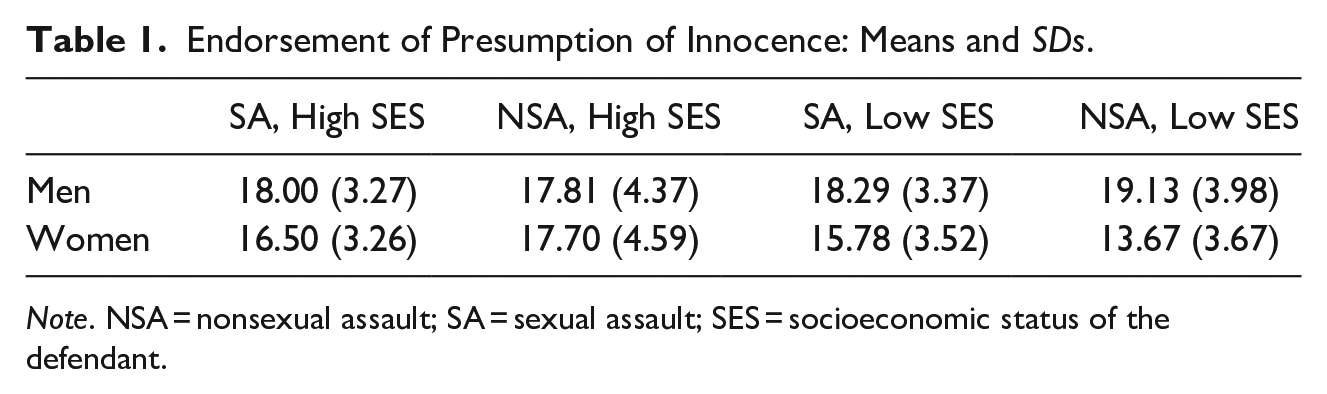
Note. NSA = nonsexual assault; SA = sexual assault; SES = socioeconomic status of the defendant.
The results of ANOVA are shown in Table 2.
Endorsement of Presumption of Innocence: Results of ANOVA.
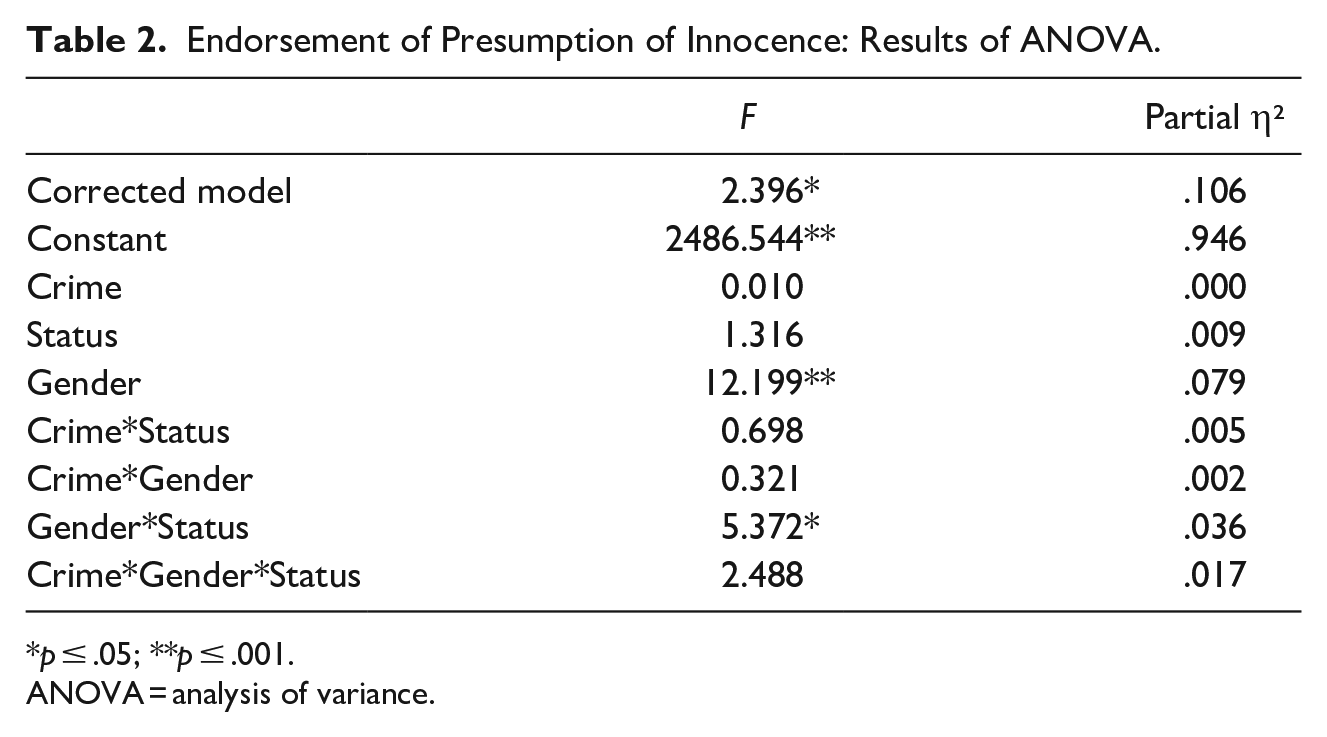
p ≤ .05; **p ≤ .001.
ANOVA = analysis of variance.
We found a main effect of the participant’s gender and an interaction effect between the participant’s gender and the defendant’s status: women tended to endorse the presumption of innocence to a greater extent when the defendant had a high status than when he had a low status, whereas among men there was no such regularity. This difference is presented in Figure 1.
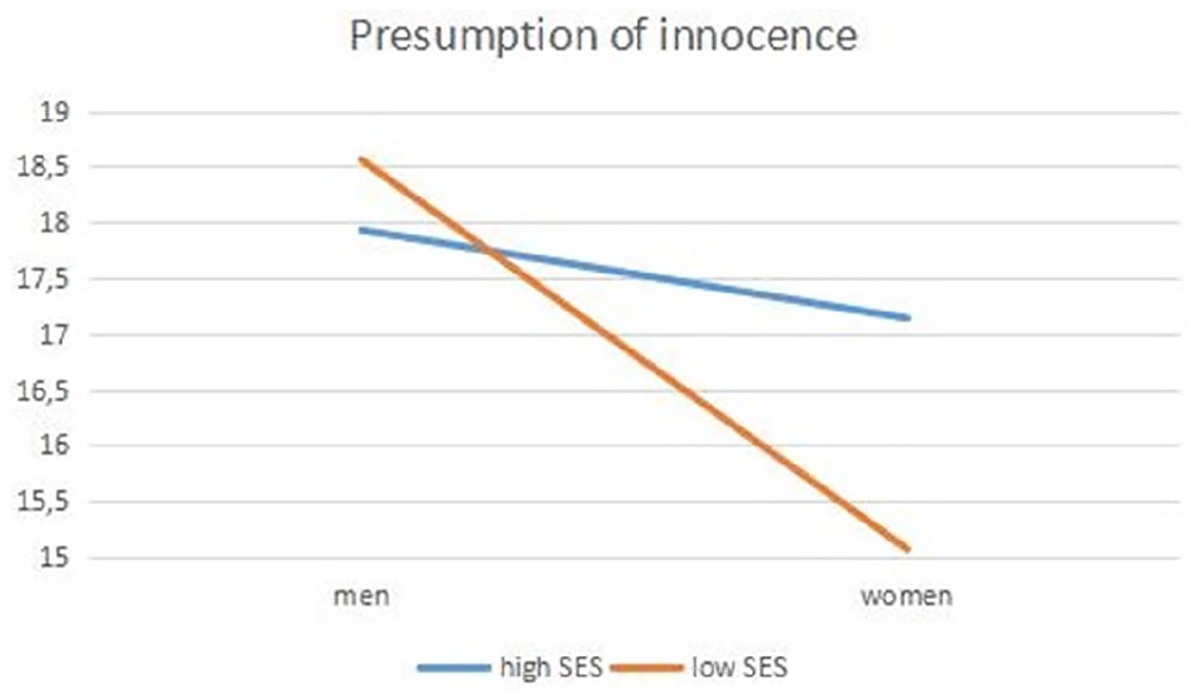
Endorsement of presumption of innocence: Role of the participant’s gender and defendant’s socioeconomic status.
There was no main effect of the type of crime nor any interaction between the type of crime and any other variable.
Discussion
The hypothesis that presumption of innocence is endorsed more strongly in the context of rape than in the context of beating (H1) was not supported. It turned out that the type of crime did not influence the perception of the presumption of innocence. Some other recent vignette-based studies (Felson & Palmore, 2018; Reich et al., 2021) did not confirm the hypothesis that rape is viewed more stereotypically than other crimes, either. They did not replicate the result demonstrated by Bieneck and Krahé (2011) and Spille (2015) who demonstrated that people are more inclined to exonerate the perpetrator and blame the victim in the case of rape than in the case of robbery. Perhaps the stereotypical view of rape has become no longer socially acceptable over the past few years. The aforementioned results found by Szekeres et al. (2020) suggest that after the emergence of the #MeToo movement, people started to treat the problem of sexual violence more seriously. However, there is some evidence that social acceptance of rape myths started to decline before the emergence of the #MeToo movement. Some studies suggest that rape myths have become more subtle with time (Gerger et al., 2007; McMahon & Farmer, 2011). For example, participants in the focus group study carried out by McMahon and Farmer (2011) unanimously stated that some myths included in the Illinois Rape Myth Acceptance Scale (Payne et al., 1999) are no longer relevant because almost no one would admit to agreeing with them today (e.g., Many women find being forced to have sex very arousing). Moreover, Beshers and DiVita (2019) demonstrated that, in 2017, the level of rape myth acceptance among American students was significantly lower than in 2010. The greatest difference existed for the “she asked for it” myths (i.e., myths related to the assumption that a rape victim provoked the perpetrator; e.g., When girls go to parties wearing slutty clothes, they are asking for trouble) and “she lied” myths (i.e., myths related to the assumption that false rape accusations are a pervasive problem; e.g., Rape accusations are often used as a way of getting back at guys). Royal (2019), based on her qualitative analysis of the media coverage of the Chad Evans case, also suggests that misconceptions about rape have become more subtle and covert. Thus, the bias against rape survivors may be less visible nowadays.
The hypothesis that presumption of innocence will be endorsed more strongly in the case of a high-status defendant than in the case of a low-status defendant (H2) was supported. It turned out that the presumption of innocence was endorsed more strongly when the defendant had high socioeconomic status than when they had low socioeconomic status. The bias against low-status defendants has already been demonstrated in previous research (Black & Gold, 2008; Mazzella & Feingold, 1994); nonetheless, our study demonstrates the presence of this bias in the context of media depictions of violent incidents, which is important when considering the enormous reach of the #MeToo movement (CBS, 2017). We should also take into account that the studies on which the meta-analysis by Mazzella and Feingold (1994) was based were mostly from the 1970s and 1980s. Our study demonstrates that favoring high-status defendants is still a problem. Furthermore, our study is, to our knowledge, the first study to demonstrate that this problem also exists outside the English-speaking world.
Our study is the first to examine the perception of the presumption of innocence among the general population. The bias in favor of the high-status defendant suggests that this perception is distorted by the qualities of the persons involved in the incident. Thus, our study demonstrates the need to improve education among the general public. Belief that a person who discloses being victimized violates the presumption of innocence may elicit unsupportive reactions toward people who disclose their victimization, especially when the defendant has a high socioeconomic status. We cannot neglect this problem since negative social reactions are linked with higher levels of post-traumatic stress disorder (PTSD) symptoms among sexual assault survivors (Ullman et al., 2006). On the other hand, the bias against low-status defendants may lead to ostracizing them. Thus, it is necessary to educate people about how our perception of other people is affected by their socioeconomic status, all the more so because there is a positive correlation between classism and rape myth acceptance (Aosved & Long, 2006), which suggests a link between inadequate perception of sexual violence and bias against disadvantaged people.
Limitations and Future Directions
We should take into account that the study was conducted only among Polish people; thus, we cannot be sure whether we can extrapolate its results to other countries and cultures. Perception of the #MeToo movement differs across countries and cultures (e.g., Kende et al., 2020; Kunst et al., 2019) and the perception of the presumption of innocence may therefore differ as well. A cross-cultural study of this topic would be useful.
Another limitation of this study is that we took into account the socioeconomic status of the defendant but not of the victim. There is some evidence that the status of the victim may also influence the perception of the assault (Spencer, 2016; Yamawaki et al., 2007; see also: Gravelin et al., 2019, for a review). Subsequent studies should also take into account the socioeconomic status of the victim, all the more so because low socioeconomic status is a risk factor for victimization (e.g., Ackerson & Subramanian, 2008; Field & Caetano, 2004; Reichel, 2017) and therefore a bias against low-status victims may be particularly harmful. There is some evidence (e.g., Maercker & Hecker, 2016; Mueller et al., 2008; Ullman et al., 2006) that social reactions to victims’ situations are an important and significant predictor of PTSDs. Socio-interpersonal relationships contain mechanisms that both prevent and may influence the development of PTSD in victims of various types of trauma (Eising et al., 2021).
We should also take into account that our sample contained more people with higher education than would be representative of the general population of the EU (Eurostat, 2020a). Thus, conducting a survey concerning the perception of innocence on a representative sample may shed new light on this issue. Moreover, as Black and Gold (2008) rightly noted, the participants of a study may be more inclined to identify with a perpetrator who has the same status as themselves. It is therefore important to replicate this study on a representative sample.
Unexpectedly, it turned out that the effect of the defendant’s socioeconomic status was significant only among women and not among men. As we mentioned earlier, bias in favor of a high-status defendant may have a system-justifying function. There is some evidence that the members of disadvantaged groups are more likely to justify the system (e.g., Dirilen-Gumus, 2011; Jost et al., 2003). Given that women are still a disadvantaged group in many ways (e.g., in terms of income; Eurostat, 2020b), this mechanism may be helpful in explaining why in our study women, but not men, turned out to be biased in favor of the high-status defendant. Our study then supports the system justification theory as a possible explanation for blaming the victims and exonerating the perpetrators of violent acts. On the other hand, women tend to have a lower level of system justification than men (e.g., Dirilen-Gumus, 2011; Goldsmith et al., 2013). Future studies should therefore include other possible explanations for this difference.
We also found that men had a higher level of endorsement of the presumption of innocence. That may result from the fact that men are accused both of rape and of physical violence more often than women (Ministry of Justice, 2010). Thus, the subsequent studies should also take into account the crimes of which women are accused more often than men, such as infanticide (Wilson et al., 2020).
Conclusion
The findings of this study demonstrate a socioeconomic status bias in the perception of the presumption of innocence in the context of media depictions of violence. Thus, journalists should be particularly careful when depicting cases where such a bias can occur to not infringe on the personal rights of either the complainant or the defendant.
Supplemental Material
sj-docx-1-jiv-10.1177_08862605221150461 – Supplemental material for Perception of the Presumption of Innocence in the Context of Media Depictions of Violence: The Role of Participant’s Gender, Type of Crime, and Defendant’s Socioeconomic Status
Supplemental material, sj-docx-1-jiv-10.1177_08862605221150461 for Perception of the Presumption of Innocence in the Context of Media Depictions of Violence: The Role of Participant’s Gender, Type of Crime, and Defendant’s Socioeconomic Status by Agnieszka E. Łyś, Kamilla Bargiel-Matusiewicz and Anna Studzińska in Journal of Interpersonal Violence
Footnotes
Declaration of Conflicting Interests
The author(s) declared no potential conflicts of interests with respect to the authorship and/or publication of this article.
Funding
The author(s) disclosed receipt of the following financial support for the research and/or authorship of this article: The study was financed by the funds from the Faculty of Psychology at the University of Warsaw awarded by the Polish Ministry of Science and Higher Education in the form of a subvention for maintaining and developing research potential in 2019 (grant number: 5011000247). The proofreading was financed by the funds from the Faculty of Psychology and Cognitive Science at the Adam Mickiewicz University in Poznań.

Supplemental Material
Supplemental material for this article is available online.
Author Biographies
References
Supplementary Material
Please find the following supplemental material available below.
For Open Access articles published under a Creative Commons License, all supplemental material carries the same license as the article it is associated with.
For non-Open Access articles published, all supplemental material carries a non-exclusive license, and permission requests for re-use of supplemental material or any part of supplemental material shall be sent directly to the copyright owner as specified in the copyright notice associated with the article.
