



Abstract
Research suggests that Indigenous girls, women, and LGBTQ+ Two-Spirit people experience disproportionately high rates of intimate partner violence (IPV), but there is a dearth of research on IPV among Indigenous college students. Therefore, the current study sought to explore rates of IPV victimization and perpetration among Indigenous college students, as well as correlates including depressive and anxious symptoms, emotion dysregulation, on-campus social support, and hazardous drinking. Participants were 230 undergraduate students who identified as American Indian/Alaska Native attending 20 medium- and large-sized universities across the contiguous U.S. Results indicated that 28.9% of Indigenous students reported any type of IPV victimization in the past 6 months (psychological: 24.5%; physical: 9.1%; sexual: 9.8%; coercive control: 12.4%). Further, 18.3% of Indigenous students reported any type of IPV perpetration in the past 6 months (psychological: 16.9%; physical: 4.5%; sexual: 2.6%; coercive control: 7.1%). Anxious and depressive symptoms were related to many forms of IPV victimization; emotion dysregulation was related to all forms of IPV victimization and sexual IPV perpetration; and hazardous drinking was related to most forms of IPV victimization and perpetration. These findings underscore the alarmingly high rates of IPV among Indigenous college students as well as the potential deleterious effects of IPV victimization on psychological functioning, as well as the need to concurrently address hazardous alcohol use in IPV prevention and response efforts.
Intimate partner violence (IPV)—which includes physical, sexual, and psychological abuse, as well as coercive control that occurs within the context of a dating/intimate relationship—is a serious problem on college campuses across the United States (U.S.) that leads to myriad deleterious outcomes (Brewer et al., 2018; Edwards et al., 2015). This underscores the critical importance of prevention and response efforts. Despite a growing body of research on IPV among college students, very little research has focused on IPV among Indigenous college students, which is the focus of the current paper.
Findings from the limited body of research that exists suggests that Indigenous girls and women as well as lesbian, gay, bisexual, transgender, queer, and other non-heterosexual or gender diverse (LGBTQ+) Two-Spirit Indigenous peoples experience disproportionately high rates of IPV (Black et al., 2011; Edwards, Siller, et al., 2022; Minnesota Indian Women’s Sexual Assault Coalition). IPV among Indigenous peoples must be considered within the context of colonization and multiple historical traumas (e.g., forced placement in boarding schools, cultural genocide) as well as ongoing traumas and stressors such as racism and poverty (Deer, 2015; Edwards et al., 2020; Smith, 2003; Warne & Lajimodiere, 2015). Indeed, prior to colonization, the wisdom of Indigenous elders suggests that IPV was rare in Indigenous communities (Deer, 2015; Smith, 2003).
To date, only three studies to our knowledge has focused specifically on IPV among Indigenous college students (Dion et al., 2021; Patterson Silver Wolf et al., 2018; Qeadan et al., 2021). First, secondary data analysis from four waves of the American College Health Association’s National College Health Survey (NCHS) documented concerning rates of past-year IPV among Indigenous students, specifically: emotional IPV victimization: 13%–14%, physical IPV victimization: 3%–6%, and sexual IPV victimization: 1% (Patterson Silver Wolf et al., 2018). Further, Qeadan et al. (2021) conducted a secondary analysis using a subsample of Indigenous college students who completed the American College Health Association National College Health Assessment II (NCHA) and documented that 15% of Indigenous college students reported IPV experiences in the past year and these experiences were positively related to opioid misuse (taking opioids that were not prescribed to them). Finally, Dion et al. (2021) conducted a large-scale study among college students in Canada and documented that compared to their non-Indigenous peers, Indigenous students experienced significantly higher levels of sexual harassment; however, no differences were found for unwanted sexual behaviors and experiences of sexual violence. Further, Dion et al. (2021)found that IPV victimization was related to lower grade point averages among Indigenous students. While important, these studies did not examine rates of IPV perpetration, and also did not examine other key correlates and outcomes associated with IPV. Further, Dion and colleagues (2021) focused on experiences of sexual violence only and did not assess other forms of IPV. Finally, the NCHS and NCHA assesses for experiences of violence but uses single item screeners for these experiences. As such, it is likely that this survey underestimates the IPV prevalence among Indigenous students.
The purpose of the current study was to extend previous findings and examine rates (Aim 1) and correlates (Aim 2) of both IPV victimization and perpetration among Indigenous students across 20 predominately White institutions of higher education in the U.S. Correlates included demographics, depressive symptoms, anxious symptoms, emotion dysregulation, on-campus social support, and hazardous drinking. These are correlates of IPV documented in samples of college students more broadly (Duval et al., 2020; Shorey et al., 2011). College students are an important population to study given the high rates of IPV (and other forms of violence, e.g., stalking) they experience (Edwards et al., 2015) and that IPV can disrupt a healthy transition into adulthood (Niolon et al., 2017). Indigenous college students, specifically, are an important population to study given preliminary research suggesting high rates of IPV among this population (Dion et al., 2021; Patterson Silver Wolf et al., 2018). While not linked to IPV, Indigenous students also frequently report experiencing racism and inadequate culturally grounded academic supports on college campuses (Musu-Gillette et al., 2017), as well as concerning rates of mental and behavioral health challenges (Liu et al., 2019; Ward & Ridolfo, 2011). Taken together, it is imperative to understand the experiences of IPV and mental and behavioral health concerns among Indigenous college students, particularly given that IPV may be a risk factor for these mental and behavioral health difficulties.
Method
Participants
Participants utilized in analyses for the current study were obtained from a larger sample of 11,871 enrolled undergraduate students (age 18–24) attending 20 medium- and large-sized public universities across the contiguous U.S. Only participants identifying as American Indian/Alaska Native were included in the current study (N = 230). We used the term Indigenous in this paper as it is preferred over American Indian/Alaska Native by our Indigenous co-authors and many of the Indigenous community partners with whom we work. The mean age of participants was 19.8 years old (range 18–24; SD = 1.65). Almost three-quarters of the sample identified as a woman (70.8%; n = 160) with the rest identifying as either a man (23.5%; n = 53) or trans or gender diverse (5.7%; n = 13). Approximately one-third (30.4%; n = 70) of participants identified as American Indian/Alaska Native only and 69.6% (n = 160) identified as multiracial. Finally, 29.7% (n = 66) identified as a sexual minority.
Procedure
The current data were collected in the Fall 2019 and Fall 2020 academic semesters during a 4- to 8-week period. The larger study focuses on campus climate specific to sexual minority college students, but the study was open to all undergraduate students between 18 and 24 years of age. Recruitment strategies varied across participating universities based on university policies and included individual emails to students as well as other recruitment methods (e.g., social media postings). Participants who met criteria (18 to 24 years of age; undergraduate student at participating institution) and consented, completed an online survey and could be entered into a drawing for one of five $50 gift cards awarded to students at each participating campus. Following survey completion, all participants received an electronic debriefing form with campus, local, and national resources. The East Carolina University (the location of the Co-Prinicipal Investigator) and University of Nebraska-Lincoln (the location of the Principal Investigator) Intitutional Review Boards (IRB) approved the study protocol. For a more detailed overview of the procedure, see Edwards et al. (2021).
Measures
Intimate partner violence
We used Dyar et al. (2021) Sexual and Gender Minority (SGM) Conflict Tactics Scale-2 (SGM-CTS2) to assess victimization and perpetration of psychological, physical, and sexual IPV as well as coercive control in the past 6 months. The 33-item SGM CTS-2 was derived from the Conflict Tactics Scale-2 (CTS-2) (Straus et al., 1996) as well as extant measures of coercive control. Specifically, Dyar et al. (2021) modified items from existing measures to be more inclusive of the experiences of SGM individuals (“My partner refused to use the safe sex methods that I requested to use.”) but the subscales used in the current study are relevant to all individuals including cisgender, heterosexual individuals. We did not include the SGM-specific IPV subscale in this paper given that only SGM college students could answer that. For each item, individuals were asked if a dating or sexual partner had done the following to them [victimization items]/they had done the following to a dating or sexual partner [perpetration items] in the past 6 months. Nine items assessed experiences of psychological IPV, 11 items assessed physical IPV, five items assessed sexual IPV, and eight items assessed coercive control IPV. Participants who endorsed any of the items on each subscale were coded as having experienced or perpetrated that form of IPV in the past 6 months.
Depression and anxiety symptoms
We measured past 6-month symptoms of depression and anxiety using the 21-item version of the Depression Anxiety Stress Scale (DASS-21) (Antony et al., 1998). We used the anxiety (seven items) and depression (seven items) subscales, specifically. Response options ranged from 0 (Did not apply to me at all) to 3 (Applied to me very much or most of the time). Items for each subscale were summed with higher values indicating higher levels of symptoms. In the present study, internal consistency was excellent for the depression subscale (α = .93) and good for the anxiety subscale (α = .89).
Emotion dysregulation
We used the 18-item Difficulties in Emotion Regulation Scale-Short Form (DERS-SF; (Kaufman et al., 2016) to assess emotion dysregulation. The DERS-SF contains six subscales: awareness, clarity, non-acceptance, goals, impulse, and strategies. Response options range from 1 (Almost never) to 5 (Almost always). A summed score was computed excluding the awareness subscale, consistent with prior research utilizing the DERS and DERS-SF (Hallion et al., 2018; Tull & Roemer, 2007). Higher values on the measure indicate more difficulties with emotion regulation. In the present study, internal consistency for the overall emotion dysregulation scales was good (α = .86).
On-campus social support
We modified the friends subscale of the Multidimensional Scale of Perceived Social Support to measure perceived peer support specific to one’s campus (Zimet et al., 1988). The modified subscale contained four items about support from friends on campus. Response options ranged from 1 (Very strongly disagree) to 7 (Very strongly agree). All items were summed with higher values indicating higher levels of perceived on-campus peer support. In the present study, internal consistency was excellent (α = .95).
Hazardous drinking
We administered the Alcohol Use Disorders Inventory Test (AUDIT-5) (Kim et al., 2013) to assess participants’ hazardous drinking during the past 6 months. The AUDIT-5 includes five questions assessing alcohol use as well as alcohol-related consequences. Response options vary for each item, and scores on each item can range from 0 to 4. All items were summed with higher values indicative of more hazardous alcohol use. Participants who did not report using alcohol in the past 6 months received a 0 on this measure. In the present study, internal consistency was acceptable (α = .73).
Data Analysis Plan
For Aim 1 (rates of IPV), we conducted frequencies. For Aim 2 (correlates of IPV), we conducted chi squares (for dichotomous variables) and correlations (for continuous variables).
Results
Aim 1
Overall, 28.9% of Indigenous students reported any type of IPV victimization in the past 6 months (psychological: 24.5%; physical: 9.1%; sexual: 9.8%; coercive control: 12.4%). Further, 18.3% reported engaging in any type of IPV perpetration in the past 6 months (psychological: 16.9%; physical: 4.5%; sexual: 2.6%; coercive control: 7.1%).
Aim 2
Rates of IPV victimization (0 = no reports of past 6-months IPV victimization and 1 = any IPV victimization in the past 6-months) did not vary as a function of demographics (see Table 1), specifically: Indigenous only compared to multiracial, χ2 (1, N = 180) = 2.73, p = .10, gender identity [man, woman, TGD], χ2 (3, N = 177) = 3.00, p = .39, sexual orientation [LGBQ+, heterosexual], χ2 (1, N = 173) = 0.07, p = .79, and age, t (178) = −0.03, p = .67. Additionally, rates of IPV perpetration (0 = no reports of past 6-months IPV perpetration and 1 = any IPV perpetration in the past 6-months) did not vary as a function of demographics (see Table 1), specifically: Indigenous only compared to multiracial, χ2 (1, N = 186) = 1.44, p = .23, gender identity [man, woman, TGD], χ2 (3, N = 183) = 1.98, p = .58, sexual orientation [LGBQ+, heterosexual], χ2 (1, N = 179) = 0.12, p = .73, and age, t (184) = 0.02, p = .76. Further, as depicted in Tables 2 and 3, whereas symptoms of anxiety and depression were positively related to most forms of IPV victimization, symptoms of anxiety and depression were unrelated to IPV perpetration. Emotion dysregulation was positively related to all forms of IPV victimization and sexual IPV perpetration but unrelated to other forms of IPV perpetration. On-campus social support was unrelated to all forms of IPV victimization and perpetration. Lastly, participants’ hazardous drinking was positively related to most forms of both IPV victimization and perpetration. Across all analyses, effect sizes were generally small.
Demographics and Rates of IPV Victimization and Perpetration Group Comparisons.

Note. n = number of non-missing cases; M = mean; SD = standard deviation; TGD = Trans and Gender Diverse; LGBQ+ = Lesbian, Gay, Bisexual, Queer, and/or other non-heterosexual identity.
p < .01. **p < .05.
Descriptive Statistics and IPV Victimization Correlates.
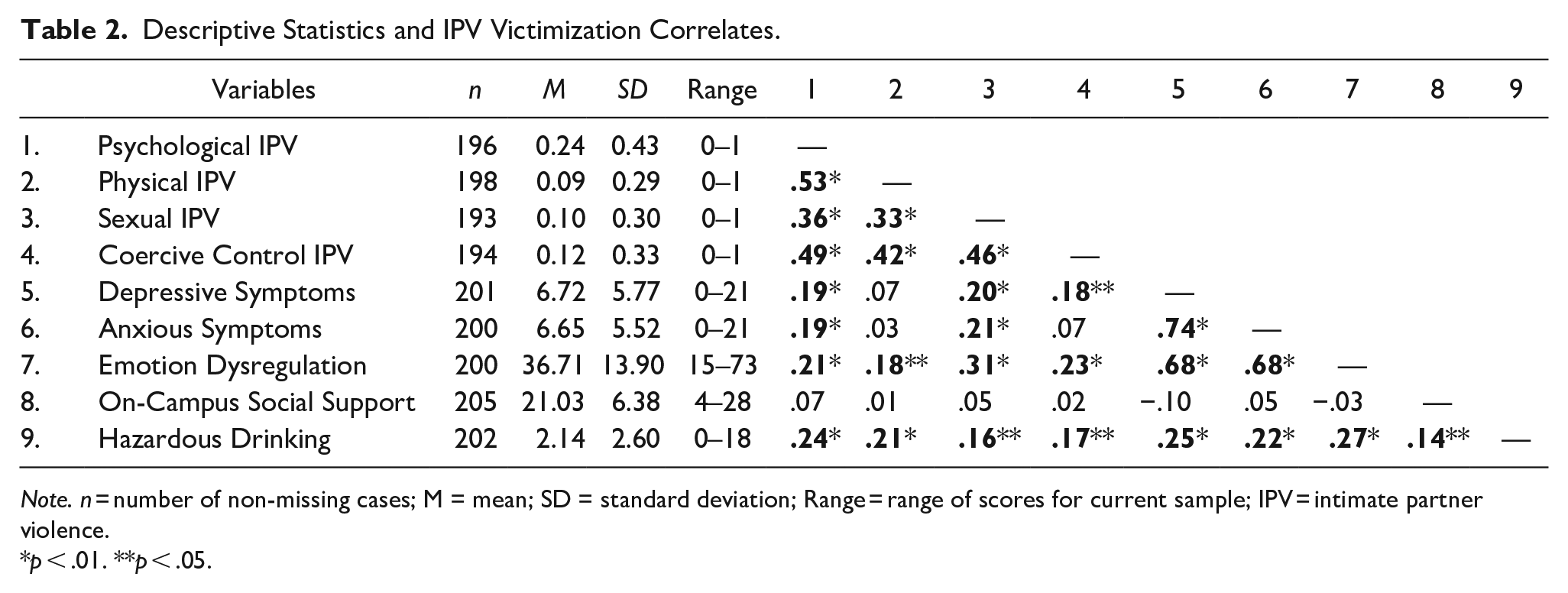
Note. n = number of non-missing cases; M = mean; SD = standard deviation; Range = range of scores for current sample; IPV = intimate partner violence.
p < .01. **p < .05.
Descriptive Statistics and IPV Perpetration Correlates.
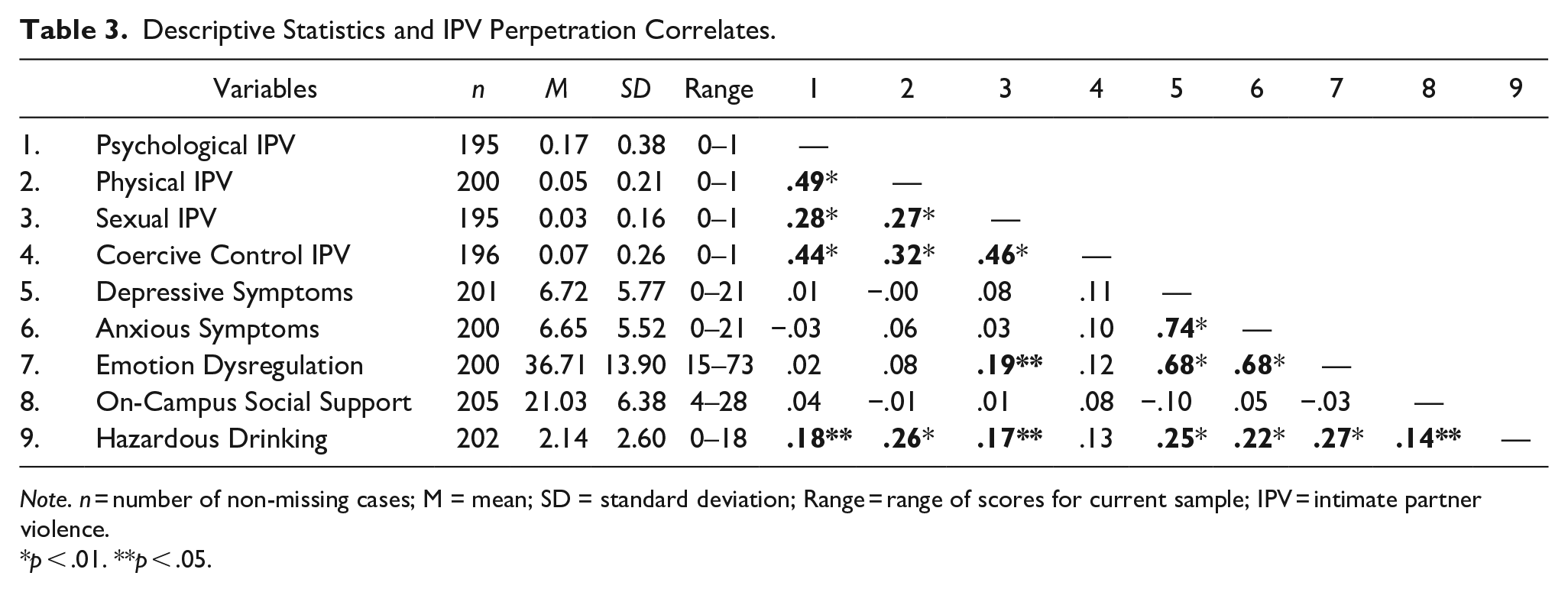
Note. n = number of non-missing cases; M = mean; SD = standard deviation; Range = range of scores for current sample; IPV = intimate partner violence.
p < .01. **p < .05.
Discussion
The purpose of the current study was to document rates and correlates of IPV among Indigenous college students. These findings documented concerning rates of past 6-month IPV victimization and perpetration, underscoring the urgency with which prevention and response efforts are needed for Indigenous college students. Moreover, these findings suggest that IPV among Indigenous college students had detrimental impacts as evidenced by the positive associations between IPV victimization and anxiety and depressive symptoms, although the cross-sectional nature of this research does not allow for strong inferences concerning causality. Further, the finding that hazardous drinking was positively related to most forms of IPV victimization and perpetration documents a clear need for the integration of alcohol misuse prevention with IPV prevention for Indigenous college students, like calls that have been made for college students more broadly (Zinzow et al., 2018).
The finding that emotion dysregulation was related to all forms of IPV victimization underscores the need to enhance intervention efforts that seeks to support adaptive regulation skills among survivors. Given that difficulties regulating emotions are linked to a range of psychological difficulties, including alcohol use (Messman-Moore & Ward, 2014; Tull & Roemer, 2007; Tull et al., 2009), tailored interventions designed to treat patterns of emotion dysregulation are warranted and may help assist individuals in IPV recovery as well as equip survivors, with tools to more effectively manage their emotional responses when experiencing conflict with their dating/romantic/sexual partners.
Although social support was unrelated to IPV victimization and perpetration in the current study, it is possible that this was an artifact of our measurement of on-campus social support only. Off-campus social support, especially social support from one’s immediate and extended families, may be especially important for Indigenous college students (Edwards, Herrington, et al., 2022; Ersan & Rodriguez, 2021; Jackson et al., 2003).
Of note, we utilized an IPV scale modified for SGM individuals although items are relevant to all individuals including heterosexual, cisgender individuals. The SGM-CTS2 was modified to have culturally appropriate measures capturing a broad range of types of IPV among SGM individuals by utilizing gender-affirming language, reducing heteronormative questions about sex, and adding coercive control and SGM-specific IPV (Dyar et al., 2021). Given 5.7% of our sample identified as trans or gender diverse and 29.7% as a sexual minority, it is possible that rates of IPV are higher in our sample in part due to utilizing an SGM-inclusive measure of IPV compared to heteronormative and cisnormative measures that may not encompass various nuances regarding IPV within relationships of SGM individuals or that may reduce engagement among SGM participants due to language used.
Despite the important information gleaned from this study, several limitations should be noted. The data were cross-sectional, and the sample was relatively small. Larger samples and prospective designs would allow us to determine temporal ordering among variables. For example, hazardous drinking may increase risk for IPV as well as be an outcome of IPV (Shorey et al., 2011); we were not able to assess these nuances. We also did not include a number of other correlates of IPV, especially culturally specific protective factors, that may reduce risk for IPV among Indigenous college students. Indeed, research with Indigenous adolescent girls documented that connection to one’s Indigenous culture was related to lower risk for IPV (Edwards, Siller, et al., 2022) and participation in traditional cultural activities has been shown to be related to less substance use among Indigenous college students (Greenfield et al., 2018). A number of Indigenous students in the study were also multiracial and future research is needed to gain a fuller understanding of their experiences with IPV. Despite these limitations, these data provide evidence of the high rates of IPV among Indigenous college students and highlight the need for culturally grounded alcohol misuse and IPV prevention efforts, as well as culturally grounded initiatives (that perhaps integrate emotion regulation skills training) and resources to support Indigenous college student survivors of IPV.
Footnotes
Declaration of Conflicting Interests
The author(s) declared no potential conflicts of interests with respect to the authorship and/or publication of this article.
Funding
The author(s) disclosed receipt of the following financial support for the research and/or authorship of this article: Funding for this study was provided by the National Science Foundation (NSF), Grant #
