




Abstract
This article reconstructs and analyzes the memories of women who were in the city of Valparaíso on September 11, 1973, the day of the coup d’état in Chile. Research participants were six women from the Valparaíso region, militants of leftist parties, and survivors of political imprisonment and torture during the Chilean civil-military dictatorship. We conducted a focus group and two semi-structured individual interviews. Data analysis was carried out in two stages: the first one phenomenological-hermeneutic and the second one based on Grounded Theory. The research results show that the day of the coup d’état in Valparaíso is remembered by women as a mighty and irrevocable milestone, functioning as a biographical event. The coup d’état means a before and after in civic experiences in social, political, and historical aspects and in the dwelling manners of the city.
Introduction
The President of the Republic speaks from La Moneda Palace. Confirmed information indicates that a sector of the navy has isolated Valparaiso, occupying the city, which means an uprising against the government, the legitimately constituted government, the government protected by law, and the will of the citizens.
Remarks by President Salvador Allende (7:55 a.m. Radio Corporación, September 11, 1973, Santiago)
In the early morning of September 11, 1973, the streets of the city-port of Valparaíso dawned occupied by the Armed Forces, who began to gather in what would be the prelude to the coup d’état against the socialist government of Salvador Allende. Military and Marines took control of the access roads to the port, port facilities, media, and universities, among others. The military raided the headquarters of trade unions and leftist political parties (Museum of Memory and Human Rights, 2020).
At 09:00 in the morning, the control was total. Afterward, the Naval War Academy, the local regiments, the naval air base El Belloto, the Playa Ancha Stadium, the ship Escuela Esmeralda, and crafts of the CSAV 1 became centers of reclusion and torture of people who supported the government of the Unidad Popular 2 (Goicovic, 2013).
In the Valparaíso region, 151 detention facilities have been recognized, including various private facilities, such as high schools, universities, the Train Port Station, and the Carlos van Buren Hospital, among others. The Chilean Navy ships, Maipo and Lebu, served as floating prisons, leaving the port of Valparaíso northward, carrying political prisoners to the Pisagua and Chacabuco Prison Camps, respectively (Museum of Memory and Human Rights, 2020). One of the places that functioned exclusively for the detention of women was the Good Shepherd Prison (Cárcel del Buen Pastor in Spanish), run by a congregation of nuns. Although this prison was present for about a century in Valparaíso, and its objective was the moral and virtuous rehabilitation of women who committed common crimes, under the dictatorship, it also served as a location to place different political prisoners and their children (Cornejo, 2020; Peña, 2001).
The coup d’état means an epicenter of the struggle of memories of the recent past, both formerly and now. People told the story of this day in many ways, whether in the intimacy of family life or public denunciation (Lira, 2013).Thus, there is not a single memory or interpretation of the past. There may be moments or historical periods of greater consensus in which a single libretto is more accepted or hegemonic. However, there will always be other stories, memories, and alternative interpretations of the resistance (Jelin, 2002).
Portelli (2013) describes the conflict between the official memory of the State or dominant groups and the memories of communities. Regarding the latter, Pollak (2006) suggests the existence of underground memories, defined as the accounts of excluded and marginalized groups in society about past events. Underground memories are transmitted intergenerationally through family networks, waiting for the moment for their emergence. The struggles between official memories and underground memories generate fragmented and internally divided versions influenced by common sense, ideology, and the predominant institutions in the groups. Given this, it is possible to affirm that there are no pure or spontaneous memories (Portelli, 2013), so that collective memory is not compact since it is the individual subjects who remember; and do so in different ways. Defeated memories remain as resistant memories, as an “underground, penetrating and deeply rooted discourse” (Portelli, 2002, p. 171). The cleavage between official and underground memory is a frequent problem in the relationship between minority groups, such as women, and the dominant society (Pollak, 2006).
According to Stern and Winn (2014), it is possible to create conditions for the expression of underground memories through legal proceedings, the building of memorials, or the construction of monuments. Underground memories, silenced by the official narrative, will insist on making themselves heard and will confront the memories of the State or groups with greater political power (Christou, 2007) to claim recognition and legitimacy (Jelin, 2009).
In Latin American transitions, the debate on collective memories has allowed us to understand the emergence of a plurality of memories of the recent past (Jelin, 2002, 2004). In Chile, studies on plural memories of the dictatorship have considered the category generation (Faúndez, 2013; Reyes, 2009), often leaving out the consideration of the cultural category gender (González, 2013).
Several investigations show differences in the memories associated with the constructions and expectations about the roles of the hegemonic sex-gender system (Hiner, 2015; Jelin, 2001). Regarding the gender category, Jelin (2002) posits differences in how men and women reconstruct memories. Women narrate their memories from the traditional point of view of the female role, which is “living for others.” Meanwhile, men reconstruct memories around expectations of justice and political change.
Our article aims to answer the following research question: What are the memories of women militants of left-wing parties who on September 11, 1973—the day of the coup d’état in Chile—were in the city of Valparaíso?
We present later the theoretical and empirical background that supports the research question. First, we will describe the city of Valparaíso and its history as an area of popular uprisings. Then, we will present the characteristics of the recent past—Civil-Military Dictatorship—in the city of Valparaíso. Finally, we will focus on women’s collective action trajectories in Chile.
Theoretical Background
Valparaíso as a Historical Zone of Popular Riots
The city of Valparaíso is an area that has developed various revolts and mass protests; throughout its history, different forms of demonstrations have been carried out through strikes by workers, students, or citizens.
As one of the most prominent Chilean port cities, there are records of union activity spanning more than a century. One of the most renowned protests for being a pioneer of the Chilean labor movement is the 1903 strike, led by Valparaíso dockers, seeking a reduction in working hours and a wage increase (Memoria Chilena, 2018a). Being also a university city, Valparaíso has historically been the site of student protests. In May 1968, when the academic community was carrying out reforms to the higher education system, the first university to hold a strike in Chile was the Catholic University of Valparaíso, followed later by a university in the capital (Memoria Chilena, 2018b).
The popular uprising, however, is not the only characteristic of this area, even so has been State repression at the hands of various State agents. After the strong police response to the 1903 strike, police officers injured hundreds of people and executed others in a public square. The aftermath was an even stronger and more violent riot, ending with massive looting and many protests at critical points in the city (Guajardo, 2012).
Recent Past: Civic-Military Dictatorship in Valparaíso
Decades later, the arrival of a socialist government generated a national panorama of diverse complexities and tensions. A conspicuous part of the Armed Forces decided to start organizing to carry out coup attempts against the government of Salvador Allende (ruled between 1970 and 1973).On June 20, 1973, the so-called Tanquetazo was carried out, which corresponded to the first military uprising that threatened the democratic regime and was stopped by another part of the Armed Forces supporting the Allende government (Biblioteca del Congreso Nacional, n.d.; Memoria Chilena, 2018c). This event generated diverse responses in the population, specifically among the working class. From this moment on, Valparaíso began to become visible as a city where the population organized several struggles to disarm the coup attempts, mainly due to the high number of workers who supported Allende’s government (Magasich, 2008).
Between June and August 1973, the Navy arrested a group of sailors who tried to oppose the coup. They had established contact with political leaders close to the government to inform them of the ongoing conspiracy and were organizing to confront it; however, the Navy’s intelligence services discovered them. After their arrest, they were isolated and tortured (Magasich, 2008).
Finally, the Armed Forces perpetrated a coup d’état on September 11, 1973, raising a civil-military dictatorship that lasted 17 years. The antecedents of the coup point out that it did not start in Santiago (with the renowned image of the bombing of the government palace and the death of Salvador Allende) but in Valparaiso, led by the Navy Vice Admiral José Toribio Merino and the commander of the Air Force Gustavo Leigh (Magasich, 2008; Memoria Chilena, 2018c). So, a strong contingent of the Navy guarded the Valparaíso streets early in the morning, earlier than in other cities of the country (Gutiérrez, 2018).
Some authors explain the repressive organization in the city because the regiments of the Naval Forces were in Valparaíso, and it was precisely their high commanders who supported the realization of a coup (Magasich, 2008). The Armed Forces planned to carry out an armed offensive against the slums of Valparaíso, mainly due to the visualization of the working class as the enemy and, therefore, the places where they lived (Magasich, 2008). Despite the hypotheses held by the military, the workers did not have organized armed resistance, and Valparaíso presented only small acts of resistance quickly repressed and defeated by the military apparatus (Gutiérrez, 2018).
Expanding the limits of the analysis to include not only the city but also the Valparaíso region, it is possible to understand that the territory had an urban structure that contained different armed state bases. The military installations were the property of the Army, the Navy, or the Air Force, allowing State agents to control the whole region during the dictatorship (National Commission on Political Prisoners and Torture [CNPPT], 2004 3 ). Political prisoners were often taken from one place to another, from detention centers to interrogation and torture centers. During the first months of the dictatorship, detention centers included installations such as police stations, barracks, and navy ships, along with nonmilitary facilities such as schools, hospitals, stadiums, and universities (CNPPT, 2005). In this way, the whole region underwent profound changes, both symbolic and concrete.
The human rights violations committed in the Valparaíso region that resulted in death or disappearance were mainly against leaders, some public officials, and representatives of the Popular Unity government. According to the Reports of the National Reparation and Reconciliation Corporation [CNRR] (1996) and the National Commission on Political Prisoners and Torture [CNTTP] (2005), in their first version, a total of 163 victims were recognized, 127 executed, and 36 qualified as disappeared, in the former Fifth Region. The CNTTP reported, after the second stage in 2011, the recognition of 6,918 victims of political imprisonment and torture in the Valparaíso region.
Hiner (2015) points out that the Rettig Commission 4 report fails to link political violence with a gender perspective. The specific violence suffered by women (sexual violence), as well as the political violence suffered by indigenous people, gay men, and lesbian or trans women, because they are all subjects marked by otherness and therefore punished, is not officially recognized by the State of Chile.
As noted above, research developed in various contexts of the Southern Cone shows differences in memories of political violence associated with the constructions and expectations about hegemonic sex-gender roles (Hiner, 2015; Jelin, 2001). Regarding the gender category, Jelin (2002) posits differences in how men and women reconstruct memories. Women narrate their memories in the traditional key of the female role, which is “living for others.” Meanwhile, men reconstruct memories around expectations of justice and political change.
Women and Political Activism in Chile
The relationship between women and history has been a story in dispute. It is relevant to specify that it is not possible to speak of there being a general history to tell. Instead, we can describe it as a fabric where each strand/story contributes from its uniqueness to build a meta-story/weave that accounts for its reality (Soto, 2017). Divisions around feminism and the political-partisan world shaped women’s collective action in Chile (Alfaro et al., 2021; Kirkwood, 2010).While some groups have relentlessly sought to promote women’s rights and living conditions, others—mostly composed of women—have mobilized around political struggles arising from the Southern Cone dictatorships, searching for their detained or disappeared relatives (Alfaro et al., 2021).
Although not always the description of situations of collective action among women’s groups has been documented in authoritarian and similar contexts, such as the Nazi Holocaust (Vasvári, 2020), it seems that there is a link between these components in South America. Thus, it is possible to find internationally renowned groups such as the Mothers and Grandmothers of the Plaza de Mayo in Argentina and the Agrupación de Familiares de Detenidos Desaparecidos in Chile, which not only functioned as an entity during the dictatorships of each country but extended to the present day in search of truth, justice, and reparation.
Some researchers addressing gender during the Chilean and Argentine dictatorships focused on women as victims of political imprisonment and sexual violence in various concentration camps and detention centers (Olavarría, 2003; Zamora, 2008). Others, on political militancy during this period (Cruz, 2018; Vidaurrázaga, 2005); the feminist movements that emerged within authoritarianism (Gross, 2015); and yet more on the resistance strategies deployed by women during periods of imprisonment (Hiner, 2015).
From this last idea, Hiner (2015) refers to the fact that “in many cases, the practices of sorority and companionship among women allowed them to resist as a group the experience of political imprisonment.” And many times, for this reason, they ended up grouping together as a collective during the post-dictatorial period (Alfaro et al., 2021). Kirkwood (2010) proposes to undertake the recovery of women’s history, especially those who do not inhabit the formal spaces of knowledge, since such an awareness will allow us to understand their mechanism of oppression.
Methodology
In this study, we sought to reconstruct the memories of women militants of left-wing parties who were in the city of Valparaíso on September 11, 1973, the day of the coup d’état in Chile. To accomplish it, we used inductive logic, focusing on the participants’ narratives. The study design was exploratory and descriptive (Krause, 1996). It is exploratory because, as previously mentioned, there are no previous studies in Chile dealing with memories of women who experienced the day of the coup in the Valparaíso region. It is descriptive because the study aimed at reconstructing and describing these memories.
Research Participants
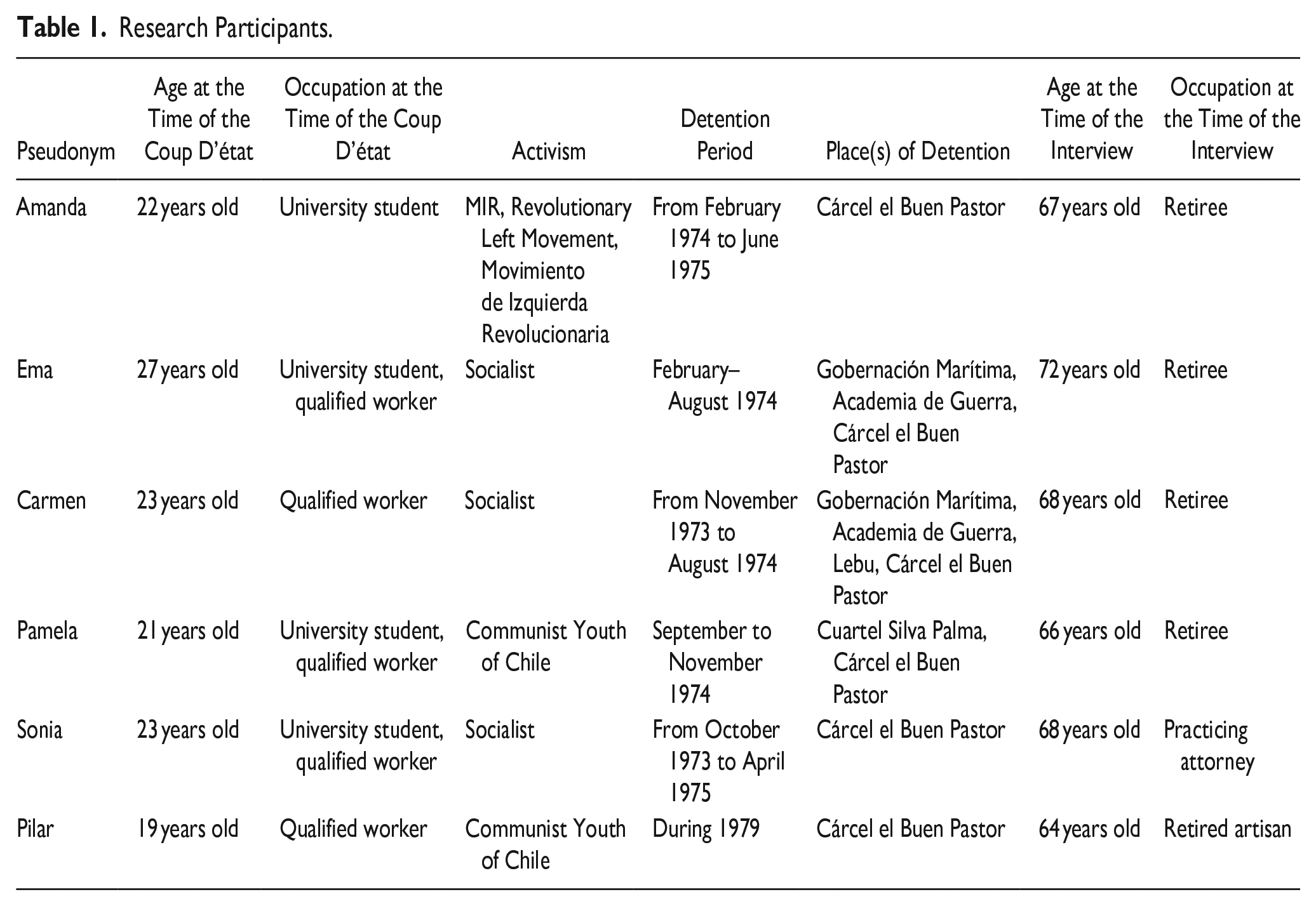
The research participants are six women, militants of left-wing parties who were in the city of Valparaíso on the day of the coup d’état. All were political prisoners; one suffered exile during the dictatorship. All currently reside in the Valparaíso region. The average age at the interview was 67 years, and the average age on the day of the coup d’état was 22 years. The participants are currently members of the Good Shepherd Collective, made up of former political prisoners of the civil-military dictatorship detained in the Good Shepherd Women’s Prison run by the Congregation of the Sisters of the Good Shepherd in the city of Valparaíso. This prison recorded the detention of political prisoners between 1973 and 1988. According to testimonies, the women who remained there were sent to this facility from various military prisons. They were imprisoned together with women arrested for common crimes, who in some cases threatened and beat them (Table 1).
Research Participants.
Techniques for Information Production and Analysis
A focus group was conducted centered on the experience shared by the participants (Canales, 2006) and two semi-structured individual interviews focused on particular and subjective experiences (Flick, 2004). The focus group was convened to learn about the shared experience of having lived the day of the coup in the Valparaíso region. The word was subordinated to an external order given by a researcher, both in the topics and in the participants’ turns of speech (Canales, 2006).
In addition, two semi-structured individual interviews were carried out, allowing for a more intimate and subjective record of the participant’s personal experiences. One of the focus group participants, chosen because she was a leader of the Good Shepherd Collective, was interviewed, and the other interview was conducted with a woman who was unable to participate in the focus group due to work commitments. The interviews were oriented to generate a conversation about what happened on the day of the coup d’état, allowing the emergence of other relevant content.
Both the focus group and the interviews had a similar pattern of questions associated with the presentation of the participants and one main question around which most of the conversation developed. Both techniques were developed by a researcher-psychologist with extensive experience working on sensitive issues.
Main question: Please tell me your story of the Day of the Coup in Valparaiso. Take as much time as you want for this. I will not ask you questions, for now, I will just take note of those things that I will ask you later.
Secondary questions: What was life like in the city of Valparaíso before the coup d’état and in what ways did it change after the coup? What do you remember about the political or social organization of your neighborhood or community during the years of the Popular Unity government and how did it change after the coup?
Data Analysis
The data analysis was carried out in two stages. First, we carried out a phenomenological-hermeneutic analysis (Finlay, 2004) to rescue the subjective experience of the participants concerning the day of the coup d’état. At the same time, it made it possible to account for how this event has an impact on the experience of inhabiting the historical and territorial space, as well as its implications in the subjective experience of each of the participants. Secondly, we carried out a thematic analysis (Flick, 2004), inspired by the open coding process of Grounded Theory (Strauss and Corbin, 2002), which made it possible to identify central topics in the interviews and focus groups.
Procedure
The SOC 180007 Anillo project, which allowed the production and analysis of data, was reviewed and approved by the Scientific Ethics Committee of the Universidad de Valparaíso. After the committee’s approval, potential participants, members of the Good Shepherd Collective, were contacted and invited to a meeting with the principal investigator and a research assistant. At the meeting, they were informed about the procedures and objectives of the study, as well as the ethical considerations for participation. All the participants agreed to participate. The informed consent forms were read and signed. The focus group and the two interviews were audio-recorded and transcribed in their entirety by a transcriber, a psychology student, with whom a confidentiality contract was signed.
Results
From the women’s accounts, it is possible to reconstruct their memories of the day of the coup in Valparaíso. The interviewer and interviewees construct a narrative following a given order: they start with contextual elements—places are described and street names are mentioned—and then progress during the interview to family elements—the experience of the coup in their homes—and later to aspects of an individual and subjective nature—pain, grief, and impotence.
Concerning September 11, 1973, it is possible to observe certain understandings related to the specificity of that day in Valparaíso, the occurring events, the emotional climate experienced, and how it is signified as a milestone that marks the experience of these women. This is presented in the first result exposed in this article (“The day of the coup d’état in the city of Valparaíso”). The coup d’état implies a before and after in the citizen experience, in the place, in the social, political, and historical aspects, and in how the city of Valparaíso is inhabited, generating changes in its dynamics even up to the present day. This is presented in a second result: “The Coup d’état: a before and after in the city of Valparaíso.” Regarding subjectivities, the coup d’état appears as a decisive and irrevocable milestone for the person who experiences this event, functioning as a biographical event and generating a before and after that changes people’s lives forever. This is portrayed in a third result which is entitled “The coup d’état as a milestone that marks subjectivities.”
The Day of the Coup D’état in the City of Valparaíso
Asking participants about their memories of September 11, 1973, the idea that the coup d’état began in the city of Valparaíso appears in their answers. They even consigned the start of the coup d’état and the subsequent establishment of a dictatorial regime headed by the country’s Armed Forces as something that begins to occur at dawn, before the remembered bombing of La Moneda at around 11:00 a.m.
The coup was at dawn, that is, the marines went out at dawn to take over the streets of Valparaíso [. . .] very early in the morning. That is, the coup began in Valparaíso. (Sonia, para. 37–39)
For the study participants, on the day of the coup, a tense emotional climate begins to be perceived very early on. The warning from a nearby person or even the radio stations’ communications provide information that something abnormal is happening or is about to happen. This is consigned as something that implies the need for a reaction on the part of the citizens, particularly the participating women, who begin a particular journey that day.
. . .what I remember is that they went to my house. . .which is in the upper part of Playa Ancha and someone went to warn, I don’t know who, probably a neighbor went to warn that something strange was happening. (Carmen, GF, para. 97) . . .on the 11th at 6 a.m.. . .I have a neighbor, I had an Asturian neighbor. She was the daughter of a detainee who disappeared during the Spanish civil war, and she was the one who. . .because she heard on the radio and. . .she pushed me a wall lamp I had in my bedroom because we lived very close to each other, we had semi-detached houses. . .and she pushed me the wall lamp and I woke up. Then she says to me “Amanda, Amanda, get up, there is a coup d’état” “What?” I said. (Amanda, GF, para. 30)
These early pieces of information established a sense of alertness among the women but lacked complete clarity about what was happening. Something anomalous was occurring in the city, but it could not be fully understood. This strangeness and lack of clarity were possible by the terror and silence that began to prevail in the early hours of the morning. After that first warning about what was happening, there was no further communication between people. Communications were restricted and the free movement of people was controlled.
. . .I remember that I talked to my friend, that is, but nobody talked in the line, nobody talked to us. (Sonia, para. 35) . . .the hospital staff was forbidden to talk to the patients about what was happening. They did not leave the shift, the 8 AM shift did not enter the hospital. (Pilar, para. 12)
As the day progresses, the political scenario begins to clarify, and people talk of a coup d’état. A key term for those who had a little more knowledge about politics. Thus, comments arise among relatives, neighbors, and trusted friends that begin to give—some—form or sense to the anomalous thing that was happening in the streets.
. . .my memories are of waking up early. . .I am not sure why we knew that something was going on. We went down, because at that time, well, I was a militant and belonged to a youth center [. . .] We went down to see what was going on with all the people in that sector. Well, it was quite clear that it was a coup d’état. (Pamela, Focus Group, para. 17)
This greater understanding of what was happening is marked by movements that seemed curious and disturbing, coming from troops and vehicles of the Armed Forces and the Navy. This differentiation was not so clear at the beginning, since those who participated in these mobilizations of the Armed Forces wore suits and war clothing that did not necessarily allow for a distinction. Initially it was perceived as something stranger, but later it was understood as an established dynamic that sought to intimidate and control the population.
There was a lot of patrolling by soldiers and marines dressed in war uniforms. What struck me the most was the fact that these people were walking around with their faces blackened, and you couldn’t identify the person in front of you. A lot of military vehicles, big and small, and them with weapons, war boots, all of that was very shocking. (Carmen, GF, para. 98) I remember standing in a line and seeing the marines very restless, very trigger-happy, and shooting in the air with the objective of intimidating the population. That is the memory I have of that day. (Sonia, E, para. 28)
This strategy, which sought to establish terror in the population, had its effect. It is not only terror but also its associated consequences, such as the recording of pain, the feeling of sadness, and deep frustration for the loss of the political project of which they were a part.
We went straight down, down a street called 18 de Septiembre, we were going down. We probably had a terrified look on our faces. My brothers were boys, they were 10 and 8 years old, they were little, they were terrified and so was I. (Pilar, para. 48) Terrible, pain, helplessness, pain, sorrow, I was saying, “this is the end of the world, we are not going to see each other anymore.” I wanted to see my classmates, my career partners. (Amanda, GF, para. 42) The coup d’état was to sow collective terror, to everyone, from that day on. In other words, there were obviously happy with the coup d’état. But somehow we were all touched, if it wasn’t a family member or a friend to whom something happened. (Pilar, para. 60)
Terror and sadness come with an inability to measure the consequences of the coup d’état. Women wondered what would happen now after seeing their political project destroyed.
If you ask me for emotion, it was like a deep sadness, a tremendous question mark because “what’s next?” And well, everything that one had dreamed utopianly of what could be done as if it all came to the ground and from there I don’t remember anymore. (Ema, GF, para. 75) If you think they are such extreme situations, but you don’t size them up at the moment, but later you start to size up everything you lived through. (Pilar, para. 57)
These mobilizations and the confirmation that it was a coup d’état came to configure a complete alteration of people’s daily routines. From the women’s accounts, alterations to daily life are evidenced, such as: Presence of marines and other agents of the Armed Forces in the streets with weapons and war clothing. Cuts in radio transmissions. Cordoning off and military control of the main streets and avenues. Raids on hospitals, political party headquarters, industries, union headquarters, slums, and even private residences.
The shift change in hospitals is at 8 a.m., it changes the night shift to the day shift. My mother-in-law worked at the hospital and had a shift at 8 a.m. and she didn’t show up. Actually, she stayed the whole previous shift, they didn’t change shifts and that was already strange, very strange. (Pilar, para. 12) Then I went out with my radio, a small one, I never did that, but I did it to know what was going to happen. Then I arrived at Caleta Abarca to take the bus to Valparaíso, and they told me that I could not cross, then there were the marines, camouflaged like that, with that war uniform and they told me “no you cannot cross, go back,” “but I have to go to work,” “no, you cannot, you are not going to work.” That’s what I remember they told me. I remember that I went up and instead of going home, I went to the house of a co-worker who lived nearby. And of course, he had already heard, and we were both left with a tremendous question mark: what was coming? (Ema, GF, para. 74).
Participants describe arrests and interrogations of supporters of the Popular Unity government. Presence of objects and sounds reminiscent of war (such as patrols, tanks, and helicopters). All this together generates the sensation of having lived a truncated day. The coup d’état stopped the normal course of that day.
We were under curfew, that’s what I remember, but for me, it was a thing of, of uneasiness, of fear, to see these people like that, with the war uniform, the weapons, everything else, uncertainty, because you don’t know, you don’t know anything, you’re at zero. (Carmen, para. 104) Within a few hours, the military called the workers to their workstations to facilitate the arrests they were about to start making. (Ema, para. 105) . . .when they began to arrest, we had a view towards the Maritime Governor’s Office and we could see how they threw them all horizontally in vans, others on top, until they were complete, they wanted to take them all away. (Ema, para. 107)
Thus, the day of September 11, 1973, is considered by women as a day that initially generates strangeness and later terror, as well as a feeling of having been a truncated day that not only altered the daily routine of the inhabitants of the city of Valparaiso but the whole life, marking a before and after for the history of the city.
The Coup D’état: A Before and After in the City of Valparaíso
The women participating in the study understand the coup d’état as an event that alters the course of local history. An event that gave rise to a long and bloody civil-military dictatorship that not only marked milestones in political terms but also fractures and changes of a social, cultural, and even environmental nature, which modified what was considered the city of Valparaíso until then. This fact becomes even more visible for those who lived in exile during the dictatorial period, where the return to the city of Valparaiso illustrates that before and after.
My perception of when I returned to Chile, Valparaíso was very changed in my opinion [. . .] That stench here in Valparaíso did not exist and it was very poor. I found that Valparaíso had become too impoverished. Because poverty existed before, well, it has always existed. It would be a lie to say that there was no poverty, but it was not noticeable. You saw poverty in the hills, you didn’t see it in the plan.
5
I remember going out at night to look at Valparaíso because you couldn’t see the dirt, and Valparaíso is beautiful at night. In all my years in Italy I longed for Valparaíso because Milan is a city in the center of Italy, it has no sea, the sea is what I was missing a lot. . .And then I arrived here, so I was like that. . .and to reenchant, I went out to visit Valparaíso, and there I have enchanted again with Valparaíso, but the first effect was shocking. (Sonia, para. 73–75)
One of the first changes registered by the women participants is related to the dynamics of encounters and relationships among citizens. Valparaíso was considered a “friendly city,” where people related to each other in a warmer way, where dialogue, conversation, and “natural solidarity” were commonplace in public space. After the coup d’état, people stopped engaging in chats with strangers: In the buses in those years you had the possibility that anyone sitting next to you would always strike up a conversation. It was very common that without knowing the person next to you, someone would talk to you. There was always communication, and I can tell you that I am just starting to observe that today because later that was totally and absolutely lost. (Carmen, GF, para. 198)
In addition to the above, the city of Valparaíso stands out for its creative capacity as a cradle of cultural and occupational life for its inhabitants. In this sense, Valparaíso of yore had a potential that allowed it to be considered a pioneer city in culture and to make spaces possible.
Valparaíso has the grace of being the first in many things, the first to invent something, or to create something. Valparaíso has that characteristic: the first sports club, the first fire department, the first mutual societies, and if we go further back there is a huge list and in the social struggle. Although Santiago was ahead because it had many inhabitants. Here, the grace was that being a smaller city, the people had an enormous level of consciousness, enormous, not only at the student level. (Pilar, para. 94)
The participants consider the Valparaíso of yesteryear a model and pioneering space at the national level in many areas. It is also full of people with conscience and respect for social and political movements. Because of it, participants believe that perhaps Valparaíso was chosen as the area where the coup d’état began.
It was possible to appreciate in Valparaíso a climate of awareness associated with the Popular Unity government and President Salvador Allende’s proposal for society. There was hope for a positive change for Chile and its inhabitants. This social awareness and hope for change were present in the young people, who carried with impetus and conviction this expectation of change.
Because the struggle before the triumph of Salvador Allende was in crescendo, the social struggles which led to the triumph of Salvador Allende. The level of class consciousness was huge, of the working class, of the dispossessed class, because the difference was enormous. (Pilar, para. 92) When you went out of your house, you saw the worker who went with his lunch box, with his food, and you could identify him physically by his clothes, as a worker, people who went to an industry, later on, all that disappeared. (Carmen, GF, para. 171)
After the coup d’état and the establishment of the civil-military dictatorship, everything that was considered characteristic of Valparaíso changed, particularly the political and cultural life that gave potential to its citizens.
After the coup d’état, the participants perceive deficiencies in general education and civic education, of the inhabitants of Valparaíso, which translates into a neglect of the city as if Valparaíso were not loved.
I think there is a lack of civic education, a lack of education, a lack of culture. I have gone many times on the bus, and people throw papers on the street. That is lack of education, lack of culture, lack of loving Valparaíso more and taking care of it; there is too much vandalism. (Sonia, para. 76)
Not only the city and what it offers to its citizens is modified but also the emotional and relational climate generated within that space. Community and collective sense of Valparaíso is lost, defined as a death of social life and a loss of the perception of a friendly city with supportive inhabitants.
After having such a large community of peers, in one day it was over. All your friends were gone, or left, or killed, or you didn’t see them anymore, in one day. (Pilar, para. 103) But there was so much discussion, so much analysis, and that was the peer community; it was so big, and in one day, it was over. Acknowledging that is so painful. Suddenly you didn’t see your friends anymore, ever again. And it happened that those friends you saw every day, you saw them 10 years later and were other people. They had to go to another country, how many had to go into exile, and you saw them and were different people. They forced you to lose your whole community. (Pilar, para. 105)
The establishment of repressive policies and terror within the sociodemographic space of Chile accomplished this modification, particularly from the experience of the participants at Valparaíso. This terror or fear paralyzes the citizens, generating uneasiness inside the city and modifying the relational patterns.
I believe that the repressive apparatuses are so big that even though fellows are not afraid, they act with fear. Because it happens that terror paralyzes, it did not paralyze all of us; that is true, the political youth tried to reorganize, and we succeeded. But it was quite difficult to work afterwards with the terror of the people. . .That was, it was a huge difference, because I was a militant before and after. (Pilar, para. 92)
These changes endured from a relational experience, but they are also registered internally and generate subjective modifications experienced from the fracture and the sensation of truncation in the life experience.
I had to file an injunction for my son when he was 15 years old. We had to hide him in a land lot in Santiago. He was in the junior year of high school, and we had to take him out of school and hide him because he had an injunction from the Naval Prosecutor’s Office. The president of the human rights commission of Viña told me: “look at the injunction that the naval prosecutor’s office has.” The truth is that what could happen to me, one assumes it, but what happens to a son, to my eldest son, is terrible. (Pilar, para. 126) Frustration, impotence, everything falls apart. Besides, our life was cut short; everything was cut short, the little things, the big things, whatever you wanted. You could no longer make projects; you had to live from day to day because what was the point; you didn’t know what was going to happen tomorrow. (Ema, GF, para. 224)
The Coup D’état as a Milestone That Marks Subjectivities
The coup d’état appears as a marker of subjective experience. Participants registered the coup as a tragedy that impacts people not only on individual terms but also on others who share with those persons, especially the family or significant others.
On the 11th I was still in the hospital [having given birth on September 8]. From that moment on, my personal tragedy began. . .Having a child, the happiness it brings, which was totally erased by the coup d’état. (Pilar, para. 2 and para. 42) For me, it is like my life before the coup and my life after the coup. I have always asked myself if the coup had not happened. . .how I would have gone on with my life because I feel that it changes, it changes you. . .In fact, that year I had begun to study Foreign Trade. My idea was that the following year I was going to study Political Science, but then, of course, there was the issue of prison, of all that it implied and from there one is still afraid [. . .] So I am left with a feeling that will remain forever, that I do not know if my life would have been the same without the coup. . .In fact, I even think, my father who had heart disease, that happened to him, then they arrested my mother, then all the raids, I think that also shortened his life, because he died relatively young. (Pamela, GF, para. 214–215)
The event of the coup d’état not only marks and truncates the lives of these women and their significant others, but also it is an event so significant that it makes one’s own experience and that of others disappear.
At that time I didn’t realize what it meant to have had a child and no one to see him, no one to ask me about him, no one to ask me about him, nothing. There was such a terror that my son was invisible. [. . .] The only thing I knew was that I was carrying him tightly with me, but nobody looked at him. You know that when you have just given birth, everybody. . .the baby is the center and goes from arm to arm. Nothing here, it was the day of the coup. But that affected me later, afterward. In fact, I wrote a chronicle, which I begin with the birth of Salvador [my son]. Salvador was born three days before the day of the coup. So, for me, that marks the coup d’état. An event as significant as having a child is made completely invisible by the coup d’état. . .At that moment too, that’s why I felt bad for a long time. For my family, I was nothing and nobody, because of the urgency of what the coup d’état meant. (Pilar, para. 39–40) To begin to remember that fact, how my son’s birth was made invisible, caused me pain. . .and I cried, and I could not write, and I cried. . .It still affects me, it affects my life. . .and my son is already 40 years old. . .he is as old as the coup. . .it will be 45 years old. (Pilar, para. 42)
In the context of this truncated subjectivity, the formation of new collectives appears as “lifelines” in the face of horror. The women interviewed formed different collectives among ex-prisoners to be able to preserve their memory, sometimes through the mere fact of grouping together, while in others, through the cultural gestation in these collectives.
I am in a very lovely collective. I have sung and played guitar all my life; it has been one of my lifelines; it has been very important in everything. And now that I am elderly, I belong to a group called “El Brasero.” “El Brasero” was a peña that was created in ’76. . .El Brasero got back together two years ago with the people who were there at that time. Now it is a collective with legal status that works for memory, human rights, and popular culture. We do a monthly peña, and it is very nice, really to sing is. . .To me, I think it saved me. . .to a great extent, music and singing saved me, to continue and to keep you sane because the truth is that there are so many things, so many. We go to all the events, here at the memorial we have been coming here since they destroyed it, and we have come to sing at the memorial several times. (Pilar, para. 136–137) It’s nice what we experienced afterward, we used to get together a lot, at least once a month, some classmates would come. . .so we would get together, there was always a reason to get together. (Amanda, GF, para. 241–243) This came about after the comrades invited us to carry out this activity referring to women, and that is when we became a collective. We are not going to join them; we are going to continue on our own. (Carmen, GF, para. 262)
Creating collectives and political groups and managing cultural and artistic spaces seems to be a return to what the coup d’état broke in Valparaíso. This allows a community life, where comrades, friends, and neighbors actively participate in their communities, interacting, and having an active and fruitful cultural life. It is as if this current “lifeline” of the truncated subjective experience consists of an opening to that which was previously lost.
Discussion
When studying a subject such as the memories of the coup d’état, it is possible to observe the crossover between different expressions and undertakings of memories that coexist in times and territories, being impossible to find a single interpretation of the recent past (Jelin, 2020; Lira, 2013). In this context, we also notice some underground memories (Pollak, 2006) and/or silenced memories (Da Silva, 2011) that constantly struggle with other hegemonic memories to claim recognition and legitimacy. Thus, studying women’s memories in the context of the Chilean coup d’état in the city of Valparaíso, both as victims of political violence and as political agents, becomes necessary and fair. Mostly true given the debt that has been present in different spaces to grant recognition, reparation, and justice to the silenced memories of women (Hiner, 2015).
This article opens a small space for the rescue of these memories, considering an approach from gender and decentralized perspective regarding the collective memory of Chile’s recent past. In thinking about history from a woman’s perspective, we also think about oppression at the macro-political and micro-political levels: At the macro-political level as stories of agents and resistant subjects with untold and invisible public and political struggles; and at the micro level as singular stories with truncated projections and subjectivities (Soto, 2017). This, in the words of Kirkwood (2010), would allow the recovery of unwritten female history, from a perspective that assumes its virtual liberation, will allow us to better understand the why and how of their oppression and undertake the search for the meanings and self-sustaining mechanisms of such oppression. (p. 21)
The six women participants in the study suffered arbitrary detention, political imprisonment, and torture. The United Nations Convention Against Torture and Other Cruel, Inhuman or Degrading Treatment or Punishment (1987), in Article 1, states that torture is any act by which severe pain or suffering, whether physical or mental, is intentionally inflicted on a person for such purposes as obtaining from him or a third person information or a confession, punishing him for an act he or a third person has committed or is suspected of having committed, or intimidating or coercing him or a third person, or for any reason based on discrimination of any kind, when such pain or suffering is inflicted by or at the instigation of or with the consent or acquiescence of a public official or other person acting in an official capacity.
According to the United Nations definition, torture is an extreme form of exposure to violence, always intentional and planned, involving physical and psychological attacks. It aims to destroy the victim’s personality, understanding of the world, and perception of the human being. But it also has effects at the social level, sending a warning message to the population to keep it under control and fostering an atmosphere of terror and permanent threat to consolidate power (Deutsch, 2007; Recler, 1995).
Regarding the gender category, Jelin (2002) suggests differences in the ways men and women reconstruct memories. Women narrate their memories in the traditional key of the female role, that is, “living for others.” In the present study, we observe that the coup d’état appears as a marker of subjective experience. The coup d’état is registered as a tragedy that impacts people not only on individual terms but also on others who share with those persons, especially the family or significant others.
Concerning the truncated subjectivity of women, which takes away the meaning of life, the formation of new collectives appears as a possible “lifeline” in the face of horror. Women create different collectives to preserve their memory, sometimes through the mere fact of grouping together, while in others, through the cultural gestation in these collectives.
The coup d’état in Chile as a historical event not only shows the intolerable associated with state terrorism, but it also generates new possibilities in life. The newly emerged distribution of the possible and desires opens a process of experimentation and creation (Lazzarato, 2006). It is necessary to experience what the mutation of subjectivity implies to create the agencies, devices, and institutions capable of deploying these new possibilities of life.
In addition, the specific content of the interviews and the focus group about the day of the coup d’état is interesting. And it is that—contrary to the renowned and remembered bombing of the government palace and the death of President Salvador Allende—the women participants in this study and militant political agents of that time emphatically recall that the coup originated in the country’s port city. Stories marked by brutality and military and naval repression recorded public and private from the beginning of the day point out a different history before that morning remembered in Santiago. As if there was another underground and silenced memory, which is no longer only related to the gender of political subjects, but also the territorial condition. A memory of the port of Valparaíso is reconstructed.
Beyond the description of what happened that day, which is related to the military and naval occupation of the territory (Gutiérrez, 2018; Magasich, 2008), the experience of the participants shows that the day of the coup d’état in Valparaíso is initially experienced as something anomalous in the daily context but at the same time uncertain, as without capacity for understanding; to later be recorded from silence and terror.
This event and its registration mark a before and after, functioning as a subjective milestone that modifies the distribution of the territorial space of Valparaíso, how it is interpreted, and the subjectivity of the participants. The city was experienced as a friendly territory with evident solidarity among its inhabitants, with creative and fighting potential. But once the coup d’état occurs, a fracture is generated that invites us to think of Valparaíso differently, both in emotional climate, economic conditions and in the relational modes of its inhabitants.
During the post-dictatorial period, Valparaíso was once again the site of nationwide protests, including demonstrations led by high school and university students, whom most of the time protested near the National Congress, located in the same city (The Guardian, 2019). In October 2019, Chile experienced one of its most controversial political crises since the end of the dictatorship. Various protests took place throughout the country to demand improvements in living standards and to reject the socio-economic inequalities originated by the neoliberal model (Somma et al., 2021). Through a State of Constitutional Emergency Exception, the Armed Forces return to monitor and control the national territory. The above gives way to the achievement of grave and widespread human rights violations, evidenced in four international reports (Amnesty International, 2019; Inter-American Commission on Human Rights, 2020; United Nations, 2019).
The Social Outbreak or Popular Revolt, as this period is named, came to mark another historical milestone in the Valparaíso area. President Sebastián Piñera imposed a curfew for the Santiago area and, a few hours later, intervened in the regions of Valparaíso and Concepción, both known for being historical areas of student and citizen protests. The Fiscalía Nacional reports that Valparaíso was the city with the second highest rate of human rights violations, with 766 cases prosecuted up to January 2020 (Fiscalía Nacional, 2020). According to the Defensoría de la Niñez (2020), between October 19 and December 31, 2019, 6,420 adolescents between 14 and 17 years old were detained by Carabineros de Chile. The Metropolitan, Biobío, and Valparaíso Regions presented a higher number of adolescents in official custody.
As already mentioned, in the face of the truncated subjectivity of women, the formation of new collectives appears as a possible “lifeline” against horror. Women form different collectives to make memories. In some cases, the mere fact of grouping together is enough, while in others, they develop a cultural gestation whose objective is the transmission of memories to new generations.
The collective memory of social movements has the potential to motivate and activate new generations who did not experience those movements (Altınay et al., 2019). We can affirm, therefore, that how the processes of transmission of recent memory operate among those who mobilize around gender is part of the political socialization and resocialization involving individuals and collectives, whose discourses and practices adopt or resist past political memories in constant dialogue with the contingencies of the present (Faúndez, 2013).
It would be relevant to continue with research in Chile that could open new memory undertakings and the subjective rescue of those who undertake them, considering the territorial as another variable within the memory struggle (Jelin, 2002) that allows giving legitimacy and recognition to decentralized experiences.
Footnotes
Declaration of Conflicting Interests
The author(s) declared no potential conflicts of interest with respect to the research, authorship, and/or publication of this article.
Funding
The author(s) disclosed receipt of the following financial support for the research, authorship, and/or publication of this article: PIA/ANID Project “Political culture and post-dictatorship: Memories of the past, struggles of the present and challenges of the future” (SOC 180007), FONDECYT Regular 1211664 Project “Estado de Chile y pueblo Mapuche: Memorias indígenas sobre el terrorismo de Estado y su relación con la militarización de la Araucanía,” and Centro de Estudios Interdisciplinarios sobre Cultura Política, Memoria y Derechos Humanos of the Universidad de Valparaíso.
