




Abstract
This study investigated whether the children of parents with physical disabilities endured higher levels of peer victimization. Particularly, this study focused on the mediating effects of peer victimization in the relationships between parental disability and both the emotional symptoms and prosocial behaviors exhibited by their children. Data were obtained from a survey on health and mental health among children and adolescents from disadvantaged families. The survey was conducted by Renmin University of China from August to September 2018 using multistage probability sampling method. The sample in this study included 716 adolescents, of whom 390 had at least one parent with physical disabilities and reported more severe peer victimization. In contrast to respondents who did not have parents with physical disabilities, these adolescents experienced more emotional symptoms and engaged in fewer prosocial behaviors. Furthermore, the analysis showed that 15.16% of the total effect of parental disability on emotional symptoms was mediated by peer victimization, which had a nonsignificant mediating effect in the relationship between parental disability and prosocial behaviors. These findings can inform practitioners who aim to help children of parents with physical disabilities improve their coping strategies and social skills to manage peer relationships. Moreover, these results highlight the importance of establishing an inclusive school and community environment to reduce social stigma and peer victimization toward children from disadvantaged families.
Introduction
Official reports state that over 10.7 million individuals in China were living with lifelong physical and/or mental disabilities as of 2020 (“Physicians’ Manual of the Second China National Sample Survey on Disability,” 2006). This figure implies that many Chinese children and adolescents live in households with parents with disabilities. Studies have found that disabilities are associated with a range of socioeconomic disadvantages, including lower education levels, unemployment, and fewer household resources (Brault, 2008; Fujiura & Yamaki, 2000; Minkler et al., 2006). Furthermore, some studies revealed that parental disabilities have direct negative effects on children and adolescents, such as poor education and malnutrition (Dennis et al., 2019; He, Yan, & Zhang, 2020; Stone & Wilson, 2016). These findings are consistent with evidence suggesting that many parents with disabilities do not provide competent care (Malacrida, 2009). Thus, the children of parents with disabilities face the risk of being neglected, which may curb their developmental trajectory (Aunos et al., 2008; He, Yan, Zhang, Wang, et al., 2020; Wade et al., 2015). Several studies have underscored vulnerabilities in parents and children with physical and mental disabilities (e.g., financial strain, inadequate services from child welfare system, difficulties in social interaction) (Duvdevany et al., 2007; Haker et al., 2022; Huus et al., 2022; Powell et al., 2022). However, evidence on mental health issues experienced by children of parents with disabilities remains limited in the Chinese context.
The ecological systems theory argues that individuals develop by interacting with their social environments (Bronfenbrenner, 1979). Adolescents directly participate and interact in the microsystem, which is divided broadly into family and peer categories. By contrast, macrosystems describe more expansive concepts, including social culture and social policy. Notably, family and peer microsystems both contribute to the formation of emotional states and social behaviors in adolescents. However, only a few studies that emphasize methods for improving parenting capacity have been conducted on family functioning, in the context of parental disability (Ali et al., 2012; Cantwell et al., 2015; Green, 2003; Watanabe et al., 2021). Moreover, evidence is lacking on the mutual effects of family and peer groups on children of parents with disabilities. Thus, it remains unclear whether these children endure more social exclusion than their counterparts.
Individuals with disabilities typically suffer from devaluation, separation, and discrimination as a result of the loss of social function (Corrigan & Watson, 2002). In this regard, parental disability is more likely to have detrimental effects on socialization in adolescent children (Jackson & Tisak, 2010). Social exclusion of disabled persons may be more severe in rural China, where the culture is generally less inclusive as there are no refined social welfare policies to help care for the disabled (Li, 2011; Ma, 2016; Peng, 2008). Moreover, family members and individuals who closely associate with disabled persons may also endure stigmatization and peer victimization, which impacts other interpersonal relationships (Goffman, 1963; Pakenham & Cox, 2012). Based on these conditions, researchers have reasonably assumed that adolescent children of parents with disabilities experience more peer victimization and emotional distress than their peers (Angermeyer et al., 2003; Birenbaum, 1992).
Increasing evidence shows that peer victimization significantly affects self-esteem and self-identification (Qiao & Shi, 2016; Shang, 2015), emotional symptoms (e.g., depression and sadness), and prosocial behaviors (e.g., volunteering, comforting, and sharing), which are major areas of concern (Olsen & Clarke, 2003; Peters & McMahon, 2002; Riebschleger, 2004). Particularly, these factors represent specific challenges in the context of child and adolescent development (Brooks-Gunn & Duncan, 1997; Spencer & Acheson, 2018; Starfield et al., 2002). Furthermore, some studies have found that socially excluded persons tend to display more violence and aggression with reduced sensitivity to the consequences of those actions (Poon & Wong, 2019; Williams, 2009). In contrast, high-quality peer relationships have been linked to positive psychological and social outcomes in adolescents (Barton et al., 2020). Therefore, social exclusion can damage the potential for prosocial behaviors (Coyne et al., 2011; Twenge et al., 2007). Moreover, adolescents with more social connections and stronger social ties are more likely to develop positive emotions and experience other prosocial outcomes (Barton et al., 2020; Evans & Smokowski, 2015; Jackson & Tisak, 2010; Padilla-Walker et al., 2016).
To address the abovementioned research gaps, this study investigated whether adolescents with parental disabilities experienced more peer victimization in China. This study hypothesizes that peer victimization mediates the relationships between parental disability and the emotional symptoms and prosocial behaviors of adolescents.
Methods
Data and Participants
This study analyzed data obtained from a survey on mental health in children from disadvantaged families, which was conducted by Renmin University of China from August to September 2018. The survey employed the multistage probability sampling method. In the first stage, two provinces were randomly selected from eastern (Shandong and Hebei provinces), middle (Henan and Jiangxi provinces), and western (Shanxi province and Chongqing) China, while one province (Liaoning province) was selected from northeastern China according to the size of four economic regions developed by the National Bureau of Statistics of China (2018). In the second stage, three cities and towns were selected from each province. In the third stage, 100 children from four types of disadvantaged families were included, namely, (1) parents with physical disabilities; (2) parents imprisoned or in compulsory drug rehabilitation; (3) poor financial status; and (4) at least one deceased parent, or other cases in which guardianship responsibilities could not be fulfilled. In this context, the set criteria argued that children must be aged between 6 and 15 years, with at least 25 children from each type of disadvantaged family. Consequently, this yielded a total of 2,099 vulnerable children. The fourth stage comprised a comparison including 30 children of similar ages and gender ratios. However, the parents of these children in each province had no disabilities, resulting in 666 additional children. Finally, 390 children had at least one parent with physical disabilities, while 326 children had parents with no physical disabilities. This study was approved by the Research Ethics Committee at the author’s university.
Measures
All participants were asked to complete the questionnaires that contained sections on sociodemographic characteristics, socioeconomic status, study-specific factors with fixed response options, and standardized measurements.
Sociodemographic Characteristics
In each case, an experienced interviewer asked one parent from each family for the ages of all parents and children, the gender of all children (male and female), the education levels of the parents (junior middle school and below, senior middle school and above), the annual family income, and the type of residence (hukou, rural residents, urban residents).
Parental Disability
The children were asked two questions to determine parental disability status: (1) Does your father have any physical disability? (e.g., difficulty seeing, hearing, walking, or problem-solving); (2) Does your mother have any physical disability? (e.g., difficulty seeing, hearing, walking, or problem-solving). Each question had two response options, namely, “1 = yes” and “0 = no.” Subsequently, a composite variable for parental disability was computed based on the answers to these two questions. The adolescents who responded “yes” to either question were identified as children of parents with disabilities. The remaining children were allocated to the comparison group.
Peer Victimization
Peer victimization was assessed based on 11 items in the modified version of the University of Illinois Bullying Scale pertaining to events that did or did not occur over the 6 months prior to the investigation (Espelage & Holt, 2001). Some sample items include (1) being made fun of; (2) being excluded from group activities or feeling lonely; (3) being hit, kicked, pushed, or closed in a door; (4) being made fun of due to family disadvantages; (5) being cursed at or insulted; and (6) having private or personal information spread over the Internet. The three response options for each case were “0 = never,” “1 = sometimes,” and “2 = often.” Higher total scores reflected a higher level of peer victimization. The Cronbach’s alpha coefficient was 0.73 in the current sample.
Emotional Symptoms and Prosocial Behaviors
The Strengths and Difficulties Questionnaire (SDQ) (Goodman, 1997) was used to measure emotional symptoms and prosocial behaviors over the previous 6 months. The SDQ is a short-form behavior screening instrument that is designed to evaluate emotional and behavioral problems in children and adolescents. Notably, the SDQ has been validated thoroughly for use among Chinese adolescents (Yao et al., 2009) and comprises two subscales for emotional symptoms and prosocial behaviors, each with five items. Items for emotional symptoms are as follows: (1) often complains of headaches, stomachaches, or sickness and several concerns; (2) often seems worried; (3) often unhappy, down-hearted, or tearful; (4) nervous or clingy in new situations and loses confidence easily; and (5) fearful and very scared. Items for prosocial behaviors are (1) considering other people’s feelings; (2) sharing readily with other children (treats, toys, pencils, etc.); (3) being helpful when someone is hurt, upset, or feeling ill; (4) expressing kindness to younger children; and (5) often volunteering to help others (parents, teachers, other children). Each of these 10 items could be answered as either not true (0), somewhat true (1), or certainly true (2). The present sample yielded a Cronbach’s alpha coefficient of 0.81.
Statistical Analysis
The current data analyses were conducted using Stata version 16.0. First, this study assessed and compared descriptive characteristics between children with and without parents with disabilities. Second, Pearson’s correlation coefficients were calculated to explore the relationships between disability status, peer victimization, emotional symptoms, and prosocial behaviors. Third, hierarchical multiple regression analysis was conducted to identify the effects of parental disability (independent variable) and peer victimization (mediator) on emotional symptoms and prosocial behaviors. The demographic (e.g., children’s gender, age, and educational level) and socioeconomic (e.g., residential type and family annual income) characteristics were entered as covariates into the regression models. Fourth, a mediation analysis was performed using the Sobel test to examine the significance and magnitude of the mediating effect. All variables had missing values of less than 5% in the final model.
Results
Participant Characteristics
The analyzed sample mainly consisted of male adolescents (55.03%) with an average age of 12.26 years. The adolescents’ parents had an average age of 46.25 years, and most of them had obtained junior middle-school education or below (76.96%). The majority of the participants were rural residents (92.04%). In contrast to adolescents with parents with disabilities, those without parents with disabilities were significantly younger (F = 6.19, p < .05). Furthermore, the parents without disabilities were younger (F = 38.09, p < .001) and had higher education levels (F = 45.55, p < .001). In addition, most of the respondents lived in urban areas (F = 17.40, p < .001) and had higher annual family incomes (F = 184.04, p < .001). Finally, children of parents without disabilities experienced less peer victimization (F = 19.20, p < .001), had fewer emotional symptoms (F = 59.42, p < .001), and exhibited more prosocial behaviors (F = 17.73, p < .001; Table 1).
Comparisons between Adolescents of Parents with Physical Disabilities and Their Counterparts.
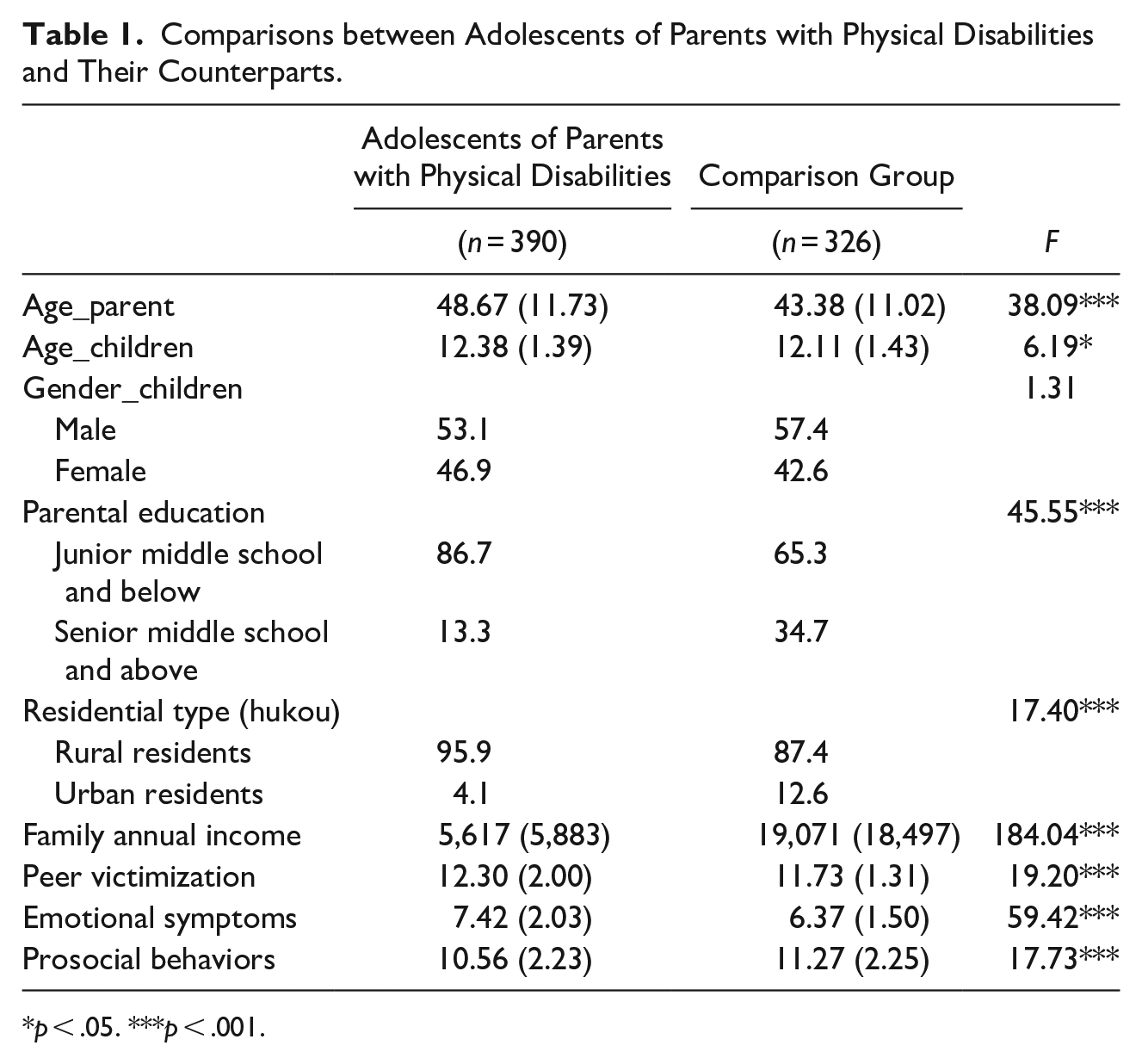
p < .05. ***p < .001.
Correlation Analysis
The results of the zero-order Pearson correlation analysis used in this study showed that emotional symptoms were significantly and positively related to both parental disability (r = .27, p < .01) and peer victimization (r = .43, p < .01). In contrast, prosocial behaviors were significantly and negatively related to parental disability (r = −.15, p < .01), while peer victimization (r = −.02, p > .05) exhibited no such association (Table 2).
Zero Correlations Between Parental Disability Status, Peer Victimization, Emotional Symptoms, and Prosocial Behaviors.
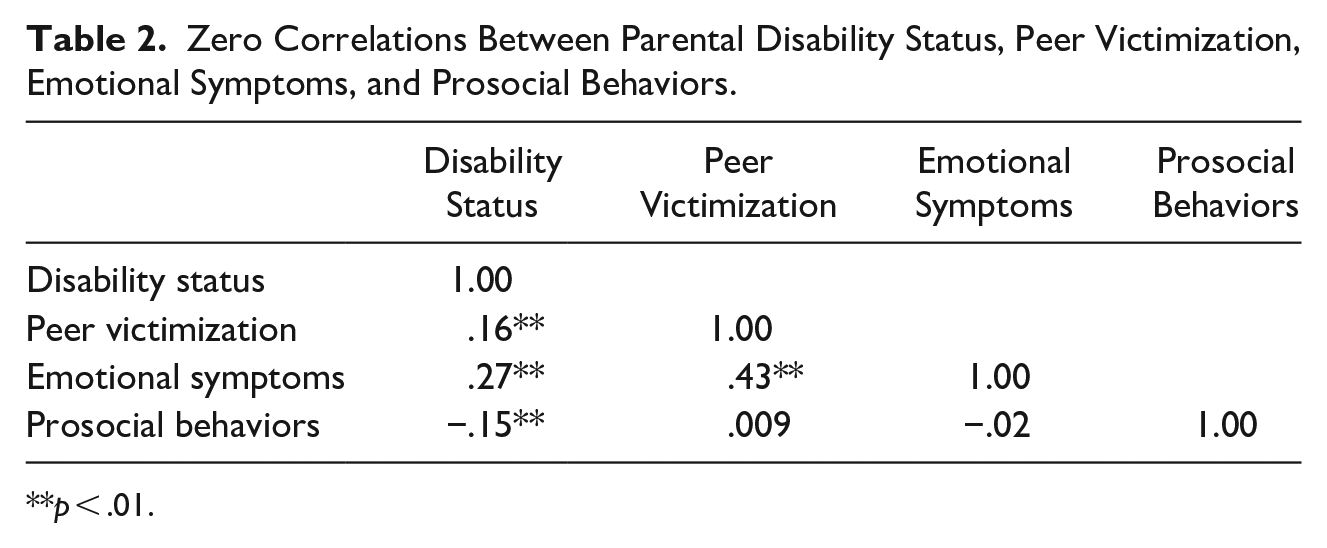
p < .01.
Mediation Tests
Table 3 presents the results of the hierarchical regression analysis. Model 1 was developed using peer victimization as the dependent variable. After controlling for covariates, the results revealed that adolescents of parents with disabilities experienced more peer victimization (β = .10, p < .01). In Models 2 and 3, emotional symptoms were set as the dependent variable. Models 3 and 4 explained 8.6% and 24.3% of the total emotional symptoms variance, respectively. Consequently, peer victimization had a significant positive effect on the relationship between parental disability and emotional symptoms (β = .40, p < .001). Finally, Models 4 and 5 regarded prosocial behaviors as the dependent variable. Particularly, these models explained 5.3% of the total prosocial behaviors variance and found that the effect of peer victimization on the relationship between parental disability and prosocial behaviors was not significant (β = .04, p > .05).
Multiple Regressions of Emotional Symptoms and Prosocial Behaviors on Disability Status and Peer Victimization.
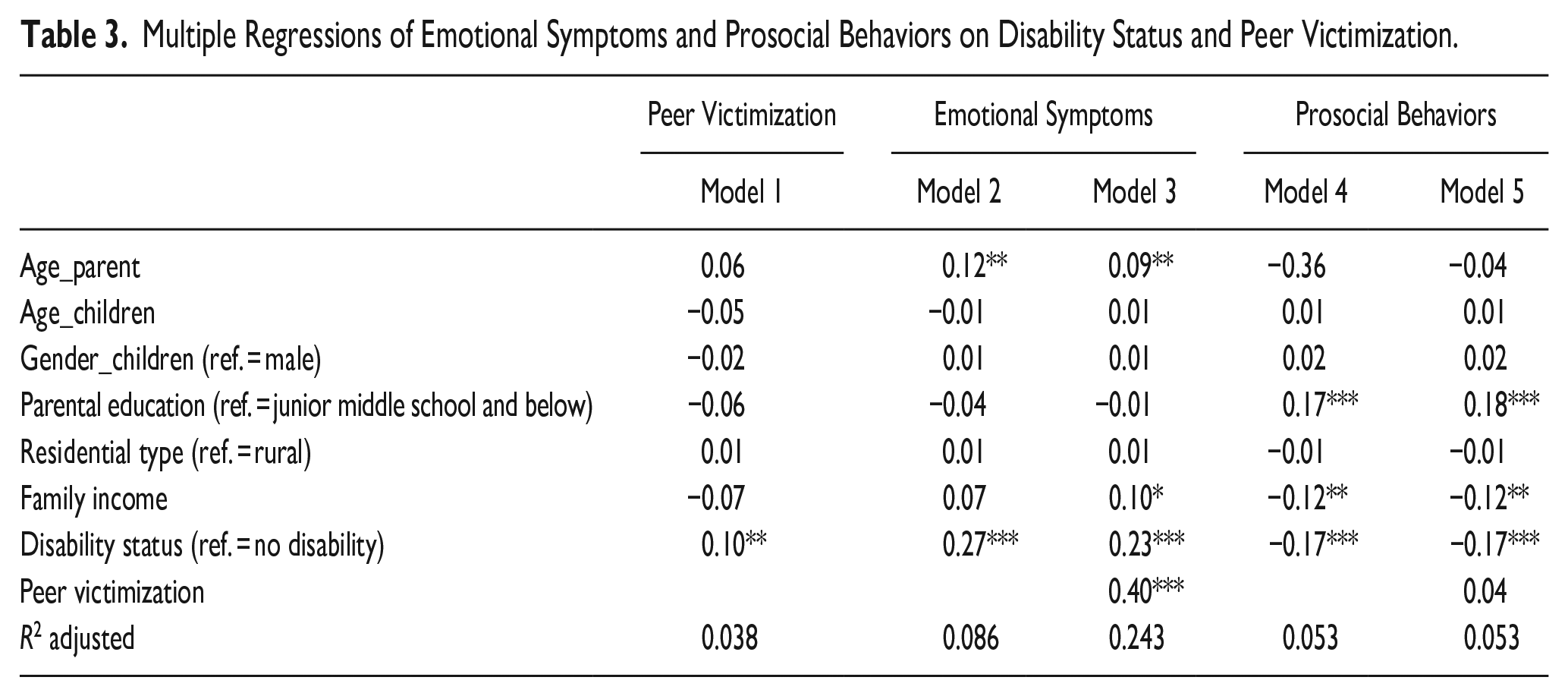
Figures 1 and 2 show the simple mediation model using the Sobel test. As indicated, the total effect of parental disability on emotional symptoms was significant. Specifically, 15.16% of the total effect was mediated by peer victimization (b = .4, p < .001; c = .3, p < .001; c′ = .2, p < .001). Moreover, the total effect of parental disability on prosocial behaviors was significant; however, this effect was not mediated by peer victimization (b = .1, p > .05; c = −.2, p < .001; c′ = −.2, p < .001).

Mediating effect of peer victimization on emotional symptoms.
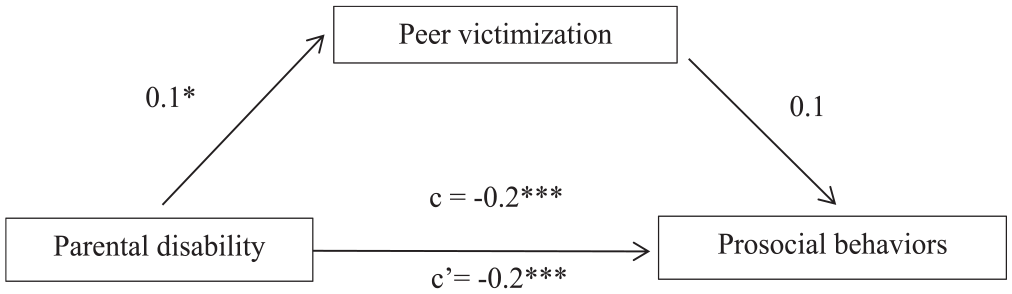
Mediating effect of peer victimization on prosocial behaviors.
Discussion
This study is among the first to focus on the interplay of two microsystems (family and peers) to clarify the psychological and behavioral states of Chinese adolescents who live with parents who have disabilities. This study used data from a nationally representative sample to analyze the associations between parental disability and peer victimization, emphasizing the mediating role of peer victimization in the relationships between parental disability, emotional symptoms, and prosocial behaviors. The results revealed the following: (1) Participants who lived with parents with disabilities reported higher levels of peer victimization; (2) peer victimization had a medium mediating effect on the relationship between parental disability and emotional symptoms; and (3) peer victimization did not mediate the relationship between parental disability and prosocial behaviors. The discussion below underscores how these findings make several contributions to the literature.
In China, most studies on the well-being of disadvantaged children and young adolescents from disadvantaged families focused either on adolescents considered to be “left-behind,” whose parents worked as migrant laborers transferring from rural to urban areas, or who migrated with their parents from rural areas and therefore must adjust to new urban environments (Fellmeth et al., 2018; Zhang et al., 2019). This study expanded these previous findings by focusing specifically on the well-being of children of parents with disabilities. From the sample of this research, this study found that adolescents from rural areas were significantly more likely to have parents with disabilities, as opposed to their urban counterparts. Moreover, the adolescents of parents with disabilities reported higher levels of exclusion by peer groups, demonstrated more emotional symptoms, and engaged in fewer prosocial behaviors. From the socioeconomic perspective, their parents also tended to have lower education levels. These findings generally suggest that children of parents with disabilities live in less advantageous conditions, which is consistent with findings from studies assessing Chinese adolescents who reside with disadvantaged families (Ning, 2017; Song et al., 2020; Zhou, 2019).
As hypothesized, peer victimization had a significant mediating effect on the relationship between parental disability and emotional symptoms, which is consistent with previous reports (Song et al., 2020; Prinstein et al., 2005). In general, adolescents rapidly develop peer relationships. However, adolescents who are excluded by their peers are at risk of developing low self-esteem and a negative social self-concept (Hawker & Boulton, 2000). Studies have found that ostracized individuals who have unmet needs for relational closeness tend to experience a diminished sense of safety, which may be related to anger, fear, and anxiety (Kothgassner et al., 2014; Li & Zhang, 2016). The present findings expand on this knowledge and suggest similar outcomes among Chinese children and adolescents who have parents with disabilities.
The present analyses observed that peer victimization did not mediate the relationship between parental disability and prosocial behaviors. Possibly, this observation could result from children’s responses to peer victimization, which could be substantially affected by how they perceive and interpret it (McConnell & Hahn, 2019). For instance, ostracized individuals tend to engage in prosocial behaviors if they are oriented toward future outcomes. Consequently, some ostracized individuals will display more prosocial behaviors to yield improved affiliations (Williams, 2007). Conversely, ostracized individuals may avoid prosocial behaviors when their need for personal control over the environment is threatened (Lee & Shrum, 2012). Furthermore, studies on Chinese adolescents have indicated that the victim’s emotions could mediate the relationship between peer victimization and prosocial behaviors (Li et al., 2019; Ning, 2017). Thus, future studies should employ a chain mediation model to explore the dynamic impacts of parental disability as mediated by subjective feelings, perceptions, and attitudes among victimized children.
The findings of this study have important implications for practitioners, particularly since the developmental period commences in adolescents aged between 10 and 15 years. During this period, peer relationships are the primary social means for finding companionship, achieving acceptance, developing status, and gaining autonomy. However, instability and rapid changes often occur during the process of identity formation (Buhrmester, 1998; De Fruyt et al., 2006; Roberts et al., 2001). In this regard, practitioners should help communities (including peer perpetrators) understand the contexts of children who live with parents who have disabilities and thus facilitate creating an inclusive school and community environment. An inclusive environment could yield reduced discrimination and social stigma from peers and increased empathy toward disadvantaged children, thereby allowing for an objective evaluation of their competence (Constantin & Cuadrado, 2020; Crocetti et al., 2019). Furthermore, practitioners should help disadvantaged children and adolescents learn coping strategies and develop other relevant skills, including habits that promote stress relief (Harstone & Charles, 2012). Moreover, such children and adolescents should master social skills that will aid them in dealing with interpersonal conflicts (Cook et al., 2013; Zhou & Fan, 2003).
Despite the contributions and strengths of this study, several limitations should be noted. First, using only one question and a self-report for children to measure parental disability presented a major limitation. Thus, future studies should analyze information in-depth, including specific diagnoses, treatment history, severity, and other medical data. Particularly, this information could be associated with how children interact with peer groups and experience social life. Moreover, this study used families as the main microsystem. Therefore, collecting more information on the parents (e.g., gender, caregiving role for children) and family dynamics (e.g., number of siblings, multigenerational, or nuclear) could help understand the children’s life experiences and interpret the impacts of parental disability. Regarding the quality of peer relationships, this study could have adopted a more comprehensive measurement, including positive experiences and support from peer groups. Second, as the main microsystem for children, classroom environment and its characteristics should also be assessed. Particularly, this includes classroom- and community-level norms, stigma arising from having close connections to peers whose parents have disabilities, teachers’ ability to manage students’ peer relationships, and emotional support (Dijkstra & Gest, 2015; Ryan et al., 2015). Third, psychological and behavioral outcomes were diverse, despite the prominence of stigmas and alienation encountered by children whose parents have disabilities. This may be because, as evidenced by research from developed countries, children can undergo positive mental development (e.g., increased independence, more sensitivity to the needs of others, and the ability to find positive aspects in negative life experiences) by assuming the role of caregiver to varying degrees (Harstone et al., 2010; Harstone & Charles, 2012). Fourth, the present study used a cross-sectional research design that did not allow for the analysis of causal relationships among variables.
Conclusion
This study found that children and adolescents of parents with disabilities suffered more peer victimization while demonstrating more emotional symptoms and fewer prosocial behaviors. The present model was based on the ecological systems theory. Particularly, the model demonstrated that peer victimization mediated the relationship between parental disability and emotional symptoms. However, the mediating effect was insignificant for the relationship between parental disability and prosocial behaviors. Practitioners can use these findings to facilitate inclusive communities that can enhance the knowledge of this vulnerable group. Moreover, these communities can help children of parents with disabilities develop coping strategies and other social skills.
Footnotes
Declaration of Conflicting Interests
The author(s) declared no potential conflicts of interests with respect to the authorship and/or publication of this article.
Funding
The author(s) disclosed receipt of the following financial support for the research, authorship, and/or publication of this article: This study has been supported by National Social Science Fund of China.
