



Abstract
A substantial minority of men who have sex with men (MSM) engage in the exchange of sex for money, drugs, shelter, or material goods. This work carries risks for violence, sexual assault, and other kinds of harm such as robbery and threatening behavior by clients. Yet limited research has focused on the strategies that male sex workers (MSWs) use to prevent or manage these risks. To gain more insights into this matter, we analyzed qualitative interview data from 180 MSM recruited from eight U.S. cities who engaged in sex work with clients they had primarily met through dating/hookup websites and apps. Participants described the strategies they used to manage risks of interpersonal violence, both prior to meeting their clients and at the time of their encounters. Many of the strategies used ahead of the encounter relied upon information and communication technologies, such as negotiating the parameters of the exchange encounter, screening clients, sharing information about the client and meeting place with others, identifying safe meeting locations, and gathering information from social networks about problematic clients. Strategies employed during the encounter included: receiving payment up front; being prepared to protect oneself with a weapon or self-defense techniques; staying alert and sober; and planning an exit route from the location. Technology-based interventions through dating/hookup apps could play an important role in providing resources and skill building for MSWs to help them protect themselves during sex work.
Introduction
Research has shown that a substantial minority of gay, bisexual, and other men who have sex with men (MSM) have engaged in exchange sex (i.e., the exchange of sex for money, drugs, or goods). For instance, in the 2017 National HIV Behavioral Surveillance survey conducted by the Centers for Disease Control, 9.3% of the 10,104 MSM participants reported “giving or receiving things like money or drugs in exchange for sex with a male casual partner” during the prior 12 months (Centers for Disease Control and Prevention [CDC], 2019). Also, an online survey of gay, bisexual, and other MSM recruited between 2016 and 2017 through advertisements on social/sexual networking sites found that 28.8% had ever sold sex, and 8.4% had done so in the past 3 months (Meunier et al., 2021). While a Canadian study of transactional sex among gay, bisexual, and other MSM conducted from 2012 to 2019 found that 22.1% reported transactional sex (i.e., receiving or both receiving and giving money, drugs, or other goods in exchange for sex, or having received money for escort or sex work) in the prior 6 months (Armstrong et al., 2022).
Public health research on male sex work has primarily focused on male sex workers’ (MSWs) increased risk for HIV infection and sexually transmitted diseases (CDC, 2019; Nerlander et al., 2017). Much less attention has been paid to other risks they might encounter, such as the risk of violence, including sexual assault. A review of literature on sex work-related violence among MSWs found that the types of violent behavior most commonly reported were verbal or emotional abuse or threats, followed by physical violence, and then sexual violence or assault (Raine, 2021). There were no substantial differences across studies between sex workers who worked in public, private, or online settings. Nevertheless, some researchers have suggested that the risk for violence might be lower among sex workers who operate online by providing more control over the details of their work, and affording greater opportunity for implementing risk reduction strategies (e.g., vetting potential clients before meeting them and alerting other sex workers about risky clients) (Argento et al., 2018; MacPhail et al., 2015).
Few U.S.-based studies provide information about the strategies that sex workers use to avoid or prevent sex work-related violence. In a community-based study of young sex workers in New York City (Dank et al., 2015), 78% reported having something to physically protect themselves when trading sex, typically a knife or blade (36%), mace (24%), or their fists (19%). Other reported strategies included getting to know clients prior to a meeting, relying on information shared by other sex workers about difficult clients, relying on their instincts and social skills to try to identify clients who might prove to be problematic, letting friends know details of client meetings, and bringing a friend with them to the encounter location (Dank et al., 2015). Studies from other high-income countries have also provided some insight into the strategies that sex workers use to protect themselves. A small qualitative study with 9 MSWs in the United Kingdom described several protective strategies such as getting paid before sex, letting a friend know the location of the encounter, scouting the meeting location, having a friend in the house for “incalls,” always having the client in sight, or having a simple escape route available (Wilcox & Christmann, 2006). While qualitative interviews with 85 male, female, and transgender sex workers in Canada revealed a variety of safety strategies used including: having a weapon; letting others know about client meetings; having people nearby, within hearing distance; security items such as cameras; receiving payment upfront; and including in their online advertisements “that they would not see someone who ‘appeared under the influence’” (Bungay & Guta, 2018).
Other recent research has documented how sex workers across genders use smartphones and online technologies to exchange information about problematic clients and reduce the risk of violent encounters with them (Campbell et al., 2019). For example, a qualitative study described male and female Canadian sex workers’ use of emails, group texts, and online platforms termed “sex industry review boards” to screen clients and exchange information about difficult ones (Jiao et al., 2021). A recent review of studies that examined sex workers of various genders’ use of information and communication technologies for managing health and safety risks reported that in 56% of the studies, primarily those based in high-income countries, sex workers initiated strategies using the internet (e.g., email and web chats) to try to assess prospective clients’ potential for abusive behavior, violence, and failure to pay, as well as to discuss with potential clients’ safe work practices (Bernier et al., 2021). Sex worker-run organizations have also created and shared online “bad date lists” (i.e., descriptions of clients who had been violent or abusive). Furthermore, in an effort to prevent violence against sex workers and improve criminal justice outcomes for them, the UK Network of Sex Work Project’s “National Ugly Mugs” system has provided a third-party reporting process for crimes committed against sex workers of all genders (Bryce et al., 2015). Studies from the United Kingdom involving sex workers of various genders have also reported the use of private chat groups through WhatsApp to exchange client information (Bernier et al., 2021; Campbell et al., 2019) (https://web.whatsapp.com).
Similar research findings have been reported in Sweden where MSWs, primarily internet based, used a variety of safety strategies to mitigate the risks of client violence. These included: staying on guard during the encounter; avoiding problemat clients after the first encounter; abstaining from alcohol and/or drugs; choosing the location of a meeting; refusing certain sexual activities; demonstrating self-confidence; using the internet to gather information about potential clients, carrying a weapon; and bringing a “guard” along to the meeting (Kuosmanen & de Cabo, 2021). Another study of LGBT sex workers in Sweden who used the internet to obtain clients reported risk-management strategies that included: obtaining information about the customer; keeping a mobile phone nearby during sex encounters; sharing details with a friend about client meetings; requiring a no alcohol or drugs policy; and refusing certain activities that may increase the risk of sexual violence (Johsson et al., 2011).
Recently, researchers have noted how dating and hookup websites and apps (not intended for sex work) have become a new pathway into sex work (McLean, 2015; Schrimshaw et al., 2017), as it was for the large majority of participants in this study. Many “inadvertently” entered sex work through uninvited solicitations from men who offered money or other goods in exchange for sex (McLean, 2015) or who simply described themselves as “generous” on the app (Schrimshaw et al., 2017; Siegel et al., 2022). As with other online sex-work venues (i.e., escorting websites), these kinds of sites can allow for easier screening of clients and negotiation of the encounter parameters. However, as noted by Schrimshaw et al. (2017, p. 1867) dating and hookup websites and apps prohibit soliciting or offering prostitution. Consequently, they do not “support the transparent negotiation of sex work,” as any explicit communication regarding fees and sexual activities carries the risk of being removed or banned from the website or app. Additionally, because these apps are designed for casual hookups rather than for sex work, those who are solicited for paid sex work through them might not identify as sex workers and may be unaware of the potential risks of violence that the sex workers face or of the protective strategies they use with clients.
Given the fundamental changes to sex work brought about by technological advances like mobile technology and the use of apps and websites for meeting clients, it is likely that there have also been changes in how sex workers attempt to maintain their safety with clients. The current study extends earlier research on interpersonal violence by focusing on the risk-management strategies used by MSWs who primarily met clients online. For the purposes of this article, we defined interpersonal violence as the intentional use of physical force or power, threatened or actual, by one individual against another that causes or has a high likelihood of causing physical injury or psychological harm. This definition is based on the broader definition of violence offered by WHO (Butchart & Mikton, 2014), but has been narrowed to reflect the kind of interpersonal violence that the study participants experienced during their interactions with clients.
Materials and Methods
Data for this report come from a study of 180 MSM who engaged in exchange sex—that is, the exchange of sex for money, drugs, shelter, or other material goods—in the prior 3 months and used online dating/hookup apps or websites as their main source of clients. The Institutional Review Board of the university at which the research was conducted approved all study procedures. The eligibility criteria for participation were: (a) had been assigned male sex at birth and currently identify as male, genderqueer, or nonbinary; (b) be 18 to 45 years of age; (c) self-report having never tested positive for HIV; (d) self-identify as Black/African American, White/Caucasian, or Hispanic/Latino of any race; (e) report being fluent in English; (f) reside in the areas of Atlanta, GA, Baltimore, MD, Boston, MA, Chicago, IL, Detroit, MI, New York City, NY, Philadelphia, PA, or Washington, D.C.; (g) report having engaged in exchange sex with at least two different male partners in the prior 3 months; (h) report anal sex with at least one of those two exchange partners from the prior 3 months; and (i) report having met at least one of their exchange partners from the prior 3 months on a hookup/dating app or website.
Procedures
Study data were collected between October 2018 and April 2020. Paid study advertisements on social media and dating/hookup websites and apps frequented by MSM were used to recruit potential participants. These advertisements specified the researchers’ interests in interviewing men who met sexual partners through online sites. Pictures in the advertisements indirectly conveyed that sex work was the focus of the study. The ads also stated that eligible participants who completed the study would earn a $100 electronic gift card. Potential participants were asked to click on a link to complete a 3 to 5 min confidential screening survey that determined their study eligibility. Respondents who were determined to be eligible were asked to provide contact information.
A study staff member then followed up to answer any questions they had and to review study procedures. The informed consent process was completed via phone. Participants were subsequently asked to complete a 20 to 30 min interviewer-administered questionnaire to confirm their eligibility and gather information regarding sexual health and behaviors. Subsequently, eligible participants were emailed a link to an online 20 to 30 min self-administered questionnaire focused on their recent sexual behaviors as well as standardized questions about their mental health and substance use. Finally, participants completed a phone-based in-depth qualitative interview during which they were asked to discuss their sex-work experiences.
Analysis
Interviews, averaging 88 min in duration, were transcribed verbatim and then coded using a qualitative data analysis software program (ATLAS.ti, 2014). Two study team members who conducted the interviews completed initial coding of the interview transcripts using topical codes associated with the qualitative interviews’ primary areas of inquiry. Material relevant to the present report was assigned the topical code “sex work-related interpersonal violence and its risk management.” Participants’ responses to several questions in the interview guide about actual experiences or felt threats of sexual or physical violence and the strategies used to try to manage or mitigate the risk of violence provided most of the data assigned this code. These included: “Do you ever feel like exchange sex [or sex work] poses risks to your physical safety?”; “Has anything bad ever happened to you with an exchange partner specifically?”; “Can you tell me how you vet your clients?”; “What are some of the things you do to protect yourself?”; and “How do you try to avoid these situations?.” However, any references to these topics at other points in the interview were also assigned this code. Additionally, in an effort to ensure that nothing relevant was missed, all interview transcripts were searched for the following terms related to violence and risk management—e.g., harm, threat, rape, assault, hit, weapon, hurt, force, struggle. The extracted material totaled more than 250 pages. Two of the authors (KS, CB) read the extracted material from a small subset of interviews and independently coded it to identify specific “risk management strategies” that were used either to prevent violence from occurring or to minimize its effects should it occur. They then came together to compare the codes they had each created, eliminate overlap, and create one comprehensive list of “strategy” codes. Definitions for each code were then developed. These codes were categorized as employed “prior to the meeting” with the client or “at the time of the meeting.” Next, they each independently coded another small subset of interviews and again came together to resolve any differences in the application of the codes and to refine code definitions as needed. Once the codes and definitions were finalized, and stromg agreement on the application had been reached, all extracted material under the code “sex work related interpersonal violence and its risk management” was reread and the “strategy” codes were applied to it. The risk-management strategies that the participants used are presented in descending order of frequency within each category, “prior to the meeting” or “at the time of the meeting.”
Results
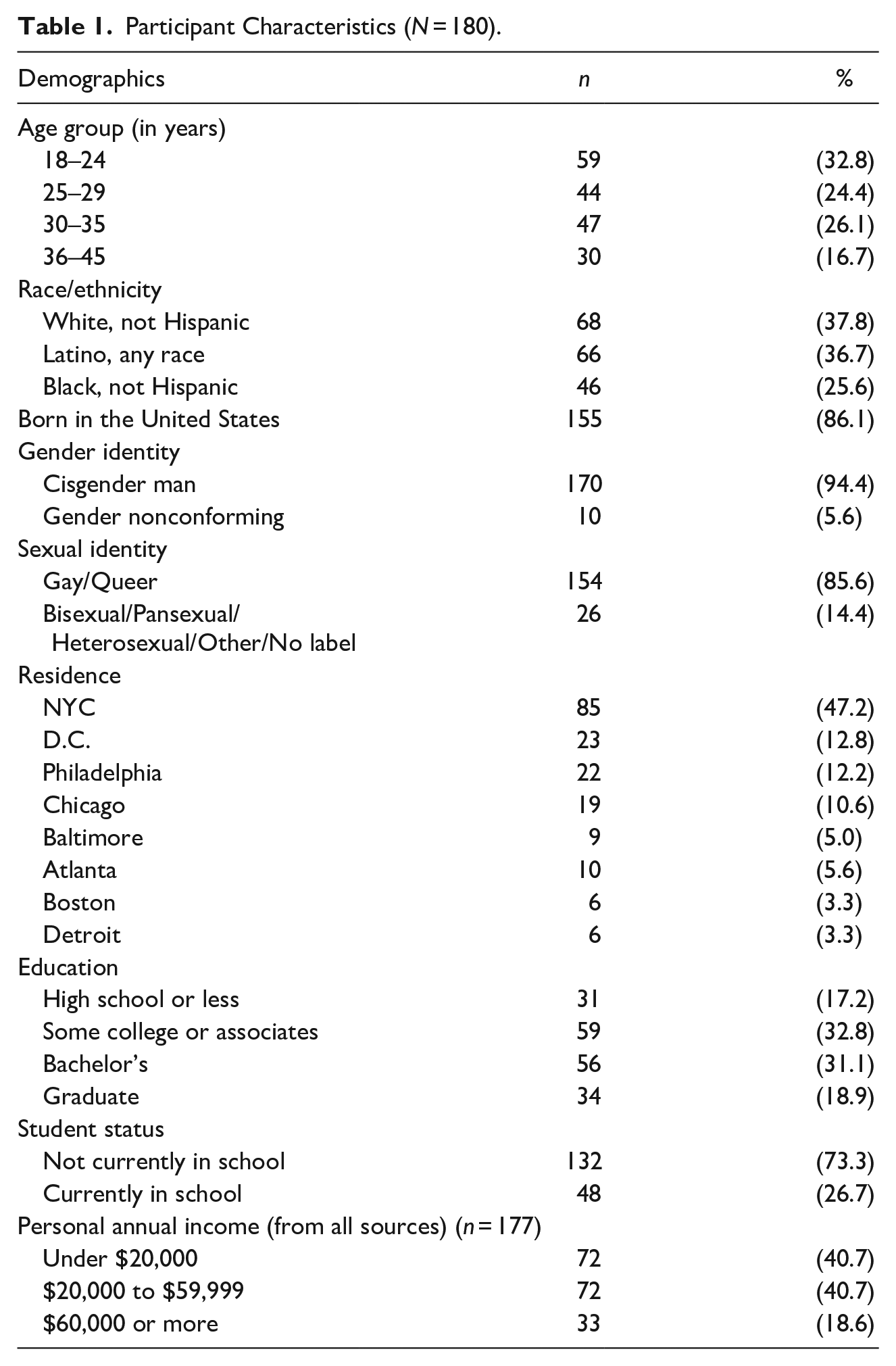
The study participants’ characteristics are reported in Table 1. The age range of participants was 18 to 45 years (median age = 28). Among the participants, 37.8% identified as White (non-Hispanic), 25.6% identified as Black (non-Hispanic), and 36.7% identified as Latino of any race. In terms of education, the sample was generally well educated; only 17.3% reported having a high school education or less and 18.9% reported having a graduate or professional degree. Reported personal annual income (from all sources including “off the books” income) were for the most part modest with 40.7% of participants earning less than $20,000, 40.7% earning $20,000 to $59,999, and only 18.6% earning $60,000 or more. Participants reported a mean of 6.88 clients in the past 3 months (range: 2–56). Most participants (86.1%) were born in the United States.
Participant Characteristics (N = 180).
In the qualitative interviews, participants described experiencing various forms of violence from clients including aggressive and threatening behaviors, robbery, physical violence, and sexual assaults. Most participants, regardless of whether they had previously experienced any of these problems or not, appeared to recognize that engaging in exchange sex with strangers they met online carried risks of personal harm. When comparing those who had reported experiences of violence from clients with those who had not reported such experiences, a similar proportion had employed one or more risk prevention or reduction strategies. The types and number of strategies used did not differ between these two groups, with the exception that those workers who had been robbed or not paid for services in the past more often reported requiring payment up front before services or before sex occurred. Only a small number of participants appeared naïve to the risks of sex work and reported not being worried about it and not engaging in any strategies to minimize such risks.
We analyzed the data by racial/ethnic group and found no differences in the frequency of employing at least one strategy to minimize the risk of violence associated with sex work. The few instances of apparent differences in the use of specific strategies are noted in the appropriate sections. Caution should be used in interpreting these differences due to small numbers in some comparison groups and the fact that participants were asked open-ended questions to generate the risk-management strategies they used and were not systematically asked whether or not they employed each of a list of strategies.
Strategies Used Prior to Meeting With Clients
Negotiating Parameters of the Encounter Prior to Meeting
In an effort to forestall finding themselves in an uncomfortable or hard to manage situation later, many participants tried to establish beforehand with clients what would or would not occur at their meeting. The following participant had learned from experience that failing to discuss exactly what his clients were interested in doing sexually prior to meeting them in person could lead to tension, conflict, and even a potentially dangerous situation. He described the type of information he wanted to clarify prior to meeting a client.
Typically, I like to know what they’re interested in. There are a wide variety of interests, and I think there are some things that frankly I don’t have an interest in performing or doing. So, that’s a big piece of it. I’m not into being beat up or scat or any of that type of stuff doesn’t appeal to me. So, that’s really important for me to get a sense of what the client’s desires are, because I want to be very honest. Because oftentimes I’ve been in encounters where I haven’t gotten very clear on that and I’ve been asked to do things, and then sometimes clients have gotten physically and verbally aggressive. And to avoid that, I’ll always make sure I’m very clear on what their desires are. (35 years old, Black, D.C.)
Similarly, another participant described his negotiation process aimed at ensuring that he would not be in a situation where he was not in control physically.
I want to know what they’re into, what they’re looking for, how much they’re willing to pay me . . . I am not willing to do any kind of scenes where I’m submissive, both because I don’t enjoy that as a person and also because, especially if I don’t know a person and they’re paying me, I don’t want them to have any kind of physical control over me at all. I won’t bottom. (21 years old, White, Chicago)
Another participant reported that he asked potential clients about their specific sexual habits before meeting to reduce the likelihood of encountering a client who would try to do something that could be degrading to him when they met.
I ask them outright, “Do you cut? Do you whip? Do you use chains? Do you punch? Do you slap?” All that shit. Anything that degrades the partner, I’m like, “No, mm-hmm (negative).” No piss play. No golden showers. None of that shit, no. Mm-hmm (negative). (44 years old, Latino, NYC)
Screening Clients
Participants frequently reported trying to screen clients prior to meeting them to identify potentially problematic clients. Those who reported an annual income of $60,000 or greater more often reported screening clients. One strategy that participants used was to try to elicit information about a potential client that could help establish his true identity. Some then used the names and numbers provided to search on Google, Facebook, and other social media sites to look for items and information such as pictures, social media posts, community ties, or police records to verify a prospective client’s legitimacy. A client’s willingness to provide his real name and number tended to reassure participants that they were less likely to become troublesome later. For example, one participant described the process he used after obtaining additional information from them.
If I can get a first and last name out of someone, I’ll try to find their Facebook or something else about them, because I like to make sure that I’m not getting catfished or I’m not entering a dangerous situation, but lately it’s been more repeat clients than new ones, so it’s been less of a fear. (23 years old, White, Chicago)
The following participant refused to meet someone who would not provide a phone number and wanted to see several pictures from potential clients.
With a profile, you have to have a picture. That’s one of the things that you would ask for. The first thing you’re asking for is, “I need to see a face pic of you.” That’s where catfishing came in. If the person shows up and it’s not the person, you immediately close the door, or you don’t answer because that’s putting you in jeopardy . . . You needed to give me a number that I could be able to call. You can’t call me from a blocked number, and you have to send me not one, not two, but three face pics. Not three face pics in the same t-shirt. Three different places, outfits, or whatever. (43 years old, Black, NYC)
Another participant said he paid attention to any sign that a client might be coercive if they met and tried to have him engage in sexual behaviors that he would be uncomfortable with or get him to do things not agreed to in advance.
It’s also the tone of their messages, how sort of desperate they seem to want this, or how insistent they are. If there’s somebody who keeps trying to encourage me to do other sexual acts, like “Oh, and then maybe when you get over here, we can find other things to do.” If there’s any speech and languages like that—that I’ve heard before—that’s a red flag. If it’s something that I feel is going to maybe lead to some coercive behavior, that’s usually just a direct no. (24 years old, Latino, NYC)
Several participants used the screening process to avoid clients who consumed drugs and/or alcohol. The following participant expressed concern that if a client used substances before or during the encounter, he might become violent or unpredictable.
I make sure that they don’t want to [do drugs] . . . I ask them, I’m like, “Do you do drugs? Do you have them on you?” I just ask them because I don’t like using it, and I don’t trust people who are on them cause I’ve seen people on drugs have really bad reactions to the drug that they’re on. So, I make sure that there’s no drugs involved. I mean, if they want to do it afterwards, that’s fine. They can do drugs when I leave. But before and during, it’s completely . . . the only thing . . . it’s either alcohol or we’re sober. (27 years old, White, Philadelphia)
Similarly, another participant, as a safety precaution, screened out potential clients who use drugs.
Sometimes, I try to make a phone call, before. The way he treated me, I can see if they’re going to treat me as an object and they’re aggressive or they use drugs. I don’t do drugs, so if they do drugs or something like that, it’s not my thing. (39 years old, Latino, NYC)
A few participants mentioned that they felt safer meeting clients through venues where some screening of them had already occurred. For example, one participant stated that his vetting process included relying in part on RentMen, a male escorting website (http://www.rentmen.cc). He felt it offered a safer approach to identifying clients compared to some hookup apps and it generally provided the opportunity for more conversations to occur between the appointment being made and the meeting date.
Yeah, I think it [RentMen] allows people who engage in sex work a level of agency over their clients. It provides both the clients and the escort a way to vet their potential hookups . . . I think people feel like they have more control. There’s more of a vetted process. There’s a rating mechanism associated with it, that allows clients to make sure that they’re meeting someone who’s legit, that allows sex workers to sort of, that clients even, I think, you can actually look at a client’s profile. Usually, they don’t have photos of themselves there, but it does show you how long they’ve been a member, whether they’re a paying member, so if it’s, for instance, if someone messages me on RentMen, and I see that their profile is a week or two old, and there might be something slightly off, I won’t see them. If I see that they’ve been on the site for five years or so, it tells me that, okay, this person’s been on the site for a while, they’re not this brand new person who just opened up this account, and it’s gonna, could potentially be risky, so there’s a lot of ways that the site and the way it’s structured, it allows you to sort of vet people in a way. (36 years old, Latino, NYC)
Sharing Information About the Client and Meeting Place With Others
Participants often shared information about clients with friends—such as names, photos, addresses of meeting places, or phone tracking capabilities—to try to make sure that they could be helped if needed. As one participant explained, he also let the client know he had done so, as a deterrent to any violent behavior.
I send my friend my location on WhatsApp, and they have access to any movements I make for like 12 hours. I say jokingly to them [clients] that, “Just so you know, my friend knows where I am, so don’t get any funny ideas.” I say it in a joking manner, and they tend to laugh it off, but I’m actually serious. That’s kind of my precaution I take. (28 years old, Black, NYC)
Similarly, whenever another participant met a client, he shared timing and location information with a friend because of his concerns about the risks of sex work to his physical safety.
Usually when I go there, I send a location pin to my friend, so they know where I am. I tell them what the deal is. I usually tell her when I leave, too. Just as safety precaution. (29 years old, Latino, Baltimore)
Another participant who recognized the potential dangers of meeting with strangers, gathered information about potential clients and used the ability his phone provided to allow his best friend and mom to know his location when he was meeting a client.
Oh, yeah. That’s scary [meeting a generous man for the first time]. Who knows? I mean, I’m very good at the internet, computers. I’m good at doxing, or getting information about people. I wouldn’t put myself in a risky situation. My best friend has my location. Even my mom has my location. You know on the iPhone, you can click share location? That’s just a safety precaution. (20 years old, White, D.C.)
Similarly, the following participant described sharing the client information he had gathered with his friend group chat. He also provided the group chat with instructions to contact police if he did not respond within a certain period of time after the time his session with a client was supposed to end.
So I have a group chat with friends, so I’ll send them the time that I’m meeting them, their face photo, their name, if I’m going to their house their address, or the hotel. And just kind of like for safety, if anything happens you know what they look like, you know who they are, and you know where to find them . . . I definitely always consider the fact that something could go wrong. Yeah. I always think about worst case scenarios. With every client, regardless of how attracted I am or not, or whatever. And that’s why I keep a group chat with friends with where I’m at, the time that I’ll be there, and if I don’t respond within an hour after I say I’m done, okay something’s not right. Yeah. So even regardless of how comfortable I am with them or whatever, I just consider it a fact that people have been killed in the past because of this. And I’ll tell my friends, “If I don’t reply an hour after I say that I’m done, I don’t know. Call the police.” (24 years old, Latino, Chicago)
Choosing a Safe Meeting Location
Meeting new clients in locations that they perceived as safe was another safety strategy participants employed. For example, before moving to a private location for sex, some preferred to meet new clients in a public setting, which made it easier to leave the situation if necessary.
I like to get to meet them out in the public sometimes at first, before I bring them into my home. To make sure that they’re not high on drugs or alcohol. At least I can be outside, and make sure if something happens . . . Before I bring them into the house. That helps. (41 years old, Black, NYC)
Others were careful about where they met clients for sex, for example, avoiding cars. Preferred locations were ones where they could safely escape or there were cameras or people nearby from whom they could seek help, if necessary.
It’s definitely a risk, but it’s less of a risk if they have an apartment or a studio somewhere because there are other people in the building . . . It’s less of a risk if they have an apartment compared to like a house or something like that. Hotel would be less of a risk to me, too. (28 years old, Black, NYC)
Additionally, some participants preferred meeting clients in densely populated locations and gathered details about where they would be meeting beforehand. For example, the following participant looked up clients’ addresses before going there and avoided meeting clients in what he thought were isolated or “bad” neighborhoods.
I’m driving, I’m going to the person, I want to know the neighborhood. If it’s like a bad neighborhood or whatever, I’m not going there. If it’s like an isolated area, neighborhood, I’m not going there. So, I’m more likely to go if it’s in an apartment building or in a community that has a lot of people. (32 years old, Black, Philadelphia)
Relying on Information From Sex Worker Networks About Problematic Clients
To protect themselves, some participants gathered information about potential clients from other sex workers either informally or shared through information and communication technologies. After having bad experiences with particular clients, these participants also tried to warn other sex workers about these individuals. The following participant shared his preferences for how he met clients and how he relied on information provided by friends to mitigate the risks he felt might be posed to his safety.
[For meeting clients] Definitely RentMen or even, it doesn’t happen often, but even there are recommendations of a friend too because then you know that they’re going to not be a horrible guy and will treat you okay . . . [to mitigate safety risks] I mean just the recommendations of friends and stuff like that because then you know . . . [friends’ tips are] just telling you who not to see and who to see. That sort of thing. (35 years old, White, Chicago)
Several participants used social media or personal contact lists to share information about problem clients with other sex workers. When they received what seemed like suspicious requests from potential clients, some participants cross-checked their information with those lists. The following participant described how he used information from approximately 100 escorts on a private Facebook group, as well as phone blocking technology, to avoid problem clients.
Well, we exchange information about clients that we’ve had bad experiences with. We cross-reference the information among a large group of people, so that the clients that have either not paid or made appointments and not shown up, or just the clients that I might have bad experience with. That we’ll exchange mostly that information just to protect each other from having repeat experiences . . . we [escorts] have an online group where you can just go in and write names, phone numbers, addresses of clients that have either stiffed the escort or not shown up or things like that. You can just go through and scan that list. What I do is I just take the phone numbers and put them in my phone and block them, so that if that person ever tries to contact me, the call won’t even go through. (31 years old, White, NYC)
Another participant discussed how he shared information about problem clients and checked out potential new clients using a Facebook group chat.
We have one Facebook chat about, it was like a whole bunch of sex workers on it and they’re talking. We all know the same people, so if there’s ever a guy who’s really bad, we let everyone know that. Like, “don’t talk to this one guy if you’re not looking for something like this.” (23 years old, Latino, Philadelphia)
Strategies Used at Meetings With Clients
Receiving or Being Shown Payment Before Sexual Activities
In an effort to avoid not receiving their fee, or receiving only partial payment, some participants required that they were paid upfront or that the money was at least shown to them and left in plain sight prior to proceeding with any sexual activities. Several mentioned that this was in response to past difficulties getting paid in full after sex. While we did not find racial/ethnic differences in reports of being robbed or not paid for services, Black participants more frequently reported requiring payment or seeing the payment before engaging in sexual activities. Every Black participant who had previously experienced not receiving their fee from the client after providing services, reported now requiring payment before services. Participants reported that this tactic also helped to prevent confrontations over payment later. For example, the following participant collected his fee before any activity because of a bad experience in which he was assaulted over the payment.
I normally collect before I do anything at all. Because I had a very bad experience once, where I went and met this guy and then when I met him, he said he’s just going downstairs for a minute, and then he’s going to come back up, he came back up with three other guys . . . and then the money he had paid me, he like, literally squeezed my throat, slammed me against the wall. So, I had to give him back his money. So, at the end of that day, I only left with a sore ass and a sore throat . . . I never got no money or anything like that. He took it back and stuff like that. (28 years old, Black, NYC)
Similarly, a participant, having previously been cheated out of electronic payments once he left the encounter, reported that he wanted to see the money before he would proceed sexually.
Some guys, they’ll think that you’re immediately going to take your clothes off and hop in the bed with them before they show you any kind of proof of money, or anything like that. I’m different. I’m going to wait until you show me the money first . . . Like, guys will also try and get over on you by saying, “Do you have PayPal?” Or, “Do you have Cash App?” And I’ve been in situations where guys would Cash App me, and then cancel the request once I left the address. Yeah, and I didn’t know you could do that. So I learned that the hard way. And now that I know that, whenever guys bring up like, “Oh, do you have PayPal?” Or, “Do you have Cash App?” I always say no. (24 years old, Black, NYC)
Another participant shared that he got his money at the very beginning of any encounter and how he felt that kept him from having difficulty getting paid.
No, [I’ve never had a hard time getting paid by a client] because I don’t, I don’t allow that. I don’t . . . We’re not even going past hello without my money in my hand. (37 years old, White, Detroit)
Self-Defense Techniques
Some participants relied on self-defense as a means to prevent or minimize violent situations. Among those relying on self-defense techniques, some reported carrying weapons or other items that they could use to defend themselves if a sex exchange encounter became threatening or violent. Those who are 18 to 29 years of age more often reported using this safety strategy than those 30 to 45 years old. They more commonly carried a weapon for protection and/or felt that their size or fitness level or training in a martial art made them prepared to deter or handle a threatening situation. The participant below looked online for safety tips, took self-defense classes, and carried a knife and pepper spray for protection during sex work.
I always carry a knife on me. I have a pocketknife that I keep and a can of pepper spray. I don’t make that known. I don’t tell them, “Oh, I have a knife,” or whatever but I make sure it’s nearby. I make sure I can get to it if I need to, but luckily, I haven’t had to do any of that with any of my clients. (27 years old, White, Philadelphia)
Another participant carried a corkscrew, which he felt he was unlikely to inadvertently harm himself with but could still inflict damage on an attacker.
Every time I meet a new partner, I’m a little bit nervous about it and what could happen, so I’ll bring a corkscrew with me . . . I feel like if I put a knife in my pocket, I’m going to accidentally cut my leg as soon as I sit down, but a corkscrew I feel like it has a little knife on it. It’s easy enough, but also I’ve seen the movies enough times to know that if you just pull the corkscrew part out and jam that in someone’s neck, you can kill them. (22 years old, Latino, NYC)
Some participants felt confident that their athleticism, size, or strength would enable them to protect themselves if the need arose. For instance, the following participant said he was not concerned about violence because he would be able to fight off perpetrators.
It crosses my mind but it’s not something that I ever seriously worry about. I mean I’m almost six-foot [tall]. I’m a relatively big person. So, I mean generally, I feel pretty secure. It’s a bit different since I’m a guy, I can fight people off. (25 years old, White, NYC)
Other participants reported they would rely on specific self-defense techniques they knew if necessary. One said: I can handle myself, like I said, I’m very flexible and that’s because I took many, many years of karate and Taekwondo. So, like if someone got a little too handsy, I know how to dispense of them easily. (34 years old, Black, D.C.)
Remaining Unimpaired and Alert
Some participants talked about the importance of staying sober or not allowing themselves to be drugged during sex work to ensure that their judgment would not be impaired during an encounter. For instance, the following participant described why it was essential to be clearheaded, given the risks of sex work.
I want to be in a clear state of mind at all times just in case something happens. . . . Of course [exchange sex could pose a risk to my physical safety]. Of course it could. That’s why I don’t drink or do any drugs, anything like that. That’s why I always have a sober mind so I can be alert. (37 years old, Black, NYC)
Some participants declined any drinks and food from a client to avoid risking ingesting something that could impair or incapacitate them, could hamper them in fending off an assault, or impair their ability to exercise good judgment in a situation. The following participant emphasized the necessity of remaining vigilant and on “high alert” throughout the meeting by refusing any drinks that the clients attempted to serve him.
It’s keeping yourself in a mindset that you’re controlling the situation at all times, and just being present . . . It’s just silly things like don’t take drinks from them. I’m neurotic already, so you’re always on high alert already. (26 years old, White, Philadelphia)
Another participant would only consume substances he had prepared himself.
I’ve never accepted food, drinks, or drugs while with the person unless I’ve prepared them myself, if that makes sense. I’ll never smoke with clients or drink a drink that a client just gave me. If we’re going to smoke or drink, I’ll prepare the weed, or the joint, or the bowl, or whatever. I’ll prepare the drink, just to make sure that I’m not being slipped anything without my knowledge. (19 years old, White, D.C.)
Having an Exit Plan
Several participants emphasized the importance of being ready to quickly leave a meeting when it starts to feel unsafe. For instance, in addition to sharing information with others and carrying a pocketknife, the following participant always tried to make sure that he had a way to escape a situation in which he felt unsafe.
I’ll always make sure I know where I guess like an escape route is. I know where the door is. I know that it’s not locked, all that sort of thing. (23 years old, White, D.C.)
Another participant said he always tried to keep his clothes on and all his belongings with him as long as possible in case he felt threatened and needed to leave quickly. After he escaped the situation described below, he immediately blocked the client’s number.
If someone wants to sit and chat, and kind of hang out, I won’t take my coat off, I won’t take my shoes off. I’ll keep everything on me in case I decide that I need to bolt, or make an exit which I’ve definitely had to do before. . . . I was in his [client’s] bathroom freshening up, and there was supposed to be only one person meeting me, and then I heard other voices and other footsteps in the apartment. I was planning on meeting one person, and now all of a sudden there are three, four, five, or however many people in the room, so I just got out as quick as possible. (19 years old, White, D.C.)
In conclusion, participants used a range of strategies to avoid meeting with potentially dangerous clients and to minimize the degree of harm they might sustain should threatening or violent behavior be perpetrated by a client. These strategies were employed both before meeting clients and at the time of the meetings. They typically relied on resources such: using information technologies to share and gain information about problem clients; sharing client meeting details with friends; meeting clients in safe locations; relying on self defense techniques; and, remaining alert and unimpaired when with clients.
Discussion
This report adds depth and context to our understanding of MSWs’ strategies to manage the risks of threatening and violent behavior and “gives voice” to the minority of MSM who engage in exchange sex. Our participants primarily found clients through dating and hookup apps, an increasingly popular venue for conducting sex work. The isolation often associated with independent, internet-based sex work has the potential to increase vulnerability to violent acts. The criminalization of sex work can further isolate those engaged in exchange sex and increase their vulnerability to client abuse or violence, while decreasing the likelihood that they will seek health and social services to help manage these risks (Bungay & Guta, 2018). We found that most of our participants recognized the potential dangers of exchange sex and rather than accepting victimization as inevitable, instead demonstrated agency by using a variety of strategies to mitigate the risks of interpersonal violence that they might confront. Some of these strategies involved using technology to reduce isolation and build mutual support by sharing information about difficult clients with other sex workers and relying on the information they shared.
Consistent with prior research, our participants employed many tactics prior to meeting a client. These included paying careful attention to phone conversations or text messages for any concerning language or signs that the potential client might not be honestly portraying himself or that he might want to engage in risky behaviors or ones that the participant wanted to avoid. Some participants requested photos or additional information about a prospective client to try to confirm the identity and truthfulness of the client. Sometimes the solicited information was used to perform Google or Facebook searches for confirmation or additional details. Additionally, sites like RentMen were utilized to find clients because the site itself provided a degree of “prescreening.” We noted that participants who reported an annual income of $60,000 or greater, were more likely to report that they had engaged in a screening process to avoid potentially harmful clients. Perhaps those with higher incomes could afford to be more selective, while those who were more dependent on income from sex work could not be so discriminating.
As has been observed in other studies (Argento et al., 2018; Bernier et al., 2021), negotiations with potential clients were frequently carried out before meeting in person to establish what sexual acts would be acceptable. Additionally, many participants had specific location requirements for their encounters with clients and generally worried about meeting in isolated or scarcely populated areas. Similar strategies to try to ensure a safe encounter environment have previously been reported (Bungay & Guta, 2018; Kuosmanen & de Cabo, 2021).
Many participants also shared with friends the details of their upcoming meetings with clients including providing information about and photos of the client, the meeting location, and/or how long they should be gone. This finding is consistent with prior research (Bernier et al., 2021; Bungay & Guta, 2018; Campbell et al., 2019; Wilcox & Christmann, 2006) including a recent literature review with studies from the United Kingdom reporting that sex workers utilized a “buddy system” to text a colleague with details of upcoming client meetings (Bernier et al., 2021). Some participants further used technology to leave a digital trail of their whereabouts (e.g., posting a comment on social media about a park near the meeting place to help others find), or giving phone tracking capabilities to their friends and/or family through services like WhatsApp or iPhone share location. While sharing meeting information with friends may not by itself prevent acts of threatening or violent behavior, if MSWs tell clients they have done so, it might serve as an adequate deterrent. It might also provide some peace of mind for the sex worker to know that others may provide or seek assistance if they do not return or contact them. Additionally, some participants in our study networked and shared information about problem clients with other sex workers personally or via social media so they could be avoided, a strategy described in earlier studies (Bernier et al., 2021; Jiao et al., 2021). However, U.S. policy changes enacted in 2018 to curb sex trafficking have created legal barriers to sex workers’ efforts to protect one another from problematic clients through online communications (Sawicki et al., 2019).
Along with prevention efforts prior to meeting with a client, participants also had tactics they employed at the time of the meeting to reduce their risk of harm. As has also been reported in previous research (Bungay & Guta, 2018; Wilcox & Christmann, 2006), some required payment, or at least proof that the client had the payment with him, before sex. This provided some reassurance that the client intended to pay and had the money with him to do so. Also consistent with prior studies (Bungay & Guta, 2018; Dank et al., 2015), some carried weapons or other household tools that could be used as weapons, as well as pepper spray, to protect themselves in the event of an assault. Others relied on their larger size, physical fitness, and/or training in self-defense to deter clients from assaulting them or to defend themselves should the need arise.
Some participants emphasized the importance of remaining very alert and aware of one’s surroundings. This included avoiding drugs and alcohol, particularly anything offered or prepared by the client, to ensure that they would not be in any way impaired. Others stressed the importance of being ready to quickly leave a client meeting or having a plan for a quick escape if necessary. These strategies have also been reported by sex workers in Sweden (Johsson et al., 2011; Kuosmanen & de Cabo, 2021).
The tactics our participants used prior to the sex work encounter could serve as a basis for developing violence prevention interventions. That is, MSWs could benefit from educational resources or skill-building interventions focused on things like empowerment and assertiveness training, to enhance sex workers’ screening and negotiating skills and assist them in avoiding and managing potentially violent situations (Rekart, 2005). Indeed, a qualitative study of 32 MSWs in Massachusetts found that participants stressed the importance of communication and negotiating boundaries in sex work (Reisner et al., 2008). Internet escorts (who made up approximately half the sample) were particularly interested in future interventions focused on communication, negotiation, and self-advocacy. The researchers suggested the development of skill-building modules to negotiate “sexual safety and risk limits” across partners, transactional or not. Findings regarding our study participants’ interest in and use of online resources and networking to assist with their sex work have been previously reported (Meunier et al., 2022).
Online dating and hookup websites and apps provide a venue for delivering interventions aimed at helping sex workers develop the risk-management strategies, such as the ones our participants reported. Such interventions could raise awareness of potential risks, promote safety practices, and/or provide links to online groups or local organizations that focus on issues such as: screening potential hookup partners (i.e., “clients”); communication, negotiation and self-advocacy skills; legal advice; information sharing and local networking regarding risky clients and unsafe areas; maintaining self-awareness during meetings with clients; and maintaining fitness and learning self-defense techniques. Some of our participants noted similar levels of concern about potentially violent behavior from anyone they met through a hookup app, whether it be for exchange sex or a personal hookup for casual sex. Therefore, educational interventions to promote safety/risk-management strategies are relevant and potentially useful to all MSM users of these apps. Targeting them to all MSM could reduce the reluctance that MSWs might feel to access them if they were targeted only to sex workers for fear it would implicate their involvement in an activity which is both stigmatized and illegal. Targeting all MSM users of these apps could also contribute to normalizing the use of such interventions.
The findings presented offer rich insights into the types of violence prevention and mitigation strategies used by MSM who engage in exchange sex with men met on dating and hookup websites and apps. However, some limitations of the current study should also be noted. The convenience sample used restricts generalizability of the findings to the full population of MSWs. While participants were recruited from multiple urban centers in the United States, still the risk reduction strategies they used might differ from those used by MSWs operating in cities located in other regions of the country or in suburban areas, small towns, or rural areas. Our findings also may not be generalizable to those MSWs who are primarily engaged in street-based sex work or those who do not have access to devices that provide information and communication technologies. Additionally, data were self-reported and may be affected by recall error. Despite these limitations, this study provides important insights into the ways MSWs try to manage violence-related risks, and the substantial role of information technology in preventing and managing potentially dangerous situations during a time where sex work is increasingly being arranged through online dating/hookup sites.
Footnotes
Acknowledgements
The authors wish to thank Katharine E. Peglow (MPH candidate) for her assistance in the preparation of this article for submission.
Declaration of Conflicting Interests
The author(s) declared no potential conflicts of interests with respect to the authorship and/or publication of this article.
Funding
The author(s) disclosed receipt of the following financial support for the research and/or authorship of this article: This work was supported by the National Institute on Minority Health and Health Disparities under Grant R01MD011587, “Exchange Sex and HIV Risk Among MSM Online” (PIs: Siegel /Schrimshaw).
