




Abstract
Anti-Asian xenophobia has exploded during the COVID-19 pandemic, after U.S. political leaders promoted anti-Asian rhetoric from its start. Confronting prejudice interrupts future perpetration of such prejudice, but confronting prejudice can only occur to the extent actions are first attributed to prejudice. Bystanders may attribute less prejudice to speech about the “Chinese Virus” than to more blatant stereotype expression, for example, and therefore be less vehement in their confrontations. Across two studies, we examined the impact of anti-Asian prejudice type (blatant, subtle, or no prejudice) and bystander race/ethnicity (White or Asian American/Pacific Islander [AAPI]), on prejudice attribution, willingness to confront, actual confrontation, and confrontation vehemence. In the context of a hiring manager justifying rejection of a Chinese applicant, we predicted that blatant prejudice would be detected and confronted most willingly, and subtle prejudice more willingly than no prejudice, and that prejudice detection would mediate the relationship between prejudice type and willingness to confront. Further, we expected AAPI bystanders to detect anti-Asian prejudice more readily than White bystanders, but to confront at lower rates, with actual confrontations being more vehement following blatant (relative to subtle or no) prejudice. Analyses were conducted using SPSS 27 and the PROCESS v4.1 macro, controlling for potential confounds such as political orientation and individual-level prejudice (expressed or perceived). Results of both studies (n = 142 [Study 1], n = 274 [Study 2]) supported hypotheses, except in Study 1 bystanders exposed to subtle prejudice were no more willing to confront than no-prejudice controls. Results of exploratory analyses indicated that attribution to prejudice was the primary obstacle to confrontation following subtle prejudice, whereas action taking was the primary obstacle following blatant prejudice. This research underscores the need for interventions to increase detection of all forms of anti-Asian prejudice and to provide would-be confronters with effective confrontation tools.
I always treated the Chinese Virus very seriously, and have done a very good job from the beginning, including my very early decision to close the “borders” from China—against the wishes of almost all.
Research conducted following the 2016 U.S. presidential election demonstrated increased social acceptability of prejudice expression toward members of groups Trump targeted during his campaign, including Asian Americans (Crandall et al., 2018). For example, after Trump initiated the phrase “Chinese Virus” and other anti-Asian rhetoric early during the COVID-19 pandemic, via the foregoing Tweet, use of phrases such as “Chinese Virus” and “China Virus” increased exponentially on Twitter (Budhwani & Sun, 2020). Further, hate incidents directed at individuals of Asian American/Pacific Islander (AAPI) descent increased substantially; specifically, 27.2% of hate-incident assailants reported to Stop AAPI Hate explicitly mentioned “China” or “Chinese Virus” during their attacks, with content analyses revealing that 31% of these assailants blamed China for the spread of COVID-19 (Borja et al., 2020). As repeated exposure to xenophobic rhetoric leads to echoed sentiments (Álvarez-Benjumea, 2023), COVID-19-related discrimination against AAPI individuals has remained pervasive for years, estimated between March 2020 and December 2021 to include verbal harassment (63%), physical assault (16.2%), deliberate avoidance (16.2%), civil rights violations such as discrimination at work (11.5%), and online harassment (8.6%; Yellow Horse et al., 2021).
A growing body of research has shown that exposure to this type of rhetoric and other anti-Asian discrimination adversely affects the health and well-being of AAPI individuals (e.g., Lee & Waters, 2021; Oh & Litam, 2022; Wing & Park-Taylor, 2022). For example, COVID-related discrimination predicted higher anxiety and depression (e.g., Lee & Waters, 2021; Oh & Litam, 2022), and physical illness and sleep disturbance (Lee & Waters, 2021), and lesser life satisfaction (Oh & Litam, 2022).
Importantly, two forms of anti-Asian prejudice, blatant and subtle, directly have related to negative mental health outcomes (Yoo et al., 2010). Moreover, in some contexts, the implications of subtle prejudice may be even more adverse. For example, Black participants experienced more cognitive impairment following an ambiguously prejudiced hiring decision than following a blatantly prejudiced decision (Salvatore & Shelton, 2007). A qualitative study examining subtle prejudice in the form of workplace incivility toward lesbian and gay coworkers indicated that subtle bias was common and manifested in various forms including “jokes,” which in turn created a sense of ambiguity about the perpetrator’s intentions and impaired work performance (Di Marco et al., 2018). As such, combating anti-Asian prejudice, whether blatant or subtle, is a mental health imperative.
Confronting perpetrators of prejudice—that is, challenging their attitudes and behaviors with disapproval—has been established as an effective method to reduce prejudice (e.g., Chaney & Sanchez, 2018; Czopp et al., 2006; Munger, 2017). However, the extent to which observed actions are first attributed to prejudice—obviously (blatant) versus ambiguously (subtle)—impacts a potential ally’s willingness to confront (Ashburn-Nardo et al., 2008). In fact, prejudiced individuals may express bias in a subtle or ambiguous way to avoid detection (and backlash) for behaviors that obviously violate social norms (Meertens & Pettigrew, 1997).
The public—particularly Trump supporters—may attribute less prejudice to phrases such as “Chinese Virus” than to more blatant stereotype expressions. Recent research revealed that relative to participants who read a media article framing the pandemic as the “COVID-19 Virus” those who read an article framing the pandemic as the “Chinese Virus” blamed China for the pandemic to a greater extent (Frush Holt et al., 2022). Thus, although research has demonstrated that these relatively “subtle” phrases are just as harmful, if not more so, they may not be as easily detectible as prejudice and therefore may induce even greater prejudice, for example based on victim blame. In fact, research examining the impact of exposure to varied type of sexual prejudice (i.e., prejudice based on sexual orientation) showed that bystanders’ personal prejudice increased from baseline when exposure was to subtle but not blatant prejudice (Krolikowski et al., 2016). This work also found that those exposed to blatant relative to subtle prejudice distanced themselves more from perpetrators, further suggesting that blatant prejudice is detected more readily than subtle prejudice and is therefore more likely to be confronted.
Confronting Prejudice as a Prejudice-Reduction Tool
Seminal research examining the utility of interpersonal confrontation for reducing future acts of racial bias in White individuals induced participants to make stereotypic inferences about Black individuals depicted in photographs, and then these offenders were confronted by another White person in either a high- or low-threat manner (Czopp et al., 2006). Following this confrontation, participants completed a second task that was also designed to elicit biased responses. Findings revealed that participants who had been confronted in a high-threat manner evaluated the confronter less favorably than did those confronted in a low-threat manner, but importantly, biased responses decreased regardless of threat type (Study 1). Later work using this paradigm found that confrontations had an enduring impact, with stereotype inhibition evident 1 week later (Chaney & Sanchez, 2018).
A randomized experiment conducted on Twitter used bots disguised as people to test the effectiveness of a confrontation intervention designed to reduce racial slurs in Tweets made by White men who had a history of engaging in racist harassment (Munger, 2017). Once identified, participants were randomly assigned to a 2 Confronter Status (many vs. few followers) × 2 Confronter Group Membership (ingroup member/White man vs. outgroup member/Black man) condition, then their racist Tweets were confronted by the corresponding bot. Following confrontation, real behavior was measured continuously for 2 months on Twitter, and results showed a significant reduction in the use of racist language among those who were confronted by the high-status ingroup member—an effect that persisted for 1 month. Yet, although an effective prejudice-reduction tool, confrontation is a low base-rate behavior, with only 24% of those who witnessed an act of blatant sexual prejudice confronting the perpetrator (Szekeres & Čabarkapa, 2023) and only 15% of women directly confronting sexist remarks (Swim & Hyers, 1999).
Barriers to Confrontation
To identify obstacles that potential confronters encounter following exposure to prejudice, Ashburn-Nardo et al. (2008) developed the Confronting Prejudiced Responses (CPR) model. Drawing from classic research that outlined the requisite steps of helping during an emergency (Latané & Darley, 1970), the CPR model similarly identifies five steps or obstacles to confrontation individuals first must surmount: (1) recognizing statements or behavior as bias, (2) determining that the bias constitutes an emergency, (3) taking responsibility for addressing bias, (4) identifying a suitable response, and (5) taking action after a cost/benefit analysis that yields more benefits than costs (Ashburn-Nardo et al., 2008).
Research suggests that detecting prejudice (Step 1) can be difficult (Ashburn-Nardo et al., 2008), particularly when prejudice is ambiguous or subtle (Salvatore & Shelton, 2007), framed as a compliment (Czopp, 2010), or when the bystander has not been a target of discrimination (Ashburn-Nardo et al., 2008). For instance, White participants failed to recognize that so-called positive stereotypes are harmful, readily endorsing stereotypes of Black Americans they viewed as complementary (e.g., athleticism; Czopp, 2010). White individuals attributed less prejudice to a relatively subtle instance of racist hiring than did Black individuals (Salvatore & Shelton, 2007), and men attributed less prejudice to expressions of sexism than did women (Drury & Kaiser, 2014). Although we found no published data demonstrating stronger attributions of anti-Asian prejudice among AAPI than White Americans, the pattern of extant findings (i.e., that targets tend to attribute to bias more readily than non-targets) suggests this pattern should also emerge in the current context.
If prejudice is detected, potential confronters must next determine whether the prejudice constitutes an emergency warranting intervention (Step 2), whether it is their responsibility to intervene (Step 3), and how to confront (Step 4; Ashburn-Nardo et al., 2008). Relevant here, the myth that AAPI individuals are “model minorities” who have worked hard to succeed and therefore do not experience prejudice (Yoo et al., 2010), along with stereotypes that AAPI individuals threaten Americans (Wing & Park-Taylor, 2022), may persuade potential allies that anti-Asian bias is neither an emergency nor their personal responsibility to confront (cf. Wlodarczyk et al., 2014). Indeed, Chinese transracial adoptees to White U.S. families reported feeling they had been relegated from the position of “model minority” to that of racial threat, understandably identifying this stereotyping as a primary COVID-19 stressor (Wing & Park-Taylor, 2022). Step 4—identifying how to confront—is daunting, particularly for those not in the habit of confronting prejudice or otherwise feeling they do not know how to confront effectively (e.g., Ashburn-Nardo & Karim, 2019).
Individuals who surmount the first four obstacles must finally determine that the benefits outweigh the costs of confronting the perpetrator (Ashburn-Nardo et al., 2008). For example, potential confronters may feel they cannot change perpetrators’ attitudes or behaviors (e.g., “one cannot change a racist”; Ashburn-Nardo & Karim, 2019). Further, potential confronters may be rightfully concerned how others will evaluate them, for example as “complainers,” particularly if they also are a target of the bias (Czopp & Monteith, 2003; Monteith et al., 2019). Social perceptions of confronters are particularly unfavorable when expressions of bias have been perceived as ambiguous (Zou & Dickter, 2013) or as less egregious, such as with expression of positive racial stereotypes (Alt et al., 2019). Moreover, potential confronters may be concerned about becoming a target of harm by a perpetrator (Ayers et al., 2009), especially among AAPI individuals themselves given the prevalence of anti-Asian hate crimes (Yellow Horse et al., 2021). Finally, although targets detect prejudice more readily than do non-targets (Drury & Kaiser, 2014; Salvator & Shelton, 2007), the social costs of confrontation are higher for targets (Czopp & Monteith, 2003). Accordingly, we anticipate that although AAPI relative to White individuals will more aptly attribute to anti-Asian prejudice, AAPI individuals will confront prejudice less.
Current Work
The present research investigated how varied type of a hiring manager’s anti-Asian prejudice, including relatively subtle forms such as verbiage about the “Chinese Virus,” affects attributions to manager bias, willingness to confront, and type of confrontation. Specifically, we tested the following hypotheses:
Hypothesis 1: Participants exposed to blatant prejudice, relative to subtle or no prejudice, will attribute more anti-Asian bias to a hiring manager, and those exposed to subtle prejudice will attribute more bias than those in the control condition.
Hypothesis 2: Participants exposed to blatant prejudice, relative to subtle or no prejudice, will report more willingness to confront, and those exposed to subtle prejudice will report more willingness to confront than those in the control condition.
Hypothesis 3: The relationship between prejudice type and willingness to confront will be mediated by attribution of anti-Asian bias to the hiring manager.
Hypothesis 4: AAPI, relative to White, participants will attribute more anti-Asian bias to the hiring manager.
Hypothesis 5: White, relative to AAPI, participants will report greater willingness to confront the hiring manager.
Hypothesis 6: Participants exposed to blatant prejudice, relative to subtle or no prejudice, will be more apt to actually confront the hiring manager.
Hypothesis 7: Participants exposed to blatant prejudice, relative to subtle or no prejudice, will confront more vehemently, and those exposed to subtle prejudice will confront more vehemently than those in the control condition.
Finally, exploratory analyses will examine explanations for confrontation and non-confrontation decisions and whether the latter align with the five CPR model obstacles. We also examine whether obstacles differ as a function of prejudice type.
Study 1
Method
Participants
White-identified, U.S. Prolific workers (https://www.prolific.com; n = 350) completed a prescreening, including attention checks, 1 week prior to recruitment. Recruitment continued until the minimum sample size (n = 150) was achieved, as determined by an a priori G*Power analysis, with a goal of attaining 80% power to detect a critical F of 3.08 (Faul et al., 2007). Pilot research examining the impact of prejudice type on willingness to confront racism and sexual prejudice (Andrus et al., 2023; Stroman-Surita et al., 2018) revealed effect sizes ranging from η2 = 0.49 to 0.63. However, given that “Chinese Virus” might be perceived as relatively subtle prejudice, a conservative estimate of effect size was utilized (η2 = 0.30).
Participants who failed an attention check (n = 2) or a manipulation check (n = 6) were removed, resulting in a sample of 142 individuals (78 women, 62 men, 2 nonbinary/transgender) ranging in age from 18 to 63 years (M = 34.84, SD = 10.92). Participants were compensated $0.75 for completing the prescreening and $1.50 for completing the study.
Procedure
Participants were invited to a study about “hiring decisions” 1 week after completing a prescreening assessing endorsement of anti-Asian stereotypes. During the experimental session, participants read a resume and rated how likely they would be to interview the job candidate. After reviewing and rating the resume, participants were randomly assigned to read one of three ostensible rationales provided by the hiring manager for why the candidate should not be interviewed: blatantly prejudiced, subtly prejudiced, or non-prejudiced. Participants then completed measures of willingness to confront the manager, attributions to manager bias, political orientation, attention and manipulation checks, and demographics.
Materials and Measures
Resume and manipulation of prejudice type
Participants reviewed a resume from “Chamen Li,” a job candidate for project manager. In the blatant and subtle prejudice conditions, the resume emanated from a candidate in China, whereas in the control condition, the candidate resided in Canada. Participants were instructed to read the resume carefully as they would answer questions about the candidate after review. To bolster the hiring decisions cover story and verify the strength of the resume, participants indicated the likelihood they would bring the candidate in for an interview using a 1 (not at all likely) to 7 (extremely likely) scale.
Next, all participants were informed that the hiring manager rejected the job applicant (i.e., “I do not recommend that the company hire this applicant. Although the candidate had pretty good credentials, I decided to offer the job to another candidate who seemed to have more potential to successfully manage the team”), and based on random assignment to one of three prejudice-type conditions participants read one of the following: “. . .although Chinese people are usually very competent, they are also communists with poor social skills” (blatant prejudice); “. . .the travel restrictions currently in place due to the ‘Chinese Virus’ would prevent them from committing to a reasonable start date” (subtle prejudice); or, “. . .the travel restrictions currently in place due to COVID-19 would prevent them from committing to a reasonable start date” (no prejudice).
Anti-Asian stereotypes
The 25-item Scale of Asian American Stereotypes (SAAAS; Lin et al., 2005) measured endorsement of anti-Asian stereotypes at prescreening (α = .96). Participants indicated the extent to which they agreed with each statement using a 1 (strongly disagree) to 6 (strongly agree) scale. The SAAAS assesses excessive competence (e.g., “Asian Americans seem to be striving to be number one”) and inadequate sociability (e.g., “Asian Americans do not interact smoothly with others in social situations”).
Attributions to manager bias
Participants rated the extent to which they attributed the manager’s deselection of the candidate to anti-Asian bias, using a scale ranging from 1 (no bias toward Asian individuals) to 7 (extreme bias toward Asian individuals), with the midpoint (4) indicating possible bias toward Asian individuals.
Willingness to confront prejudice
Five items assessed willingness to confront prejudice (α = .90; e.g., “What is the likelihood that you will tell the hiring manager that they are prejudiced?”). Participants responded using a 1 (not at all likely) to 7 (extremely likely) scale.
Demographics, political orientation, and attention and manipulation checks
A demographics questionnaire assessed age, gender identity, and racial/ethnic identity. One item assessed political orientation on a scale of 1 (extremely liberal) to 7 (extremely conservative). Participants also could indicate no orientation. Two attention checks were embedded among other items (e.g., “Please check slightly disagree”). Also, two manipulation checks assessed memory for the job applicant’s race/ethnicity and the hiring manager’s decision.
Analytic approach
Mean scores were computed for each multi-item scale, except for anti-Asian stereotypes, which utilized summed scores (SAAAS; Lin et al., 2005). Higher scores indicated greater degrees of the construct.
A one-sample t-test established that the job candidate was more desirable than average, with evaluative ratings falling above the mid-point of the scale (test value = 4).
A multivariate analysis of covariance (MANCOVA), adjusted for endorsement of anti-Asian stereotypes at prescreening and political orientation, examined the impact of prejudice type on attributions to manager bias (H1) and willingness to confront the manager (H2).
The mediation hypothesis (H3) was tested using the PROCESS v4.2 macro, Model 4, which reports direct and indirect effects and includes a 95% bootstrap confidence interval (CI) for the indirect effect using 10,000 bootstrap samples (Hayes, 2022). The predictor variable was coded as multi-categorical with the no-prejudice condition as the reference group, scored as 1, subtle prejudice as 2, and blatant prejudice as 3.
Results
The job candidate was viewed favorably, with likelihood of offering an interview significantly above the scale midpoint (M = 6.08, SD = 1.05), t(141) = 23.63, p < .0001, 95% CI [1.91, 2.26].
Table 1 depicts means, standard deviations, and analyses for H1 and H2. Manipulation of prejudice type was effective, as those exposed to blatant prejudice, relative to subtle or no prejudice, attributed more bias to the manager, and individuals in both prejudice conditions attributed more bias than did those in the control condition (H1). Supporting H2, participants exposed to blatant prejudice, relative to subtle or no prejudice, were more willing to confront. Inconsistent with predictions, however, individuals exposed to subtle prejudice were no more willing to confront than were those in the control condition.
Means, Standard Deviations, and Univariate Analyses of Variance from a MANCOVA for Study 1 Variables.
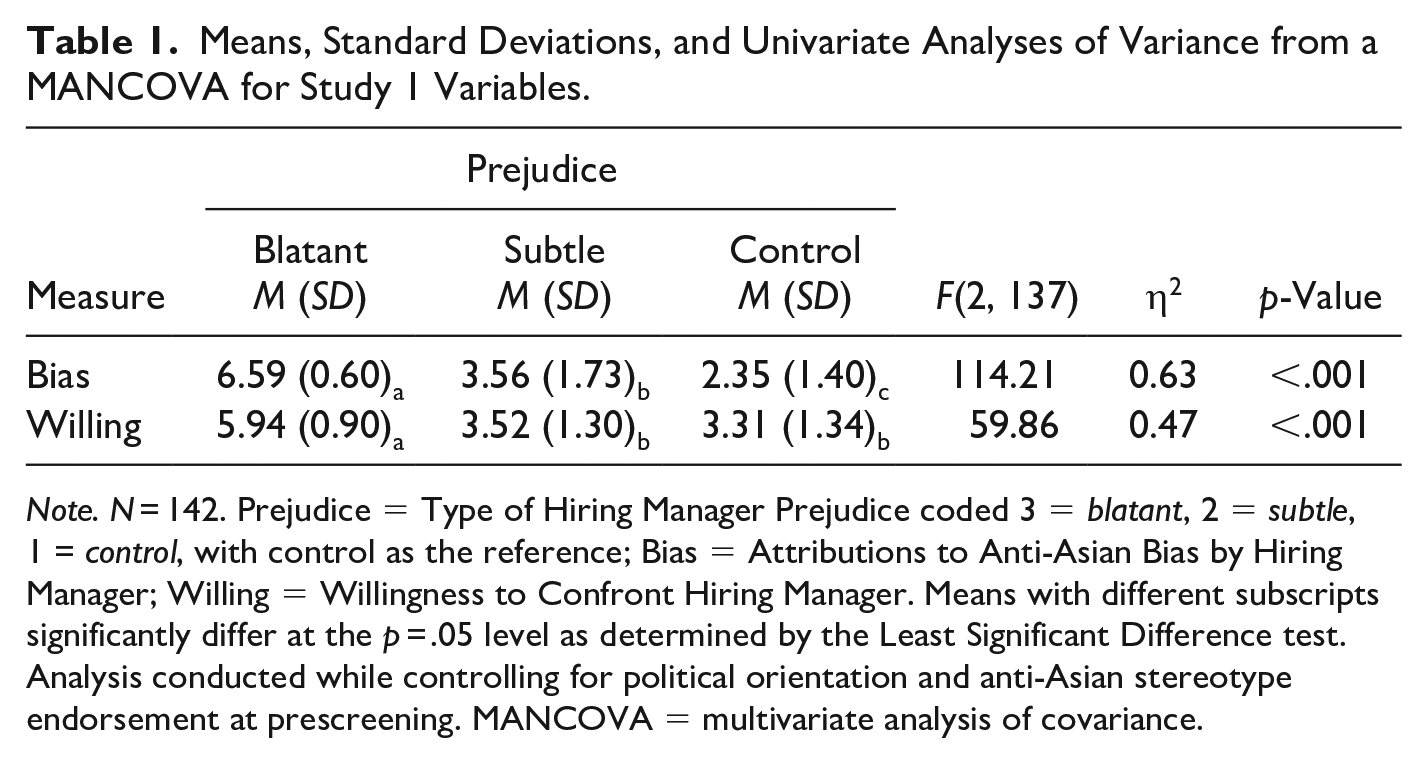
Note. N = 142. Prejudice = Type of Hiring Manager Prejudice coded 3 = blatant, 2 = subtle, 1 = control, with control as the reference; Bias = Attributions to Anti-Asian Bias by Hiring Manager; Willing = Willingness to Confront Hiring Manager. Means with different subscripts significantly differ at the p = .05 level as determined by the Least Significant Difference test. Analysis conducted while controlling for political orientation and anti-Asian stereotype endorsement at prescreening. MANCOVA = multivariate analysis of covariance.
The model (H3) accounted for 79% of the variance in willingness to confront (R2 = .63), F(5, 136) = 46.09; p < .0001. As depicted in Figure 1, those in the blatant and subtle prejudice conditions attributed more bias to the manager than did those in the no-prejudice control condition, and attribution to manager bias in turn predicted greater willingness to confront. Accounting for attributions to manager bias, there was no direct effect of prejudice type on willingness to confront. The indirect effect of prejudice type on willingness to confront through attribution to manager bias was significant for both the subtle prejudice (0.56, 95% CI [0.23, 0.93]) and blatant prejudice (2.03, 95% CI [1.45, 2.58]) conditions. These results suggested that prejudice type predicted willingness to confront only through attributions to manager bias.
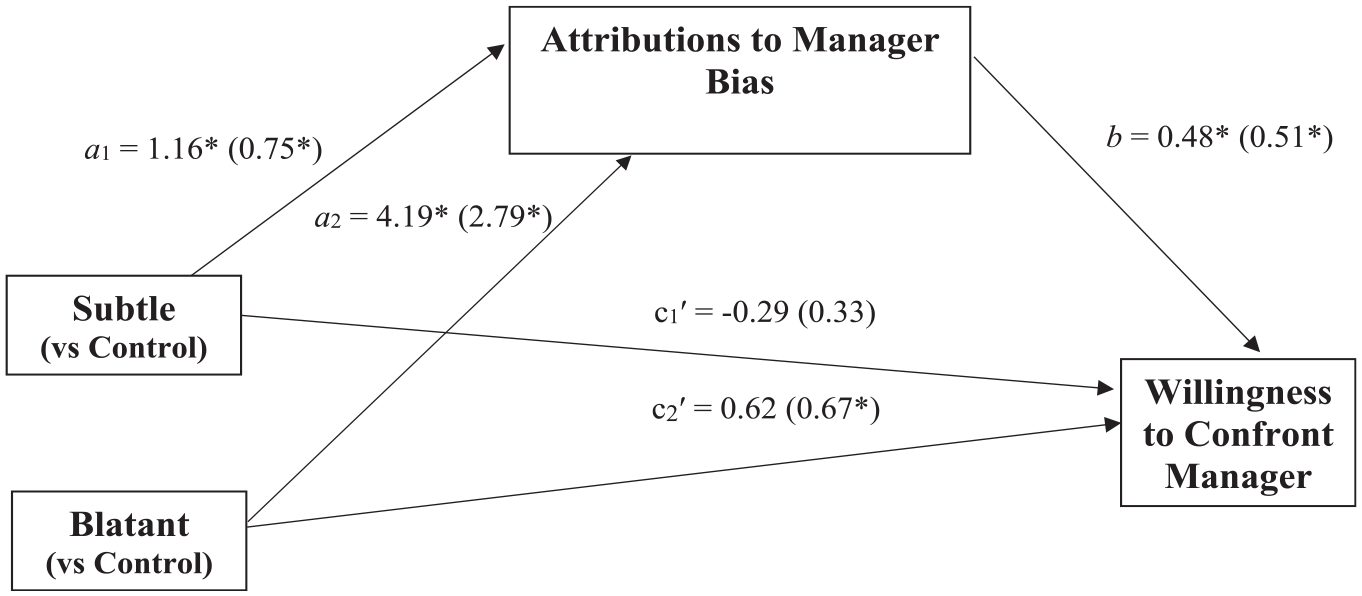
Supported mediation model for Study 1 (N = 142) and Study 2 (N = 274).
Discussion Study 1
Overall, results suggested that White Americans exposed to the phrase “Chinese Virus,” relative to more blatant anti-Asian prejudice, attributed less prejudice to a hiring manager, and this resulted in lesser willingness to confront the manager.
Although more prejudice was attributed to the hiring manager in the subtle prejudice relative to no-prejudice condition, counter to predictions, individuals exposed to subtle prejudice were no more willing to confront the manager than were controls. This could have been due to timing of data collection—only 3 months after the phrase “Chinese Virus” was thrust into social media discourse. In other words, social norms that might typically have proscribed such verbiage could have been weakened (Álvarez-Benjumea, 2023; Crandall et al., 2018), creating greater ambiguity for would-be confronters (Ashburn-Nardo et al., 2008).
Study 2
In Study 1, White Americans (non-targets) attributed less prejudice to “subtle” relative to blatant prejudice expressions. Study 2 includes both White American and AAPI participants, to allow for direct comparisons between these groups (H4 and H5).
Also, Study 1 focused on willingness to confront (i.e., intentions), whereas Study 2 focuses on actual confrontation behavior. Predicting confrontation willingness is a valuable first step, but research shows that intention to confront is not highly predictive of actual behavior in situations in which prejudice is encountered (Woodzicka & LaFrance, 2001). The behavioral measure of confrontation in Study 2 was supplemented by assessment of explanations for confrontation and non-confrontation decisions (H6, H7, and supplemental).
Method
Participants
An a priori power analysis conducted using G*Power, with a goal of attaining 80% power to detect a critical F of 2.26, indicated that the minimum sample size needed to detect a medium effect size was 211 participants (Faul et al., 2007). To account for failed attention and manipulation checks and attrition from prescreen to experiment, 500 Prolific workers who identified as U.S. citizens were prescreened. One week after prescreening, qualified White (150) and AAPI (150) individuals were recruited for the study until the target sample size of 300 was reached. Participants were compensated $0.50 for completing the prescreening and $1.60 for completing the study.
Individuals who failed a manipulation or attention check (n = 21), or who identified with a race/ethnicity that was neither White nor AAPI (n = 8), were removed from the sample. The final sample included 133 White participants (72 women, 58 men, 3 non-binary/transgender) ranging in age from 18 to 69 years (M = 28.66, SD = 8.87) and 141 AAPI participants (74 women, 67 men) ranging in age from 18 to 63 years (M = 34.84, SD = 10.92).
Procedure
The procedure was identical to that of Study 1 except a behavioral measure of confrontation was included following presentation of the hiring manager’s decision and prior to the willingness to confront prejudice scale (α = .87). Participants were also prompted to explain their confrontation and non-confrontation decisions.
Materials and measures
Materials and measures were identical to those of Study 1 unless noted below.
Resume
Dates on the resume were updated, and due to changes in border restrictions with Canada at the time of data collection all participants received a resume in which the candidate resided in China.
Anti-Asian stereotypes
For White Americans, endorsement of anti-Asian stereotypes was assessed via the SAAAS (α = .93), whereas AAPI participants were instructed to complete the SAAAS as they believed the average American might (α = .96; Lin et al., 2005).
Actual confrontation behavior
A single item assessed confrontation behavior. Participants indicated whether they wished to write a message to the hiring manager in response to their hiring decision (1 = yes; 2 = no).
Also, two open-ended items assessed confrontation/non-confrontation explanations. Specifically, those who indicated “yes” had an opportunity to write a response to the hiring manager. These responses were subsequently coded by two raters blind to condition and participant race/ethnicity for level of confrontation vehemence (1 = no confrontation; 2 = calling in; 3 = mixed confrontation; 4 = calling out). A “call in” confrontation was operationalized as an attempt to educate or change the manager’s mind (e.g., “I believe this candidate has shown potential to increase productivity in the workplace as shown [by]. . .. I would like to at least interview him to see if his personality, work style and skills meet our initial criteria. Thank you for your kind consideration in this matter”), whereas a “call out” confrontation was operationalized as a direct challenge to the manager’s bad behavior (e.g., “You are a racist. Please resign from your position and go join the Proud Boys”). A mixed confrontation contained both “call in” and “call out” content. There was substantial agreement between the two raters, κ = .61, p < .0001, 95% CI [0.47, 0.75], thus a mean vehemence score was computed.
Those who chose not to confront (i.e., non-confronters) could also explain their decisions, subsequently coded by raters according to CPR model obstacles to confrontation (Ashburn-Nardo et al., 2008). Where participants described multiple CPR model obstacles, the code was based on the primary reason listed. For these nominal data, a weighted Cohen’s kappa showed almost perfect agreement between the two raters, κ = .87, p < .0001, 95% CI [0.82, 0.93], and instances of disagreement were resolved by a third rater.
Analytic approach
The analytic approach was identical to that of Study 1 except where noted, including new analyses. Political orientation and either endorsement of anti-Asian prejudice (White participants) or perceptions of anti-Asian prejudice (AAPI participants) at prescreening served as covariates in all analyses of covariance (ANCOVAs) and the mediation analysis described below.
Quantitative data
Due to a programming error, AAPI participants who chose not to confront did not receive the willingness to confront questionnaire, making a MANCOVA infeasible. Thus, separate 2 (Participant Race/Ethnicity) × 3 (Prejudice Type) ANCOVAs were conducted to examine the impact of these factors on attributions to manager bias (H1 and H4), willingness to confront (H2 and H5), and confrontation vehemence (H7).
The mediation hypothesis (H3) was tested on the full sample.
A chi-square analysis examined the impact of prejudice type on willingness to confront the manager (H6).
Qualitative data
On the open-ended item assessing confrontation explanations, two participants explicitly agreed with the manager’s decision so were recoded as non-confronters, and one participant who wrote a message to the applicant instead of the manager was removed.
On the open-ended item assessing nonconfrontation explanations, frequencies of respective CPR model obstacles were calculated.
Results
Study 1 replications
The job candidate was again viewed favorably, with likelihood of offering an interview significantly above the midpoint of the scale (M = 5.52, SD = 1.36), t(273) = 18.57, p < .0001, 95% CI [1.36, 1.68].
Table 2 depicts means and standard deviations from separate ANCOVAs for attributions to manager bias, willingness to confront, and actual confrontation, broken down by prejudice type and participant race/ethnicity.
Means and Standard Deviations for Study Variables as a Function of Separate Participant Race/Ethnicity by Prejudice Type ANCOVAs, Study 2.

Note. N = 274. Prejudice = Type of Hiring Manager Prejudice (coded 3 = blatant, 2 = subtle, 1 = control, with control as the reference); Bias = Attributions to Anti-Asian Bias by Hiring Manager; Willing = Willingness to Confront Hiring Manager; Vehemence = Type of Confrontation Message; White = White American participants; AAPI = Asian American and Pacific Islander participants. Analyses conducted while controlling for political orientation and either endorsement of (White participants) or perception of (AAPI participants) anti-Asian prejudice at prescreening. ANCOVAs = analyses of covariance.
A main effect of prejudice type emerged, such that those exposed to blatant prejudice attributed more bias to the manager (M = 6.32, SD = 1.15) than did those exposed to subtle prejudice (M = 4.28, SD = 1.78), and individuals in both prejudice conditions attributed more bias than did those in the control condition (M = 3.44, SD = 1.43), F(2, 260) = 94.49, p < .001, η2 = .42 (H1). The predicted main effect of participant race/ethnicity also emerged, with AAPI participants attributing more bias (M = 4.99, SD = 1.87) than White participants (M = 4.40, SD = 1.90), F(1, 260) = 5.58, p < .02, η2 = 0.42 (H4). The interaction was not significant, F(2, 260) = 1.51, p = .22, η2 = 0.01.
Also replicating Study 1, participants exposed to blatant prejudice reported greater willingness to confront (M = 5.15, SD = 1.41) than did those exposed to subtle prejudice (M = 3.66, SD = 1.32) or no prejudice (M = 2.98, SD = 1.16), but in contrast to Study 1, and supporting H2, individuals exposed to subtle prejudice were more willing to confront than were controls, F(2, 199) = 2.60, p < .0001, η2 = 0.29. The predicted main effect for participant race/ethnicity also emerged, with White participants more willing to confront (M = 4.18, SD = 1.68) than AAPI participants (M = 3.34, SD = 1.22), F(1, 260) = 5.82, p < .02, η2 = 0.03 (H5). The interaction was not significant, F(2, 199) = 2.60, p = .08, η2 = 0.03.
The model (H3) accounted for 78% of the variance in willingness to confront (R2 = .61), F(5, 201) = 63.43; p < .0001. As depicted in Figure 1, those in the blatant- and subtle-prejudice conditions attributed more bias to the manager than did those in the no-prejudice condition, and more attribution to bias was associated with greater willingness to confront the manager. Accounting for attributions to manager bias, there was a significant direct effect of prejudice type on willingness to confront for the blatant prejudice condition (relative to control; 0.67, 95% CI [0.24, 1.10], p = .002) but not for the subtle prejudice condition (relative to control; 0.33, [−0.01, 0.66], p = .058). The indirect effect of prejudice type on willingness to confront the manager through attributions to manager bias was significant for those exposed to both subtle prejudice (0.38, [0.12, 0.66]) and blatant prejudice (1.43, [1.10, 1.76]). These results suggested that prejudice type again predicted willingness to confront the manager through attributions to manager bias.
Novel Study 2 results
Only 37% of participants chose to confront the hiring manager, and confrontation was more prevalent among individuals exposed to blatant prejudice (53.3%) than subtle prejudice (34.1%) or no prejudice (30.8%), χ2 (2, N = 274) = 11.33, p = .003. Exposure to blatant prejudice resulted in greater confrontation vehemence (M = 2.80, SD = 0.66) than did exposure to subtle prejudice (M = 2.38, SD = 0.62), and exposure to subtle prejudice resulted in greater confrontation vehemence than from controls (M = 1.95, SD = 0.63; H7), F(2, 88) = 12.38, p < .0001, η2 = 0.22. There was neither a main effect of participant race/ethnicity, F(1, 88) = 3.00, p = .24, η2 = 0.02, nor an interaction, F(2, 88) = 1.01, p = .37, η2 = 0.02.
Rationale for non-confrontation decisions aligned closely with the five obstacles to confrontation outlined by the CPR model (Ashburn-Nardo et al., 2008; Ashburn-Nardo & Karim, 2019) (see Table 3 for examples of each), with most participants describing a barrier at either Step 1 (detecting discrimination) or Step 5 (taking action to confront discrimination following a cost/benefit analysis). Prejudice type affected barriers to confrontation, in terms of the obstacles listed, with most participants exposed to either subtle (46.6%) or no (63.5%) prejudice describing barriers at Step 1 and those exposed to blatant prejudice (74.4%) describing obstacles at Step 5 χ2 (8, N = 164) = 54.54, p < .0001. In fact, only 7% of participants exposed to blatant prejudice described a barrier at Step 1, and 0% described a barrier at Step 2 (i.e., deeming the prejudice an emergency).
CPR Obstacles Resulting in the Decision Not to Confront, Study 2 (n = 164).

Note. CPR = Confronting Prejudiced Responses.
General Discussion
The current results suggest that the phrase “Chinese Virus” is less readily attributed to prejudice than are blatant anti-Asian stereotypes, and for both non-targets and targets this ambiguity results in less projected and actual willingness to confront a perpetrator of hiring discrimination. Across both studies, attribution to manager bias mediated the relationship between prejudice type and willingness to confront the manager.
In Study 1, contrary to predictions, individuals were no more willing to confront a hiring manager following expressions of subtle anti-Asian prejudice than when the manager did not express prejudice, whereas in Study 2, participants were more willing to confront subtle prejudice. These conflicting findings may be a function of the timing of data collection. Data for Study 1 were collected in June 2020, 3 months after President Trump’s instigation of anti-Asian Tweets, whereas data for Study 2 were collected in June 2021, less than 1 month after President Biden signed the COVID-19 Hate Crimes Act to combat anti-Asian hate crimes and following a mass shooting in Atlanta targeting AAPI women (Cathey, 2021). Leaders have a powerful impact on the perceived acceptability of expressed prejudice (Crandall et al., 2018), as does the normative context overall (Álvarez-Benjumea, 2022; Monheim & Ratcliff, 2023). Indeed, social norms affect a would-be confronter’s attribution to prejudice and inclination to confront (Ashburn-Nardo & Karim, 2019). The shift from U.S. political leaders’ encouragement of anti-Asian hate in 2020 to the condemnation of it in 2021 may have shifted perceived norms (including attribution of “Chinese Virus” to prejudice).
Study 2 demonstrated that AAPI participants attributed both forms of prejudice to anti-Asian manager bias more readily than did White participants and that White participants were more willing to confront the manager. Consistent with prior research (e.g., Swim & Hyers, 1999; Szekeres & Čabarkapa, 2023), participants confronted at a low rate, with only 37% electing to write the hiring manager. Among those willing to confront, confrontation patterns mirrored the willingness to confront data, with blatant prejudice confronted at the highest rate and with more vehemence relative to subtle or control conditions.
The qualitative data on non-confrontation explanations corresponded with the finding that so-called subtle expressions of prejudice were less detectable than blatant ones. Most individuals in the subtle-prejudice condition had difficulty detecting prejudice whatsoever, whereas most individuals in the blatant-prejudice condition recognized prejudice but got stuck when deciding to act, commonly citing the perceived futility of such confrontation (e.g., “I don’t believe in making comments to someone who has a racial bias. It won’t change any outcome”) or even more explicitly citing perceived costs to self (e.g., “I might get fired”).
Strengths, Limitations, and Future Directions
The American Psychological Association (2020) issued a press release with corresponding fact sheet, calling for leaders and the public to stop spreading anti-Asian xenophobia and hate. The fact sheet suggested methods to combat xenophobia, among which were educating, leveraging social media influencers to shift norms, and challenging those who use bias-promoting language. The reported research addressed this call to action by exploring factors that discourage confrontation of anti-Asian bias specifically in the time of COVID-19, at the height of exploding hate. We view confrontation as a particularly useful approach to combat prejudice because, done effectively, confrontation can simultaneously challenge bias, educate perpetrators and bystanders, and establish egalitarian norms (Monteith et al., 2019). Indeed, confrontation is an effective and relatively enduring prejudice-reduction tool (Chaney & Sanchez, 2018; Munger, 2017), including changing norms around the acceptability of anti-Asian prejudice expression (Meyers et al., 2020).When allies are willing to confront and follow through, it benefits both targets (Chu & Ashburn-Nardo, 2022) and confronters (Dickter, 2012). Regarding the former, for instance, Black participants reported higher self-esteem after a White ally confronted racism expressed by another White individual, particularly when the confrontation was interpreted as authentic and intrinsically motivated (Chu & Ashburn-Nardo, 2022). Regarding the latter, confronters may feel increased satisfaction in having had a role in changing the beliefs and/or actions of perpetrators of prejudice. For example, heterosexual individuals who confronted perpetrators of sexual prejudice reported greater satisfaction with their behavior than did heterosexual students who did not confront (Dickter, 2012).
The current work also represents a critical first step toward understanding roadblocks to confrontation, a notoriously low base-rate action. Thus, developing interventions to increase effective confrontation is a critical research agenda. Difficulty even attributing to prejudice was the primary obstacle to confronting subtle prejudice, highlighting the importance of educational interventions that increase bystander recognition of prejudice as well as the importance of responding to it (Monteith et al., 2019).
Most who did not confront blatant prejudice in Study 2 cited lack of self-efficacy to successfully confront or personal costs that impeded confrontation. To address this, intervention work might utilize “deep fake” technology, or deceptively realistic videos of individuals doing and saying things they never did (Westerlund, 2019). Much research suggests that deepfakes are dangerous (e.g., creation of false memories; Westerlund, 2019), but researchers have begun to examine the utility of the technology for personal growth (Hancock & Bailenson, 2021). For example, researchers are currently working on a project showing that individuals who view deepfakes of themselves confidently and successfully executing a speaking task subsequently exhibit greater creativity (Leong, 2021, as cited by Hancock & Bailenson, 2021). In this vein, we suggest that future research examine the effects of allowing would-be confronters to observe themselves engaging in a successful confrontation via deepfakes. We posit that viewing the self successfully confronting a perpetrator of prejudice will build preparedness and self-efficacy to respond effectively in a “confrontable moment” (Monteith et al., 2019). This approach could also model an effective confrontation, providing a reference for future confrontations.
A primary limitation of this work was the loss of willingness to confront data for AAPI participants, such that all data for AAPI participants was comprised of individuals who were willing to confront the perpetrator to begin with, whereas the willingness to confront data for White participants included confronters and non-confronters. This may have skewed the data in terms of our AAPI group appearing to be more willing to confront, and vehement in their confrontations than the White group overall. Nevertheless, the predicted pattern of results emerged, with White participants expressing more willingness to confront than AAPI participants. Also suggesting that the omitted data did not result in baseline differences between the two groups of confronters, there was no effect of participant race/ethnicity on confrontation vehemence.
Our focus was on factors that inhibit confrontation both by non-targets (i.e., White Americans) and targets (i.e., AAPI individuals), but this limited our sample. Future work examining attribution to anti-Asian bias should include participants of additional minoritized identities. For example, would-be allies from stigmatized groups may fear backlash for confronting perpetrators, and more work is needed to examine this possibility (Monteith et al., 2019).
Practical Implications and Conclusions
The authors do not view the phrase “Chinese Virus” to be subtle or otherwise inconsequential—in contrast, we believe the phrase is extremely harmful, as are all forms of so-called subtle prejudice. Indeed, the present work supports this view, demonstrating that subtle relative to blatant expressions may be less readily attributed to prejudice, leading to less confrontation and ultimately perpetuating prejudiced norms. This vicious cycle must be interrupted through education about the violence such phrases inflict on AAPI individuals, first by helping bystanders to better understand and detect prejudice (Monteith et al., 2019). It is also important to develop tools for would-be confronters that facilitate their confidence and ability to surmount obstacles to confrontation outlined by the CPR model and to thereby execute successful confrontations (Ashburn-Nardo et al., 2008).
Footnotes
Acknowledgements
We thank Korrine Minster, Chelsea Monheim, and Angela Sushko for their assistance with various aspects of this work.
Declaration of Conflicting Interests
The author(s) declared no potential conflicts of interests with respect to the authorship and/or publication of this article.
Funding
The author(s) received financial support for the research reported in this article from the McNair Scholar Program at the State University of New York, Brockport.
