



Abstract
Affective empathy is generally considered an important inhibitor of aggression. However, the meta-analysis studies on the relationship between affective empathy and aggression have challenged this common-sense view and found no substantial correlation between the two variables. We proposed a double-edged sword model to explain this counterintuitive phenomenon and tested this model by establishing an inconsistent mediation model. A total of 663 college students in China (59.1% female; Mage = 20.69 years) completed questionnaires measuring affective empathy, sympathy, personal distress, anger proneness, and physical aggression. The results showed that on the one hand, affective empathy can indirectly inhibit physical aggression by increasing sympathy; on the other hand, affective empathy can indirectly promote physical aggression through the serial mediation of personal distress and anger proneness. Such two pathways offset each other, leading to an insignificant relation observation between affective empathy and physical aggression. The findings revealed the complexity of the relationship between affective empathy and aggression, which suggested that more efforts to reduce aggression should be made to develop individuals’ sympathy, while affective empathy training should be moderate to avoid excessive empathic emotional arousal.
Introduction
Affective empathy, generally defined as vicarious experience of another person’s emotional states, is considered a fundamental element for moral development and social adaptation (Gantiva et al., 2021). One of the most basic suppositions regarding the role of affective empathy is that it both facilitates prosocial behavior and inhibits antisocial behavior (e.g., aggression; Eisenberg & Miller, 1987; Vachon et al., 2014). For the relationship between affective empathy and aggression, a common-sense and intuitive view holds that after observing the pain displayed by the victim, the attacker will automatically and vicariously experience the pain, which will make the attacker unwilling to continue hurting the victim and thus reduce aggressive behaviors (Miller & Eisenberg, 1988). A growing body of studies have found affective empathy to negatively relate to different forms of aggression (e.g., verbal aggression, physical aggression, and aggressive humor; Dryburgh & Vachon, 2019; Halfpenny & James, 2020; Kokkinos & Voulgaridou, 2019). Therefore, improving affective empathy ability has become one of the core goals of therapy programs for violence and aggressive behaviors (Vachon et al., 2014).
The Surprisingly Weak Relation between Affective Empathy and Aggression
It appears that theorists and clinical workers have reached a consensus on the relationship between affective empathy and aggression. However, in recent years, this relationship has been increasingly challenged. Many empirical studies failed to find a negative correlation between affective empathy and aggression, reporting positive or insignificant relations instead (e.g., Gantiva et al., 2021; Ouvrein et al., 2018; Wang et al., 2017). More importantly, a series of meta-analysis studies consistently found that the correlation between affective empathy and aggression was not as pronounced as one might expect (Jolliffe & Farrington, 2004; Miller & Eisenberg, 1988; Vachon et al., 2014).
Miller and Eisenberg (1988) conducted a meta-analysis of the correlation between empathy and aggression based on 43 questionnaire studies and behavioral experiments. They found a significant but low negative correlation for questionnaire studies (average correlation was −.18) and a non-significant correlation for other empathy measurement methods (i.e., picture/story methods, facial/gestural reactions, and experimental inductions; average correlations were −.08 ~ −.06). Jolliffe and Farrington (2004) found a weak negative link between affective empathy and offensive behaviors in their meta-analysis with 14 questionnaire studies (Hedges’ g = −.11; Hedges, 1981). More recently, Vachon and colleagues (2014) reviewed 86 questionnaire studies in the adult population. They found that the association between affective empathy and different aggression aspects is very weak. All empathy components (including affective empathy and cognitive empathy) can only explain 1% of the variance in aggression.
Considering that the ways to measure empathy used in the above meta-analyses are somewhat subjective (e.g., facial indexes may be unreliable for those who mask their emotions), Gantiva and colleagues (2021) used a variety of psychophysiological indicators (including corrugator muscle activity, zygomatic muscle activity, skin conductance response, and heart rate) to measure affective empathy objectively. However, they did not find significant differences of any psychophysiological empathy indicators between aggressive and non-aggressive subjects.
To summarize, we can at least draw the conclusion that the effect of affective empathy on aggression is not as strong as expected. Affective empathy as a potent inhibitor of aggression is probably overstated, which seems to defy clinical wisdom and common sense. Why does this counterintuitive phenomenon occur? Little research has been done to explain it. The most detailed theoretical analysis may come from the discussion in Vachon et al. (2014), which provided two possible explanations. The first explanation is that there is no necessary connection between affective empathy and aggression (hereafter referred to as irrelevance theory). The authors pointed out that a person’s lack of affective empathy does not mean that he/she does not care about the welfare of others and has a tendency to violence. He/she just lacks sensitivity and emotional feedback to the emotions of others. It may be unreasonable to expect that low affective empathy will strongly predict aggression. The second explanation is that affective empathy and aggression should have a high negative correlation, but the inappropriate empathy measures cover up the inherent relationship (see also Jolliffe & Farrington, 2004). Existing empathy measures tend to adopt an overly narrow conceptualization of affective empathy, in which affective empathy only involves experiencing the same or similar emotions (e.g., feeling angry for others’ anger). Such measurement undoubtedly reduces the ability of affective empathy to predict aggression. If the concept of affective empathy is extended to experience the emotion with same valence and different valence, then a negative correlation between affective empathy and aggression should be found (hereafter referred to as narrow conceptualization theory). Same valence means that the emotions of the empathized and empathizers are both negative (or both positive), but not necessarily same (e.g., feeling sympathy rather than anger for others’ anger due to unfair treatment). Different valence implies no response or opposite emotional response to the emotional state of others (e.g., indifference or schadenfreude for others’ distress).
Although these two explanations provided us with a new possibility to understand the relationship between affective empathy and aggression, there are still some concerns that need to be addressed further. First, for irrelevance theory, this perspective is potentially plausible, but it is not the only one. The overall irrelevance in the meta-analysis does not necessarily mean that there is no association between affective empathy and aggression. Another potentially plausible but understudied explanation is that affective empathy may have a double-edged sword effect on aggression. Specifically, affective empathy may promote and inhibit aggression simultaneously: the two effects cancel each other out, resulting in a negligible apparent relationship between affective empathy and aggression (hereinafter referred to as double-edged sword theory).
Second, for narrow conceptualization theory, although broadening the concept of affective empathy may increase its ability to predict aggression to a certain extent, the effect may not be obvious. The previous empathy measures in meta-analyses (including Vachon et al., 2014), for example, the Interpersonal Reactivity Index (IRI), the Questionnaire Measure of Emotional Empathy, and the Empathy Quotient, have already contained some broadened constructs of empathy (i.e., experiencing the emotions with same or different valence rather than just similar emotions). Specifically, all of these measures incorporate sympathy (same valence) into the concept of affective empathy. In addition, the negatively keyed items contained in these questionnaires also cover the emotions with different valence in a sense. Take the item of the IRI “When I see someone being treated unfairly, I sometimes don’t feel very much pity for them” as an example, both schadenfreude and indifference for others’ suffering can make the individual “don’t feel very much pity.” Therefore, the existing evidence does not sufficiently support narrow conceptualization theory. Moreover, as Vachon et al. (2014) indicated, broadening the concept of affective empathy may blur the conceptual boundaries between affective empathy and similar constructs, leading to theoretical confusion. For example, an increasing number of studies have proven that there is a clear difference between sympathy and affective empathy (Brazil et al., 2023; Singer & Klimecki, 2014).
Third, since the aforementioned sample of the meta-analyses was mostly from the Western individualistic cultural population, whether the insufficient correlation between affective empathy and aggression can be generalized to other populations such as the Chinese is less clear. According to the literature, there may be cultural differences in the relationship between affective empathy and aggression. On the one hand, collectivistic cultural countries (e.g., China) advocate interpersonal dependence, cooperation, and abnegation of self-serving interests, as opposed to individualistic cultures that place more emphasis on inter-individual competition (Forbes et al., 2009; Liu & Su, 2017; Yeo et al., 2011). The happiness of others is more intertwined with individual happiness (Chopik et al., 2017). Thus, compared to people from individualistic cultures, Chinese subjects may have higher levels of trait empathy as well as a stronger inhibitory effect of empathy on aggression. On the other hand, however, collectivistic cultures encourage the expressive suppression of negative individual feelings (Liu et al., 2016). Aversive emotions experienced during emotional sharing may accumulate and further induce maladaptive consequences for those who use more suppression strategies (Cho & Lee, 2023), such as reactive aggression (Fung et al., 2015). That is to say, for the Chinese, the relationship between affective empathy and aggression could be any of positive, negative, or zero correlation, to be explored. In summary, the insufficient correlation between affective empathy and aggression and the reasons behind it have not been well investigated.
Current Study
As described above, there are at least two relatively reasonable explanations for the seemingly unrelated correlation between affective empathy and aggression: irrelevance theory proposed by Vachon et al. (2014) and double-edged sword theory proposed by this manuscript. Through empirical investigation, our article aims to conduct the first study exploring which view is more reasonable in the context of Chinese culture. Specifically, we establish a dual-pathway mediation model and identify two opposite mechanisms between affective empathy and aggression. If both mediation paths are significant but their aggregation is not significant, then the double-edged sword theory is more reasonable; if all the paths of affective empathy to aggression are not significant, then irrelevance theory is preferred.
Reviewing the previous literature we assumed that sympathy plays a negative mediating role, whereas the mediating chain consisting of personal distress and anger proneness plays a positive mediating role between affective empathy and aggression.
Before going any further, one more point to clarify is, aggression can be classified into various subtypes by specific criteria (Severance et al., 2013), such as by form (e.g., direct vs. indirect and verbal vs. relational vs. physical), proactivity (e.g., proactive vs. reactive), observability (explicit vs. implicit), motivation (e.g., hostile vs. instrumental), and target (e.g., organizational vs. interpersonal). Each type of aggression has its unique characteristics and correlates (Severance et al., 2013). It is almost impossible to focus on all subtypes in one single study, so we choose one of them, that is, physical aggression, as the focal variable. As a relatively original and maladaptive form of aggression (Dewi et al., 2022; Wang et al., 2011), physical aggression is direct, overt, and immediately harmful (Card et al., 2008; Ji et al., 2017; Severance et al., 2013). Moreover, its threat to personal safety, disruption of social stability, and illegality are often considered more serious (Jia, 2015; Severance et al., 2013; Wang et al., 2011). Physical aggression may be closer to the aggressive form that first comes to mind when we mention the word “aggression.”
Mediating Effect of Sympathy
Sympathy refers to caring and sorrow for the suffering and misfortune of others (Kienbaum et al., 2019). Many researchers have pointed out that sympathy is an important outcome of affective empathy (e.g., Clark et al., 2019; Kienbaum et al., 2019; Luberto et al., 2018). Empathy for the suffering of others motivates us to care for their well-being as much as we care for our own (Batson, 1987). Empirical studies also support this view. For example, studies have found that individuals with higher affective empathy levels have higher levels of self-reported sympathy (e.g., Guerrero, 2019; Wang et al., 2017, 2019). A longitudinal study by Eisenberg et al. (2002) found that tendencies to experience affective empathy during childhood predict compassionate behaviors during adulthood.
On the other hand, sympathy is considered an important factor in restraining violence (Goetz et al., 2010). High sympathy makes the individual more sensitive to pain perception (Loggia et al., 2008) and reduces harm to others (Condon & DeSteno, 2011). A large number of empirical studies have found that sympathy can suppress aggression (e.g., MacEvoy & Leff, 2012; Wang et al., 2017; Yun & Li, 2019). A meta-analysis of 25 aggression studies also supported a significant negative correlation between sympathy and aggression (Rudolph et al., 2004). Based on the above evidence, we propose the following hypothesis (H1): sympathy mediates the relationship between affective empathy and physical aggression.
Serial Mediating Effect of Personal Distress and Anger Proneness
Personal distress is defined as a self-directed and stressful negative emotion elicited by affective states of others. Studies have shown that vicarious experience for other’s distress may lead to overarousal of negative emotions and intensification of empathizer’s own anxious state (Gambin & Sharp, 2018; Hunt et al., 2017). In addition, individuals with high affective empathy are more sensitive to the negative emotions of others (Sonnby-Borgström, 2002; Surguladze et al., 2017). This feature makes empathizers inclined to be overwhelmed by personal distress (Wang et al., 2018, 2021). Therefore, it can be expected that affective empathy positively predicts personal distress.
According to previous studies, there should be a positive correlation between personal distress and anger proneness. For example, Cognitive-Neoassociationistic Model of Anger Formation noted that negative affect of any kind will first activate anger-related feelings, action tendencies, thoughts and memories (Berkowitz, 1990). Ng et al. (2019) pointed out that negative emotions, such as anxiety, stress and anger, have similar nomological networks, so they easily trigger each other. Personal distress, as an intense, high-arousal negative emotion with anxiety and stress, may be more likely to trigger anger than other single negative emotions. Consistent with this view, empirical research has revealed that personal distress can positively predict anger proneness (Ewing et al., 2019; Mohr et al., 2007).
High anger level is an important predictor of aggression (Blair, 2018). Studies have shown that trait anger is associated with selective attention to hostile social cues, the tendency to interpret the behavior of others as indicating potential hostility, and the predisposition to ruminate over past anger-provoking experiences (Jiang et al., 2019). Individuals with high levels of trait anger are more likely to exhibit deviant behaviors and even violent aggression (Leki & Wilkowski, 2017).
In summary, we propose hypothesis H2: personal distress and anger proneness act as a mediating chain between affective empathy and physical aggression. Based on H1 and H2, it can be inferred that the negative mediating effect of sympathy may offset the positive serial mediating effect of personal distress and anger proneness, which diminishes the total effect of affective empathy on physical aggression.
The main contributions of this study are twofold: (a) it provides a new explanation for the insufficient correlation between affective empathy and aggression; (b) it is the first empirical study to compare the different theoretical explanations on the insufficient correlation between affective empathy and aggression.
Method
Participants
For this cross-sectional study, the sample consisted of 663 college students, who enrolled in the investigator’s course, from three provinces (Guangdong, Jiangxi, and Gansu) in China. Investigators consisting of university teachers sent a Sojump (https://www.wjx.cn/; a Chinese online survey platform) link to subjects in their classes. Subjects completed and submitted the Web-based questionnaires on-site under the supervision of the investigators. All participants gave informed consent before filling out the questionnaire. Of the subjects, 271 were males and 392 were females; 502 were undergraduates and 161 were graduate students. The mean age of the overall sample was 20.69 years.
Measurement Tools
Measure of Empathy and Sympathy
Affective empathy and sympathy were assessed by the Chinese version of the Measure of Empathy and Sympathy (MES) (Wang et al., 2017). It included three dimensions: cognitive empathy, affective empathy and sympathy, with four items for each subscale. All items were assessed on a five-point scale (1 = completely disagree, 5 = completely agree). In this study, the omega coefficients (i.e., composite reliability; Hayes & Coutts, 2020) were .76 for affective empathy and .73 for sympathy.
Buss-Perry Aggression Questionnaire
Physical aggression and anger proneness were assessed by the physical aggression subscale and the anger proneness subscale from the Chinese version of the Buss-Perry Aggression Questionnaire (BPAQ) (Lv et al., 2013). Respondents were asked to indicate their degree of agreement on each item statement using a five-point Likert scale ranging from 1 (“Strongly disagree”) to 5 (“Strongly agree”). The omega coefficients of the two subscales were .88 and .82, respectively.
Interpersonal Reactivity Index
We employed the five-item personal distress dimension of the Chinese version of the IRI (Zhang et al., 2010) to measure personal distress. Responses were given on a five-point Likert-type scale ranging from 1 (Does not describe me well) to 5 (Does describe me well). The omega coefficient was .73 for the personal distress dimension.
Statistical Analyses
First, all data were downloaded from the survey websites. There were no missing values for any of the study variables because the online survey required that participants answer all items. Second, descriptive statistics and Pearson correlations were calculated among the key variables using SPSS (Version 23, IBM Corp, Chicago, IL). Third, considering that the data in this study are collected by Likert scales, the results may be biased by common method variance; thus we adopted the unmeasured latent method factor technique to detect whether there was common method bias. Specifically, two models were developed and compared. Model A was a confirmatory factor analysis model with five factors (affective empathy, sympathy, personal distress, anger proneness, and physical aggression). Model B adds a method factor having loadings on all items on the basis of Model A. If the fit index of Model B is significantly better than Model A (e.g., ΔCFI and ΔTLI are higher than .1, ΔRMSEA and ΔSRMR are higher than .05; Wen et al., 2018), it indicates that there is a serious common method bias.
Fourth, to test mediating effects, a structural equation model was employed using Mplus (Version 8.3, Muthén & Muthén, Los Angeles, CA). For latent mediating model fit assessment, RMSEA and SRMR less than .08, and CFI and TLI greater than .9 indicate acceptable model fit (Finch & French, 2015). A significant indirect effect (mediation) is supported when bias-corrected nonparametric percentile bootstrapped 95% CIs do not contain zero.
Results
Preliminary Analyses
The skewness and kurtosis values showed that none of the variable items seriously violated the normality assumption (i.e., the absolute value of skewness <2 and the absolute value of kurtosis <7; Hancock & Mueller, 2019). The means, standard deviations and Pearson correlations for the study variables are reported in Table 1. Affective empathy was positively correlated with sympathy and personal distress. Sympathy was negatively correlated with physical aggression. Personal distress was positively correlated with anger proneness. Anger proneness was positively correlated with physical aggression.
Descriptive Statistics and Correlations Among Variables of Interest.
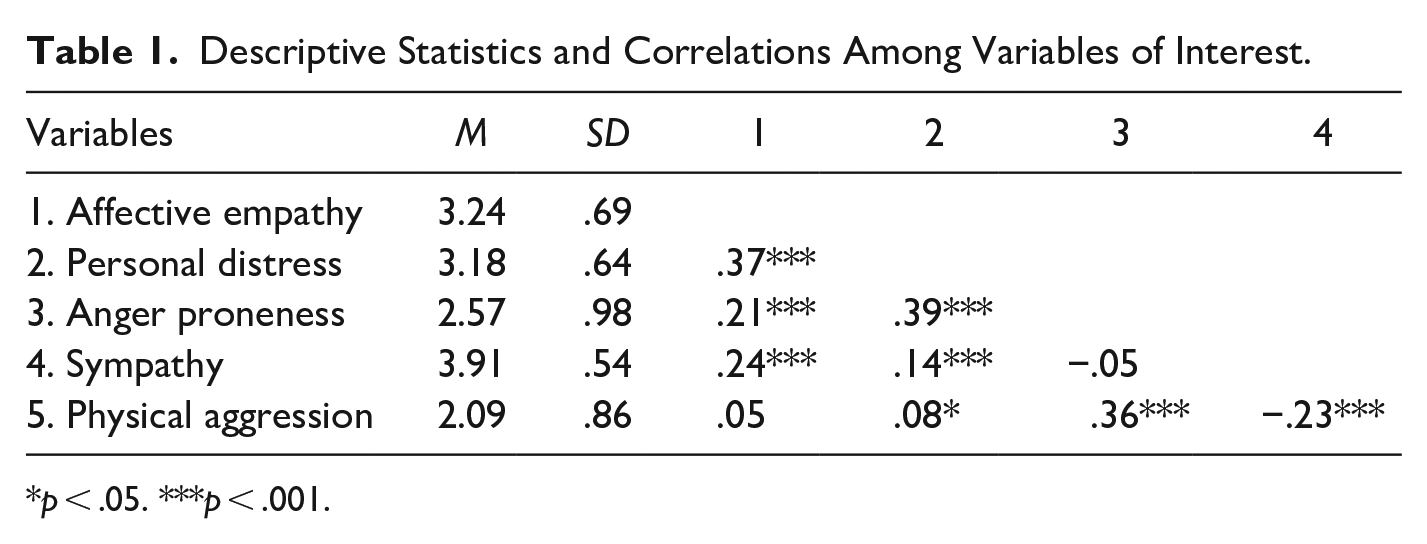
p < .05. ***p < .001.
The Test of Common Method Bias
The analyses based on the unmeasured latent method factor technique showed that the model without the method factor (Model A) is fitted as χ2 = 569.264, df = 260, RMSEA = .042, CFI = .943, TLI = .935, SRMR = .048, and the model with the method factor (Model B) is fitted as χ2 = 385.239, df = 235, RMSEA = .031, CFI = .973, TLI = .965, SRMR = .031. Model B did not improve the fitting index substantially when compared with Model A (ΔRMSEA = .011, ΔCFI = .030, ΔTLI = .030, ΔSRMR = .017). Therefore, the data were not seriously affected by common method variance according to the methodological literature (Wen et al., 2018).
The Mediating Role of Sympathy, Personal Distress, and Anger Proneness between Affective Empathy and Physical Aggression
Considering that all questionnaires in this study were scored with scale points of no less than five categories and that the variables did not deviate significantly from a normal distribution, we used maximum likelihood estimation for parameter estimates as suggested in the methodology literature (Hancock & Mueller, 2019). The fit indices were as follows: χ2 = 431.346, df = 183, RMSEA = .045, CFI = .948, TLI = .940, SRMR = .054. Affective empathy positively affected sympathy (β = .32, t = 5.04, p < .001), which in turn negatively affected physical aggression (β = −.30, t = −6.10, p < .001). Therefore, sympathy mediated the relationship between affective empathy and physical aggression (indirect effect = −.10, SE = .02, bootstrapped 95% CI = [−.15, −.06]). For another mediating path, affective empathy was positively related to personal distress (β = .48, t = 8.80, p < .001), and personal distress was positively associated with anger proneness (β = .48, t = 9.69, p < .001), which in turn positively linked with physical aggression (β = .39, t = 8.98, p < .001). Therefore, the serial mediation of personal distress and anger proneness between affective empathy and physical aggression was supported (indirect effect = .09, SE = .02, bootstrapped 95% CI = [.06, .13]). The total indirect effect (β = −.004, t = −.13, p = .90) and the direct effects of affective empathy on physical aggression after (β = .05, t = 1.03, p = .30) and before (i.e., total effect; β = .05, t = 1.02, p = .31) ruling out both indirect effects were not significant (see Table 2 and Figure 1).
The Pathways from Affective Empathy to Physical Aggression.
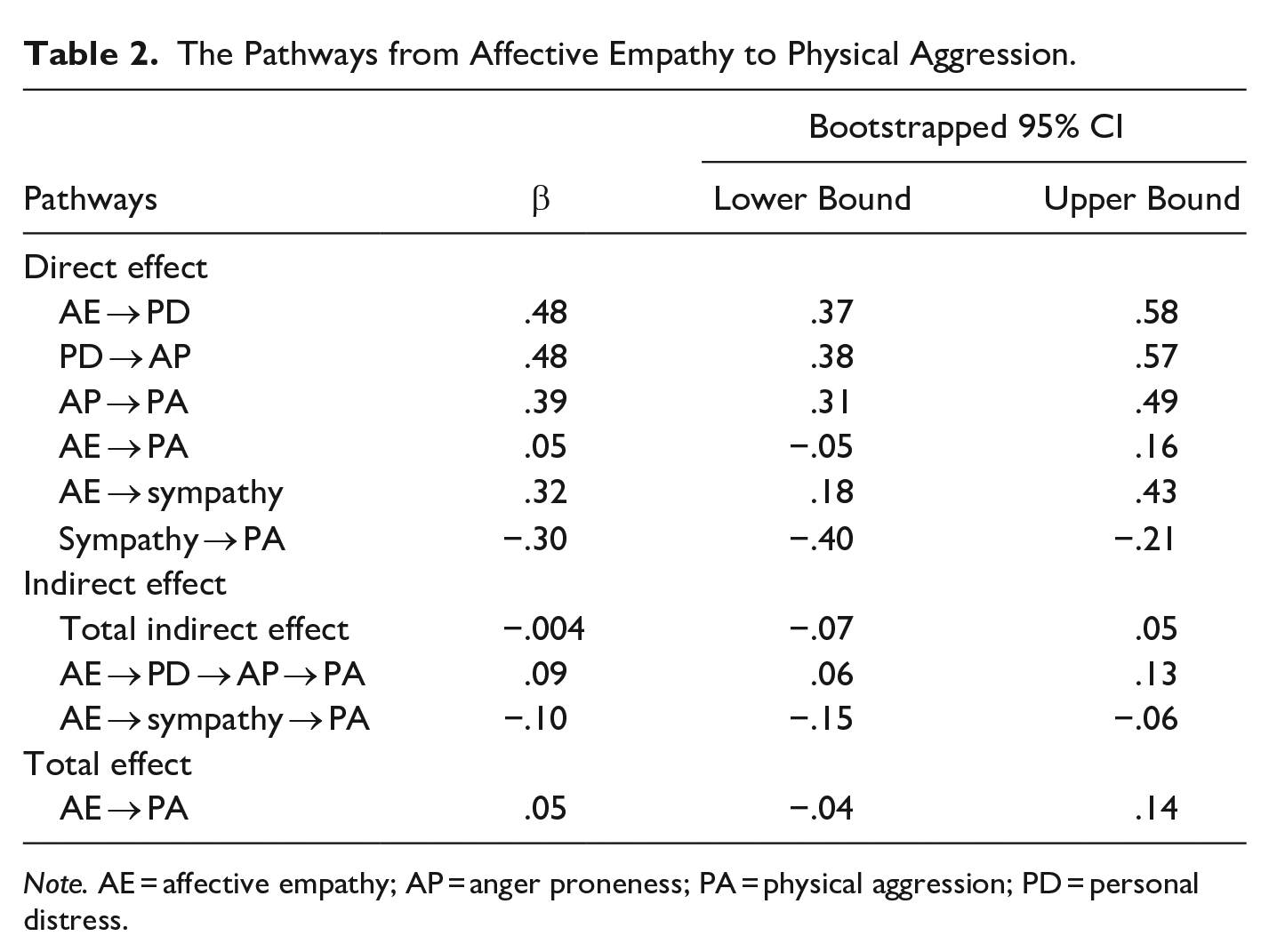
Note. AE = affective empathy; AP = anger proneness; PA = physical aggression; PD = personal distress.

The mediating model with PD, AP and sympathy mediating the relationship between AE and PA.
Discussion
This article tried to explain an anti-common sense phenomenon: why is there an insufficient link between affective empathy and aggression? First, we found that the overall effect of affective empathy on physical aggression was not significant. This result confirmed the existence of the anti-common sense phenomenon mentioned above, also consistent with the conclusions of previous meta-analyses (Jolliffe & Farrington, 2004; Miller & Eisenberg, 1988; Vachon et al., 2014).
Second, we compared the two theories explaining the insufficient correlation between affective empathy and aggressive behavior (irrelevance theory and double-edged sword theory) by establishing and analyzing an inconsistent multiple mediation model. The results are more supportive of the double-edged sword theory. Specifically, although it appeared that the total effect of affective empathy on physical aggression was not significant, the intermediate mechanisms are much more complex beyond this surface finding.
On the one hand, affective empathy can indirectly inhibit physical aggression by increasing sympathy. This result is consistent with the classical theory of empathy-altruism hypothesis (Batson, 1987), which states that our empathy for other people’s emotions will make us worry about them and caring about their well-being. This induced sympathy then enhances an individual’s altruistic motivation and reduces the possibility of attacking others.
On the other hand, affective empathy indirectly promotes physical aggression through the serial mediating effect of personal distress and anger proneness. This result confirms the arguments in a few recent studies that affective empathy may cause emotional problems. Affective empathy leads individuals to pay much attention to others’ negative emotions (Sonnby-Borgström, 2002; Surguladze et al., 2017) and fall into self-directed anxiety state (Gambin & Sharp, 2018). This may be because affective empathy requires emotional overlap with the other’s experience, which makes empathizers lose a clear sense of self to separate the other’s distress from their own, so they absorb another individual’s pain and negative emotions and finally suffer empathic personal distress (Hofmeyer et al., 2020; Krol & Bartz, 2022). The sense of losing control for personal distress can easily trigger anger and increase the individual’s aggressiveness (Chen et al., 2021). The two mediating pathways were similar in size but opposite in sign, and their effects almost offset each other, leading to no significant total effect of affective empathy on physical aggression.
This finding shows that the relationship between affective empathy and physical aggression involves a series of complicated underlying mechanisms. Affective empathy should not be regarded as pure angels or devils. Its role depends on which of the positive and negative mediating pathways has a comparative advantage. What is interesting about this result is that it actually suggested that both conventional wisdom (affective empathy helps to suppress aggression) and recent irrelevance theory have rationality. They are not mutually exclusive. However, both of them have some limitations. For conventional wisdom, we did find that affective empathy inhibits physical aggression in certain ways, but this inhibition effect has to work through the mediating variable sympathy. In other words, sympathy is the more proximal predictor of physical aggression compared with affective empathy. Therefore, it may be better to conduct sympathy training rather than affective empathy training for aggressive behavior intervention. In addition, conventional wisdom fails to recognize that affective empathy not only suppresses aggression but also fuels it through personal distress and anger proneness. To increase the benefits of affective empathy and reduce its detriments, attention should be paid to increasing emotional regulation ability in the training of empathy to keep the individual’s empathic emotion at an appropriate level and to avoid empathic overarousal.
For irrelevance theory, we did verify that affective empathy and physical aggression are not substantively related on the surface. However, this result was just because the different path coefficients between them cancel each other out, rather than that they are not related at all. The current study thus deepened our understanding of the relationship between affective empathy and aggressive behavior.
Another noteworthy issue is that the current study based on Chinese subjects found a trivial association between affective empathy and physical aggression, similar to the previous findings based primarily on Western subjects, although we had previously speculated this association might be cross-culturally different. One possible reason, as we described in the introduction, is that Chinese people place more emphasis on interpersonal dependence and cooperation (Forbes et al., 2009; Liu & Su, 2017; Yeo et al., 2011), resulting in more other-oriented and caring emotional responses (i.e., empathy and sympathy) accompanied by reduced aggression; at the same time, however, Chinese culture encourages suppression in the expression of one’s bad feelings, because communicating negative emotions to others without restraint is considered to undermine interpersonal harmony (Liu et al., 2016). Research has shown that this emotion regulation strategy converts affective empathy more into personal distress (Cho & Lee, 2023), thus increasing one’s propensity for venting anger and violence (Fung et al., 2015). That is, for the mechanisms underlying affective empathy and aggression in the Chinese context, not only was the inhibitory pathway stronger, but the facilitative pathway was also stronger, relative to Western individualistic cultural groups. The result remains that the two pathway effects cancel each other out.
Limitations and Future Directions
The limitations of this study are as follows. First, this study is a cross-sectional study, and thus, causality cannot be determined. In future studies, the experimental research paradigm and longitudinal research are advised to test our findings. Second, we believe the double-edged sword effect tested in this study is not necessarily the only determining factor for the insufficient correlation between affective empathy and aggression. For example, some researchers have argued that the relationship between affective empathy and aggression is moderated by some moderating variables (e.g., implicit beliefs about the malleability of empathy; Gandhi et al., 2021). Third, the present study focused exclusively on affective empathy and physical aggression, not considering other forms of empathy and aggression. Whether the relationship between all forms of empathy and aggression is so complex warrants further exploration. Fourth, our sample consisted of Chinese college students only, not essentially a cross-cultural study, which may limit the generalizability of findings to a wider context. Given that both empathy and aggression are associated with cultural settings (Chopik et al., 2017; Forbes et al., 2009), further studies are needed to test whether the double-edged sword model can be generalized to Western countries. Fifth, given the lower levels of empathy and sympathy and higher physical aggression for males relative to females found in previous literature (Dryburgh & Vachon, 2019), it is reasonable to expect a gender difference in the relationship between affective empathy and physical aggression. For example, for males, the facilitative pathway in the double-edged sword model may be relatively dominant, whereas, for females, the inhibitory pathway may be stronger. However, because the sample size for either gender in this study was insufficient for the usual requirements of complex latent variables models based on online surveys (e.g., n = 500; Groskurth et al., 2021), we employed a combined dataset of male and female students for modeling in our study. The issue of gender differences is a topic of concern for the future.
Conclusion
This study explained the insufficient correlation between affective empathy and aggression through a dual-pathway mediation model. Affective empathy negatively influenced physical aggression through sympathy; and simultaneously, it also had a positive effect on physical aggression through the mediating chain of personal distress and anger proneness. The two mediating pathways were close in magnitude but opposite in sign, and their effects almost cancelled each other out.
Footnotes
Declaration of Conflicting Interests
The author(s) declared no potential conflicts of interests with respect to the authorship and/or publication of this article.
Funding
The author(s) disclosed receipt of the following financial support for the research and/or authorship of this article: This work was supported by grants from the Planning Project of Philosophy and Social Science of Guangdong Province (GD21YXL04) and the Innovation Team Project of Guangdong Province Universities [2019WCXTD005].
