



Abstract
Cyber reactive aggression (CRA) among college students is a prevalent and harmful phenomenon. Psychological characteristics, such as trait anger (TA), hostile attribution bias (HAB), and revenge motivation (RM), are known to contribute to reactive aggression. However, the interactions between these factors in the context of cyberspace and their contribution to CRA among college students have not been extensively studied. This cross-sectional study aimed to identify the associations among psychological characteristics, demographic factors, and CRA among Chinese college students through Mixed Graphical Model (MGM) network and mediation effect analyses. A total of 926 participants completed questionnaires assessing TA, HAB, RM, and CRA. The study found both direct and indirect relationships between TA and CRA, with HAB and RM serving as mediating factors. Comparisons indicated that HAB had a more significant impact on the three indirect effects than RM. Furthermore, gender was found to be associated with TA and CRA, while the left-behind experience strongly influenced HAB but had no association with other variables. This study highlights the importance of considering psychological characteristics and demographic factors in understanding CRA among college students, suggesting that effective psychological interventions, such as anger management, and promoting positive attribution training, may help reduce CRA among college students and inform the development of targeted interventions to reduce cyber aggression.
Keywords
Introduction
Cyber aggression is defined as intentional and harmful behavior performed by an individual or group using electronic devices such as computers and mobile phones (Little et al., 2003). A study found that Chinese college students had the highest prevalence of cyber aggression at 59.47% compared to any other country (Jin et al., 2017). This behavior directly impacts academic performance (Tokunaga, 2010) and hinders the healthy psychological development of college students (Pabian & Vandebosch, 2016), highlighting the need to identify potential protective factors against cyber aggression. Many studies have identified psychological factors for their predictive role in cyber aggression, such as personality factors (e.g., gender, trait anger (TA), and revenge motivation (RM)), and cognitive processing (e.g., hostile attribution bias (HAB)) (Griskevicius et al., 2009; Wilkowski et al., 2012, 2015). However, previous studies have failed to differentiate between two subtypes of aggression: reactive aggression and instrumental aggression, which differ in aims, antecedents, harmfulness, and formation mechanisms (Dambacher et al., 2015). Research suggests that college students’ aggressive behavior is more commonly reactive than instrumental (Barratt et al., 1999). Anger-driven cyber reactive aggression (CRA) refers to a response to perceived threats in the internet, closely linked to anger, anxiety, and hostility, as noted by Miller and Lynam (2006). The psychological factors mentioned above may also independently influence CRA, but it remains unclear how they interact in the cyberspace context and how they relate to college students’ CRA. In this study, we aimed to explore the interactions between TA, RM, and HAB, and their influence on CRA in college students.
TA and CRA
TA refers to the general tendency of individuals to experience and express anger (Spielberger et al., 1983). TA is a widely recognized personality trait for aggression, which is guided by the General Aggression Model (GAM) (Bettencourt et al., 2006). The GAM suggests that personal factors (e.g., beliefs, attitudes, personality traits) and situational factors jointly affect the cognitive process, thus triggering aggression (Anderson & Bushman, 2002). Individual differences in reactive aggression can be shown in people’s reactions to specific situations. People with high TA have stronger responses to hostile situational stimuli (such as provocation, name-calling, etc.) than people with low TA (Bettencourt et al., 2006). Higher TA increases reactive aggression because it facilitates the detection of danger cues and the rapid re-identification of hostile stimuli, even in the absence of situational priming, which are key antecedents of aggression (Berkowitz, 1990). Several studies also have confirmed the role of TA in reliably predicting reactive aggression that is shown in response to perceived provocation (Bondü & Richter, 2016).
As described above, TA is closely related to reactive aggression in real life. However, little is known about the relationship between CRA and TA. Batson and Powell (2003) suggested that there is no substantial difference between the online world and real life. Moreover, the Co-Construction theory hold that individuals’ psychological connections on the Internet are similar to their connections in the offline world, and they will jointly construct their online worlds and offline worlds (Subrahmanyam & Greenfield, 2008). As in real aggression, TA may plays a similar role in CRA.
Hypothesis 1: TA will be positively associated with CRA.
The Mediating Role of HAB
Hostile motivation is a unique motivation that distinguishes reactive aggression from proactive aggression (Dodge & Coie, 1987). Hostile motivation refers to one’s tendency, driven by emotions such as hostility, anger, or fear, to retaliate against the instigator (Anderson & Bushman, 2002). HAB, as cognitive component of hostile motivation (Dodge & Coie, 1987), can be defined as an individual’s tendency or cognitive response to interpret others’ behavioral intentions as hostile in ambiguous situations (Crick & Dodge, 1993). As social information processing theory (SIPT) described (Crick & Dodge, 1993), when individuals perceive hostility from others, they are more likely to use violence to retaliate against them (Wilkowski et al., 2015). There are evidences that the HAB is more closely related to reactive aggression than to proactive aggression (Martinelli et al., 2018; Thomas & Weston, 2019).
In addition, empirical studies have also shown that individuals with higher TA are more likely to interpret others’ behavior and intentions in terms of hostility (Gagnon et al., 2016; Veenstra et al., 2017). There are two possible reasons why TA might influence hostility attribution bias. First, TA can cause individuals to make negative evaluations of the environment and others, while the hostile interpretation of others’ behavior and intentions in the vague provocative situation is a negative evaluation (Hazebroek et al., 2001). Second, individuals with TA tend to have a perceptual bias in the face of threat-related information (Smith & Waterman, 2003). TA was also found to be related to the selective attention of hostile social cues (Wilkowski & Robinson, 2007). The definitions of cyber and traditional aggression share common criteria and are closely related (Grigg, 2010). Based on these findings, it can be reasonably presumed that:
Hypothesis 2: HAB may mediate the relationship between TA and CRA.
The Mediating Role of RM
RM refers to an individual’s desire to retaliate or harm the aggressor out of righteous indignation after being provoked (McCullough et al., 1998). The cognitive model of anger suggests that individuals with high levels of TA have a cognitive processing bias that makes them more likely to interpret ambiguous situations as hostile rather than benign (Jin et al., 2017; Wilkowski & Robinson, 2010), and this HAB leads to RM (Wilkowski et al., 2015). For example, a cross-sectional study found that college students with higher levels of anger rumination were more likely to experience more retaliation (Zhang, 2015). Another study conducted by Roseman et al. (1994) also showed that anger was significantly associated with revenge goals and action tendencies after participants were asked to recall negative emotion experiences.
In addition, RM is one of the major drivers of reactive aggression (Wilkowski et al., 2012). A study of boys with severe rheumatoid arthritis problems found that they often described their aggressive behavior in terms of revenge (Fluck, 2017). Statistics also show that approximately 20% of homicides in wealthy countries are revenge-related, and 61% of school shootings in the United States between 1974 and 2000 were revenge-related (McCullough et al., 2013). Other studies found that bully/victim status was more closely related to RM (Barcaccia et al., 2017; Runions et al., 2018). Thus, it is likely that high levels of TA also increase CRA by producing high levels of RM. Therefore, this study hypothesized:
Hypothesis 3: RM mediates the relationship between TA and CRA.
HAB and RM
Both HAB and RM can be associated with CRA. In addition, there is evidence that college students with high levels of HAB have higher RM (Wilkowski et al., 2015), because such individuals tend to believe that revenge is reasonable and feasible (Dodge & Coie, 1987). Moreover, in a study examining the role of RM in the relationship between HAB and reactive aggression, Quan and Xia (2019) found that individuals with higher levels of HAB are more likely to raise RM, thus resulting in reactive aggression. These findings suggest that it is more plausible to consider HAB as a factor influencing RM, rather than vice versa. Thus, TA may be a predictor of HAB, while HAB may influence RM and increase CRA. Therefore, we propose:
Hypothesis 4: HAB and RM play a chain mediation effect in the association between TA and CRA.
Method
Participants and Procedure
We recruited 926 college students through convenience sampling from twelve universities located in Anhui, Fujian, and Guangzhou provinces in China. Among the participants, 555 were females and 102 were left-behind children, with an average age of 18.69 (SD = 0.34), ranging from 16 to 21 years old. Regarding the education level of the participants’ mothers, 317 (34.2%) had primary education, 367 (39.6%) had junior high education, 171 (18.5%) had high school education, 67 (7.2%) had college education, and 4 (0.4%) had a master’s degree or higher. For the participants’ fathers, 198 (21.4%) had primary education, 409 (44.2%) had junior high education, 214 (23.1%) had high school education, 99 (10.7%) had college education, and 6 (0.6%) had a master’s degree or higher.
Data collection was conducted using an online questionnaire system called Wenjuanxing (https://www.wjx.cn). We obtained verbal consent from all participants before sending them an online survey link containing the consent form and the scale. The questionnaire took approximately 15–20 min to complete. Participants who completed the survey were given the chance to win an online prize draw. This study was approved by the Ethics Committee of the authors’ university.
Measures
Demographical Information
For each college student we collected basic demographic information, including gender, age, whether or not they were a left-behind child, parents’ education (primary, junior high, high school, college, master’s degree, and above).
TA Scale
The Chinese version of the TA Scale (Spielberger, 1988) revised by Luo et al. (2011) consists of 10 items. Items are rated from 1 (never) to 4 (always). A sample item is “I am an impatient person.” Higher scores reflect a stronger sense of TA. This scale has demonstrated good acceptable parameters for both validity and reliability with Chinese people (Luo et al., 2011). In this study, the Cronbach’s alpha was .86.
HAB Scale
The Word Sentence Association Paradigm for Hostility Scale was used to assess HAB (Dillon et al., 2016). The subjects were asked to rate how similar the hostile words were to the 16 different situational sentences on a scale of 1 (not at all) to 6 (very similar). Higher scores indicate higher levels of HAB. A representative item was: “Someone bumped into you (aggressive).” The validity of the scale has been verified in Chinese research (Quan & Xia, 2019). The scale was found to have a high reliability level in the current study (Cronbach’s alpha = .95).
RM Scale
The RM subscale of the Transgression-Related Interpersonal Motivations Inventory was developed by McCullough et al. (1998). The five-item questionnaire recorded on a five-point Likert scale (1 = “strongly disagree” to 5 = “strongly agree”), higher total scores indicate higher levels of RM. An example item is as follows: I wish that something bad would happen to him/her who recently hurt me. This scale demonstrated high reliability and validity with Chinese college students (Quan & Xia, 2019). The Cronbach’s alpha was .95 in the study.
Cyber Reactive Aggressive Scale
The CRA subscale of Adolescent Online Aggressive Behavior Scale (Zhao & Gao, 2012) consists of 16 items. Items (e.g., If someone said something bad about me on the Internet, I would treat him the same way) are rated from 1 (never) to 4 (always). The higher the score is, the stronger the CRA. The scale has been widely used among Chinese adolescents with acceptable validity and reliability (Jin et al., 2019; Li, 2022). In the present study, the scale showed high reliability (Cronbach’s alpha = .90).
Data Analysis
First, a Harman one-way test was performed to test for bias in the common method, and the results showed that the first factor had an explanation rate of 15.48%, which is less than 40% (Lee et al., 2011), indicating that there was no bias in the common method in this study. We then performed descriptive statistics and Pearson correlation analysis using IBM SPSS 23.0. Second, Mixed Graphical Model (MGM) Network analyses were conducted in R using the MGM package to construct the network of continuous and categorical variables. In MGM, the GLMNET package was used to provide regression analysis with L1 and/or L2 regularization. Third, a serial multiple mediation model was performed using SPSS the PROCESS macro Model 6 by Hayes (2013), with 95% bias-corrected confidence intervals (CIs) based on a bootstrap sample of 5,000 (in our study, gender and left-behind experience were controlled).
Results
Descriptive Statistics
As shown in Table 1, TA was positively related to HAB (r = .48, p < .001), RM (r = .49, p < .001), and CRA (r = .42, p < .001). HAB was positively related to RM (r = .51, p < .001), and CRA (r = .42, p < .001). Finally, there was a significantly positive correlation between RM and CRA (r = .38, p < .001).
Descriptive Statistics and Correlations Among Variables (N = 926).
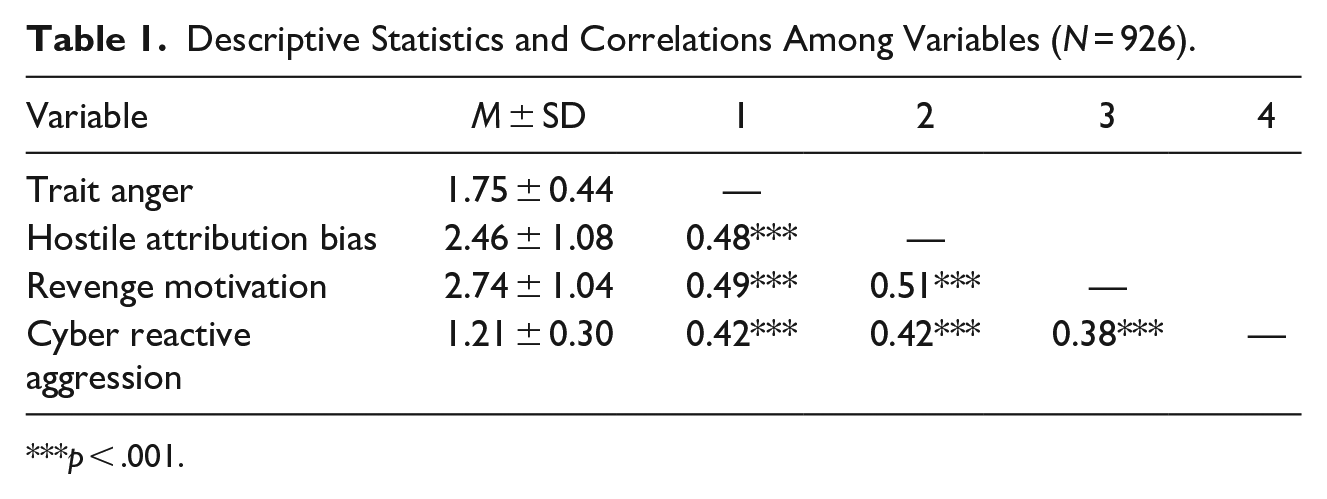
p < .001.
MGM Network Analysis
Our MGM network analysis yielded several noteworthy results (see Figure 1). Firstly, we observed strong interrelationships between CRA, TA, HAB, and RM, indicating that these individual factors may contribute to the development of reactive aggression in cyberspace. However, the direction of these correlations remains unclear and requires further investigation to determine the causal relationships between these variables.
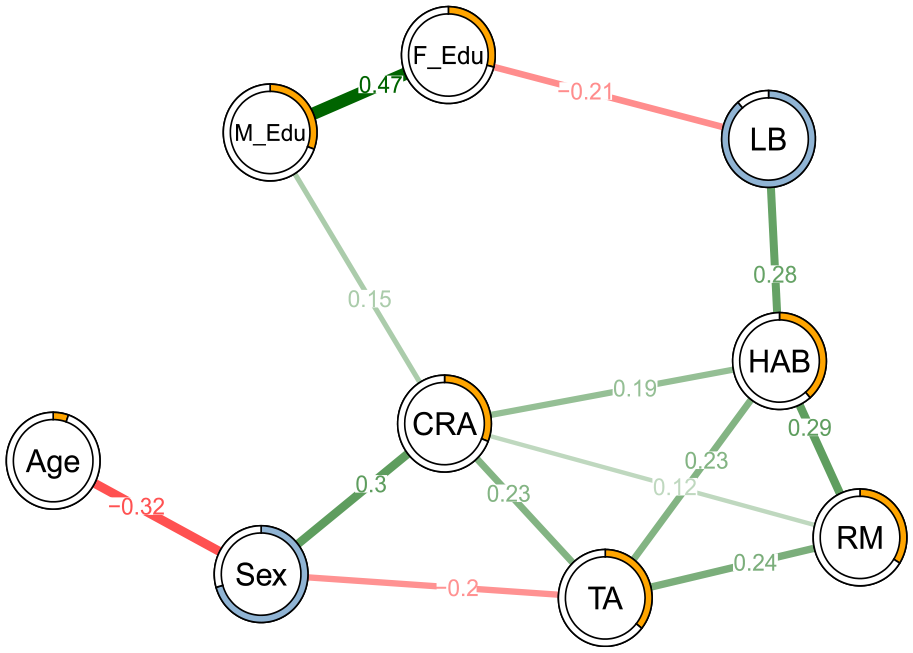
Estimated network structure of 926 college students based on the MGM package in R. Green/red edges indicate positive/negative weights between nodes. Rings on nodes indicate R2 (continuous variable, orange) or categorical accuracy (categorical variable, light blue).
Secondly, we identified a significant association between being left-behind and the father’s education level (weight = −0.21). This finding suggests that fathers with lower educational backgrounds are more likely to have left-behind children, highlighting the potential impact of parental education on family dynamics and its downstream effects on individual factors related to reactive aggression.
Lastly, we found gender-based differences in the relationship between individual factors and CRA (weight = 0.3). Specifically, males exhibited higher CRA, while females had higher TA, implying that gender may influence how individuals express and regulate their emotions in the cyberspace context.
Mediational Analysis
The results showed that TA significantly predicted HAB (B = 0.46, p < .001) and RM (B = 0.30, p < .001). HAB was also found to have a positive effect on RM (B = 0.36, p < .001). Both HAB and RM had a significant effect on CRA (B = 0.24, p < .001 for HAB; B = 0.15, p < .001 for RM). In addition, the overall effect of TA on CRA was significant (B = 0.44, p < .001), and the direct effect was also significant after controlling for the effects of HAB and RM (B = 0.26, p < .001) (see Table 2 and Figure 2).
Regression Coefficients and Standard Errors for the Serial Mediation Model.

Note. HAB = Hostile attribution bias, CRA = cyber reactive aggression, RM = revenge motivation; *** p<0.001.

The serial mediation model testing hostile attribution bias and revenge motivation as mediators between trait anger and cyber reactive aggression.
All the three hypothesized mediating effects are supported (see Table 3). First, HAB mediated the relationship between TA and CRA (B = 0.11, SE = 0.02, 95% CI = [0.07, 0.15]). Second, there was a significant indirect path from TA to CRA through RM (B = 0.04, SE = 0.01, 95% CI = [0.02, 0.07]). Finally, the indirect path from TA to CRA through the link “HAB—RM” was significant (B = 0.02, SE = 0.01, 95% CI = [0.01, 0.04]). We conducted a pairwise comparison among the three indirect effects for the proposed model. Results (see Table 3) indicated that the indirect effect of TA on CRA through HAB was significantly greater than the indirect effect through RM (B = 0.07, SE = 0.03, 95% CI = [0.01, 0.12]), and the serial mediating effect (B = 0.09, SE = 0.02, 95% CI = [0.04, 0.13]). Moreover, the indirect effect of TA on CRA through RM was significantly greater than the serial mediating effect (B = 0.02, SE = 0.01, 95% CI = [0.00, 0.04]).
Comparisons of the Indirect Effects of the Proposed Model.
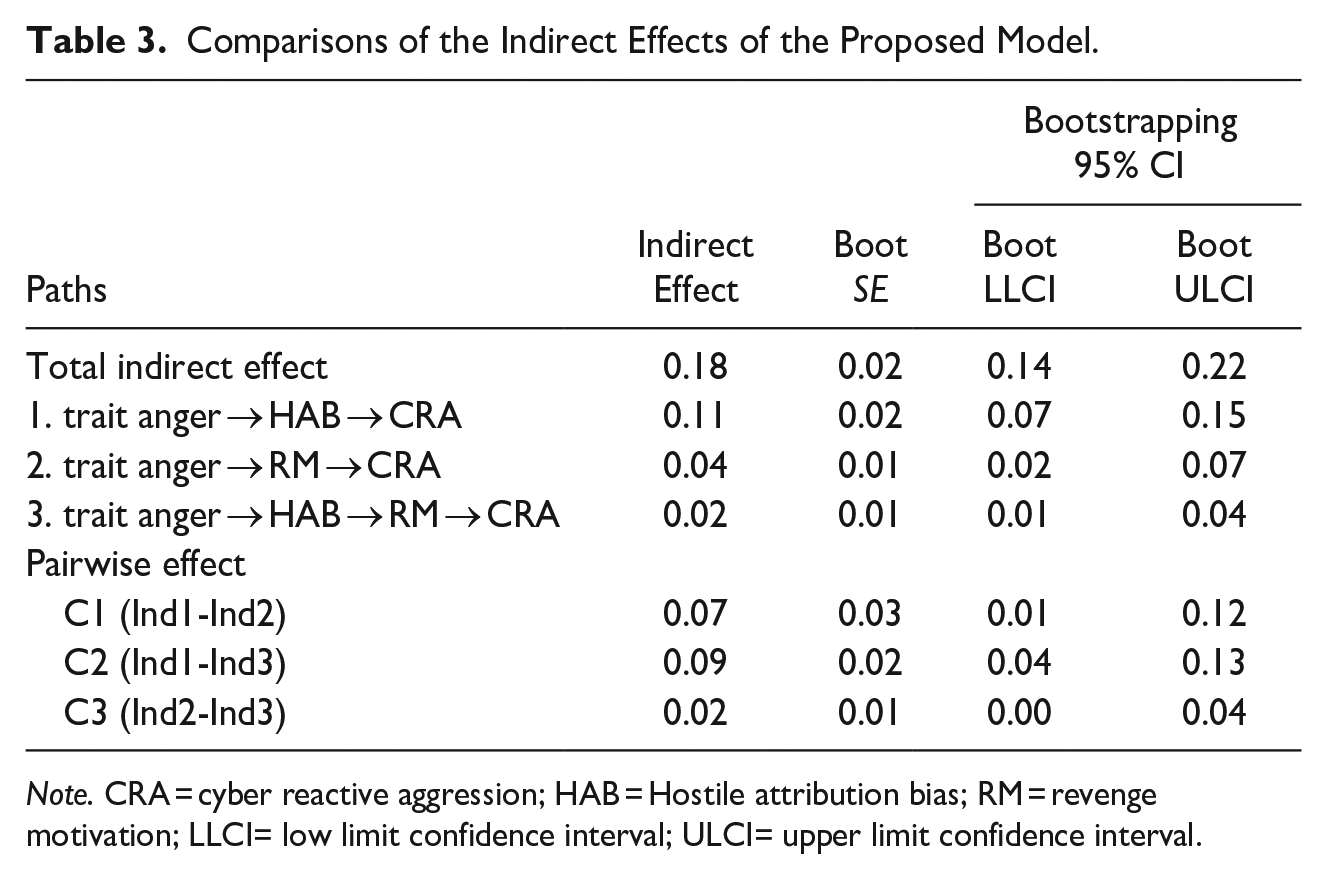
Note. CRA = cyber reactive aggression; HAB = Hostile attribution bias; RM = revenge motivation; LLCI= low limit confidence interval; ULCI= upper limit confidence interval.
Discussion
Based on SIPT and GAM, the present study examined potential mechanisms influencing college students’ CRA in Chinese samples, focusing on individual factors such as TA, HAB, RM, and basic demographic information. We used network analysis to build a structure indicating the relationship between individual factors and CRA, and further validated local associations through mediation effects analysis. The evidence supported three hypothesized indirect effects: (a) TA → HAB → CRA; (b) TA → RM → CRA; and (c) TA → HAB → RM → CRA. Comparisons suggested that the effect of HAB was significantly greater among the three indirect effects.
Demographic Variables and CRA
The present study revealed significant gender differences in CRA among college students, with male students exhibiting higher levels of CRA than female students. This finding can be explained by evolutionary pressures (Archer, 2009) or social-learning processes (Eagley & Wood, 2009). Previous studies have reported that men are more likely than women to take extreme revenge against minor provocations (Griskevicius et al., 2009). Additionally, a large proportion of murders can be attributed to men responding to minor provocations, whereas similar incidents are extremely rare among women (Wilkowski et al., 2012), possibly because women tend to be more tolerant of minor provocations. This suggests that male college students in China are a high-risk group for CRA and highlights the need for appropriate prevention interventions.
Another important finding was that college students with left-behind experiences were more likely to attribute hostile intent. This is consistent with previous research, where left-behind middle school students had significantly different hostility levels compared to non-left-behind students (Du et al., 2019), particularly among left-behind children aged 7–12 (Liu, 2021). Furthermore, compared to non-left-behind college students, left-behind college students had less educated fathers. According to the National Migrant Workers Monitoring Report for 2021, about 13.7% of migrant workers in China have only received primary school education, while most have achieved junior high school (56%) or senior middle school education (12.6%), and about 0.8% of the migrant worker population is illiterate.
The present study also found reliable gender differences in TA among college students, which is consistent with the findings of Wong et al. (2018), who reported that girls scored higher on TA than boys in a representative Chinese sample. One possible explanation for this gender difference is that females are generally more sensitive than males, making it easier for them to suppress their emotions.
The Importance of TA in Affecting CRA
Previous studies have examined only the relationship between TA and reactive aggression in real life. Our findings first confirmed that TA is likely to be a key factor leading to CRA in a sample of Chinese college students. The results are consistent with previous research (Bondü & Richter, 2016) and the GAM, which suggests that individuals with high TA tend to interpret relevant situational input hostilely when interacting online, especially when faced with ambiguous online information. In contrast, individuals with low TA do not tend to be frequently and intensely angry in a variety of situations (Buss & Perry, 1992), and thus exhibit less reactive aggressive behavior than their high-TA counterparts.
However, further research suggests that TA may also be an indirect factor in CRA (Rubio-Garay et al., 2016; Tanrikulu & Campbell, 2015). Therefore, we conducted a mediation effect analysis on local networks to further validate the relationship between the variables. Another finding of this study was that HAB and RM jointly mediated the relationship between TA and CRA. It can be hypothesized that college students with higher levels of TA are more likely to experience more negative cognitive processing (a clearer sense of HAB and more levels of RM) compared to those with lower TA, leading to a rapid increase in their CRA. This finding follows studies that have highlighted HAB as an important factor in how individuals experience RM and CRA levels (Martinelli et al., 2018; Wilkowski et al., 2015). In contrast to previous studies, the present study provides a specific analysis of the effect of TA on CRA, demonstrating for the first time that TA may be associated with CRA through multiple pathways. The results of this study have implications for guiding interventions for CRA. Furthermore, the results show that fathers’ educational levels is not directly related to CRA, but rather influences it through left-behind experience and HAB, suggesting that a better fathers’ educational background leads to better attribution patterns. This suggests that increasing fathers’ educational levels can effectively improve left-behind status and reduce CRA.
The Mediation Effect of HAB and RM
This study shows that both HAB and RM mediate the relationship between TA and CRA. These results support our hypothesis and are consistent with SIPT and GAM. The importance of the mediating effect of HAB suggests that higher TA leads to significantly more CRA by increasing an individual’s HAB. When college students with higher TA communicate in cyberspace, they extract anger-related information at an extremely rapid rate, which leads to hostile cognitive processing and interpretation of this information, resulting in false attentional biases and thus CRA (Jin et al, 2017; Luo et al., 2011). Previous studies have found correlations between TA and HAB, and the current study further found a relationship between them and CRA. The results of the current study provide a new perspective for understanding the relationship between TA and CRA.
The study also verifies RM mediates the effect of TA on CRA. That is, people with higher levels of TA results in significantly more CRA by producing RM. This finding is similar to previous studies suggesting that anger is an emotion that tends to trigger revenge desires and behaviors (Zinner, 2008) and that RM can influence reactive aggression (Barlett & Anderson, 2012). Higher levels of TA imply deficits in cognitive processing, leading to symptoms of hostile interpretation bias and anger, and indirectly triggering RM and CRA (McCullough et al., 2013). In contrast, individuals with lower levels of TA may be able to form correct attributions to reduce the level of RM and their CRA decreases.
Limitations and Suggestions for Future Research
There are several limitations that should be mentioned. First, this study used a cross-sectional design. Since the relationship between anger and cyber aggression is quadratic (Barlett et al., 2017), it would be useful to examine changes in TA–CRA relationship over time, a longitudinal design may be a good avenue for future research. Second, all data were collected through self-report methods, which may affect the objectivity of the measures due to social expectations. Objective measures, such as the Taylor aggression paradigm (Taylor, 1967), could be included in future studies. Third, to ensure a more comprehensive understanding of the psychological characteristics contributing to CRA among Chinese college students, future research should include more diverse samples. This could be achieved through multi-center collaborations across different universities and regions in China. By doing so, researchers could explore whether the relationships identified in this study hold true in different cultural contexts within the country. In addition, future studies could incorporate a larger sample size to increase the statistical power and accuracy of the findings. A more extensive study population would not only provide a better understanding of the underlying psychological dynamics of CRA but also increase the generalizability of the results. Finally, only Chinese college students were used in this study, which limits the generalizability of our findings. Our findings need to be replicated in subsequent studies with other types of populations.
Implication
The findings of our study, which highlight the interplay of TA, HAB, and RM in triggering CRA among Chinese college students, carry substantial policy implications. In the light of these results, it becomes evident that colleges should adopt psychological screenings as part of their routine health and wellness checks. This would enable the identification of students with these high-risk traits and the subsequent design of targeted interventions such as anger management programs and positive attribution training. The integration of these psychological assessments and interventions into student support services is therefore a key policy recommendation. Alongside, there is a pronounced need for enhancing digital citizenship education to include aspects of digital respect, empathy, and guidelines for appropriate responses to cyber provocations. Policy measures can encourage such education in school curricula and student orientation programs, and even extend to online platforms and social media networks. Furthermore, our research underscores the need for special attention to left-behind students, as they display a significant association between their status and HAB. Policies providing these students with additional psychological support, mentorship programs, and initiatives for better integration into the college environment are thus essential. Finally, the complex dynamics of psychological factors contributing to CRA underscore the necessity for continued research in this area. Policies promoting academic and applied research can ensure the ongoing refinement of intervention strategies and contribute to the development of data-driven policies to combat cyber aggression among college students. By applying these policy recommendations, we aim to turn our research findings into practical action that reduces CRA among college students and fosters healthier, more respectful digital communities.
Conclusion
In conclusion, this study emphasizes the importance of distinguishing between reactive and instrumental aggression to better understand the antecedents and formation mechanisms of cyber aggression among college students. The study found that TA influences CRA through the mediation of HAB and RM, shedding new light on the relationships among these factors in the cyberspace context. The practical implications of this study suggest that educational institutions can implement programs to manage anger, decrease HAB and RM, and promote positive attribution training to reduce CRA among college students. A clean network environment and emotional support from family members can also help reinforce the mental health of college students. Finally, the study highlights the importance of training individuals to control and express their anger properly, both in real life and in cyberspace, through the use of favorable supported systems like the theory of reasoned action.
Footnotes
Authorship Contribution Statement
Jin-Liang Ding: Conceptualization, Data curation, Investigation, Formal analysis, Writing—original draft, Investigation, Formal analysis.
Yu-Wei Wu: Provided valuable theoretical implications and clarity and revision for the revised manuscript.
Wen-Jing Yan: Conceptualization, Writing—review & editing.
Declaration of Conflicting Interests
The author(s) declared no potential conflicts of interests with respect to the authorship and/or publication of this article.
Funding
The author(s) disclosed receipt of the following financial support for the research and/or authorship of this article: This research was supported by a grant from the National Office for Philosophy and Social Sciences Planning, China (Title: Research on school bullying, cognitive bias and online intervention of autistic adolescents studying in the class [随班就读自闭症青少年的校园欺凌、认知偏向及其网络干预研究]. No. 22XSH004).
Ethics approval statement
This study was approved by the Ethics Committee of Wenzhou Medical University.

Data availability
The datasets generated and/or analyzed during the current study are not publicly available because the authors are still working on them but are available from the corresponding author on reasonable request.