



Abstract
Homicide followed by suicide (HS) is a tragic event with varied characteristics across countries and regions. Compared to Western countries, there are limited studies on HS in Asian countries. Therefore, this study aimed to clarify the characteristics of recent HS cases by examining forensic autopsy records from 2008 to 2020 collected from the Department of Legal Medicine, Chiba University, in Japan. A total of 77 HS cases were identified, involving 77 perpetrators (52 completed suicides, 25 attempted suicides), with 28 perpetrator and 89 victim autopsies. Our findings showed that older adults accounted for nearly half of the victims; victims were mostly females, whereas most perpetrators were male. The most common HS relationship was that between a parent and a child. Autopsy findings showed that the most common cause of death was strangulation, and illegal drugs were detected only in a few cases; however, psychotropic drugs were detected in child victims. No obvious evidence of past child physical abuse by caregivers was found. In contrast, intimate partner violence (IPV) was present, with a history of IPV found in half of HS cases involving adult intimate partner relationships. Notably, gender differences in age and relationship to the victim were identified. Likewise, some perpetrators may have expressed their plans and intentions for HS before the event, which may represent an important sign for HS prevention. However, to accurately reveal the course of HS, nationwide integrated statistics, forensic autopsies, including toxicological analyses of the deceased; and forensic psychiatric perspectives, including psychological autopsy, are required.
Keywords
Introduction
Death by homicide and/or suicide is a tragic event, and being killed by someone is the ultimate human rights violation. Homicide followed by suicide (HS), owing to the nature of the event, has extremely serious consequences not only for the individuals involved but also for the family, given the lifelong anguish that accompanies it. It represents a major loss to the community and society. Although HS cases are relatively rare, society is affected greatly, and the cases are often reported in newspapers and internet media worldwide. Further, there may be multiple victim fatalities.
While the need for detailed information to prevent such tragedies is obvious, HS research is challenging because the persons involved are deceased, making it difficult to obtain information about their characteristics. Previous studies have suggested that persons involved in HS have common features and varied characteristics in different countries or areas (Liem et al., 2011; Regoeczi et al., 2016; Satoh & Osawa, 2016). In addition, there have been few studies on HS in Asian countries compared with Western countries.
Generally, HS has been studied in various countries, and the common trends are as follows: most cases occur within close relationships, including family (Liem, 2010; Marzuk et al., 1992; Regoeczi et al., 2016; Rouchy et al., 2020); perpetrators are often male (Bossarte et al., 2006; Flynn et al., 2009; Regoeczi et al., 2016; Rouchy et al., 2020); tend to have mental health issues, mainly depression (Bossarte et al., 2006; Liem, 2010; Marzuk et al., 1992; Roma et al., 2012); have a history of intimate partner violence (IPV) (Bossarte et al., 2006; Logan et al., 2019; Regoeczi et al., 2016), tending to victimize more women and children (Liem, 2010; Marzuk et al., 1992; Rouchy et al., 2020); and tend to have multiple victims (Liem, 2010). Oftentimes, the place of occurrence is a residential setting (Carretta et al., 2015; Liem, 2010); involves recent separations, divorces, and domestic conflicts (Logan et al., 2019); and the perpetrator’s age tends to be higher than that of homicide-only perpetrators (Liem, 2010; Rouchy et al., 2020). Moreover, the higher the level of intimate relationships, the higher the likelihood of suicide after homicide (Flynn et al., 2009; Stack, 1997).
In HS involving children, studies have shown that perpetrators are mostly biological parents, with fathers being the majority (Hatters Friedman et al., 2005); however, the proportion of mothers as perpetrators tends to be higher in newer cases of HS (Flynn et al., 2009). Notably, problems related to parents’ intimate relationships were reported as more common, whereas child abuse was less conspicuous, occurring more frequently at home, and mental health problems were found in perpetrators, especially in cases perpetrated by mothers (Hatters Friedman et al., 2005). In addition, the age of the child victim peaks in elementary school (Logan et al., 2013).
Gender differences in HS perpetrator–victim relationships have been identified (Rouchy et al., 2020), and in homicide, differences in victim–perpetrator relationships and age and gender differences within the family have been reported (Allen et al., 2020; Krienert & Walsh, 2010).
Japan is recognized as a safe country with one of the world’s lowest crime rates, especially murder, which has been found to be approximately 0.5 per 100,000 persons annually (Ministry of Justice, 2021). However, Japan’s suicide rate remains the highest among the G7, a Group of seven developed countries that cooperate on global issues, such as economy and security, at 16.7 per 100,000 persons in 2020 (National Police Agency, 2021). In Japan, the terms “Muri-shinju” and “Oyako-shinju” are sometimes used, and the phenomena of homicide and suicide occurring consecutively or simultaneously are often included under this term. However, there are no known standard definitions of these terms (Hoshina, 2006). Recently, there has been sustained interest in HS statistics, but without much success, as official national statistics on HS are lacking. In the field of child abuse, “Muri-shinju” involving children are defined as cases where the guardian “intends to die together” with their child (ren) by committing (or attempting) homicide and then committing (or attempting) suicide (National Police Agency, 2022). In 2021, 54 deaths by child abuse and 29 deaths from “Muri-shinju” perpetrated by their guardians were reported (National Police Agency, 2022). The incidence rate of HS was reported as 0.06 (0.03–0.11) in Kanagawa prefecture between 1998 and 2011, and when compared with Western Europe, where male perpetrators generally predominated HS between parents and children, females accounted for half of the perpetrators (Satoh & Osawa, 2016). Although “Muri-shinju” is often reported in the media as being due to caregiver fatigue or the disability of the involved persons, there is a scarcity of research on these issues in Japan. Watanabe and Fujita (2008), using police data on mass murders in Japan, reported a higher suicide rate among those who committed two or more murders than among those who perpetrated other murders in Japan, including the murder of a child a quarter of the time. Taguchi examined maternal filicide through court outcomes and noted the presence of mental disorders and conflict with the husband (Taguchi, 2007). However, a limitation of these studies is that they did not have information on perpetrators who died (complete suicide) or were not brought to court trial, which is important for HS prevention.
Even though the data may not be comprehensive, specific types of HS involving children have been studied in Japan. However, there are very few studies in Japan on HS victims and perpetrators regarding characteristics such as gender, age difference, history of IPV, mental health problems, and break-up of intimate relationships, except for newspaper reports, cases where the perpetrator is still alive, and court records. Therefore, it is unclear at what age and in what relationship HS occurs today. We believe that studying the characteristics of HS will be of great social importance in understanding the actual situation of HS and its potential preventive measures.
In Japan, the rate of forensic autopsies is low (Ishihara et al., 2018), and it is difficult for forensic experts to identify all the unnatural deaths because the police are the main investigators of unnatural deaths, and no national database is available. However, forensic autopsies are almost always performed on unnatural deaths where there is a strong suspicion of intentional homicide from the outset, as opposed to other deaths. Consequently, almost all victims suspected of intentional homicide, including HS, are autopsied in the forensic department. As a result, since autopsy records are kept in the forensic department, we estimated that it would be possible to identify almost all suspected HS cases by extracting information from the forensic autopsy data.
Therefore, in this study, we aimed to clarify the basic demographics of HS in Japan, including gender, age group, relationship, health problems, and location of occurrence, using mainly descriptive statistics, with some supplementary statistical tests to examine differences between the perpetrator’s gender and their age category, as well as the relationship to the victim. We used data from forensic autopsy cases to gain a basic understanding of HS.
Methods
This was a quantitative, retrospective study that reviewed descriptive records of forensic autopsy cases from the Department of Legal Medicine, Chiba University, from 2008 to 2020. This study was conducted primarily with descriptive statistics, with some supplementary statistical tests. This study was approved by the research ethics committee of the Graduate School of Medicine, Chiba University. We extracted the available data on demographics, relationships, background, circumstances, and autopsy findings, including toxicological data, health status, medical services, and history of violence. Furthermore, to reduce information bias, the case definition described below was adopted.
Case Definition
HS was defined as an event involving one or more homicides followed by the suicide of the suspected perpetrator. In such cases, the direct cause of death of the homicide victim was external, confirmed from the records with the cause of death indicating that another person injured the victim fatally, and the perpetrator attempted or committed suicide within 7 days of the discovery of the incident and killing. To be included in the study, the cases had to include circumstances on how and when the suicide occurred that were consistent with an attempted or completed suicide, at the same time or after the murder (within 7 days), based on the described information in the records or the estimated time of the death. We excluded cases in which the forensic autopsy report indicated that the cause of death was unknown or by natural causes. In addition, double deaths with evidence of suspected double suicide, for example, suicide notes or other records, were excluded.
Statistical Analysis
Descriptive statistics were calculated for HS cases’ socio-demographics, event month, health status, and offense characteristics. The means and standard deviations were calculated for the continuous data and percentages for the categorical data. Between-group differences in the categorical data were analyzed using the Chi-square or Fisher’s exact tests. Cohen’s kappa coefficient is a statistical measure used to assess the reliability of inter-rater or intra-rater. The kappa coefficient is commonly viewed as a more reliable metric than a basic percentage agreement calculation, as it incorporates chance agreement into its assessment. This coefficient was used to calculate the degree of agreement between the victim’s cause of death and the HS perpetrator. The values of the kappa coefficient were interpreted according to the criteria defined by Landis and Koch: −1.00, total disagreement; 0.00, no agreement; 0.01–0.20, slight agreement; 0.21–0.40, fair agreement; 0.41–0.60, moderate agreement; 0.61–0.80, substantial agreement; 0.81–0.99, almost perfect agreement; and 1.00, perfect agreement (Landis & Koch, 1977).
All analyses were performed with SAS software v.9.4 for Windows (SAS Institute Inc., Cary, NC, USA), and two-sided p-values of <.05 were considered statistically significant.
Results
During 2008–2020, 3,757 forensic autopsies were performed, excluding 3,640 cases, with unidentified bodies, unknown and natural deaths, and double-external causes with evidence of double suicide. Finally, we identified 117 HS autopsies for review in this study.
Overall Findings
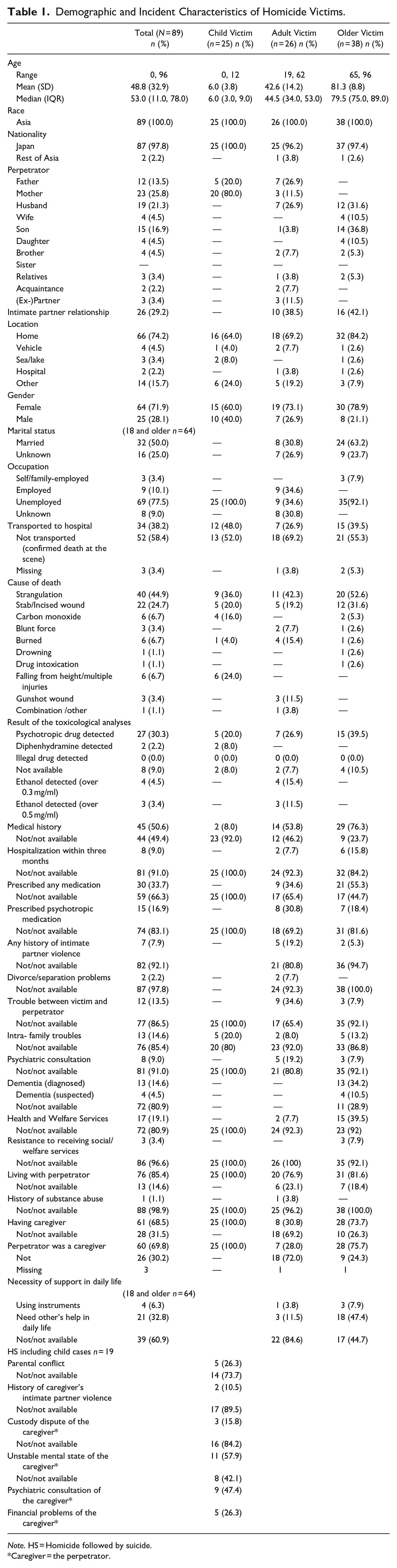
In total, 77 HS cases were identified, involving 77 perpetrators (25 attempted suicides and 52 completed suicides). We obtained autopsy data for 89 victims, and forensic autopsy data for 28 individuals among the 52 perpetrators who completed suicide, all collected between 2008 and 2020 at the Department of Legal Medicine, Chiba University. The characteristics of the victims and perpetrators are presented in Tables 1 and 2, respectively. The month with the highest incidence of HS was March (13.0%), and 47 (61.0%) cases occurred from January to June (Supplemental Figure S-1). Among the 77 cases, 38 (42.7%) included victims aged > 65 years, and 29 (32.6%) included those aged ≥75 years. Victim–perpetrator relationships were older parent–adult child in 19 (24.7%) cases, parent–child in 17 (22.1%), older spouse in 16 (20.8%), adult parent–adult child in 8 (7.8%), (ex) partner in 7 (9.1%), familial HS in 4 (5.2%) (including children in 3 [3.9%] and older adults in 1 [1.3%]), other relatives in 6 (7.8%), and other acquaintances in 2 (2.6%). Notably, intimate partner relationships comprised 26 (29.2%) cases, 54 (60.7%) cases were parent–child relationships, and suicide notes by perpetrators were found in 34 (44.2%) cases. Among HS victims in intimate partner relationships, five of the adult victims (50%) and two of the older victims (12.5%) had a history of IPV, including police-involved events. Three cases involved dead pets at the scene; one had a ligature mark on the neck. The animals were dogs and birds found at the same location as the people involved in the HS. No cases indicated that forensic veterinary autopsies of the animals had been conducted.
Demographic and Incident Characteristics of Homicide Victims.
Note. HS = Homicide followed by suicide.
Caregiver = the perpetrator.
Demographic and Incident Characteristics of Perpetrators.

Among the 52 completed suicide HS cases, 38 (73.1%) indicated the same cause of death for both the victim and perpetrator, with a Cohen’s kappa coefficient of .69 (95% confidence interval, 0.53–0.84).
HS Victims
Table 1 shows the demographic and incident characteristics of the 89 homicide victims. Of the 89 homicide victims, the majority were female (64 cases; [71.9%]), and strangulation was the most frequent cause of death. A history of IPV was described in seven (7.9%) cases, but data on most cases were unavailable. Following toxicological analyses, psychotropic drugs were detected in 27 victims (30.3%), including five children (20.0%), seven adults (26.9%), and 15 (39.5%) older adults. In two children, multiple types of psychotropic drugs were detected. In addition, diphenhydramine, which is also an over-the-counter antihistamine drug used to aid sleep, was detected in two children. A total of 69 (77.5%) victims were unemployed, and 61 (68.5%), including children, had caregivers. Among the 28 older adults who required caregivers, 15 (53.6%) used medical-social services such as home visiting care. The medical history was described in 45 (50.6%) cases, and 13 (14.6%) were diagnosed with dementia. Among the child victims, those aged <1 year comprised 4.0% of the victims, and 12 (48.0%) were at elementary school. No obvious examination findings in the records suggested past and repeated severe child physical abuse. The caregiver’s intimate partner conflicts were indicated in five (26.3%) cases.
HS Perpetrators
Table 2 provides the demographic and incident data by category of the perpetrator. Perpetrators aged >65 years comprised 29 (38.2%) cases, and 12 (15.6%) were aged >75 years. From the records, 32 (41.6%) cases described a medical history, among whom 23 (29.9%) cases were prescribed at least one medication, 19 (24.7%) cases had a history of psychiatric consultation, and 19 (24.7%) cases were prescribed psychotropic medications. An unstable mental state was described in 22 (28.6%) perpetrators, including child cases where the perpetrator had earlier mentioned homicide and dying together with the victim before the HS event. The mean age of the perpetrators of child victims was 38.1 years (28–51 years).
Table 3 shows the relationship between the gender of the perpetrator and the victim. Whether they were a caregiver for the victim or not was also examined. We observed differences between the male and female perpetrators in their relationship with the victims. In child HS victims, more perpetrators were mothers than fathers (80.0% vs. 20.0%; p < .001). Furthermore, more HS involving caregiving relationships were perpetrated by females than males (96.7% vs. 49.1%; p < .001).
Relationship Between Victim, Caregiving, and Gender of Perpetrator.

Fisher’s exact test p-value.
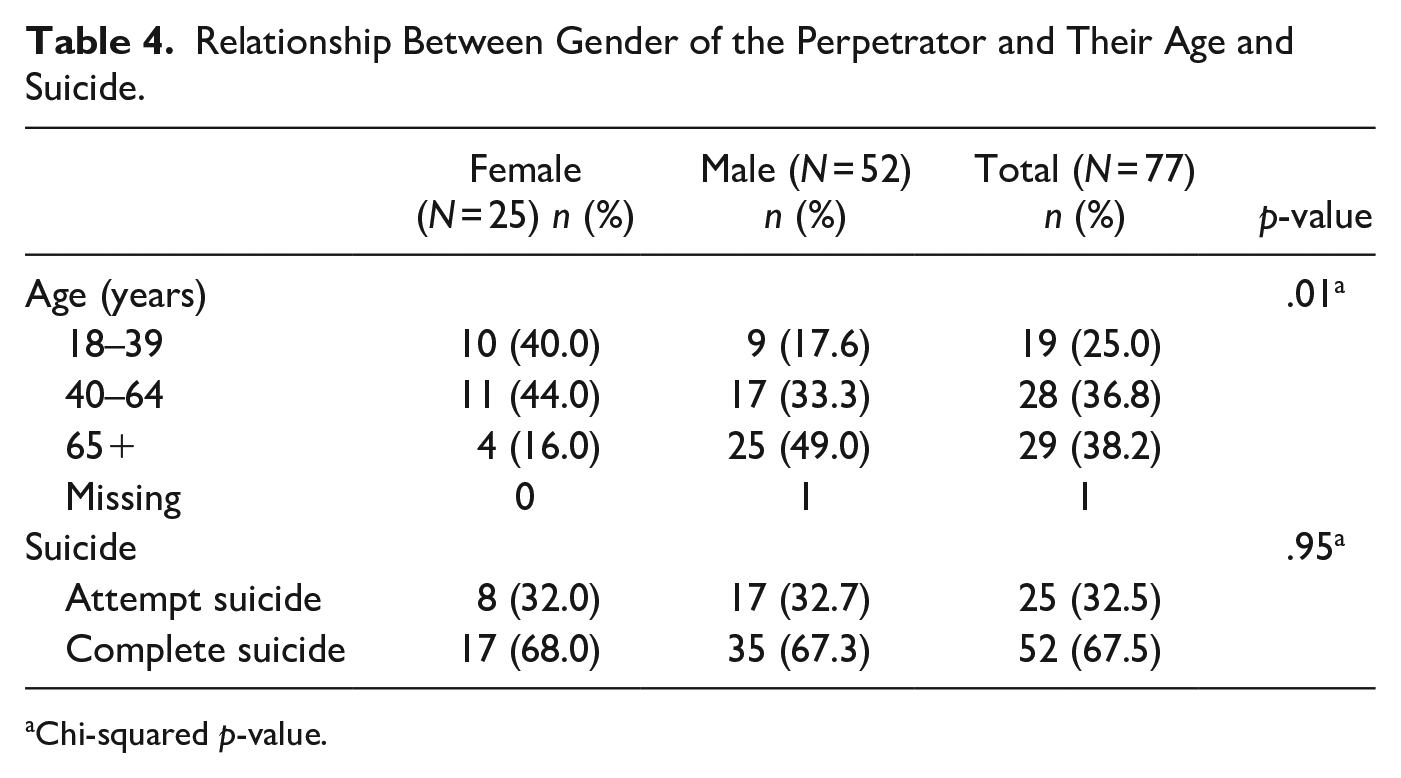
Table 4 shows the relationship between the perpetrator’s gender and their age category. The suicide attempt/completion status was also examined. We also observed differences in the age distribution of the perpetrators (p = .01), with 16% of the female and 49.0% of the male perpetrators aged ≥65 years.
Relationship Between Gender of the Perpetrator and Their Age and Suicide.
Chi-squared p-value.
Of the 52 completed suicide perpetrators with data, the autopsy record described the method of suicide as hanging in 20 (38.5%) cases. In addition, of the 28 autopsied perpetrators, psychotropic drugs were detected in 10 (35.7%) cases and hard drugs in one.
HS Including Multiple Victims (Two or More Dead Victims)
Table 2 shows the characteristics of the perpetrators of HS, including those with multiple victims. There were 11 cases with two or more victim fatalities. The mean age of the perpetrators was 45.7 (34–76) years, the incident took place at home in 54.5% of cases, female perpetrators comprised 54.5% of cases, 81.8% were married, and 36.4% were employed. In multiple-victim HS cases, children were the only family members involved if the perpetrator was a female, whereas spouses and children were involved if the perpetrator was a man. Among the perpetrators, four (36.4%) had a medical history, and six (54.5%) had mental instability perceived by family or medical staff before the incident. In three cases, family members contacted a hospital, but the patients were not seen or examined by a medical doctor. In addition, this category was characterized by the difficulty in obtaining information because many family members were killed or injured.
Discussion
In this study, we investigated the characteristics of HS victims and perpetrators using forensic autopsy cases. All of the HS-involved individuals were Asian and predominantly Japanese. The sex of the victim and the perpetrator, marital status, age of the children, location, suicide notes, financial problems, and mental health issues tended to be similar to those reported in previous studies (Liem & Nieuwbeerta, 2010; Nguyen et al., 2022). In addition, HS cases in parent–child relationships were relatively common in this study, and the results are similar to those of previous Japanese studies (Satoh & Osawa, 2016). This differs from the situation in Western countries, where HS in intimate partner relationships, especially among the older adult population, is more prevalent (Bourget et al., 2010).
Other than children, most of the victims were female and located at home, and this is consistent with the characteristics of interpersonal homicide (UNDOC, 2019). Notably, the number of completed suicides was higher than that of attempted suicides, and there was no confirmed gender difference. Although the number of pets in this study was small, they were involved in some HS cases. As identified in previous studies, HS occurred predominantly at home (Liem et al., 2011; McPhedran et al., 2018; Regoeczi et al., 2016). Regarding the actual situation of HS occurrence, the trend found in this study was similar to that in other countries. The seasonality of HS occurrence tended to be relatively high in the first half of the year, although not statistically significantly, with the highest number of occurrences in March. Generally, suicide has been suggested to peak in spring, with the highest numbers reported in March (Yu, 2020). HS is a phenomenon that includes suicide and thus could be similar in seasonality to suicide. Similar to previous studies in Asia, including Japan (Chan et al., 2004; Sato and Osawa, 2016), the most common cause of death was strangulation/hanging, followed by stab wounds, which were moderately consistent between the victim and perpetrator. Firearm-related deaths were few compared with Western countries (Liem et al., 2011), likely because of the low gun use in Japan related to strict gun control regulations.
Drugs and Alcohol
The toxicological findings showed that illegal drugs were rarely detected, and alcohol was detected in a small number of cases, consistent with a previous report that the detection of psychotropic drugs in HS is lower than that in homicide-only cases (Hedlund et al., 2014). Psychotropic drugs were detected in both the victims and autopsied perpetrators. Many of the adults were believed to have been prescribed psychotropic medications. However, psychotropic drugs were detected even in child victims and were not evidently prescribed to them, indicating that they had been exposed to them during or before the event. In addition, antihistamines, mainly diphenhydramine, were detected in child victims and the perpetrators, consistent with previous reports on suicide or abuse/homicide (Kang, 2019; Palmer et al., 2020). These results suggested the need for a medical/forensic response that considers the possibility that child victims in HS may have been exposed to psychotropic drugs (Lee et al., 2002). Therefore, instrumental toxicological screening (rather than simple urine drug testing) is required when dictated by legal considerations. This study did not provide sufficient information; however, prescribed medication information would be useful in estimating medication adherence (Forsman et al., 2019) and whether the detected medications are prescribed or non-prescribed medications. Furthermore, such information would be more helpful in elucidating the circumstances surrounding death.
Mental Health Problems and HS Ideation
Approximately, one-third of the perpetrators and half of the perpetrators in child-involved cases had documented evidence of instability in their mental state before the event. Moreover, as suggested by a previous study, HS perpetrators tend to have mental illness/problems (Carretta et al., 2015; Flynn et al., 2016; Holland et al., 2018; Knoll & Hatters-Friedman, 2015; Roma et al., 2012). With respect to victims, about one-third of adult and older adult victims reported mental health problems, including suspected dementia, which may explain the higher rate of HS victimization among persons with such mental disorders than in the general population. This is consistent with previous findings on the increased risk of death from homicide victimization among persons with mental disorders (Crump et al., 2013; Hiroeh et al., 2001).
In at least 11% of the cases in this study, we found information about the perpetrator expressing thoughts of homicide, suicide, or death to the victim prior to the incident. This can be considered a specific warning sign of an HS incident. Therefore, since HS also suggests the involvement of mental health issues, including a psychiatric emergency, a psychological autopsy should be performed to clarify the circumstances leading to HS from a professional perspective (Burgess et al., 2015; Knoll & Hatters-Friedman, 2015; Flynn et al., 2009), and forensic psychiatrists should be involved in the investigation and review of HS cases (Hatters Friedman et al., 2021).
HS Involving Children
Among those below 18 years involved in HS, mothers were the most common perpetrators, and the most common cause of death was strangulation, which is consistent with the previous study in Japan (Satoh & Osawa, 2016). In the present study, the mean age of child victims was 6.0 years (0–12 years), which is similar to those reported in previous studies (Hatters Friedman, 2005; Logan et al., 2013; Satoh & Osawa, 2016). In addition, children were more likely to be victims of HS along with their siblings, consistent with previous reports (Hatters Friedman, 2005; Hedlund et al., 2016). When a child is expected to be harmed in HS, the safety of not only one child, but all siblings should be considered.
Among the child victims, we found no evidence of prior physical abuse nor records of physical abuse of the child by a parent. In contrast, we observed multiple instances of parental conflict, including custody disputes, and more than half of the caregivers/offenders of child victims were described as having mental health problems, suggesting similar characteristics to those described in previous studies (Flynn et al., 2013; Hedlund et al., 2016; Jung et al., 2020; Lysell et al., 2014). These findings suggest that it is difficult to predict HS from factors based solely on parents’ attitudes toward their children and the presence or absence of physical abuse. Therefore, a risk assessment that includes parental health, relationships with partners, and financial problems will likely be needed.
HS Involving Older Adults
In the present study, older adults accounted for approximately 40% of the perpetrators and victims. Older adult victims were more prevalent than child or adult victims. More than half of the victims received care, had the perpetrators as their caregivers, and more victims were older women, as observed in previous studies (Karch & Nunn, 2011; Malphurs & Cohen, 2005; Zimmermann & Tsokos, 2021). In this study, half of the HS cases among older adult victims in Japan occurred between parents and children. However, in other countries, the majority of HS among older adult victims occur between spouses, whereas the number of parental homicides by adult children is low (Bourget et al., 2010). This difference may be partly due to sociocultural factors, such as the strong parent–child bond in Japan and differences in the social environment of caregiving compared with other countries. The results of this study suggest that similar to reports from other countries, HS victimization is more likely to occur among older adult women in need of care and more likely to be perpetrated by caregivers. Thus, it may be useful to protect the mental and physical health, including suicide prevention, of caregivers, especially males.
Dementia was also found in one-third of the older adult victims in this study. Dementia has been found to be associated with caregiver health and may lead to partner loss and marital relationship changes (Evans & Lee, 2014; Karch & Nunn, 2011; Sorensen et al., 2006); however, we could not derive a causal relationship between dementia and HS in the present study. Further research should consider previous relationships among the individuals, violence, the caregiving environment, and the caregiver’s health status to verify the relevance of these factors for HS.
History of Violence
There was no obvious evidence of past child physical abuse by caregivers against their patients; however, the information was limited. In contrast, the presence of IPV and intrafamilial troubles were noted, as reported previously (Malphurs & Cohen, 2005). Thus, it is necessary to consider the possibility of HS, as the worst outcome, especially in any violence response organization, including IPV. However, the frequency, period, and violence response details were unavailable. One of the most important issues to be considered in providing support to victims of violence, including IPV, is the prevention of homicide. As a result, to formulate preventive HS measures, it is necessary to investigate the cases that led to the responses instituted.
Clinical Implications and Future Research
In this study, older adults accounted for nearly half of the HS cases. Thus, it is necessary to conduct a thorough investigation of older adults as the main victims of HS in an aging society. However, the incidence of HS may change over time; therefore, HS statistics should be based on a standardized definition of HS. The fact that HS is relatively common between parents and their children even after adulthood, consistent with previous results in Japan, may be a characteristic that distinguishes Japan from other countries. This may be due to the degree of intimacy between parents and children, family structure, and sociocultural influences, and is an issue for future research. Most cases occur within families where victims are more likely to be female and perpetrators male. Moreover, children are more likely to be multiple victims, as perpetrators tend to have mental health problems prior to the incident, especially in childhood HS, and IPV is present, especially in adulthood. Finally, we found that many of the characteristics were similar to those observed in previous studies of HS in other countries.
Within the caregiving relationship, older adult females needing care, including those with dementia, are more likely to be victimized. Therefore, investigating and responding to health problems, including suicide prevention among their caregivers, may be useful in HS prevention and response.
In the present study, although information was limited, forensic autopsy findings did not indicate any evidence of obvious past physical abuse on the part of child victims. In contrast to fatal cases of repeated physical abuse, HS may need to be treated as fatal violence without a history of repeated severe physical abuse. Nevertheless, a history of violence, IPV, or interpersonal conflict has been reported, especially in adulthood. Thus, to provide specific risk assessment and risk prediction in these violent relationships, research involving in-depth case investigation and case–control studies, including IPV experts, are required. Psychotropic drugs were also detected in child victims. The possibility of improper drug administration in HS cases, particularly in child victims, should be considered. At the very least, highly accurate laboratory drug screening is necessary to detect drug involvement in HS cases accurately. Some HS perpetrators expressed their thoughts regarding HS (one who mentioned HS, or one who mentioned dying together) before the HS occurred. This may represent an important sign for HS prevention, and details should be investigated in future studies, including a review of suicide prevention responses, access to medical care, and psychiatric emergency responses and systems.
Limitations
In this study, other than basic demographics, information on relevant factors, such as IPV and other histories of violence, was limited due to a large amount of missing data. Notably, only approximately half of the deceased perpetrators were autopsied at the Department of Legal Medicine, Chiba University; thus, the data from autopsy cases are not representative of the entire database of perpetrators. HS is considered to have regional and cultural uniqueness; thus, the results of this study may not be generalized to other countries and regions. In addition, information on the circumstances of HS was obtained from the records at the time of the autopsy and may not reflect the final results of the judicial investigations. Medical information about the deceased was likely underestimated, as no integrated information on the complete medical history, treatment, and prescription history was obtained.
Conclusion
From the examined HS forensic autopsy cases in our study, other than the fact that older adults constituted almost half of the HS victims, the demographic characteristics of people involved in HS were generally consistent with those reported in previous studies, including gender, mental health problems, caregiving relationships, and presence of IPV. The present study found that drugs, such as psychotropic drugs, were detected in child victims of HS and that some perpetrators may have expressed their plans and intentions for HS before the event. However, a lot is still unknown about the course of HS regarding health. To reveal the course of HS accurately, nationwide integrated statistics; forensic autopsies, including toxicological analyses of the deceased; and forensic psychiatric perspectives, including psychological autopsy, are required.
Supplemental Material
sj-docx-1-jiv-10.1177_08862605231207616 – Supplemental material for A Descriptive Study of the Characteristics of Homicide-Suicide in Forensic Autopsy Cases
Supplemental material, sj-docx-1-jiv-10.1177_08862605231207616 for A Descriptive Study of the Characteristics of Homicide-Suicide in Forensic Autopsy Cases by Yukiko Oya, Kenji Ishihara, Yuki Shiko, Yohei Kawasaki and Hirotaro Iwase in Journal of Interpersonal Violence
Footnotes
Acknowledgements
The authors appreciate the Laboratory of Forensic Toxicology, Chiba University, for their professional advice. We also thank all the staff of Department of Legal Medicine, Chiba University, for lending their expertise and significant support in this research. We would like to thank Editage ( ) for English language editing. We also appreciate the Academic English consultation in Chiba University for editing and helpful advice.
Declaration of Conflicting Interests
The author(s) declared no potential conflicts of interests with respect to the authorship and/or publication of this article.
Funding
The author(s) disclosed receipt of the following financial support for the research and/or authorship of this article: This study was financially supported by the Innovative Research Program on Suicide Countermeasures for FY 2018 and 2019, Japan Support Center for Suicide Countermeasures (Grant 2_2,3_2).
Supplemental Material
Supplemental material for this article is available online.
Author Biographies
References
Supplementary Material
Please find the following supplemental material available below.
For Open Access articles published under a Creative Commons License, all supplemental material carries the same license as the article it is associated with.
For non-Open Access articles published, all supplemental material carries a non-exclusive license, and permission requests for re-use of supplemental material or any part of supplemental material shall be sent directly to the copyright owner as specified in the copyright notice associated with the article.
