



Abstract
Intimate partner violence (IPV) is a serious and recurrent phenomenon in many societies with severe physical and psychological consequences. In the present study, we aimed to explore the role of triarchic dimensions of psychopathy (disinhibition, boldness, and meanness) across gender in this occurrence. A questionnaire on inflicted (self) and experienced (partner) IPV and the Triarchic Psychopathy Measure were administered to a sample of 1,149 individuals from the Italian community. In general, self and partner IPV were moderately correlated. Bayesian regression analysis showed that disinhibition was positively correlated to both self and partner IPV (psychological and physical). In addition, boldness was negatively associated with perpetrated psychological IPV. Interactions by gender showed that meanness was positively related to perpetrated IPV in women (psychological and physical), whereas men with disinhibition features inflicted more physical violence than women. A high externalizing tendency (i.e., disinhibition) is therefore an important correlate of both perpetrated and reported IPV; moreover, boldness was associated with less psychological violence in general, whereas the effect of meanness depended on the gender of the individuals involved. Interestingly, the association between IPV and self-reported delinquent activities was low in magnitude (Spearman’s Rho around .20) suggesting limited overlap between these two constructs.
Keywords
Introduction
Intimate partner violence (IPV) includes physical violence, sexual violence, threats of physical or sexual violence, stalking, and psychological aggression (including coercive tactics) by a current or former intimate partner. IPV may occur among cohabitating or non-cohabitating romantic or sexual partners and among opposite or same-sex couples.
A few decades of research have shown that sexual violence and IPV are major public health problems with serious long-term physical and mental health consequences, as well as significant social and public health costs (e.g., Breiding et al., 2008; Desmarais et al., 2012; Logan & Cole, 2007). For instance, data from the United States National Intimate Partner and Sexual Violence Survey (tNISVS, 2022) showed that about 1 in 4 women (30 million) and 1 in 10 men (12.1 million) experienced contact sexual violence, physical violence, and/or stalking by an intimate partner and reported an IPV-related impact during their lifetime. The majority of victims first experienced these or other forms of violence by that partner before age 25 (71.1% women and 55.8% men) and a significant number first experienced IPV prior to age 18 (25.8% women and 14.6% men). Across all types of violence, most of both female and male victims reported experiencing violence from one perpetrator.
In Italy, 13.6% of women (2 million 800 thousand) have suffered physical or sexual violence from partners or former partners. The most serious forms of violence in Italy are perpetrated by partners, relatives, or friends. Rapes were committed in 62.7% of cases by partners, 3.6% by relatives, and 9.4% by friends. Even physical violence (such as slapping, kicking, punching, and biting) is mostly perpetrated by present or past partners (ISTAT, 2014). Most of the women who had an abusive partner in the past left him precisely because of the violence they suffered (68.6%). Lastly, for women who suffered violence during pregnancy, in just under one out of four cases (23.9%) the violence decreased, while for 11.3% of women, it even increased and for 5.7% it started (ISTAT, 2014).
Many survivors of these forms of violence can experience physical injury, and mental health consequences such as depression, anxiety, low self-esteem, and suicide attempts, and other health consequences. Victims were more likely to report frequent headaches, chronic pain, difficulty with sleeping, activity limitations, poor physical health, and poor mental health than men and women who did not experience these forms of violence (tNISVS, 2022).
Risk for IPV perpetration includes factors within the community, family, and the individual (Benson et al., 2003). In terms of individual differences influencing IPV, psychopathy has been indicated in the literature as a prominent factor. Psychopathy is defined by traits that exacerbate violence and antisocial risk, including lack of remorse, manipulativeness, shallow emotion, callousness, and persistent violation of social norms (Cooke et al., 2012; Hare, 2003; see also Leistico et al., 2008).
In earlier studies, individuals with psychopathy were more likely to commit IPV compared to non-psychopathic individuals (Grann & Wedin, 2002; see Holtzworth-Munroe et al., 2003; Huss & Langhinrichsen-Rohling, 2000). Likewise, total psychopathy scores have been reported as useful predictors of IPV (Holtzworth-Munroe & Stuart, 1994; Marshall & Holtzworth-Munroe, 2010).
An important caveat of such studies is the lack of attention to specific psychopathy dimensions: theory and psychometric work suggests that psychopathy can be conceptualized as multidimensional (Benning et al., 2003; Hare, 2003). Therefore, researchers have called for the integration of different dimensions of psychopathy in the same model to elucidate the specific mechanisms that link psychopathy to offending (Lilienfeld, 2018) and establish the relative importance of these dimensions to different outcomes (Ridder & Kosson, 2018). Turning to IPV, individuals with strong affective deficits tend to show little affiliation and this may promote violence toward intimate partners; or, interpersonal deficits of psychopathy may lead an individual to manipulate and use dominance and control against his/her partner. Lastly, features of impulsivity, irresponsibility, and reckless disregard for the safety of others may facilitate the use of violence in intimate relationships.
The few existing studies have focused almost exclusively on the two factors of the Psychopathy Check List (PCL; Hare, 1991, 2003), namely the interpersonal-affective factor (commonly termed Factor 1), involving manipulation, callousness, lack of remorse, and lack of empathy and the impulsive-antisocial factor (Factor 2) reflecting risk-taking, irresponsibility, aggressiveness, and antisocial conduct. Unfortunately, these studies have not provided clear conclusions. A meta-analysis including 43 studies with adults (13,476 participants, 67% men) across 10 countries, evidenced that psychopathy typically emerged as the strongest predictor of IPV above other known risk factors, but the relationship between psychopathy factors (1 and 2) and IPV was inconclusive (Robertson et al., 2020). Shaffer and Colleagues (2021) examined the role of 885 male adolescents interpersonal-affective, and impulsive-antisocial psychopathic features and developmental risk factors in trajectories of physical IPV in young adulthood. Results showed that only the lifestyle-antisocial features (Factor 2) were associated with IPV. On the contrary, in previous research, Mager and Colleagues (2014) found that the interpersonal-affective factor of psychopathy (Factor 1) played a unique role in mutual violence in women. No doubt that more research on the role of psychopathy features in IPV as well as the moderating effect of gender is warranted.
A theoretical model of psychopathy that could advance our knowledge in the field is the Triarchic Model of Psychopathy (Patrick et al., 2009). This model was formulated to reconcile alternative conceptions of psychopathy represented in historic writings and contemporary assessment instruments and to address persisting unresolved issues (see Patrick, 2022 for a thorough review). The model proposes that contrasting perspectives and apparent contradictions in the existing literature can be reconciled by conceiving of psychopathy as encompassing three distinct but intersecting phenotypic tendencies: disinhibition, boldness, and meanness.
Disinhibition refers to a general proneness toward impulse control problems, entailing a lack of planfulness, a focus on immediate versus delayed gratification, difficulty in controlling emotions and urges, and weak behavioral restraint; boldness encompasses tendencies toward social assurance and self-confidence, calmness, and poise in the face of stress or danger, rapid recovery from aversive experiences, and tolerance or preference for uncertainty and risk. It reflects the intersection of stress immunity, thrill-adventure seeking, and dominance (Benning et al., 2003, 2005; Kramer et al., 2011). Lastly, meanness includes deficient empathy, inability to bond with others, uncooperativeness, exploitativeness, and empowerment through cruelty and destructive acts; it can be viewed as a disaffiliated agency—an orientation entailing active pursuit of goals and resources without concern for and at the expense of others.
These three components are not viewed as elements or indicators of a unitary higher-order psychopathy construct, but instead as distinguishable phenotypes that can be operationalized and investigated separately, as well as in relation to one another. In this respect, the constructs of the model can be viewed as building blocks for alternative conceptions of psychopathy and differing variants of the condition that have been described (e.g., psychiatric and criminological, primary and secondary, successful and unsuccessful, aggressive and non-aggressive, anxious and non-anxious).
Importantly, these three dimensions are conceptualized as biobehavioral traits, that is behavioral propensities with a basis in biology (Patrick et al., 2012; see also Patrick, Iacono et al. 2019; Patrick & Drislane, 2015) and they readily connect to established models of general personality including the Five Factor Model (Poy et al., 2014) and Tellegen’s (2011) multidimensional personality framework (Brislin et al., 2015).
A large number of studies have established the reliability and validity of the triarchic model (Patrick, 2022). To illustrate, the triarchic trait constructs are represented to varying degrees in alternative historical accounts of psychopathy (see Crego & Widiger, 2016; Patrick, 2018) and different instruments for assessing it (Drislane & Patrick, 2017; Patrick & Drislane, 2015; Sellbom et al., 2016). They are consistently related to antisocial outcomes (e.g., Bertoldi et al., 2022; Drislane et al., 2022; Sica et al., 2021) and other mental disorders (e.g., Lynam et al., 2018; Palumbo et al., 2023).
Overall, this model appears particularly fruitful and useful to inquire into socially relevant phenomena such as IPV.
The Current Study
In the current study, we wanted to ascertain whether and how the psychopathy dimensions indexed in the triarchic model of psychopathy were related to IPV. First, there are no studies employing this important theoretical model of psychopathy in relation to IPV. Second, we investigated the impact of psychopathy on both the perception and reporting of IPV. Lastly, there is no investigation of this kind in Italy: providing data on this topic in a culture different from those where such studies are typically performed, it is particularly important considering the frequency and severity of IPV in this country.
As a secondary analysis, we also wanted to clarify the role of gender in moderating the relationship between psychopathy and IPV. For instance, whereas Fanti and Colleagues (2016) found no significant sex differences in the associations between triarchic traits and antisocial conduct in a community sample, another research on prisoners showed stronger associations for the disinhibition trait with substance use problems, self-harm, and staff ratings of prison misbehavior among females compared to males (Sica et al., 2021; see also Verona & Vitale, 2018). Hence, the role of such traits in IPV according to gender needs to be further explored.
The study hypotheses were the following:
(a) Disinhibition and meanness should be related to IPV, given their well-known links with aggression and, in case of meanness, lack of empathy;
(b) Boldness should be no or negatively related to interpersonal violence. Such a trait is associated with self-confidence, manipulativeness, and the ability to handle stressful situations—characteristics that would be expected either to diminish the use of violence in interpersonal relationships or not be related at all to IPV.
Lastly, given the scarcity of studies and the lack of consistent findings, we did not have specific hypotheses about the interaction between gender and psychopathy traits.
Method
Participants
A Google Forms link for the study survey was shared on Facebook and WhatsApp, inviting undergraduate students and their family/acquaintances to participate, and relying on the snowball principle to reach a large number of participants. Participants were 1,678 individuals from the nation of Italy (42.3% undergraduate students and 57.7% from the community) who completed an online large battery of questionnaires about a generic “survey on personality characteristics,” which also included the Triarchic Psychopathy Measure (TriPM; Patrick, 2010) and a measure of IPV (see below).
In all, 284 individuals did not respond to most questionnaires and were therefore excluded. To enhance the quality of the collected data, the Triarchic Assessment Procedure for Inconsistent Responding (TAPIR; Mowle et al., 2017) was also performed on the remaining sample. The TAPIR index identified 211 participants who answered the TriPM inconsistently and were also excluded. Based on the foregoing exclusions, the dataset was composed of 1,183 participants; however, 34 additional participants did not respond to the questionnaire on IPV behaviors, leaving a final sample of 1,149 individuals. The mean age was 31.3 years (SD = 14.8), and 45.8% were female. The mean education level was 14.0 years (SD = 2.8). Regarding relationship status, 69.5% were single, 26.5% were married or cohabitating, and 3.1% were separated or divorced, 0.8% were widows, or widowers.
Ethical approval was obtained from the Institutional Review Board of the University of Firenze in conformity with the principles of the Declaration of Helsinki. All participants were advised of the study’s aims and provided informed consent before completing the study measures.
Measures
Triarchic Psychopathy Measure
The TriPM (Patrick, 2010) is a 58-item questionnaire; its items are rated on a four-point Likert scale from 0 (false) to 3 (true). The TriPM’s Boldness scale (19 items) taps features related to fearless dominance; TriPM’s Meanness (19 items) and Disinhibition (20 items) scales index the callous-aggression and general externalizing (disinhibition) factors, respectively. The Italian version of the TriPM has shown excellent validity and reliability in both community and incarcerated samples (e.g., Brislin et al., 2019; Sica et al., 2015). In the current sample, all three scales showed good internal consistency reliability (Boldness: α = .82; Meanness: α = .90; Disinhibition: α = .87).
Victimization Questionnaire (VQ)
The VQ asks participants to respond according to behaviors enacted in their current or most recent heterosexual 1 relationships within the last year. Items are rated as to the frequency of the violent behavior ranging from 0 (never) to 4 (more than one time a month). Participants responded to each item twice: once for themselves (self-IPV) and once for their partner (partner-IPV). The questionnaire includes 30 behavior-specific questions that assess psychological aggression, including expressive aggression and coercive control; control of reproductive or sexual health; physical violence; sexual violence; and stalking. Questions were drawn from the list of victimization questions used in the United States National Intimate Partner and Sexual Violence Survey (tNISVS; 2014 Appendix C, pp. 106–109) and adapted to the Italian language.
The instructions of the questionnaire were the following: Regardless of how close a couple is, sometimes it can happen that you disagree, be annoyed by the other person, want different things from the other, have arguments or quarrels because you are in a bad mood, tired or for other reasons. This questionnaire is divided into two parts. The first part is a list of things you may have done when you disagreed with your partner; the second part is a list of things you may have suffered when you disagreed with your partner.
The 30 VQ items were subjected to a principal component factor analysis with Promax Rotation (separately for self and other-IPV). Cattell’s scree test and the factor interpretability indicated a two-factor solution which explained the 46% (self-IPV) and 56% (partner-IPV) of the total variance: Psychological Violence and Threat (“I mocked my partner in front of others or purposely humiliated her/him”; I continually demanded to know where my partner was and what he was doing”; 10 items, alpha = .78 for self-IPV, .87 for partner-IPV); Restriction and Physical Violence (“I prevented my partner from leaving the house”; I hit my partner hard; 20 items alpha = .93 for self-IPV, .95 for partner-IPV).
Data Analysis
Spearman’s rank correlation coefficients (ρ) were computed to quantify the bivariate correlations among study variables since the highly skewed nature of the IPV scores; following Cohen’s (1988) classification, large correlations were defined as .50 and above, medium correlations between .30 and .49, and small correlations between .10 and .29.
Cohen’s d was employed to evaluate the differences by sex on the same variables (.20 = small; .50 = medium; .80 = large).
Because psychological and physical IPV were highly skewed and there were many participants reporting no IPV during the last year (Self-IPV: Psychological = 590 (51.3%), Physical = 876 (76%); Partner-IPV: Psychological = 685 (60%), Physical = 916 (80%), we employed a Bayesian regression analysis to predict the role of psychopathy traits and the other study variables in IPV. Bayesian methods are considered preferable to the maximum likelihood approach to data analysis because they provide a more flexible and robust framework for handling complex models and non-normally distributed variables. In our Bayesian regression models, we standardized the predictor variables, allowing us to interpret the posterior partial regression coefficients as beta weights, akin to the frequentist approach.
Also, credibility intervals are provided to evaluate the value of the coefficients: like the confidence interval, a wider credibility interval indicates greater uncertainty or less information about the true value of the parameter. Conversely, a narrower credibility interval indicates greater precision or more information. In addition, if a credibility interval contains zero, the observed data do not provide strong evidence for the parameter being different from zero. This could indicate that the parameter is not relevant to the analysis.
This analysis was carried out through the BRM function of the BRMS package in the R statistical environment, version 4.2.3 (R Core Team, 2023), whereas significant interaction terms were explored using the plot-model function of the SJMISC package. Data are available from the first author on request.
Results
Table 1 displays descriptive statistics for the different study variables and bivariate correlations among them. The two subscales of Self- and Partner-IPV (Psychological, Physical) were each moderately intercorrelated (ρs = .54 and .56, respectively), and ρs for counterpart Self- and Partner-IPV subscales were also moderate (ρs = .58 for Psychological and .48 for Physical). Within the TriPM, Boldness correlated negligibly with Disinhibition (ρ = −.05) but positively with Meanness (ρ = .24), and Disinhibition and Meanness correlated to a moderate degree (ρ = .56). TriPM Boldness related significantly at the bivariate level to psychological Self IPV (ρ = −.07) only, but TriPM Disinhibition and Meanness each related significantly (albeit modestly, ρs = .13–.32) to subscale scores for both forms of IPV.
Bivariate Correlations (Spearman’s rho) Among the Study Variables. In the Bottom of the Table, Descriptives Statistics and the Magnitude of Gender Differences for Each Variable are Also Reported.
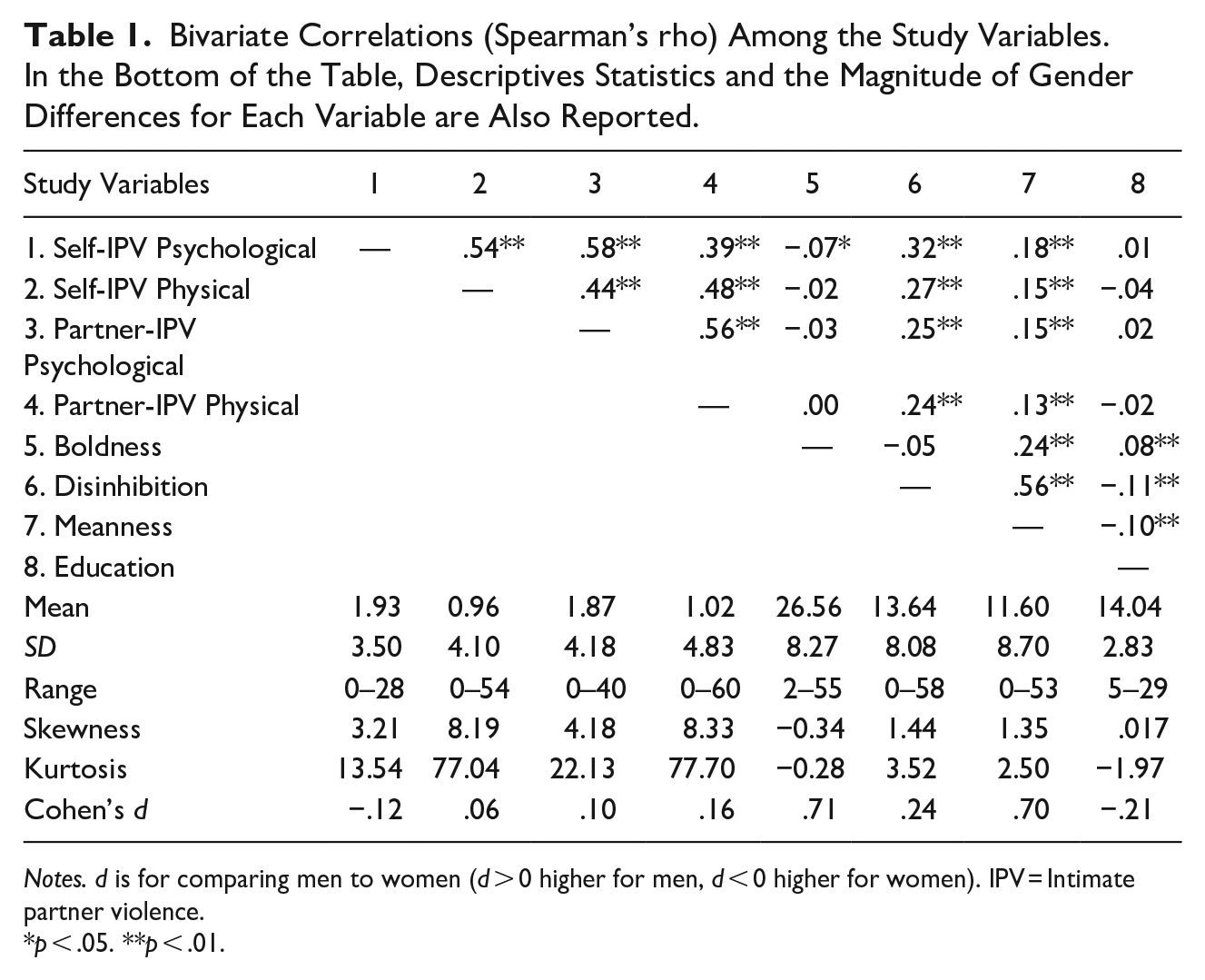
Notes. d is for comparing men to women (d > 0 higher for men, d < 0 higher for women). IPV = Intimate partner violence.
p < .05. **p < .01.
Education was not related to scores on either Self- or Partner-IPV subscale (Psychological, Physical), whereas Boldness was positively associated with education (ρ = .08) and Disinhibition and Meanness were negatively related to this variable (−.11 and −.10, respectively). In any case, all these figures were negligible in magnitude.
Lastly, for the three TriPM scales (Boldness, Meanness, and Disinhibition), sex differences were found, with men scoring higher than women on each.
Triarchic Traits and IPV: Bayesian Regression Analyses
In the Bayesian regression analyses, which evaluated unique associations for each of the TriPM scales when controlling for their overlap (shared variance), Boldness and Disinhibition showed negative and positive associations, respectively, with inflicted psychological victimization (see Table 2). In addition, TriPM Disinhibition was associated positively with perpetrated physical victimization. Disinhibition also consistently predicted reported violence by participant partners, both psychological and physical (Table 2). 2
Bayesian Regression Results for Psychopathy Facets. Values Show the Posterior Means of the Partial Regression Coefficients.
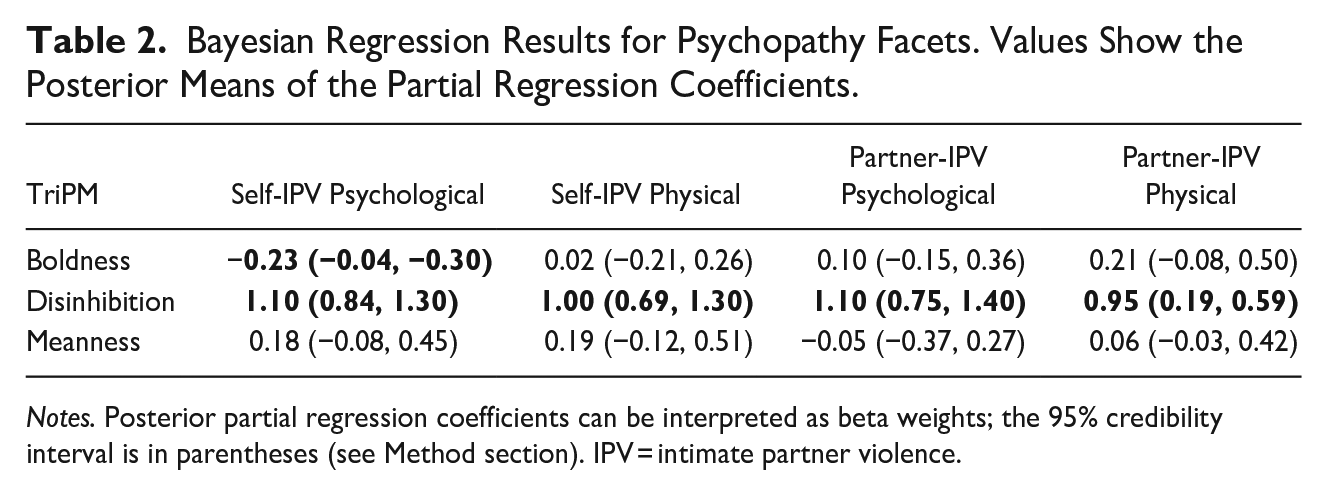
Notes. Posterior partial regression coefficients can be interpreted as beta weights; the 95% credibility interval is in parentheses (see Method section). IPV = intimate partner violence.
The analyses including participant gender as a factor revealed some notable interactions (Table 3) 3 : Meanness was a significant predictor of perpetrated psychological and physical violence in women (Figures 1 and 2), whereas disinhibition was especially associated with physical IPV in men (Figure 3).
Bayesian Regression Results for Psychopathy Facets and Their Interactions with Gender. Values Show the Posterior Means of the Partial Regression Coefficients.

Notes. Men were coded as “0” and women as “1”; posterior partial regression coefficients can be interpreted as beta weights; 95% credibility Interval in parentheses (see Method section). IPV = intimate partner violence.

Interaction between meanness and gender in predicting psychological violence.

Interaction between meanness and gender in predicting physical violence.
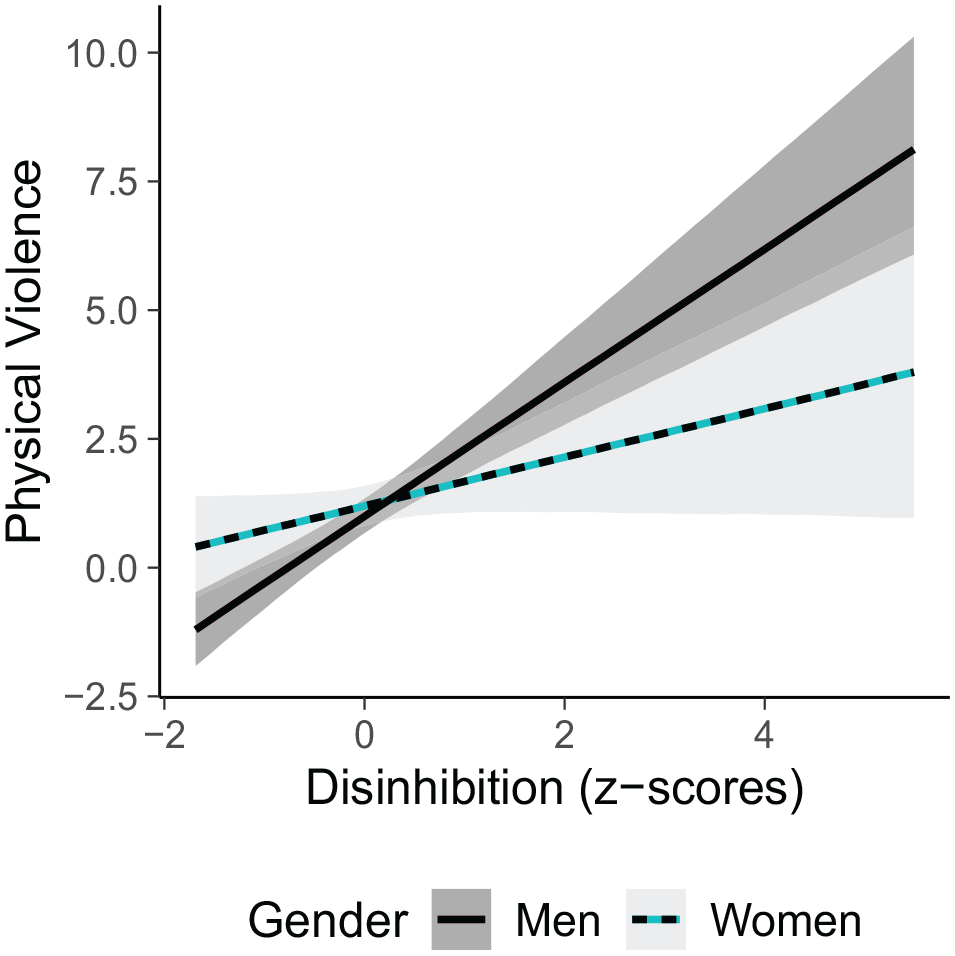
Interaction between disinhibition and gender in predicting physical violence.
Discussion
The worrying prevalence of violence in the context of an intimate relationship calls for an in-depth exploration of this phenomenon. In Italy, for example, IPV is one of the leading causes of homicide and a source of the most severe psychological and physical negative consequences for the individual. In addition, sadly, IPV is a frequent occurrence: in our sample, 23.7% of participants declared to have perpetrated in the last year at least one form of physical violence against his/her partner and 20.3% to have suffered at least one instance of physical violence from his/her partner.
The current study aimed to clarify the role of triarchic psychopathy traits both in perpetrated and suffered IPV. In fact, previous research has been inconsistent in identifying which psychopathy features are putatively more related to this phenomenon. Our results confirm the role of psychopathy in this form of violence and extend the current knowledge in that they offer novel indications about the psychological aspects of psychopathy in IPV.
Self-IPV
Consistent with our hypotheses, in the regression model, disinhibition and boldness were, respectively, positively and negatively associated with IPV. This confirms that triarchic traits represent important individual characteristics associated with IPV also in the nonclinical population.
The triarchic traits are in fact considered specific bio-behavioral vulnerabilities along a dimensional continuum. In particular, disinhibition involves frontal-brain-based differences in the capability to restrain behavior and regulate emotional reactivity (Patrick et al., 2012), and it shows robust associations with Factor 2 of the PCL-R. Actually, the association between disinhibition and externalizing problems and behavior is well documented in adults (e.g., Drislane et al., 2019) as well as in children (e.g., Green et al., 2020; Sica et al., 2020).
In accordance with our hypotheses, a negative correlation was observed between boldness and psychological IPV, with no significant associations found regarding physical IPV. It is plausible that the self-assuredness and adeptness in managing stressful situations inherent to individuals with a disposition toward boldness may lead them to employ interpersonal manipulation and persuasion tactics to fulfill their relational objectives. Consequently, individuals high in boldness may not find it necessary to resort to threats or overtly violent strategies when navigating interpersonal conflicts. For example, partners in such relationships may perceive coercive control exerted by one partner as a common and acceptable behavior within the context of the relationship. This characterization of boldness and the possible consequence for the couple dynamics well aligns with Cleckley’s (1941, 1976) description of psychopathy, which encompasses a lack of social concern and skill for influencing others (also see Crego & Widiger, 2016).
Notwithstanding, we acknowledge that our explanation is somewhat speculative since we cannot exclude that, theoretically, extreme levels of boldness may lead individuals to psychological or even physical IPV. To illustrate, a recent study on men with a history of serious offending and a diagnosis of personality disorder found that boldness was associated with proactive (i.e., premeditated) but not reactive violence (Gray et al., 2021; see also Cima & Raine, 2009; S. T. Smith et al., 2013). Also, the negative behaviors associated with high boldness may manifest in the interaction of the other triarchic traits. For instance, Drislane and colleagues (2022) found that boldness positively interacted with disinhibition in predicting poor behavior in prison in a sample of incarcerated individuals. No doubt that further research is warranted to elucidate this point.
In addition to disinhibition and boldness, the hypothesized effects of meanness were found in women but not in men: women with higher meanness reported more psychological and physical IPV than men. In women, who typically engage in less IPV (Mager et al., 2014; Swogger et al., 2007), the presence of emotional insensitivity and callousness may have triggered violent behavior and/or amplified disinhibitory tendencies. That is, as meanness is linked to deficiencies in affective and affiliative systems (Palumbo et al., 2020; Viding & McCrory, 2019) that contradict gender norms which dictate that women should be nurturing and cooperative (Eagly, 2009), it is possible that even a minor degree of indifference and insensitivity could be willingly associated with aggressive behavior in women.
On the other hand, and consistent with the above hypothesized mechanism, disinhibition was linked to physical violence, especially in men. In this case, the general proclivity for externalizing behaviors (i.e., aggressive, and uncontrollable emotions/behaviors), inherent in the concept of disinhibition, has overshadowed the potential impact of emotional insensitivity and callousness on IPV in men.
Partner-IPV
The examination of psychopathy traits linked to the perception/reporting of partner-IPV is a novelty in this field of study. Disinhibition was once again linked to violence committed by one’s own partner: this finding supports the idea that certain types of IPV are commonly observed in couples with high levels of conflict, where both partners are easily triggered and lack effective strategies for resolving disputes and differences: as a matter of fact, in our sample self and partner IPV were moderately related.
In fact, disinhibition in the context of interpersonal conflicts may be expressed with a particular erratic and unpredictable behavior leading to a strong reaction by the partner.
In summary, the triarchic model of psychopathy allowed us to better understand the individual differences associated with IPV and to clarify a few inconsistencies in the extant literature. The tendency to externalize (i.e., disinhibition) characterized IPV in both genders with no substantial differences. In the present study, this was the main factor associated with IPV and it is probably an important determinant of the correlation between self- and partner-IPV. Impulsivity, high reactivity, and habitual use of aggression all identify the psychological context in which conflicts can easily escalate into violence. As a matter of fact, high externalizing is generally associated with increased internalizing symptomatology (Achenbach & Edelbrock, 1978; Krueger, 1999), another factor contributing to conflicts inside couples. Interestingly, earlier studies indicated similar characteristics as correlates of IPV. Shorey and Colleagues (2011) reported a positive correlation between anger and impulsivity—traits relevant to Factor 2 psychopathy—and the perpetration of psychological and physical IPV among a sample of women arrested for domestic violence. Weinstein and Colleagues (2012) found a relationship between borderline symptoms (i.e., disinhibited features) and IPV.
On the other hand, the results about boldness and meanness call for additional studies on individuals convicted of violence against his/her partner.
As a concluding note, it is important to stress that, the lack of correlation between IPV and education indicates that one’s cultural background does not serve as a protective factor against intimate relationship turmoil and violence.
Psychopathy, IPV, and General Violence
One of the main results of our study revealed disinhibition as a predictor of perpetrated and received IPV. Since IPV may take place in a context of escalating violence, it is not unexpected that a trait theoretically and empirically linked to reactive aggression like disinhibition (e.g., Gray et al., 2004; Kennealy et al., 2010; Salekin et al., 1996) has a better predictive value than interpersonal/affective traits (i.e., boldness and meanness), typically more associated with instrumental aggression (Laurell et al., 2010; Vitacco et al., 2009; Weidacker et al., 2017; Woodworth & Porter, 2002).
In addition, this result echoes a vast literature on psychopathy which found features of impulsivity, poor behavioral control, and deficits in delaying gratification all related to aggressive misconducts both in correctional and non-correctional contexts and on adult and adolescent samples (e.g., Drislane et al., 2022; Gray et al., 2004, 2021; Sica et al., 2020). For instance, Drislane et al., (2022) using data for incarcerated males (n = 273) and females (n = 83) found that a latent factor composed of different indicators of disinhibition uniquely related to self-harm, drug use, poor behavior in prison, and poor reintegration prognosis. Gray and Colleagues (2021) showed that disinhibition was associated with criminal convictions and antisocial behavior in prison in a group of 108 male offenders. Sica and colleagues (2020) administered the triarchic constructs along with measures of conduct problems, callous-unemotional traits, attachment style dimensions, negative emotionality, and hyperactivity/inattention to 608 Italian adolescents. The disinhibition dimension of the triarchic model was related most highly to general externalizing outcomes, such as conduct problems and hyperactivity-inattention (for a thorough review, see Patrick & Drislane, 2015).
However, we might wonder whether in our sample IPV is just one of the possible outcomes of a general tendency to commit acts of violence. To investigate this issue, we computed Spearman’s Rho correlations between the four IPV variables and the self-reported delinquent activities of the individuals in our sample. These activities were assessed as part of our battery of questionnaires. In particular, we asked participants to indicate their engagement (Yes/No response) on a 36-item delinquent activities checklist over the past 6 months. In all, 29 of such activities were extracted from the 56-item checklist by Curcio et al. (2015) for their appropriateness in the Italian context, and seven more were added to better represent certain types of acts (cheating and fighting). The 36 items used in the present version had very good reliability (Cronbach’s alpha = .84; Sica et al., in preparation).
The obtained correlation values averaged around .20. This indicates that IPV is a distinct and separate phenomenon from antisocial behavior, as the correlation strength is relatively low, suggesting limited overlap between these two constructs (see also the conclusions below).
Limitations and Conclusion
The present research was performed on a substantial sample drawn from the community, with an equal representation of both genders. The study employed reliable measures to evaluate the variables of interest and adopted sophisticated analysis (Bayesian regression). In fact, the traits of psychopathy resulted in a crucial characteristic associated with IPV. Despite these strengths, some limitations are also present.
Our results may not generalize to individuals from other cultures and ethnic backgrounds, nor to clinical or forensic samples. Also, the present study data set did not include demographic variables such as race, ethnicity, and gender identity, precluding the evaluation of moderating effects for this sample. On the contrary, we were able to evaluate the moderating effect of marital status and sample type (undergraduates vs. community): gender-related results remained consistent across different marital status and sample type groups (see Note 3).
To obtain data for a large sample, we collected only self-report measures. Strict reliance on self-report measures can artificially inflate associations due to shared method variance. In addition, although the IPV measure utilized in the present study demonstrated good reliability and validity (expected relation with psychopathy), clearly more study is needed to ascertain its validity in the Italian population.
Also, the current study was cross-sectional: as a result, temporal precedence cannot be established, precluding the ability to make causal interpretations. Nonetheless, the triarchic traits of psychopathy are believed to be liability factors that are shaped by both genetics and experiences. As a result, in a theoretical but substantiated manner, these traits may be regarded as harbingers of aggressive conduct like that observed in cases of IPV.
Lastly, social desirability may have influenced results, as participants may feel inclined to underreport IPV; nonetheless, complete anonymity was ensured throughout the study, and the survey questions were included as part of a battery of measures that did not focus on socially unacceptable conduct.
On the whole, it must be acknowledged that deciphering relational dynamics, which are frequently mutual, can be challenging. In addition, we cannot exclude that men are more likely to justify their IPV by endorsing that their partner also engages in IPV, as there are stronger proscriptions on male violence against female partners than vice versa.
Despite the above limitations, the results were pretty clear: IPV was a relatively common occurrence in an unscreened community sample, and it was linked to psychopathic traits. Moreover, these traits had varying effects on IPV, depending also on the gender of the individuals involved and whether they were the perpetrator or the victim.
From a clinical perspective, these findings indicate the need to carefully monitor couples experiencing challenges, particularly when one partner exhibits disinhibited features. In addition, it is crucial to promote assertive behaviors in such situations, while being mindful about the expression and interpretation of such behaviors as showed by results about boldness. IPV is a pervasive issue in Western societies, and psychopathy plays a presumably not trivial role in its prevalence. Therefore, it is necessary to pay even greater attention to these personality traits.
Footnotes
Declaration of Conflicting Interests
The author(s) declared no potential conflicts of interests with respect to the authorship and/or publication of this article.
Funding
The author(s) received no financial support for the research and/or authorship of this article.
