




Abstract
Teen dating violence (TDV) is a public health concern impacting more than half of U.S. adolescents aged 12 to 18. Sexual minority youth (i.e., adolescents who are not exclusively heterosexual) experience disproportionately high rates of TDV. Yet, measures of TDV such as the Conflict in Adolescent Dating Relationships Inventory (CADRI) have been developed without considering sexual identity with items and instructions frequently anchored in heterosexual romantic relationships. Examination of measurement equivalence across heterosexual and sexual minority youth has only begun recently with existing research examining the CADRI’s victimization scale measurement invariance providing empirical support for invariance across heterosexual and sexual minority youth. However, no prior research has examined the measurement invariance of the CADRI perpetration scales across heterosexual and sexual minority youth. The current study fills this gap by examining the CADRI perpetration scale measurement invariance across heterosexual and sexual minority youth. Using multigroup confirmatory factor analysis responses from 1,143 adolescents (Mage = 15.88, SD = 2.49) to the CADRI perpetration items were examined across heterosexual (n = 922) and sexual minority youth (n = 218). Results confirmed the five-factor structure of the CADRI perpetration scales, providing empirical support for the appropriateness of the use of the CADRI perpetration scale’s scores across heterosexual and sexual minority youth broadly. However, findings of partial scalar measurement invariance on the emotional/verbal abuse perpetration scale raise questions about the appropriateness of mean-score comparisons on this particular subscale. Areas of potential revisions of the emotional/verbal abuse perpetration scale are discussed to facilitate meaningful comparisons among heterosexual and sexual minority youth and to substantiate program evaluation results by groups.
Teen dating violence (TDV) is an umbrella term frequently used to describe a continuum of abuse perpetrated by a current or former romantic partner, including acts of sexual violence (e.g., non-consensual sexual touching or forced sex), physical violence (e.g., hitting, scratching, biting), psychological aggression (e.g., communicating threats, controlling behaviors), and stalking/monitoring of activities (Niolon et al., 2015). Lifetime prevalence rates indicate that approximately 63% of 12- to 18-year-old U.S. youth perpetrate some form of TDV at some point in their life (Taylor & Mumford, 2016). Such high lifetime prevalence rates are alarming as TDV has many negative consequences for its victims, including higher levels of heavy episodic drinking, substance use, depression, and suicidal ideation (Edwards, 2018; Smith et al., 2020). In addition, victims of TDV not only experience a greater number of health complaints but are also at a greater risk for physical injuries requiring medical care (Haynie et al., 2013), posing a substantial burden on healthcare systems and the economy (Tharp et al., 2017). Considering a preventable public health concern, disparities in TDV exist among sexual minority youth (i.e., youth who are not exclusively heterosexual), who experience significantly higher rates of TDV compared to heterosexual youth (Edwards, 2018, Martin-Storey et al., 2021, Ray et al., 2022). However, many studies examining dating violence among sexual minority populations rely on measures not validated for this population and predominantly focus on victimization (Kim & Schmuhl, 2021). The use of TDV measures with unknown reliability and validity for sexual minority youth, paired with the marked focus on dating violence victimization is concerning as it reinforces heteronormative scripts about dating violence perpetration. Moreover, to examine the effectiveness of TDV perpetration and victimization prevention efforts among sexual minority youth, reliable and validated measurement of prevention program outcomes is of tantamount importance. Furthermore, without TDV perpetration measures validated for sexual minority youth, conclusions about program effectiveness cannot be drawn. The current study aims to contribute to translational prevention science by examining the degree to which inferences about TDV perpetration derived from the Conflict in Adolescent Dating Relationships Inventory (CADRI; Wolfe et al., 2001), a frequently used measure of TDV, are generalizable across heterosexual and sexual minority youth.
The Conflict in Adolescent Dating Relationships Inventory
The CADRI (Wolfe et al., 2001) was one of the first measures specifically developed to capture the complexity of dating violence occurring in adolescent romantic relationships; it has served as a foundation for decades of TDV research (Exner-Cortens, 2018). Although measure development was partially informed by the adult intimate partner violence literature, the CADRI conceptualizes TDV to be distinct from violence occurring in adult relationships, with adolescent abusive behaviors viewed to be multidimensional, involving distinct subtypes/subscales (Wolfe et al., 2001). More specifically, the CADRI frames TDV as abusive or violent behaviors that manifest as five distinct types, namely emotional/verbal abuse (e.g., speaking in a hostile tone of voice), physical abuse (e.g., kicking, hitting, or punching), sexual abuse (e.g., forcing sex), relational aggression (e.g., spreading rumors), and threatening behaviors (e.g., threatening to destroy something). To date, this TDV framing has been very appealing to many researchers and a large body of research has relied on the CADRI both to study predictors of TDV (e.g., Temple et al., 2013) and to examine the effectiveness of TDV prevention programs (e.g., Peskin et al., 2019). Nevertheless, adolescents’ sexual identity was not considered in the initial measure of development which is concerning in a multitude of ways. First, it is important to recognize that TDV is not an exclusively heterosexual phenomenon. In fact, physical, sexual, and threatening TDV were shown to occur at higher prevalence and recurrence rates among sexual minority youth relative to heterosexual youth (Petit et al., 2021). Secondarily, the CADRI was developed under assumptions of heteronormativity which is reflected in the original item wording. Specifically, the original items of the CADRI assume that respondents are involved in heterosexual relationships with sex-specific versions inquiring about abusive behavior toward the other-gender romantic partner. For example, CADRI items developed for females ask about abusive behaviors toward their boyfriends while the male versions ask about abusive behaviors toward their girlfriends (Wolfe et al., 2001). While the identical item structure across both sex-specific versions is beneficial from a psychometric perspective, the anchoring of items and instructions in heterosexual romantic relationships raises concerns about the equivalence of measurement properties for sexual minority respondents.
The most examined and reported psychometric properties of the CADRI are its internal consistencies (i.e., the degree to which the CADRI items relate to the same type of abusive behavior), which have supported the use of the CADRI in racially and ethnically diverse samples of high school students (Niolon et al., 2015). While such information supports the reliability of the CADRI in a given sample, measures of internal consistency cannot support the equivalence of a construct and its scores across groups. Yet, the internal consistencies of the CADRI subscales continue to present the most frequently examined psychometric property, whereas its subscale structure has been subject to few replication attempts. As such, research identifying violations of construct validity using psychometric techniques (e.g., measurement invariance) to examine the equivalence of the CADRI perpetration scales for heterosexual and sexual minority youth is of tantamount importance and serves as an important foundation for ongoing intervention and prevention programming.
To date, only a couple of studies have explicitly examined the CADRI’s measurement structure (e.g., Rivas-Koehl et al., 2023; Shorey et al., 2019). One pivotal study examined the CADRI perpetration scale measurement invariance across sex, race/ethnicity, and time (six waves) using a sample of high school students (Shorey et al., 2019). Findings supported the CADRI perpetration scales factor structure (i.e., the presence of five distinct subscales) as well as its invariance over time, providing support for the measures’ use throughout developmental transitions (i.e., from adolescence to young adulthood). In addition, Shorey et al.’s (2019) results supported the broad equivalence of the latent factor structure across sex and race/ethnicity, with partial invariance evident for both sex and race/ethnicity during adolescence but not young adulthood. Items showing partial invariance included items assessing sexual abuse (i.e., forced sex, coercion of sex, non-consensual kissing) as well as items assessing relational abuse (e.g., spreading rumors; Shorey et al., 2019). A second, even more recent study examined the measurement equivalence of the CADRI victimization scales across time and between heterosexual and sexual minority youth (Rivas-Koehl et al., 2023). Using longitudinal data from a sample of high school students, the results suggest that the CADRI victimization scales are invariant across time and sexual minority status, providing support for the comparability of the victimization scales (Rivas-Koehl et al., 2023). Taken together, existing research examining the measurement invariance of the CADRI provides empirical support for invariance over time, as well as invariance of the perpetration scales across sex and race/ethnicity and invariance of the victimization scales across heterosexual and sexual minority youth. However, no prior research has examined the measurement invariance of the CADRI perpetration scales across heterosexual and sexual minority youth. The current study fills this gap.
Measurement Invariance
Measurement invariance, also commonly referred to as measurement equivalence, is a psychometric property of quantitative measures that provides information about the degree to which item responses are similarly related to a given construct across different populations. Information about a measure’s equivalence is crucial to gauge the appropriateness of use in different populations and to support inferences based on scale scores across different groups. Correspondingly, the degree to which the CADRI perpetration subscales can be compared across heterosexual and sexual minority youth depends on the respective level of measurement invariance. Specifically, measurement invariance is tested and established in an iterative, stepwise process with most tests of measurement invariance including tests of configural, metric, and scalar invariance (Putnick & Bornstein, 2016). On a conceptual level, configural invariance provides information about the degree to which the CADRI perpetration subscales hold up across heterosexual and sexual minority youth. In other words, it tests the replicability of the five types of TDV developed in heterosexual samples for sexual minority youth. Once configural invariance is established, metric invariance can be tested which examines the equivalence of item factor loading across heterosexual and sexual minority youth. Metric invariance answers the question of whether items of a respective subscale are equally important for the subscale across both groups. If equality of factor loadings is established, scalar invariance testing can be conducted which provides information about the degree to which mean differences in the latent construct are captured in the shared variance of the items. In other words, tests of scalar invariance provide information about the degree to which group differences in CADRI subscale scores are the result of true differences in perpetration and not due to differences in scale properties. Such evidence is ultimately needed to support inferences about scale scores such as the comparison of TDV prevalence rates across heterosexual and sexual minority youth. If measurement equivalence is not established, observed group differences on the CADRI are more likely the result of measurement invariance (i.e., performance differences in measurement across groups) than true between-group differences. Therefore, invariance testing provides important information about the degree to which inferences about TDV perpetration as measured by the CADRI are generalizable across heterosexual and sexual minority youth.
The Current Study
Utilizing Queer Theory (Butler, 1990) as an overarching conceptual framework to critically examine the privileging of heterosexuality social science scholarship, this study examined the CADRI (Wolfe et al., 2001) perpetration scales’ measurement invariance for heterosexual youth and sexual minority youth. To increase the stability of estimates, the current study leveraged individual item-level data from three secondary datasets with the overall goal to increase the total number of sexual minority youth responses included in the study sample. Moreover, the current study utilized multi-group confirmatory factor analysis to test the configural, metric, and scalar equivalence of the CADRI’s perpetration scales factor structure across heterosexual and sexual minority youth.
Methods
Procedure
Following the recommendations of Dowrick et al. (2009), existing data sources were combined to increase the representation of hard-to-reach groups (i.e., sexual minority youth). To identify existing datasets for the purpose of this study, a scoping review (i.e., an examination of the extent, range, and nature of available datasets) was conducted from July 2021 to November 2021 following a modified version of Arksey and O’Malley (2005)’s methodological framework. 1 Using this approach, three restricted access datasets were identified and obtained via a restricted data use agreement from The Inter-University Consortium for Political and Social Research (ICPSR). All datasets were associated with studies investigating predictors of teen dating violence in the United States. Specifically, data from a cross-sectional survey research study examining adolescents at risk for teen dating violence were included (Developmental Pathways of Teen Dating Violence in a High-Risk Sample, Erie County NY; Livingston et al., 2016). The second dataset was the third wave of a longitudinal panel research study examining the changing nature of adolescent dating relationships in a nationally representative sample of youth (The National Survey of Teen Relationships and Intimate Violence; Taylor et al., 2016). 2 Finally, wave six of a longitudinal cohort study (The Bullying, Sexual, and Dating Violence Trajectories From Early to Late Adolescence in the Midwestern United States; Espelage et al., 2014) examining individual characteristics and environmental contexts associated with dating violence and bullying was included. 3 See Appendix A for more information.
Sample
Survey responses from 1,979 participants were obtained from datasets stored by ICPSR. Participants’ ages ranged between 11 and 21 years with the average age being 15.88 years (SD = 2.49). Approximately 52% of the participants were female (n = 1,022). Most identified as non-Hispanic (81.8%) and White (71.3%) Approximately 15% (n = 305) of participants identified as sexual minority youth.
Measures
Conflict in Adolescent Dating Relationships Inventory
The CADRI (Wolfe et al., 2001) perpetrator version consists of 25 items scored on a four-point scale ranging from never to often. Items load onto five different subscales, each representing distinct types of teen dating violence: threatening behavior (4 items; e.g., “I deliberately tried to frighten him/her”), relational abuse (3 items; e.g., “I spread rumors about him/her”), physical abuse (4 items; e.g., “I kicked, hit, or punched him/her”), sexual abuse (4 items; e.g., “I forced him/her to have sex when he/she didn’t want to”), and emotional/verbal abuse (10 items; e.g., “I threatened to end the relationship”). Past research examining measurement invariance of the CADRI across sex and race/ethnicity in an adolescent sample reported variable internal consistencies across multiple waves of data collection with some subscales evidencing consistently low internal consistencies (e.g., sexual abuse and relational abuse with Cronbach’s alpha ranges of .15 to .56 and .54 to .65, respectively), whereas other subscales consistently evidenced higher internal consistencies (e.g., physical abuse Cronbach’s alpha range = .76 to .86, threatening behavior Cronbach’s alpha range = .61 to .76 and emotional/verbal abuse with a Cronbach’s alpha range of .78 to .85; Shorey et al., 2019). In the current study, subscales evidenced slightly higher levels of internal consistency across all subscales with Cronbach’s alpha = .85 for physical abuse, Cronbach’s alpha = .70 for threatening behaviors, Cronbach’s alpha = .60 for sexual abuse, Cronbach’s alpha = .71 for relational aggression, and Cronbach’s alpha = .87 for verbal/emotional abuse perpetration.
Sexual Minority Status
Participants’ responses to survey items about sexual orientation were used to characterize the sample and to categorize respondents into sexual minority and heterosexual youth groups. As such, participants’ responses to the sexual orientation items were dichotomized to indicate sexual minority group status. All participants identifying as gay, lesbian, bisexual, something else, or not sure were considered to be sexual minorities (i.e., not strictly heterosexual).
Control Variables
Secondary datasets differ in the measurement of sexual orientation with some asking about romantic attraction (i.e., “Choose the description that best fits how they [you] think about themselves [yourself]” with response options such as “Mostly heterosexual [straight], but somewhat attracted to people of your own sex”), with others requiring participants to self-label (i.e., “What is your sexual orientation?”), or asked about dating behaviors (i.e., “Do you most often go out with . . . girls, boys, or both”). Consequently, in line with best practice recommendations (e.g., Steenkamp & Maydeau-Olivares, 2021), a two-level fixed factor for measurement of sexual orientation (i.e., methods factor) was created to control for the potential effect of measurement of sexual orientation on group assignment and group differences.
Statistical Analysis
Missing data patterns were visually inspected and assessed using Little’s Missing Completely at Random (MCAR) test. Sensitivity analysis was conducted to examine mean differences in scale scores by sexual orientation. Descriptives for the CADRI subscales were obtained, including their association with demographic variables and potential covariates (including measurement of sexual orientation).
Given the scarcity of research examining the psychometric properties of the CADRI perpetration scale for sexual minority youth (Exner-Cortens, 2018), an exploratory multi-group confirmatory factor analysis was conducted in RStudio using the package lavaan (Rosseel, 2012). The estimation method was selected based on item-response distributions and ordinal-level measurement (i.e., four-point frequency scale). The five continuous latent factors representing the TDV components (threatening behavior, relational abuse, physical abuse, sexual abuse, and verbal/emotional abuse) were specified to load onto a higher-order factor that represents TDV perpetration more broadly. Model fit was assessed using chi-square fit statistics, the comparative fit index (CFI), and root mean square error of approximation (RMSEA) with accompanying 90% confidence intervals (CIs). As recommended by Hu and Bentler (1999), a CFI value greater than .95 and RMSEA values below .05 were considered indicative of good model fit (Hu & Bentler, 1999). Likelihood ratio tests were used to evaluate the goodness of model fit of the different measurement models.
To test the hypothesis that the five different subtypes of TDV perpetration measured by the CADRI function equivalently across heterosexual and sexual minority youth, the equivalence of the CADRI’s factor structure and differences in the magnitude of non-invariance as a function of sexual orientation were compared. Configural invariance was examined by estimating the parameters of the measurement model separately for each group. Metric invariance was tested through constraining factor loadings to equality across both groups. To examine scalar invariance, factor loadings and intercepts were constrained to equality across groups. To control for differences related to the combination of secondary datasets, an alternative model including covarying variables was estimated and compared to the final multi-group CFA model. 4
Results
CADRI responses from a total of 1,979 participants were examined. Approximately 42% of the sample (n = 837) did not answer any of the 25 CADRI perpetration items and were therefore excluded from the analysis. Of the 1,143 participants providing responses on the CADRI, 95.3% (n = 1,089) provided responses on all items. As expected, CADRI item responses were non-normally distributed with low-base rates prevalent across items. Participants with more than 40% missing item responses (n = 3) on the CADRI were excluded (Graham, 2009), yielding a final sample of 1,140 participants. 5 Roughly 20% (n = 218) of the final sample identified as sexual minority youth. Consequently, both group and sample power were adequate for multigroup CFA (Kline, 2023). Please see Table 1 for sample descriptives.
Sample Demographics (N = 1,140).

Missing data patterns were visually inspected and indicated that three items assessing sexual abuse perpetration (i.e., unwanted sexual touch, communication of threats to elicit sex, and forced sex) were the most frequently missing items. Little’s MCAR test was conducted using the expectation-maximization algorithm with likelihood functions requested from Student’s t-distribution (df = 24) to account for the non-normality of item response distributions. The results of Little’s MCAR test indicated that data were not missing completely at random, χ2 = 1415.95, df = 661, p = .001. Subsequently, Student’s t-tests were conducted to examine differences between complete and missing item responses across demographic variables. There was a significant effect for age for 12 of the CADRI items and a significant effect for race for three CADRI items (see Supplemental A). Missing data mechanism appeared to be most consistent with missing at random (MAR, i.e., missing data pattern is accounted for by the effect of age and race) given that correlates of missingness were identified using Student’s t-tests and taking into consideration the influence of non-normality on Little’s MCAR test (Little, 1988). Subsequently, per recommendations of Little and Rubin (1989), the missing data mechanism was considered to be ignorable, and robust weighted least estimators mean- and variance-adjusted estimation method with listwise deletion was deemed appropriate (Sass et al., 2014). Chi-square difference testing was conducted using the Satorra–Bentler scaled chi-square (Satorra & Bentler, 2001).
Sensitivity Analysis
A sensitivity analysis was conducted to examine mean differences in scale scores by sexual orientation. Levene’s test was used to test the equality of variances across heterosexual and sexual minority youths for each CADRI subscale. The results of Levene’s test indicated that variances were not equal across groups for physical abuse, F(1, 1138) = 174.58, p < .001, threatening behavior, F(1, 1138) = 153.37, p < .001, sexual abuse, F(1, 1138) = 5.08, p = .024, relational aggression, F(1, 1138) = 37.98, p < .001, and emotional/verbal abuse, F(1, 1138) = 30.24, p < .001. As such, Mann–Whitey U tests were conducted to determine whether there were differences in CADRI perpetration subscale scores of heterosexual and sexual minority youths. Results suggested significant differences in CADRI perpetration subscale scores. Specifically, youths identifying as heterosexual evidenced higher physical abuse (Z = −8.66, p < .001), threatening behaviors (Z = −4.08, p < .001), relational aggression (Z = −3.95, p < .001), and emotional/verbal abuse (Z = −5.58, p < .001) CADRI perpetration scores relative to sexual minority youth. There were no significant differences in CADRI sexual abuse scores by group. Across all participants, average subscale scores were highest for the emotional/verbal abuse perpetration scale and lowest for the relational aggression perpetration scale. Scale means and item means are displayed in Table 2.
Means and Standard Deviations of CADRI Perpetration Scales and Items (n = 1,140).

Descriptive Statistics
Associations between demographic variables such as age, grade level, and sexual orientation and CADRI subscale scores were examined using Spearman correlations and chi-square test. As seen in Table 3, there was a small, positive significant correlation between the perpetration of sexual and emotional/verbal abuse and age as well as grade level. Moreover, sexual orientation was significantly and positively correlated with the perpetration of threatening behaviors, relational aggression, and emotional/verbal abuse. In addition, the results of chi-square tests indicated a significant relationship between sex and physical abuse, χ2 (12, 1140) = 65.64; p < .001, threatening behaviors χ2 (11, 1140) = 22.31; p = .002, and emotional/verbal abuse, χ2 (33, 1137) = 72.23; p < .001. Similarly, race was significantly associated with CADRI scores on four subscales, namely physical abuse, χ2 (44, 929) = 120.15; p < .001, sexual abuse, χ2 (24, 919) = 36.95; p = .044, emotional/verbal abuse, χ2 (128, 926) = 169.44; p = .008, and threatening behaviors, χ2 (44, 929) = 98.89; p < .001. Chi-square tests were not significant for ethnicity and there was no significant relationship between CADRI subscale scores and the study’s measurement of sexual orientation.
Spearman Correlation Matrix for Key Variables (n = 1,140).
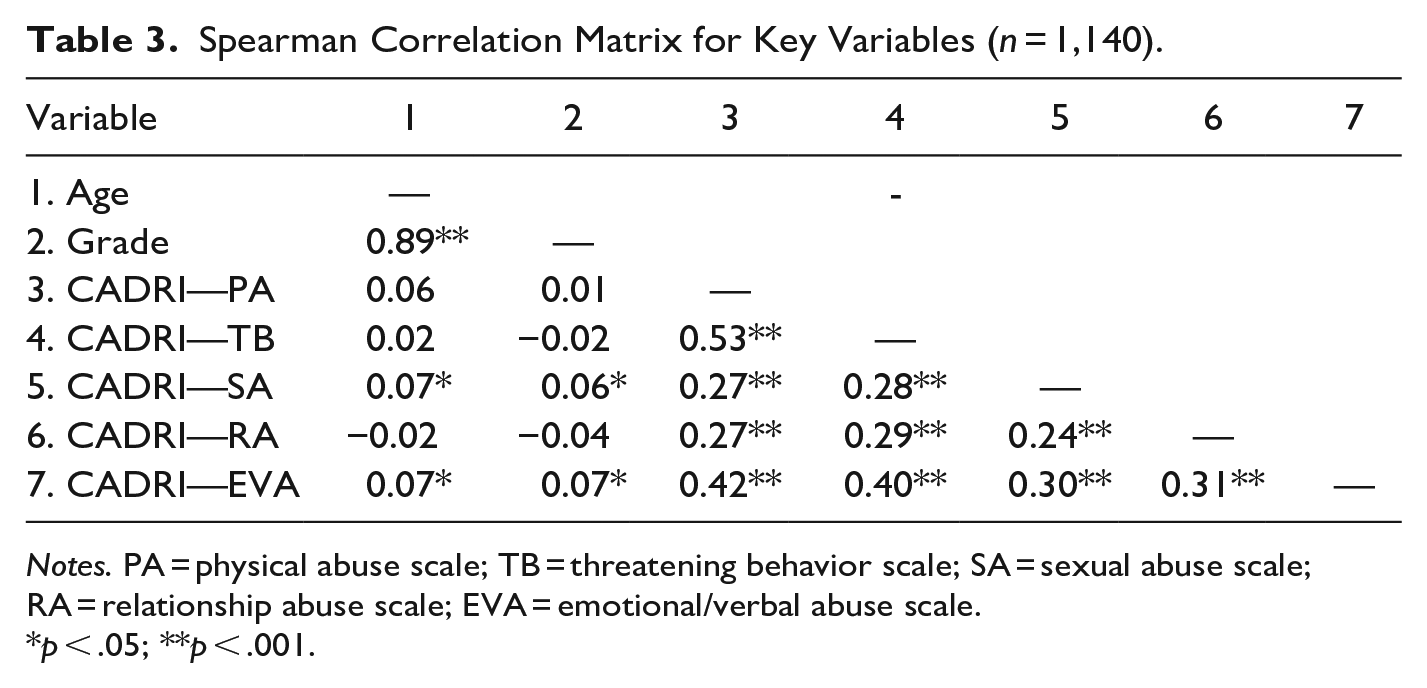
Notes. PA = physical abuse scale; TB = threatening behavior scale; SA = sexual abuse scale; RA = relationship abuse scale; EVA = emotional/verbal abuse scale.
p < .05; **p < .001.
Multigroup Confirmatory Factor Analysis
To examine the CADRI’s measurement invariance across heterosexual youth and sexual minority youth, multigroup invariance testing was conducted.
Configural Invariance
As a first step, the fit of the hypothesized model was analyzed separately for each group (i.e., configural invariance). Using a testing approach from least restrictive to most restrictive, the first step of the testing for multigroup equivalence was to establish configural invariance, where the same number of factors and their loading pattern were estimated freely for heterosexual and sexual minority youths. The configural model demonstrated good model fit, χ 2 = 388.87, df = 530, p < .001, CFI = .969, TLI = .969, RMSEA = .024, 90% [.017, .030], SRMR = .086, indicating that the CADRI perpetration factor structure has an equal model fit across heterosexual and sexual minority youth. In other words, the multidimensional construct measured by the CADRI is the same construct across both groups. Subsequently, the factorial invariance of the measurement model (i.e., metric invariance) was tested by constraining the factor loadings to equality.
Metric Invariance
As displayed in Table 4, the metric invariance model fit the data well and showed improvements in model fit, Δχ2 = 17.508, Δdf = 20, p = .620. This suggests that the CADRI not only measures the same multidimensional construct across heterosexual and sexual minority youth but also that the specific statistical relationships between the CADRI items and their associated latent factors (i.e., types of abuse) are the same across both groups. As such, metric invariance was established and the next level of measurement invariance (i.e., scalar invariance) was tested by constraining both factor loadings and intercepts to equality.
Multigroup CFA/Measurement Invariance Testing (n = 1,140).

Note. Δχ2 = Satorra–Bentler-scaled chi-square difference test statistic; configural model = no equality constraints imposed; metric invariance = all factor loadings constrained equal; scalar invariance = all factor loadings and intercepts constrained equal; partial scalar invariance = like scalar invariance but intercepts freely estimated for jealousy item and putdowns/insult item.
Scalar Invariance
The scalar invariance model demonstrated good model fit; however, the metric invariance model showed greater parsimony as indicated by likelihood ratio test results, Δχ2 = 52.271, Δdf = 20, p < .001. Sources of local misfit were explored by examining modification indices to test for a model of partial scalar invariance. Modification indices suggested that freeing the intercepts of the emotional/verbal abuse items “I did something to make him/her jealous” and “I insulted him/her with putdowns” across groups would improve model fit.
Partial Scalar Invariance
When both intercepts were left to vary freely between groups, the difference in model fit between the metric invariance model and partial scalar invariance model was in the recommended range with Δχ2 = 25.384, Δdf = 18, p = .115, providing support for partial scalar measurement invariance. This finding indicates that the multidimensional TDV perpetration construct captured by the CADRI is measured on the same scale with the same statistical relationships between the CADRI items and their associated latent factors (i.e., types of abuse) across heterosexual and sexual minority youth. It also indicated that all subscales, except for emotional/verbal abuse, have the same latent means across groups. The scalar non-invariance of the intercepts of two emotional/verbal abuse CADRI items assessing jealousy and insults/putdowns suggests that sexual minority youth report more frequent perpetration of jealousy (i.e., doing something to make the partner jealous) and heterosexual youths report greater perpetration of insults/putdowns (i.e., insulting partner with putdowns). For neither group were items indicating increased perpetration of jealousy and insults/putdowns related to greater emotional/verbal abuse perpetration.
Alternative Model Including Covariates
To control for differences related to the operationalization of sexual orientation (i.e., romantic attraction vs. self-label) across datasets, 6 an alternative model was estimated and compared to the final multi-group CFA model. In the alternative model, an observed fixed factor for the measurement of sexual orientation was regressed onto each continuous latent factor (i.e., abuse types). The alternative model showed adequate model fit that was comparable to the partial scalar measurement invariance model, χ2 = 416.23, df = 570, p = .000, CFI = 0.97, TLI = 0.96, RMSEA = .025, 90% [.018, .031], SRMR = .084, indicating that the operationalization of sexual orientation did not significantly change the fit of the partial scalar invariance model.
Discussion
The current study examined the equivalence of a measure of TDV perpetration (i.e., CADRI; Wolfe et al., 2001) across heterosexual and sexual minority youth. With 70% of existing dating violence research focusing on violence victimization among sexual minority youth (e.g., Kim & Schmuhl, 2021), the current study makes important contributions through its explicit focus on TDV perpetration. Except for the perpetration of sexual abuse, differences in prevalence rates across heterosexual and sexual minority youth were evident with youths identifying as heterosexual self-reporting perpetrating higher rates of physical abuse, threatening behaviors, relational aggression, and emotional/verbal abuse relative to sexual minority youth. However, the results of measurement invariance testing caution against an examination of mean score differences across heterosexual and sexual minority youth on the CADRI emotional/verbal abuse subscale due to partial scalar invariance.
Specifically, the results of multi-group invariance testing suggest that apart from the verbal/emotional abuse perpetration scale, the underlying latent factor structure of the remaining CADRI perpetration scales can be interpreted similarly across heterosexual and sexual minority youth. Put differently, meaningful comparisons of CADRI subscale scores are possible for most subscales except for emotional/verbal abuse, where partial invariance emerged. More precisely, two emotional/verbal abuse items pertaining to the perpetration of insults and putdowns were shown to exhibit invariance across heterosexual and sexual minority youth. However, the overall percentage of items showing invariance across groups was low (less than 20%) and thereby should have minimal impact on the use of the scale (Dimitrov, 2010). Broadly speaking, the five-factor structure of the CADRI (i.e., physical, threatening, sexual, relational, and emotional/verbal abuse) appeared to hold up well and were comparable across heterosexual and sexual minority youth. As such, results of the current study support prior research on the factor structure of the CADRI broadly (e.g., Shorey et al., 2019) and its conceptual equivalence for sexual minority youth specifically (e.g., Rivas-Koehl et al., 2023).
At the same time, the current findings, if replicated, and considered within the extent of minority stress research, also provide important directions for potential revisions of the CADRI to promote greater inclusivity of sexual minority specific experiences. One particular avenue for revisions is rooted in the findings of partial invariance of emotional/verbal abuse items. These items seem to underlie the intersection of dating violence and identity-based violence. A salient form of psychological dating violence specific to individuals identifying as members of the LGBTQ+ community is identity abuse, where systemic oppression (i.e., heterosexism) is leveraged to perpetrate psychological harm or exert control over current or former dating partners (Woulfe & Goodman, 2021). Manifestations of identity abuse include the use of pejorative name calling, insults/putdowns that undermine and belittle partners’ identities (e.g., “not being gay enough” or “not being a real lesbian”), as well as threats to out the dating partner. Although recently linked to psychological violence perpetration (Swann et al., 2022), identity abuse itself is frequently not considered within TDV conceptualization and measurement. Based on the findings of the current study, the inclusivity of the CADRI could be bolstered either through revisions aimed at the inclusion of items assessing identity-based emotional/verbal abuse tactics or through the addition of a sixth factor/subtype assessing identity-based abuse more broadly. In addition, as recent research has highlighted the role of my minority stress for heightened cyber dating abuse perpetration and victimization rates among the sexual minority population (e.g., Yang et al., 2023), the inclusion of additional cyber dating abuse items may support a continuous use of the measure for a general adolescent population while also capturing the unique experiences of sexual minority youth. Such efforts may be combined with other ongoing validation work to ensure that inferences drawn from the CADRI reflect contemporary perspectives on TDV perpetration as well as the lived experience of present-day youth.
Outside of measure development, the findings of the current study are also of great relevance for prevention program evaluation and development. Not only does the omission of identity abuse fail to consider sexual minority-specific forms of TDV but the use of the CADRI in non-majority populations has the potential to skew prevalence rates (Exner-Cortens, 2018). Given that research has relied on the prevalence rates reported in the initial measurement development and validation study as norms to gauge the clinical significance of community-based dating violence prevention programs (e.g., Wolfe et al., 2003), accurate and sensitive measurement of TDV is of great importance to effectively prevent TDV. With a recent meta-analysis encouraging ongoing focus on the prevention of TDV perpetration (over victimization; Lee & Wong, 2020), it is important for TDV perpetration scales to capture the continuum of violence, including the broad range of emotional abuse and threatening behaviors and their intended appraisal from a developmental perspective (Cascardi et al., 2022). Moreover, as evidence-based TDV prevention programs such as Safe Dates undergo adaptations to include sexual minority-specific risk factors (e.g., psychoeducation about identity abuse; Wesche et al., 2020), ongoing accumulation and synthesis of research examining the appropriateness, meaningfulness, and usefulness of TDV perpetration measures for sexual minority youth is needed to substantiate program evaluation results by group.
Constraints on Generalizability
Although this study is one among a few that are “queering methodology” to become more inclusive (Han et al., 2019), its results should be considered in light of several limitations. The current study used secondary data combining participant-level data from existing research studies. Despite efforts to increase statistical power through the integration of three data sources, approximately 42% of the cumulative sample were missing all responses on the CADRI and therefore had to be excluded from the analysis. Relatedly, although this study pooled data from multiple contributing studies containing small subsamples to increase statistical power and representation, roughly one-fifth of the participants providing CADRI responses were identified as sexual minority youth which may limit the generalizability of the findings and does not represent all members of the LGBTQ+ community equally. Nevertheless, the combination of three secondary datasets allowed a greater representation of sexual minority youth relative to existing individual studies. In future research, the combination of multiple LGBTQ+ samples/datasets may allow researchers to further extend the findings of the current study to examine measurement invariance across LGBTQ+ subgroups as well as intersectional identities (e.g., LGBTQ+ youth of color) which will further advance measurement and prevention programming.
As it pertains to generalizability more broadly, it is noteworthy that although responses from adolescents ages 11 through 21 were obtained and both males and females were equally represented, findings were constrained in their generalizability across racial and ethnic groups, as well as gender identities. Racial and ethnic minorities including African American/Black, Asian, Native American/Indigenous, and Latinx participants were underrepresented, and findings warrant replication in more racially and ethnically diverse samples. At the same time, taking into consideration the strengths of the existing datasets that were utilized, findings may extend to a broad range of U.S. adolescents as one of the included datasets indeed was a nationally representative sample. Moreover, as existing data sources were combined to increase the representation of LGBTQ+ adolescents, individuals from school-based samples and high-risk samples (i.e., with documented exposure to adverse childhood experiences) were included in the final sample. As such, findings have the potential to apply to an expansive group of U.S. adolescents. Although the combination of existing data sources presents a strength of the current study, secondary data did limit generalizability. Across datasets only information about participants’ sex was available and gender identity was not assessed, precluding tests of measurement equivalence across trans- and gender diverse (including gender expansive and gender nonconforming) youth. Relatedly, as relationship partners gender identities shape sexual orientation identity (i.e., labels of emotional, romantic, and/or sexual attraction; Bowling et al., 2023), and considering diverging measurement of sexual orientation across datasets, nuanced and accurate measurement of these concepts is a crucial aspect of inclusive methodology.
Conclusion
This is the first study to examine the measurement invariance of the CADRI perpetration scale across heterosexual and sexual minority youths, with only one existing study examining measurement invariance across groups for the victimization scales (Rivas-Koehl et al., 2023). As such, while the current findings echo those of prior research emphasizing the need for a greater focus on measure development and adaptation to represent the lived experiences of diverse youth (including sexual and gender minority youths), findings support the use of CADRI for TDV prevention programs adapted for LGBTQ+ populations.
Supplemental Material
sj-docx-1-jiv-10.1177_08862605231213381 – Supplemental material for Queering the Conflict in Adolescent Dating Relationships Inventory: An Examination of the Conflict in Adolescent Relationships Inventory Perpetration Scale’s Measurement Invariance Across Heterosexual and Sexual Minority Youth
Supplemental material, sj-docx-1-jiv-10.1177_08862605231213381 for Queering the Conflict in Adolescent Dating Relationships Inventory: An Examination of the Conflict in Adolescent Relationships Inventory Perpetration Scale’s Measurement Invariance Across Heterosexual and Sexual Minority Youth by Iris F. McMillan, Erika Montanaro, Jennifer Langhinrichsen-Rohling and Annelise Mennicke in Journal of Interpersonal Violence
Supplemental Material
sj-docx-2-jiv-10.1177_08862605231213381 – Supplemental material for Queering the Conflict in Adolescent Dating Relationships Inventory: An Examination of the Conflict in Adolescent Relationships Inventory Perpetration Scale’s Measurement Invariance Across Heterosexual and Sexual Minority Youth
Supplemental material, sj-docx-2-jiv-10.1177_08862605231213381 for Queering the Conflict in Adolescent Dating Relationships Inventory: An Examination of the Conflict in Adolescent Relationships Inventory Perpetration Scale’s Measurement Invariance Across Heterosexual and Sexual Minority Youth by Iris F. McMillan, Erika Montanaro, Jennifer Langhinrichsen-Rohling and Annelise Mennicke in Journal of Interpersonal Violence
Footnotes
Authors’ Note
A note on language. Queering is a conceptual approach rooted in Queer Theory that challenges heteronormative sexual and gender assumptions. We use Queer as an umbrella term that encompasses but is not limited to gay, lesbian, bisexual, and questioning positionalities, to include anyone who experiences marginalization because of their sexual identity.
Author Contribution Statement
All listed authors meet the ICMJE criteria. We attest that all authors contributed significantly to the creation of this manuscript, each having fulfilled the criteria as established by the ICMJE.
Declaration of Conflicting Interests
The author(s) declared no potential conflicts of interests with respect to the authorship and/or publication of this article.
Funding
The author(s) disclosed receipt of the following financial support for the research and/or authorship of this article: This work is part of a three-manuscript dissertation project that has received support from the University of North Carolina at Charlotte Graduate School Summer Fellowship Program. Outside of this, this research did not receive any specific grant from funding agencies in the public, commercial, or not-for-profit sectors.

Supplemental Material
Supplemental material for this article is available online.
Notes
Author Biographies
References
Supplementary Material
Please find the following supplemental material available below.
For Open Access articles published under a Creative Commons License, all supplemental material carries the same license as the article it is associated with.
For non-Open Access articles published, all supplemental material carries a non-exclusive license, and permission requests for re-use of supplemental material or any part of supplemental material shall be sent directly to the copyright owner as specified in the copyright notice associated with the article.
