



Abstract
School bullying victimization is a highly concerning issue that can lead to a range of negative outcomes. Despite the research showing a significant association between bullying victimization and complex posttraumatic stress disorder (CPTSD), the internal mechanisms with its two components (i.e., posttraumatic stress disorder symptoms [PTSD] and disorders of self-organization symptoms [DSO]) remain unclear. Previous studies have indicated that attachment style may influence the development of CPTSD symptoms and that there may be sex differences in attachment styles. Thus, the present study aims to examine the mediating role of insecure attachment between school bullying victimization and CPTSD symptoms in males and females. The study assessed bullying victimization, attachment orientation, and CPTSD (i.e., PTSD symptoms and DSO symptoms) symptoms in 675 college students (65.2% females; Mage = 19.6, SD = 1.34) from China who had reported bullying experiences at two different time points, 6 months apart. For females, school bullying victimization predicted PTSD and DSO symptoms through attachment anxiety and only predicted DSO symptoms through attachment avoidance. For males, we found that school bullying victimization predicted PTSD symptoms through attachment avoidance. These findings suggest that attachment is critical in understanding how school bullying victimization may lead to CPTSD symptoms among individuals of different sexes.
Introduction
Bullying victims are subjected to intentional and repeated aggressive acts by an individual or group (Olweus, 1993). Victims often believe that they are unable to defend themselves due to a social status or physical power imbalance (Gaffney et al., 2018; Olweus, 1993). Although bullying victimization can occur in various settings, much research has emphasized its prevalence on campus. School bullying victimization can take multiple forms, including physical bullying victimization (e.g., being hit, kicked, and punched), verbal bullying victimization (e.g., being threatened, mocked, name-called, and subjected to malicious rumors), and relational bullying victimization (e.g., experiencing social exclusion and the spreading of rumors) (Monks et al., 2009; Olweus, 1993). According to the 2019 UNESCO report, globally, 32% of students have been bullied by their peers at school at least once in the past month, and one in three students has been bullied by a classmate. In China, the prevalence of being bullied at least once is estimated to be between 20% and 30% (UNESCO, 2019). Moreover, bullying can negatively impact physical and mental health, including anxiety, depression, low self-esteem, loneliness, suicide attempts, and completed suicides (Gaffney et al., 2018). Notably, except for present pain and stress, the negative effects of bullying victimization can be persistent and lasting (Gaffney et al., 2018). Recent evidence demonstrated that bullying victimization was associated with long-term disorders such as complex posttraumatic stress disorder (CPTSD) (Hyland et al., 2021).
School Bullying Victimization and CPTSD
CPTSD is a new diagnostic disorder under the parent category of “disorders specifically associated with stress” in the 11th revision of the International Classification of Diseases (ICD-11) (WHO, 2018). Different from posttraumatic stress disorder (PTSD), which emphasizes the effects of single major traumatic events (e.g., natural disasters, traffic events, and terrorist attacks), CPTSD focuses more on the symptoms caused by long-term, chronic, and interpersonal trauma (e.g., domestic violence, school violence, and physical or mental abuse) (Sandberg & Refrea, 2022; WHO, 2018). The diagnostic requirements of CPTSD include two dimensions: three diagnostic criteria for PTSD (i.e., re-experiencing the traumatic event, deliberate avoidance of traumatic reminders, and persistent perception of heightened current threat), and three symptoms of disturbances of self-organization (DSO) (i.e., trouble in affect regulation [e.g., emotional numbing and inability to feel good], negative self-consciousness [e.g., guilt and shame], and difficulties in sustaining relationships ) (Cloitre et al., 2018; WHO, 2018). However, as CPTSD is a newly recognized disorder, its diagnostic criteria are still being refined and updated. Meanwhile, a recent review used a latent variable model to demonstrate the construct validity of the two-factor model of CPTSD. By decomposing CPTSD into PTSD and DSO (Redican et al., 2021), this approach provides a deeper understanding of the disorder’s nature and facilitates more accurate symptom descriptions. Also, many prior studies have decomposed CPTSD into PTSD and DSO symptoms to investigate the disorder’s underlying structure (e.g., Karatzias et al., 2022; Sandberg & Refrea, 2022). Thus, CPTSD is recommended to be investigated based on its dimensions (i.e., PTSD symptoms and DSO symptoms).
Bullying victimization has been linked to the development of CPTSD. For example, Li et al. (2021) demonstrated that school violence was a predictor of CPTSD symptoms. Besides, previous studies also demonstrated the association between school bullying victimization and the components of CPTSD (i.e., PTSD symptoms and DSO symptoms) (e.g., Ossa, 2019; Plexousakis, 2019). On the one hand, Idsoe et al. (2012) reported that students who had been bullied displayed higher levels of PTSD symptoms, with more than one-third of them meeting the clinical diagnostic criteria for PTSD. A meta-analytical review indicated that being bullied increases feelings of emotional distress and anxiety (Gaffney et al., 2018), which are typical symptoms of PTSD. On the other hand, school bullying victimization has been linked to DSO symptoms. Victims of bullying may have negative self-consciousness, feelings of guilt and shame, and difficulty sustaining relationships (e.g., having few or no friends, low quality of friendship, and low peer acceptance) (Beduna & Perrone-McGovern, 2019; Lian et al., 2022; Menesini & Salmivalli, 2017). However, although there is preliminary evidence of a direct association, the mechanism underlying the link between school bullying victimization and CPTSD is not yet well understood. Further research is needed to gain a better understanding of the formation of CPTSD.
Insecure Attachment as A Potential Mechanism
Some researchers believe that CPTSD symptoms are not entirely due to experiences of traumatic events but rather to the combination of attachment disruption and traumatic events (Karatzias et al., 2022; Sandberg & Refrea, 2022). As traumatic events can significantly impact the stability of security and disrupt the functioning of the attachment system (Huang et al., 2017), attachment might be a crucial factor in understanding the mechanisms underlying CPTSD and school bullying victimization.
Although attachment patterns are formed in childhood through early experience with their primary caregivers, they can be maintained or changed through interpersonal relationships in later life (Bowlby, 1982). According to the organizational perspective, attachment styles can develop dynamically, meaning they can change over time in different situations or with different attachment objects (Fraley, 2019). Many factors are linked to changes in attachment patterns, including the experiences of trauma, relationship conflicts, and stable vulnerability factors (Fraley, 2019). Furthermore, some researchers have demonstrated the relationships between bullying victimization and insecure attachment patterns (Monks et al., 2005; Myron-Wilson, 1998; Rajendran et al., 2016). Therefore, understanding the causes and consequences of attachment issues is crucial among college students.
Besides, attachment patterns reflect the individual differences in attachment system functioning, which includes two forms of insecurity: attachment anxiety and avoidance (Marshall & Frazier, 2019). According to attachment theory, when people face traumatic events and feel stressed, their attachment system is activated automatically (Mikulincer et al., 2015). People with secure attachment will enhance their internal security and intimacy, gain more support from attachment figures, and respond positively and effectively to negative emotional reactions, eventually reducing their PTSD symptoms (Mikulincer et al., 2015). In contrast, people with high insecure attachment may doubt themselves and others and, therefore, are prone to using secondary strategies of the attachment behavioral system (e.g., hyperactivating or deactivating behavioral strategies) as they struggle to gain love, security, and assistance (Marshall & Frazier, 2019; Mikulincer & Shaver, 2007). Individuals with attachment anxiety tend to use hyperactivating and overactive behavioral strategies to get more attention. Thus, they might enhance their negative emotional responses since they may not gain enough assistance from others since they may not receive enough support from others (Marshall & Frazier, 2019; Mikulincer et al., 2015). Meanwhile, individuals with attachment avoidance tend to use deactivating behavioral strategies such as emotion suppression and avoiding others’ attention to prevent pain and frustration (Marshall & Frazier, 2019; Mikulincer et al., 2015).
Several studies have examined the relationship between attachment and CPTSD, yet their results were inconsistent. For example, previous studies demonstrated that preoccupied attachment (associated with attachment anxiety) was associated with neither PTSD nor DSO symptoms, fearful attachment (a combination of attachment anxiety and avoidance) was associated with DSO symptoms but not PTSD symptoms, and dismissing attachment (associated with attachment avoidance) was associated with both DSO symptoms and PTSD symptoms (Elling et al., 2022; Karatzias et al., 2022). Besides, Sandberg and Refrea (2022) found that attachment anxiety, but not attachment avoidance, mediated the link between interpersonal trauma and CPTSD symptoms. Therefore, further investigation is necessary to determine the precise mediating role of insecure attachment between school bullying victimization and CPTSD symptoms.
Sex Differences
Except for the association between variables, it is important to consider the influence of sex. First, based on the diagnostic criteria, females are more likely to experience psychological distress and dysfunction and are more likely to develop CPTSD symptoms than males (WHO, 2018). Besides, Hyland et al. (2017) found that, among people who had experienced trauma, females were more likely to develop CPTSD symptoms. In addition, a study among Chinese students who had experienced trauma showed sex differences in CPTSD symptoms, where girls scored higher on deliberate avoidance of traumatic reminders and trouble in affect regulation than boys (Li et al., 2021). Moreover, Sandberg and Refrea (2022) demonstrated that the mediating role of attachment anxiety in interpersonal trauma and DSO symptoms differed between sexes. The evidence above suggested that traumatic experience might have a closer relation with CPTSD among females. However, to our knowledge, few previous studies focused on the sex differences in the associations between school bullying victimization and the different roles of insecure attachment.
The Present Study
Above all, we aimed to examine the mediating role of insecure attachment between school bullying experience and CPTSD symptoms among different sexes. We hypothesized that bullying victimization experiences could positively predict CPTSD symptoms in college students, and that attachment avoidance and attachment anxiety could mediate these associations. At the same time, we expected to observe sex differences in these relationships.
In addition, the socio-ecological perspective of bullying behavior suggests that bullying behavior responds to a complex set of variables related to both the individual and the environment (Espelage & Swearer, 2004). Several studies demonstrated the prevalence of traditional bullying is higher in rural areas than in urban areas (Cabrera et al., 2022). Additionally, research has shown that the number of victims decreases as age increases (Waasdorp & Bradshaw, 2015). Chen et al. (2021) demonstrated that relative poverty and household deprivation are indirectly related to bullying victimization. And in this study, we introduce T1-time CPTSD as a covariate to control for potential confounding factors, ensuring a more precise examination of the impact of school bullying on T2-time CPTSD and the mediating role of insecure attachment. Additionally, CPTSD can be triggered by other negative life events (WHO, 2018), so we have also controlled for those. Therefore, we included age, household registration, impoverishment, negative life events, and T1-time PTSD and DSO symptoms as covariates in our study.
Method
Procedure and Participants
We utilized a convenience sampling method to conduct two surveys at five universities in China, with a 6 month interval between them. While conducting a cross-sectional analysis, even in an ideal scenario where mediation is presumed to be entirely complete, there is a risk of bias affecting the estimates of longitudinal mediation parameters (Maxwell & Cole, 2007). Therefore, we conducted two waves of surveys to mitigate this potential bias. Before the surveys, we established contact with teachers who possessed professional training in psychology within each institution. Some of these educators expressed interest in our study and demonstrated a willingness to aid in data collection. Following their teaching schedules, they subsequently chose several classes from various majors within their respective schools to administer the survey. All the participants used their mobile phones to complete an online questionnaire in their classrooms with the guidance of professionally trained doctoral students majoring in psychology. There were no missing values in the final sample since the missing values were regarded as invalid by the online questionnaire. The Human Research Ethics Committee of the first author’s institution approved the study. All participants received informed consent before participating in the study.
This study comprised a sample of 1,123 college students who successfully completed both surveys. Within this group, 675 students (61%) reported experiencing at least one instance of bullying victimization during their lifetime. The mean age of participants was 19.60 years (SD = 1.34). Besides, 235 (34.8%) participants were male, and 440 (65.2%) were female. There were 167 (24.7%) participants whose household registration was urban, and 508 (75.3%) were rural. In addition, 122 (18.1%) participants had applied for subsidies for impoverishment, and 553 (81.9%) hadn’t.
Measures
Negative Life Events
The revised version of the Life Events Checklist for DSM-5 (LEC-5) for Chinese college students (Tian et al., 2020; Weathers et al., 2013) was used to assess participants’ lifetime negative life events except for school bullying victimization. Participants were asked to report the extent to which these negative life events affected them, and each item was rated on a six-point Likert-type scale, ranging from 0 (never happened to me) to 5 (extremely).
School Bullying Victimization Experience
We used The Chinese Version of the Delaware Bullying Victimization Scale-Student (Xie et al., 2018) to measure the participants’ experiences with school bullying victimization from primary school to college. The scale consists of three forms of school bullying experience: verbal bullying, physical bullying, and relational bullying. Each form has four items rated on a six-point Likert scale, and the response options range from 1 (never) to 6 (every day). The Chinese version (2016) showed good psychometric properties in previous studies (Xie et al., 2018). In the present study, Cronbach’s αs for the three subscales were .87 for verbal bullying, .88 for body bullying, and .91 for relational bullying.
Insecure Attachment
The participants’ attachment orientation was measured by an updated version of The Experiences in Close Relationships-Relationship Structures measure (Fraley et al., 2011), which uses the “close relationships” instead of “specific relationships” in the instruction. The scale covers nine items: six items assess attachment anxiety, and three items assess attachment avoidance. Each item is rated on a seven-point Likert scale ranging from 1 (disagree strongly) to 7 (agree strongly). In the current study, Cronbach’s α of attachment anxiety was .94, and Cronbach’s α of attachment avoidance was .83.
Complex Posttraumatic Stress Disorder
The PTSD and DSO symptoms were measured by the 18-item self-report International Trauma Questionnaire (Cloitre et al., 2018). The scale covers 18 items: 6 items assess 3 dimensions of PTSD (i.e., re-experiencing the traumatic event, deliberate avoidance of traumatic reminders, and persistent perception of heightened current threat), six items assess three dimensions of DSO (i.e., trouble in affect regulation, negative self-consciousness, and difficulties in sustaining relationships), and three items separately assess functional impairment related to PTSD and DSO symptoms. Each item used a five-point Likert score ranging from 0 (not at all) to 4 (extremely). In this study, Cronbach’s α was .94 for PTSD and .93 for DSO.
Statistical Analyses
We used SPSS Version 26.0 (SPSS Inc., Chicago, IL, USA) to calculate all variables’ descriptive statistics and AMOS Version 24.0 (SPSS Inc., Chicago, IL, USA) to analyze the relationship between school bullying victimization experiences, attachment, and CPTSD via path analyses. All the analysis was performed independently according to sex. The indicators of model fit are the comparative fit index (CFI) ≥ .90, the Tucker–Lewis index (TLI) ≥ .90, and the root mean square error of approximation (RMSEA) ≤ .08 (Hu & Bentler, 1999). The scores of all dimensions of each scale were taken as observable variables in the structural equation model. School bullying victimization experience was a latent variable extracted from verbal, physical, and relational bullying victimization. Attachment avoidance, attachment anxiety, PTSD, and DSO were observable variables. To determine significant sex differences, we used the following criteria when testing the significant difference between nested models: Δχ2 significant at p < .05 and ΔCFI ≥ .010 (Chen, 2007; Cheung & Rensvold, 2002). The bias-corrected bootstrapping techniques were conducted to test indirect effects by 5,000 samples.
Results
Descriptive Statistics and Intercorrelation Analysis
Table 1 shows the descriptive statistics (means, standard deviations, and intercorrelations). For males, school bullying victimization experience was positively related to attachment avoidance. Attachment anxiety was significantly positive related to both PTSD and DSO symptoms. Besides, attachment avoidance was positively related to PTSD symptoms. For females, school bullying victimization was positively related to attachment anxiety, attachment avoidance, PTSD, and DSO symptoms. Besides, attachment anxiety and avoidance were positively related to PTSD and DSO symptoms. In addition, the results of the t-test are presented in Table 1. Males had a significantly higher mean score for school bullying victimization and attachment avoidance compared to females, while females had a significantly higher mean score for attachment anxiety compared to males. T-test results for DSO and PTSD symptoms did not differ significantly between males and females.
Descriptive Statistics and Correlations with 95% Confidence Intervals.
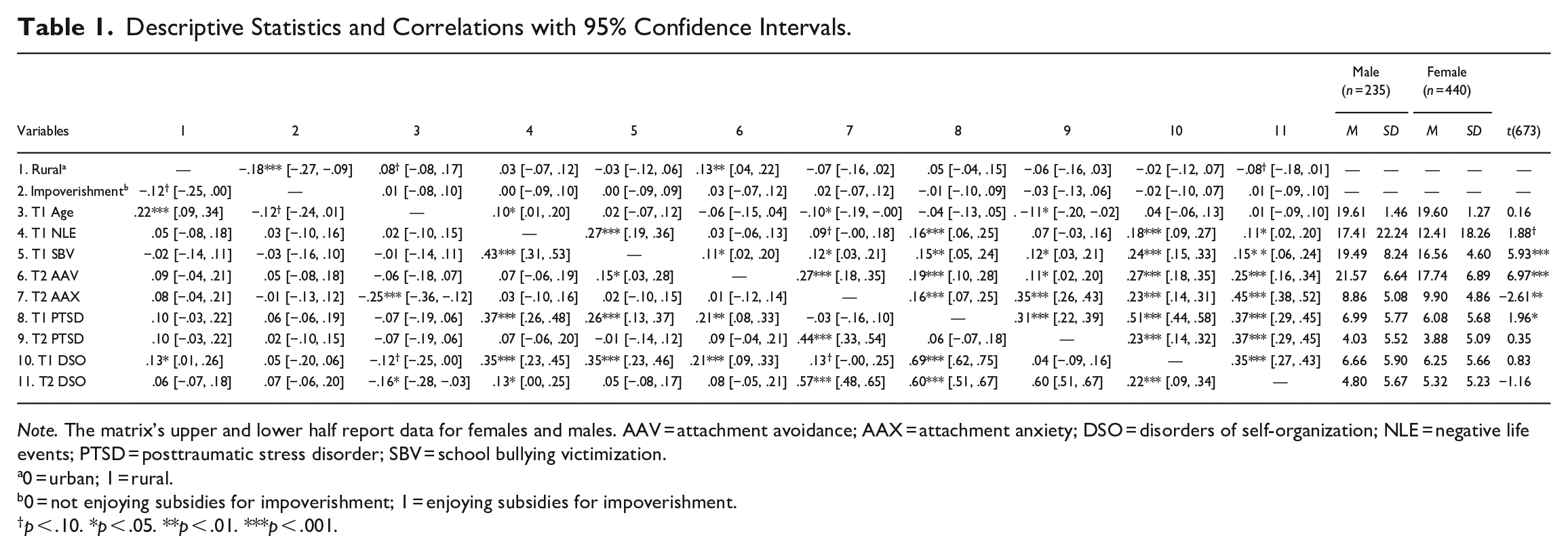
Note. The matrix’s upper and lower half report data for females and males. AAV = attachment avoidance; AAX = attachment anxiety; DSO = disorders of self-organization; NLE = negative life events; PTSD = posttraumatic stress disorder; SBV = school bullying victimization.
0 = urban; 1 = rural.
0 = not enjoying subsidies for impoverishment; 1 = enjoying subsidies for impoverishment.
p < .10. *p < .05. **p < .01. ***p < .001.
SEM Analysis
Multigroup analysis indicated significant differences in model pathways across sexes (see Table 2). We respectively tested the mediating effect of attachment on the relationship between school bullying and CPTSD symptoms for males and females (see Figure 1). For females, the path analysis estimated that school bullying victimization experience was positively related to attachment avoidance (β = .15, p = .005), which in turn was positively related to DSO (β = .09, p = .038) symptoms. In addition, school bullying experience is positively related to attachment anxiety (β = .16, p = .003), which in turn was positively related to PTSD (β = .30, p < .001) and DSO (β = .38, p < .001) symptoms. For males, school bullying victimization experience was positively related to attachment avoidance (β = .16, p = .019), and attachment anxiety was positively related to PTSD (β = .45, p < .001) and DSO (β = .55, p < .001). For covariates among males, PTSD showed no significant autoregressive effect (β = .07, p = .244), while DSO showed significant autoregressive effect (β = .17, p = .001). Besides, age was negatively associated with attachment anxiety (β = −.28, p < .001), and household registration was positively associated with attachment anxiety (β = .15, p = .023). For covariates among females, both PTSD and DSO had significant autoregressive effects (β = .27, p < .001; β = .23, p < .001). Besides, age was negatively associated with attachment anxiety (β = −.10, p = .043), and household registration was positively associated with attachment avoidance (β = .14, p = .003).
Results of Multigroup Analyses.

Note. CFI = comparative fit index; M0 = unconstrained model; M1 = measurement weight invariant model; M2 = measurement weight invariant model; RMSEA = root mean square error of approximation; TLI = Tucker–Lewis index.
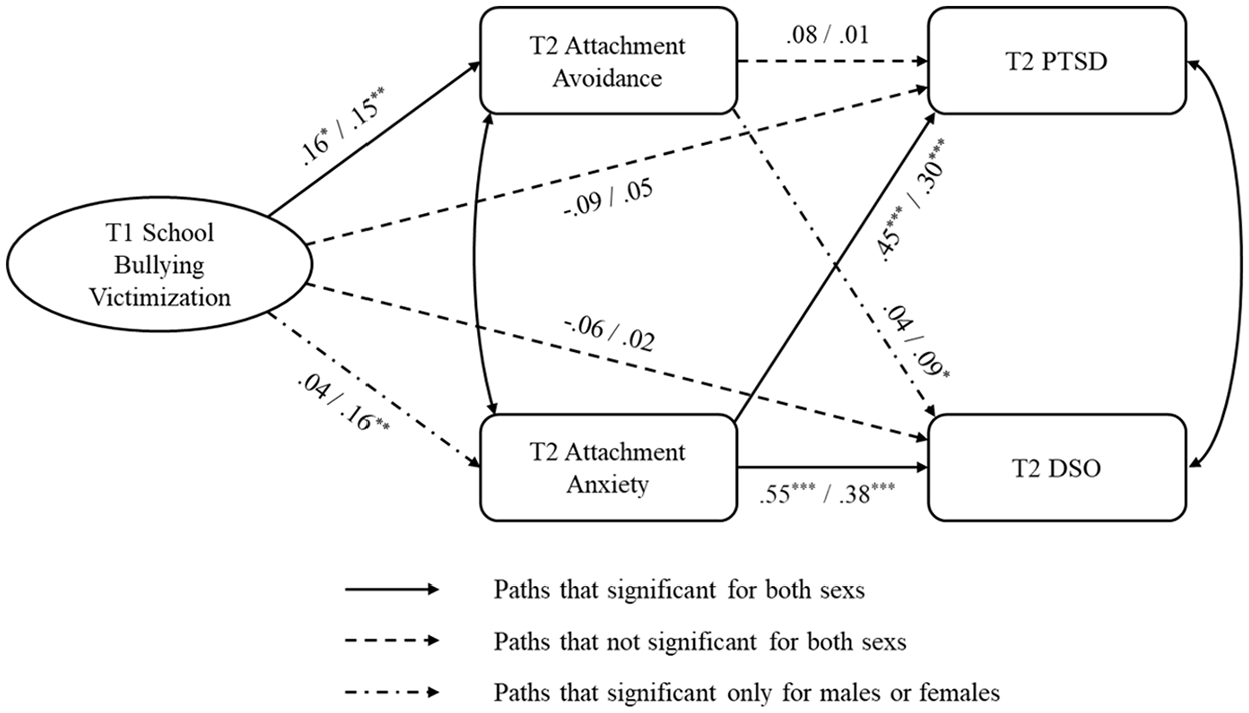
The structural equation models (SEM) examining the mediating model of attachment in the relationship between school bullying victimization experiences and complex posttraumatic stress disorder.
Table 3 shows the bootstrap examination. The results indicated that attachment avoidance significantly mediated the relationship between school bullying victimization and PTSD symptoms for males (β = .012, 95% CI = [0.000, 0.039]). For females, attachment anxiety significantly mediated the relationship between school bullying victimization and both PTSD symptoms (β = .048, 95% CI = [0.012, 0.092]) and DSO symptoms (β = .060, 95% CI = [0.014, 0.111]). Attachment avoidance significantly mediated the relationship between school bullying victimization and DSO symptoms (β = .013, 95% CI = [0.001, 0.040]).
Bias-Corrected Bootstrap Test of Mediating Effects.
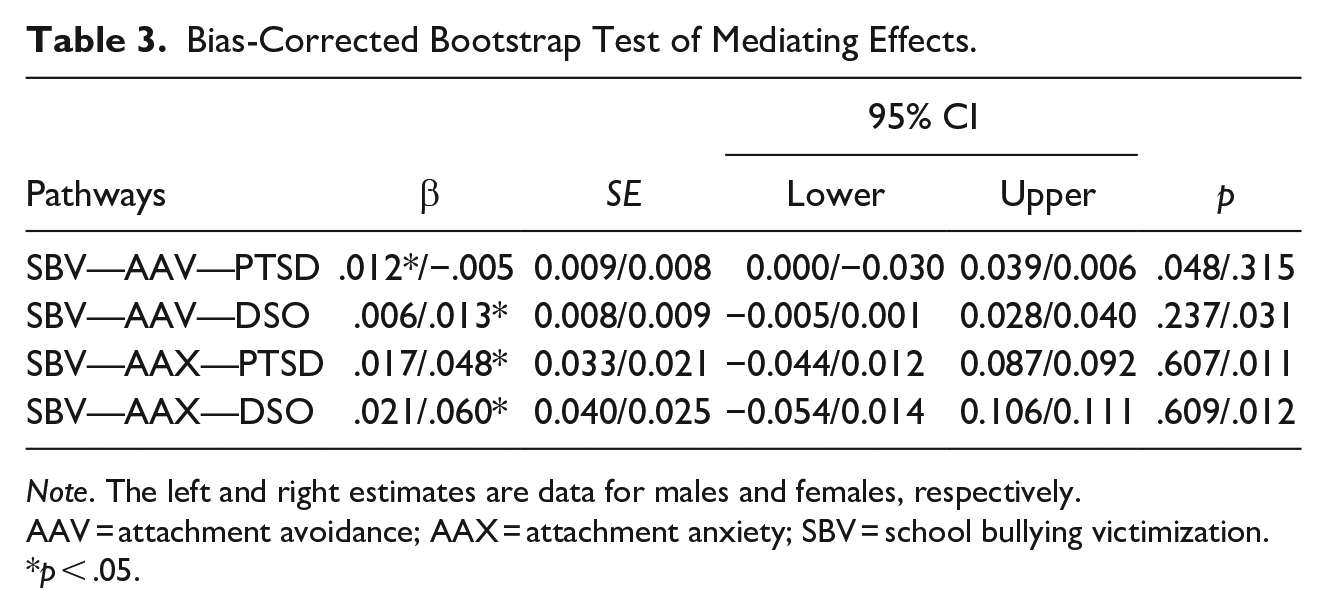
Note. The left and right estimates are data for males and females, respectively. AAV = attachment avoidance; AAX = attachment anxiety; SBV = school bullying victimization.
p < .05.
Discussion
The study examined the mediating roles of attachment anxiety and avoidance between school bullying victimization and CPTSD (PTSD and DSO) symptoms. The results revealed that, for females, school bullying victimization was positively associated with PTSD and DSO symptoms through attachment anxiety and with DSO symptoms through attachment avoidance. For males, the study found that school bullying victimization related to PTSD symptoms through attachment avoidance.
Firstly, T-test results showed that females had significantly higher levels of attachment anxiety and significantly lower levels of school bullying victimization and attachment avoidance, aligning with findings from prior studies (Chen & Santo, 2016; Menesini & Salmivalli, 2017; Weber et al., 2022). Moreover, there were no significant sex differences observed in CPTSD symptoms (i.e., PTSD symptoms and DSO symptoms), which is also consistent with previous studies (Karatzias et al., 2022; Wolf et al., 2015). However, taking sex differences into account, bullying victimization is generally related to CPTSD symptoms (i.e., PTSD symptoms and DSO symptoms), which was supported by previous studies (Hyland et al., 2021; Li et al., 2021). Our mediation analyses further revealed that these sex differences in the effects of school bullying victimization on CPTSD symptoms could be explained by the different roles of attachment between males and females.
To be specific, we found school bullying victimization is associated with PTSD symptoms through attachment avoidance in males but not in females, which may result from males’ greater inclination to use avoidance as an emotion regulation strategy. Individuals with attachment avoidance generally withdraw from emotional situations, deflect negative emotions, and exhibit less sensitivity to stress (Besser & Neria, 2010). Meanwhile, they tend to suppress their feelings to avoid more pain and stress (Marshall & Frazier, 2019; Mikulincer et al., 2015). In other words, attachment avoidance can be seen as an emotion regulation strategy. However, sex differences exist in the adoption of avoidant emotion regulation strategies. Compared to females, males tend to use more avoidant strategies, such as emotional suppression, distraction, and repression (Schick et al., 2020). In contrast, females often employ less avoidant strategies and more external or interpersonal emotion regulation strategies, such as crying and seeking social support (Tamres et al., 2002). T-tests in our study also indicated that females had a lower level of attachment avoidance. Thus, since avoidant strategies have been generally regarded as significant factors related to PTSD symptoms (Schick et al., 2020), the relatively less adoption of avoidant strategies may explain the insignificant prediction of attachment avoidance on PTSD symptoms among females. Besides, sex differences in specific PTSD symptoms may also account for the findings. Females with PTSD symptoms tend to exhibit more self-blame and negative alterations in cognition about themselves, others, and their worldview compared to males (Schick et al., 2020). However, individuals with high attachment avoidance tend to exhibit self-reliance, implying fewer self-oriented negative cognition (Ainsworth et al., 1978). In other words, females with high attachment avoidance may be less prone to cognitive vulnerability to female-specific PTSD symptoms. Therefore, attachment avoidance had a less relational effect on PTSD symptoms among females.
We also found that school bullying victimization could only relate to CPTSD symptoms through attachment anxiety in females, as it failed to relate to males’ attachment anxiety. Since interpersonal relationships and trauma can influence attachment patterns, individuals’ secure attachment might be compromised (Fraley, 2019). Those who experienced school bullying could experience loneliness, social withdrawal, and less confidence in social interactions (Gaffney et al., 2018; Juvonen & Graham, 2014). Social norms and gender conformity pressures often lead males to exhibit greater independence, competitiveness, and risk-taking behavior (Asher et al., 2017; Pauletti et al., 2016). This inclination may result in males being more self-reliant. They may also be less likely to express their negative emotions and traumatic experiences to others. As a result, school bullying victimization is less likely to evoke an association with attachment anxiety in males.
In addition, school bullying victimization relates to DSO symptoms through attachment avoidance in females but not males. The higher prevalence of avoidance in males may offer a potential explanation. Individuals with attachment avoidance have difficulties in interpersonal communication and emotion regulation (Mikulincer & Shaver, 2007; Velotti et al., 2015). However, sex differences exist in avoidant emotion regulation strategies. Due to societal gender norms, males are often expected to maintain an independent self-construal (Asher et al., 2017). Therefore, the negative impact of interpersonal problems caused by bullying victimization in males might be relatively small. Other research has shown that men expect limited emotional expression in socializing, so they try to avoid emotionally charged situations that might trigger emotional expression (Schick et al., 2020). These socially avoidant behaviors may lead males to suppress and regulate their emotions. Meanwhile, males are less likely to report their emotional experiences and emotion-related symptoms, which means the consequences of self-reporting might not entirely reflect an individual’s emotional experiences, especially negative emotions (Street & Dardis, 2018). Thus, males with attachment avoidance may not be aware of their emotional problems or that their social functioning is impaired. Attachment avoidance does not relate to DSO symptoms in males. For females, relationship bullying victimization is generally more prevalent (Monks et al., 2009). Specifically, relationship bullying victimization may manifest as criticism and ridicule, resulting in feeling shame and lacking confidence among females. Compared with males, females are more interdependent and value interpersonal relationships (Asher et al., 2017). Difficulty in managing interpersonal relationships and gaining acceptance can result in relationship breakdowns and increased distress for females. Therefore, females with attachment avoidance are more prone to experiencing significant difficulties in their relationships. DSO-related symptoms encompass mood disturbances, relationship issues, and more in various contexts (WHO, 2018). Thus, difficulties in interpersonal relationships have a more significant negative impact on females, leading to DSO.
Some limitations in this study need to be acknowledged. First, the self-report inventory used in the study may have led to some level of subjectivity. Future studies can incorporate other data collection methods like laboratory experiments and multi-subject reports to increase accuracy and reduce subjectivity. Second, only two waves of surveys were conducted in the study, which may limit the casual interference of the relationship between variables. As per the fundamental criterion for causation, the cause must precede the effect (Jose, 2016). Therefore, conducting assessments of all variables at distinct time points would significantly enhance our capacity to gain a deeper understanding of causality. Third, investigations in other sample groups and even clinical samples are necessary to enhance the generalizability of the findings. Fourth, we did not include bullying experiences at T2, which might have provided a more comprehensive understanding of the impact of bullying on mental and emotional health. Our primary focus was on assessing the influence of chronic bullying experiences from childhood to university years on CPTSD symptoms, as CPTSD symptoms are primarily caused by the long-term effects of sustained traumatic events (WHO, 2018). Future research could consider incorporating short-term bullying experiences to further explore their effects on mental and emotional health, providing a more comprehensive picture of the relationship between bullying and CPTSD symptoms. Finally, the retrospective investigation of past bullying experiences in this study may have resulted in memory bias. Subsequent studies can focus on the effects of recent bullying victimization.
Despite these limitations, the study is expected to contribute to the understanding of the formation mechanism and clinical intervention of CPTSD. First, this study examined the mechanism between previous school bullying victimization and the present CPTSD symptoms. Second, the study revealed significant sex differences in the CPTSD formation process, which complemented previous studies and provided more insight into the sex-specific effects of trauma. Third, the study proved the influence of insecure attachment on the formation of CPTSD and highlighted the importance of addressing attachment issues in clinical interventions.
Notably, the results of this study also have some implications for clinical intervention. For individuals who have experienced school bullying victimization, we can reduce the distress and allow them to re-establish secure and stable relationships through psychotherapy to help them establish secure attachments. Meanwhile, interventions should be tailored to the characteristics of different sexes—targeted interventions for sex-specific types of bullying, insecure attachment, and symptoms of CPTSD. Compared with the treatment of PTSD, the intervention of CPTSD requires more emphasis on allowing individuals to learn emotional regulation and establish healthy interpersonal relationships. Males are more likely to develop attachment avoidance and avoid psychotherapy (Weber et al., 2022), making it essential to help them overcome their reluctance to seek help and develop trust in others to build positive relationships. For females with high attachment anxiety levels, mindfulness or meditation can help relieve anxiety and the mental friction caused by anxiety.
Finally, the study’s findings highlight the long-lasting impact of school bullying on its victims, emphasizing the need for schools and society to prevent and prohibit the occurrence of school bullying in a timely manner. For individuals who have been bullied, families and schools need to provide them with more protection and care to minimize the negative impact.
Footnotes
Acknowledgements
We appreciate the participants and research assistants involved in the present research. We are also grateful to the tutor for his guidance and suggestions.
Author Contributions
Yuchen Li: conceptualization, data analyses, writing—original draft preparation and editing. Luming Liu: methodology, data analyses, writing—reviewing and editing. Wenchao Wang: data collection, writing—reviewing and editing.
Data availability
The data supporting this study’s findings are available from the corresponding author upon reasonable request.
Declaration of Conflicting Interests
The author(s) declared no potential conflicts of interest with respect to the authorship and/or publication of this article.
Funding
The author(s) disclosed receipt of the following financial support for the research and/or authorship of this article: The current study was supported by “The Humanities and Social Sciences Youth Foundation of Ministry of Education of China (Project No. 22YJC190023)”.
