




Abstract
Cyber dating abuse (CDA) concerns the use of digital technology to control, monitor, and hurt one’s intimate partner. CDA can have profound detrimental outcomes, such as mental health problems. As such, it is important to identify intrapersonal factors that may explain these behaviors. Previous research suggests that one such factor is the personality cluster of Dark Triad traits (DTT), comprising Machiavellianism, narcissism, and psychopathy. Additionally, DTT and CDA perpetration have both been linked to poor self-control ability, but these relationships have not yet been tested together in one model. As such, the present study examines if individuals’ poor self-control ability mediates the relationship between the DTT and CDA perpetration. To test these associations, we conducted a survey study among a representative sample of Belgian adults (n = 1,144; Mage = 47.66 years; 51.3% female). Findings from correlation analyses revealed that all three DTT were individually associated with CDA perpetration, such that higher scores on these traits corresponded with more CDA perpetration. Additionally, pathway analyses from structural equation modeling revealed that individuals’ poor self-control ability fully explained the relationship between Machiavellianism and narcissism and CDA perpetration, and partially explained the relationship between psychopathy and CDA perpetration. As our findings suggest that self-control plays an instrumental role in explaining why individuals control and monitor their partner via digital technology, prevention and intervention efforts should seek ways to improve individuals’ self-control ability in situations that may trigger such harmful interpersonal behaviors, particularly among individuals who exhibit Dark Triad personality traits.
Keywords
Interpersonal processes within people’s (romantic) relationships are increasingly or even primarily taking place online. One such process is cyber dating abuse (CDA), which concerns the use of online means to control, monitor, and (publicly) harass one’s partner (Zweig et al., 2014). CDA is considered a (highly) prevalent phenomenon, with prevalence rates reported up to 73% (for a systematic review, see Caridade et al., 2019). Recently, scholars have paid considerable attention to CDA, and several studies have shown that CDA experiences may have profound detrimental (mental health) outcomes, such as depression (Zweig et al., 2014) and anxiety (Wright, 2016). Furthermore, previous research has found that CDA experiences are linked to offline experiences of intimate partner violence (e.g., Borrajo, Gámez-Guadix, Calvete et al., 2015; Schokkenbroek, Van Ouytsel et al., 2022). To further understand the etiology of this phenomenon, substantial effort has been made to identify social (e.g., peer norms), environmental (e.g., exposure to family violence), and intrapersonal (e.g., low self-esteem) predictors of CDA perpetration (e.g., Cava et al., 2020; March et al., 2021). In this study, we examine intrapersonal predictors of CDA perpetration.
Dark Triad traits (DTT) and CDA
One intrapersonal factor that has been linked to both offline and online harmful interpersonal behaviors is the Dark Triad of personality (e.g., Carton & Egan, 2017; Goodboy & Martin, 2015; Pabian et al., 2015). The Dark Triad traits (DTT) were first introduced by Paulhus and Williams (2002) and concern three personality traits: Machiavellianism, narcissism, and psychopathy. All three personality traits share a common core of callousness, selfishness and manipulative tendencies (Jones & Figueredo, 2013). The first trait, Machiavellianism, is characterized by manipulative and deceptive tendencies (e.g., Bereczkei, 2018; Christie & Geis, 1970). The second trait, narcissism, concerns a multidimensional trait that is reflected by a sense of superiority, grandiosity, and entitlement (e.g., Van Geel et al., 2017). Psychopathy, the last dimension of the DTT, is generally associated with a tendency for thrill-seeking as well as a lack of empathy and fear (e.g., Paulhus & Williams, 2002).
Previous partner violence research has found associations between all three DTT and partner violence perpetration. For example, in a small convenience sample of adults, Carton and Egan (2017) found that high psychopathy tendencies were associated with psychological partner abuse. More recently, Plouffe et al. (2020) found that narcissism was related to psychological abuse perpetration, and that psychopathy was related to severe physical partner aggression. Additionally, previous research has identified several links between DTT and harmful interpersonal behaviors within the online context. For example, research has shown that all three DTT are related to cyberstalking behaviors (Kircaburun et al., 2018; Smoker & March, 2017). Furthermore, Stiff (2019) examined the association between DTT and Facebook surveillance and found that psychopathy and Machiavellianism significantly predict the tendency to spy on others on social media. In line with this, Branson and March (2021) examined the relationship between narcissism and psychopathy (but not Machiavellianism) and CDA perpetration, and found that both narcissism and psychopathy predict these online partner controlling behaviors. To the best of our knowledge, however, only two studies today have linked all three DTT to online monitoring and control within people’s romantic relationships. In their study among a convenience sample of adults, Pineda et al. (2021) found that all three DTT significantly predicted CDA perpetration. Contrarily, a recent study by Bhogal and Wallace (2022) found no significant association between CDA perpetration and any of the DTT. As the amount of research on the relationship between DTT and CDA perpetration is severely limited, and as findings from existing studies are inconclusive and based on convenience samples, more research on the relationship between DTT and CDA perpetration is warranted. Thus, in the present study, we examine this relationship, and we will do so among a representative sample of Belgian adults.
The Role of Self-Control
Although scholars have identified a clear link between DTT and harmful online interpersonal behaviors, attempts to understand the mechanisms underlying this link are scarce. Arguably, the association between the DTT and harmful interpersonal behaviors such as CDA is not only direct, but presumably will be mediated by other intra- and interpersonal factors. One factor that has been linked to various personality traits as well as to different types of harmful interpersonal behaviors is self-control. Self-control is a key factor in self-regulation and refers to a person’s ability to guide their thoughts, emotions, behaviors, and impulses (Baumeister, 2002). When an individual is less able to exercise self-control, this prevents them to carefully think through a situation and consider the potential consequences of their actions before acting (Gottfredson & Hirschi, 1990). This increases the likelihood that individuals with poor self-control would engage in harmful behaviors, also in the online context (e.g., Vazsonyi et al., 2017). In fact, in their general theory of crime, Gottfredson and Hirschi (1990) argue that self-control is the “main inhibiting factor that keeps people on the right path” (De Buck et al., 2018, p. 471). As such, we propose that individuals’ (in)ability to exercise self-control may explain the proposed relationship between the Dark Triad personality traits and CDA.
Several previous studies have identified a link between self-control ability and the DTT. Findings from previous studies on the relation with Machiavellianism have reported mixed findings, but some studies have shown that Machiavellianism is positively associated with poor self-control (Jonason & Tost, 2010). For psychopathy, several studies have found a positive association exists between psychopathy and poor self-control (DeLisi et al., 2018; Jonason & Tost, 2010; Jones & Paulhus, 2011). Similar to Machiavellianism, previous research on the relation between narcissism and self-control presents mixed results. A majority of research identified a link between narcissism and a lack of self-control (Jones & Paulhus, 2011; Muris et al., 2017; Vazire & Funder, 2006). However, Jonason and Tost (2010) found that Machiavellianism and psychopathy, but not narcissism, were related to self-control. Overall, all three DTT were found to be related to poor self-control ability. A possible explanation for why the DTT are associated with one’s self-control ability is provided by Jonason and Tost (2010). They argue that within the evolutionary framework of Life History Theory (Wilson, 1975), personality traits and individual differences are explained by differences in which of the two life history strategies 1 is employed by an individual. Jonason and Tost (2010) describe these two life history strategies as (a) fast life history strategy, reflected by individuals who seek short-term gains at the expense of long-term costs and (b) slow life history strategy, reflected by individuals who make long-term considerations. In previous research, personality characteristics related to the DTT, such as antisocial (e.g., Ellis, 1988) and opportunistic personality traits (e.g., Figueredo et al., 2007), have been associated with the fast life history strategy. Jonason and Tost (2010) argue that poor self-control ability is likely characteristic to those with a fast life strategy as poor self-control “will not interfere and may actually facilitate a shorter-term and opportunistic perspective” (p. 611).
In relation to CDA perpetration, few studies have empirically tested if CDA perpetration may be explained by one’s self-control ability. In their recent study, Linares et al. (2021) found that individuals with a greater tendency to lose control under positive and negative emotional states were more likely to engage in CDA perpetration. Additionally, Marcum et al. (2014) found that people with poor self-control ability were more likely to engage in cyberstalking. Lastly, Curry and Zavala (2020) also found that people with poor self-control engaged in more CDA perpetration, although this effect was rather small.
Despite previous findings on the association between the DTT and poor self-control and between poor self-control and CDA perpetration, no study today has accounted for individuals’ self-control when examining the relation between DTT and CDA perpetration. This is particularly surprising considering the ample amount of research that supports the notion that the inherent accessibility, velocity, and—to a certain extent—anonymity of online interactions presents particular challenges for individuals’ emotion regulation and self-control (e.g., Suler, 2004). Indeed, a recent study on online trolling behaviors (i.e., online communication intended to be offensive; Buckels et al., 2014) on dating sites found that impulsivity, which is a dimension of self-control (Gottfredson & Hirschi, 1990), played a role in the relationship between DTT and expressing online trolling behaviors (March et al., 2017). Based on these findings, it may be expected that self-control also plays a role in the relationship between DTT and CDA perpetration.
Present Study
The present study will address the identified knowledge gaps by examining the (indirect) relation between the DTT (i.e., Machiavellianism, narcissism, and psychopathy) and CDA perpetration through poor self-control ability among a representative sample of Belgian adults. Specifically, we propose that a positive relationship exists between DTT and CDA perpetration, and that this relationship can be explained through individuals’ poor ability to exert self-control. Additionally, as previous research has shown that sex and age differences may exist in CDA perpetration (e.g., Rubio-Garay et al., 2017; Toplu-Demirtaş et al., 2022), we will control for the role of individuals’ age and sex in these proposed pathways. Notably, while previous research has extensively shown that CDA is particularly common among younger age groups (Taylor & Xia, 2018), we decided to extend the age range to include adults of all ages. One reason for this is that the general assumption that CDA is most common among younger people is strongly driven by the fact that research on CDA among older adults is severely lacking (see Caridade et al. (2019); Taylor & Xia (2018) for an overview of age ranges in previous CDA research). In fact, very few studies have included adults over the age of 30 in their examinations of CDA experiences (e.g., Fox et al., 2014; Schokkenbroek, Van Ouytsel et al., 2022), and more research is needed to paint a more inclusive picture of CDA experiences (and its driving factors) among adults (Taylor & Xia, 2018). Thus, the present study addresses CDA experiences among a more inclusive and diverse sample in terms of age. A schematic overview of our hypothesized model can be found in Figure 1.
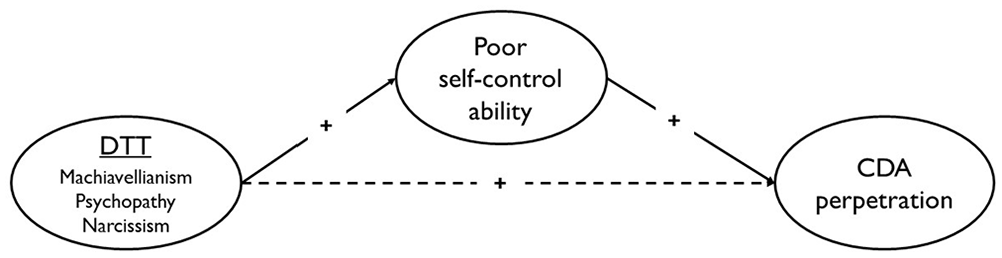
Schematic overview of hypothesized model.
Methods
Procedure and Sample
The study data were collected through a cross-sectional survey conducted in the fall of 2019 among an adult sample of people living in the city of Ghent in Flanders, the Dutch-speaking part of Belgium. 2 Citizens were selected randomly in a representative sampling technique, which was realized in cooperation with the municipality. 3 Prospective respondents were informed via a letter that they were selected for participation, and were visited at their home by trained interviewers a couple of days later. Respondents could fill out the online survey, which was programmed in Qualtrics, on a laptop or tablet brought by the interviewer. Whereas part of the survey was filled out through face-to-face interviewing, sensitive questions (e.g., about CDA perpetration) were filled out by the respondents individually in a discrete part of the survey, shielded from the interviewers. Ethical approval for the study was obtained from the institutional review board of Ghent University. For more detailed information on the study protocol, see Hardyns et al. (2019).
The study sample was representative with regard to age (18–65+ years), sex (male versus female), and nationality (Belgian versus non-Belgian). Age of majority (18+ years) and sufficient knowledge of the Dutch language were considered as inclusion criteria. People who resided in an institutional setting (e.g., residential care center) were not eligible for participation. In this study, the prospective sample initially consisted of 1,880 respondents who were invited to participate in the survey. Upon completion of the data collection phase, a total of 1,587 respondents (Mage = 48.06 years; 51.4% female) fully completed the survey. This resulted in a dropout rate of 15.6%, reflecting the percentage of respondents who did not complete the survey as originally anticipated. 4 Of these 1,587 respondents, 1,144 were in a romantic relationship. As such, the final sample for the present study comprised of 1,144 respondents (Mage = 47.66 years; 51.3% female).
Materials
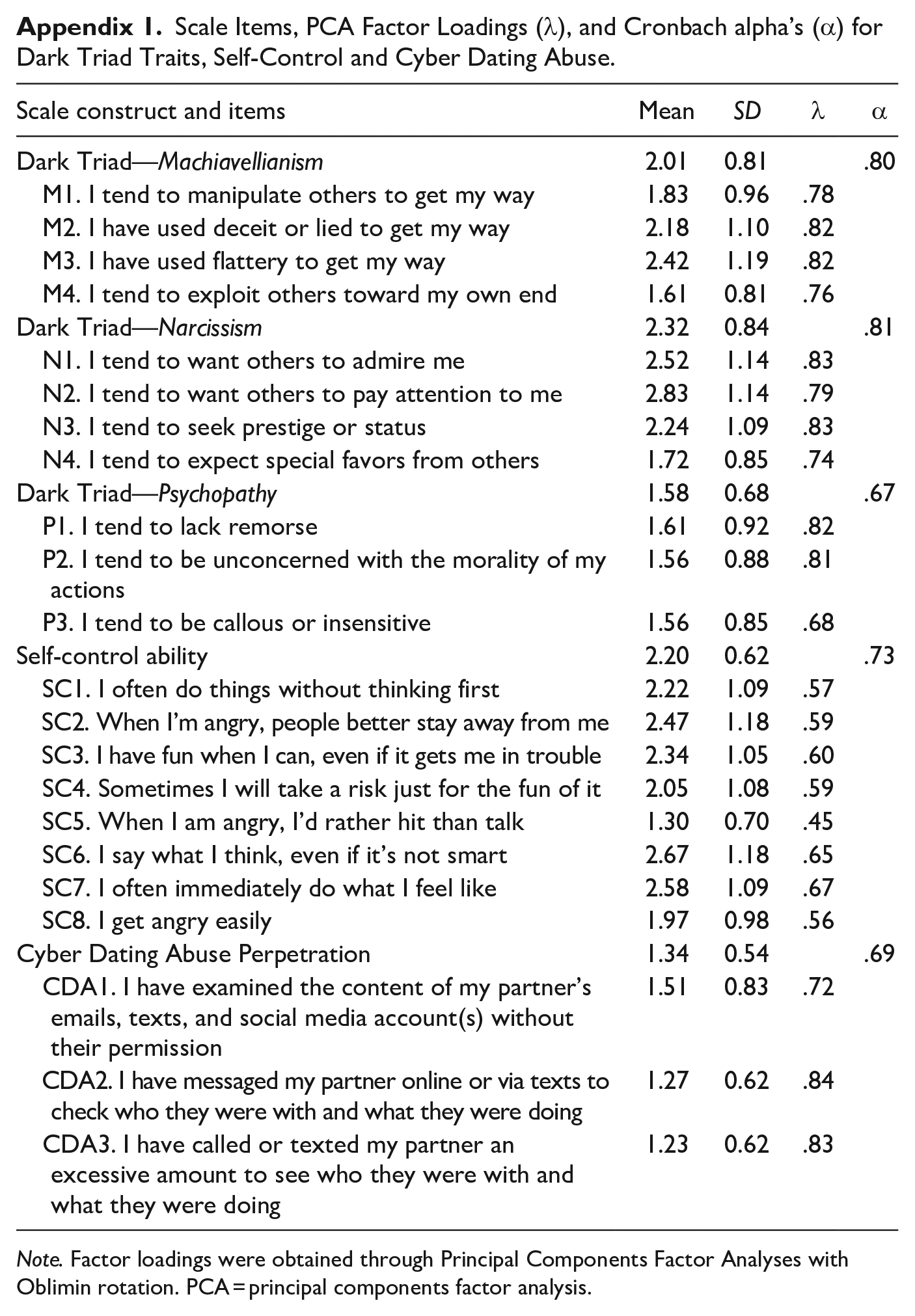
For all scale items, the exact phrasings, mean scores (and standard deviations), factor loadings, and reliability statistics can be found in Appendix I.
Dark Triad Traits
The DTT were measured with the Dark Triad Dirty Dozen scale (Jonason & Webster, 2010; Dutch version by Lambrechts et al., 2019). The Dirty Dozen scale consists of 12 items; each DTT is measured with four items. Preliminary principal component factor analysis (PCA) with oblimin rotation confirmed a three-factor solution for the present sample. Additionally, PCA for each subscale revealed that the factor loading for one item of the psychopathy subscale was considerably lower (λ = .538) than those of the other items in the psychopathy subscale (with factor loadings ranging from 0.73 to 0.76). Additionally, reliability analyses revealed that Cronbach’s alpha for the psychopathy subscale would improve from .629 to .667 if item 4 was omitted. As such, we decided to omit item 4 from the psychopathy subscale, that is, “I tend to be cynical,” from further analyses.
Responses on the Dirty Dozen scale were given on a five-point Likert scale ranging from 1 = “strongly disagree” to 5 = “strongly agree.” An example of an item for Machiavellianism is “I tend to manipulate others to get my way,” for narcissism an example item is “I tend to want others to admire me,” and an example item for psychopathy is “I tend to lack remorse.” For the present study, all three subscales demonstrated acceptable to good reliability, with Cronbach’s alpha values of .80 (Machiavellianism), .81 (narcissism), and .67 (psychopathy), respectively. For all three DTT, the continuous variables were composed by calculating the average score of the three (psychopathy) or four (Machiavellianism and narcissism) items corresponding to the particular trait.
Self-Control Ability
Self-control was measured with eight items inspired by the self-control scale from Grasmick et al. (1993). Responses were given on a five-point Likert scale ranging from 1 = “strongly disagree” to 5 = “strongly agree.” An example of an item is “I say what I think, even if it’s not smart.” Responses were coded such that high scores corresponded with poor self-control ability. In the present study, the self-control scale reported a Cronbach’s alpha of .73. The self-control ability variable was composed by calculating the average score on the eight self-control ability items.
Cyber Dating Abuse Perpetration
CDA perpetration was measured with an abbreviated scale adapted from the Cyber Dating Abuse Questionnaire (Borrajo, Gámez-Guadix, Pereda et al., 2015). The scale is comprised of three items assessing the perpetration of three online controlling behaviors, namely (a) excessive texting to check who their partner was with and what they were doing, (b) excessive calling to check who their partner was with and what they were doing, and (c) examining the content of their partner’s emails, texts, and social media account(s) without permission. Perpetration of these behaviors was assessed using a five-point frequency scale ranging from 1 = “never” to 5 = “very often.” For the present sample, the abbreviated CDA perpetration scale demonstrated acceptable reliability (Cronbach’s α = .69). For the study analyses, a CDA perpetration variable was composed by calculating the average score on the three CDA perpetration items.
Control Variables
We included respondents’ age and sex as control variables. Age was measured as a continuous variable with a range from 18 to 91 years. Sex was measured as a binary variable and was coded zero for men and one for women.
Analytical Plan
Statistical significance was determined at p ≤ .05. Recently, however, the use of the p-value to signal statistical significance is heavily debated. The problem with (only) using p-values is that it concerns a single value that often varies considerably between study samples, and additional information on this variability and the (un)certainty it represents is thus warranted (Halsey, 2019). As such, we additionally examined confidence intervals (CIs) as indicators of the accuracy of the estimated effect sizes (Cumming & Calin-Jageman, 2016).
First, prevalence rates of CDA perpetration were examined. For this purpose only, the CDA average scores were recoded into a binary variable distinguishing between people who never (= 0) perpetrated any of the three measured CDA behaviors versus people who perpetrated any of the measured CDA behaviors at least once (= 1). For subsequent analyses, however, CDA perpetration was examined as a continuous variable.
Second, bivariate correlation analyses were performed to assess the direct relations between the study variables. The analyses were conducted in IBM SPSS Statistics (Version 28; IBM Corp, Armonk, NY, USA). Preliminary examinations of the variable distributions revealed that the variables CDA perpetration, Machiavellianism, narcissism, psychopathy, and self-control ability were not normally distributed such that all variables were negatively skewed. Data transformations did not correct the skewness and kurtosis in the data. As such, bivariate associations for all study variables were assessed using nonparametric Spearman rank correlations. 95% CIs were estimated through bootstrapping with 5,000 bootstrap samples.
Third, the proposed model was tested using structural equation modeling (SEM). Mplus (version 7.11; Muthén & Muthén, 2012) was used to (a) conduct a confirmatory factor analysis to evaluate how well the observed variables in our measurement model reflected the latent variables (i.e., Machiavellianism, narcissism, psychopathy, self-control ability, and CDA perpetration) and (b) to construct a structural model with CDA perpetration as the outcome variable and age and sex as covariates. Using the INDIRECT command in Mplus, we also tested the significance of the product of the indirect pathways between the three DTT and CDA perpetration. As all study variables were skewed, these analyses were based on maximum likelihood estimation, with bias-corrected bootstrap CIs based on 10,000 bootstrap draws. The use of asymmetric CIs based on bootstrap methods is also recommended for significance testing of indirect effects (MacKinnon, 2008; MacKinnon et al., 2004). Several fit indices were applied to assess the adequacy of both the measurement model and the structural model, namely Maximum Likelihood Robust (MLR) Chi-square test of model fit, comparative fit index (CFI), Tucker–Lewis index (TLI), root-mean-square error of approximation (RMSEA), and standardized root-mean-square residual (SRMR). A nonsignificant Chi-square test also indicates a good model fit, but due to its sensitivity to large sample sizes (Kline, 2016), the Chi-square test is almost always significant and therefore not a great indicator of model fit in the present sample. Both CFI and TLI indicate adequate model fit when they are above 0.90, and good model fit when their values are higher than 0.95 (Hu & Bentler, 1999). RMSEA demonstrates an adequate model fit when the value is below 0.08, and a good model fit when the value is below 0.05. Lastly, SRMR should be smaller than 0.08 to indicate good fit (Hu & Bentler, 1999; MacCallum et al., 1996).
Results
Prevalence of CDA Perpetration
First, we assessed how many respondents had perpetrated CDA toward their partner in the past 12 months. We found that 41.7% of respondents had perpetrated CDA at least once in the past year.
Bivariate Associations
The results of the Spearman rank correlation analyses can be found in Table 1. We found that all three DTT were significantly and positively associated with each other, with moderate effect sizes. For poor self-control ability, we found small to moderate significant positive associations with all three DTT. This means that people who scored higher on Machiavellianism, narcissism, and psychopathy were less able to exert self-control. With regard to CDA perpetration, we found small significant positive associations with Machiavellianism, narcissism, psychopathy, and poor self-control. Thus, people who score higher on Machiavellianism, narcissism, and/or psychopathy traits and people with poor self-control ability were more likely to perpetrate CDA. Lastly, we found that age was significantly negatively associated with CDA, Machiavellianism, narcissism, and self-control ability, such that younger people reported more CDA experiences, higher scores on all three DTT, and less ability to exert self-control. Also, sex was positively associated with CDA and negatively associated with all three DTT, meaning that women were more likely to perpetrate CDA and that men scored higher on Machiavellianism, narcissism, and psychopathy personality traits.
Spearman Rank Correlation Coefficients Between Study Variables.
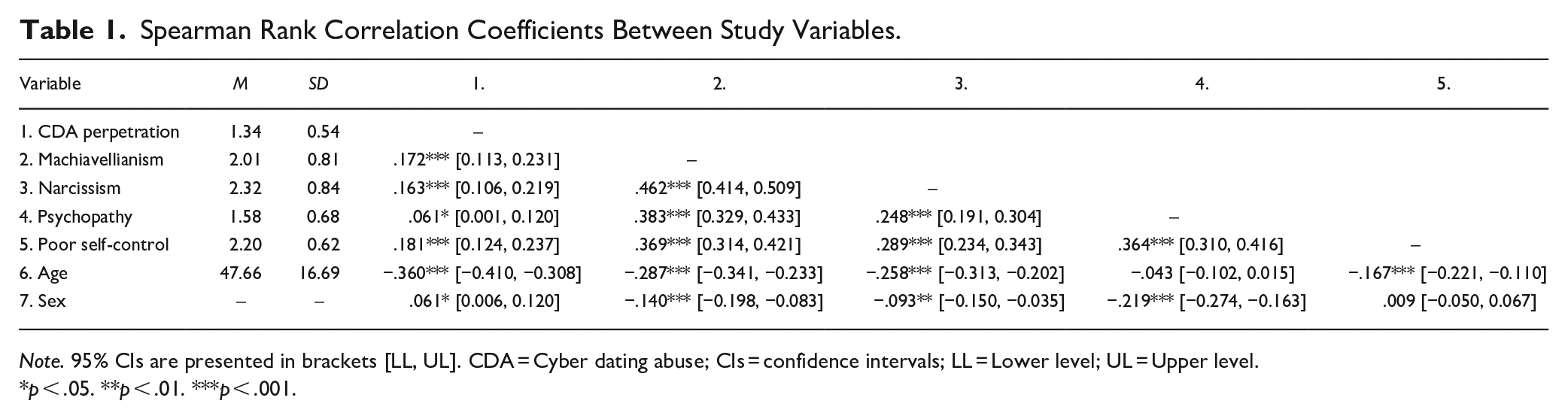
Note. 95% CIs are presented in brackets [LL, UL]. CDA = Cyber dating abuse; CIs = confidence intervals; LL = Lower level; UL = Upper level.
p < .05. **p < .01. ***p < .001.
Measurement and Structural Model
The measurement model provided an adequate model fit: MLRχ²(199) = 801.24, p < .001; RMSEA = .05 (90% CI [0.048, 0.055]); CFI = 0.88; TLI = 0.86; SRMR = 0.05. The hypothesized model was tested using SEM. The structural model provided an adequate fit: MLRχ²(239) = 1450,27, p < .001; RMSEA = 0.07 (90% CI [0.062, 0.069]); CFI = 0.83; TLI = 0.81; SRMR = 0.07. Figure 2 presents the full structural model, which explained 26.4% of the variance in CDA perpetration (R2 = .264, p < .001). The standardized path coefficients that were significant at p ≤ .05 are indicated in the figure.

Structural equation model with factor loadings and R-squared values.
Direct path analyses revealed that Machiavellianism (β = .40, p = .000, 95% CI [0.285, 0.515]), narcissism (β = .23, p = .000, 95% CI [0.110, 0.360]), and psychopathy (β = .16, p = .004, 95% CI [0.053, 0.270]) were all related to poor self-control ability. Poor self-control ability, in turn, was positively associated with CDA perpetration (β = .13, p = .040, 95% CI [0.005, 0.245]). Furthermore, psychopathy was positively associated with CDA perpetration (β = .41, p = .000, 95% CI [0.305, 0.505]). Conversely, Machiavellianism (β = −.04, p = .470, 95% CI [−0.161, 0.077]) and narcissism (β = .05, p = .481, 95% CI [−0.086, 0.198]) were not significantly associated with CDA perpetration. Furthermore, we found that the control variable age (β = −.16, p = .000, 95% CI [−0.226, −0.095]) was negatively related to CDA perpetration, indicating that CDA was reported more by younger people. Lastly, contrary to the correlation analyses, we found no significant relation between CDA perpetration and respondents’ sex (β = −.04, p = .215, 95% CI [−0.108, 0.021]) in our SEM analysis.
To assess whether the relationship between DTT and CDA perpetration can be explained through individuals’ poor self-control ability, the indirect pathways were also tested for significance. The direct, indirect and total effects of the DTT on CDA perpetration with bootstrapped CIs, are summarized in Table 2. Whereas the p-values for these three indirect effects are merely approaching significance, with values of .057 (Machiavellianism), .088 (narcissism), and .094 (psychopathy), respectively, the CIs indicate that all three of the DTT were indirectly related to CDA perpetration through poor self-control. This suggests that the relationship between Machiavellianism, narcissism, and psychopathy and CDA perpetration can be explained through poor self-control ability. For psychopathy, a significant direct effect remained in the model, indicating that the relationship with CDA perpetration was only partially mediated by poor self-control ability.
Summary of Standardized Direct, Indirect, and Total Effects on CDA Perpetration.
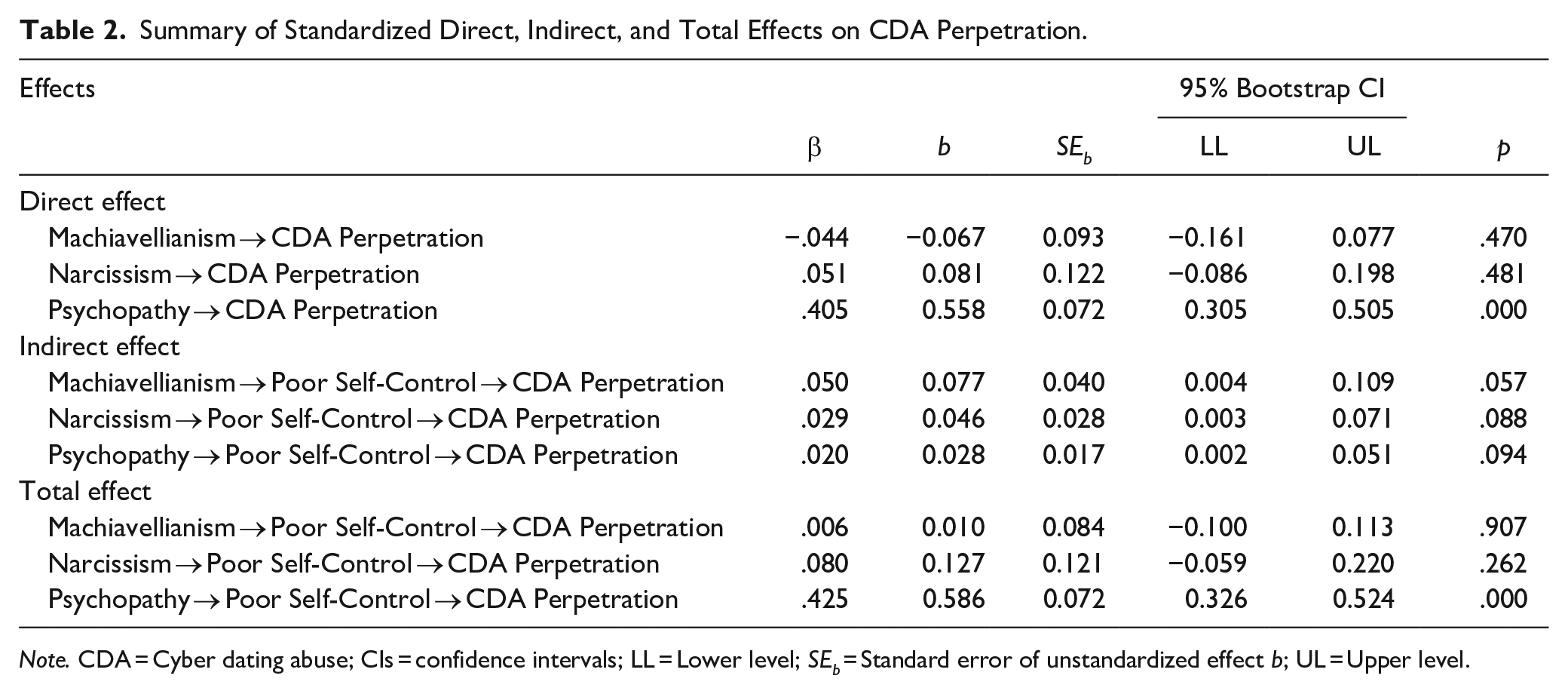
Note. CDA = Cyber dating abuse; CIs = confidence intervals; LL = Lower level; SEb = Standard error of unstandardized effect b; UL = Upper level.
Discussion
In this study, we set out to examine whether CDA perpetration could be predicted by the DTT Machiavellianism, narcissism, and psychopathy, and whether these effects could be explained through poor self-control ability. First, we found that CDA perpetration was rather common, with 41.7% of respondents reporting that they had engaged in any of the partner controlling and monitoring behaviors. In our study, we determined the prevalence rate by distinguishing between people who had never perpetrated CDA versus people who had at least once. As such, the high prevalence rate of CDA perpetration is likely the result of this broad classification, as is also evidenced by the rather low average scores on each of the CDA perpetration behaviors measured in our study (see Supplemental Appendix 1). Arguably, however, even if CDA is only enacted once, this may already have a harmful impact on the partner. As such, we advocate for the broader classification of perpetration as presented in our study to make sure all CDA experiences are included.
Second, findings from correlation analyses revealed that, similar to previous research, people who scored higher on DTT were more likely to perpetrate CDA (e.g., Pineda et al., 2021). Also, and in line with previous research (e.g., Jonason & Tost, 2010), we found that people who scored higher on Machiavellianism, narcissism, and psychopathy reported poorer self-control ability. Furthermore, we found that poor self-control ability was associated with CDA perpetration, meaning that people who were less able to exert self-control more often used digital technology to control and monitor their partner’s behaviors. As for the control variables in the present study, we found that people who were younger (compared to older people) and women (compared to men) were more likely to engage in CDA perpetration, although these sex differences were only revealed in our correlation analyses, not in SEM. These findings are in line with previous studies identifying high prevalence rates of CDA among young people (e.g., Caridade & Braga, 2020) and differences between men and women in CDA perpetration (e.g., Burke et al., 2011; Deans & Bogha, 2017). Future research focusing on sex and age differences in CDA perpetration and its link with the DTT and self-control should expand on the present study, for example by performing and comparing separate SEM models for different groups, or by accounting for (differences in) the digital skills and (the intensity and frequency of) technology use and social media activity of men and women and among different age groups.
Additionally, we hypothesized that the effect between the DTT and CDA perpetration can be explained through individuals’ poor self-control ability. For all three DTT, we found that the effect on CDA perpetration was indeed indirect, explained by an individual’s ability to exert self-control. Thus, the personality traits Machiavellianism, narcissism, and psychopathy affect self-control ability within an individual, which, in turn, predicts their engagement in online controlling and monitoring behaviors toward their partner. These findings are in line with those of previous research identifying a link between the DTT and self-control ability (e.g., Jonason & Tost, 2010; Jones & Paulhus, 2011). Notably, we found that the relationship between psychopathy and CDA perpetration can only partially be explained by individuals’ self-control ability, as a strong direct effect remains in the model. A possible explanation for this could be that, compared to Machiavellianism and narcissism, psychopathy in particular is characterized by a need for power and control (e.g., Hare, 2006). As such, people with psychopathic traits could generally be more inclined to check on their partner’s online activities, regardless of their ability to exercise self-control.
Study Limitations and Future Directions
There are several study limitations to consider when interpreting the presented findings. First, the cross-sectional nature of the study makes it impossible to conclude with certainty the process of causality within the proposed pathways predicting CDA perpetration. To test the assumption of the DTT and poor self-control as the causes of CDA perpetration, a longitudinal study should be implemented. A second limitation concerns the self-report nature of the measures. Self-report raises problems with memory recall, willingness to report about sensitive topics and social desirability and self-serving bias, especially considering the DTT are characterized by tendencies toward self-promotion (Paulhus & Williams, 2002). However, self-report measurements of the DTT were found to be quite accurate in previous research (Jonason & Webster, 2010), and a recent study by Kowalski et al. (2018) found that only narcissism is associated with social desirability. We also limited social desirability bias by including the questions relating to CDA behaviors and DTT in the part of the survey that was filled out by the respondent alone, shielded from the interviewer. In relation to self-serving bias, however, it is important to note that we asked respondents to report on the extent to which they engaged in excessive texting behaviors toward their partner, without providing a definition of what is understood as “excessive.” We did not give a definition because we were interested in measuring behaviors and experiences that respondents themselves would perceive as excessive. However, this raises the important limitation that perpetrators may have downplayed or underestimated their behaviors as a form of self-serving bias, which, as a consequence, may have distorted our data. Future research should account for this by using less ambiguous and subjective phrasing in their CDA perpetration measures. Third, we used relatively short measures in our study to minimize participant burden, particularly given the sensitive nature of some of the questions. These brief measures, however, do not allow for more fine-grained analyses of the constructs of interest. For example, CDA is generally considered a multidimensional construct, in which controlling and monitoring, the behaviors of interest in our study, only comprise one dimension (in addition to the dimensions: online expressions of verbal violence; sexual coercion; and isolation and manipulation; Rodríguez-deArriba et al., 2021). Additionally, in our measure of self-control, we did not distinguish between dimensions of self-control, namely thrill-seeking and impulsiveness (Schulz, 2016). Furthermore, both narcissism (vulnerable vs. grandiose narcissism (Hendin & Cheek, 1997) and psychopathy (primary vs. secondary psychopathy) are considered to be multidimensional traits. Several scholars have raised concerns about the use of the Dirty Dozen instrument to measure the DTT, as it would not sufficiently cover the constructs of interest (e.g., Miller et al., 2012). On the other hand, multiple studies have shown that the structure of the Dirty Dozen scale is stable across different cultural contexts and populations, and the scale appears to offer a reasonable trade-off between efficiency and accuracy (De Buck et al., 2021; Rogoza et al., 2021). To account for these limitations in our measures, future research should further disentangle the processes between self-control, DTT, and CDA perpetration by using more elaborate measurements and by accounting for the multidimensional nature of the study constructs. Additionally, in this study, we only focused on individuals’ CDA experiences as a perpetrator, and (prior) victimization experiences were not accounted for. As several studies have found that victimization and perpetration experiences of CDA are strongly linked (e.g., Curry & Zavala, 2020; Schokkenbroek, Ponnet et al., 2024; Temple et al., 2016), future work should expand our model by additionally accounting for individuals’ victimization experiences in explaining CDA perpetration. Lastly, it should be noted that the study sample was representative but only for an urban, Western-European context, specifically for the city of Ghent. While we tried to address the experiences of a more inclusive and diverse sample by extending the age range beyond the often studied group of young adults, we did not measure other characteristics relating to sample diversity, such as respondents’ gender identity and sexual orientation. As such, we cannot account for the experiences of underrepresented groups of people, such as individuals who identify as LGBTQIA+. This is an important shortcoming, as recent research suggests that LGBTQIA+ individuals are at greater risk to experience CDA compared to cisgender heterosexual individuals (Butler et al., 2023). Future research should replicate this study among a more diverse sample and across various geographical and cultural boundaries.
Despite these limitations, the findings from this study provide important insights for future research and practice. Our findings show that one’s ability to exert self-control should be considered in future examinations of DTT as predictors of harmful online interpersonal behaviors. Consequently, CDA prevention efforts could improve their efficacy by pre-emptively increasing self-control ability among people with personality traits associated with self-control, such as the DT. Similarly, CDA intervention efforts could improve their efficacy by including exercises aimed at enhancing self-control abilities particularly among perpetrators of partner violence. Previous research on practices aimed at improving self-control ability has yielded promising results (e.g., Smith et al., 2015; for a meta-analysis, see Friese et al., 2017), also in the context of violent behaviors (Zhou et al., 2018). In the study by Zhou et al. (2018), it was found that a violence prevention program successfully enhanced self-control ability by helping respondents identify situations that may trigger a certain inclination to react in a harmful or even violent way. Additionally, respondents received training in affect regulation and conflict resolution skills. The procedure and findings of this study may provide an insightful basis for prevention and intervention efforts in the context of CDA, in which (potential) perpetrators of CDA receive guidance in identifying and navigating through situations that may trigger an intention to act in a harmful way toward their partner using online means.
Footnotes
Appendix
Scale Items, PCA Factor Loadings (λ), and Cronbach alpha’s (α) for Dark Triad Traits, Self-Control and Cyber Dating Abuse.
| Scale construct and items | Mean | SD | λ | α |
|---|---|---|---|---|
| Dark Triad—Machiavellianism | 2.01 | 0.81 | .80 | |
| M1. I tend to manipulate others to get my way | 1.83 | 0.96 | .78 | |
| M2. I have used deceit or lied to get my way | 2.18 | 1.10 | .82 | |
| M3. I have used flattery to get my way | 2.42 | 1.19 | .82 | |
| M4. I tend to exploit others toward my own end | 1.61 | 0.81 | .76 | |
| Dark Triad—Narcissism | 2.32 | 0.84 | .81 | |
| N1. I tend to want others to admire me | 2.52 | 1.14 | .83 | |
| N2. I tend to want others to pay attention to me | 2.83 | 1.14 | .79 | |
| N3. I tend to seek prestige or status | 2.24 | 1.09 | .83 | |
| N4. I tend to expect special favors from others | 1.72 | 0.85 | .74 | |
| Dark Triad—Psychopathy | 1.58 | 0.68 | .67 | |
| P1. I tend to lack remorse | 1.61 | 0.92 | .82 | |
| P2. I tend to be unconcerned with the morality of my actions | 1.56 | 0.88 | .81 | |
| P3. I tend to be callous or insensitive | 1.56 | 0.85 | .68 | |
| Self-control ability | 2.20 | 0.62 | .73 | |
| SC1. I often do things without thinking first | 2.22 | 1.09 | .57 | |
| SC2. When I’m angry, people better stay away from me | 2.47 | 1.18 | .59 | |
| SC3. I have fun when I can, even if it gets me in trouble | 2.34 | 1.05 | .60 | |
| SC4. Sometimes I will take a risk just for the fun of it | 2.05 | 1.08 | .59 | |
| SC5. When I am angry, I’d rather hit than talk | 1.30 | 0.70 | .45 | |
| SC6. I say what I think, even if it’s not smart | 2.67 | 1.18 | .65 | |
| SC7. I often immediately do what I feel like | 2.58 | 1.09 | .67 | |
| SC8. I get angry easily | 1.97 | 0.98 | .56 | |
| Cyber Dating Abuse Perpetration | 1.34 | 0.54 | .69 | |
| CDA1. I have examined the content of my partner’s emails, texts, and social media account(s) without their permission | 1.51 | 0.83 | .72 | |
| CDA2. I have messaged my partner online or via texts to check who they were with and what they were doing | 1.27 | 0.62 | .84 | |
| CDA3. I have called or texted my partner an excessive amount to see who they were with and what they were doing | 1.23 | 0.62 | .83 |
Note. Factor loadings were obtained through Principal Components Factor Analyses with Oblimin rotation. PCA = principal components factor analysis.
Declaration of Conflicting Interests
The author(s) declared no potential conflicts of interests with respect to the authorship and/or publication of this article.
Funding
The author(s) disclosed receipt of the following financial support for the research and/or authorship of this article: The work of Janneke M. Schokkenbroek is supported by the Research Foundation—Flanders (FWO) (11K5421N). The work of Thijs Hauspie, Koen Ponnet, and Wim Hardyns is supported by the Research Foundation—Flanders (FWO) (G010519N).
