




Abstract
Firearms are the leading cause of pediatric deaths. Few studies have identified protective factors that reduce the risk of firearm violence. Interpersonal factors, including school connectedness and social support, protect against multiple health-affecting risk behaviors. Therefore, this study examines associations of school connectedness and social support with firearm and weapon violence involvement. Data were gathered through an anonymous survey conducted across 13 high schools within an urban school district in 2018 (n = 2,604) modeled on the Centers for Disease Control and Prevention Youth Risk Behavior Surveillance Survey. Separate hierarchical logistic regression models examined associations between school connectedness and social support, and the outcomes of firearm carrying and engaging in violence with a weapon on school property in the past 12 months. Models were adjusted for age, race, and covariates representing basic needs, education, and mental health. The mean age was 15.7 years, and 57.5% of youth were female. 5.8% of youth had carried firearms and 5.5% engaged in violence with a weapon on school property in the past 12 months. School connectedness was significantly inversely associated with engaging in violence with a weapon on school property (odds ratio [OR] 0.225, 95% confidence interval [CI] [0.080, 0.632] and high levels of social support were significantly inversely associated with firearm carrying (OR 0.522, 95% CI [0.313, 0.870]). School connectedness and social support may be important in protecting youth from firearm and weapon-related violence. Interventions that strengthen safe and supportive interpersonal relationships within school environments and broader support systems across contexts may help reduce firearm and weapon violence involvement.
Introduction
Firearms have consistently been a concern for adolescent health and are a leading mechanism of pediatric deaths nationwide. Surpassing motor vehicle crashes in 2017, firearm-related injuries are now the leading cause of death from injury among individuals ages 1 to 24 (Lee et al., 2022). Specifically among youth ages 13 to 18, there were 3,173 firearm-related deaths in 2021 (Centers for Disease Control and Prevention (CDC), 2021) and 129 firearm-related unintentional injuries for ages 15 to 24 in 2020. Nationally, in 2019, 10,859 high school students reported carrying guns during the past year, excluding the use of a gun for hunting or sport (Centers for Disease Control and Prevention, 2017). Increased firearm access and carrying during preadolescence and adolescence is linked with firearm use (Stevens et al., 2001), violence (Carter et al., 2015; Ruback et al., 2011), and suicide (Shah et al., 2000) by firearm at a young age. In addition, adolescents who had carried firearms (Teplin et al., 2021; Wallace, 2017) or who were exposed to firearm violence (Beardslee et al., 2018) are more likely to carry firearms through their early and mid-20s. Victims of firearm violence are too often those from socioeconomically disadvantaged populations residing in urban areas, specifically minoritized young adult males. Research to date on firearm violence among minoritized youth and communities has focused predominantly on risk factors rather than assessing strengths and existing assets (Resnick, 2000). Identifying protective factors (Kim et al., 2015), defined as positive attributes that reduce the risk of adverse behaviors, may help to center youth, families, and communities, and provide a strengths-based approach to firearm violence prevention (Resnick, 2000).
Interpersonal protective factors that are potentially modifiable in a young person’s proximal environment include connection to school and school-based supports (school connectedness) and having a support system (social support). Being part of a positive school culture fosters open communication and builds conflict resolution skills (Centers for Disease Control and Prevention (U.S.), National Center for Chronic Disease Prevention and Health Promotion (U.S.), & Division of Adolescent and School Health, 2009) and has been associated with school competence and positive mental health outcomes (Bond et al., 2007). School connectedness appears to have a preventative role in violence involvement (Chapman et al., 2011) and is protective against overall weapon violence perpetration among a national cohort of adolescents (Henrich et al., 2005). However, school connectedness has not been studied as a protective factor specifically against firearm carrying, and limited studies have examined its association with weapon-related violence in an urban school setting.
Social support comes from various sources and is vital in promoting positive youth development and engagement in prosocial behaviors. Specific sources of social support, such as teachers (Benhorin & McMahon, 2008) and parents (Culyba et al., 2016), have been associated with better mental and physical well-being and lower levels of aggression and health-affecting risk behaviors among youth. A prior study among early adolescent youth in an urban middle school found that youth who carried weapons (including knives and firearms) to school reported significantly lower social support than youth who did not carry weapons (Kerres Malecki & Kilpatrick Demaray, 2003). Such social support may be potentially protective for weapon-related violence and carrying firearms among older youth.
This study focused on youth in 9th to 12th grades from 13 public high schools in urban neighborhoods in a mid-sized city (Pittsburgh, PA). We analyzed the role of interpersonal protective factors school connectedness and social support in firearm carrying and using a weapon in an act of violence on school property. Based on the existing literature, we hypothesized that there would be an inverse association between school connectedness and social support and both outcome measures of violence. Identifying protective factors associated with firearm carrying and weapon-related violence may help in promoting strengths-based interventions to mitigate the risk that firearms pose to youth.
Methods
Survey Data
This cross-sectional study used data from the Pittsburgh Public Schools Youth Risk Behavior Surveillance Survey (YRBS) to analyze the associations between the protective factors of school connectedness and social support with measures of violence involvement including firearm carrying and the use of a weapon in an act of violence on school property.
The Pittsburgh YRBS was modeled on the Youth Risk Behavior Surveillance Survey (YRBSS) designed by the CDC which has been used to analyze youth risk behaviors since 1990. The Pittsburgh YRBS included additional protective factors, such as future orientation, parental monitoring, social support, and school connectedness. The survey was conducted in partnership with Pittsburgh Public Schools, the Allegheny County Health Department, and the University of Pittsburgh Division of Adolescent and Young Adult Medicine and administered to students in 13 high schools. In all, 4,207 surveys were collected, with 91% of the students in grades 9 to 12 taking part in the surveys in person, between October 15 and October 19, 2018. Youths who responded to at least one of the protective measure survey items and one of the outcome measure items were included in the current analysis (n = 2,604). The responses to the survey were non-identifiable and processed by the Allegheny County Health Department. The University of Pittsburgh Human Research Protection Office deemed this analysis exempt from review.
Protective Factors
For this paper, we focused on two protective factors from the Pittsburgh YRBS that represent modifiable factors at the interpersonal level: school connectedness and social support. The five survey items for school connectedness, from Resnick and colleagues (Resnick et al., 1997), were “I feel close to people at this school,” “I am happy to be at this school,” “I feel like I am part of this school,” “The teachers at this school treat students fairly,” and “I feel safe in my school.” Responses for these items were on a five-point Likert scale from 1 = “strongly disagree” to 5 = “strongly agree.”
The three survey items for social support, from Sarason and colleagues (Sarason et al., 1987), were as follows: “Is there someone you really count on to be dependable when you need help?” “Is there someone you really count on to care about you, regardless of what is happening to you?” and “Is there someone you really count on to help you feel better when you are feeling generally down-in-the-dumps?” Responses for these items were on a five-point Likert scale from 1 = “None of the time” to 5 = “All of the time.”
“School Connectedness” and “Social Support” were calculated as mean scores of the responses to the respective items. For analysis, school connectedness and social support mean scores were then converted to binary outcomes, and mean response values less than four were programmed as “0” and anything four or greater was labeled as “1.” The binary variables categorized individuals as having high or low levels of social support and endorsing or not endorsing school connectedness.
Outcome Variables
The two outcomes from Pittsburgh YRBS to measure youth violence involvement in this analysis were firearm carrying and using a weapon in an act of violence on school property. The measure of firearm carrying was based on the survey questionnaire item, “During the past 12 months, on how many days did you carry a gun?” The firearm-carrying item was measured on a five-point frequency scale from 0 days to 6 or more days.
This measure was converted to a binary outcome and responses that had “0 times” were converted to “0” and all other responses were converted to “1.” The binary variable categorized individuals as either carrying a firearm or not.
The measure for weapon violence was based on the item, “During the past 12 months, how many times have you threatened or injured someone with a weapon such as a gun, knife, or club on school property?” This survey questionnaire item was measured on an eight-point frequency scale from 0 to 12 or more times. This measure was also converted to a binary outcome and responses that had “0 times” were converted to “0” and all other responses were converted to “1.” The binary variable categorized individuals as either using a weapon in an act of violence on school property or not.
Statistical Analysis
The statistical analysis included 2,604 students who responded to at least one of the outcome measures and at least one of the protective measure items. Descriptive statistics summarized sample characteristics overall, and by firearm carrying and weapon use. Chi-squared tests were used for dichotomous variables and t-tests were used for continuous variables.
The covariates that were tested include age, sex (assigned at birth), ethnicity, race, self-harm, suspension, parent education, food security, and stable housing. A univariate analysis was performed separately for each covariate and the outcome measures of violence to identify their eligibility for the multi-variate analyses. Specifically, covariates with a p-value of under .2 were eligible for inclusion in the adjusted statistical models.
Hierarchical logistic regression models with random intercept adjustments (representing the schools that students were enrolled in) were performed to assess the associations between the social support and school connectedness constructs and each outcome, (i.e., firearm carrying and the use of a weapon in an act of violence on school property). At the individual level, the hierarchical logistic regression model identified the associations between protective measures social support and school connectedness against outcome measures of violence among the surveyed youth from the same school. At the group level, the model assessed the variable representing schools and its contribution to the variability of the outcome. The categorical variable representing the schools (n = 13) that students were enrolled in was included as the random intercept to better understand the variance in the data between the schools. The regression models were fit into a binary distribution. Based on the p-value threshold of .2, the following covariates were forced into the adjusted models: age, sex (assigned at birth), ethnicity, race, self-harm, suspension, parent education, food security, and stable housing. We report odds ratios (ORs) with 95% confidence intervals (CIs). Sensitivity analyses were performed to compare between the protective factors as continuous and binary measures against measures of violence. The analyses helped in understanding the impact that the operationalization of the protective factors had on the results and justified the use of the binary protective measures. Statistical analyses were completed in SAS 9.4 Software (SAS Institute Inc., Cary, NC, USA). Specifically, the PROC GLIMMIX procedures in SAS were used for the logistic regression models with random intercept adjustments.
Results
The analytic sample (n = 2,604) had a mean age of 15.7 ± 1.3 years (Table 1) and the majority of the respondents were assigned female sex at birth (n = 1,477, 57.5%). Approximately 5.5% (n = 142) of the youth had used a weapon in an act of violence on school property and 5.8% (n = 151) had carried firearms. While age was not significantly associated with firearm carrying (p = 0.23), younger respondents were more likely to use a weapon in an act of violence on school property (p = 0.02). Compared to students assigned female sex at birth (firearm carrying (n, %): 38, 27.9%, weapon violence (n, %): 51, 41.1%), students assigned male sex at birth had carried firearms (n = 98, 72.1%) and engaged in violence with a weapon on school property (n = 73, 58.9%) at higher rates (p < .0001 and p < .0001, respectively). A higher proportion of Black youth (8.3%) carried firearms in comparison to white youth (3.3%) and a similar pattern was present for those who used a weapon in an act of violence on school property, with 7.4% of Black youth engaging in weapon-related violence compared to 2.3% of white youth (p < .0001 and p < .0001, respectively).
Demographic Characteristics, Firearm Carrying, and Weapon Violence on School Property.
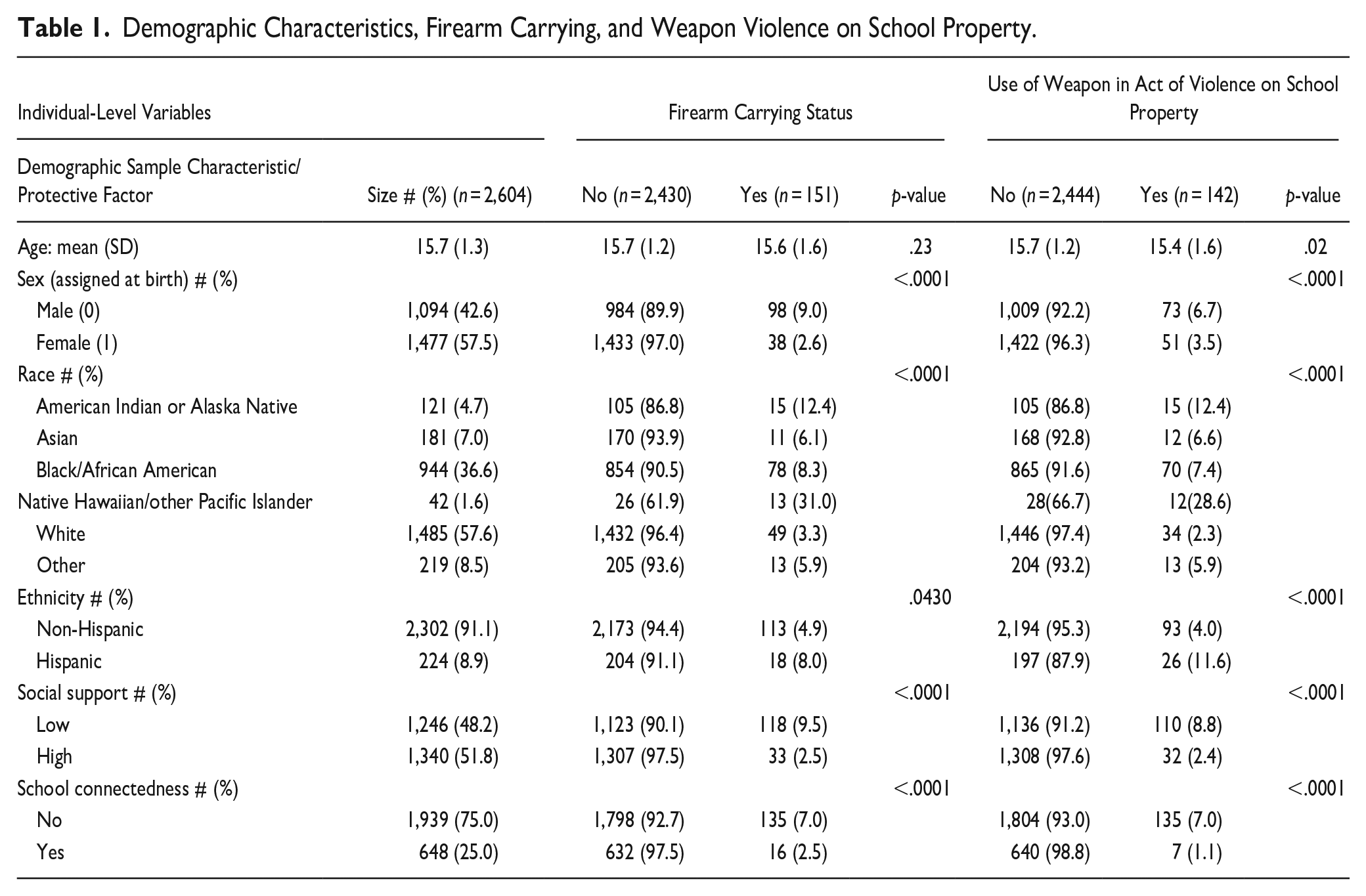
Of the 151 individuals who had carried firearms, 78.2% (n = 118) had low levels of social support and 89.4% (n = 135) did not endorse school connectedness. Among the 142 individuals who had used a weapon in an act of violence on school property, a majority of them had low levels of social support (n = 110, 77.5%) and did not endorse school connectedness (n = 135, 95.1%).
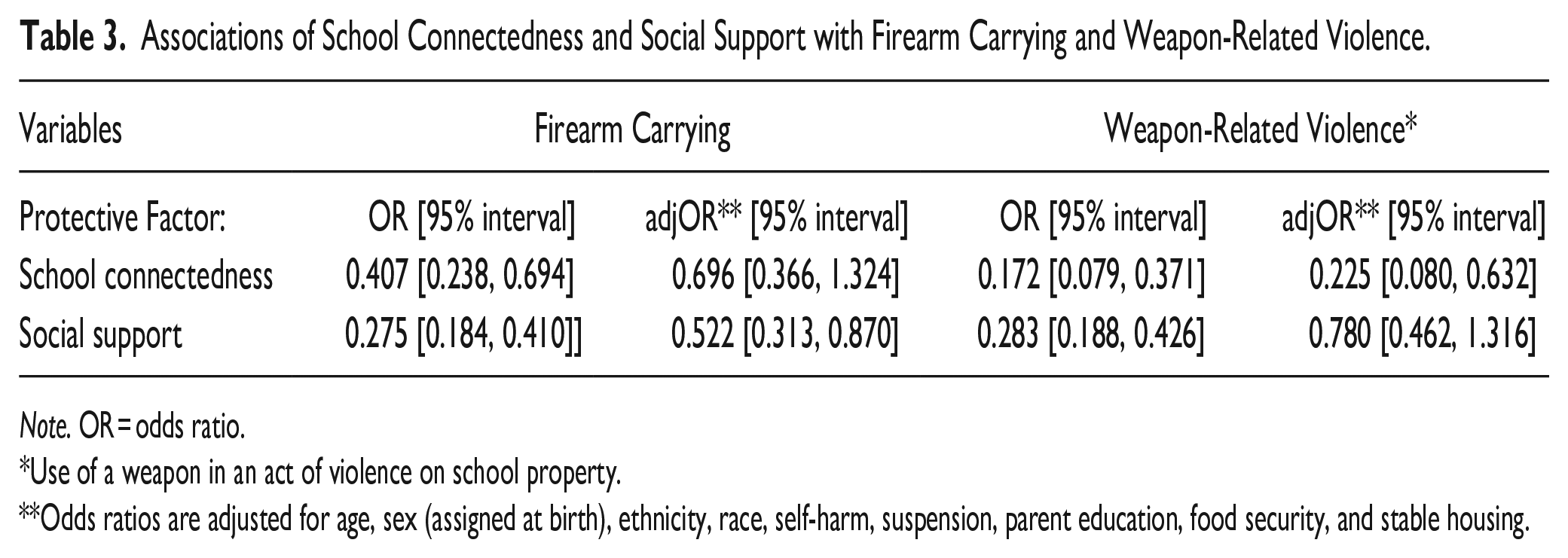
Table 2 displays the results of the univariate analysis performed to identify covariates eligible for the adjusted statistical models. Based on a p-value threshold of .2, the variables age, sex assigned at birth, ethnicity, race, self-harm, suspension, parent education, food security, and stable housing served as covariates. Table 3 highlights the unadjusted and adjusted models for the summary variables of school connectedness and social support against the outcome measures of firearm carrying and weapon violence involvement. In the adjusted models for school connectedness, school connectedness was not significantly associated with firearm carrying (adjusted odds ratio [aOR] 0.696, 95% CI [0.366, 1.324]). School connectedness was significantly inversely associated with the use of a weapon in an act of violence on school property (aOR 0.225, 95% CI [0.080, 0.632]).
Demographic and Related Variables and Associations with Firearm Carrying and Weapon-Related Violence.

Eligible to serve as a covariate.
Refer to Table 1 for the distribution of outcomes for the following variables.
Associations of School Connectedness and Social Support with Firearm Carrying and Weapon-Related Violence.
Note. OR = odds ratio.
Use of a weapon in an act of violence on school property.
Odds ratios are adjusted for age, sex (assigned at birth), ethnicity, race, self-harm, suspension, parent education, food security, and stable housing.
In the adjusted models for social support (Table 3), high levels of social support were significantly inversely associated with firearm carrying (aOR 0.522, 95% CI [0.313, 0.870]). Social support was not significantly associated with the use of weapons in an act of violence on school property (aOR 0.780, 95% CI [0.462, 1.316]). The intercept variable representing the students’ school was statistically significant in the four adjusted models.
Discussion
Among 2,604 students in grades 9 to 12 from 13 Pittsburgh high schools, we examined interpersonal protective factors and their relationships to firearm carrying and weapon-related violence on school property. We found that school connectedness was significantly inversely associated with the use of a weapon in an act of violence on school property. In addition, high levels of social support were inversely associated with firearm carrying. These findings on the role of protective factors against firearm carrying and weapon violence may help in promoting strength-based strategies that serve to reduce the risk of youth violence involvement.
Approximately 5.5% (n = 142) of the youth had used a weapon in an act of violence on school property and 5.8% (n = 151) had carried firearms, which is higher than the prevalence reported in national YRBSS data (4.4%) in 2019 (Centers for Disease Control and Prevention, 2019). Assessing the National Survey on Drug Use and Health of adolescents aged 12 to 17 from 2002 to 2019, Carey and Coley identified that handgun carriage is highest among cohorts of adolescents in concentrated areas of the nation who are lower income, male, and older adolescents (Carey & Coley, 2022). Our results align with findings that firearm carriage is higher among male youth; however, we did not see significant associations with age in our sample. We assessed parental education as a proxy for income in the current study and did find significant inverse associations between this proxy measure and violence.
The intercept variable representing the schools that students attended was statistically significant in the four comparisons that we have analyzed. This relationship signifies that there is a significant school-level effect, wherein patterns of protective factors and violence outcomes vary across schools. The Pittsburgh YRBS was focused on youth-defined risk and protective behaviors and thus did not capture additional school-level factors beyond school connectedness. While school connectedness was the only school-level factor studied in the YRBS study, previous research has shown that assessing the surveillance, sense of order, indicators of victimization (Van Dorn, 2004), and support from school staff (Eliot et al., 2010) can aid in identifying attributes of the academic environment that are salient in the presence of firearm carrying and school-based violence. Future work across diverse geographic contexts can best examine the role of additional school-level factors in violence prevention.
This is one of the few studies to examine the relationship between school connectedness and weapon violence involvement (Henrich et al., 2005). Our findings of a protective association between school connectedness and weapon violence perpetration align with previous research demonstrating the role of school connectedness in mitigating the risk of other health-affecting behaviors, such as cigarette use, marijuana use, and alcohol consumption (Weatherson et al., 2018). Henrich et al. had similar findings from the National Longitudinal Study of Adolescent Health among students nationally from grades 7 to 12 (Henrich et al., 2005), identifying school connectedness as reducing the likelihood of weapon violence. Our results expand upon these findings suggesting that school connectedness has a similar role on school property among youth in urban school districts who are at a higher risk of weapon violence involvement. Henrich et al. identified that age was positively correlated with committing weapon violence, which we did not identify with our sample.
The nonsignificant association between high levels of social support and weapon violence on school property highlights that there are other factors, such as at the school level, that play a role in youth violence involvement. Support systems, such as caregivers and guardians who can monitor actions and provide support within the household, may not be able to mitigate the challenges youth experience at school. These factors, such as relations with school peers, faculty, and security (Resnick et al., 1993), may be more important in influencing when young people engage in violence on school property. Furthermore, relationships nurtured within a school environment can potentially serve as a positive influence on youth, especially for youth whose emotional needs are unmet at home and in external environments (Lemkin et al., 2018).
A large portion of the lives of youth are spent in a school environment. Addressing how this setting can foster a sense of safety, community, and well-being is integral in promoting positive school connections and, thus, improving adolescent health. For instance, school-based restorative justice programs, which focus on reducing punitive discipline (Sandwick et al., 2019), fostering relationships (Fronius et al., 2019), and conflict resolution (Morrison, 2003), have had success in promoting student’s mental health, emotional well-being (Bonell et al., 2014) and building positive relationships between students and staff (Sandwick et al., 2019). The National Academies National Research Council, Institute of Medicine, and the CDC support the importance of promoting school connectedness for its role in fostering positive relationships with teachers and peers (National Research Council and Institute of Medicine, 2004) and improving both educational and health outcomes (Centers for Disease Control and Prevention (U.S.), National Center for Chronic Disease Prevention and Health Promotion (U.S.), & Division of Adolescent and School Health, 2009). Our findings underscore the importance of understanding school and interpersonal-level factors among youth and highlight the school environment as a potential site for intervention to reduce weapon-related violence.
We did not find a significant association between school connectedness and firearm carrying, indicating that the potentially protective association between school connectedness and weapon violence on school property did not extend to the carriage of firearms in multiple environments in our sample. One potential explanation for the lack of an observed association may be that interpersonal connections and other sources of influence external to the school environment may be most influential in firearm carriage. Prior research demonstrates that youth may be more likely to carry firearms due to lower levels of perceived interpersonal safety (Hemenway et al., 2011), protect themselves from exposure to violence (Carter et al., 2015; Wilkinson et al., 2009), and prevent repeated aggression and bullying toward them (Turner et al., 2016). Studies have also indicated that gang membership (Spano & Bolland, 2011), victimization (Spano & Bolland, 2013), and drug dealing (Lizotte et al., 2000) are linked with weapon carrying. These factors were not assessed in the examined YRBSS data, and they may contribute to the multifaceted reasoning for why youth may carry a firearm. Youths’ appraisal of peer behavior may also play an important role in firearm carrying. Hemenway et al. highlighted that youth tend to overestimate the percentage of their peers who carry firearms and demonstrated that if youth who reported carrying firearms were informed of a more accurate representation of this data, 40% of them felt less inclined to carry a firearm themselves. These factors were not assessed in the YRBS data, and they may contribute to the multifaceted reasoning for why youth may carry a firearm. Recognizing the complex role of firearms in youths’ perceived safety and advocating for safer alternatives and education is crucial in keeping youth safe (Butts et al., 2015; Whitehill et al., 2014).
Our findings also show that high levels of social support are significantly inversely associated with firearm carrying, emphasizing how overall perceived social support may serve a protective role in youth firearm involvement similar to how specific sources of support, such as support from parents (Culyba et al., 2016) and teachers (Benhorin & McMahon, 2008) serve in reducing adverse behaviors and aggression. Previous research among youth in urban Illinois middle schools found that youth who reported less overall perceived social support were more likely to carry a weapon (Kerres Malecki & Kilpatrick Demaray, 2003). Our study extends these findings to high school-aged youth in a midsized city, and specifically, firearm carrying, highlighting the critical role of social support for youth across various contexts and violence-related outcomes.
Contrary to our hypotheses that school connectedness and social support would be broadly protective across both firearm carrying and weapon violence at school, we found that the associations differed. While the reasons behind these patterns require further investigation, this may represent context-specific protections. While weapon violence was studied specifically on school property and firearm carrying was done in a broader context, this may have played a role in the nonsignificant association between school connectedness and firearm carrying. School connectedness was measured in a broad context and more specific motives, such as a lower level of perceived safety and lack of social belonging, are important to recognize among youth carrying firearms. Further examination with validated measures of these specific constructs can aid in better supporting youth and developing tailored interventions.
This study has important limitations. Among 4,207 participants in the Pittsburgh YRBS, 2,604 individuals (62%) met the inclusion criteria for this analysis. Protective factor items being located at the end of the survey likely contributed to incomplete data. Surveys were cross-sectional and causality cannot be inferred. Strengths of the study included the addition of validated measures of school connectedness and social support, which are not part of the national YRBSS survey. This study helped us better understand the experiences of minoritized youth in Pittsburgh but may have limited generalizability to other geographic regions. The survey gathered data in person from public high schools, which can lead to concerns about selection bias. Expanding this survey assessment to new regions and to youth in Pittsburgh who may not consistently attend school can help in identifying the presence of protective factors among diverse youth and tailor strength-based initiatives accordingly.
Our study suggests that interpersonal protective factors are important to consider when developing interventions to prevent youth violence involvement, and studies must continue to identify factors that are associated with reducing adverse behaviors (Yeager et al., 2018) and promoting policies that are trauma-informed and strengths-based ((Centers for Disease Control and Prevention (U.S.), National Center for Chronic Disease Prevention and Health Promotion (U.S.), & Division of Adolescent and School Health, 2009). The National Educational Association (The School‑to-Prison Pipeline: Time to Shut It Down | NEA, n.d.) has emphasized the need to build school-community partnerships through the integration of community members and social workers in a school setting to foster support networks. Our study supports these recommendations and underscores the vital role of supportive school environments and interpersonal connections in protecting youth. Youth violence prevention must consider the environments and support systems that surround youth and their potential roles in safeguarding youth.
Footnotes
Acknowledgements
Thank you to the Miller Lab, my mentors Dr. Anthony Fabio, Dr. Alison Culyba, Dr. Elizabeth Miller for the opportunity and the support throughout this project. We thank the Allegheny County Health Department for their role in data collection and the use of these data. We are grateful to Pittsburgh Public School Board Leadership for their collaboration. This project was presented at the Dean’s Day Symposium at the University of Pittsburgh School of Public Health and the 2022 National Research Conference on Firearm Injury Prevention.
Declaration of Conflicting Interests
The author(s) declared no potential conflicts of interests with respect to the authorship and/or publication of this article.
Funding
The author(s) disclosed receipt of the following financial support for the research and/or authorship of this article: National Institutes of Health (K23HD098277-01; Culyba); Heinz Endowments; Grable Foundation. The funders had no role in the design and conduct of the study; collection, management, analysis, and interpretation of the data; preparation, review, or approval of the manuscript; and decision to submit the manuscript for publication.
