




Abstract
As state and local governments attempt to manage fiscal stress created by the Great Recession, the level of compensation received by public sector workers has become an increasingly debated policy issue. A significant amount of research exists that addresses national public sector compensation trends, but relatively few state-level studies have been performed. This analysis provides a preliminary analysis of public and private sector compensation in Florida. Using data from the U.S. Bureau of Labor Statistics and the U.S. Census Bureau, sector-level comparisons are made between public and private sector workers within the state with regard to compensation, age and education. This sector-level comparison is then supplemented by an occupational analysis of career fields found in both sectors. The sector-level analysis suggests public sector workers in Florida are, on average, not only better compensated than those in the private sector in aggregate but are also considerably more educated and older. The occupational analysis suggests that public sector workers in Florida are in general less well-compensated than private sector workers employed in the same field, even when older and more highly educated on average.
Introduction
As one of the states hardest hit by the Great Recession and the collapse of the housing market, Florida and its cities and counties have experienced—and continue to experience—considerable fiscal distress as tax revenues decline and service demands increase. As they attempt to meet these demands with fewer financial resources, greater scrutiny is being paid to the compensation of state and local government workers. Just as in many other states, the pay, pensions and other ancillary benefits received by public sector workers in Florida are now the subject of serious public policy debates at both the state and local levels. 1
Layoffs, privatization of services, pay freezes, decreased benefits and increased employee contributions to health insurance and pension plans have been suggested and implemented as a means to reduce compensation costs in the public sector. Proponents of these cost-savings measures argue that reducing public sector compensation in Florida is both needed and fair. It is “needed” because compensation costs—including pensions—represent a major and growing cost of government; it is “fair” because state and local government workers are allegedly overcompensated when compared to private sector workers. 2 Those opposing such measures argue instead that public sector workers in Florida and elsewhere are in fact undercompensated and that reducing compensation will make it difficult to attract and retain the skilled workers needed to provide the specialized services of government. 3 In evaluating the two perspectives, Risher 4 concludes that “comparative analyses have generated conflicting results and neither side has presented information that is readily understood, completely credible or convincing (p. 73).
The outcome of this public policy debate will affect more than budgets; it will directly affect the lives and livelihoods of many workers and their families throughout the state. Roughly 1 million Floridians are employed as state or local government workers. 5 State and local government agencies are the single largest employer in 51 of Florida’s 67 counties and are at least one of the top five largest employers for all 67 counties. 6
As debate over whether state and local government workers are over- or undercompensated relative to the private sector workers has become increasing salient, the need has similarly increased for a better understanding of public and private sector compensation in Florida. Although a significant body of literature exists addressing public versus private sector compensation on the national level, only limited state-specific analyses have been performed. The purpose of this study is to impartially examine the relative differences in compensation between the public and private sectors in Florida.
The Evolution of Public Versus Private Compensation
The public versus private sector compensation issue is neither new nor unique to Florida; determining proper compensation for those in the public sector has long been a concern for policymakers and politicians. In 1862, a law was passed by Congress that required the pay for blue-collar workers in the Navy to “conform to those in private sector establishments in the immediate vicinity.” 7 In 1962, the Federal Reform Act also provided that federal workers’ pay match that of similar private sector jobs. 8 This goal of relative compensatory parity between the two sectors is known as the comparability or “prevailing wage” principle; this principle has long guided all levels of government in the development of pay systems for public employees. 9
For most of the 20th century, it was generally accepted that public sector workers were paid less than their private sector counterparts; to attract and retain workers in the public sector, this lower pay was balanced out by generous ancillary benefits. With these adjustments, total compensation (i.e., pay and benefits) was largely considered to be comparable between the two sectors.
Since the 1970s, reviews of national compensation data have suggested to some observers that the comparability principle has been violated, with compensation of public sector employees exceeding that of their private sector counterparts. The perception of a compensation gap between the public and the private sectors has only grown as private sector workers have faced reduced benefits and a decrease in job security because of economic pressures and global labor trends. 10
The debate over whether workers in the public sectors are over- or undercompensated relative to private sector workers has only become more salient in the most recent recession as all levels of government grapple with budget shortfalls, stagnant and declining revenues and increasing service demands. Lawmakers, political candidates and pundits alike are advocating for a reduction in pay and benefits for public sector employees. The public policy question, however, is whether the actual data support the assertion that public sector employees are compensated more than their private sector peers and what factors should be considered when evaluating these data to reach a fair and accurate conclusion.
Evaluating Research on Public Versus Private Sector Compensation
The Bureau of Labor Statistics’ March 2012 Employer Costs for Employee Compensation (BLS ECEC) survey reported the average compensation in the private sector was $28.57 per hour worked, whereas for state and local government workers the average compensation was $40.90 per hour worked. 11 The ECEC may appear to answer the basic question concerning compensation differences between the public and private sectors, but it does not offer anything more than the aggregate average of compensation between sectors. As is explicitly noted in the ECEC’s technical notes, the compensation costs between state and local government and the private sector cannot be fairly compared to each other as significant differences exist in the work activities, the workforce composition and occupational structures of these sectors. A more nuanced approach to account for such differences is needed to fairly compare compensation between the private and public sectors.
Comparing the two sectors has always been difficult, because in many cases, there are no clear private sector analogues for notable public sector positions (i.e., police, firefighters, water treatment plant operators, etc.). In a recent analysis of Census Bureau occupational categories, 12 it was determined that 150 of the 509 occupations listed were occupations that were unique only to either the public or the private sector. Even when occupations exist in both public and private sectors, the proportion of workers employed in certain occupational groups varies greatly between the two sectors. For example, public sector workers employed in “education, training and library” occupations comprise 25.4% of all public sector workers, whereas only 2.2% of all private sector workers are employed in such occupations. Likewise, a larger percentage of public sector workers are employed in “protective service” occupations than in the private sector (11.5%:0.9%). Conversely, “sales and related” occupations employ only 0.7% of public sector workers, but such occupations employ 11.5% of all private sector workers. 13 In general, the occupational composition of the private sector much more closely mirrors the overall occupational composition of the economy as a whole than does the public sector. 14
In addition to differences in occupational employment by sector, other substantial differences exist between public and private sector workers. A 2011 Congressional Research Service report provides a thorough analysis of those characteristics that may affect differences in compensation between the public and private sectors. Public sector workers in 2010, who in total comprise roughly of 17.3% of all workers, are on average older than their private sector counterparts. Among all full-time public sector workers, 51% were between 45 and 64 years of age, compared to 43% of full-time private sector workers. 15 Older employees typically have more years of work experience than younger ones, and employees with more work experience will generally earn more than workers with less experience. Public sector workers also have, on average, more years of education than private sector workers. In 2010, 34% of private sector workers held bachelor’s, advanced or professional degrees, compared to 52% of public sector workers. Roughly 57% of state government workers, 52% of local government workers and 46% of federal government workers hold such degrees. It is generally accepted that workers with more education generally earn more than workers with less education. Last, a greater share of public sector workers (55.4%) than private sector workers (36.9%) are employed in the “management, professional and related occupations” category, a category that earns more than most other occupational categories. As suggested by the report, any comparison of public and private sector workers must fairly account for the differences in average age, education and occupation type between the public and private sector that can affect compensation.
Traditionally, such differences were ignored in comparative compensation studies. Instead, early studies compared primarily the aggregate compensation levels between the two sectors, assuming that workers in both sectors government were mutually comparable with regard to qualifications and experience. 16
These differences in occupational employment and demographic characteristics between the two sectors limit the usefulness of aggregate comparisons between the two. The first attempts to estimate compensation differentials between public and private sector workers were performed in the 1970s relying on what is known as the “human capital” model. This model focuses on using statistical techniques to analyze and control for specific characteristics of workers in both sectors that would have an effect on compensation outcomes. For example, a higher level of education generally correlates with higher pay and benefits. 17
The general consensus produced by these earlier studies was that public sector workers were overcompensated compared to private sector workers and the that pay differential increased with the level of government. 18 These studies also concluded that the public sector paid low-skilled workers more, but executives and professionals received significantly less in pay and benefits than their private sector counterparts. 19
Improved methodologies to reduce potential biases were introduced in the 1990s, but the results of newer studies have produced mixed results. Some studies have shown that state and local government workers are less well compensated than those in the private sector.20-22 Other studies have shown that state and local government workers are better compensated.23,24 Although no consensus has emerged with regard to the question of whether or not public sector workers are overcompensated relative to their private sector counterparts, the literature does suggest that a consensus does exist concerning which characteristics are the most important in explaining pay differences.
In a study by Schmitt, 25 the age and experience of public versus private sector workers were determined to be significant and relevant factors. State and local government workers were on average better compensated than private sector workers, but the study also concluded that state and local government employees were older and substantially better educated than private sector workers. When workers were matched by age and education, state and local workers actually received less compensation than private sector workers; this “wage penalty” was most pronounced for the most highly educated and experienced workers. Regardless of conclusions concerning compensation, the importance of age and education among national studies of compensation differences is firmly established.26-29
The importance of age and education to compensation outcomes is similarly supported in various state-specific studies of the compensation differences between the private sector and state and local government. A compensation study of Ohio workers 30 concluded that education was the most important factor in earnings. In a study conducted by Ballard and Funari, 31 it was determined that educational qualifications among Michigan employees was a significant and relevant factor in explaining compensation differences between the sectors. For example, the overall average compensation for Michigan state workers was greater than the overall compensation of Michigan workers in the private sector. However, when education was controlled, state employees earned less than their private sector peers in every educational category. Studies of compensation in Iowa and Rhode Island both produced similar results, noting that differences in education and age were both significant factors in explaining differences in compensation between private, state and local government workers.32,33
Approach Used for the Public–Private Pay Comparisons in Florida
In order to achieve accurate results to address this comparison question in Florida, the authors reviewed and analyzed data from the U.S. Bureau of Labor and Statistics, the U.S. Census Bureau’s Annual Current Population Survey (CPS) and the Florida Department of Economic Opportunity. The CPS data series is widely used in both state-specific and national compensation studies as a source for wage and demographic data; the ECEC data series is similarly used to provide estimates of nonwage benefits.
The March Annual Demographic and Income Supplements of the CPS were merged to create a single, collective sample of 830,766 observations nationwide. All dollar figures in the sample were adjusted to reflect 2009 dollars. From this base, certain observations were removed to ensure the appropriateness of the sample for the study. Federal employees, members of the armed forces, the self-employed, children younger than 16 years, the disabled, the unemployed, the retired and those otherwise not in the labor force were excluded from the study. After the application of the above exclusions, a total of 13,440 Florida specific observations remained in the data set. These observations represent the primary source of information for this study. Specifically, these observations provided the base information regarding wage earnings, educational attainment, age and occupation.
To provide a more complete picture of total employee compensation (salaries and benefits), the average compensation was calculated using data from the U.S. BLS ECEC report. National estimates of average benefit costs as a ratio of total compensation for the private sector and state and local government from the BLS ECEC report were then applied to the Florida salary estimates derived from the CPS data, enabling the researchers to estimate the value of benefits and total compensation between the two sectors in Florida.
Results of the Data Analysis
Average Employee Compensation
Nationally, state and local government employees are, on average, better compensated than employees in the private sector, in terms of both salary and estimated benefits. In Florida, this same trend exists with Florida public employees who, on average, are more highly compensated than the national average for public sector workers. As shown below in Table 1, Florida’s private sector compensation is more consistent with the national average—albeit slightly greater than the national average. Similar to national figures, state and local government workers in Florida are much more likely to have access to an employer-provided and funded pension, which includes both defined benefit and defined contribution (401k) plans.
Employee Compensation

Source. 2007-2010 Current Population Survey, U.S. Census, Center for Florida Local Government Excellence and Rhode Island Public Expenditure Council calculations and Bureau of Labor Statistics Employer Costs for Employee Compensation.
Note. ESI = employer-sponsored insurance; full or partial contribution; EPP = employer-provided pension.
State and local government only.
Average Salary by Age
The age and experience of employees are important factors when considering compensation levels for government versus private sector employees. As discussed in previous sections, age serves as a proxy for work-related experience; it is generally accepted in compensation literature that a positive relationship exists between experience and pay.
As shown below in Table 2, public sector employees younger than 34 years nationwide are slightly better paid than employees in the private sector within the same age categories. However, in every age category over the age of 35 nationwide, state and local government employees are paid less than their private sector peers. A relatively similar trend is observed between private and public sector workers in Florida. Similar to national trends, younger employees in both state and local government are better compensated than younger private sector employees. Likewise, private sector pay in Florida peaks between the ages of 45 and 54 years, whereas public sector pay appears to peak between the ages of 55 and 64 years.
Average Salary by Age
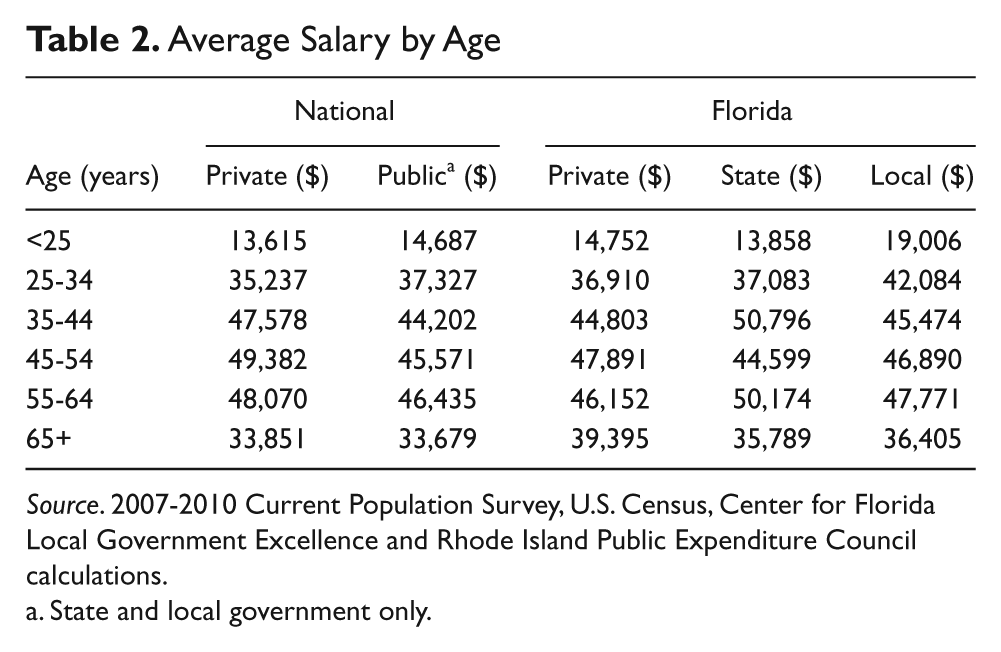
Source. 2007-2010 Current Population Survey, U.S. Census, Center for Florida Local Government Excellence and Rhode Island Public Expenditure Council calculations.
State and local government only.
Age by Sector
There are significant differences in age between the public and private sector workforces in Florida. The average age of private sectors workers is 40 years, whereas state and local government workers have average ages of 43 and 44, respectively. As shown below in Figure 1, the distribution of workers by age varies considerably among private sector and state and local government workers.
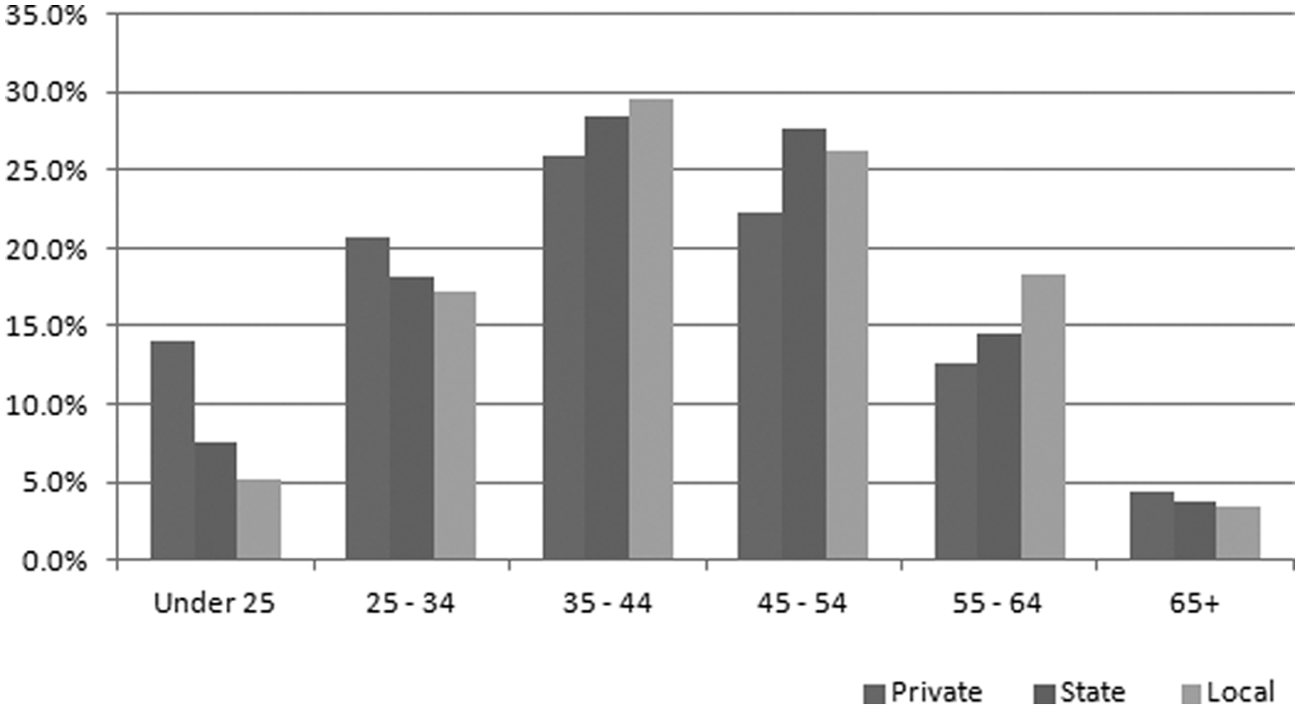
Florida: Age by sector
Florida’s state and local government workforces are significantly older compared to the private sector workforce, which employs a much larger proportion of Florida’s younger workers. More than one third (34.7%) of private sector workers 34 years and younger, but only 25.6% of state workers and 22.4% of local government workers are younger than 34 years. It is notable that the youngest workers in Florida are overwhelming employed in the private sector: Statewide, workers younger than 25 years constitute approximately 14% of all private sector employees. This is nearly 3 times the percentage of local government employees younger than 25 years and nearly twice the percentage of state employees in this same category.
Average Salary by Educational Attainment
Education is an important and perhaps the most understated factor when considering compensation differences between public and private sector employees. As shown below in Table 3, considerable differences in pay can be observed in salaries among the various levels of education.
Average Salary by Educational Attainment
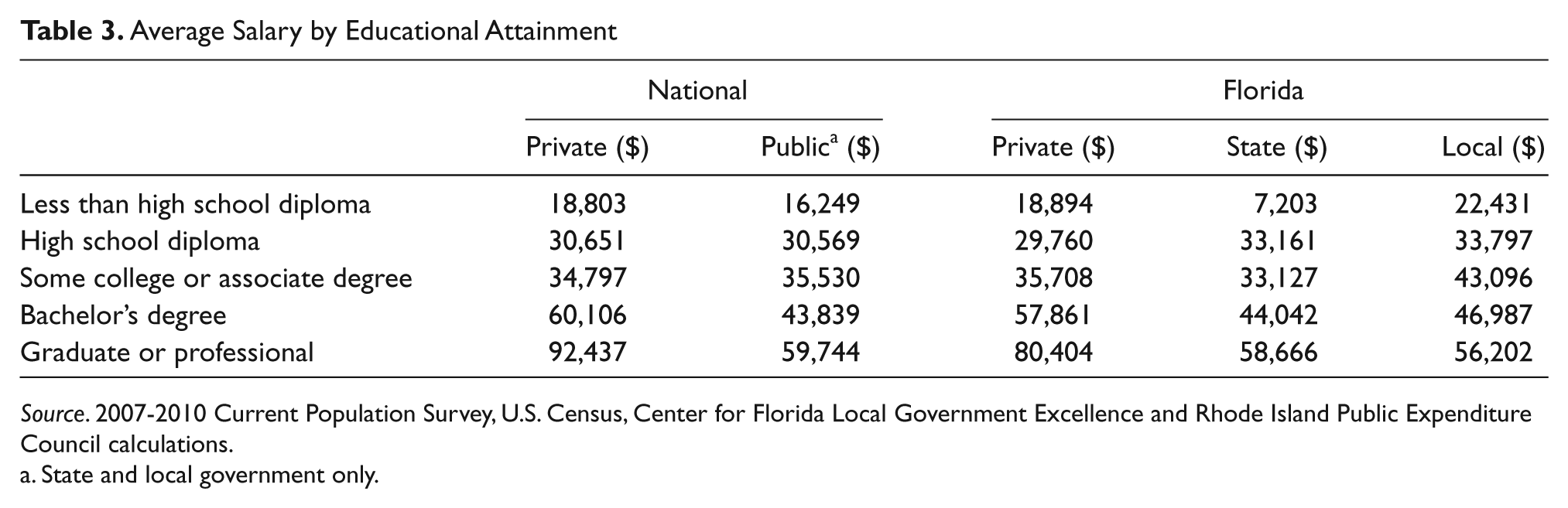
Source. 2007-2010 Current Population Survey, U.S. Census, Center for Florida Local Government Excellence and Rhode Island Public Expenditure Council calculations.
State and local government only.
Florida follows national trends in which progressively higher levels of educational attainment show progressively higher levels of remuneration in both the public and private sectors. Again mirroring national trends, public sector workers in Florida with bachelor’s degree or higher receive considerably less in pay than similarly educated private sector workers. Conversely, state and local government workers with a high school diploma or less receive higher salaries and wages than private sector workers with the same level of education.
Educational Attainment by Sector
As shown below in Figure 2, the public sector workers in state and local government have much higher levels of educational attainment than private sector workers. The percentage of state employees who have earned a bachelor’s degree or higher is approximately 57%, which is more than double that of private sector employees who have earned this same level of education. Approximately 47% of all local government employees in Florida hold bachelor’s or advanced degrees.
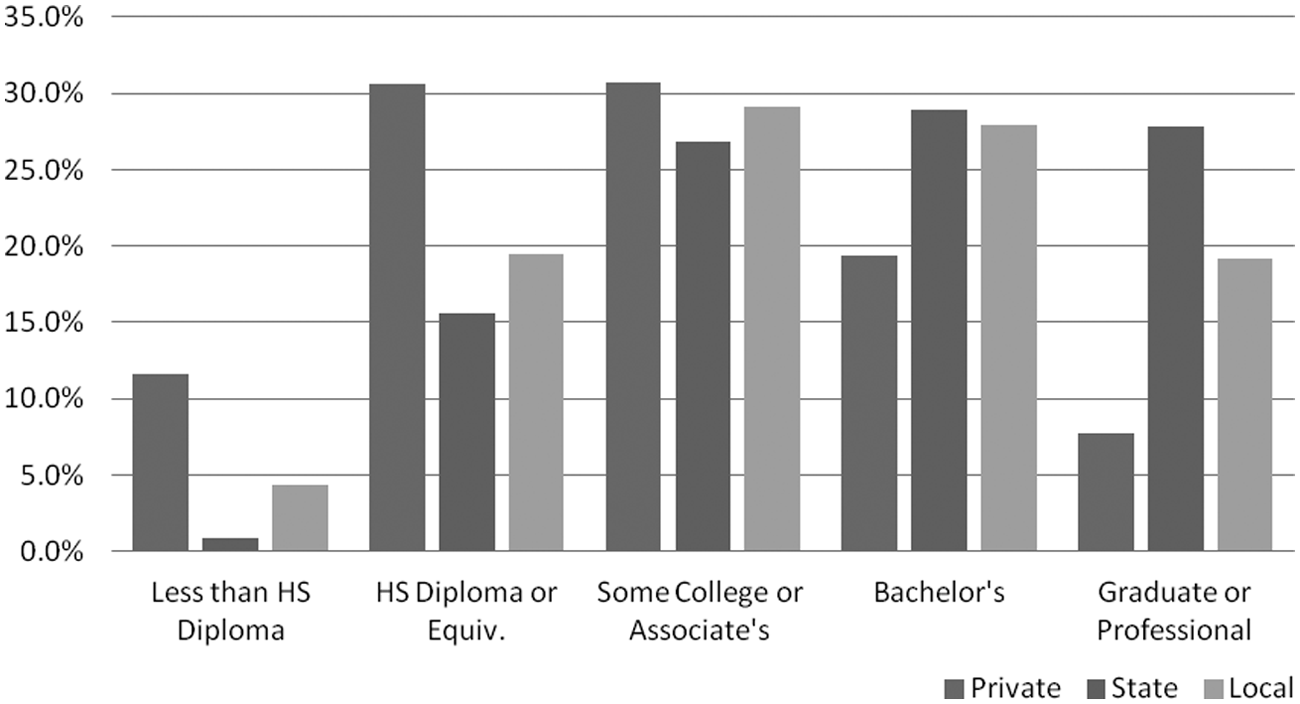
Educational attainment by sector
Almost 12% of private sector workers have less than a high school education; less than 1% of state workers and 5% of local government workers lack a high school diploma or equivalent. A much higher share of private sector workers have obtained only a high school diploma (30.6%) compared to state and local governments workers (15.6% and 19.4%, respectively).
Occupational Analysis
As shown above, public sector workers in Florida are on average better compensated than workers in the private sector. Although average compensation is higher in the public sector, the age and educational levels of the state and local government employees are much higher than those of private sector employees. Moreover, the above analysis shows that even the most educated public sector workers receive far less in pay than similarly educated private sector workers. Although these aggregate averages are important, it is equally vital to review the compensation differences between the public and private sectors for specific occupations.
As mentioned earlier, the type of occupational employment in each sector varies considerably. Many occupations exist in the public or private alone; law enforcement officers are exclusively found in the public sector. Some occupations represent a much smaller share of employment in one sector than the other; the public sector, for example, employs few workers in retail occupations, and private sector firefighters are exceedingly rare.
To better examine and understand public and private sector pay by occupation in Florida, an occupational analysis was conducted using income, occupational and compensation data from the CPS March Supplement for years 2007 to 2010 and benefits data from the most recent BLS ECEC report.
Method
Nine occupational categories were selected for analysis: engineers, IT professionals, janitorial/maintenance workers, lawyers, office/administrative staff, registered nurses, social workers, teachers and managers. These occupational categories were selected because of the prevalence of these careers among the private sector and state and local governments. Some of these occupational categories represent a single specific occupation as defined by the U.S. Census Standard Occupational Classification system, such as “Registered Nurses.” In other cases, similar Standard Occupational Classification occupations were combined to increase sample size and improve reliability. For example, the “Teachers” occupational category includes preschool and kindergarten teachers, elementary and middle school teachers, secondary school teachers and special education teachers. To further increase sample size and improve the reliability of the analysis, state and local government workers were combined into a single “Public Sector” category. As in the earlier analysis, federal workers were excluded.
Income, age, employment sector, educational attainment and income data for these nine occupational groupings were extracted from the Florida CPS sample used previously. From these data, the average annual salary, percentage of workers with a bachelor’s degree or higher and average age were calculated for each occupational category by sector. The average value of benefits for each occupation was calculated through a ratio analysis using data from the ECEC. The average salary and average benefits for each occupation were then combined to determine the average total compensation.
Results and Discussion
To ease presentation and discussion, the nine occupational categories are grouped together into three different tables: highly paid professional positions (engineers, IT professionals and lawyers), midrange professional positions and maintenance, managerial and administrative positions common to all organizations (janitorial/maintenance workers and office/administrative staff).
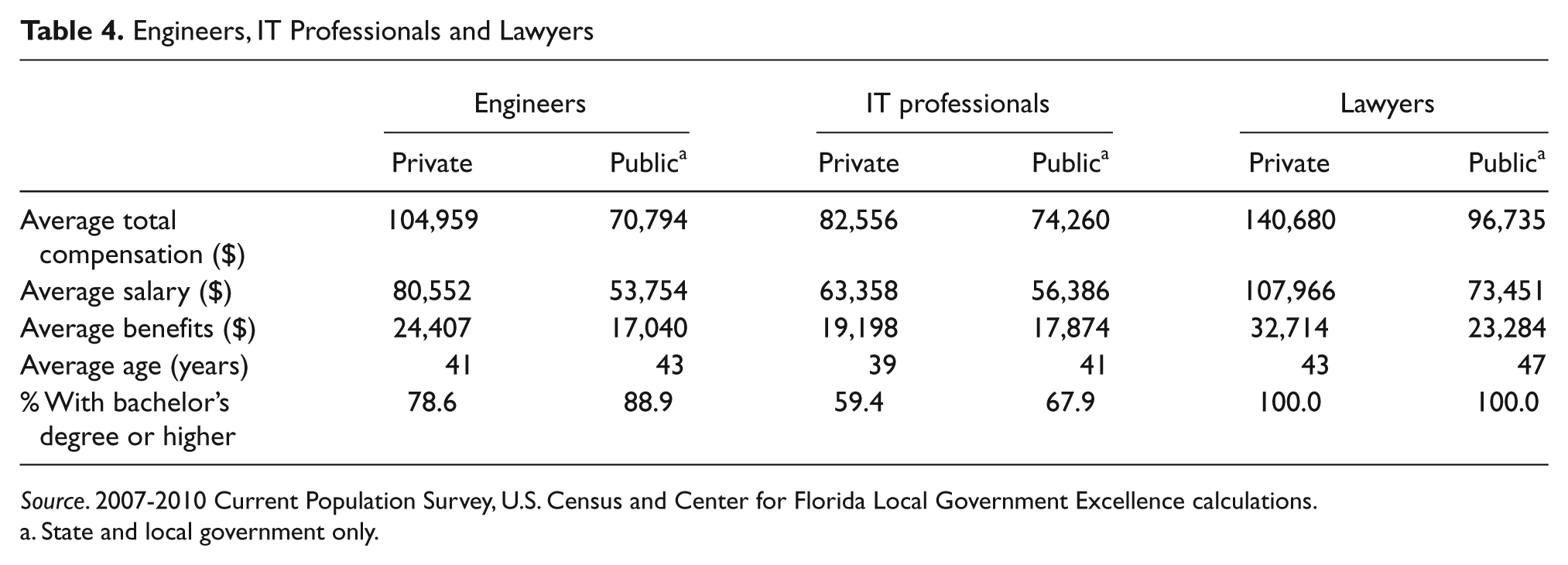
As shown below in Table 4, engineers, IT professionals and lawyers employed in the private sector are much more highly compensated than their peers working in state and local governments. Although public sector engineers are better educated and somewhat older than those in the private sector, they receive substantially less in both pay and benefits; their total compensation is roughly two thirds (67.5%) that of private sector engineers in Florida.
Engineers, IT Professionals and Lawyers
Source. 2007-2010 Current Population Survey, U.S. Census and Center for Florida Local Government Excellence calculations.
State and local government only.
Compared with their private sector peers, public sector IT professionals are slightly older (by 2 years) and also more educated. The compensation received by IT professionals in the public sector is roughly 90% that of private sector IT professionals, with the difference being largely attributable to the lower average salary of the public sector.
Lawyers in the public sector are older on average than those in the private sector by 4 years. Educational attainment for both sectors is identical, as a law degree is required to be admitted to the bar in Florida. Private sector attorneys are on average much more highly compensated in Florida than those in the public sector, with state and local government compensation being only 68.8% that of private sector compensation—a difference of $43,946.
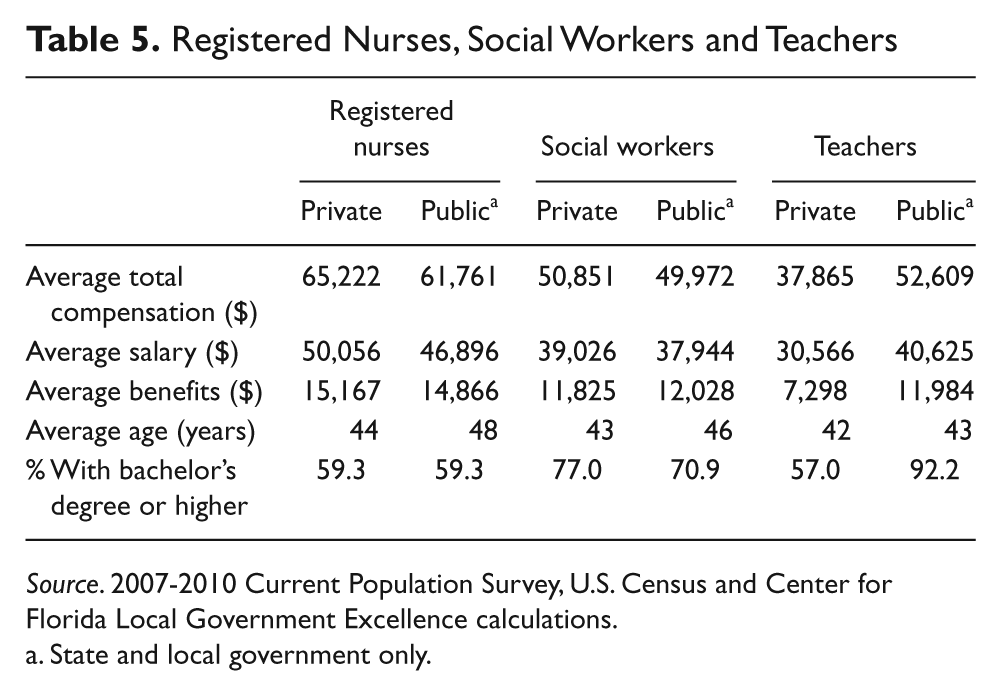
Table 5 shows compensation differences between registered nurses, social workers (including counselors) and teachers. There are only slight differences between nurses in the private sector and the public sector with regard to compensation and demographic characteristics; both are equally educated and receive similar amounts of benefits, but private sector nurses tend to be paid slightly more despite being younger than public sector nurses.
Registered Nurses, Social Workers and Teachers
Source. 2007-2010 Current Population Survey, U.S. Census and Center for Florida Local Government Excellence calculations.
State and local government only.
Social workers in the private sector have higher levels of educational attainment, whereas social workers in the public sector tend to be older on average. The differences appear to balance each other out, as private sector social workers in Florida receive a compensation only $879 greater than those in the public sector, an almost negligible difference.
With the exception of average age, there is significant variation between public and private sector teachers in Florida. As shown above, nearly all public school teachers possess a bachelor’s degree or higher, whereas only slightly more than half of all private school teachers hold a bachelor’s degree. Public school teachers receive a total compensation package on average that is roughly $15,000 greater than the average package received by private school teachers.
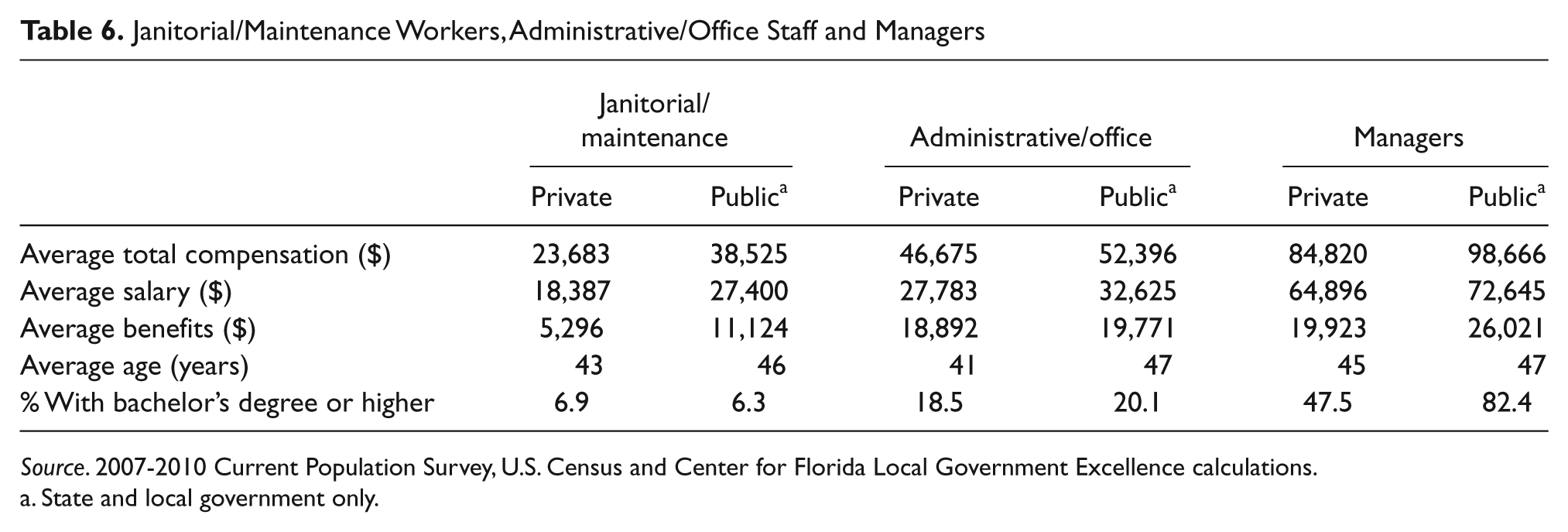
As shown above in Table 6, janitorial and maintenance workers, administrative and office staff and managers in Florida are on average more highly compensated in the public sector than in the private sector. Janitorial and maintenance workers in the public sector are somewhat older on average (by 3 years) and negligibly less educated than those in the private sector (a 0.6% difference). The incomes of public sector workers in this occupational category are roughly $9,000 greater than those in the private sector; the value of the benefits received by these public sector workers are on average slightly more than twice those of packages in the private sector (an almost $6,000 difference). On average, the total compensation of public sector janitors and maintenance workers is 163% that of those employed in the private sector.
Janitorial/Maintenance Workers, Administrative/Office Staff and Managers
Source. 2007-2010 Current Population Survey, U.S. Census and Center for Florida Local Government Excellence calculations.
State and local government only.
Public sector administrative and office staff in Florida are on average 6 years older and slightly more educated than those in the private sector. Public sector workers in this category earn 17.4% more in pay and 4.7% more in benefits compared to those employed in private sector.
Significant variation exists between managers in the private and public sectors with regard to educational attainment; fewer than half (47.5%) of all private sector managers hold bachelor’s degrees or higher, whereas over three fourths (82.4%) of public managers hold bachelor’s degrees or higher. Public sector managers are also slightly older (by 2 years) than their private sector counterparts in Florida. Public sector managers receive on average $7,749 (11.9%) more in wages and $6,098 (30.6%) more in benefits. On average, the total compensation for public sector managers is 16% higher than for private sector managers.
Conclusions/Observations
In aggregate, the data clearly suggest that state and local government employees in Florida receive a higher average level of compensation compared to those in the private sector. Yet the data clearly demonstrate that the demographic composition of the public and private sectors varies to a considerable extent. State and local government workers have a much higher average age and level of education compared to private sector workers. Given such differences, simple average-to-average comparisons become almost meaningless as it can only be expected for a workforce with higher average ages and level of education to be better compensated than one with a lower average age and level of education.
Although these stark differences in demographic data may limit the utility of aggregate comparisons between the two sectors, meaningful comparisons can still be made between similarly aged and similarly educated private and public sector workers. As shown in the primary analysis, the data clearly suggest that private sector employees in Florida are better compensated than state and local government employees in Florida who have similar levels of experience and education.
The suggestion that demographically comparable private sector workers are in fact better compensated than those in public sector was further reinforced by the results of the occupational analyses. These analyses, which provided a direct, if limited, comparison of public and private sector workers employed in the same occupational fields, suggest that public sector workers in Florida are in general less well-compensated than private sector workers in the same field, even when older and more highly educated on average. This lower level of compensation in the public sector was particularly pronounced for those employed in higher paying occupations, such as attorneys, engineers and IT professionals. Nevertheless, it should be noted that compensation was considerably higher in the public sphere with regard to lower paying occupations, such as janitor or administrative assistant.
There is no simple answer to the question of whether public sector workers in Florida are overcompensated relative to private sector workers. Compared to the private sector, state and local government workers have a higher average age and level of education; they also have a higher average compensation. Yet their average compensation is lower than the average compensation of similarly educated and experienced private sector workers. Even when employed in the same occupational fields, the average compensation for public sector workers is generally lower.
As the debate over public sector compensation in Florida continues, it can only be hoped that future research on the subject is performed. To provide a better understanding of compensation differences, it is suggested that more thorough and expansive occupational analyses be performed, taking into account occupations found in both sectors and also those exclusive to one or the other. It is similarly suggested that additional research be done to explore the value of the benefits received by workers in both sectors.
Footnotes
Declaration of Conflicting Interests
The authors declared no potential conflicts of interest with respect to the research, authorship, and/or publication of this article.
Funding
The authors received no financial support for the research, authorship, and/or publication of this article.